Baijiayun Group Ltd 20-F, filed Apr 21, 2010: Annual report (foreign issuer)
UNITED
STATES
SECURITIES
AND EXCHANGE COMMISSION
Washington,
D.C. 20549
FORM
20-F
(Mark
One)
|
◻
|
REGISTRATION STATEMENT PURSUANT
TO SECTION 12(b) OR (g) OF THE SECURITIES EXCHANGE ACT OF 1934
|
OR
|
⌧
|
ANNUAL
REPORT PURSUANT TO SECTION 13 OR 15(d) OF THE SECURITIES EXCHANGE ACT OF
1934
|
For
the fiscal year ended December 31, 2009
OR
|
◻
|
TRANSITION
REPORT PURSUANT TO SECTION 13 OR 15(d) OF THE SECURITIES EXCHANGE ACT OF
1934
|
For the transition period from
________________ to ___________________
OR
|
◻
|
SHELL
COMPANY REPORT PURSUANT TO SECTION 13 OR 15(d) OF THE SECURITIES EXCHANGE
ACT OF 1934
|
Date of
event requiring this shell company report _______________
Commission
file number: 001-33176
Fuwei Films (Holdings) Co.,
Ltd.
(Exact name of Registrant as
specified in its charter)
(Translation
of Registrant’s name into English)
Cayman Islands
(Jurisdiction
of incorporation or organization)
No. 387
Dongming Road
Weifang
Shandong
People’s Republic of China,
Postal Code: 261061
(Address
of principal executive offices)
Huang
Meijuan
Tel: +86
10-68522612
fuweiir@fuweifilms.com
(Name,
Telephone, E-mail and/or Facsimile number and Address of Company Contact Person)
Securities
registered or to be registered pursuant to Section 12(b) of the Act.
|
Title
of each class
|
Name
of each exchange on which registered
|
|
Ordinary
Shares
|
NASDAQ
Global Market
|
Securities
registered or to be registered pursuant to Section 12(g) of the Act.
None
Securities
for which there is a reporting obligation pursuant to Section 15(d) of the
Act. None
As of
December 31, 2009, there were 13,062,500 ordinary shares outstanding.
Indicate
by check mark if the registrant is a well-known seasoned issuer, as defined in
Rule 405 of the Securities Act.
◻Yes ⌧No
If this
report is an annual or transition report, indicate by check mark if the
registrant is not required to file reports pursuant to Section 13 or 15(d) of
the Securities Exchange Act of 1934.
◻Yes ⌧No
Note -
Checking the box will not relieve any registrant required to file reports
pursuant to Section 13 or 15(d) of the Securities Exchange Act of 1934 from
their obligations under those Sections.
Indicate
by check mark whether the registrant (1) has filed all reports required to be
filed by Section 13 or 15(d) of the Securities Exchange Act of 1934 during the
preceding 12 months (or for such shorter period that the registrant was required
to file such reports), and (2) has been subject to such filing requirements for
the past 90 days.
⌧Yes ◻No
Indicate
by check mark whether the registrant is a large accelerated filer, an
accelerated filer, or a non-accelerated filer. See definition of “accelerated
filer and large accelerated filer” in Rule 12b-2 of the Exchange Act. (Check
one):
Large
accelerated filer ◻
Accelerated filer ◻ Non-accelerated filer ⌧
Indicate
by check mark which basis of accounting the registrant has used to prepare the
financial statements included in this filing:
|
U.S.
GAAP
|
⌧
|
International
Financial Reporting Standards as issued by
the
International Accounting Standards Board
|
◻
|
Other
|
□
|
If
“Other” has been checked in response to the previous question, indicate by check
mark which financial statement item the registrant has elected to follow:
◻Item 17
◻ Item 18
If this
is an annual report, indicate by check mark whether the registrant is a shell
company (as defined in Rule 12b-2 of the Exchange Act).
◻ Yes ⌧ No
SPECIAL
NOTE ON FORWARD-LOOKING STATEMENTS
This
Annual Report contains many statements that are “forward-looking” and uses
forward-looking terminology such as “anticipate,” “believe,” “expect,”
“estimate,” “future,” “intend,” “may,” “ought to,” “plan,” “should,” “will,”
negatives of such terms or other similar statements. You should not place undue
reliance on any forward-looking statement due to its inherent risk and
uncertainties, both general and specific. Although we believe the assumptions on
which the forward-looking statements are based are reasonable and within the
bounds of our knowledge of our business and operations as of the date of this
annual report, any or all of those assumptions could prove to be inaccurate. As
a result, the forward-looking statements based on those assumptions could also
be incorrect. The forward-looking statements in this Annual Report include,
without limitation, statements relating to:
|
|
·
|
our
goals and strategies;
|
|
|
·
|
our
future business development, results of operations and financial
condition;
|
|
|
·
|
our
ability to protect our intellectual property rights;
|
|
|
·
|
expected
growth of and changes in the PRC BOPET film industry and in the demand for
BOPET film products;
|
|
|
·
|
projected
revenues, profits, earnings and other estimated financial information;
|
|
|
·
|
our
ability to maintain and strengthen our position as a leading provider of
BOPET film products in China;
|
|
|
·
|
our
ability to maintain strong relationships with our customers and suppliers;
|
|
|
·
|
our
planned use of proceeds;
|
|
|
·
|
effect
of competition in China and demand for and price of our products and
services; and
|
|
|
·
|
PRC
governmental policies regarding our industry.
|
The
forward-looking statements included in this Annual Report are subject to risks,
uncertainties and assumptions about our businesses and business environments.
These statements reflect our current views with respect to future events and are
not a guarantee of our future performance. Actual results of our operations may
differ materially from information contained in the forward-looking statements
as a result of risk factors some of which are described under “Risk Factors” and
elsewhere in this Annual Report. Risks, uncertainties and assumptions include,
among other things:
|
|
·
|
adverse
effect on our business caused by the global financial crisis;
|
|
|
·
|
competition
in the BOPET film industry;
|
|
|
·
|
growth
of, and risks inherent in, the BOPET film industry in China;
|
|
|
·
|
uncertainty
as to future profitability and our ability to obtain adequate financing
for our planned capital expenditure requirements;
|
|
|
·
|
uncertainty
in our ability as to obtain additional funding in order to complete the
construction of the new production line (thick film) project and begin
production;
|
|
|
·
|
uncertainty
as to our ability to continuously develop new BOPET film products and keep
up with changes in BOPET film technology;
|
|
|
·
|
risks
associated with possible defects and errors in our products;
|
2
|
|
·
|
uncertainty
as to our ability to protect and enforce our intellectual property rights;
|
|
|
·
|
uncertainty
as to our ability to attract and retain qualified executives and
personnel;
|
|
|
·
|
uncertainty
in acquiring raw materials on time and on acceptable terms, particularly
in view of the volatility in the prices of petroleum products in recent
years;
|
|
|
·
|
adverse
effect on our business caused by adjustment of economic structure
regulations of the Chinese government; and
|
|
|
·
|
adverse
effect on our business caused by extreme climate changes.
|
These
risks, uncertainties and assumptions are not exhaustive. Other sections of this
Annual Report include additional factors which could adversely impact our
business and financial performance. The forward-looking statements contained in
this Annual Report speak only as of the date of this annual report or, if
obtained from third-party studies or reports, the date of the corresponding
study or report, and are expressly qualified in their entirety by the cautionary
statements in this Annual Report. Since we operate in an emerging and evolving
environment and new risk factors and uncertainties emerge from time to time, you
should not rely upon forward-looking statements as predictions of future events.
Except as otherwise required by the securities laws of the United States, we
undertake no obligation to update or revise any forward-looking statements to
reflect events or circumstances after the date of this Annual Report or to
reflect the occurrence of unanticipated events.
3
Introduction
This
annual report on Form 20-F includes our audited consolidated financial
statements as of December 31, 2008 and 2009 and for the years ended December 31,
2007, 2008 and 2009.
Our
ordinary shares are listed on the Nasdaq Global Market, or NASDAQ, under the
symbol “FFHL.”
Except as
otherwise required and for purposes of this Annual Report only:
|
|
·
|
“Fuwei”,
“Company”, “us” or “we” refer to Fuwei Films (Holding) Co., Ltd. The term
“you” refers to holders of our ordinary shares.
|
|
|
·
|
“China”
or “PRC” and the “Chinese government” refer to the People’s Republic of
China and its government.
|
|
|
·
|
All
references to “Renminbi,” or “RMB” are to the legal currency of China, all
references to “U.S. dollars,” “dollars,” “$” or “US$” are to the legal
currency of the United States and all references to “Hong Kong dollars” or
“HK$” are to the legal currency of Hong Kong. Any discrepancies in any
table between totals and sums of the amounts listed are due to rounding.
|
|
|
·
|
“BOPET”
refers to the Biaxially Oriented Polyester Film.
|
CURRENCIES AND EXCHANGE RATES
We
publish our financial statements in Chinese Yuan (Renminbi). In this
annual report on Form 20-F, references to “U.S. dollars” or “$” are to the
currency of the United States and references to “RMB” are to the currency of
China.
Solely
for your convenience, certain RMB amounts in this annual report have been
translated into U.S. dollars. The rate of translation is based on the noon
buying rate for Chinese Yuan in New York City as certified for customs purposes
by the Federal Reserve Bank of New York on the various dates specified where the
translations are set forth in this annual report. References to the
“noon buying rate” in this annual report refer to this rate. These translations
should not be taken as assurances that the RMB amounts actually represent these
U.S. dollar amounts or that they were or could have been converted in U.S.
dollars at the rate indicated or at any other rate. The noon buying
rate was US $1.00 = RMB 6.8270.
The
following table sets forth various information concerning exchange rates between
the Renminbi and the U.S. dollar for the periods indicated. These rates are
provided solely for your convenience and are not necessarily the exchange rates
that we used in this Annual Report or will use in the preparation of our other
periodic reports or any other information to be provided to you. The source of
these rates is the Federal Reserve Bank of New York.
|
Average
|
High
|
Low
|
Period-end
|
|||||||||||||
|
(Rmb per U.S.$1.00)
|
||||||||||||||||
|
2005
(1)
|
8.1472 | 8.2765 | 8.0702 | 8.0709 | ||||||||||||
|
2006
(1)
|
7.9723 | 8.0702 | 7.8041 | 7.8041 | ||||||||||||
|
2007
(1)
|
7.6038 | 7.7881 | 7.2946 | 7.2946 | ||||||||||||
|
2008
(1)
|
6.9623 | 7.2941 | 6.7480 | 6.8542 | ||||||||||||
|
2009
(1)
|
6.8311 | 6.8368 | 6.8242 | 6.8270 | ||||||||||||
|
September
2009 (2)
|
6.8283 | 6.8310 | 6.8258 | 6.8263 | ||||||||||||
|
October
2009 (2)
|
6.8270 | 6.8296 | 6.8234 | 6.88275 | ||||||||||||
|
November
2009 (2)
|
6.8274 | 6.8301 | 6.8259 | 6.8271 | ||||||||||||
|
December
2009 (2)
|
6.8278 | 6.8300 | 6.8253 | 6.8253 | ||||||||||||
|
January
2010 (2)
|
6.8271 | 6.8277 | 6.8264 | 6.8268 | ||||||||||||
|
February
2010 (2)
|
6.8265 | 6.8346 | 6.8260 | 6.8260 | ||||||||||||
|
March
2010 (2) (3)
|
6.8263 | 6.8271 | 6.8255 | 6.8259 | ||||||||||||
4
|
(1)
|
Annual averages are calculated by
averaging the rates on the last business day of each month during the
relevant period.
|
|
(2)
|
Monthly average is calculated by
averaging the daily rates during the relevant period.
|
|
(3)
|
As
of April
20
,
2010 , t
he
exchange rate was 6.8253 .
|
PART
I
Item
1. Identity of Directors, Senior Management and Advisers
Not
Applicable.
Item
2. Offer Statistics and Expected Timetable
Not
Applicable.
Item
3. Key Information
A.
Selected financial data.
The
following selected financial data should be read in conjunction with Item 5 -
the “Management’s Discussion and Analysis of Financial Condition and Results of
Operations” and the Financial Statements and Notes thereto included elsewhere in
this Annual Report.
The
following selected historical statement of income data for the years ended
December 31, 2007, 2008 and 2009 and the selected historical balance sheet data
as of December 31, 2008 and 2009 have been derived from the Company’s audited
consolidated financial statements included in this Annual Report beginning on
page F-1. The following selected historical statement of income data for the
year ended December 31, 2005 and 2006, and the selected historical balance sheet
data as of December 31, 2005, 2006 and 2007 have been derived from the Company’s
audited financial statements not included in this Annual Report. The audited
financial statements are prepared and presented in accordance with United States
generally accepted accounting principles, or U.S. GAAP.
Certain
factors that affect the comparability of the information set forth in the
following table are described in the “Management’s Discussion and Analysis of
Financial Condition and Results of Operations,” and the Financial Statements and
related notes thereto included elsewhere in this Annual Report.
|
Year Ended
December 31,
|
||||||||||||||||||||||||
|
2005
|
2006
|
2007
|
2008
|
2009
|
||||||||||||||||||||
|
(in
thousands, except per share data)
|
RMB
|
RMB
|
RMB
|
RMB
|
RMB
|
US$
|
||||||||||||||||||
|
Statement
of Operations Data:
|
||||||||||||||||||||||||
|
Revenues
|
346,205 | 436,884 | 449,373 | 447,255 | 320,731 | 46,980 | ||||||||||||||||||
|
Gross
profit
|
87,115 | 102,543 | 99,842 | 70,332 | 24,612 | 3,605 | ||||||||||||||||||
|
Operating
income
|
65,999 | 78,017 | 64,266 | 24,604 | (16,547 | ) | (2,424 | ) | ||||||||||||||||
|
Interest
expense
|
(13,747 | ) | (12,884 | ) | (13,233 | ) | (3,995 | ) | (6,540 | ) | (958 | ) | ||||||||||||
|
Income
before income taxes
|
57,069 | 68,422 | 51,941 | 21,124 | (23,024 | ) | (3,373 | ) | ||||||||||||||||
|
Net
income/(loss)
|
57,128 | 67,665 | 47,260 | 18,157 | (18,963 | ) | (2,776 | ) | ||||||||||||||||
|
Earnings
per share
|
||||||||||||||||||||||||
|
Basic
|
74,096 | 61.46 | 3.62 | 1.39 | (1.45 | ) | (0.21 | ) | ||||||||||||||||
|
Diluted
|
74,096 | 61.37 | 3.62 | 1.39 | (1.45 | ) | (0.21 | ) | ||||||||||||||||
|
Weighted
average number ordinary shares, Basic and diluted
|
||||||||||||||||||||||||
|
Basic
|
771 | 1,101,031 | 13,062,500 | 13,062,500 | 13,062,500 | 13,062,500 | ||||||||||||||||||
|
Diluted
|
771 | 1,102,488 | 13,062,500 | 13,062,500 | 13,062,500 | 13,062,500 | ||||||||||||||||||
5
|
As of
December 31,
|
||||||||||||||||||||||||
|
2005
|
2006
|
2007
|
2008
|
2009
|
||||||||||||||||||||
|
(in
thousands)
|
RMB
|
RMB
|
RMB
|
RMB
|
RMB
|
US$
|
||||||||||||||||||
|
Balance
Sheet Data:
|
||||||||||||||||||||||||
|
Cash
|
7,427 | 249,939 | 30,909 | 15,823 | 26,804 | 3,926 | ||||||||||||||||||
|
Accounts
receivable, net
|
46,129 | 75,530 | 58,195 | 38,579 | 28,785 | 4,216 | ||||||||||||||||||
|
Inventories
|
24,887 | 23,783 | 41,670 | 30,589 | 45,039 | 6,597 | ||||||||||||||||||
|
Total
current assets
|
93,349 | 372,001 | 211,842 | 104,562 | 119,282 | 17,470 | ||||||||||||||||||
|
Property,
plant and equipment, net
|
303,596 | 317,690 | 493,562 | 578,643 | 555,718 | 81,400 | ||||||||||||||||||
|
Total
assets
|
440,361 | 738,082 | 738,975 | 739,904 | 735,509 | 107,733 | ||||||||||||||||||
|
Short-term
bank loans
|
248,046 | 239,678 | 188,027 | 164,764 | 153,179 | 22,435 | ||||||||||||||||||
|
Total
current liabilities
|
367,401 | 272,175 | 226,445 | 204,305 | 198,666 | 29,099 | ||||||||||||||||||
|
Total
shareholders’ equity
|
72,960 | 465,907 | 512,530 | 530,599 | 511,567 | 74,932 | ||||||||||||||||||
If our
subsidiary, Fuwei Films (Shandong) Co. Ltd., or Shandong Fuwei, was not entitled
to a reduced enterprise income tax, or EIT, rate of 0% for the year ended
December 31, 2005 and 2006, and rate of 7.5% for the year ended December 31,
2007, it would have had an EIT rate of 15% for both of those years. Shandong
Fuwei was entitled to preferential tax treatment at an EIT rate of 15% for the
year ended December 31, 2008 and 2009 due to its status as a High-and-New Tech
Enterprise since December 2008. If Shandong Fuwei was no longer
designated as such, it would have been subject to a standard enterprise income
tax at a rate of 25%. Net income and basic and diluted earnings per share would
be reduced by the following amounts, if Shandong Fuwei was not entitled to a
reduced EIT rate for the years 2005, 2006, 2007, 2008 and 2009:
|
Years
Ended December 31,
|
||||||||||||||||||||||||
|
(In
thousands, except per share data)
|
2005
|
2006
|
2007
|
2008
|
2009
|
|||||||||||||||||||
|
(RMB)
|
(RMB)
|
(RMB)
|
(RMB)
|
(RMB)
|
(US$)
|
|||||||||||||||||||
|
Net
income/(loss)
|
(8,736)
|
(10,453)
|
(4,340)
|
(2,966)
|
-
|
-
|
||||||||||||||||||
|
Earnings
per share
|
||||||||||||||||||||||||
|
-
basic
|
(11,331.00)
|
(9.50)
|
(0.33)
|
(0.23)
|
-
|
-
|
||||||||||||||||||
|
-
diluted
|
(11,331.00)
|
(9.48)
|
(0.33)
|
(0.23)
|
-
|
-
|
||||||||||||||||||
6
Exchange
Rate Information
On July
21, 2005 the Chinese government changed its policy of pegging the value of the
Renminbi to the U.S. dollar. This revaluation of the Renminbi was based on a
conversion of Renminbi into United States dollars at an exchange rate of
US$1.00=RMB8.11. Under the new policy, the Renminbi will be permitted to
fluctuate within a band against a basket of certain foreign currencies. In
December 2009, this change in policy resulted in an approximately 15.8%
appreciation in the value of the Renminbi against the U.S. dollar compared to
2005. Although the Company generates its revenue in the PRC in Renminbi which
has become more valuable in U.S. dollars, the Company’s overseas sales and U.S.
dollars cash deposits are subject to foreign currency translations which will
impact net income (loss).
B. Capitalization and
indebtedness.
Not
Applicable.
C. Reasons for the offer and use of
proceeds.
Not
Applicable.
D. Risk factors.
The
following matters and other additional risks not presently known to us or that
we deem immaterial, may have a material adverse effect on our business,
financial condition, liquidity, results of operations or prospects or otherwise.
Reference to a cautionary statement in the context of a forward-looking
statement or statements shall be deemed to be a statement that any one or more
of the following factors may cause actual results to differ materially from
those in such forward-looking statement or statements.
(a)
Risks Associated with Our Business
Our
business has been adversely affected by the global financial crisis since 2008.
Although in the second half of 2009, the world economy showed signs of has been
gradually recovery, in 2009 the Company’s operation were still adversely
affected which due primarily to the deline of the market demand and sales price,
and decrease of exports, and so on. If the economy does not continue to recover,
our operation will continue to face such declines again.
Since the
fourth quarter of 2008, our business has been significantly affected by the
global financial crisis. The domestic market has experienced a drop in demand
for our products, especially in the volume of high value-added special films,
and our sales export markets declined significantly. Despite the remedial
measures taken by the Company in 2009, such as reducing costs and decreasing
expenses in order to strengthen our profitability and lessen the adverse effect
on our business caused by the financial crisis, the Company continued to suffer
the adverse effect of the global financial crisis due to the competition in the
market place. In the event that the global economy does not continue to recover,
our operation may continue to face such declines.
In
addition, the financial crisis may affect our suppliers and customers. Such
adverse effect on our supplies and customers may, in turn, adversely affect our
business.
A
sharp fluctuation in the demand for raw materials may have a negative impact on
our operations if we are unable to pass on all increases in cost of raw
materials to our customers on a timely basis.
The total
cost of raw materials made up approximately76.0%, 78.6% and 73.3% of our cost of
goods sold in 2007, 2008 and 2009 respectively. The main raw materials used in
our production of BOPET film are polyethylene terephthalate (or PET) resin and
additives, which respectively made up approximately 76.8% and 23.2% of our total
cost of raw materials in the past three years on average.
7
Currently
the PET resin is mainly used as a raw material in China’s textile industry. The
market prices of PET resin may fluctuate due to changes in supply and demand
conditions in that industry. Any sudden shortage of supply or significant
increase in demand, of PET resin and additives may result in higher market
prices and thereby increase our cost of sales. The prices of PET resin and
additives are, to a certain extent, affected by the price movement of crude oil.
The international market prices for crude oil increased in 2009 compared to the
fourth quarter of 2008, which caused the price of raw materials to increase. In
addition it is difficult to pass all the increase in cost of raw materials to
customers, which in turn limits our profitability.
In 2010,
if there is a significant increase in the cost of raw materials, as the the
economy has not fully recovered, we may not be able to pass the increase in
costs of raw materials to our customers on a timely basis. As a result, the
fluctuation of the crude oil price will continue to have an adverse impact
on our operation. Currently, we have no hedging transactions in place with
respect to PET resin or any other petroleum product.
Entry
of new BOPET producers and continuously expanded production capacity of current
BOPET film manufacturers in the industry in the PRC may increase the supply of,
and decrease the prices of, BOPET film in the industry, and hence lead to a
decline in our profit margins.
We
believe that we are currently one of the few producers of BOPET film in the PRC
with research and development capability. Over time, there may be new investors
into BOPET film industry, whether as a result of increased access to the
production technology of BOPET film or increasing demand of BOPET films in the
domestic market or otherwise. At the same time the current BOPET films
manufacturers are expanding their productivity. Accordingly, we may experience
increased competition which could result in more competitive pricing. In the
event that we are unable to compete successfully or retain effective control
over the pricing of our products, our profit margins will decrease and our
revenues and net income may also continue to decrease.
In
addition, China has gradually lowered import tariffs and relaxed foreign
investment restrictions after its entry into the World Trade Organization in
December 2001. This may lead to increased competition from foreign companies in
our industry some of which are significantly larger and financially stronger
than us. If we fail to compete effectively with these companies in the future,
our current business and future growth potential would be adversely affected.
We
maybe subject to inventory risks that would negatively impact our operating
results.
The
possible price decline of the inventory may adversely affect the Company’s
operation.
To some
extent, the price of raw materials and end-productions of our inventories are
affected by the price of crude oil. If the price of crude oil keeps
increase it may lead to a higher cost of our raw material; to the contrary, the
continue declining of the price of the crude oil may cause the price decrease of
the end-productions, which will adversely affect our operation.
A
significant portion of our revenue is derived from the flexible packaging
industry in the PRC, our revenue might be adversely impacted if the flexible
packaging industry is adversely affected.
A
significant portion of our revenue is currently derived from the production and
sale of BOPET film. Our BOPET film is largely used for the flexible packaging
industry, such as relating to the processed food and tobacco packaging,
cosmetics and alcoholic beverages. The demand for our BOPET film is therefore
indirectly affected by the demand for flexible packaging.
Any
decrease in the demand for our BOPET film will significantly affect our
financial performance. The global financial crisis has caused a slowdown in the
demand for growth in the PRC market and a decrease in demand in the overseas
market for our products, which as a result, has led to the decline both in sales
quantity or the sales price of our products. If the economy slowdown
continues, it could continue to have an adverse impact on our financial
condition, business and operation.
8
We
rely on key managerial and technical personnel and failure to attract or retain
such personnel may compromise our ability to perform our strategies and then to
develop new products and to effectively carry on our research and development
and other efforts.
Our
success to date has been largely attributable to the contributions of key
management and experienced personnel, some with whom we have entered into
service agreements. The loss of their services might impede the achievements of
our strategies and development objectives and might damage the close business
relationship we currently enjoy with some of our larger customers. Our continued
success is dependent, to a large extent, on our ability to attract or retain the
services of these key personnel. Except for Mr. Xiaoan He, we do not currently
maintain any other key man insurance for our directors or officers.
Our
R&D center is managed by Mr. Hanyong Lee. If he does not effectively lead
the R&D team to research and develop new products and facilitate the
marketing process, or we are unable to receive our R&D team’s services
continuously, or we are unable to recruit outstanding R&D personnel as a
replacement, this may have an adverse affect on our ability to progress and
develop new products, and may adversely affect our business results and market
competitiveness.
Marketability
of any of our new products is uncertain and low acceptance levels of any of our
new products will adversely affect our revenue and profitability.
The
development of our products is based on complex technology, and requires
significant time and expertise in order to meet industry standards and
customers’ specifications. Although we have developed some products that meet
customers’ requirements in the past, there is no assurance that any of our
research and development efforts will necessarily lead to any new or enhanced
products or generate sufficient market share to justify commercialization. We
must continually improve our current products and develop competitive new
products to address the requirements of our customers. If our new products are
unable to gain market acceptance, we would not be able to generate future
revenue from our investment in research and development. In such event, we would
be unable to increase our market share and achieve and sustain profitability.
Our failure to further refine our technology and develop and introduce new
products attractive to the market could cause our products to become
uncompetitive or obsolete, which could reduce our market share and cause our
sales to decline.
We
may not be able to complete our new production line (thick film) currently under
construction and start production in the near future. This may have an adverse
impact on us and cause losses due to potential claims that may be raised by the
supplier of equipments.
The new
production line (thick film) project, which is currently under construction,
still has a shortage of funds of US$ 20 million to US$ 25 million out of the
total expected investment required for this new production line of approximately
US$ 40 million to US$ 45 million. Although our management has made its best
efforts to obtain additional financing, it has not been successful due to
various adverse factors, such as the shareholders case, general weak economy and
our inability to obtain financing through issuing shares or bonds caused by the
continuous decline in our share price. As a result, we may fail to make payments
to suppliers on equipment. In the event that we are unable to obtain additional
financing and pay our suppliers, we may encounter potential litigation from our
suppliers or lost the ordered equipment. In the event that there is a claim for
the breach of contract by our suppliers, we may endure a significant loss. In
addition, although the plant has been completed and certain other equipment has
been delivered, if we lost the production line or suppliers refuse to suply
equipments to us, we cannot begin production without the main production line
being completed. This may have a material adverse impact in the Company’s
development of thick films industry.
9
The
circumstances under which we acquired ownership of our main productive assets
may jeopardize our ability to continue as an operating business.
Substantially
all of our operating assets were acquired through two auction proceedings under
relevant PRC law. We acquired the Brückner production line in 2003 as a result
of a foreclosure proceeding enforcing an effective court judgment and the DMT
production in 2004 as a result of a commercial auction from a consigner who
obtained such assets through a bankruptcy proceeding. In the opinion of our PRC
counsel, Concord & Partners, these proceedings are both valid under Chinese
auction and bankruptcy law based on certain factual assumptions. Our PRC
counsel’s opinion solely relates to the legal procedure of the auctions and is
based upon certain factual assumptions, our written representations and written
reports of the auction company and other related parties. There can be no
assurance that relevant authorities or creditors of the predecessor owner of
these assets will not challenge the effectiveness of these asset transfers based
upon the facts and circumstances of these transfers, despite the existence of
independent appraisals, and other facts and circumstances of the auctions that
cannot be verified by our PRC counsel. Taking into consideration the facts known
by our PRC counsel related to the auction of the Brückner production line and
the significant difference in the price paid for the DMT production line at the
two bankruptcy auctions involved in our purchase of that asset and, assuming the
representations and reports received by our PRC counsel are true and correct in
all material respects, our PRC counsel is of the opinion that the auctions of
the Brückner and DMT production lines were valid under PRC law and the
possibility of the creditors of Shandong Neo-Luck successfully exercising
recourse or claiming repayment with respect to our assets purchased in the
bankruptcy proceeding should be remote. However, should any such challenge be
brought in China (or elsewhere) and prevail, we may incur substantial
liabilities and be required to pay substantial damages as a result of acquiring
these assets. Although we believe any such challenge is unlikely to lead to the
forfeiture of the related assets, it could materially affect our ability to
continue operations.
On June
25, 2007, we announced the investigation of three controlling shareholders, Mr.
Jun Yin, Mr. Duo Wang, and Mr. Tongju Zhou, and on September 28, 2007, the three
shareholders have been arrested, relating to the suspicion of the Crime of
Irregularities for Favoritism and to sell state-owned assets at low prices.
On
November 12, 2009, the company announced that it had become aware of the final
verdict issued by the Supreme People's Court of Shandong Province, concerning
the Company's three major shareholders, Mr. Jun Yin, Mr. Tongju Zhou and Mr. Duo
Wang. The Supreme People's Court upheld the initial verdict issued by the
Intermediate court in March 2009. The March 2009 initial verdict sentenced Mr.
Yin to death, with a stay of execution for two years; the other two defendants,
Mr. Zhou and Mr. Wang, each received life imprisonment; all of the personal
property of the three individuals will be confiscated. The three individuals
appealed the initial verdict to the Supreme People's Court of Shandong Province
in March 2009. None of these individuals is involved in Fuwei's day-to-day
operations. The final judgement aginst the three shareholders may cause
uncertainty of the company’s operation.
We have, in the
past, experienced and may, from time to time, experience negative working
capital. We also face risks associated with debt financing (including
exposure to variation in interest rates).
Our total
short-term loan as of December 31, 2009 was RMB 153.2 million (US$22.4 million),
which excludes RMB 25 million (US$ 3.7 million) in long-term loans. We have
pledged property, plant and equipment and lease prepayments as security for RMB
165.0 million (US$ 24.2 million) of the above outstanding indebtedness. In the
event that we default on all expired indebtedness, our lenders could foreclose
on our assets. In the event that our assets are foreclosed upon, we will not be
able to continue to operate our business.
Our
obligations under our existing loans have been mainly met through the cash flow
from our operations and our financing activities. We are subject to risks
normally associated with debt financing, including the risk of significant
increases in interest rates and the risk that our cash flow will be insufficient
to meet required payment of principal and interest. In the past, cash flows from
operations have been sufficient to meet payment obligations. There is however,
no assurance that we will be able to continue to do so in the future. We may
also underestimate our capital requirements and other expenditures or
overestimate our future cash flows. In such event, we may consider additional
bank loans, issuing bonds, or other forms of financing to satisfy our capital
requirements. If any of the aforesaid events occur and we are unable for any
reason to raise additional capital, debt or other financing to meet our working
capital requirements, our business, operating results, liquidity and financial
position will be adversely affected. For example, if we fail to get appropriate
financing, it will negatively impact the investment in the production of our
third production line. In addition, if we do not obtain financing or have
negative working capital, there is a possibility that we may not be able to
perform our contracts with our suppliers as a result of our inability to pay
them. All of these factors may cause a significant adverse effect on our
operations.
10
We
may lose our competitive advantage and our operations may suffer if we fail to
prevent the loss or misappropriation of, or disputes over, our intellectual
property.
As of
December 31, 2009, we have received four patents from, and have thirteen patent
applications pending with the PRC authorities. All these patents are related to
our products and production processes. We may not be able to successfully obtain
the approvals of the PRC authorities for the pending patent applications.
Furthermore, third parties may assert claims to our proprietary processes and
technologies. These products, proprietary processes and technologies are
important to our business as they allow us to maintain our competitive edge over
our competitors.
Our
ability to compete in our markets and to achieve future revenue growth will
depend, to a certain extent, on our ability to protect our proprietary
technology and operate without infringing upon the intellectual property rights
of others. The legal regime in China for the protection of intellectual property
rights is still at its early stage of development. Intellectual property
protection became a national effort in China in 1979 when China adopted its
first statute on the protection of trademarks. Since then, China has adopted its
Patent Law, Trademark Law and Copyright Law and promulgated related regulations,
such as the Regulation on Computer Software Protection, Regulation on the
Protection of Layout Designs of Integrated Circuits and Regulation on Internet
Domain Names. China has also acceded to various international treaties and
conventions in this area, such as the Paris Convention for the Protection of
Industrial Property, Patent Cooperation Treaty, Madrid Agreement and its
Protocol Concerning the International Registration of Marks. In addition, when
China became a party to the World Trade Organization in 2001, China amended many
of its laws and regulations to comply with the Agreement on Trade-Related
Aspects of Intellectual Property Rights. Despite many laws and regulations
promulgated and other efforts made by China over the years with a view to
tightening up its regulation and protection of intellectual property rights,
private parties may not enjoy intellectual property rights in China to the same
extent as they would in many Western countries, including the United States, and
enforcement of such laws and regulations in China have not achieved the levels
reached in those countries. Both the administrative agencies and the court
system in China are not well-equipped to deal with violations or handle the
nuances and complexities between compliant technological innovation and
non-compliant infringement.
We rely
on trade secrets and registered patents and trademarks to protect our
intellectual property. We have also entered into confidentiality agreements with
our management and employees relating to our confidential proprietary
information. However, the protection of our intellectual properties may be
compromised as a result of:
|
|
·
|
departure
of any of our management members or employees in possession of our
confidential proprietary information;
|
|
|
·
|
breach
by such departing management member or employee of his or her
confidentiality and non-disclosure undertaking to us;
|
|
|
·
|
expiration
of the protection period of our registered patents or trademarks;
|
|
|
·
|
infringement
by others of our proprietary technology and intellectual property rights;
or
|
|
|
·
|
refusal
by relevant regulatory authorities to approve our patent or trademark
applications.
|
Any of
these events or occurrences may reduce or eliminate any competitive advantage we
have developed, causing us to lose sales or otherwise harm our business. There
is no assurance that the measures that we have put into place to protect our
intellectual property rights will be sufficient. As the number of patents,
trademarks, copyrights and other intellectual property rights in our industry
increases, and as the coverage of these rights and the functionality of the
products in the market further overlap, we believe that business entities in our
industry may face more frequent infringement claims. Litigation to enforce our
intellectual property rights could result in substantial costs and may not be
successful. If we are not able to successfully defend our intellectual property
rights, we might lose the rights to technology that we need to conduct and
develop our business. This may seriously harm our business, operating results
and financial condition, and enable our competitors to use our intellectual
property to compete against us.
11
Furthermore,
if third parties claim that our products infringe their patents or other
intellectual property rights, we might be required to devote substantial
resources to defending against such claims. If we are unsuccessful in defending
against such infringement claims, we may be required to pay damages, modify our
products or suspend the production and sale of such products. We cannot
guarantee that we will be able to modify our products on commercially reasonable
terms.
We
may incur capital expenditures in the future in connection with our growth plans
and therefore may require additional financing.
To expand
our business, we will need to increase our production variety and productivity
which will require substantial capital expenditures. Such expenditures are
likely to be incurred in advance of any increase in sales. We cannot assure you
that our revenue will increase after such capital expenditures are incurred as
this will depend on, among other factors, our ability to maintain or achieve
high capacity utilization rates. Any failure to increase our revenue after
incurring capital expenditures to expand production capacity will reduce our
profitability.
In
addition, we may need to obtain additional debt or equity financing to fund our
capital expenditures. Additional equity financing may result in dilution to
existing shareholders’ return. Additional debt financing may be required which,
if obtained, may:
|
|
·
|
limit
our ability to pay dividends or require us to seek consents for the
payment of dividends;
|
|
|
·
|
increase
our vulnerability to general adverse economic and industry conditions;
|
|
|
·
|
limit
our ability to pursue our growth plan;
|
|
|
·
|
require
us to dedicate a substantial portion of our cash flow from operations as
payment for our debt, thereby reducing availability of our cash flow to
fund capital expenditures, working capital and other general corporate
purposes;
|
|
|
·
|
limit
our flexibility in planning for, or reacting to, changes in our business
and our industry; and/or
|
|
|
·
|
We
cannot assure you that we will be able to obtain the additional financing
on terms that are acceptable to us, if at all.
|
A
disruption in the supply of utilities, fire or other calamity at our
manufacturing plant would disrupt production of our products and adversely
affect our sales.
Our BOPET
films are manufactured solely at our production facility located in Weifang City
in the PRC. Any disruption in the supply of utilities, in particular,
electricity or power supply or any outbreak of fire, flood or other calamity
resulting in significant damage at our facilities would severely affect our
production of BOPET film and, as a result, we could incur substantial
liabilities that could reduce or eliminate the funds available for product
development or result in a loss of equipment and properties.
While we
maintain insurance policies covering losses in respect of damage to our
properties, machinery and inventories of raw materials and products, we cannot
assure you that our insurance would be sufficient to cover all of our potential
losses.
We
have limited experience in operating outside mainland China, and failure to
achieve our overseas expansion strategy may have an adverse effect on our
business growth in the future.
Our
future growth depends, to a considerable extent, on our ability to develop both
the domestic and overseas markets. We are currently exploring new business
opportunities outside mainland China for our BOPET film products. We have a
limited number of customers outside China, mainly in South Korea, the United
States and Europe. However, we have limited experience in operating outside
mainland China, have limited experience with foreign regulatory environments and
market practices, and cannot guarantee that we will be able to penetrate any
overseas market. In connection with our initial efforts to expand overseas, we
have encountered many obstacles, including cultural and linguistic differences,
difficulties in keeping abreast of market, business and technical developments
in foreign jurisdictions, and political and social disturbances. Failure in the
development of overseas markets may have an adverse effect on our business
growth in the future.
12
We have encountered anti-dumping
investigations in South Korea and the United States. Although we received
approvals for comparatively low anti-dumping tax rates in the final anti-dumping
arbitration judgments in South Korea and the United States, our overseas
expansion strategy in our future business growth may be adversely affected.
Since
2007, the manufacturers in China, India and other countries have encountered
anti-dumping investigations conducted by South Korea and the United States. The
Korean Trading Committee (KTC) announced the final results for anti-dumping
investigations for enterprises in China and India on August 27, 2008. Although
we finally received the anti-dumping duties (ADD) rate of 5.67% which is much
lower than the average rate of 23.60% for other enterprises in China, our export
to South Korea is still adversely affected by paying the ADD to a certain
extent.
The US
Department of Commerce conducted the anti-dumping investigation in October, 2007
covering exporters in China, Brazil, Thailand and the United Arab Emirates. 41
exporters in China were under investigation. In October 2008, the
anti-dumping judgments were announced. Although we received the lowest ADD rate
of 3.49% among five exporters that received a duty, our export to the United
States, to a certain extent, is still adversely affected by paying the ADD. On
December 12, 2009, the US Department of Commerce will begin to review the
results of anti-dumping investigation in 2008. If we can not aquire a
relatively low rate, it will not only have a significant impact on our export to
the US market but also make us face the risk to repay the US anti-dumping duties
for the last two years.
In
addition, if other countries or regions, such as the European Union, take trade
protection measures against China's BOPET film or downstream industries, our
business may be adversely affected.
New
governmental regulation relating to greenhouse gas emissions may subject us to
significant new costs and restrictions on our operations.
Climate
change is receiving increasing attention worldwide. Many scientists, legislators
and others attribute climate change to increased levels of greenhouse gases,
including carbon dioxide, which has led to significant legislative and
regulatory efforts to limit greenhouse gas emissions. There are bills pending in
Congress that would regulate greenhouse gas emissions through a cap-and-trade
system under which emitters would be required to buy allowances to offset
emissions of greenhouse gas. In addition, several states are considering various
greenhouse gas registration and reduction programs. Certain of our manufacturing
plants use significant amounts of energy, including electricity and gas, and
emit amounts of greenhouse gas are likely to be affected by existing proposals.
Greenhouse gas regulation could increase the price of the electricity we
purchase, increase costs for our use of natural gas, potentially restrict access
to or the use of natural gas, require us to purchase allowances to offset our
own emissions or result in an overall increase in our costs of raw materials,
any one of which could significantly increase our costs, reduce our
competitiveness in a global economy or otherwise negatively affect our business,
operations or financial results. While future emission regulation appears
likely, it is too early to predict how this regulation will affect our business,
operations or financial results.
13
Our
primary source of funds for dividends and other distributions from our operating
subsidiary in China is subject to various legal and contractual restrictions and
uncertainties, and our ability to pay dividends or make other distributions to
our shareholders are negatively affected by those restrictions and
uncertainties.
We are a holding company established in
the Cayman Islands and conduct our core business operations through our
principal operating subsidiary, Shandong Fuwei, in China. As a result, our
profits available for distribution to our shareholders are dependent on the
profits available for distribution from Shandong Fuwei. If Shandong Fuwei incurs
debt on its own behalf, the debt instruments may restrict its ability to pay
dividends or make other distributions, which in turn would limit our ability to
pay dividends on our ordinary shares. Under the current PRC laws, because we are
incorporated in the Cayman Islands, our PRC subsidiary, Shandong Fuwei, is
regarded as a wholly foreign-owned enterprise in China. Although dividends paid
by foreign invested enterprises, such as wholly foreign-owned enterprises and
Sino-foreign joint ventures, are not subject to any PRC corporate withholding
tax, the PRC laws permit payment of dividends only out of net income as
determined in accordance with PRC accounting standards and regulations.
Determination of net income under PRC accounting standards and regulations may
differ from determination under U.S. GAAP in significant respects, such as the
use of different principles for recognition of revenues and expenses. In
addition, distribution of additional equity interests by our PRC subsidiary,
Shandong Fuwei, to us (which is credited as fully paid through capitalizing its
undistributed profits) requires additional approval of the PRC government due to
an increase in our registered capital and total investment in Shandong Fuwei.
Under the PRC laws, Shandong Fuwei, a wholly foreign-owned enterprise, is
required to set aside a portion of its net income each year to fund designated
statutory reserve funds. These reserves are not distributable as cash dividends.
As a result, our primary internal source of funds of dividend payments from
Shandong Fuwei is subject to these and other legal and contractual restrictions
and uncertainties, which in turn may limit or impair our ability to pay
dividends to our shareholders. Moreover, any transfer of funds from us to
Shandong Fuwei, either as a shareholder loan or as an increase in registered
capital, is subject to registration with or approval by PRC governmental
authorities. These limitations on the flow of funds between us and Shandong
Fuwei could restrict our ability to act in response to changing market
conditions.
Investor
confidence and the market price of our shares may be adversely impacted if we or
our independent registered public accountants are unable to issue an unqualified
opinion on the adequacy of our internal controls over our financial reporting
beginning as of December 31, 2010, as required by Section 404 of the U.S.
Sarbanes-Oxley Act of 2002.
As a
public company, we are required by section 404 of the Sarbanes-Oxley Act 2002 to
include a report by management on our internal controls over financial reporting
that contains our management’s assessment of the effectiveness of our internal
controls in our annual report on Form 20-F beginning with the fiscal year
ended December 31, 2010 and the report of our independent registered
public accounting firm on our internal control over financial reporting in our
annual report on Form 20-F beginning with the fiscal year ending December 31,
2010. We have documented, tested, and evaluated our internal controls as
required. Our management has concluded that our internal controls over financial
reporting are effective in 2009. Moreover, although our management does conclude
that our internal controls over financial reporting are effective, if our
independent registered public accountants are not satisfied with our internal
control structure and procedures, the level at which our internal controls are
documented, designed, operated or reviewed, or if the independent registered
public accountants interpret the requirements, rules or regulations differently
from us, they may conclude that our internal controls over financial reporting
are not effective. Any of these possible outcomes could result in an adverse
reaction in the financial marketplace due to a loss of investor confidence in
the reliability of our financial statements, which could lead to a decline in
the market price of our shares.
Risks
Relating to Business Operations in China
Changes
in China’s political and economic policies and conditions could cause a
substantial decline in the demand for our products and services.
Currently,
we derive substantially most of our revenues from mainland China. We anticipate
that mainland China will continue to be our primary production and sales base in
the near future. In addition, currently, substantially all of our
assets are located in China and most of our services are performed in China. In
2007, 2008 and 2009, sales to our customers in the PRC accounted for
approximately 75.5%, 86.9% and 88.9%, respectively, of our total revenue.
Accordingly, any significant slowdown in the PRC economy or decline in demand
for our products from our customers in the PRC will have an adverse effect on
our business, financial condition and results of our operations. Furthermore,
any unfavorable changes in the social and political conditions of the PRC may
also adversely affect our business and operations.
Since the
adoption of the “open door policy” in 1978 and the “socialist market economy” in
1993, the PRC government has been reforming and is expected to continue to
reform its economic and political systems. Any changes in the political and
economic policy of the PRC government may lead to changes in the laws and
regulations or the interpretation of the same, as well as changes in the foreign
exchange regulations, taxation and import and export restrictions, which may in
turn adversely affect our financial performance. While the current policy of the
PRC government seems to be one of imposing economic reform policies to encourage
foreign investments and greater economic decentralization, there is no assurance
that such a policy will continue to prevail in the future. We cannot make any
assurances that our operations would not be adversely affected should there be
any policy changes.
14
Because
of the global financial crisis, the Chinese government implemented policies to
stimulate economic growth and to encourage investment, by reducing bank deposit
and loan interest rates. However, from the fourth quarter of 2009, the Chinese
government increased the bank deposit reserve ratio by double. Changes in these
policies may adversely effect the Company's operations.
The
discontinuation of any preferential tax treatments or other incentives currently
available to us in the PRC could materially and adversely affect our business,
financial condition and results of operations.
Our
subsidiary, Shandong Fuwei, was converted into a wholly foreign owned enterprise
in January 2005 and enjoys certain special or preferential tax treatments
regarding enterprise income tax in accordance with the “Income Tax Law of the
PRC for Enterprises with Foreign Investment and Foreign Enterprises.”
Accordingly, it is entitled to tax concessions whereby the profit for the first
two financial years beginning with the first profit-making year (after setting
off tax losses carried forward from prior years) is exempt from income tax in
the PRC and the profit for each of the subsequent three financial years is taxed
at 50% of the prevailing tax rates set by the relevant tax authorities. In
addition, as a “High Technology Enterprise,” Shandong Fuwei currently enjoys
enterprise income tax at an incentive rate of 15%. Although Shandong Fuwei was
redesignated as a High-and-New Tech Enterprise in December 2008 and enjoys the
favorable income tax rate, if there are any future changes in PRC tax laws,
rules and regulations or Shandong Fuwei will not be designated as a High-and-New
Tech Enterprise ,
Shandong Fuwei will no longer enjoy the preferential tax treatment. If
that were to occur, Shandong Fuwei would be subject to a 25% standard enterprise
income tax rate which would significantly increase our effective tax rate and
materially adversely affect our operating results.
On March
16, 2007, the National People’s Congress of the PRC passed the Enterprise Income
Tax Law of the People’s Republic of China, which law took effect on January 1,
2008. In accordance with the new law, a unified enterprise income tax rate of
25% and unified tax deduction standards were applied equally to both
domestic-invested enterprises and foreign-invested enterprises such as Shandong
Fuwei. Enterprises established prior to March 16, 2007 eligible for preferential
tax treatment in accordance with the currently prevailing tax laws and
administrative regulations would, under the regulations of the State Council,
gradually become subject to the new tax rate over a five-year transition period
starting from the date of effectiveness of the new law. We expect details of the
transitional arrangement for the five-year period from January 1, 2008 to
December 31, 2012 applicable to enterprises approved for establishment prior to
March 16, 2007, such as Shandong Fuwei, to be set out in more detailed
implementing rules to be adopted in the future. In addition, certain qualifying
“High Technology Enterprises” may still benefit from a preferential tax rate of
15% under the new tax law if they meet the definition of “Government Developing
High Technology Enterprise” to be set forth in the more detailed implementing
rules when they become adopted. Shandong Fuwei was redesignated as a
High-and-New Tech Enterprise in December, 2008 and enjoys the favorable income
tax rate of 15% pursuant to the Enterprise Income Tax Law.
We
are subject to environmental laws and regulations in the PRC.
We are
subject to environmental laws and regulations in the PRC. Any failure by us to
comply fully with such laws and regulations will result in us being subject to
penalties and fines or being required to pay damages. Although we believe we are
currently in compliance with the environmental regulations in all material
respects, any change in the regulations may require us to acquire equipment or
incur additional capital expenditure or costs in order to comply with such
regulations. Our profits will be adversely affected if we are unable to pass on
such additional costs to our customers.
15
Changes
in foreign exchange regulations in China may affect our ability to pay dividends
in foreign currencies.
We
currently receive most of our operating revenues in Renminbi. Currently,
Renminbi is not a freely convertible currency and the restrictions on currency
exchanges in China may limit our ability to use revenues generated in Renminbi
to fund our business activities outside China or to make dividends or other
payments in U.S. dollars. The PRC government strictly regulates conversion of
Renminbi into foreign currencies. Over the years, the PRC government has
significantly reduced its control over routine foreign exchange transactions
under current accounts, including trade- and service-related foreign exchange
transactions, foreign debt service and payment of dividends. In accordance with
the existing foreign exchange regulations in China, our PRC subsidiary, Shandong
Fuwei, is able to pay dividends in foreign currencies, without prior approval
from the PRC State Administration of Foreign Exchange, or SAFE, by complying
with certain procedural requirements. The PRC government may, however, at its
discretion, restrict access in the future to foreign currencies for current
account transactions and prohibit us from converting our Renminbi-denominated
earnings into foreign currencies. If this occurs, our PRC subsidiary may not be
able to pay us dividends in foreign currency without prior approval from SAFE.
In addition, conversion of Renminbi for most capital account items, including
direct investments, is still subject to government approval in China and
companies are required to open and maintain separate foreign exchange accounts
for capital account items. This restriction may limit our ability to invest
earnings of Shandong Fuwei.
Fluctuation
in the value of Renminbi could adversely affect our overseas sales and import of
raw materials and the value of, and dividends payable on, our shares
in foreign currency terms.
The value
of Renminbi is subject to various factors and depends to a large extent on
China’s domestic and international economic, financial and political
developments, as well as the currency’s supply and demand in the local market.
From 1994, the conversion of Renminbi into foreign currencies, including the
U.S. dollar, was based on exchange rates set and published daily by the People’s
Bank of China, the PRC central bank, based on the previous day’s interbank
foreign exchange market rates in China and exchange rates on the world financial
markets. The official exchange rate for the conversion of Renminbi into U.S.
dollars remained stable until Renminbi was revalued in July 2005 and allowed to
fluctuate by reference to a basket of foreign currencies, including the U.S.
dollar. Under the new policy, Renminbi is permitted to fluctuate within a band
against a basket of foreign currencies. This change in policy resulted initially
in an approximately 2.0% appreciation in the value of Renminbi against the U.S.
dollar. There remains significant international pressure on the PRC government
to adopt a substantially more liberalized currency policy, which could result in
a further and more significant appreciation in the value of Renminbi against the
U.S. dollar. Further revaluations of Renminbi against the U.S. dollar may also
occur in the future. Since our income and profits are denominated in Renminbi,
fluctuation in the value of Renminbi could adversely affect our overseas sales
and import of raw materials and further negtively affect our revenue and net
income. Any appreciation of Renminbi would increase the value of, and
any dividends payable on, our shares in foreign currency terms. Conversely, any
depreciation of Renminbi would decrease the value of, and any dividends payable
on, our shares in foreign currency terms.
The
uncertain legal environment in China could limit the legal protections available
to you.
The PRC
legal system is a civil law system based on written statutes. Unlike the common
law system, the civil law system is a system in which decided legal cases have
little precedential value. In the late 1970s, the PRC government began to
promulgate a comprehensive system of laws and regulations to provide general
guidance on economic and business practices in China and to regulate foreign
investment. Our PRC subsidiary, Shandong Fuwei, is a wholly foreign-owned
enterprise and is subject to laws and regulations applicable to foreign
investment in China in general and laws and regulations applicable to wholly
foreign-owned enterprises in particular. China has made significant progress in
the promulgation of laws and regulations dealing with economic matters such as
corporate organization and governance, foreign investment, commerce, taxation
and trade. However, the promulgation of new laws, changes of existing laws and
abrogation of local regulations by national laws may have a negative impact on
our business and prospects. In addition, as these laws, regulations and legal
requirements are relatively recent and because of the limited volume of
published cases and their non-binding nature, the interpretation and enforcement
of these laws, regulations and legal requirements involve significant
uncertainties. These uncertainties could limit the legal protections available
to foreign investors, including you. For example, it is not clear if a PRC court
would enforce in China a foreign court decision brought by you against us in
shareholders’ derivative actions. Moreover, the enforceability of contracts in
China, especially with the government, is relatively uncertain. If
counterparties repudiated our contracts or defaulted on their obligations, we
might not have adequate remedies. Such uncertainties or inability to enforce our
contracts could materially and adversely affect our revenues and earnings.
16
Outbreak
of viruses such as SARS, H1N1 or other epidemics could materially and adversely
affect our overall operations and results of operations.
From
March to July 2003, mainland China, Hong Kong, Singapore, Taiwan and some other
areas in Asia experienced an outbreak of a new and contagious form of atypical
pneumonia known as severe acute respiratory syndrome, or SARS. A recurrent
outbreak, or an outbreak of a similarly contagious disease, such as the H1N1
avian flu, could potentially disrupt our operations to the extent that any one
of our employees is suspected of having the infection or that any of our
facilities is identified as a possible source of spreading the virus or disease.
We may be required to quarantine employees who are suspected of having an
infection. We may also be required to disinfect our facilities and therefore
suffer a suspension of production of indefinite duration. Any quarantine or
suspension of production at any of our facilities will adversely affect our
overall operations. In the recent two years, infectious disease like H1N1 has
occurred in high frequency worldwide, which would have adverse effect on the
consumption on packaged foods, and have influence on our products sales. In
addition, any such outbreak will likely restrict the level of economic
activities in the affected areas, which could lead to a substantial decrease in
our revenues accompanied by an increase in our costs.
Regulations
relating to offshore investment activities by PRC residents may limit our
ability to acquire PRC companies and adversely affect our business and
prospects.
In
October 2005, SAFE issued a circular (SAFE circular 75) concerning foreign
exchange regulation on investments by PRC residents in China through special
purpose companies incorporated overseas. The circular states that, if PRC
residents use assets or equity interests in their domestic entities as capital
contribution to establish offshore companies or inject assets or equity
interests of their PRC entities into offshore companies to raise capital
overseas, such PRC residents must register with local SAFE branches in advance
with respect to their overseas investments in offshore companies and must also
file amendments to their registrations within 30 days upon the generation of
material events if their offshore companies experience material events, such as
changes in share capital, share transfer, mergers and acquisitions, spin-off
transactions or use of assets in China to guarantee offshore obligations which
are not involved with return investment. Our existing shareholders prior to our
initial public offering the offering have completed the relevant SAFE
registration procedures as currently required by SAFE circular 75.
On May
29, 2007, SAFE issued the operative measures of SAFE circular 75 (SAFE circular
106), which specified the registration and approval procedures of SAFE circular
75.
As
it is uncertain how these existing regulations, and any future legislation
concerning offshore or cross-border transactions, will be interpreted, amended
and implemented by the relevant government authorities, we cannot predict
how this circular and other SAFE circulars will affect our business operations
or future strategies. For example, we may be subject to a more stringent review
and approval process with respect to our foreign exchange activities, such as
remittance of dividends and foreign currency-denominated borrowings, which may
adversely affect our ability to provide funds to us to pay dividends on our
ordinary shares.
Item
4. Information on the Company
Overview
We were
formed as a Cayman Islands corporation in August 2004 under the name “Fuwei
Films (Holding) Co., Ltd.” Our corporate headquarters, principal place of
business, production and ancillary facilities occupy an area of approximately
74,251 square meters at No. 387 Dongming Road, Weifang Shandong, People’s
Republic of China, 261061. Our agent for service in the United States is CT
Corporation System located at 111 Eighth Avenue, NY, NY 10011.
17
We
develop, manufacture and distribute high quality plastic film using the
Biaxially oriented stretch technique, otherwise known as BOPET film (Biaxially
oriented polyethylene terephthalate). The film is light-weight, non-toxic,
odorless, transparent, glossy, temperature and moisture-resistant, and retains
high barrier resistance, making it suitable for many forms of flexible
packaging, printing, laminating, aluminum-plating and other applications. In
addition, it retains high dielectric strength and volume resistance even at high
temperatures, which are essential qualities for electrical and electronic uses.
Our BOPET film is widely used in consumer based packaging (such as the food,
pharmaceutical, cosmetics, tobacco and alcohol industries), imaging (such as
printing plates and microfilms), electronics and electrical industries (such as
wire and cable wrap, capacitors and motor insulation), as well as in magnetic
products (such as audio and video tapes). We market our products under our brand
name “Fuwei Films.” We sale our products to packaging customers and distributors
mainly in Chinese market and also export to South Korea, the United States,
Europe and others. The principal products we produce are namely:
|
|
·
|
Printing
base film used in printing and lamination;
|
|
|
·
|
Stamping
foil base film and transfer base fims used for packaging of luxury items
of cigarettes and alcohol to increase the aesthetic presentation of the
item and improving environmental performance;
|
|
|
·
|
Metallization
film or aluminum plating base film used for vacuum aluminum plating for
paper or flexible plastic lamination;
|
|
|
·
|
High-gloss
film used for aesthetically enhanced packaging purposes;
|
|
|
·
|
Heat-sealable
film and Transfer base film used for construction, printing and
making heat sealable bags;
|
|
|
·
|
Laser
holographic base film used as anti-counterfeit film for food, medicine,
cosmetics, cigarettes and alcohol packaging; and
|
|
|
·
|
Dry
film generally used in circuit boards (PCB & FPC) production, and
sometimes used for nameplate and crafts etching. It is not only the most
widely used mask film for PCB graphic but also indispensable image
material for manufacturing excessive circuit.
|
Since our
establishment, all of our revenues have been derived from the sales of BOPET
film, particularly our printing film, stamping film, metallization film,
transfer film, high-gloss film and heat sealable films.
We
currently operate two production lines. The first line is a Brückner 6.3 m (in
width) production line with an annual designed production capacity of 13,000
metric tons of BOPET film. The second line is a DMT production line which is
three-layer co-extruded with 6.7 m (in width), and has an annual designed
production capacity of 16,100 metric tons of BOPET film. The total annual
production capacity of the two production lines is 29,100 metric
tons. At the beginning of 2009, we closed the leased production line
which has an 8,000 metric tons’ production capacity. In 2008 we built a trial
production line which has an annual designed production capacity of 1,500 metric
tons As of December 31, 2009, our manufacturing operations had a
total annual designed production capacity of 30,600 metric tons based upon 7,200
production hours per annum.
We sell
most of our BOPET film products to customers in the flexible packaging industry
in the PRC in the coastal region of China. Our top five customers over the three
years ended December 31, 2008 were Dongguan Klaser Technologies Co., Ltd.,
Jiangyin Teruida Packaging Technology Co., Ltd., Dare Technical Co., Ltd.
Danyang Advance Packaging Material Subsidiary Company, Southeast Films
Technology Co.,Ltd.,and Holotek Technology Co., Ltd . None of our
customers accounted for more than 10% of our total revenues in any such year. In
addition, we expect to continue to expand our product portfolio to exploit
opportunities in different market sectors, such as electronics industries. The
BOPET products for high-end and special usage used by these industries are
currently imported and are costly. In 2007, 2008 and 2009 our sales to our
overseas customers constituted approximately 24.5%, 13.1% and 11.1%,
respectively, of our total revenue.
On April
23, 2009, Fuwei Films USA, LLC was set up in South Carolina and co-invested by
Fuwei Films (Holdings) Co., Ltd. and Newell Finance Management Co.,
Ltd.. Fuwei Films USA, LLC has a registered capital of US$10,000 and
total investment amount of US$100,000. Fuwei Films (Holdings) Co., Ltd. and
Newell Finance Management Co., Ltd. own 60% and 40% of the total shares of Fuwei
Films USA, LLC, respectively. As of December 31, 2009, the sale revenue of the
Fuwei Films USA, LLC was $449,830.
18
Competitive
Strengths
We
believe that our competitive strengths have enabled us over the years to meet
the needs of our customers and become a leading provider of BOPET film products
in China. We also believe that our strengths will continue to help us grow in
the BOPET film industry in both China and internationally. Our principal
strengths include the following:
We
have the capability to expand our product range and markets by introducing new
products required by customers
We
believe that our experience in the industry and personnel will enable us to
continue to provide new BOPET film products required by customers. While other
companies in our industry have also made significant advances in BOPET
technology and production, we have introduced a variety of BOPET film products
by developing and formulating our own material fomula, production processing and
equipmemt adjusting used in the production of BOPET film. Our research and
development team comprised of fourteen research personnel in total.
We
have an established brand name and are recognized for our product quality in the
PRC
Although
our operating history is relatively short and our market presence is primarily
in the PRC, our products are marketed under our brand name, “Fuwei Films.” We
believe that this brand name is well known in the BOPET film market in the PRC
and, although our selling prices sometimes exceed those of our competitors, our
products have achieved significant market acceptance because of its high quality
and our superior customer service.
We
manufacture high quality products that can be customized for our clients
We
implement and enforce stringent quality controls on our production process and
products. As part of our production process, we formulate different blends of
PET resins and additives to produce film with specific properties for our
customers based on their requirements. In addition, we have developed a special
production process and we believe using these formulas will produce products
that will meet our customers’ requirements in quality.
We
have an experienced management team with extensive industry experience
Our
management team is led by our Chairman and Chief Executive Officer, Mr. Xiaoan
He who has more than ten years of related experience in the plastics and
packaging industries. He has been instrumental in our operations and strategies,
contributing his knowledge and experience in the industry. Each member of our
management team has many years of experience in industries related to the
manufacturing and development of products.
Since
January 2008, our R&D center has been managed by Mr. Hanyong Lee. Mr.
Hanyong Lee has more than 20 years management and research experience in the
BOPET industry.
Our
technical expertise are advanced in the PRC
We
consider our technical expertise to be highly advanced with respect to the BOPET
film industry in the PRC. Our first production line was German made and
manufactured by Brückner. It is a 6.3 m (in width) production line with an
annual designed production capacity of 13,000 metric tons of BOPET film. Our
second production line was manufactured in France by DMT. It is a 6.7 m (in
width) production line that has an annual designed production capacity of 16,100
metric tons of BOPET film. We believe that our experts have sufficient
experience to manage and operate the production lines and with their guidance
our production lines are able to provide high quality products and to compete
effectively with our competitors.
19
Awards
and Certifications
Our
subsidiary, Shandong Fuwei, has received the following awards and certificates,
each of which, we believe, is an indication of our achievements, the quality of
our products and makes us more attractive to our potential customers and
therefore a more competitive company both in the local and international
markets:
|
Date
|
Award/Certificate
|
Issuing Authority
|
||
|
September
2004 (1)
|
ISO
9001:2000 Certificate
|
China
Certification Center for Quality Mark
|
||
|
June
2009 (2)
|
ISO
14001 Certificate
|
SGS
|
||
|
December
2007 (3)
|
Key
High-Tech Enterprise of the National Torch Program
|
Ministry
of Science and Technology
|
||
|
July
2008 (4)
|
Designated
as an A-Category taxpayer by the National Taxation Bureau and the Local
Taxation Bureau of Shandong Province.
|
the
National Taxation Bureau and the
Local Taxation Bureau of Shandong Province
|
||
|
December
2008 (5)
|
Redesignated
as a High-and-New Tech Enterprise by Shandong Department of Science and
Technology, National and Local Taxation Bureau of Shandong Province, as
well as from the Shandong Province Financial Bureau
|
Shandong
Department of Science and Technology, National and Local Taxation Bureau
of Shandong Province, and Shandong Province Financial Bureau
|
||
|
May
2009
|
Designated
as “Advanced Enterprise of Chinese plastic industry”
|
China
Plastic and Packaging Assositaion
|
||
|
Technological
Innovation Award
|
||||
|
August
2009
|
||||
|
Mr.Lee
was awarded as “Leader of Technological Innovation in Shandong Province”
|
Shandong
Province enterprise technological innovation promotion association
|
|
(1)
|
ISO
9000 certification has become an international reference for quality
management requirements in business-to-business dealings. This
certification enables us to compete on many more markets around the world
and provides our customers with assurances about our quality, safety and
reliability.
|
|
(2)
|
After
strict examination and approval by China Environment United (Beijing)
Certification Center Co., Ltd (Environment Conformity Assessment Center of
State Environment Protection Bureau), Fuwei Films (Shandong) Co., Ltd. has
successfully passed the ISO14001 Environmental Administration System in
July 2006, and passed the review by SGS in June 2009.
|
|
(3)
|
Fuwei
Shandong was awarded as Key High-Tech Enterprise of the National Torch
Program in December 2007.
|
|
(4)
|
The
A-Category is the top of the four ratings for corporate taxpayers in
China. Candidates eligible for the category are reviewed and designated by
the authorities every two years.
|
|
(5)
|
Because
of China’s new Enterprise Income Tax Law which became effective on January
1, 2008, the status Fuwei Shandong as an HNTE had to be renewed. On
December 2008, Fuwei Shandong was re-designated High-and-New Tech
Enterprises by Shandong Department of Science and Technology, National and
Local Taxation Bureau of Shandong Province, as well as from the Shandong
Province Financial Bureau.
|
20
Business
Prospects
The
financial crisis which began in the second half of 2008, has had significant
adverse impact on the global economy, including China. The world’s economy, as
well as the Chinese economy has been recovering gradually upon measures taken by
each government to stipulate the economy. If the stipulated policy adopted by
the Chinese government does not change, the Chinese economy is expected to
continue to grow in 2010 and as a result, will lead to the market demand of our
products.
We have
identified thick BOPET film (typically with a thickness of between 50 to 250
microns), which is mainly used in the electrical and electronics industries, as
a key market segment for potential growth. With the expansion of the electrical
and electronics industries in China, the market for thick BOPET film, used
particularly in the manufacturing of thin film transistor-liquid crystal display
(or TFT-LCD base film, solar battery base film) screens, is also anticipated to
increase significantly. Although there are BOPET manufacturers in the PRC that
are able to produce BOPET film of such thickness, we believe that generally
their product quality is not able to meet requirements for high-end usage such
as TFT-LCD screens and solar battery. As a result, manufacturers of TFT-LCD and
solar battery screens requiring thick BOPET film generally obtain their supply
from overseas.
Business
Development Strategies
We
believe we have the ability to increase our sales and expand our markets. To
strengthen our market position, we intend to improve our product offerings. As
manufacturers based in the PRC strive to reduce their costs in the face of
competition, we believe that there will be greater demand for locally-produced
BOPET film products. We will also explore suitable opportunities to look for new
customers and markets in the PRC and overseas.
Our
future plans include:
|
|
·
|
Continue d construction of the new BOPET
produ ction line
|
We have
commenced construction of a new production line capable of producing BOPET film
that is between 50 to 250 microns thick in our current premises at Weifang City,
PRC. The BOPET film production using this new production line is targeted at
industrial use, including TFT-LCD screen films. We expect to penetrate into the
electrical and electronics industry with such new product offerings. Such
industries for high-end and special usage currently rely on expensive imports.
The construction of the new BOPET production line has been postponed due to a
shortage of funds. However, we will continue to make efforts to obtain the
required funds to complete new BOPET production line. The total investment for
this new production line is expected to be approximately US$40 million to US$ 45
million.
|
|
·
|
Expansion into overseas markets
and promotion of our products in the PRC
|
We
believe that the overseas markets hold significant potential for future growth.
We believe that our venture into the overseas markets which began in 2004 has
been successful. Although we are not focused on any particular overseas market,
we have identified North America as an area of potential growth. We would also
like to expand our European and Japanese market. In 2008, our overseas sales
were significantly affected by the anti-dumping investigations conducted by
South Korea and the United States against BOPET exporters in China, India and
other countries and the appreciation of Renminbi. Although we have overcome many
difficulties and received the lowest rates in the anti-dumping investigations,
we experienced a significant decrease in our overseas market demand, such as in
the United States, Europe and South Korea, due to the global financial crisis
and, as a result, our overseas sales significantly decreased in 2008 and 2009.
With our low manufacturing and labor costs compared to overseas manufacturers
and with high quality products and competitive prices, we believe that we can
capture certain market share in the overseas market. As we believe that the
domestic market for BOPET products has significant potential for growth, we also
intend to engage in promotional activities in this area and further develop our
customer relationships. In 2007, 2008 and 2009, sales to our customers in the
PRC accounted for approximately 75.5%, 86.9% and 88.9%, respectively, of our
total revenue, while the remainder was sold overseas in US dollars.
21
|
|
·
|
Investment in research and
development
|
As we
have a strong focus on research and development, we plan to continue to invest
substantially in this area. We have constructed a small-scale production line
for the purpose of conducting research and development. Such a production line
may also produce small batches of high value-added products. This trial
production line will enable us to save experimental costs and reduce waste
during the process of development, particularly during test production. We also
intend to expand our research and development team by hiring additional advanced
research personnel either from China or overseas.
In 2006,
the Weifang government established the Hi & New Technology Project
Industrial Development Fund (“IDF”) for the purpose of enhancing independent
innovation and technical R&D ability of local enterprises in order to
support the development of local Hi & New Technology enterprises. On January
31, 2007, we obtained the first installment of a loan from the industrial
development fund from our local government. Our subsidiary, Shandong Fuwei used
all of these funds for the construction of the Fuwei technology center trial
production line project mentioned above. In 2008, Shandong Fuwei received a
second IDF loans to continue supporting our R&D. These funds made a
significant contribution to the development of our R&D for new products.
Since
2008, the Chinese government has adopted a series of plans to stimulate the
economy casued as a result of the global financial crisis. In October 2009, the
Company received a RMB10 million financial support after completing the
necessary procedures with the local Chinese government. Shandong Fuwei is
planning to use this project fund in accordance with the needs of the Company.
This financial support is an eight year long-term loan.
Our
Products and Services
We are
principally engaged in the manufacture and distribution of BOPET film. We
currently produce BOPET films from the three production lines, with an aggregate
annual designed production capacity of 30,600 metric tons with thicknesses
varying between 8 - 125 microns.
BOPET is
a high quality plastic film manufactured using the Biaxially oriented stretch
(transverse and machine direction) technique. Our advanced production process
improves the physical properties of the plastic film such as its tensile
strength, resistance to impact, resistance to tearing and malleability. The high
dimensional stability of the film over a wide range of humidity and temperature
fulfills the basic requirements for flexible packaging. The film is
light-weight, non-toxic, odorless, transparent, glossy, moisture-resistant, and
retains high barrier resistance, making it suitable for many forms of flexible
packaging, printing, laminating, aluminum-plating and other processes. In
addition, it retains high dielectric strength and volume resistance even at high
temperatures, which are essential qualities for electrical and electronic uses.
The three-layer co-extruded structure enables us to develop high quality BOPET
products.
BOPET
film has been widely used in the packaging (such as food, pharmaceutical,
cosmetics, cigarettes, and alcoholic beveridges), imaging (such as printing
plates and microfilms), electronics and electrical (such as wire and cable wrap,
capacitors and motor insulation) and industries. Due to its unique qualities, it
has become a popular choice as a flexible packaging material in these industries
in recent years.
We market
our products under our brand name “Fuwei Films.” Our operations are based
primarily in Shandong Province, PRC, where we manufacture our products for sale
to customers engaged in flexible packaging businesses in the PRC, in particular
the coastal region. We also export our products to packaging customers and
distributors mainly in South Korea, the United States, Europe and others.
Our BOPET
film is mainly used in the flexible packaging industry for consumer products
such as those relating to processed foods, pharmaceutical products, cosmetics,
tobacco and alcohol. Our products may be sub-divided into five main categories
constituting the following percentages of our total revenue for each of the
twelve months ended 2007, 2008 and 2009.
22
|
Category
|
2007
|
2008
|
2009
|
|||||||||
|
Printing
film
|
18.6 | % |
12.6
|
% |
11.0
|
% | ||||||
|
Stamping
foil film
|
21.0 | % | 31.2 | % | 54.4 | % | ||||||
|
Metallization
film
|
6.8 | % | 10.1 | % | 10.9 | % | ||||||
|
Special
film
|
37.8 | % | 24.0 | % | 10.6 | % | ||||||
|
Base
film for other applications
|
15.8 | % | 22.0 | % | 13.1 | % | ||||||
The above
categorizes BOPET film products by application.
Printing
film
This is a
high transparency film that is corona treated on one side to provide excellent
adhesion to ink. This is primarily used in printing and lamination.
Stamping
foil film
This is a
film that displays excellent thermal stability and tensile strength and is used
in metallized film and laser stamping foil and transfer.
Metallization
film
This is
an aluminum plating base film that displays good thermal stability and tensile
strength and provides good adhesion between film and aluminum layer. This is
mainly used for vacuum aluminum plating for paper or flexible plastic
lamination.
Special
film
We mainly
produce the following types of special film:
|
|
·
|
High-gloss
film: Film with high levels of reflection approaching a mirror-like
surface, used for aesthetically-enhanced packaging purposes.
|
|
|
·
|
Heat-sealable
film: Film with a three layer structure. The heat-sealable film is
primarily sold for use in construction, printing and making heat
sealable bags.
|
|
|
·
|
Laser
holographic base film: A directly embossable film with high transparency,
used as anti-counterfeit film and for aesthetics for food, medicine,
cosmetics, cigarette and alcoholic packaging.
|
|
|
·
|
Dry
film: Generally used in circuit boards (PCB & FPC) production,
and sometimes used for nameplate and crafts etching. It is not only the
most widely used mask film for PCB graphic but also indispensable image
material for manufacturing excessive circuit.
|
Base
film for other applications
Base
films for other application are ordinary commodity polyester films with
applications other than for the usages mentioned above.
Production
Our
operating subsidiary, Shandong Fuwei, currently operates three production lines.
The first is a Brückner 6.3 m (in width) production line with an annual designed
production capacity of 13,000 metric tons of BOPET film. The second is a DMT 6.7
m (in width) production line, which could produce three layers co-extruded
production with annual designed production capacity of 16,100 metric tons of
BOPET film. The total annual production capacity of the two production lines is
29,100 metric tons. In addition, we closed our leased production line in the
beginning of 2009. Designed production capacity of the trial production line
that we built in 2009 is 1,500 metric tons. As of December 31, 2009, the total
production capacity of Shandong Fuwei was 30,600 metric tons.
23
BOPET
film is manufactured from polyethylene terephthalate (PET) resin, which is a
petrochemical product. BOPET film is produced by melting the granulated PET
resin and extruding it into a flat sheet. This sheet is stretched to 3.0 to 3.6
times its original length, and then horizontally from 3.0 to 3.6 times its
width, before being heat-set and finally wound into reels. The orientation
process (stretching during the application of heat) gives the film its
mechanical strength, barrier and optical properties (clarity and gloss). Our
Brückner production line comprises a single extruder which can produce
single-layer BOPET film, whereas our DMT production line comprises one main
extruder and two co-extruders which can produce BOPET film comprising three
layers, of which the core layer and the outer co-polymer layers are made of
different materials. Depending on the additives used, the films produced have
varying physical and chemical properties. The main steps of our manufacturing
process involve:
Dosing
and Mixing
PET resin
is dosed and mixed with relevant additives to give it its desired
characteristics. In the case of the production three-layer co-extruded BOPET
film, the materials are dosed and mixed separately for each of the core and
outer layers.
Extrusion/Co-extrusion
The mixed
material is melted and plasticized to achieve the required homogenous state with
the requisite characteristics and then it is filtered and transported to the die
unit. Our DMT production line has one main extruder and two auxiliary extruders
to allow us to produce multiple-layer co-extruded BOPET film.
Die
Casting
The
respective mixed materials are extruded from the die unit which produces a flat
layered cast sheet and casted on the chill roll which is cooled by the pinning
system.
Machine
Direction Orientation (vertical stretching)
The cast
sheet is then heated and stretched by machine direction before annealing the
cast sheet, which is a process of heat-setting so as to control the shrinkage of
the sheet after the vertical stretching.
Transversal
Direction Orientation (horizontal stretching)
After the
machine direction stretching, the cast sheet is horizontally stretched before
annealing again.
Pull
Roll Station
The
stretched sheet is trimmed and measured for thickness. For the production of
base film for printing, the surface is treated by corona treatment. Corona
treatment is the process which enables the BOPET film to become receptive to
printing. At the pull roll station, continuous feedback on the thickness of the
BOPET film is also relayed back to the die unit which therefore ensures
consistency in the thickness of the BOPET film.
Winder
The final
BOPET film is then wound up into metal rolls in the mill roll by the winder.
Slitter
The wound
BOPET film is then unwound from the metal rolls, divided to the requisite width
and length, and wound again into paper core for delivery to customers.
24
Inventory
Management
Our
warehousing facilities are located in the Shandong Province, PRC. Our warehouses
are guarded by security personnel and loss of our inventory is covered under our
insurance policies. As of December 31, 2009, our total inventories amounted to
approximately RMB 45 million and our raw materials, work-in-progress, finished
goods and consumables and spare parts made up approximately 58.7%, 4.6%, 35.4%
and 1.3% of our inventories, respectively.
To ensure
an accurate inventory record and to monitor our inventory aging, we conduct
monthly stock counts. We usually maintain raw materials whcichcan be used for
one week of production. In the second half of 2009, we stored some materials
based on the orders from our customers. Typically, we start manufacturing such
goods upon receipt of orders from our customers.
Our
inventory turnover periods (in days) for 2007, 2008 and 2009 were 34.2, 34.9 and
45.9, respectively. Inventory turnover is calculated as 365 days times inventory
at period/year end date divided by cost of sales in respect of the financial
period/year.
There
were no provisions for inventory obsolescence, inventory written off or
inventory written down to net realizable value in 2008. In 2009, the Company
prepared RMB 4.2 million provisions for inventory impairment.
Manufacturing
Facilities and Utilization Rates
As of
December 31, 2009 , we have the
following production lines:
|
Production Line
|
Designed Production Capacity
|
Estimated Remaining Life Span
|
||
|
Brückner
Production Line
|
13,000
metric tons per annum
|
Approximately
9 years
|
||
|
DMT
Production Line
|
16,100
metric tons per annum
|
Approximately
16 years
|
||
|
Trial
Production Line
|
1,500
metric tons per annum
|
Approximately
10 years
|
The
designed production capacity as given by the manufacturer is determined based on
the assumption of the production of a specific mix of BOPET films of varying
thicknesses. Our Brückner and DMT production lines and the trial production line
have been in use since 1996, 2003 and 2009, respectively. The production lines
are depreciated on the straight-line method over their respective estimated
useful lives.
Our
approximate annual production volumes and the average annual utilization rates
for our facilities for 2007, 2008 and 2009, based on our estimated operational
production capacities were as follows.
|
Approximate Annual Production Volume
(tons)
|
Average Annual Uti lization Rate (%)
|
|||||||||||||||||||||||
|
Production Line
|
2007
|
2008
|
2009
|
2007
|
2008
|
2009
|
||||||||||||||||||
|
Brückner
Production Line
|
12,299 | 12,092 | 11,823 | 94.6 | % | 93.0 | % | 90.9 | % | |||||||||||||||
|
DMT
Production Line
|
12,378 | 13,769 | 13,822 | 76.9 | % | 85.5 | % | 85.8 | % | |||||||||||||||
There are
currently no regulatory requirements that may materially affect the utilization
rates of our property, plant and equipment. However, certain of the fixed assets
relating to our production lines have been mortgaged in respect of certain of
our bank loans as described under “Properties” for further details.
Quality
Control
The
quality and reliability of our products are essential for our continued success.
We adopt strict measures for quality control in the entire production process of
all our products, from the purchase and selection of raw materials, to each
stage of the manufacturing processes and to the final inspection of the end
products. Our quality control procedures were certified for ISO 9001:2000
compliance in September 2004.
25
As of
December 31, 2009, our product inspection and quality control department
comprised of nineteen employees. We have one manager, one deputy manager, one
purchase inspector, seven process inspectors and seven end-product inspectors
and two after-sale personnel. Members of our quality control departments have
had relevant training in the area of quality control in accordance with ISO
9001:2000 procedures. Our product inspection and quality control department
ensures that our production process, raw materials and end products are of the
quality to our customers’ satisfaction. Only products which have been endorsed
with our certified quality marks are delivered to our customers.
Raw
Materials
We adopt
and adhere to a set of quality inspection procedures and internal controls for
the procurement, selection and quality checks of raw materials. Different types
of checks are utilized for different categories of raw materials. Our suppliers
are also required to meet our internal qualification criteria such as the
quality and pricing of their suppliers, their ability to meet our requirements
and timely delivery. We conduct batch inspections for raw materials delivered to
us before they are accepted and stored in our warehouses. Defective materials
are returned to our suppliers for necessary corrective action to ensure that
such defects are not repeated. The raw materials are inspected again prior to
selection for use in the production process.
Production
Process
We have
established standard operational procedures and implementation rules for each
stage of the production process to ensure that our products comply with and
adhere to our stringent quality control standards and that our productivity is
optimized. We only permit employees who have undergone and completed the
relevant training to work on our production lines. At each stage of the
production process, our inspectors check and ensure that our production process
complies with our quality standards, while our quality control department
monitors and ensures that our products-in-process and final products comply with
our internal and international standards of quality control by carrying out
random sampling of the products.
End
Products
To ensure
that our products fulfill our quality criteria established by our product
inspection and quality control department, our products undergo final quality
inspection upon production, labeling and packaging. Our product inspection and
quality control department continues to monitor and ensure that our products are
properly handled and stored in our warehouses. Prior to delivery to our
customers, our products are inspected one final time to ensure that they are in
good condition and not damaged.
Maintenance
Our
maintenance engineers regularly maintain and repair our machinery and equipment
to ensure that they are in good working order and functioning properly. We also
conduct periodic maintenance of all our machinery on a rotation basis. On an
average basis, we replace our filters every 25-35 days and this replacement
process takes about six to eight hours. We believe that because of our stringent
maintenance policies, we can maintain sustainable production. Our monthly
average downtime for 2009 (primarily for maintenance) was less than 1.5% of our
monthly production time.
For 2009,
the rejection rates of our products were generally less than 0.9% of our total
production volume. Defective or inferior products that do not fulfill our
customers’ control standards are recycled. We ensure that these recycled
products meet our customers’ quality standards and requirements before selling
them to our customers.
New
Products
Through
years of R&D endeavors, we have introduced a variety of BOPET film products.
The following are some of the new products for which commercial production has
begun:
26
|
Product
|
Achievement
|
|
|
Laser
holographic base film
|
Our
laser holographic base film is a directly embossable BOPET film, ideal for
holographic applications. This film eliminates the need to coat and
prepare substrates for holographic embossing, thus reducing costs for our
customers. It can be used for anti-counterfeit purposes and in packaging
to help enhance the aesthetic perception of food, medicine, cosmetics,
cigarettes and alcohol.
|
|
|
Single/double
surface matte film
|
Our
matte film is mainly used for aesthetically-enhanced packaging purposes.
Our ability to produce single-sided matte films offers significant cost
savings for our customers as the non-matte side of the film may be used
for other applications without further processing.
|
|
|
Anti-counterfeit
film
|
Our
anti-counterfeit film changes color under ultraviolet rays. Accordingly,
it is used for packaging branded products for anti-counterfeit purposes.
|
|
|
Chemical
pretreated film
|
Our
film is pretreated in-line and coated, which results in a strong adhesion
to ink and aluminum.
|
|
|
Heat-sealable
film
|
Heat-sealable
film is a three layers co-extruded Biaxially oriented polyester film with
an amorphous polyester heat seal layer. Available with corona treatment on
the non-seal side to give improved adhesion to typical packaging inks and
metallizing. It not only can provide permanent seals to PET, but also can
seals to APET, CPET, PETG and others. Heat-sealable film can be
aluminized, printed and composite with other films. It is microwave
ovenable film for packaging refrigerated and frozen foods.
|
|
|
Heat
sealable film for steel
|
To
improve the heat-sealable strength between the film and steel and adjust
the stretchable capability so as to be more suitable for steel’s heat
sealing. Mainly used for protection and decoration of colorful armor plate
for home appliances.
|
|
|
High-gloss
film
|
By
using special raw chips and process, provides very high gloss, uniform
thickness, good mechanical properties, and surface smoothness. It can be
used under -70~200°C for packaging food, cigarettes, alcohol and laser
embossing, holographic anti-fake and metallic yarn and others.
|
|
|
White
film
|
To
be used for print, composite, coating and others, such as advertising lamp
house, release film and reflector film.
|
|
|
DFR
base film
|
Generally
used in circuit boards (PCB & FPC) production, sometimes used for
nameplate and crafts etching. This is not only the most widely used mask
film for PCB graphic, but also an indispensable image material for
manufacturing excessive circuit.
|
|
|
Hot
shrink film
|
|
To
change the hot shrinkage rate by enlarging the draw ratio. It
is mainly used for PET beverage bottle shrinkable tags. Hot shrink film
uses PET structure which is the substitute of PVC shrinkable tags, which
is also in line with the requirements of environmental protection and
recyclable.
|
27
New
Product Development
We have
also begun working on the following projects which are currently in the test
production phase:
|
Product
|
Objectives
and Applications
|
Commercialization Date
Expected
|
||
|
Metal-adhesion
improved film
|
To
improve the peel strength after be metalized sealing. Mainly used for
liquid packages.
|
July
2010
|
||
|
Window
film
|
To
be used in automobile window application and building window
|
September
2010
|
||
|
Positioning
Transfer base film
|
|
For
high value-added packaging, such as tobacco and alcohol, increasing the
apparence of the products
|
|
December
2010
|
We have
applied for patents with respect to some of our new processes and technologies
used in our business. Currently there are pending approvals from the
relevant PRC authorities. We do not believe that the denial of any of these
applications will affect our ability to continue to manufacture our products on
a competitive basis. As our operations expand internationally, we plan to
evaluate the benefits of seeking international protection of our intellectual
property in relevant markets. In addition to our patent applications, we protect
our proprietary know-how by subjecting our employees to confidentiality,
non-compete and non-solicitation obligations through our labor contracts with
them and restricting access to our research and development center and access to
technology know-how to authorized personnel.
Our
expenditure on research and development, excluding staff salaries and related
expenses, in 2007, 2008 and 2009 were as follows (in thousands):
|
Year Ended
Dec. 31, 2007
|
Year Ended
Dec. 31, 2008
|
Year Ended Dec. 31, 2009
|
||||||||||||||
|
RMB
|
RMB
|
RMB
|
US$
|
|||||||||||||
|
Research
and Development Expenses
|
1,596 |
(1)
|
2,631 |
(2)
|
1,264 |
(3)
|
185 | |||||||||
Note:(1)&(2)&(3)
In addition to the above-mentioned Expenses in 2007, 2008 and 2009 of RMB 1.6
million, RMB 2.6 million and RMB1.3 million, respectively, the R&D capital
expenditure is RMB 48.8 million, RMB3.2 million and RMB5.5million, respectively.
We view
research and development as an essential part of our business. In the face of
increasing competition, we increased our expenditure on research and development
from 2007 to 2009, as we believe that higher investment in the equipment of our
R&D center and in the development of new products and upgrading of existing
products will enhance our ability to compete.
Sales,
Marketing and Key Customers
As of
December 31, 2009, our sales department comprised of 15 employees in the
domestic sales division and 2 employees in the over sales division. Our
marketing department comprised of two employees. Our sales department is
responsible for our market penetration, such as cultivating new customers and
businesses, and market development such as developing existing accounts through
better service support and customer relationship. Our marketing department is
responsible for market research, development and promotion. Our management is
actively involved in overseeing and supervising our marketing activities and
often visits our clients together with our sales personnel. They have
established and maintained close business relationship with our key customers.
28
Customers
and Markets
Over the
past years, we have established good working relationships with our customers in
the flexible packaging industry. Our products are mainly used in the packaging
of consumer products such as those relating to processed foods, pharmaceutical
products, cosmetics, tobacco and alcohol. In addition, we entered into dry films
market and mantain good relationship with major dry films customers.
The
majority of our domestic customers are located in the coastal region of the PRC.
Our overseas customers are mostly based in South Korea, the United States,
Europe and others. In 2009, sales from our domestic and overseas customers
constituted approximately 88.9% and 11.1%, respectively, of our annual revenue.
The
following are our top five customers and their respective percentages of
contribution to our total revenue for each of the years ended December 31, 2007,
2008 and 2009:
|
Percentage of Total Revenue (%)
|
||||||||||||
|
2007
|
2008
|
2009
|
||||||||||
|
Dongguan
Klaser Technologies Co.,Ltd.
|
0.9 | 4.9 | 7.2 | |||||||||
|
Jiangyin
Teruida Packaging Technology Co.,Ltd.
|
2.3 | 2.5 | 5.1 | |||||||||
|
Dare
Technical Co., Ltd. Danyang Advance Packaging Material Subsidiary Company
|
3.1 | 3.4 | 5.0 | |||||||||
|
Southeast
Films Technology Co.,Ltd.
|
0.8 | 1.8 | 3.9 | |||||||||
|
Holotek
Technology Co., Ltd.
|
0.9 | 2.7 | 2.9 | |||||||||
None of
our customers accounted for more than 10% of our total revenue in any of the
previous three years.
None of
our directors or principal shareholders or any of their affiliates has any
interest, direct or indirect, in any of our customers listed above.
Sales
Because
of our broad range of product offerings and customers, our sales and marketing
efforts are generally specific to particular types of products, customer or
geographic region. Most of our products are sold by our own direct sales force.
These salespeople, including our management, maintain close relationships with
our customers by paying visits to our customers from time to time to understand
their needs, and to obtain their feedback and suggestions. Our sales personnel
provide technical support to our customers when required. We also regularly
invite our existing and potential customers to our manufacturing facilities for
visits as we believe that such visits enable our customers to better understand
our production processes and operations and also enhance our customers’
confidence in us.
We adopt
a risk assessment model to our customer credit management system, and we offer
different credit terms to our customers based on criteria such as working
relationship, payment history, creditworthiness and their financial position. We
offer our domestic customers credit terms of up to 30 - 45 days. Our
international sales are settled through telegraphic transfer and letters of
credit, which generally have payment terms of between 30 and 60 days.
We offer
a basic salary and commission package for our sales personnel. The scale for the
commission payable is dependent on a number of factors such as sales completion
targets, debt collection, and credit rating of our customers, customer service
rendered, customer feedback and development of new customers.
Customer
Service
We place
great emphasis on good, fast and effective pre-sales and after-sales customer
support services. As such, all our sales personnel have undergone stringent
training and have sufficient knowledge and understanding of our products. Our
sales personnel are responsible for coordinating and providing after-sales
services which include following through with our customers’ orders, maintaining
relationships with our customers, handling complaints effectively, ensuring that
our customers’ needs are met and understanding the future needs of our
customers. Our quality department gives support to our customer service, and is
responsible for explaining questions related to our products usage from
customers. If there are complaints as to our product quality, they are
responsible for receiving and settling complaints on our customers’ site.
29
Marketing
We have
the following marketing channels:
|
|
·
|
we
regularly attend trade fairs and exhibitions as we believe that they serve
as a good platform for us to exhibit our new products and expand our sales
network. In addition, participation in seminars, fairs and exhibitions
provides us with opportunities to network with our potential and existing
customers and allows us to obtain up-to-date information on new products,
market trends and consumer demand;
|
|
|
·
|
referrals
from existing customers as well as business associates to generate sales
opportunities; and
|
|
|
·
|
promotion
through our corporate website. Information on our products and services
are also found on our corporate website which allows us to reach out to
potential domestic and overseas customers.
|
Our
marketing personnel also conduct PRC domestic and overseas market surveys and
research. The statistics, findings and information obtained from such surveys
and research are then passed on to our management and production department for
their analysis on the demand for and supply of our products, which allows them
to make adjustments to our production and sales targets as well as our marketing
strategies.
Suppliers
and Raw Materials
Suppliers
We
purchase raw materials according to the relevant technical specifications and
production requirements. We select our suppliers based on the following
considerations and/or methods:
|
|
·
|
the
consistency of the quality of raw materials supplied and any relevant
certifications;
|
|
|
·
|
our
inspection of the supplier’s quality control system;
|
|
|
·
|
positive
feedback from the supplier’s other customers;
|
|
|
·
|
pricing
of raw materials;
|
|
|
·
|
timely
delivery of raw materials;
|
|
|
·
|
the
supplier’s financial position and viability;
|
|
|
·
|
the
service provided by the supplier;
|
|
|
·
|
qualifying
suppliers by sample testing and batch purchasing of their raw materials;
and
|
|
|
·
|
annual
evaluation and review of our suppliers.
|
The
following are the suppliers that supplied 10% or more of our purchases of raw
materials for each of the years ended December 31, 2007, 2008 and 2009:
|
Percentage
of total purchases (%)
|
||||||||||||||
|
Supply
|
2007
|
2008
|
2009
|
|||||||||||
|
Sinopec
Yizheng Chemical Fibre Company Limited
|
PET
resin and Additives
|
46.4 | 44.8 | 45.8 | ||||||||||
|
Jiangyin
Huaxing Hecheng Co., Ltd.
|
PET
resin
|
12.3 | 9.7 | 12.5 | ||||||||||
30
We
purchase the majority of our PET resin from Sinopec Yizheng as the quality of
its supply of PET resin consistently meets our requirements. We currently have
an annual supply agreement with Sinopec Yizheng pursuant to which Sinopec
Yizheng has agreed to supply us fixed quantities of PET resin monthly at the
prevailing market prices. Such supply agreement is renewable
annually. We have not entered into any long-term supply contracts with any other
supplier. Our purchases of raw materials are on a cash basis. While we believe
that there are only a limited number of suppliers of PET resin that can
consistently meet our quality and quantity requirements on a timely basis, there
are several PET resin suppliers in the PRC or overseas market from whom we may
easily obtain PET resin, on a short-term basis, if necessary.
None of
our directors or principal shareholders or any of their affiliates has any
interest, direct or indirect, in any of our major suppliers mentioned above.
Raw
Materials
The main
raw materials that we purchase from our suppliers are as follows:
|
Percentage
of Total Purchases (%)
|
|||||||||||||
|
Raw
Material
|
2007
|
2008
|
2009
|
Country
|
|||||||||
|
PET
resin
|
78.0 | 77.2 | 76.0 |
PRC
and Korea
|
|||||||||
|
Additives
|
22.1 | 22.8 | 24.0 |
PRC
|
|||||||||
The
market prices of PET resin and additives may fluctuate due to changes in supply
and demand conditions. Any sudden shortage of supply or significant increase in
demand, of PET resin and additives may result in higher market prices and
thereby increase our costs of sales. The prices of PET resin and additives are,
to a certain extent, affected by the price movement of crude oil. Since
September 2008, the intense fluctuation of the crude oil price has significantly
affected the price of raw materials. In 2009, the oil price continued to
increase, especially at the end of 2009, which the price increased by 90%.
Therefore, the price for raw materials continued to increase and at the end of
2009 it increased by 43%.
As we are
unable to predict the price movements of such raw materials and to minimize the
impact of such price fluctuations on our cost, we generally purchase such raw
materials in quantities sufficient for our production process for approximately
one week. In the second half of 2009 along with the economy recovery and based
on the orders from our customers we stored some raw marterials. This way we
saved some purchase costs. We may also adjust the prices of our end products,
when appropriate, and pass portion of cost increases to our customers.
Competition
We face
intense competition in the PRC plastic film industry. We believe that there are
currently many plastic film manufacturers in the PRC and we expect further
entrants into this market in the future. Among the flexible packaging
industries, in particular those involving packaging of processed food and
pharmaceutical products, the primary types of plastic films in the packaging
products include BOPET, Biaxially oriented polyester (BOPP); and Biaxially
oriented polyamide (BOPA).
The
following table gives a general comparison of the key differences in the
technical specifications and usage of the above types of plastic films.
31
Comparison
of BOPP Film, BOPET Film and BOPA Film (1)
|
Features
|
BOPP
|
BOPET
|
BOPA
|
|||
|
Water
vapor barrie
|
Excellent
|
Fair
|
Poor
|
|||
|
Gas
barrier properties
|
Poor
|
Excellent
|
Excellent
|
|||
|
Break
down voltage
|
Poor
|
Excellent
|
Excellent
|
|||
|
Machine-ability
|
Fair
|
Excellent
|
Excellent
|
|||
|
Print-ability
|
Fair
|
Excellent
|
Fair
|
|||
|
Suitability
for Metallizing
|
Poor
|
Excellent
|
Fair
|
|||
|
Density
(gm/cc)
|
Low
(0.91)
|
High
(1.39)
|
Medium
(1.15)
|
|||
|
Tensile
strength
|
|
Poor
|
|
Excellent
|
|
Excellent
|
|
(1)
|
This
comparison is based on the book of Biaxially Oriented Plastics Film,
edited by Yanping Yin and published by China Chemical Press in August
1999.
The Company did not notice updated technical specifications
subsequently as of December 31, 2009.
|
The
production of BOPET film requires a large capital investment. We believe that we
are one of the few BOPET film manufacturers in the PRC with research and
development capabilities.
We
believe that the major competitive factors in our industry include:
|
|
·
|
research
and development capability;
|
|
|
·
|
quality
and reliability of products;
|
|
|
·
|
technical/manufacturing
capability;
|
|
|
·
|
industrial
reputation; and
|
|
|
·
|
production
cost and sale prices.
|
We
believe that our major competitors in BOPET manufacturing are currently:
|
|
·
|
Dupont
Hongji Films Foshan Co., Ltd;
|
|
|
·
|
Yihua
Toray Polyester Film Co., Ltd.; and
|
|
|
·
|
Ningbo
Shunsu Film Co., Ltd.
|
We
believe that we have established a good reputation and management track record
as a manufacturer of BOPET film and are able to offer quality products.
C.
Organizational structure.
The
following table set forth the details of our subsidiaries as at the date of this
Annual Report:
|
Name
|
Country
of Incorporation
|
Ownerships
Interests
|
Direct
Parent
|
|||
|
Fuwei
Films (Shandong) Co., Ltd.
|
Weifang
Shandong, China
|
100%
wholly owned by Direct Parent
|
Fuwei
Films (BVI) Co. Ltd.
|
|||
|
Fuwei
Films (BVI) Co., Ltd.
|
British
Virgin Islands,UK
|
100%
wholly owned by Direct Parent
|
Fuwei
Films (Holdings) Co. Ltd.
|
|||
|
Fuwei
Films USA LLC
|
|
South
Carolina, USA
|
|
60%
owned by Direct Parent (1)
|
|
Fuwei
Films (Holdings) Co. Ltd.
|
(1) Fuwei
Films (Holdings) Co., Ltd. and Newell Finance Management Co., Ltd. own 60% and
40% of the total shares of Fuwei Films USA, LLC, respectively.
32
D.
Property, plant and equipment.
Our
corporate headquarters and production and ancillary facilities occupy an area of
approximately 74,251 square meters in Weifang City, Shandong Province. The land
at our facilities is covered by land use rights held by us. The land use rights
for the land upon which our buildings and facilities are located have terms of
50 years, the earliest of which expires in November 2050. All of our research
and development, manufacturing, warehousing and administrative functions are
conducted at our corporate headquarters. The total gross floor area of
production and other facilities owned by us is approximately 29,808 square
meters. We own all the buildings and facilities on the premises. Most of our
land use rights, office buildings and two facilities in operation have been
mortgaged to a bank in the PRC for loans totaling RMB 165 million. Additionally,
in April 2009, we stopped to rent the workshop area of leased production line
which was about 9,310 square meters (including the warehouse).
We are in
the process of constructing our new production line located in Weifang Hi &
New Technology Development Zone. We anticipate that this new production line
will produce BOPET film that is between 50 to 250 microns thick. The BOPET film
produced using this new production line is targeted at industrial use, including
TFT-LCD screen base films, solar battery base films. The construction of the
plants has already been completed. We initially planned to obtain
additional funding during the first half of 2008 and complete the production
line construction at the end of 2008. Due to various reasons, such as the
general weakened economy and our inability to obtain financing through issuing
shares or bonds caused by the continuous decline in our share price, we could
not fulfill the financing plan as expected. However, we are still making great
efforts to obtain additional funding to complete the project. If the project
financing is further postponed, there may be contract disputes between us and
the suppliers of the project and we will not be able to aquire the equipment we
ordered, which will significantly impact our operations and our development in
the thick films industry.
Item
4 A. Unsolved Staff Comments
None.
Item
5. Operating and Financial Review and Prospects
MANAGEMENT’S
DISCUSSION AND
ANALYSIS
OF FINANCIAL CONDITION AND RESULTS OF OPERATIONS
You
should read the following discussion and analysis of our financial condition and
results of operations in conjunction with our consolidated financial statements
included in this Annual Report beginning on page F-1. The consolidated financial
statements have been prepared in accordance with U.S. GAAP. The following
discussion and analysis contain forward-looking statements that involve risks
and uncertainties.
Overview
We
develop, manufacture and distribute high quality plastic film using the
Biaxially oriented stretch technique, otherwise known as BOPET film. Since the
establishment of our predecessor company in 2003, all of our revenues have been
derived from the sales of BOPET film. We sell most of our BOPET film products to
domestic customers in China in the flexible packaging industry. We established
an overseas sales division in June 2004 and have been selling our products into
overseas markets, most notably South Korea, the United States Europe and others.
Our
Operating History and Corporate Structure
The
diagram below illustrates our corporate structure:
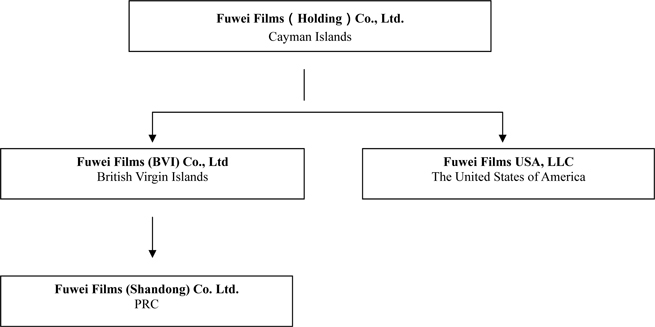
33
Shandong
Fuwei, our PRC operating subsidiary, was formed on January 28, 2003, as a
Sino-foreign equity joint venture under the name Weifang Fuwei Plastic Co., Ltd.
In July 2003, this company began production of BOPET film, initially renting the
necessary fixed assets from Shandong Neo-Luck, a company involved in BOPET film
production for which Mr. Xiaoming Wang, our current executive officer, served as
executive officer at the time.
Shandong
Fuwei subsequently acquired these fixed assets through two auction proceedings,
the first in October of 2003 and the second in December 2004. At the first
auction proceeding in October 2003, Shandong Fuwei acquired assets related to
the Brückner production line that it had been renting from Shandong Neo-Luck.
This line had been previously mortgaged by Shandong Neo-Luck to the Bank of
China, Weifang city branch as security for several loans extended to Shandong
Neo-Luck’s affiliates. When these loans went into default, the Bank of China
brought a series of legal actions in Weifang Municipal People’s Court that
resulted in the assets securing the loans being sold at a public auction.
Following its successful bid at an auction on October 9, 2003, Shandong Fuwei
acquired the Brückner production line and facilities (with an appraised value of
approximately RMB 169 million) for RMB 156 million.
In
November 2003, Shandong Fuwei’s shares were sold to Shenghong Group Co., Ltd.
(“Shenghong Group”) and Shandong Baorui for an aggregate consideration of RMB
98.2 million. Tongju Zhou, a former director of the Company, and Duo Wang each
indirectly own 50% of Easebright Investments Limited (“Easebright”), one of our
principal shareholders, and are both officers and directors of Shandong Baorui.
Jun Yin and Duo Wang own 17.5% and 4.6%, respectively, of Shandong Baorui. In
2004, Messrs. Zhou and Wang, along with Jun Yin established several offshore
holding companies in the British Virgin Islands and the Cayman Islands to
acquire and hold these shares. In October 2004, Fuwei (BVI) entered into a sale
and purchase agreement with Shenghong Group and Shandong Baorui pursuant to
which Fuwei (BVI) acquired the respective equity interest of Shenghong Group and
Shandong Baorui in Shandong Fuwei for an aggregate consideration of RMB 91
million. Shandong Fuwei thereafter became a wholly-owned subsidiary of Fuwei
(BVI) and was converted into a wholly-foreign owned enterprise pursuant to PRC
law.
As a
result of its ongoing financial difficulties, Shandong Neo-Luck was declared
bankrupt by the Weifang Municipal People’s Court in the PRC on September 24,
2004. Prior to the bankruptcy, Shandong Neo-Luck’s then major operating asset,
the DMT production line, had been pledged by Shandong Neo-Luck to Weifang City
Commercial Bank. When Shandong Neo-Luck was declared bankrupt, the Shandong
Branch of the Bank of China seized the production line by order of the Qingdao
Intermediate People’s Court and the Qingdao Southern District People’s Court
while the Weifang Branch of Bank of Communications did so through Weifang
Intermediate People’s Court. As such, the effectiveness of the pledge in favor
of Weifang City Commercial Bank was under dispute. Subsequently, pursuant to the
decision from Weifang Intermediate People’s Court, Weifang City Commercial Bank
ranked senior in terms of the right of claims.
The
pledged DMT production line was put up for public auction by the Shandong
Neo-Luck liquidation committee on October 22, 2004. In view of the above
complexities, the auction was deemed to be tremendously risky at that time, and
therefore, our PRC operating subsidiary did not directly participate in the
first auction, which began with a bid price of approximately RMB 53 million by
reference to an independent valuation performed on a forced sale basis. However,
due to the potential tremendous risk involved, the auction had been withdrawn
twice and the starting bid price had been further reduced to approximately RMB
34 million and was finally purchased by Beijing Baorui, a company indirectly
controlled by Shandong Baorui. When the DMT production line was put for public
auction by Beijing Baorui three months later, our PRC operating subsidiary
purchased it for approximately RMB 119 million, which was supported by an
independent valuation performed on a going concern basis. We understood that
acquiring the DMT production line from Beijing Baorui through the first auction
would be an effective way to minimize the risk associated with the uncertainties
arising from the bankruptcy of Shandong Neo-Luck. The price difference of
approximately RMB 85 million represented a risk premium paid to Beijing Baorui,
which bore the ultimate risks of recourse from creditors of Shandong Neo-Luck.
34
Subsequent
to the auction for several years, the PRC government conducted an investigation
into the conduct of certain individuals in connection with such
transactions. In March 2009 Messrs Yin, Wang and Zhou committed the
crime of corruption by verdict of the Jinan Intermediate People’s Court in the
city of Jinan, Shandong Province. In Novernber 2009 the Company became aware of
the final verdict issued by the Supreme People's Court of Shandong Province.
The
Supreme People’s Court upheld the initial verdict issued by the Intermediate
court in March 2009. The March 2009 initial verdict sentenced Mr. Yin to death,
with a stay of execution for two years; the other two defendants, Mr. Zhou and
Mr. Wang, each received life imprisonment; all of the personal property of the
three individuals will be confiscated.
At the time of the Company’s initial
public offering, we had obtained an opinion of PRC counsel with respect to the
validity of the auction proceedings under PRC law, although you should read the
description of the opinion and the subsequent development in March 2009
described under the title “Risk Factors — The
circumstances under which we acquired ownership of our main productive assets
may jeopardize our ability to continue as an operating business.” Certain of the assumptions relied upon
in providing that opinion have been called into question by the verdict referred
to above.
Key
Factors Affecting Our Results of Operations
The
following are key factors that affect our financial condition and results of
operations and we believe them to be important to the understanding of our
business:
Raw
Material Prices
During
the period for the years ended 2007, 2008 and 2009, the total cost of raw
materials made up approximately 76.0%, 78.6% and 73.3% of our cost of goods
sold, respectively. The primary raw materials used in our production of BOPET
film are polyethylene terephthalate (or PET) resin and additives, which made up
approximately 76.2% and 23.8%, respectively, of our total cost of raw materials
in 2009. PET resin trades as a commodity and its market price is influenced
significantly by global energy prices, including the price of crude oil. In
addition, PET resin is also largely used in the textile industry and accordingly
the demand from that industry will also affect the price of PET resin.
Although
we try to pass on all increases in our raw material costs to our customers, and
have generally been able to pass partial increases in recent years on to them,
we are occasionally constrained partially in this regard by industry practice
and preexisting obligations. We obtain a significant amount of the PET resin
used at our facilities from one supplier, who has agreed to supply us fixed
quantities of PET resin monthly at the prevailing market price. We have not
engaged in any hedging transactions to limit our exposure to fluctuations in the
market prices of these raw materials or their components.
Prices
of Our Products
Our BOPET
film products generally fall into two categories: commodity products and
specialty products. The price of commodity products, such as our printing,
stamping film and metallization films, is typically driven by supply and demand
conditions in the market. We have more control over setting the prices for our
specialty products, such as our high-gloss films and heat sealable film.
35
As
selling prices are generally higher for those types of BOPET film products which
require higher technical expertise, our revenue will be affected, to certain
extent, by our product mix. Our product mix is dependent on, among other things,
our production facilities, R&D abilities and new products commercialization.
Presently, our Brückner production line is capable of producing single-layer
BOPET film while our DMT production line is capable of producing both
single-layer and three-layer BOPET films.
Demand
for Our Products
We have
been able to expand our product range and markets by introducing new products
required by customers. We believe that our technical expertise is important in
introducing products that are in demand.
Our BOPET
film products are mostly sold to customers in the flexible packaging industry
for consumer products such as processed foods, pharmaceutical products,
cosmetics, tobacco and alcohol. In the fiscal years ended December 31, 2007,
2008 and 2009, approximately 75.5%, 86.9% and 88.9%, respectively, of our total
revenue was derived from the PRC. The demand for our products is therefore, to a
large extent, affected by the general economic conditions in the PRC. A
significant improvement in the economic environment in the PRC will likely
improve consumer spending, increase the demand for our customers’ products and
consequently increase the demand for our BOPET film. However, the economic
downturn of the PRC market will impact our customers’ demand and will decrease
the demand for our products. The global financial crisis, which began in the
fourth quarter of 2008, not only impacted the international market but also
impacted the domestic market which resulted in a significant effect on the
demand of our products.
Production
Capacity and Utilization Rates
Our sales
volume is limited by our operational annual production capacity.
As we
grow our business in the future, our ability to fulfill more and larger orders
will be dependent on our ability to increase our production capacity. As our
business is capital-intensive, our ability to expand our production capacity
will depend on, inter alia
, the availability of capital to meet our needs of expansion or upgrading
of production lines.
Competition
We
believe that we are currently one of the few producers of BOPET film in the PRC
with research and development capability for new BOPET film production. Our past
financial performance is attributable to our market position in the industry.
Over time, there may be new investors into our industry, and the current BOPET
film manufacturers may expand their production capacity. We believe that
currently our major competitors in the BOPET manufacturing market in the PRC
include Dupont Hongji Films Foshan Co., Ltd, Yihua Toray Polyester Film Co.,
Ltd, and Ningbo Shunsu Film Co., Ltd.
Our
ability to enhance existing products, introduce new products to meet customers’
demand, deliver quality products to our customers and maintain our established
industry reputation will affect our competitiveness and our market position.
Our
ability to compete against new and existing competitors to maintain or improve
our market position and secure orders will affect our revenue and financial
performance.
Description
of Certain Statements of Income Line Items
Revenues
Revenue
from the sale of our domestic BOPET film products is recognized when significant
risks and rewards of ownership have been transferred to the buyer. No revenue is
recognized if there are significant uncertainties regarding recovery of the
consideration due, associated costs or the possible return of goods, or when the
amount of revenue and costs incurred or to be incurred in respect of the
transaction cannot be measured reliably. In respect of our overseas sales, we
ship directly to the destinations of our overseas customers and our revenue is
recognized at the time when we receive customs clearance of our exports. Most of
our overseas sales were conducted on a Cost, Insurance and Freight (or “CIF”)
basis, meaning that we pay the costs and freight necessary to get the products
to the port of destination, and the risk of loss is transferred from us to the
buyer when the goods pass the ship’s rail at the port of destination. In
addition, we have to procure marine insurance against the buyer’s risk of loss
of damage to the goods during the carriage. Most of our sales invoices are
denominated in the Renminbi Yuan, although certain of our overseas sales are
denominated in US dollars.
36
Cost
of Goods Sold
Our cost
of goods sold comprises mainly of materials costs, factory overheads, packaging
materials and direct labor. The breakdown of our cost of goods sold in
percentage is as follows:
|
Year
Ended
Dec.
31, 2007
|
Year
Ended
Dec.
31, 2008
|
Year
Ended
Dec.
31, 2009
|
||||||||||
|
Materials
costs
|
80.9 | % | 78.6 | % | 73.3 | % | ||||||
|
Energy
expense
|
6.9
|
% | 8.2 | % | 9.0 | % | ||||||
|
Factory
overhead
|
8.6 | % | 9.0 | % | 13.1 | % | ||||||
|
Packaging
materials
|
2.7 | % | 2.9 | % | 3.0 | % | ||||||
|
Direct
labor
|
0.9 | % | 1.3 | % | 1.6 | % | ||||||
Material
Costs
As noted
above, the raw materials used in our BOPET film production are PET resin and
additives, which made up approximately 76.2% and 23.8%, respectively of our
total materials costs in 2009.
Energy
expense
Energy
expense includes water, electricity and gas costs, in which electricity is the
main energy consumed.
Factory
Overhead
Factory
overhead comprises primarily of depreciation, electricity and water charges, and
repair and maintenance of our machinery and equipment, etc. In 2009, the repair
and maintenance of our machinery and equipment were RMB 7.8 million, accounting
for 2.6% of Cost of Goods Sold, including overhaul repairs of the equipment.
Packaging
Materials
Our
packaging materials comprise of, among other things, packaging pallets and
carton boxes, used for the packaging of our BOPET film products for delivery to
customers. Generally, our unit cost of packaging materials does not fluctuate
significantly and our total costs for packaging materials typically vary in line
with our sales volume.
Direct
Labor
Direct
labor cost includes salaries, wages, bonuses and other payments to our employees
in the PRC who are involved in the production of our products. The main factors
affecting our direct labor cost are the demands and supply of skilled labor and
the implementation or changes of any new government policies or laws relating to
employment such as defined contribution plans stipulated by the PRC municipal
government.
Operating
Expenses
Our
operating expenses comprise of administrative expenses, distribution expenses
and other operating expense.
Our
administrative expenses comprise mainly of allowance for doubtful trade
receivables, administrative staff salaries and related welfare costs,
entertainment expenses, depreciation charges of office equipment, furniture and
fixtures, amortization charges relating to our trademark and land use rights,
professional fees, government duties and fees, insurance expenses, rental
expenses, travel expenses, office expenses, research and development expenses,
and other miscellaneous expenses.
37
Our
distribution expenses comprise mainly of freight costs, travel expenses, selling
and promotion expenses as well as salaries, allowances and welfare benefits paid
to our sales and marketing personnel.
Other
operating expenses comprise mainly of loss on disposal of property, plant and
equipment and other miscellaneous expenses.
Finance
Costs
Finance
costs comprise mainly of interest expense relating to our loans , exchange deficit,
and bank charge.
Income
Tax Expense
For the
period from January 28, 2003 to December 31, 2004, Shandong Fuwei was granted
certain tax relief under which it was exempted from PRC income tax. As of
January 2005, Shandong Fuwei has been a wholly foreign-owned enterprise under
the laws of the PRC. Accordingly, Shandong Fuwei is entitled to tax concessions
whereby the profit for the first two financial years beginning with the first
profit-making year (after setting off tax losses carried forward from prior
years) is exempt from income tax in the PRC and the profit for each of the
subsequent three financial years is taxed at 50% of the prevailing tax rates set
by the relevant tax authorities.
On March
16, 2007, the National People’s Congress of the PRC passed the Enterprise Income
Tax Law of the People’s Republic of China, which law took effect on January 1,
2008 (the “New Tax Law”). Under the New Tax Law, domestic enterprises and
foreign-invested enterprises will generally become subject to a unified
enterprise income tax rate of 25%, except that enterprises incorporated prior to
March 16, 2007 may continue to enjoy existing preferential tax treatments until
January 1, 2013. In addition, certain qualifying “High Technology Enterprises”
may still benefit from a preferential tax rate of 15% under the New Tax Law if
they meet the definition of “Government Developing High Technology Enterprise”
to be set forth in the more detailed implementing rules when they become
adopted. Shandong Fuwei was redesignated as a High-and-New Tech Enterprise in
December 2008 and enjoyed the favorable income tax rate of 15% pursuant to the
New Tax Law in 2008 and 2009. In accordance with New Tax Law, during
the transitional period we enjoy 12.5% income tax rate, which is 50% of 25%
income tax.
The US
entity, Fuwei Films USA, LLC, is headquartered in South Carolina. As of December
31, 2009, the income tax rate is 39%, including 34% of federal income tax rate
and 5% of state income tax rate.
Inflation
According
to the National Bureau of Statistics of China, the change in the consumer price
index in China was 4.8%, 5.9% and 1.9% in 2007, 2008 and 2009,
respectively. Inflation in the PRC has not had any material impact on
our business operations.
Critical
Accounting Policies
The SEC
defines critical accounting policies as those that are, in management's view,
most important to the portrayal of our financial condition and results of
operations and those that require significant judgments and estimates. We
prepare our financial statements in accordance with the U.S. GAAP, which
requires us to make estimates and assumptions that affect the reported amounts
of our assets and liabilities, to disclose contingent assets and liabilities on
the date of the financial statements, and to disclose the reported amounts of
revenues and expenses incurred during the financial reporting period. We
continue to evaluate these estimates and assumptions based on the most recently
available information, our own historical experience and various other
assumptions that we believe to be reasonable under the circumstances. We rely on
these evaluations as the basis for making judgments about the carrying values of
assets and liabilities that are not readily apparent from other sources. Since
the use of estimates is an integral component of the financial reporting
process, actual results could differ from those estimates. Some of our
accounting policies require higher degrees of judgment than others in their
application. We consider the policies discussed below to be critical to an
understanding of our financial statements as their application assists
management in making their business decisions.
38
Goodwill
Impairment. Goodwill
represents the excess of purchase price and related costs over the value
assigned to the net tangible and identifiable intangible assets of businesses
acquired. Goodwill is not amortized but is tested for impairment annually,
or when circumstances indicate a possible impairment may exist. Impairment
testing is performed at a reporting unit level. An impairment loss
generally would be recognized when the carrying amount of the reporting unit
exceeds the fair value of the reporting unit, with the fair value of the
reporting unit determined using a discounted cash flow (DCF) analysis. A
number of significant assumptions and estimates are involved in the application
of the DCF analysis to forecast operating cash flows, including the discount
rate, the internal rate of return, and projections of realizations and costs to
produce. Management considers historical experience and all available
information at the time the fair values of its reporting units are
estimated.
Collectibility of
Accounts Receivable. Our management has a credit policy in place and the
exposure to credit risk is monitored on an ongoing basis. Credit evaluations are
performed on all customers requiring credit over a certain amount. Generally, we
offer our customers in the PRC credit terms of up to 30-45 days. Our
international sales are settled through telegraphic transfer and letters of
credit, which generally have payment terms of between 30 and 60 days.
We adopt
a risk assessment model to our customer credit management system, and we offer
different credit terms to our customers based on criteria such as working
relationship, payment history, creditworthiness and their financial position.
All credit terms are to be approved by our finance department, in consultation
with our sales and marketing department. For extension of larger credit limits,
approvals have to be sought from our credit committee which is made up of
members from our finance department, sales department and CFO. Our finance
department and sales department review our outstanding debt account on a monthly
basis and follow up with customers when payments are due. We do not impose
interest charges on overdue account receivable.
As of
December 31, 2009 our largest trade debtor was Dongguan Klaser Technologies Co.,
Ltd, a company based in China. The trade receivables from Dongguan Klaser
Technologies Co., Ltd. amounted to approximately RMB3.9 million as of December
31, 2009.
We make
specific allowance for doubtful trade receivables when our management takes the
view (taking into account the aging of trade receivables and in consultation
with our sales department) that we will not be able to collect the amounts due.
Our customers pay by installments, creating long accounts receivable cycles. We
provide for an allowance for doubtful accounts based on our best estimate of the
amount of losses that could result from the inability or intention of our
existing customers not to make the required payments. We generally review the
allowance by taking into account factors such as historical experience, age of
the accounts receivable balances and economic conditions.
Specific
write-off of trade receivables is made when the outstanding trade receivables
have been due for more than two years.
The
analysis of the allowance for doubtful amounts for 2007, 2008 and 2009 is as
follows (in thousands):
|
2007
|
2008
|
2009
|
||||||||||||||
|
RMB
|
RMB
|
RMB
|
US$
|
|||||||||||||
|
Balance
at beginning of year
|
872 | 2,644 | 4,074 | 597 | ||||||||||||
|
Bad
debt (recovery) / expense
|
1,772 | 1,430 | (1,713 | ) |
(
251
|
) | ||||||||||
|
Write-offs
|
- | - |
(
102
|
) |
(
15
|
) | ||||||||||
|
Balance
at end of year
|
2,644 | 4,074 | 2,259 | 331 |
39
Impairment of
Long-lived Assets. We assess the impairment of long-lived assets when
events or changes in circumstances indicate that the carrying value of the
assets or the asset grouping may not be recoverable. Factors that we consider in
deciding when to perform an impairment review include significant
under-performance of a business or product line in relation to expectations,
significant negative industry or economic trends, and significant changes or
planned changes in our use of the assets. We measure the recoverability of
assets that will continue to be used in our operations by comparing the carrying
value of the asset grouping to our estimate of the related total future
undiscounted net cash flows. If an asset grouping’s carrying value is not
recoverable through the related undiscounted cash flows, the asset grouping is
considered to be impaired. The impairment is measured by comparing the
difference between the asset grouping’s carrying value and its fair value. We
estimate the fair value of an asset group based on market prices (i.e., the
amount for which the asset could be bought by or sold to a third party), when
available. When market prices are not available, we estimate the fair value of
the asset group using the income approach and/or the market approach. The income
approach uses cash flow projections. Inherent in our development of cash flow
projections are assumptions and estimates derived from a review of our operating
results, approved business plans, expected growth rates and cost of capital,
among others. We also make certain assumptions about the level of demand for our
products in the marketplace, our cost levels, future economic conditions,
interest rates, and other market data. Many of the factors used in assessing
fair value are outside the control of management, and these assumptions and
estimates can change in future periods.
Impairments
of long-lived assets are determined for groups of assets related to the lowest
level of identifiable independent cash flows. Our operating subsidiary, Shandong
Fuwei, currently operates three production lines. Since our products are capable
of being produced, and are produced, on multiple lines, each production line
cannot produce cash flow separately resulting from the combined administrative
expense, R & D, market and sales, etc. Therefore, the Company considers
whole assets as an asset group. The estimated undiscounted net cash flow was
higher than the net carrying amount of asset as of December 31, 2008 and 2009,
hence there was no impairment of long-lived assets recognized for the year ended
December 31, 2008 and 2009.
Results
of Operations
The
following discussion of our results of operations is based upon our audited
consolidated financial statements beginning on page F-1 of this Annual Report.
The table
below sets forth certain line items from our Statement of Income as a percentage
of revenues:
|
Year
Ended Dec.
31, 2007
|
Year
Ended Dec.
31, 2008
|
Year
Ended Dec.
31, 2009
|
||||||||||
|
(%
of Total Revenue)
|
||||||||||||
|
Gross
Profit
|
22.2 | 15.7 | 7.7 | |||||||||
|
Operating
expenses
|
(7.9 | ) | (10.2 | ) | (12.8 | ) | ||||||
|
Other
expense
|
(2.7 | ) | (0.8 | ) | (2.0 | ) | ||||||
|
Income
tax benefit
|
(1.0 | ) | (0.7 | ) | 1.3 | |||||||
|
Net
income/ (loss)
|
10.6 | 4.1 | (5.9 | ) | ||||||||
40
Fiscal
year ended 2009 compared to fiscal year ended 2008
Revenue
Our
revenue can be analyzed as follows (in thousands):
|
December 31, 2009
|
December 31, 2008
|
|||||||||||||||||||
|
RMB
|
US$
|
% of Total
|
RMB
|
% of Total
|
||||||||||||||||
|
Printing
film
|
35231 | 5,161 | 11.0 | % | 56,607 | 12.7 | % | |||||||||||||
|
Stamping
film
|
174,356 | 25,539 | 54.4 | % | 139,571 | 31.2 | % | |||||||||||||
|
Metallization
film
|
35,138 | 5,147 | 10.9 | % | 45,148 | 10.1 | % | |||||||||||||
|
Specialty
film
|
34,004 | 4,981 | 10.6 | % | 107,404 | 24.0 | % | |||||||||||||
|
Base
film for other applications
|
42,002 | 6,152 | 13.1 | % | 98,526 | 22.0 | % | |||||||||||||
|
Total
|
320,731 | 46,980 | 100.0 | % | 447,255 | 100 | % | |||||||||||||
During
the fiscal year ended December 31, 2009, our revenues were RMB 320.7
million, which is a decrease of RMB 126.5 million or 28.3%, as compared to the
same period for 2008. The decrease in sales is mainly because the decrease of
average unit sales price and the closing of leased production line , which
caused the revenue to decrease RMB 74.8 million and RMB 51.7 million
respectively compared to the same period in 2008.
In 2009,
sales of special films were RMB 34.0 million and 10.6% of our total revenues as
compared to RMB 107.4 million and 24.0% in 2008, which is a decrease of RMB 73.4
million, or 68.3%, as compared to the same period in 2008. The decrease was
attributable to the decreased demand for high value-added packaging caused by
financial crisis which further caused the decreased demand for specialty films.
Furthermore, we adjusted the composition of products portfolio, reducing sales
of some specitay films, such as matte films. In 2009, the sales of specialty
films such as dry films increased.
Cost
of Goods Sold
Our cost
of goods sold was RMB 296.1million for the year ended December 31, 2009, which
is a decrease of RMB 80.8 million, or 21.4%, as compared to the same period for
2008. The decrease resulted from the decreased unit sales price and the closing
of the leased production line , which
caused the total cost of goods sold to decrease RMB 35.1 million and RMB 45.7
million respectively compared to the same period in 2008.
Gross
Profit
Our gross
profit during the year ended December 31, 2009 was RMB 24.6 million representing
a gross margin of 7.7%, compared to RMB 70.3 million or 15.7% for the year ended
December 31, 2008. The decrease in gross profit margin was mainly due to the
decline in sales quantity of specialty films which further lead to a sharp
decline in average unit sale prices.
Operating
Expenses
Our
operating expenses during the year ended December 31, 2009 was RMB 41.2 million,
which is an decrease of RMB 4.6 million, or 10.0%, as compared to the same
period for 2008. The decrease was mainly due to decline of the maintainance
expenses as a public company.
Other Expense
Our other
expenses during the year ended December 31, 2009 was RMB 6.5 million, which is a
increase of RMB 3.0 million, or 86.1%, as compared to the same period for 2008.
The increase was mainly due to the decrease of capitalized expenditure of
interest by RMB 6 million.
Income
Tax Benefit / (Expense)
The
effective tax rate was 17.7% and 14.0% in 2009 and 2008 respectively. The higer
effective tax rate in 2009 was primarily due to the net loss for the period
ended 2009, hence, no income tax was incurred only deferred tax benefit.
41
Fiscal
year ended 2008 compared to fiscal year ended 2007
Revenue
Our
revenue can be analyzed as follows (in thousands):
|
December
31, 2007
|
December
31, 2008
|
|||||||||||||||
|
(RMB in thousands)
|
% of Total
|
(RMB in thousands)
|
% of Total
|
|||||||||||||
|
Printing
film
|
83,453
|
18.6
|
56,607
|
12.7
|
||||||||||||
|
Stamping
film
|
94,366
|
21
|
139,571
|
31.2
|
||||||||||||
|
Metallization
film
|
30,668
|
6.8
|
45,148
|
10.1
|
||||||||||||
|
Special
film
|
169,961
|
37.8
|
107,404
|
24.0
|
||||||||||||
|
Base
film for other applications
|
70,925
|
15.8
|
98,526
|
22.0
|
||||||||||||
|
449,373
|
100
|
447,255
|
100
|
|||||||||||||
During
the fiscal year ended December 31, 2008, our revenues were RMB 447.3 million,
which is a decrease of,RMB 2.1 million, or 0.5%, as compared to the same period
for 2007. In 2008, sales of special films were RMB 107.4 million and 24.0% of
our total revenues as compared to RMB 170.0 million and 37.8% in 2007, which is
a decrease of RMB 62.6 million, or 36.8%, as compared to the same period in
2007. The decrease, in the first three quarters of 2008, was largely
attributable to the change in demand for luxurious packaging caused by the
change in regulations in the packaging design of tobaccos, which require a large
quantity of our laser holographic base film and matte film, as well as others.
In addition, the global financial crisis, which began in the second half of
2008, has caused a further decline in the demand for specialty film.
Cost
of Goods Sold
Our cost
of goods sold was RMB376.9 million for the year ended December 31, 2008, which
is an increase of RMB 27.4 million or 7.8%, as compared to the same period for
2007. The increase resulted from the increased sales quantity in 2008 by 3,508
tons, or 12.7 %.
Gross
Profit
Our gross
profit during the year ended December 31, 2008 was RMB 70.3 million representing
a gross margin of 15.7%, compared to 22.2% for the year ended December 31,
2007. The decrease in gross profit margin was mainly due to the
decline in sales quantity of specialty films and a sharp decline in sale prices
as a result of the global financial crisis.
Operating
Expenses
Our
operating expenses during the year ended December 31, 2008 was RMB 45.7 million,
which is an increase of RMB 10.2 million or 28.5%, as compared to the same
period for 2007. The increase was mainly a result of increases in the costs of
professional service fees related to being a public company and increased
delivery fees caused by expanded sales quantity and the allowances for doubtfull
account receivable and other receivables.
Other
Expense
Our other
expenses during the year ended December 31, 2008 was RMB 3.5 million, which is a
decrease of RMB 8.8 million, or 71.8%, as compared to the same period for
2007. The decrease was mainly due to the decreased expenditure of
interest by RMB 1.1 million and capitalized expenditure of interest by RMB 7.7
million.
Income
Tax Expense
The
effective tax rate was 14.0% in 2008 and 8.7% in 2007. The higher effective tax
rates were primarily attributable to the fact that our operating subsidiary,
Shandong Fuwei, was subject to the 15.0% income tax rate in 2008 pursuant to the
prevailing PRC income Tax Law, while such rate was 7.5% in 2007.
Liquidity
and Capital Resources
Since
inception, our sources of cash were mainly from cash generated from our
operations and borrowings from financial institutions and capital contributed by
our shareholders.
42
Our
capital expenditures in 2009 have been primarily financed through short-term
borrowings from financial institutions. The interest rates of short-term
borrowings from financial institutions during the three year period from 2007 to
2009 ranged from 0% to 6.73%, and these borrowings may not be prepaid prior to
maturity.
Since our
inception, we have utilized significant amounts of secured short-term financing
to fund our acquisition of the Brückner and DMT production lines and our working
capital needs. At December 31, 2009, we had borrowings of RMB 153.2 million
including four different loan agreements with four financial institutions in the
PRC. In June 2009, we signed an extension for our RMB10 million loan agreement,
which will expire in June 2010. During 2008, we received interest-free loan of
RMB 25 million from the Bank of Weifang entrusted by the Weifang City Hi &
New Technology Project Industrial Development Fund. Each of the related loan
agreements contains provisions regarding collateral, covenants prohibiting us
from engaging in certain activities (including selling, mortgaging or otherwise
disposing of or encumbering all or substantially all of our assets or before any
merger, acquisition, spin-off, or other transaction resulting in a change in our
corporate structure) without the lenders consent and acceleration (and setoff)
provisions in the event of default in payment or failure to comply with such
covenants. Because of appreciation in the exchange rate of RMB compared to the
US dollars, the estimated total investment of our thick film project is US$40
million to US$ 45 million. As a result, we will need an additional US$20 million
to US$25 million to complete this project. The management is currently seeking
sources of financing in order to recommence this project soon.
We
obtained new short-term loans on June 9, 2009 for RMB 140 million maturing on
June 8, 2010. The annual interest rate is up by 10% compared with the
fixed benchmark interest rate of 5.31% announced by the People’s Bank of China.
As of December 31, 2009, the interest rate in effect was 5.841%.
We
entered into three interest free loan agreements with the Bank of Weifang for
the amount of (i) RMB10 million, effective January 13, 2009, with a maturity
date of January 12, 2010. On January 12, 2010, we obtain an extension for this
loan for an additional two years, which will expire on January 12, 2012. (ii)
RMB10 million effective January 16, 2009, with the maturity date of January 12,
2012; and (iii) RMB5 million effective December 2, 2008, with a maturity date of
December 2, 2011. All of the above loans are interest-free
loans. These are industrial development fund loans administrated by
the local government of Shandong Province, and made through the Bank of Weifang,
to be provided to local high-and–new tech enterprises for the purpose of
enhancing innovation and technical research and development and to support their
development. The proceeds of these loans have been used for the construction of
the trial production line and for research and development.
On June
4, 2009, Shandong Fuwei entered into a one-year foreign currency loan agreement
with Bank of China Weifang Branch for US$ 477,000 which is secured by a deposit
of RMB3,259,000. The lending rate is 0.2% down by trading day’s LIBOR interest,
which is 1.38375%, in order to reduce the currency translation cost of Shandong
Fuwei.
On
November 20, 2009, we signed a long-term loan contract of RMB10 million with
Weifang Dongfang State-owned Assets Management Co., Ltd., for a term of
eight-year effective as of October 19, 2009, which will expire on October 18,
2017. From 2015 to 2016, we will make equal payments of RMB3.35
million per year and in 2017 we should repay the remaining RMB3.3 million. The
annual interest rate is 5.346% which is up by 10% compared to the fixed
benchmark of 5-year interest rate announced by the People’s Bank of China. The
loan is guaranteed by Shandong Deqin Investment& Guarantee Co., Ltd. with a
guarantee expense of RMB 0.6 million for 8 years and is used for the Company's
key projects.
We are of
the opinion that, after taking into consideration our present banking
facilities, existing cash and the expected cash flows to be generated from our
operations, we have adequate sources of liquidity to meet our short-term
obligations, and our working capital. However, in order to be able to put the
third production line into operation we still need US$20 to US$25 million.
43
A summary
of our cash flows for 2007, 2008 and 2009 is as follows (in thousands):
|
Year
Ended December 31,
2007
|
Year
Ended December 31,
2008
|
Year
Ended December 31,
2009
|
||||||||||||||
|
RMB
|
RMB
|
RMB
|
US$
|
|||||||||||||
|
Net
cash generated from operating activities
|
82,856 | 80,027 | 9,929 | 1,453 | ||||||||||||
|
Net
cash used in investing activities
|
(246,787 | ) | (76,750 | ) | (7,599 | ) | (1,112 | ) | ||||||||
|
Net
cash (used in)/generated from financing activities
|
(51,651 | ) | (18,262 | ) | 8,415 | 1,233 | ||||||||||
|
Effect
of foreign exchange rate change
|
(3,448 | ) | (104 | ) | 236 | 44 | ||||||||||
|
Net
increase/(decrease) in cash and cash equivalents
|
(219,030 | ) | (15,086 | ) | 10,981 | 1,618 | ||||||||||
|
Cash
as at the beginning of the year
|
249,939 | 30,909 | 15,823 | 2,308 | ||||||||||||
|
Cash
as at the end of the year
|
30,909 | 15,823 | 26,804 | 3,926 | ||||||||||||
Operating
Activities
Net cash
from operating activities was RMB 9.9 million for the year ended December 31,
2009 as compared to RMB 80.0 million for the year ended December 31, 2008. The
decrease was mainly due to the decline of net income and increased inventories.
Net cash
from operating activities was RMB 80.0 million for the year ended December 31,
2008 as compared to RMB 82.9 million for the year ended December 31, 2007. The
decrease was mainly due to the decline of net income which resulted from the
financial crisis in the fourth quarter that caused the inventory cost to be
higher than the sales price.
Net cash
from operating activities was RMB 82.9 million for the year ended December 31,
2007. We implemented better controls over the collection of accounts receivable
from customers and resulted in a smaller balance of accounts receivable as of
December 31, 2007. In addition, we had more inventories stored at the
end of 2007.
Investing
Activities
Net cash
used in investing activities was RMB 7.6 million in 2009 which is mainly used in
equipment purchase and payment for constructions.
Net cash
used in investing activities was RMB 76.8 million in 2008 which is mainly used
in rebuilding the equipment of the second production line, expenditures related
to the third production line and the equipment for trial production line.
Net cash
used in investing activities was RMB 246.8 million in 2007, which was mainly
used for construction of the plant for the third production line and purchase
equipment for the third production line as well as the expenditures related to
the trial production line.
Financing
Activities
Net cash
generated from financing activities was RMB 8.4 million for the year ended
December 31, 2009, which was mainly from bank loans.
Net cash
generated from financing activities was RMB (18.3 million) for the year ended
December 31, 2008, which was mainly used to repay short-term loans to banks and
pay the interest.
Net cash
generated from financing activities was RMB 51.7 million for the year ended
December 31, 2007, which was mainly used to repay bank loans.
44
Foreign
Exchange Exposure
Translations
Our
reporting currency is RMB. The functional currency of our operating subsidiary
in the PRC is RMB and our operating subsidiary also maintains its books and
records in RMB. Accordingly, we are not exposed to any material foreign currency
translation effects.
Transactions
We are,
to a certain extent, exposed to transaction foreign currency exposure arising
from our operations in the PRC.
We began
conducting part of our sales in foreign currency in 2004 with the commencement
of our overseas sales business. During 2007, 2008 and 2009, approximately75.5%
and 86.9% and 88.9%, respectively, of our revenue was denominated in RMB and the
remainder was in US dollars. The proportion of raw materials we procured within
the PRC during 2007, 2008 and 2009 were 81.9%, 93.4% and 95.6%, respectively.
The remainder was purchased in US dollars.
Our
foreign currency exchange risk arises mainly from this mismatch between the
currency of our sales, purchases and operating expenses. We may, therefore, be
susceptible to foreign exchange exposure.
In
addition, we also maintain US dollar accounts with financial institutions for
our US dollar receipts and US dollar payments. We may also incur foreign
exchange gains or losses when we convert the US dollar balances into RMB.
Currently,
we do not have a formal foreign currency hedging policy as our foreign exchange
gains and losses in 2007, 2008 and 2009 were insignificant. Our management
believes that it is more efficient for us to assess the hedging need of each
transaction on a case-by-case basis. We will continue to monitor our foreign
exchange exposure in the future and will consider hedging any material foreign
exchange exposure should such need arise.
Capital
Expenditures and Contractual Commitments
Capital
Expenditures
Our
capital expenditures in 2007, 2008 and 2009 were as follows (in thousands):
|
Year Ended Dec. 31,
2007
|
Year Ended Dec. 31,
2008
|
Year Ended Dec. 31,
2009
|
||||||||||||||
|
RMB
|
RMB
|
RMB
|
US$
|
|||||||||||||
|
Buildings
|
- | - | - | - | ||||||||||||
|
Plant
and equipment
|
1,685 | 50,553 | 7,924 | 1,161 | ||||||||||||
|
Motor
vehicles
|
184 | 466 | - | - | ||||||||||||
|
Assets
under construction
|
181,308 | 4,645 | 1,462 | 214 | ||||||||||||
|
Others
(computer and furniture fittings)
|
114 | 4,134 | - | - | ||||||||||||
|
Total
|
183,291 | 59,798 | 9,386 | 1,375 | ||||||||||||
The
following table summarizes our contractual commitments as of December 31, 2009
and the effect those commitments are expected to have on our liquidity and cash
flow in future periods:
45
|
Payments
Due by Period
|
||||||||||||||||||||
|
Contractual
Commitments
|
Total
|
Less
than 1
Total
Year
|
1-3
Years
|
3-5
Years
|
More
than 5
Years
|
|||||||||||||||
|
(RMB
in thousands)
|
||||||||||||||||||||
|
Equipment
Purchase Contract(i)
|
149,430 | 149,430 | - | - | - | |||||||||||||||
|
Bank
loans(ii)
|
||||||||||||||||||||
|
Principal
|
178,179 | 153,179 | 15,000 | - | 10,000 | |||||||||||||||
|
Interest(iii)
|
8,552 | 8,552 | - | - | - | |||||||||||||||
|
Operating
leases(iv)
|
120 | 120 | - | - | - | |||||||||||||||
|
Total
|
336,281 | 311,281 | 15,000 | - | 10,000 | |||||||||||||||
|
(i)
|
The
purchase of equipment has been financed by the sale of our ordinary shares
and in the future would be financed by bank borrowings and internally
generated funds from operations.
|
|
(ii)
|
We
had short-term bank loans of RMB 153.2 million at December 31,
2009 that are due at various times in 2010. We also have long-term loans
for RMB 25 million. We renegotiated substantially all of our outstanding
indebtedness resulting in approximately RMB 165.0 million of secured
indebtedness of the total outstanding. Our obligations under our existing
loans have been mainly met through the cash flow from our operations and
our financing activities. In the past, cash flow from operations has been
sufficient to meet payment obligations and/or we have been able to extend
our borrowings. In the event that our cash flows are insufficient to
satisfy these obligations, we may consider additional bank loans, issuing
bonds, or other forms of financing to satisfy our capital requirements.
|
|
(iii)
|
The
interest expenses are estimated based on the interest rate of short-term
borrowings adopted by People Bank of China on December 31, 2009 plus an
estimated risk premium on borrowing.
|
|
(iv)
|
The
operating leases mainly relate to our rental of warehouse. The term of
these leases typically ranges from 1-3 years, and are renewable, subject
to renegotiation of terms, upon expiration. We intend to finance these
operating leases from our cash flows from operations.
|
Off-Balance
Sheet Arrangements and Contingent Liabilities
We do not
have any off-balance sheet guarantees, any outstanding derivative financial
instruments, interest rate swap transactions or foreign currency forward
contracts.
Inflation
Inflation
in China has not had a material impact on our results of operations in recent
years. According to the National Bureau of Statistics of China, the change in
the consumer price index in China was 4.8 %, 5.9% and 1.9% in 2007, 2008 and
2009 respectively.
Recent
Accounting Pronouncements
In
June 2009, the FASB issued ASC 810 (previously SFAS No. 167) for
determining whether to consolidate a variable interest entity. These amended
standards eliminate a mandatory quantitative approach to determine whether a
variable interest gives the entity a controlling financial interest in a
variable interest entity in favor of a qualitatively focused analysis, and
require an ongoing reassessment of whether an entity is the primary beneficiary.
These amended standards are effective for us beginning in the first quarter of
fiscal year 2010 and we are currently evaluating the impact that adoption will
have on our consolidated financial statements.
46
In
September 2009 the New FASB Accounting Standards Update 2009-08 issued in Earnings Per Share
(amendments to Section 260-10-S99). This update includes technical
corrections to Topic 260-10-S99 Earnings
Per Share, based on EITF Topic D-53, “Computation of Earnings Per Share
for a Period that includes redemption or an induced conversion of a portion of a
class of preferred stock” and EITF Topic D-42, “The effect of the calculation of
Earnings Per Share for the redemption or induced conversion of preferred stock.”
The Company does not expect the implementation of this statement to have an
impact on its results or financial position.
In
October 2009, the FASB issued an amendment to the accounting standards related
to certain revenue arrangements that include software elements. This standard
clarifies the existing accounting guidance such that tangible products that
contain both software and non-software components that function together to
deliver the product’s essential functionality, shall be excluded from the scope
of the software revenue recognition accounting standards. Accordingly, sales of
these products may fall within the scope of other revenue recognition standards
or may now be within the scope of this standard and may require an allocation of
the arrangement consideration for each element of the arrangement. This
standard, for which the Company is currently assessing the impact, will become
effective on January 1, 2011.
In
January 2010, the FASB issued an amendment to ASC 505, Equity, where entities
that declare dividends to shareholders that may be paid in cash or shares at the
election of the shareholders are considered to be a share issuance that is
reflected prospectively in EPS, and is not accounted for as a stock dividend.
This standard is effective for interim and annual periods ending on or after
December 15, 2009 and is to be applied on a retrospective basis. The adoption of
this standard is not expected to have a significant impact on the Company’s
consolidated financial statements.
In
January 2010, the FASB issued an amendment to ASC 820, Fair Value Measurements
and Disclosure, to require reporting entities to separately disclose the amounts
and business rationale for significant transfers in and out of Level 1 and Level
2 fair value measurements and separately present information regarding purchase,
sale, issuance, and settlement of Level 3 fair value measures on a gross basis.
This standard, for which the Company is currently assessing the impact, is
effective for interim and annual reporting periods beginning after December 15,
2009 with the exception of disclosures regarding the purchase, sale, issuance,
and settlement of Level 3 fair value measures which are effective for fiscal
years beginning after December 15, 2010.
The
Company has implemented all new accounting pronouncements that are in effect and
that may impact its financial statements and does not believe that there are any
other new accounting pronouncements that have been issued that might have a
material impact on its consolidated financial statements.
Research
and Development, Patents and Licenses
We rely
on copyright, patent, trademark and other intellectual property law,
nondisclosure agreement and technical know-how to protect our intellectual
property and proprietary rights. We enter into confidentiality and licensing
agreements with our employees. Our senior employees and employees who work in
our research and development department and other technical departments have
signed agreements acknowledging that we own the rights to all technology,
inventions, trade secrets, works of authorship, developments and other processes
generated in connection with their employment with us or their use of our
resources or relating to our business or our property and that they must assign
any ownership rights that they may claim in those works to us. As most of our
business is currently conducted in mainland China, we have not taken any action
outside mainland China to protect our intellectual property.
As of the
date of this Annual Report, we have received four patents from, and have
thirteen patent applications pending with, the Patent Office of the National
Intellectual Property Office of China with respect to our BOPET film technology.
Two of these applications are not being used in our production process as they
require expensive imported raw materials and, most importantly, they have been
replaced by the films used in LCD and electronic products in the market.
47
We
currently sell our products in the PRC under our brand “Fuwei Films.” We have a
pending application for the registration of the trademark “Fuwei Films” with the
Trademark Bureau of the State Administration of Industry and Commerce in the
PRC. Our ability to compete in our markets and to achieve future revenue growth
will depend, in significant part, on our ability to protect our proprietary
technology and operate without infringing upon the intellectual property rights
of others. An infringement upon these rights may reduce or eliminate any
competitive advantage we have developed, causing us to lose sales or otherwise
harm our business. We are not aware of any infringement or unauthorized use of
our intellectual property rights. We will take appropriate legal actions to
protect our rights if there is any unauthorized use or infringement of our
rights in the future. To date, we have not been sued for infringement of
intellectual property rights by any third party.
Trend
Information
Other
than as disclosed elsewhere in this Annual Report, we are not aware of any
trends, uncertainties, demands, commitments or events that are reasonably likely
to have a material effect on our net sales, profitability, liquidity or capital
resources, or that caused the disclosed financial information to not necessarily
be indicative of future operating results or financial conditions.
Item
6. Directors, Senior Management and Employees
A. Directors and senior management.
Our
directors and executive officers and their present positions with us, as
of April 20, 2010, are as follows:
Directors
and Executive Officers
|
Name
|
Age
|
Position
|
||
|
Xiaoan
He
|
48
|
Chairman
and Chief Executive Officer
|
||
|
Xiuyong
Zhang
|
40
|
Chief
Financial Officer and Director
|
||
|
Tee
Chuang Khoo
|
64
|
Independent
Director
|
||
|
Changrong
Ji
|
64
|
Independent
Director
|
||
|
Yudong
Huang (4)
|
45
|
Independent
Director
|
||
|
Bo
Xu (1)
|
47
|
Secretary
|
||
|
Zhibing
Qian (2)
|
45
|
Senior
Vice President and Secretary
|
||
|
Bin
Sun (3)
|
55
|
President
of Shandong Fuwei
|
||
|
Xiaoming
Wang
|
50
|
Vice
President (Production) of Shandong Fuwei
|
||
|
Hanyong
Lee
|
|
54
|
|
Vice
President (Research & Development) of Shandong Fuwei
|
(1) Mr.Xu
resigned as the Secretary of Board of Directors on April 1, 2009.
(2) Mr.
Qian was appointed as the Secretary of the Board of Director following the
resignation of Mr. Xu.
(3) The
term of Mr. Sun’s service agreement ended on April,
2009. Mr. Xiaoan He assumed Mr. Sun’s position as President
of Shandong Fuwei and took over Mr. Sun’s responsibility for the general
management of the Company’s operation from that time, in addition to keeping his
current responsibility as our Chairman and Chief Executive Officer.
(4) Mr.
Yudong Huang resigned as an Independent director of the Company on Novermber 30,
2009.
Information
about Directors and Officers
Set forth
below is certain information with respect to each director and officer as of
December 31, 2009:
48
Xiaoan
He
has been the Chairman of the Board of Directors and Chief Executive
Officer of our Company since 2005 and is responsible for the formulation and
implementation of our business strategies and management of our business
operations. Mr. He has more than ten years of management experience in the
plastics and packaging industries in the PRC. From June 2004 to January 2005,
Mr. He was our General Manager responsible for our daily operation and
management. Prior to joining us in June 2004, Mr. He was the General Manager of
Suzhou Broadway Plastic Packaging Co., Ltd from 1996 to 2003. From 1990 to 1996,
he was the Vice General Manager at Suzhou Xiangxuehai Freezer Co., Ltd and from
1983 to 1990, he was the Vice General Manager at Suzhou Marine Machinery Co.,
Ltd. Mr. He obtained his EMBA from the China Europe International Business
School in 2003 and Bachelor in Engineering from the Shanghai Jiaotong University
in 1983.
Xiuyong Zhang
has been a director of our Company since November 2007. He began serving
as our Chief Financial Officer on April 11, 2008. He had accumulated more than
10 years of experience in investment, accounting and financial fields. He is
responsible for the day-to-day management of our investment, financing,
accounting and auditing matters in the Company and financing, financial and
taxation matters for its subsidiary. Prior to join us as a director of the
Company. Mr. Zhang has also been the director of Shandong Fuwei since July 2004,
and the Vice President since January 2005. Mr. Zhang was the Vice-head of an
audit firm, Shandong Zhengyuan Hexin Auditors, Weifang branch from 1999 to 2004.
From 1991 to 1999, he was an accounting supervisor at the main office of the
Weifang City Local Products Company. Mr. Zhang was jointly certified as a Public
Valuer by the Ministry of Personnel and Ministry of Finance in the PRC in 2004.
He was certified as the Chinese Certified Public Accountant by the Ministry of
Finance of the PRC in 1997. He received the Professional Certification in Law
from China University of Political Science and Law and China Central Radio and
TV University in 2005. He received the Certification of Financial Accounting
from the Shandong Television University in 1996.
Tee Chuang Khoo
has been a director of our Company since November 2007. Mr. Khoo was a
Senior Partner in Management Consulting at DENEC Management Consulting Co. Ltd.
(“DENCE”) in Shanghai from October 2005 to October 2007. From November 2000 to
September 2005, Mr. Khoo was a Senior Partner at Improve Management Consulting
Services in Malaysia where he was responsible for reducing manufacturing costs
and process improvement. Mr. Khoo was an Executive Director at JPK (M) Sdn Bhd,
a Malaysian-listed company, from October 1998 to September 2000, where he
assisted the Managing Director with the entire operation of the company. From
November 1996 to August 1998, he was the General Manager of Broadway Group’s (a
Singapore-listed company) product factories in Johor Baru, Malaysia, and in
China. He also held managerial positions at the Malaysian conglomerate, The Lion
Group, and he was a Human Resources Manager at Metal Box Singapore Ltd, a
Singapore-listed company owned by the British Metal Box Group. Mr. Khoo received
a Bachelor of Arts in Finance & Management from the University of Oregon
(USA), a Masters in Business Administration (MBA) from University of Southern
California (USA) and a diploma in Accounting from the Association of
International Accountants from the United Kingdom.
Changrong Ji
has been a director of our Company since March 2007. Mr. Ji is currently
the Investigation Officer of the People’s Bank of China, Weifang city central
branch and has been since 2004. Mr. Ji was the
President of People’s Bank of China, Weifang City central branch from 2001 to
2004 and was the President of People’s Bank of China, Weihai City central branch
from 1999 to 2001. From 1989 to 1997, Mr. Ji was the Vice-president of People’s
Bank of China, Weifang city central branch. He joined the State Administration
of Foreign Exchange, Weifang branch as its deputy director from 1989 to 1997 and
was appointed as the director of the State Administration of Foreign Exchange,
Weihai branch from 1999 to 2001. Mr. Ji was the director of the State
Administration of Foreign Exchange, Weifang branch from 2001 to 2004. Mr. Ji
obtained his Master’s degree in Economics in 1999 from Shanghai Fudan University
and his bachelor’s degree in international economics in 1993 from East China
Normal University.
Yudong Huang
has been a director of our Company since November 2007. Professor Huang
is a Professor and Director of the Department of Applied Chemistry of Harbin
Institute of Technology. His research coverage includes PET films. Since 1992,
Professor Huang has performed more than 20 research projects, out of which 3
projects have won science and technology awards at the provincial and
ministerial levels. He has published more than 60 papers in the national and
international levels. He was awarded the “Excellent Scientist Prize” of
Heilongjiang Province in 1998. Professor Huang graduated from Department of
Applied Chemistry of Harbin Institute of Technology with doctor’s degree.
49
Bo Xu
joined the Company in October 2006 and was appointed as the Board
Secretary of the Company in December 2006. From 2002 to September
2006, he was the director of finance for Beijing Platinum Investment Co., Ltd.
where he was in charge of accounting and finance. Prior to that, he was a
Finance Manager at Weifang Wanyou Enterprise Co., Ltd. from 1993 to 2002. Mr. Xu
received his bachelor’s degree in finance from Weifang Staff and Worker’s
University in 1989.
Zhibing Qian
has been the Senior Vice President of the Company since April 2007. From
2003 to March 2007, he was the General Manager of Beijing Capital Jindian
Technology Limited. From 2000 to 2003, Mr. Qian was appointed as the General
Manger of Beijing Zhongguancun International Incubator Limited, comprehensively
responsible for the company’s set up and operations. Mr. Qian also worked at
senior management level at other state-owned and joint venture companies in
China. Mr. Qian received his Doctor’s and Master’s degrees from University of
Idaho in 1995 and 1993, respectively.
Xiaoming Wang
has been Vice President (Production) of Shandong Fuwei since January 2005
and is responsible for the management of our production facilities. Prior to
joining us, Mr. Wang was the Vice Manager of Weifang Engine Manufacturing Co.
from 1986 to 1998 and the deputy General Manager of Shandong Neo-Luck from 1998
to 2003. Mr. Wang was the deputy General Manager of Shandong Fuwei during 2004.
Mr. Wang was certified as a professional economist by the Shandong Province
Human Resources Committee in 2001 and obtained a certificate in Economics
Management awarded by the PRC Central Party Learning Institute and obtained a
certificate in Business Enterprises Operational Management from the Shandong
Television University in 1986.
Hanyong Lee
has been Vice President of Research and Development of Shandong Fuwei
since January 8, 2008. He has more than 22 years of experience in the BOPET film
industry, especially in the aspects of development and management. He worked for
18 years at SKC Co., Ltd., a world-famous BOPET supplier. From 2002 to 2007, Mr.
Lee was Vice President of i-components and Polystar International in South
Korea. From 1987 to 1997, he was mainly responsible for the management of the
R&D team, including the development of the BOPET film technology, the
refinement of the manufacturing process and the production in general at SKC in
Korea. At SKC from 1998 to 2000, he worked in the American Branch of SKC where
he was responsible for evaluating the technology, monitoring the production
growth and managing a professional staff. In 1987 Mr. Lee received Master’s
degree from the University of Connecticut.
None of
our directors or officers is related to each other. To the best of
our knowledge and belief, there are no arrangements or understandings with any
of our principal shareholders, customers, suppliers, or any other person,
pursuant to which any of our directors or executive officers were appointed.
The
business address of our directors and executive officers is No. 387 Dongming
Road, Weifang Shandong, People’s Republic of China, Postal Code: 261061.
Board
Committees
Our Board
of Directors has established an Audit Committee, Compensation Committee and a
Corporate Governance and Nominating Committee, and adopted charters for each of
these committees. We have appointed independent directors to each of our
committees.
Under the
Nasdaq Marketplace Rule 4350(c)(5), a “Controlled Company” is exempt from the
requirements to have a majority of independent directors. A “Controlled Company”
is a company of which more than 50% of the voting power is held by an
individual, a group or another company. Currently, as of the date of this Annual
Report, Apex Glory Holding Limited holds 53% of our outstanding ordinary shares
of the Company. As a result, Fuwei is considered to be a Controlled Company and
relied upon the exemption from December 25, 2007 until March 31, 2009.
50
Audit
Committee
Our Audit
Committee currently consists of Tee Chuang Khoo, and Changrong Ji. Mr. Yudong
Huang declined to stand for re-election at the Company’s annual shareholder
meeting and resigned from his position as a director of the Company, effective
November 30, 2009 and as a result, ceased to serve as a member of our Audit
Committee. The Audit Committee will oversee our accounting and financial
reporting processes and the audits of our financial statements. The Aaudit
Committee is responsible for, among other things:
|
|
·
|
selecting
the independent auditors and pre-approving all auditing and non-auditing
services permitted to be performed by the independent auditors;
|
|
|
·
|
reviewing
and approving all proposed related-party transactions;
|
|
|
·
|
discussing
the annual audited financial statements with management and the
independent auditors;
|
|
|
·
|
annually
reviewing and reassessing the adequacy of our audit committee charter;
|
|
|
·
|
meeting
separately and periodically with management and the independent auditors;
|
|
|
·
|
reviewing
such other matters that are specifically delegated to our audit committee
by our board of directors from time to time; and
|
|
|
·
|
reporting
regularly to the full board of directors.
|
Compensation
Committee
Our
Compensation Committee currently consists of Tee Chuang Khoo and Changrong Ji.
Yudong Huang declined to stand for re-election at the Company’s annual
shareholder meeting and resigned from his position as a director of the Company,
effective November 30, 2009 and as a result, ceased to serve as a member of our
Compensation Committee. The Compensation Committee is responsible
for, among other things:
|
|
·
|
reviewing
and determining the compensation package for our senior executives;
|
|
|
·
|
reviewing
and making recommendations to our board with respect to the compensation
of our directors;
|
|
|
·
|
reviewing
and approving officer and director indemnification and insurance matters;
|
|
|
·
|
reviewing
and approving any employee loan in an amount equal to or greater than RMB
100,000; and
|
|
|
·
|
reviewing
periodically and approving any long-term incentive compensation or equity
plans, programs or similar arrangements, annual bonuses, employee pension
and welfare benefit plans.
|
Corporate
Governance and Nominating Committee
Our
Corporate Governance and Nominating Committee consist of Changrong Ji. The
Corporate Governance and Nominating Committee is responsible for, among other
things:
|
|
·
|
identifying
and recommending to the board nominees for election or re-election to the
board;
|
|
|
·
|
making
appointments to fill any vacancy on our board;
|
|
|
·
|
reviewing
annually with the board the current composition of the board in light of
the characteristics of independence, age, skills, experience and
availability of service to us;
|
|
|
·
|
identifying
and recommending to the board any director to serve as a member of the
board’s committees;
|
|
|
·
|
advising
the board periodically with respect to significant developments in the law
and practice of corporate governance as well as our compliance with
applicable laws and regulations, and making recommendations to the board
on all matters of corporate governance and on any corrective action to be
taken; and
|
51
|
|
·
|
monitoring
compliance with our code of business conduct and ethics, including
reviewing the adequacy and effectiveness of our procedures to ensure
proper compliance.
|
Duties
of Directors
Under
Cayman Islands laws, our directors have a common law duty of loyalty to act
honestly in good faith with a view to our best interests. Our directors also
have a duty to exercise the skill they actually possess and such care and
diligence that a reasonably prudent person would exercise in comparable
circumstances. In fulfilling their duty of care to us, our directors must ensure
compliance with our memorandum of association. A shareholder has the right to
seek damages if a duty owed by our directors is breached. You should read
“Description of Share Capital - Differences in Corporate Law” for a more
complete discussion of these matters.
B. Compensation.
Compensation
of Directors and Executive Officers
All
directors receive reimbursements from us for expenses which are necessary and
reasonably incurred by them for providing services to us or in the performance
of their duties. Our directors who are also our employees receive compensation
in the form of salaries, housing allowances, other allowances and benefits in
kind in their capacity as our employees. Our directors do not receive any
compensation in their capacity as directors in addition to their salaries and
other remunerations as members of our management team. We pay their expenses
related to attending board meetings and participating in board functions.
The
aggregate cash compensation and benefits that we paid to our directors and
executive officers, a group of 9 persons for the year ended December 31,
2009 was approximately RMB2.5 million. No executive officer is entitled to
any severance benefits upon termination of his or her employment with the
Company.
Employment
and Service Agreements
Executive
Officers
We have
entered into an Employment Agreement, dated as of April 27, 2005, with Mr.
Xiaoan He for the position of Chief Executive Officer for a three year period,
effective December 25, 2006. On December 26, 2009, we extended the agreement
with Mr. He for three years to December 25, 2012. Under this Employment
Agreement, Mr. He’s annual basic salary is RMB 500,000 and is eligible for a
discretionary bonus. Each of our other current executive officers, Messrs.
Zhibing Qian, Xiaoming Wang, and Hanyong Lee, have also entered into service
agreements (the “Service Agreements” and each a “Service Agreement”) with us.
The term of service for the executive officers is for an initial period of 3
years commencing January 1, 2009 in the case of Mr. Wang, is for an initial
period of two years, commencing April 2, 2007 in the case of Mr. Qian, the
Company renewed his Service Agreement on April, 2010 for one more year, and is
for an initial period of three years, commencing January 8, 2008, in the case of
Mr. Lee. We may only terminate the Service Agreement prior to the expiration of
the initial period (except by mutual agreement and except as provided in the
Service Agreement) upon the occurrence of certain events including, without
limitation, for cause, disability or personal bankruptcy. The term of service of
each of our executive officers will be renewed for successive periods of one
year each after the expiration of the initial period. The Service Agreement may
be terminated by not less than three months notice in writing served by either
party to the Service Agreements. We have the option to pay the executive officer
salary in lieu of any required period of notice of termination. Under the terms
of their respective Service Agreements, Messrs. Zhibing Qian, Xiaoming Wang, and
Hanyong Lee are jointly entitled to an annual basic salary of RMB 1.3 million.
Their annual salaries may be revised at the discretion of the Compensation
Committee. We may pay them discretionary management bonuses for any financial
year, the payment and the amount of which are subject to the approval of the
Compensation Committee. Except for the payment in lieu of notice described
above, there are no provisions for benefits for termination of employment of our
executive officers under the Service Agreements. The term of service agreement
for Mr. Bin Sun, former President of Shandong Fuwei, ended on April 2009. Mr. Bo
Xu, the former Secretary of the Board of Directors, resigned from his position
on April 1, 2009 and Mr. Qian took his position. Pursuant to Mr. Sun
and Mr. Xu’s service agreements, they were not entitled to any severance
benefits upon termination of their employment with the Company.
52
We have
entered into a service agreement with Mr. Xiuyong Zhang our Chief Financial
Officer. (the “Service Agreements” and each a “Service Agreement”) The first
term of his Service Agreement began from March 1, 2006 to March 1, 2009. After
expiration of his Service Agreement, we extended his term for another three
years from Marhc 1, 2009 to March 1, 2012. Pursunat to his Service Agreement Mr.
Zhang is entitled to an annual base salary of RMB 300,000. After the initial
period, Mr. Zhang can terminate his Service Agreement upon three months prior
written notice or by paying the Company a sum equal to three months salary in
lieu of such notice. The Service Agreement may also be terminated by either
party without prior notice or payment pursuant to the applicable provisions of
the China Labor Law.
Share
Option Plan
We plan
to adopt a share option plan that is a share incentive plan, the purpose of
which is to recognize and acknowledge the contributions the eligible
participants had or may have made to our company. The share option plan will
provide the eligible participants an opportunity to have a personal stake in our
company with the view to achieving the following objectives:
·
motivate the eligible participants to optimize their
performance efficiency for the benefit of our company; and
· attract
and retain or otherwise maintain an on-going business relationship with the
eligible participants whose contributions are or will be beneficial to our
long-term growth.
Indemnification
Cayman
Islands law does not limit the extent to which a Company’s articles of
association may provide for indemnification of officers and directors, except to
the extent any such provision may be held by the Cayman Islands courts to be
contrary to public policy, such as to provide indemnification against civil
fraud or the consequences of committing a crime. Pursuant to our memorandum and
articles of association, our directors and officers, as well as any liquidator
or trustee for the time being acting in relation to our affairs, will be
indemnified and secured harmless out of our assets and profits from and against
all actions, costs, charges, losses, damages and expenses that any of them or
any of their heirs, executors or administrators may incur or sustain by reason
of any act done, concurred in or omitted in or about the execution of their
duties in their respective offices or trusts. Accordingly, none of these
indemnified persons will be answerable for the acts, receipts, neglects or
defaults of each other; neither will they be answerable for joining in any
receipts for the sake of conformity, or for any bankers or other persons with
whom any moneys or effects belonging to us may have been lodged or deposited for
safe custody, or for insufficiency or deficiency of any security upon which any
moneys of or belonging to us may be placed out or invested, or for any other
loss, misfortune or damage which may happen in the execution of their respective
offices or trusts. This indemnity will not, however, extend to any fraud or
dishonesty that may attach to any of said persons.
Insofar
as indemnification for liabilities arising under the Securities Act may be
permitted to directors, officers or persons controlling us pursuant to the
foregoing provisions, we have been informed that in the opinion of the
Securities and Exchange Commission such indemnification is against public policy
as expressed in the Securities Act and is therefore unenforceable.
C. Board practices.
Our
Articles provide that our board of director will consist of not less than two
directors. Each director must retire from office at least once every three
years, but a director who is appointed by the board mustretire at our next
annual general meeting of the shareholders following his or her appointment. The
chairman of the board is not subject to retirement by rotation or taken into
account in determining the number of directors to retire in each
year. A retiring director is eligible for re-election.
53
D.
Employees.
As of
December 31, 2009 , our
total staff consisted of 247 employees.
We do not
have any collective bargaining agreements with our employees. We have never
experienced any material labor disruptions and are unaware of any current
efforts or plans to organize employees. We believe we have good relationships
with our employees.
Item
7. Major Shareholders and Related Party Transactions
A. Major shareholders.
The
following table sets forth information with respect to the beneficial ownership,
within the meaning of Rule 13d-3 under the Exchange Act, of our ordinary shares,
as of April 20, 2010, for:
|
|
·
|
each
person known to us to own beneficially more than 5% of our ordinary
shares; and
|
|
|
·
|
each
of our directors and executive officers who beneficially own our ordinary
shares.
|
Beneficial
ownership includes voting or investment power with respect to the securities.
Except as indicated below, and subject to applicable community property laws,
the persons named in the table have or share the voting and investment power
with respect to all ordinary shares shown as beneficially owned by them. The
number of our ordinary shares used in calculating the percentage for each listed
person includes any options exercisable by such person within 60 days after the
date of this Annual Report. Percentage of beneficial ownership is based on
13,062,500 ordinary shares outstanding as of April 20, 2010.
|
Shares Beneficially Owned
|
||||||||
|
Number
|
Percent
|
|||||||
|
Executive
Officers and Directors:
|
||||||||
| — | — | |||||||
|
Xiaoan
He
|
— | — | ||||||
|
Xiuyong
Zhang
|
— | — | ||||||
|
Tee
Chuang Khoo
|
— | — | ||||||
|
Changrong
Ji
|
— | — | ||||||
|
Yudong
Huang (3)
|
— | — | ||||||
|
Bo
Xu
|
— | — | ||||||
|
Zhibing
Qian
|
— | — | ||||||
|
Bin
Sun
|
— | — | ||||||
|
Xiaoming
Wang
|
— | — | ||||||
|
Hanyong
Lee
|
— | — | ||||||
|
All
directors and executive officers as a group ( 8 persons)
|
— | — | ||||||
|
5%
Shareholders:
|
||||||||
|
Apex
Glory Holdings Limited (1)
|
6,912,503 | 52.9 | % | |||||
|
Easebright
Investments Limited (2)
|
1,637,497 | 12.5 | % | |||||
(1)Apex
Glory Holdings Limited is a wholly-owned subsidiary of Eastfaith Holdings
Limited, a British Virgin Islands corporation. Mr. Jun Yin is the sole
shareholder of Eastfaith Holdings Limited.
(2)Easebright
Investments Limited is a wholly-owned subsidiary of Goodsuccess Enterprises Ltd.
Mr. Tongju Zhou and Mr. Duo Wang each indirectly own 50% of Goodsuccess
Enterprises Ltd.
(3)Mr.
Yudong Huang resigned on Novermber 30, 2009.
Except as
disclosed below, there were no related party transactions with major
shareholders during the period commencing January 1, 2007 and ending March 31,
2010.
54
B.
Related party transactions.
Our
Related-Party Transaction Policies
We have
conducted our related-party transactions on normal commercial terms that we
believe are fair and reasonable and in the interests of our shareholders as a
whole. We believe that the terms of our related-party transactions are
comparable to the terms we could obtain from independent third parties. Our
related-party transactions are subject to the review and approval of the Audit
Committee of our board of directors.
The
transactions and balances with related parties are analyzed as follows:
(a)
Transactions with related parties
During
the years ended 2007, 2008 and 2009, we paid approximately
RMB143,047, RMB182,625 and RMB 136,820 (US$20,041) , respectively, to
Fuhua Industrial Material Management Co., Ltd. as rental payments in connection
with living quarters for our staff.
C. Interests of experts and counsel.
Not
Applicable.
Item
8. Financial Information
A. Consolidated Statements and Other
Financial Information.
Our
consolidated financial statements are included herein under Item 18.
We have
not paid any dividends on our ordinary shares. The payment of dividends in the
future, if any, is within the discretion of our Board of Directors and will
depend upon our earnings, capital requirements and financial condition and other
relevant factors. We do not anticipate declaring or paying any dividends in the
foreseeable future.
Legal
Proceedings
DMT
Arbitration
In 2006,
Shandong Fuwei received correspondence relating to an arbitration proceeding
initiated by DMT S. A. (“DMT”) against Shandong Neo-Luck in the ICC
International Court of Arbitration (the “ICC”) in which DMT sought monetary
damages against Shandong Neo-Luck of approximately US $1,250,000 plus interest
relating to a claim of partial non-payment for the DMT production line Shandong
Fuwei acquired from Beijing Baorui in 2005. In early 2007, the ICC determined
that despite arguments made to the ICC that Company should not be a party to the
proceeding, the arbitration should proceed with Fuwei as the respondent pending
adjudication of issues relating to jurisdiction and liability.
A hearing
was held by the ICC in November 2007. Subsequent to the hearing, at the
invitation of Weifang Neoluck (Group) Co., Ltd (“Neoluck Group”), the original
majority shareholder of Shandong Neo-Luck, the Neoluck Group and DMT engaged in
efforts to achieve a settlement of the pending arbitration on January 18, 2008.
Shandong Fuwei joined these discussions later as an interested party and in
order to support a resolution of the pending dispute and to achieve resolution
of certain outstanding service and spare part issues.
After
several weeks of negotiations among the parties, in March 2008, the parties
entered into two agreements, a Service and Technical Assistance Agreement (the
“Service Agreement”), between DMT and Shandong Fuwei, and a Settlement Agreement
(the “Settlement Agreement”) between DMT and the Neoluck Group. Under the
Service Agreement, Shandong Fuwei would pay an amount of US$180,000 in two
installments with respect to service and spare parts. As of December 31, 2009,
Shandong Fuwei has paid US$135,000 and still US$45,000 left unpaid.
55
Under the
Settlement Agreement, the Neoluck Group was obligated to pay an amount equal to
US$900,000 in Renminbi by delivery of a bank draft to DMT. In late April, the
Neoluck Group had not performed its obligation under the Settlement Agreement,
and, the Neoluck Group and DMT entered into a Supplemental Agreement pursuant to
which the Neoluck Group would pay the amount owed to DMT in two installments.
The Neoluck Group paid the first installment equal to US$ 450,000 in April 2008.
As agreed between Neoluck Group and DMT, the remaining US$450,000 will be paid
in installments by the end of December 2008. As of December 31,2009, Neoluck
Group has paid US$ 320,000 and still has US$130,000 outstanding to DMT.
In the
event the arbitration proceedings continue as a result of non-performance of the
payment obligation, it is possible for the arbitral tribunal for the ICC
International Court of Arbitration to rule in favor of DMT, which might result
in a liability for Fuwei for the amount claimed plus interest. However, any
possible liability regarding DMT’s claim should be reduced by the amount
previously paid to DMT in connection with the above-described settlement. It
should be noted further in such event that Fuwei might have sustainable claims
for damages as against the Neoluck Group for its failure to perform its
obligations under the Settlement Agreement.
On
January 18, 2010 we were advised by the Secretary of The International Court of
Arbitration of International Chamber of Commerce (ICC), that the arbitration was
withdrawn due to DMT’s failure to pay the balance of the advance on costs.
However, such withdrawal shall not prevent DMT from reintroducing the same
claims at a later date in another proceeding.
HKG Arbitration
At
December 31, 2007, Hampden Kent Group LLC had threatened the Company with
an arbitration, seeking a penalty fee in the amount of US$ 3.8 million relating
to services allegedly performed by HKG in attempting to provide financing to
Fuwei pursuant to an August 19, 2006 letter agreement (the "Letter
Agreement") between the parties. Pursuant to the Letter Agreement,
any dispute between the parties would be arbitrated by the American Arbitration
Association (“AAA”) in accordance with its Commercial Arbitration Rules.
Pursuant to these rules, a demand for arbitration must be filed with the AAA
regional office together with a filing fee by the claimant, in this case,
HKG.
In
December 2007, HKG filed a demand for arbitration with the International Centre
for Dispute Resolution of the AAA (“AAA/ICDR”). On January 28, 2008, the
AAA/ICDR informed us that an arbitration process would commence in
accordance with its rules. On February 18, 2008, HKG submitted an
Amended Demand for Arbitration and Statement of Claim.
On March
14, 2008, the Company submitted its answering statement and counterclaim in
response to HKG's Amended Demand for Arbitration and Statement of Claim. The
Company denied HKG's claims for breach of contract and breach of the covenant of
good faith and fair dealing as legally and factually without merit and asserted
various defenses. The Company also asserted a counterclaim against HKG for
breach of the Letter Agreement, seeking to recover in excess of US$0.3 million
in fees and costs paid to HKG and other consequential damages.
On March
27, 2008, HKG submitted a letter in reply to the Company's counterclaim,
generally denying the allegations and claims made by the Company.
At the
request of HKG, the Company had agreed to attempt to resolve this dispute
through mediation. A neutral mediator was appointed by the AAA/ICDR. On April
24, 2008, HKG unilaterally cancelled the mediation and sought to proceed with
the arbitration. A panel of three arbitrators (the “Panel”) was
appointed, and a hearing on the parties’ respective claims was
scheduled to commence on September 22, 2008.
By orders
dated September 9 and 15, 2008, the Panel suspended the hearing pending receipt
of a full deposit of the arbitrators’ fees. On November 7, 2008, the
Panel advised that if payment of the outstanding fees was not remitted on or
before February 6, 2009, the case would be terminated for nonpayment on that
date. That deadline was twice extended. By order
dated February 23, 2009, the Panel directed that if payment of the full
deposit was not remitted to the ICDR on or before March 23, 2009, the case
would be terminated.
On March
27, 2009, the Panel issued an order terminating the arbitration proceeding for
nonpayment of the deposits due in accordance with Sections R-52 and R-54 of the
Commercial Arbitration Rules of the American Arbitration Association. As of
March 27, 2009, the arbitration was dismissed and the Company was not required
to make any payment to HKG.
56
Class
Action
On
October 19, 2007, the Company became aware that a class action lawsuit had been
filed in the United States District Court for the Southern District of New York,
on behalf of all purchasers of the Company’s stock from the date of the
Company’s IPO on December 19, 2006 through October 16, 2007. The complaint
alleged that the Company and certain of its present and former officers,
directors, and shareholders violated the Securities Act of 1933.
On
November 21, 2007, the Company was given notice that a second class action
lawsuit had been filed in the United States District Court for the Southern
District of New York, commenced on behalf of all purchasers of the Company’s
stock pursuant or traceable to the Registration Statement and Prospectus issued
in connection with the Company’s IPO on December 19, 2006 through November 12,
2007. The complaint alleged that the Company, its underwriters and certain of
its executives (collectively, the “defendants”) violated Sections 11, 12(2), and
15 of the Securities Act of 1933. The complaint also alleged that the defendants
misrepresented or omitted material information regarding the Company and its
business operations.
On
January 24, 2008, the Court consolidated into a single action the putative
securities class actions pending against the Company and certain of its
officers, directors, and shareholders. The Court also appointed Nijat
Tonyaz as lead plaintiff, appointed the Rosen Law Firm, P.A. as lead
counsel, and granted plaintiffs leave to file a consolidated amended class
action complaint. The consolidated action is styled In re Fuwei Films Securities
Litigation, Case No. 07-CV-9416 (RJS).
On March
14, 2008, plaintiffs filed a consolidated amended class action
complaint (the "Amended Complaint") naming as defendants the
Company, Xiaoan He, Mark Stulga, Jun Yin, Tongju Zhou, Duo Wang, and the
Company's IPO underwriters — Maxim Group LLC, WR Hambrecht + Co.,and
Chardan Capital Markets, LLC (collectively, the “Underwriter Defendants”).
The Amended Complaint asserts claims for violation of Sections 11,
12(a)(2), and 15 of the Securities Act of 1933. The Company, Messrs. He
and Stulga, and the Underwriter Defendants were served with the Amended
Complaint and, as described below, moved to dismiss the claims asserted against
them.
On
November 3, 2008, Plaintiffs filed proofs of service with the Court, indicating
that Messrs. Yin, Zhou, and Wang were served with the Amended Complaint on or
about August 14, 2008, and that they had 90 days after such date to serve an
answer to the Amended Complaint or a motion pursuant to Rule 12 of the Federal
Rules of Civil Procedure.
By letter
dated March 17, 2009, Plaintiffs apprised the Court of Fuwei’s March 10, 2009
Press Release disclosing the initial verdict against Messrs. Yin, Wang, and
Zhou. Plaintiffs requested that the Court take judicial notice of
Fuwei’s March 10, 2009 Press Release (as filed with the Company’s March 13, 2009
Form 6-K) in adjudicating the pending motions to dismiss.
The
Company and Messrs. He and Stulga filed a motion to dismiss the Amended
Complaint in its entirety. The Underwriter
Defendants separately moved to dismiss the Amended Complaint. By the
Court’s Memorandum and Order dated July 10, 2009, the motions to dismiss of the
Company, Messrs. He and Stulga, and the Underwriter Defendants were granted in
part and denied in part. At this preliminary stage of the litigation,
the Court was required to assume that the facts alleged by the plaintiffs are
true and to draw all reasonable inferences in the plaintiffs’
favor. Applying that standard, the Court dismissed plaintiffs’ claims
to the extent they were based upon Fuwei’s alleged failure to disclose the DMT
arbitration proceeding. The Court also dismissed certain of
plaintiffs’ claims to the extent they were brought on behalf of shareholders who
did not purchase their shares directly in the IPO.
The Court
sustained plaintiffs’ remaining claims. However, the Court noted that
defendants may be able to assert affirmative defenses provided by the federal
securities laws in a motion for summary judgment, which could resolve the case
before trial.
On
September 9, 2009, the Company and Messrs. He and Stulga filed their answer to
the Amended Complaint. On October 2, 2009, the Court entered a case management
plan and scheduling order, which sets deadlines relating to pre-trial discovery,
mediation, and dispositive motions. Discovery is proceeding.
57
The Company and plaintiffs engaged in a mediation on March 26,
2010. The case was not settled at the mediation.
The
Company’s management continues to believe that the plaintiffs’ allegations are
without merit. The Company intends to defend itself vigorously against the
claims and has engaged a law firm in this regard. However, the Company's
management is currently unable to reasonably estimate the amount or range of
possible losses that will result from the ultimate resolution of this
matter. As of March 31, 2010, the Company has not accrued any liability in
connection with this litigation except for the defense expenses.
Other
significant events
B. Significant
Changes.
Not
Applicable
Item 9. The Offer and Listing.
A. Offer and listing details.
We have
authorized capital of 20,000,000 ordinary shares, par value US$0.129752 per
share. As of March 31, 2010, 13,062,500 ordinary shares were issued and
outstanding.
The
annual high and low market prices of our ordinary shares for the three most
recent full financial years and subsequent period are as set forth below:
|
Ordinary
Shares
|
||||||||
|
(Year
Ended)
|
High
|
Low
|
||||||
|
December
31,2007
|
$ | 17.14 | $ | 2.12 | ||||
|
December
31,2008
|
$ | 6.19 | $ | 0.70 | ||||
|
December
31,2009
|
$ | 2.07 | $ | 0.34 | ||||
The high
and low market prices of our ordinary shares for each financial quarter over the
two most recent full financial years and subsequent period are as set forth
below:
|
Ordinary
Shares
|
||||||||
|
(Quarter
Ended)
|
High
|
Low
|
||||||
|
March
31,2008
|
$ | 6.19 | $ | 2.52 | ||||
|
June
30, 2008
|
$ | 3.69 | $ | 2.27 | ||||
|
September
30, 2008
|
$ | 2.58 | $ | 1.21 | ||||
|
December
31,2008
|
$ | 1.41 | $ | 0.70 | ||||
|
March
31,2009
|
$ | 0.99 | $ | 0.34 | ||||
|
June
30, 2009
|
$ | 2.07 | $ | 0.65 | ||||
|
September
30, 2009
|
$ | 1.55 | $ | 1.10 | ||||
|
December
31,2009
|
$ | 1.93 | $ | 1.00 | ||||
For the
most recent six months, the high and low market prices of our ordinary shares
are as set forth below:
|
Ordinary
Shares
|
||||||||
|
(Month
Ended)
|
High
|
Low
|
||||||
|
October
31, 2009
|
$
|
1.25
|
$
|
1.00
|
||||
|
November
30, 2009
|
$
|
1.45
|
$
|
1.05
|
||||
|
December
31, 2009
|
$
|
1.93
|
$
|
1.16
|
||||
|
January
30, 2010
|
$
|
1.32
|
$
|
1.03
|
||||
|
February
28, 2010
|
$
|
1.14
|
$
|
0.86
|
||||
|
March
31, 2010
|
$
|
1.25
|
$
|
1.02
|
||||
58
B. Plan of Distribution.
Not
Applicable.
C. Markets.
Our
ordinary shares were included for quotation on the Nasdaq Global Market on
December 18, 2006 under the symbol “FFHL”.
D. Selling Shareholders.
Not
applicable.
E.
Dilution.
Not
applicable.
F. Expenses of the issue.
Not
Applicable.
Item 10. Additional Information.
A. Share capital.
Not
Applicable.
B. Memorandum and articles of
association.
We are a
Cayman Islands company and our affairs are governed by our memorandum and
articles of association and the Companies Law, Cap.22 (Law 3 of 1961, as
consolidated and revised)of the Cayman Islands, or the Companies Law. We have
filed copies of our complete Memorandum and Articles of Association as exhibits
to our Annual Report on Form 20-F for the year ended 2006 filed with the SEC on
April 2, 2007.
As of the
date of this Annual Report, our authorized share capital consisted of 20,000,000
ordinary shares, par value US$0.129752 per share. As of the date of this Annual
Report, 13,062,500 ordinary shares were issued and outstanding, and no
preference shares were issued and outstanding.
Ordinary
Shares
We were
incorporated under the laws of the Cayman Islands as an exempted company. A
Cayman Islands exempted company:
|
|
·
|
is
a company that conducts its business outside the Cayman Islands;
|
|
|
·
|
is
exempted from certain requirements of the Companies Law, including the
filing of any annual return of its shareholders with the Registrar of
Companies or the Immigration Board;
|
|
|
·
|
does
not have to make its register of shareholders open to inspection; and
|
|
|
·
|
may
obtain an undertaking against the imposition of any future taxation.
|
59
The
following summarizes the terms and provisions of our share capital, as well as
the material applicable laws of the Cayman Islands. This summary is not
complete, and you should read our amended and restated memorandum and articles
of association, filed as exhibits to this Annual Report.
The
following discussion primarily concerns ordinary shares and the rights of
holders of ordinary shares.
Protection
of Minority Shareholders
The Grand
Court of the Cayman Islands may, on the application of shareholders holding not
less than one fifth of our shares in issue, appoint an inspector to examine our
affairs and report thereon in a manner as the Grand Court shall direct.
Any
shareholder may petition the Grand Court of the Cayman Islands which may make a
winding up order, if the court is of the opinion that it is just and equitable
that we should be wound up. Where any such petition has been presented by our
shareholders, the Grand Court is permitted to make alternative order to a
winding-up order including orders regulating the conduct of our affairs in the
future, requiring us to refrain from doing an act complained of by the
petitioner or for the purchase of our shares by us or another shareholder.
Claims
against us by our shareholders must, as a general rule, be based on the general
laws of contract or tort applicable in the Cayman Islands or their individual
rights as shareholders as established by our amended and restated memorandum and
articles of association.
The
Cayman Islands courts ordinarily would be expected to follow English case law
precedents which permit a minority shareholder to commence a representative
action against, or derivative actions in our name to challenge
|
|
·
|
an
act which is ultra vires or illegal;
|
|
|
·
|
an
act which constitutes a fraud against the minority shareholder and the
wrongdoers are themselves in control of us; and an irregularity in
the passing of a resolution which requires a qualified (or special)
majority.
|
Pre-emption
Rights
There are
no pre-emption rights applicable to the issue of new shares under either Cayman
Islands law or our amended and restated memorandum and articles of association.
Modification
of Rights
Except
with respect to share capital (as described below) alterations to our amended
and restated memorandum and articles of association may only be made by special
resolution of no less than two-thirds of votes cast at a meeting of the
shareholders.
Subject
to the Companies Law, all or any of the special rights attached to shares of any
class (unless otherwise provided for by the terms of issue of the shares of that
class) may be varied, modified or abrogated with the sanction of a special
resolution passed at a separate general meeting of the holders of the shares of
that class.
The
provisions of our amended and restated articles of association relating to
general meetings shall apply similarly to every such separate general meeting,
but so that the quorum for the purposes of any such separate general meeting or
at its adjourned meeting shall be a person or persons together holding (or
represented by proxy) not less than one third in nominal value of the issued
shares of that class, every holder of shares of the class shall be entitled on a
poll to one vote for every such share held by such holder and that any holder of
shares of that class present in person or by proxy may demand a poll.
The
special rights conferred upon the holders of any class of shares shall not,
unless otherwise expressly provided in the rights attaching to or the terms of
issue of such shares, be deemed to be varied by the creation or issue of further
shares ranking pari passu therewith.
60
Alteration
of Capital
We may
from time to time by ordinary resolution:
|
|
·
|
increase
our capital by such sum, to be divided into shares of such amounts, as the
resolution shall prescribe;
|
|
|
·
|
consolidate
and divide all or any of our share capital into shares of larger amount
than our existing shares;
|
|
|
·
|
cancel
any shares which at the date of the passing of the resolution have not
been taken or agreed to be taken by any person, and diminish the amount of
our share capital by the amount of the shares so cancelled subject to the
provisions of the Companies Law;
|
|
|
·
|
sub-divide
our shares or any of them into shares of smaller amount than is fixed by
our amended and restated memorandum and articles of association, subject
nevertheless to the Companies Law, and so that the resolution whereby any
share is subdivided may determine that, as between the holders of the
share resulting from such subdivision, one or more of the shares may have
any such preference or other special rights, over, or may have such
deferred rights or be subject to any such restrictions as compared with,
the others as we have power to attach to unissued or new shares; and
|
|
|
·
|
divide
shares into several classes and without prejudice to any special rights
previously conferred on the holders of existing shares, attach to the
shares respectively as preferential, deferred, qualified or special
rights, privileges, conditions or such restrictions which, in the absence
of any such determination in a general meeting, may be determined by our
directors.
|
We may,
by special resolution, subject to any confirmation or consent required by the
Companies Law, reduce our share capital or any capital redemption reserve in any
manner authorized by law.
Transfer
of Shares
Subject
to any applicable restrictions set forth in our amended and restated memorandum
and articles of association, any of our shareholders may transfer all or any of
his or her shares by an instrument of transfer in the usual or common form or in
any form prescribed by the NASDAQ Global Market or in any other form which our
directors may approve. You should note that, under Cayman Islands law, a person
whose name is entered on the register of members will be deemed to be a member
or shareholder of our company. We have designated Continental Stock Transfer and
Trust Company as our share registrar. Under Cayman Islands law, a share
certificate constitutes admissible evidence as proof of title of its holder to
the shares specified on such certificate.
Our
directors may decline to register any transfer of any share which is not paid up
or on which we have a lien. Our directors may also decline to register any
transfer of any share unless:
|
|
·
|
the
instrument of transfer is lodged with us accompanied by the certificate
for the shares to which it relates and such other evidence as our
directors may reasonably require to show the right of the transferor to
make the transfer;
|
|
|
·
|
the
instrument of transfer is in respect of only one class of shares;
|
|
|
·
|
the
instrument of transfer is properly stamped (in circumstances where
stamping is required);
|
|
|
·
|
in
the case of a transfer to joint holders, the number of joint holders to
whom the share is to be transferred does not exceed four; and
|
|
|
·
|
a
fee of such maximum sum as the NASDAQ Global Market may at any time
determine to be payable or such lesser sum as our directors may from time
to time require is paid to us in respect thereof.
|
If our
directors refuse to register a transfer, they shall, within two months after the
date on which the instrument of transfer was lodged, send to each of the
transferor and the transferee notice of such refusal.
61
The
registration of transfers may, on notice being given by advertisement in such
one or more newspapers or by any other means in accordance with any requirements
of the NASDAQ Global Market, be suspended and the register closed at such times
and for such periods as our directors may from time to time determine; provided,
however, that the registration of transfers shall not be suspended nor the
register closed for more than 30 days in any year as our directors may
determine.
Share
Repurchase
We are
empowered by the Companies Law and our amended and restated memorandum and
articles of association to purchase our own shares, subject to certain
restrictions. Our directors may only exercise this power on our behalf, subject
to the Companies Law, our amended and restated memorandum and articles of
association and to any applicable requirements imposed from time to time by the
U.S. Securities and Exchange Commission, the NASDAQ Global Market, or by any
recognized stock exchange on which our securities are listed.
Dividends
Subject
to the Companies Law, we may declare dividends in any currency to be paid to our
shareholders. Dividends may be declared and paid out of our profits, realized or
unrealized, or from any reserve set aside from profits which our directors
determine is no longer needed. Our board of directors may also declare and pay
dividends out of the share premium account or any other fund or account which
can be authorized for this purpose in accordance with the Companies Law.
Except in
so far as the rights attaching to, or the terms of issue of, any share otherwise
provides (1) all dividends shall be declared and paid according to the amounts
paid up on the shares in respect of which the dividend is paid, but no amount
paid up on a share in advance of calls shall be treated for this purpose as paid
up on that share and (2) all dividends shall be apportioned and paid pro rata
according to the amounts paid upon the shares during any portion or portions of
the period in respect of which the dividend is paid.
Our
directors may also pay any dividend that is payable on any shares semi-annually
or on any other dates, whenever our financial position, in the opinion of our
directors, justifies such payment.
Our
directors may deduct from any dividend or other moneys payable to any
shareholder all sums of money (if any) presently payable by such shareholder to
us on account of calls or otherwise.
No
dividend or other money payable by us on or in respect of any share shall bear
interest against us.
In
respect of any dividend proposed to be paid or declared on our share capital,
our directors may resolve and direct that (1) such dividend be satisfied wholly
or in part in the form of an allotment of shares credited as fully paid up,
provided that our shareholders entitled thereto will be entitled to elect to
receive such dividend (or part thereof if our directors so determine) in cash in
lieu of such allotment or (2) the shareholders entitled to such dividend will be
entitled to elect to receive an allotment of shares credited as fully paid up in
lieu of the whole or such part of the dividend as our directors may think fit.
We may also, on the recommendation of our directors, resolve in respect of any
particular dividend that, notwithstanding the foregoing, it may be satisfied
wholly in the form of an allotment of shares credited as fully paid up without
offering any right of shareholders to elect to receive such dividend in cash in
lieu of such allotment.
Any
dividend, interest or other sum payable in cash to any shareholder may be paid
by check or warrant sent by mail addressed to the shareholder at his registered
address, or addressed to such person and at such addresses as the shareholder
may direct. Every check or warrant shall, unless the shareholder or joint
shareholders otherwise direct, be made payable to the order of the shareholder
or, in the case of joint shareholders, to the order of the shareholder whose
name stands first on the register in respect of such shares, and shall be sent
at their risk and payment of the check or warrant by the bank on which it is
drawn shall constitute a good discharge to us.
All
dividends unclaimed by shareholders for one year after having been declared may
be invested or otherwise made use of by our board of directors for the benefit
of our company until claimed. Any dividend unclaimed by shareholders after a
period of six years from the date of declaration of such dividend may be
forfeited and, if so forfeited, shall revert to us.
62
Whenever
our directors have resolved that a dividend be paid or declared, our directors
may further resolve that such dividend be satisfied wholly or in part by the
distribution of specific assets of any kind, and in particular of paid up
shares, debentures or warrants to subscribe for our securities or securities of
any other company. Where any difficulty arises with regard to such distribution,
our directors may settle it as they think expedient. In particular, our
directors may issue fractional certificates, ignore fractions altogether or
round the same up or down, fix the value for distribution purposes of any such
specific assets, determine that cash payments shall be made to any of our
shareholders upon the footing of the value so fixed in order to adjust the
rights of the parties, vest any such specific assets in trustees as may seem
expedient to our directors, and appoint any person to sign any requisite
instruments of transfer and other documents on behalf of a person entitled to
the dividend, which appointment shall be effective and binding on our
shareholders.
Untraceable
Shareholders
We are
entitled to sell any shares of a shareholder who is untraceable, provided that:
|
|
·
|
all
checks or warrants in respect of dividends of such shares, not being less
than three in number, for any sums payable in cash to the holder of such
shares have remained c for a period of twelve years prior to the
publication of the advertisement and during the three months referred to
in the third bullet point below;
|
|
|
·
|
we
have not during that time received any indication of the whereabouts or
existence of the shareholder or person entitled to such shares by death,
bankruptcy or operation of law; and
|
|
|
·
|
we
have caused an advertisement to be published in newspapers in the manner
stipulated by our amended and restated memorandum and articles of
association, giving notice of our intention to sell these shares, and a
period of three months has elapsed since such advertisement and the NASDAQ
Global Market has been notified of such intention.
|
The net
proceeds of any such sale shall belong to us, and when we receive these net
proceeds we shall become indebted to the former shareholder for an amount equal
to such net proceeds.
Issuance
of Additional Ordinary Shares or Preference Shares
Subject
to the Companies Law and the rules of the NASDAQ Global Market and without
prejudice to any special rights or restrictions for the time being attached to
any shares or any class of shares, our board of directors may issue additional
ordinary shares from time to time as our board of directors determines, to the
extent of available authorized but unissued shares and establish from time to
time one or more series of preference shares and to determine, with respect to
any series of preference shares, the terms and rights of that series, including:
|
|
·
|
the
designation of the series;
|
|
|
·
|
the
number of shares of t
|
|
|
·
|
the
dividend rights, conversion rights, voting rights; and
|
|
|
·
|
the
rights and terms of redemption and liquidation preferences.
|
Subject
to the foregoing, our board of directors may issue series of preference shares
without action by our shareholders to the extent authorized but unissued.
Accordingly, the issuance of preference shares may adversely affect the rights
of the holders of the ordinary shares. In addition, the issuance of preference
shares may be used as an anti-takeover device without further action on the part
of the shareholders. Issuance of preference shares may dilute the voting power
of holders of ordinary shares.
63
Subject
to applicable regulatory requirements, our board of directors may issue
additional ordinary shares without action by our shareholders to the extent of
available authorized but unissued shares. The issuance of additional ordinary
shares may be used as an anti-takeover device without further action on the part
of the shareholders. Such issuance may dilute the voting power of existing
holders of ordinary shares.
Our
ordinary shares are listed on the NASDAQ Global Market under the symbol “FFHL”.
Committees
of Board of Directors
Pursuant
to our amended and restated articles of association, our board of directors, we
have established an audit committee, a compensation committee and a corporate
governance and nominating committee.
Differences
in Corporate Law
The
Companies Law is modeled after similar laws in the United Kingdom but does not
follow recent changes in United Kingdom laws. In addition, the Companies Law
differs from laws applicable to United States corporations and their
shareholders. Set forth below is a summary of the significant differences
between the provisions of the Companies Law applicable to us and the laws
applicable to companies incorporated in the United States, such as in the State
of Delaware.
Duties and Director s
Under
Cayman Islands law, at common law, members of a board of directors owe a
fiduciary duty to the company to act in good faith in their dealings with or on
behalf of the company and exercise their powers and fulfill the duties of their
office honestly. This duty has four essential elements:
|
|
·
|
a
duty to act in good faith in the best interests of the company;
|
|
|
·
|
a
duty not to personally profit from opportunities that arise from the
office of director;
|
|
|
·
|
a
duty to avoid conflicts of interest; and
|
|
|
·
|
a
duty to exercise powers for the purpose for which such powers were
intended.
|
In
general, the Companies Law imposes various duties on officers of a company with
respect to certain matters of management and administration of the company. The
Companies Law contains provisions, which impose default fines on persons who
fail to satisfy those requirements. However, in many circumstances, an
individual is only liable if he knowingly is guilty of the default or knowingly
and willfully authorizes or permits the default.
In
comparison, under Delaware law, the business and affairs of a corporation are
managed by or under the direction of its board of directors. In exercising their
powers, directors are charged with a fiduciary duty of care to protect the
interests of the corporation and a fiduciary duty of loyalty to act in the best
interests of its shareholders. The duty of care requires that directors act in
an informed and deliberative manner and inform themselves, prior to making a
business decision, of all material information reasonably available to them. The
duty of care also requires that directors exercise care in overseeing and
investigating the conduct of the corporation’s employees. The duty of loyalty
may be summarized as the duty to act in good faith, not out of self-interest,
and in a manner which the director reasonably believes to be in the best
interests of the shareholders.
Under
Delaware law, a party challenging the propriety of a decision of a board of
directors bears the burden of rebutting the applicability of the presumptions
afforded to directors by the “business judgment rule.” If the presumption is not
rebutted, the business judgment rule protects the directors and their decisions,
and their business judgments will not be second guessed. Where, however, the
presumption is rebutted, the directors bear the burden of demonstrating the
entire fairness of the relevant transaction. Notwithstanding the foregoing,
Delaware courts subject directors’ conduct to enhanced scrutiny in respect of
defensive actions taken in response to a threat to corporate control and
approval of a transaction resulting in a sale of control of the corporation.
64
Interested
Directors
There are
no provisions under the Companies Law that require a director who is interested
in a transaction entered into by a Cayman Islands company to disclose his
interest. However, under our amended and restated memorandum and articles of
association, our directors are required to do so, and in the event that they do
not do so it may render such director liable to such company for any profit
realized pursuant to such transaction.
In
comparison, under Delaware law, such a transaction would not be voidable if (a)
the material facts as to such interested director’s relationship or interests
are disclosed or are known to the board of directors and the board in good faith
authorizes the transaction by the affirmative vote of a majority of the
disinterested directors, even though the disinterested directors are less than a
quorum, (b) such material facts are disclosed or are known to the shareholders
entitled to vote on such transaction and the transaction is specifically
approved in good faith by vote of the shareholders, or (c) the transaction is
fair as to the corporation as of the time it is authorized, approved or
ratified. Under Delaware law, a director could be held liable for any
transaction in which such director derived an improper personal benefit.
Voting
Rights and Quorum Requirements
Under
Cayman Islands law, the voting rights of shareholders are regulated by the
company’s articles of association and, in certain circumstances, the Companies
Law. The articles of association will govern matters such as quorum for the
transaction of business, rights of shares, and majority votes required to
approve any action or resolution at a meeting of the shareholders or board of
directors. Under Cayman Islands law, certain matters must be approved by a
special resolution which is defined as two-thirds of the votes cast by
shareholders present at a meeting and entitled to vote or such higher majority
as is specified in the articles of association; otherwise, unless the articles
of association otherwise provide, the majority is usually a simple majority of
votes cast.
In
comparison, under Delaware law, unless otherwise provided in the corporation’s
certificate of incorporation, each shareholder is entitled to one vote for each
share of stock held by the shareholder. Unless otherwise provided in the
corporation’s certificate of incorporation or bylaws, a majority of the shares
entitled to vote, present in person or represented by proxy, constitutes a
quorum at a meeting of shareholders. In matters other than the election of
directors, with the exception of special voting requirements related to
extraordinary transactions, the affirmative vote of a majority of shares present
in person or represented by proxy at the meeting and entitled to vote is
required for shareholder action, and the affirmative vote of a plurality of
shares is required for the election of directors.
Mergers
and Similar Arrangements
A merger
of two or more constituent companies under Cayman Islands law requires a plan of
merger or consolidation to be approved by the directors of each constituent
company and authorization by (a) a majority in number representing seventy-five
percent (75%) in value of the shareholders voting together as one class and (b)
if the shares to be issued to each shareholder in the surviving company are to
have the same rights and economic value as the shares held in the constituent
company, a special resolution of the shareholders voting together as one class.
A merger
between a Cayman parent company and its Cayman subsidiary or subsidiaries does
not require authorization by a resolution of shareholders. For this
purpose a subsidiary is a company of which at least ninety percent (90%) of the
issued shares entitled to vote are owned by the parent company.The consent of
each holder of a fixed or floating security interest over a constituent company
is required unless this requirement is waived by a court in the Cayman Islands.
Save in
certain circumstances, a dissentient shareholder of a Cayman constituent company
is entitled to payment of the fair value of his shares upon dissenting to a
merger or consolidation. The exercise of appraisal rights will
preclude the exercise of any other rights save for the right to seek relief on
the grounds that the merger or consolidation is void or unlawful.
65
There are
statutory provisions that facilitate the reconstruction and amalgamation of
companies, provided that the arrangement in question is approved by a majority
in number of each class of shareholders and creditors with whom the arrangement
is to be made, and who must in addition represent three fourths in value of each
such class of shareholders or creditors, as the case may be, that are present
and voting either in person or by proxy at a meeting, or meetings convened for
that purpose.
The
convening of the meetings and subsequently the arrangement must be sanctioned by
the Grand Court of the Cayman Islands. While a dissenting shareholder would have
the right to express to the court the view that the transaction should not be
approved, the court can be expected to approve the arrangement if it satisfies
itself that:
|
|
·
|
the
company is not proposing to act illegally or ultra vires and the statutory
provisions as to majority vote have been complied with;
|
|
|
·
|
the
shareholders have been fairly represented at the meeting in question;
|
|
|
·
|
the
arrangement is such as a businessman would reasonably approve; and
|
|
|
·
|
the
arrangement is not one that would more properly be sanctioned under some
other provision of the Companies Law or that would amount to a “fraud on
the minority.”
|
When a
takeover offer is made and accepted by holders of 90% of the shares within four
months, the offerer may, within a two-month period, require the holders of the
remaining shares to transfer such shares on the terms of the offer. An objection
may be made to the Grand Court of the Cayman Islands but is unlikely to succeed
unless there is evidence of fraud, bad faith or collusion.
Cayman
Islands laws do not require that shareholders approve sales of all or
substantially all of a company’s assets as is commonly adopted by U.S.
corporations.
If the
arrangement and reconstruction are thus approved, any dissenting shareholders
would have no rights comparable to appraisal rights, which would otherwise
ordinarily be available to dissenting shareholders of United States
corporations, providing rights to receive payment in cash for the judicially
determined value of the shares.
Shareholders’
Suits
Derivative
actions have been brought under Cayman Islands law but were unsuccessful for
technical reasons. In principle, we will normally be the proper plaintiff and a
derivative action may not be brought by a minority shareholder. However, based
on English authorities, who would in all likelihood be of persuasive authority
in the Cayman Islands, exceptions to the foregoing principle apply in
circumstances in which:
|
|
·
|
a
company is acting or proposing to act illegally or beyond the scope of its
authority;
|
|
|
·
|
the
act complained of, although not beyond the scope of its authority, could
be effected duly if authorized by more than a simple majority vote which
has not been obtained; and
|
|
|
·
|
those
who control the company are perpetrating a “fraud on the minority.”
|
Class
actions and derivative actions generally are available to shareholders under
Delaware law for, among other things, breach of fiduciary duty, corporate waste
and actions not taken in accordance with applicable law. In such actions, the
court generally has discretion to permit the winning party to recover attorneys’
fees incurred in connection with such action.
Corporate
Governance
Cayman
Islands laws do not restrict transactions with directors, requiring only that
directors exercise a duty of care and owe a fiduciary duty to the companies for
which they serve. Under our amended and restated memorandum and articles of
association, subject to any separate requirement for audit committee approval
under the applicable rules of The Nasdaq Stock Market, Inc. or unless
disqualified by the chairman of the relevant board meeting, so long as a
director discloses the nature of his interest in any contract or arrangement
which he is interested in, such a director may vote in respect of any contract
or proposed contract or arrangement in which such director is interested and may
be counted in the quorum at such meeting.
66
Cayman
Islands law does not limit the extent to which a company’s articles of
association may provide for indemnification of officers and directors, except to
the extent any such provision may be held by the Cayman Islands courts to be
contrary to public policy, such as to provide indemnification against civil
fraud or the consequences of committing a crime. Our amended and restated
memorandum and articles of association provide for the indemnification of our
directors, auditors and officers against all losses or liabilities incurred or
sustained by him or her as a director, auditor or officer of our company in
defending any proceedings, whether civil or criminal, in which judgment is given
in his or her favor, or in which he or she is acquitted provided that this
indemnity may not extend to any matter in respect of any fraud or dishonesty
which may attach to any of these persons.
Insofar
as indemnification for liabilities arising under the Securities Act may be
permitted to directors, officers or persons controlling us pursuant to the
foregoing provisions, we have been advised that in the opinion of the SEC such
indemnification is against public policy as expressed in the Securities Act and
therefore is unenforceable.
We are
managed by our board of directors. Our amended and restated memorandum and
articles of association provide that the number of our directors shall not be
less than two and there shall be no maximum number of our directors unless our
shareholders in general meeting otherwise determine a maximum number. Initially
we have set our board of directors to have 4 directors. Any director on our
board may be removed by way of an ordinary resolution of shareholders. At each
annual general meeting, one-third of our directors for the time being (or, if
their number is not a multiple of three, the number nearest to but not less than
one-third) shall retire from office by rotation provided that every director
shall be subject to retirement at least once every three years. Any vacancies on
our board of directors or additions to the existing board of directors can be
filled by an ordinary resolution of our shareholders or the affirmative vote of
a majority of the remaining directors, although this may be less than a quorum
where the number of remaining directors falls below the minimum number fixed by
our board of directors. Our directors are not required to hold any of our shares
to be qualified to serve on our board of directors.
Meetings
of our board of directors may be convened at any time deemed necessary by any
one of our directors. Advance notice of a meeting is not required if each
director entitled to attend consents to the holding of such meeting.
A meeting
of our board of directors shall be competent to make lawful and binding
decisions if a majority of the members of our board of directors are present or
represented. At any meeting of our directors, each director is entitled to one
vote.
Questions
arising at a meeting of our board of directors are required to be decided by
simple majority votes of the members of our board of directors present or
represented at the meeting. In the case of a tie vote, the chairman of the
meeting shall have a second or deciding vote. Our board of directors may also
pass resolutions without a meeting by unanimous written consent.
Insofar
as indemnification for liabilities arising under the Securities Act may be
permitted to directors, officers or persons controlling us pursuant to the
foregoing provisions, we have been advised that in the opinion of the SEC such
indemnification is against public policy as expressed in the Securities Act and
therefore is unenforceable.
Inspection
of Corporate Records
Shareholders
of a Cayman Islands company have no general right under Cayman Islands law to
inspect or obtain copies of a list of shareholders or other corporate records of
the company. However, these rights may be provided in the articles of
association.
In
comparison, under Delaware law, shareholders of a Delaware corporation have the
right during normal business hours to inspect for any proper purpose, and to
obtain copies of list(s) of shareholders and other books and records of the
corporation and its subsidiaries, if any, to the extent the books and records of
such subsidiaries are available to the corporation.
67
Shareholder
Proposals
The
Companies Law does not provide shareholders any right to bring business before a
meeting or requisition a general meeting. However, these rights may be provided
in the articles of association.
Unless
provided in the corporation’s certificate of incorporation or bylaws, Delaware
law does not include a provision restricting the manner in which shareholders
may bring business before a meeting.
Approval
of Corporate Matters by Written Consent
The
Companies Law allows a special resolution to be passed in writing if signed by
all the shareholders and authorized by the articles of association.
In
comparison, Delaware law permits shareholders to take action by written consent
signed by the holders of outstanding stock having not less than the minimum
number of votes that would be necessary to authorize or take such action at a
meeting of shareholders.
Calling
of Special Shareholders Meetings
The
Companies Law does not have provisions governing the proceedings of shareholders
meetings that are usually provided in the articles of association.
In
comparison, Delaware law permits the board of directors or any person who is
authorized under a corporation’s certificate of incorporation or bylaws to call
a special meeting of shareholders.
Staggered
Board of Directors
The
Companies Law does not contain statutory provisions that require staggered board
arrangements for a Cayman Islands company. Such provisions, however, may validly
be provided for in the articles of association.
In
comparison, Delaware law permits corporations to have a staggered board of
directors.
Anti-takeover
Provisions
Neither
Cayman Islands nor Delaware law prevents companies from adopting a wide range of
defensive measures, such as staggered boards, blank check preferred, removal of
directors only for cause and provisions that restrict the rights of shareholders
to call meetings, act by written consent and submit shareholder proposals.
C.
Material Contracts.
We also
entered into two Loan Contracts with the Bank of Communication for the amount of
(i) RMB 70 million, effective June 9, 2009, with a maturity date of June 8,
2010, and (ii) RMB 70 million effective June 9, 2009, with a maturity date of
June 8, 2010, The proceeds of these two loans are being used for
acquisition capital and working capital turnover. In addition, we
entered into three interest free Loan Contracts with Bank of
Weifang (formerly known as Weifang City Commercial Bank) for the amount of
(i) RMB 10 million effective January 16, 2009, with a maturity date of January
12, 2010, which was extended for an additional two years from Januray
13, 2010 to January 2012 after it expired on January 12; (ii) RMB 10 million
effective January 16, 2009, with a maturity date of January 12, 2012; and (iii)
RMB 5 million effective December 2, 2008, with a maturity date of December 2,
2011. The proceeds of these three loans have been used for construction the
trial production line and research and development of special BOPET films.
On
November 20, 2009, we signed a long-term loan contract of RMB10 million with
Weifang Dongfang State-owned Assets Management Co., Ltd., for a term of
eight-year effective October 19, 2009, which will expire on October 18,
2017. From 2015 to 2016, we will make equal payments of RMB3.35
million per year and in 2017. We should repay the remaining RMB3.3 million. The
annual interest rate is 5.346% which is up by 10% compared the fixed benchmark
5-year interest rate announced by the People’s Bank of China. The loan is
guaranteed by Shandong Deqin Investment& Guarantee Co., Ltd. and is used for
the Company's key projects.
68
D. Exchange controls.
Chinese
government imposes control over the convertibility of Rmb into foreign
currencies. Under the current unified floating exchange rate system, the
People’s Bank of China publishes a daily exchange rate for Rmb, or the PBOC
Exchange Rate, based on the previous day’s dealings in the inter-bank foreign
exchange market. Financial institutions authorized to deal in foreign currency
may enter into foreign exchange transactions at exchange rates within an
authorized range above or below the PBOC Exchange Rate according to market
conditions.
Pursuant
to the Foreign Exchange Control Regulations issued by the State Council on
January 29, 1996 and effective as of April 1, 1996 (and amended on January 14,
1997) and the Administration of Settlement, Sale and Payment of Foreign Exchange
Regulations which came into effect on July 1, 1996 regarding foreign exchange
control, or the Regulations, conversion of Renminbi into foreign exchange by
foreign investment enterprises for current account items, including the
distribution of dividends and profits to foreign investors of joint ventures, is
permissible upon the proper production of qualified commercial vouchers or legal
documents as required by the Regulations. Foreign investment enterprises are
permitted to remit foreign exchange from their foreign exchange bank account in
China upon the proper production of, inter alia, the board resolutions declaring
the distribution of the dividend and payment of profits. Conversion of Rmb into
foreign currencies and remittance of foreign currencies for capital account
items, including direct investment, loans, security investment, is still subject
to the approval of the State Administration of Foreign Exchange, or SAFE, in
each such transaction. On January 14, 1997, the State Council amended the
Foreign Exchange Control Regulations and added, among other things, an important
provision, as Article 5 provides that the State shall not impose restrictions on
recurring international payments and transfers.
Under the
Regulations, foreign investment enterprises are required to open and maintain
separate foreign exchange accounts for capital account items (but not for other
items). In addition, foreign investment enterprises may only buy, sell and/or
remit foreign currencies at those banks authorized to conduct foreign exchange
business upon the production of valid commercial documents and, in the case of
capital account item transactions, document approval from SAFE.
Currently,
foreign investment enterprises are required to apply to SAFE for “foreign
exchange registration certificates for foreign investment enterprises.” With
such foreign exchange registration certificates (which are granted to foreign
investment enterprises, upon fulfilling specified conditions and which are
subject to review and renewal by SAFE on an annual basis) or with the foreign
exchange sales notices from the SAFE (which are obtained on a
transaction-by-transaction basis), foreign-invested enterprises may enter into
foreign exchange transactions at banks authorized to conduct foreign exchange
business to obtain foreign exchange for their needs.
E. Taxation.
United
States Federal Income Taxation
General
The
following is a summary of the material U.S. federal income tax consequences of
the acquisition, ownership, and disposition of our ordinary shares. The
discussion below of the U.S. federal income tax consequences to “U.S. Holders”
will apply if you are a beneficial owner of our ordinary shares and you are for
U.S. federal income tax purposes:
|
|
·
|
an
individual citizen or resident of the United States;
|
|
|
·
|
a
corporation (or other entity treated as a corporation) that is created or
organized in or under the laws of the United States, any state thereof or
the District of Columbia;
|
|
|
·
|
an
estate whose income is includible in gross income for U.S. federal
income tax purposes regardless of its source; or
|
69
|
|
·
|
a
trust if (i) a U.S. court can exercise primary supervision over the
trust’s administration and one or more U.S. persons are authorized to
control all substantial decisions of the trust, or (ii) it has a valid
election in effect under applicable U.S. Treasury regulations to be
treated as a U.S. person.
|
If you
are not described as a U.S. Holder and are not an entity treated as a
partnership or other pass-through entity for U.S. federal income tax purposes,
you will be considered a “Non-U.S. Holder.” The U.S. federal income tax
consequences applicable to Non-U.S. Holders of owning and disposing of our
ordinary shares described below under the heading “Non-U.S. Holders.”
This
summary is based on the Internal Revenue Code of 1986, as amended, or the Code,
its legislative history, existing and proposed Treasury regulations promulgated
thereunder, published rulings and court decisions, all as currently in effect.
These authorities are subject to change, possibly on a retroactive basis.
This
discussion does not address all aspects of U.S. federal income taxation that may
be relevant to any particular holder based on such holder’s individual
circumstances. In particular, this discussion considers only holders that will
own and hold our ordinary shares as capital assets within the meaning of Section
1221 of the Code and does not address the potential application of the
alternative minimum tax or the U.S. federal income tax consequences to holders
that are subject to special rules, including:
|
|
·
|
financial
institutions or financial services entities;
|
|
|
·
|
broker-dealers;
|
|
|
·
|
taxpayers
who have elected mark-to-market accounting;
|
|
|
·
|
tax-exempt
entities;
|
|
|
·
|
government
or agencies or instrumentalities thereof;
|
|
|
·
|
regulated
investment companies;
|
|
|
·
|
real
estate investment trusts;
|
|
|
·
|
insurance
companies;
|
|
|
·
|
persons
that actually or constructively own 10% or more of our voting shares;
|
|
|
·
|
certain
expatriates or former long-term residents of the United States;
|
|
|
·
|
persons
that hold our ordinary shares as part of a straddle, constructive sale,
hedging, conversion or other integrated transaction; or
|
|
|
·
|
persons
whose functional currency is not the U.S. dollar.
|
This
discussion does not address any aspect of U.S. federal non-income tax laws, such
as gift or estate tax laws, or state, local or non-U.S. tax laws. Additionally,
the discussion does not consider the tax treatment of partnerships or other
pass-through entities or persons who hold our ordinary shares through such
entities. If a partnership (or other entity classified as a partnership for U.S.
federal income tax purposes) is the beneficial owner of our ordinary shares, the
U.S. federal income tax treatment of a partner in the partnership will generally
depend on the status of the partner and the activities of the partnership.
We have
not sought and will not seek a ruling from the Internal Revenue Service (“IRS”)
or an opinion of counsel as to any U.S. federal income tax consequence described
herein. The IRS may disagree with the description herein, and its determination
may be upheld by a court. Moreover, there can be no assurance that future
legislation, regulations, administrative rulings or court decisions will not
adversely affect the accuracy of the statements in this summary.
70
BECAUSE
OF THE COMPLEXITY OF THE TAX LAWS AND BECAUSE THE TAX CONSEQUENCES TO ANY
PARTICULAR HOLDER MAY BE AFFECTED BY MATTERS NOT DISCUSSED HEREIN, EACH
PROSPECTIVE HOLDER IS URGED TO CONSULT WITH ITS TAX ADVISOR WITH RESPECT TO THE
SPECIFIC TAX CONSEQUENCES OF THE ACQUISITION, OWNERSHIP AND DISPOSITION OF OUR
ORDINARY SHARES, INCLUDING THE APPLICABILITY AND EFFECT OF STATE, LOCAL AND
NON-U.S. TAX LAWS, AS WELL AS U.S. FEDERAL TAX LAWS.
U.S.
Holders
Taxation
of Distributions Paid on Ordinary Shares
Subject
to the passive foreign investment company (“PFIC”) rules discussed below, a U.S.
Holder will be required to include in gross income as ordinary income the amount
of any dividend distribution paid on our ordinary shares. A
distribution of our ordinary shares will be treated as a dividend for U.S.
federal income tax purposes to the extent the distribution is paid out of our
current or accumulated earnings and profits (as determined for U.S. federal
income tax purposes). Such dividend generally will constitute foreign source
passive income for foreign tax credit purposes. Such dividend also will not be
eligible for the dividends-received deduction generally allowed to U.S.
corporations in respect of dividends received from other U.S. corporations.
Distributions in excess of such earnings and profits will be applied against and
reduce the U.S. Holder’s basis in its ordinary shares and, to the extent in
excess of such basis, will be treated as gain from the sale or exchange of such
ordinary shares. We do not expect, however, to maintain calculations of earnings
and profits in accordance with U.S. federal income tax principles. As a result,
the entire amount of any distribution paid by us to a U.S. Holder generally will
be treated as a dividend.
With
respect to noncorporate U.S. Holders for taxable years beginning before January
1, 2011, dividends (to the extent paid out of our earnings and profits) may be
taxed at the lower applicable long-term capital gains rate (see “Taxation Upon
Disposition of Ordinary Shares” below) provided that (1) the ordinary shares are
readily tradable on an established securities market in the United States, (2)
we are not a PFIC, as discussed below, for either the taxable year in which the
dividend was paid or the preceding taxable year, and (3) certain holding period
requirements are met. Under recently published IRS authority, ordinary shares
are considered for purposes of clause (1) above to be readily tradable on an
established securities market in the United States if they are listed on certain
exchanges, which currently include the NASDAQ Global Market. While we expect
that our shares will be listed on the NASDAQ Global Market, U.S. Holders should
consult their own tax advisors regarding the availability of the lower rate for
any dividends paid with respect to our ordinary shares.
If PRC
taxes apply to dividends paid to a U.S. Holder on our ordinary shares, such
taxes may be treated as foreign taxes eligible for credit against such holder’s
U.S. federal income tax liability (subject to certain limitations), and a U.S.
Holder may be entitled to a reduced rate of PRC taxes under the income tax
treaty between the United States and the PRC. U.S. Holders should consult their
own tax advisors regarding the creditability of any such PRC tax and their
eligibility for the benefits of the income tax treaty between the United States
and the PRC.
Taxation
Upon Disposition of Ordinary Shares
Upon a
sale or other taxable disposition of our ordinary shares, and subject to the
PFIC rules discussed below, a U.S. Holder should recognize capital gain or loss
in an amount equal to the difference between the amount realized and the U.S.
Holder’s adjusted tax basis in the ordinary shares.
Capital
gains recognized by U.S. Holders generally are subject to U.S. federal income
tax at the same rate as ordinary income, except that long-term capital gains
recognized by non-corporate U.S. Holders are generally subject to U.S. federal
income tax at a maximum rate of 15% for taxable years beginning before January
1, 2011 (and 20% thereafter). Capital gain or loss will constitute long-term
capital gain or loss if the U.S. Holder’s holding period for the ordinary shares
exceeds one year. The deductibility of capital losses is subject to limitations.
If PRC
taxes apply to any gain from the disposition of our ordinary shares by a U.S.
Holder, such taxes may be treated as foreign taxes eligible for credit against
such holder’s U.S. federal income tax liability (subject to certain
limitations), and a U.S. Holder may be entitled to certain benefits under the
income tax treaty between the United States and the PRC. U.S. Holders should
consult their own tax advisors regarding the creditability of any such PRC tax
their eligibility for the benefits of the income tax treaty between the United
States and the PRC.
71
Passive
Foreign Investment Company Rules
A foreign
corporation will be a passive foreign investment company, or PFIC, if at least
75% of its gross income in a taxable year, including its pro rata share of the
gross income of any company in which it is considered to own at least 25% of the
shares by value, is passive income. Alternatively, a foreign corporation will be
a PFIC if at least 50% of its assets in a taxable year, ordinarily determined
based on fair market value and averaged quarterly over the year, including its
pro rata share of the assets of any company in which it is considered to own at
least 25% of the shares by value, are held for the production of, or produce,
passive income. Passive income generally includes dividends, interest, rents,
royalties (other than certain rents or royalties derived from the active conduct
of a trade or business), and gains from the disposition of passive assets.
We do not
expect to be treated as a PFIC for U.S. federal income tax purposes, but this
conclusion is a factual determination that is made annually and thus may be
subject to change. Our actual PFIC status for any taxable year will not be
determinable until after the end of the taxable year, and accordingly there can
be no assurance that we will not be considered a PFIC for our current or any
future taxable year.
If we are
a PFIC for any taxable year during which a U.S. Holder held our ordinary shares,
the U.S. Holder that did not make either timely qualified electing fund (“QEF”)
election for the first taxable year of its holding period or a mark-to-market
election, as described below, such holder will be subject to special rules with
respect to:
|
|
·
|
any
gain recognized by the U.S. Holder you realize on the sale or other
disposition (including a pledge)of its ordinary shares,
|
|
|
·
|
any
“
excess distribution ” made to the
U.S. Holder (generally, any distributions to such U.S. Holder during a
taxable year that are greater than 125% of the average annual
distributions received by such U.S. Holder in respect of the
ordinary shares during the three preceding taxable years or, if shorter,
such holder’s holding period for the ordinary shares).
|
|
|
·
|
Under
these rules,
|
|
|
·
|
the
U.S. Holder’s gain or excess distribution will be allocated ratably over
its holding period for the ordinary shares,
|
|
|
·
|
the
amount allocated to the taxable year in which the U.S. Holder recognized
the gain or received the excess distribution or to any taxable year prior
to the first taxable year in which we are a PFIC will be taxed as ordinary
income,
|
|
|
·
|
the
amount allocated to other taxable years each prior year, with certain
exceptions, will be taxed at the highest tax rate in effect for that year
and applicable to the U.S. Holder (and cannot be offset by any net
operating losses for such years), and
|
|
|
·
|
the
interest charge generally applicable to underpayments of tax will be
imposed in respect of the tax attributable to each such other taxable
year.
|
In
addition, if we are a PFIC, a U.S. Holder who acquires our ordinary shares from
a deceased U.S. Holder who dies before January 1, 2010 and who had not made a
timely QEF election for the ordinary shares generally will be denied the step-up
of U.S. federal income tax basis in such shares to their fair market value at
the date of the deceased holder’s death. Instead, such U.S. Holder would have a
tax basis in such shares equal to the deceased holder’s tax basis, if lower.
In
general, a U.S. Holder may avoid the PFIC tax consequences described above in
respect to our ordinary shares by making a timely QEF election to include in
income its pro rata share of our net capital gain (as long-term capital gain)
and other earnings and profits (as ordinary income), on a current basis, in each
case whether or not distributed. However, a U.S. Holder may make a QEF election
only if we agree to provide certain tax information to such holder annually. At
this time, we do not intend to provide U.S. Holders with such information as may
be required to make a QEF election effective.
72
Alternatively,
if a U.S. Holder owns ordinary shares in a PFIC that are treated as marketable
stock, the U.S. Holder may make a mark-to-market election. If a U.S. Holder
makes a mark-to-market election for the first tax year in which the U.S. Holder
holds (or is deemed to hold) ordinary shares and for which we are determined to
be PFIC, such holder generally will not be subject to the PFIC rules described
above. Instead, in general, the U.S. Holder will include as ordinary income each
year the excess, if any, of the fair market value of its ordinary shares at the
end of its taxable year over the adjusted basis in its ordinary shares. The U.S.
Holder also will be allowed to take an ordinary loss in respect of the excess,
if any, of the adjusted basis of its ordinary shares over the fair market value
of such shares at the end of its taxable year (but only to the extent of the net
amount of previously included income as a result of the mark-to-market
election). The U.S. Holder’s basis in its ordinary shares will be adjusted to
reflect any such income or loss amounts, and any further gain recognized on a
sale or other taxable disposition of the ordinary shares will be treated as
ordinary income.
The
mark-to-market election is available only for stock that is regularly traded on
a national securities exchange that is registered with the Securities and
Exchange Commission (including NASDAQ), or on a foreign exchange or
market that the IRS determines has rules sufficient to ensure that the market
price represents a legitimate and sound fair market value. While we expect that
our ordinary shares will be listed on the NASDAQ Global Market, U.S. Holders
nonetheless should consult their own tax advisors regarding the availability and
tax consequences of a mark-to-market election in respect to our shares under
their particular circumstances.
If we are
a PFIC and, at any time, have a non-U.S. subsidiary that is classified as a
PFIC, U.S. Holders generally would be deemed to own a portion of the shares of
such lower-tier PFIC, and generally could incur liability for the deferred tax
and interest charge described above if we receive a distribution from, or
dispose of all or part of our interest in, the lower-tier PFIC. U.S. Holders are
urged to consult their own tax advisors regarding the tax issues raised by
lower-tier PFICs.
If a U.S.
Holder owns (or is deemed to own) shares during any year in a PFIC, such holder
may have to file an IRS Form 8621 (whether or not a market-to-market election is
made).
The rules
dealing with PFICs and with the QEF and mark-to-market elections are very
complex and are affected by various factors in addition to those described
above. Accordingly, U.S. Holders should consult their own tax advisors
concerning the application of the PFIC rules to our ordinary shares under their
particular circumstances.
Non-U.S.
Holders
Dividends
paid to a Non-U.S. Holder in respect to its ordinary shares generally will not
be subject to U.S. federal income tax, unless the dividends are effectively
connected with the Non-U.S. Holder’s conduct of a trade or business within the
United States (and, if required by an applicable income tax treaty, are
attributable to a permanent establishment or fixed base that such holder
maintains in the United States).
In
addition, a Non-U.S. Holder generally will not be subject to U.S. federal income
tax on any gain attributable to a sale or other disposition of our ordinary
shares unless such gain is effectively connected with its conduct of a trade or
business in the United States (and, if required by an applicable income tax
treaty is attributable to a permanent establishment or fixed base that such
holder maintains in the United States) or the Non-U.S. Holder is an individual
who is present in the United States for 183 days or more in the taxable year of
sale or other disposition and certain other conditions are met (in which case
such gain may be subject to tax at a 30% rate or a lower applicable tax treaty
rate).
Dividends
and gains that are effectively connected with the Non-U.S. Holder’s conduct of a
trade or business in the United States (and, if required by an applicable income
tax treaty attributable to a permanent establishment or fixed base in the United
States) generally will be subject to tax in the same manner as for a U.S.
Holder. Effectively connected dividends and gains received by a corporate
Non-U.S. Holder may also be subject to an additional branch profits tax at a 30%
rate or a lower applicable tax treaty rate.
73
Backup
Withholding and Information Reporting
In
general, information reporting for U.S federal income tax purposes will apply to
distributions made on the shares within the United States to a non-corporate
U.S. Holder and to the proceeds from sales or other dispositions of our ordinary
shares by a non-corporate U.S. Holder to or through a U.S. office of a broker by
a non-corporate U.S. Holder. Payments made (and sales and other dispositions
effected at an office) outside the United States will be subject to information
reporting in limited circumstances.
In
addition, backup withholding of U.S. federal income tax, currently at a rate of
28%, generally will apply to dividends paid on our ordinary shares to a
non-corporate U.S. Holder and the proceeds from such sales and other
dispositions our ordinary shares by a non-corporate U.S. Holder, in such case
who:
|
|
·
|
fails
to provide an accurate taxpayer identification number,
|
|
|
·
|
is
notified by the IRS that backup withholding will be required, or
|
|
|
·
|
in
certain circumstances, fails to comply with applicable certification
requirements.
|
A
Non-U.S. Holder generally may eliminate the requirement for information
reporting and backup withholding by providing certification of its foreign
status to the payor, under penalties of perjury, on a duly executed applicable
IRS Form W-8 or by otherwise establishing an exemption.
Back-up
withholding is not an additional tax. Rather, the amount of any back-up
withholding will be allowed as a credit against a U.S. Holder’s or a Non-U.S.
Holder’s U.S. federal income tax liability and may entitle such holder to a
refund, provided that certain required information is timely furnished to the
IRS.
Other
Non-United States Taxation Treatment
The
following discussion is a summary of certain anticipated Cayman Islands and PRC
tax consequences of an investment in our ordinary shares. The discussion does
not deal with all possible tax consequences relating to an investment in our
ordinary shares and does not purport to deal with the tax consequences
applicable to all categories of investors, some of which (such as dealers in
securities, insurance companies and tax-exempt entities) may be subject to
special rules. In particular, the discussion does not address the tax
consequences under state, local and other national tax laws. Accordingly, each
prospective investor should consult its own tax advisor regarding the particular
tax consequences to it of an investment in our ordinary shares. The following
discussion is based upon laws and relevant interpretations thereof in effect as
of the date of this Annual Report, all of which are subject to change.
China
Taxation
There are
significant uncertainties under the new corporate income tax law of the PRC, or
the New Tax Law, which became effective on January 1, 2008, regarding our PRC
enterprise income tax liabilities, such as a tax on any dividends paid to us by
our PRC subsidiary. The New Tax Law also contains uncertainties
regarding possible PRC withholding tax on dividends we pay to our overseas
shareholders and gains realized from the transfer of our shares by our overseas
shareholders.
We are a
holding company incorporated in the Cayman Islands, which indirectly holds,
through Fuwei (BVI), our equity interest in Shandong Fuwei, our subsidiary and
actual operating body in the PRC. Our business operations are
principally conducted through Shandong Fuwei.
Under the
New Tax Law, enterprises established under the laws of jurisdictions outside
China with their “de facto management bodies” located within China may be
considered to be PRC tax resident enterprises for tax purposes and subjected to
the tax obligations of a PRC tax resident. If we or Fuwei (BVI) is
considered as a PRC tax resident enterprise under the New Tax Law, then our
global income will be subject to PRC enterprise income tax at the rate of 25%.
74
On
April 22, 2009, the State Administration of Taxation issued a Notice on
Issues Regarding Recognition of Overseas Incorporated Enterprises Controlled by
PRC Domestic Enterprises as PRC Resident Enterprises Based on the De Facto
Management Body Criteria (the “Tax Residency Notice”). Under the Tax Residency
Notice, which was retroactively effective as of January 1, 2008, an
overseas enterprise will be deemed to be a PRC resident enterprise — and thus
subject to Enterprise Income Tax of 25% on its global income if it satisfies
four conditions: (i) the company’s management team responsible for daily
operations are located in China, or the location where the management team
carries out their responsibilities is in China; (ii) finance and personnel
decisions are made or need approval by institutions or people in China;
(iii) the company’s major property, accounting ledger, company seal and
minutes of board meetings and shareholder meetings are kept in China; and
(iv) at least half of the members of the board of directors with voting
rights or the management team habitually live in China.
Although
Tax Residency Notice applies only to overseas registered enterprises controlled
by PRC enterprises, not to those controlled by PRC individuals, the determining
criteria set forth in Tax Residency Notice may reflect the State
Administration of Taxation’s general position on how the “de facto management
body” test should be applied in determining the tax resident status of offshore
enterprises, regardless of whether they are controlled by PRC enterprises or
individuals. If we are deemed a PRC resident enterprise, we may be subject to
the Enterprise Income Tax at 25% on our global income. If we are considered a
resident enterprise and earn income other than dividends from our PRC
subsidiaries, a 25% Enterprise Income Tax on our global income could
significantly increase our tax burden and materially and adversely affect our
cash flow and profitability.
However,
China-sourced income of foreign enterprises, such as dividends paid by a PRC
subsidiary to its overseas parent, will normally be subject to PRC withholding
tax at a rate of 10%.
Furthermore,
the implementation rules of the New Tax Law provide that (i) if the enterprise
that distributes the dividends is domiciled in the PRC, or (ii) if gains are
realized from transferring equity interests of enterprises domiciled in the PRC,
then such dividends or capital gains are treated as China-sourced
income. It is not clear how “domicile” may be interpreted under the
New Tax Law, and it may be interpreted as the jurisdiction where the enterprise
is a tax resident. Therefore, if we are considered as a PRC resident
enterprise for PRC tax purposes, any dividends we pay to our overseas
shareholders as well as gains realized by such shareholders from the transfer of
our shares may be regarded as China-sourced income and, thus, may be subject to
PRC withholding tax at a rate of 10%.
As the
New Tax Law and the implementation rules have only recently taken effect, it is
uncertain as to how they will be implemented by the relevant PRC tax
authorities. If dividend payments from Shandong Fuwei and from Fuwei
(BVI) to us are subject to PRC withholding tax, our financial condition, results
of operations and the amount of dividends available to pay our shareholders may
be adversely affected. Also, if dividends we pay to our overseas
shareholders or gains realized by such shareholders from the transfer of our
shares are subject to PRC withholding tax, it may materially and adversely
affect your investment return and the value of your investment in
us. There is an income tax treaty in effect between the United States
and China, and U.S. shareholders may be entitled to certain benefits under such
treaty.
Cayman
Island Taxation
The
Cayman Islands currently has no exchange control restrictions and no income,
corporate or capital gains tax, estate duty, inheritance tax, gift tax or
withholding tax applicable to the Company or any holder of our ordinary shares.
Accordingly, payment of dividends on, and any transfer of, the shares will not
be subject to taxation in the Cayman Islands, no Cayman Islands withholding tax
will be required on such payments to any holder of a share and gains derived
from the sale of shares will not be subject to Cayman Islands income or
corporation tax.
F.
Dividends and paying agents.
Not
Applicable.
G.
Statement by experts.
Not
Applicable.
75
H.
Documents on display
We are
subject to the periodic reporting and other informational requirements of the
Securities Exchange Act of 1934, as amended, or the Exchange Act. Under the
Exchange Act, we are required to file reports and other information with the
Securities and Exchange Commission. Specially, we are required to file annually
a Form 20-F no later than six month after the close of each fiscal year, which
is December 31. Copies of reports and other information, when so filed, may be
inspected without charge and may be obtained at prescribed rates at the public
reference facilities maintained by the Securities and Exchange Commission at
Judiciary Plaza, 100 F. Street, N.E., Washington, D.C. 20549. The public may
obtain information regarding the Washington, D.C. Public Reference Room by
calling the Commission at 1-800-SEC-0330. The SEC also maintains a Web site at
www.sec.gov
that contains reports, proxy and information statements, and other
information regarding registrants that make electronic filings with the SEC
using its EDGAR system.
As a
foreign private issuer, we are exempt from the rules under the Exchange Act
prescribing the furnishing and content of quarterly reports and proxy
statements, and officers, directors and principal shareholders are exempt from
the reporting requirements pursuant to Section 16 of the Exchange Act.
Documents
concerning the Company that are referred to in this document may also be
inspected at our office, which is at No. 387 Dongming Road, Weifang Shandong,
People’s Republic of China, 261061.
Subsidiary
Information.
Not
applicable.
Item
11. Quantitative and Qualitative Disclosures about Market Risk.
Foreign
exchange risk
We are
exposed to the risk of foreign currency exchange rate fluctuation. We have never
used derivative instruments to hedge our exchange rate risks, do not plan to do
so, and may not be successful should we attempt to do so in the future.
Nevertheless, we believe such risk is low as no foreign currency liabilities are
incurred and the principal operations are limited mainly to the market in China.
Our
operating subsidiary, Shandong Fuwei’s functional currency is Renminbi while our
functional currency is Hong Kong Dollars. Transactions in other currencies are
recorded in Renminbi at the rates of exchange prevailing when the transactions
occur. Monetary assets and liabilities denominated in other currencies are
converted into Renminbi at rates of exchange in effect at the balance sheet
dates. Exchange gains and losses are recorded in our statements of operations as
a component of current period earnings.
The China
State Administration for Foreign Exchange, under the authority of the People’s
Bank of China, controls the conversion of Renminbi into foreign currencies. The
principal regulation governing foreign currency exchange in China is the Foreign
Currency Administration Rules (1996), as amended. Under the Rules, once various
procedural requirements are met, Renminbi is convertible for current account
transactions, including trade and services, but not for capital account
transactions, including direct investment, loan or investment in securities
outside China, unless the prior approval of the State Administration of Foreign
Exchange of China is obtained. Although the Chinese government regulations now
allow greater convertibility of Renminbi for current account transactions,
significant restrictions still remain. Currently, we are not involved in foreign
exchange transactions as all transactions are conducted in China are in Renminbi
and all exporting business is completed in U.S. dollars.
The value
of the Renminbi is subject to changes in China’s central government policies and
to international economic and political developments affecting supply and demand
in the China Foreign Exchange Trading System market. Since 1994, the conversion
of Renminbi into foreign currencies, including U.S. dollars, has been based on
rates set by the People’s Bank of China, which are set daily based on the
previous day’s interbank foreign exchange market rates and current exchange
rates on the world financial markets. Since 1994, the official exchange rate
generally has been stable. The official exchange rate for the conversion of
Renminbi into U.S. dollars remained stable until Renminbi was revalued in July
2005 and allowed to fluctuate by reference to a basket of foreign currencies,
including the U.S. dollar. Under the new policy, Renminbi is permitted to
fluctuate within a band against a basket of foreign currencies.
76
We
conduct substantially most of our operations through Shandong Fuwei, and its
financial performance and position are measured in terms of Renminbi. Any
appreciation of the Renminbi against the United States dollar would consequently
have an adverse effect on our financial performance and asset values when
measured in terms of United States dollar. Our solutions are primarily procured,
sold and delivered in China for Renminbi. The majority of our revenues are
denominated in Renminbi. Should the Renminbi appreciate against United States
dollar, such appreciation could have a material adverse effect on our profits
and the foreign currency equivalent of such profits repatriated by the Chinese
entities to us.
Interest
rate risk
We are
exposed to interest rate risk arising from having short-term variable rate
borrowings from time to time. Our future interest expense would fluctuate in
line with any change in our borrowing rates. We do not have any derivative
financial instruments and believe our exposure to interest rate risk and other
relevant market risks is not material.
Inflation
In recent
years, China has not experienced significant inflation, and thus inflation has
not had a material impact on our results of operations in recent years.
According to the National Bureau of Statistics of China, the change in Consumer
Price Index in China was 1.5%, 4.8% and 1.9% in 2007, 2008 and 2009
respectively.
Credit
and liquidity risks
We adopt
a risk assessment model to our customer credit management system, and we offer
different credit terms to our customers based on criteria such as working
relationship, payment history, creditworthiness and their financial position.
All credit terms are approved by our finance department, in consultation with
our sales department. For extension of larger credit limits, approvals have to
be sought from our credit committee which is made up of members from our finance
department, sales department and the CFO. Our finance department and sales
department review our outstanding debtor balances on a monthly basis and follow
up with customers when payments are due. We believe that there would not
material impact risk to our operations in our credit and liquidity risk from
sales and customers and other relevant market risks.
Item
12. Description of Securities Other than Equity Securities
Not
Applicable.
PART
II
Item
13. Default, Dividend Arrearages and Delinquencies
None.
Item
14. Material Modifications to the Rights of Security Holders and Use of Proceeds
We
completed our initial public offering of 4,312,500 ordinary shares on December
22, 2006. The shares sold in the initial public offering, or IPO, were
registered on a Registration Statement on Form F-1 (file number: 333-138948)
declared effective on December 18, 2006. Maxim Group LLC was the sole book
running manager for the offering of our ordinary shares. After the payment of
underwriting fees, proceeds from the initial public offering were $33,207,975,
of which $3,269,846 were used to pay legal, accounting and professional fees and
other related printing and filing fees. The net proceeds were used up by the
year ended December 31, 2008.
77
The total
uses of the net proceeds during the two fiscal periods from 2007 to 2008 are as
follows:
|
Approximate
Allocation of Net
Proceeds
|
Approximate
Percentage of Net
Proceeds
|
|||||||
|
Net
proceeds from IPO
|
$ | 29,938,129 | 100.0 | % | ||||
|
Investment
in new production line equipment
|
16,140,417 | 53.91 | ||||||
|
Buildings
and property for new production line
|
8,997,711 | 30.05 | ||||||
|
Sales
and marketing
|
300,000 | 1.0 | ||||||
|
General
corporate purpose, including working capital
|
4,500,000 | 15.3 | ||||||
None of
the proceeds were paid, directly or indirectly, to our directors, officers or
their associates or to any person owning ten percent or more of our ordinary
shares or to our affiliates.
Item
15. Controls and Procedures
Under the
supervision and with the participation of our management, including the
principal executive officer and the principal accounting officer, we conducted
an evaluation of the effectiveness of the design and operation of our disclosure
controls and procedures, as defined in Rules 13a-15(e) and 15d-15(e) under the
Securities Exchange Act of 1934, as of the end of the period covered by this
report (the “Evaluation Date”). Based on this evaluation, our principal
executive officer and principal accounting officer concluded as of the
Evaluation Date that our disclosure controls and procedures were effective such
that the material information required to be included in our Securities and
Exchange Commission (“SEC”) reports is accumulated and communicated to
management (including such officers) as appropriate to allow timely decisions
regarding required disclosure and recorded, processed, summarized and reported
within the time periods specified in SEC rules and forms relating to us,
including our consolidated subsidiaries. Additionally, there were no changes in
our internal control over financial reporting that during the period covered by
this Annual Report on Form 20-F has materially affected, or is reasonably likely
to materially affect, our internal control over financial reporting.
Our
management is responsible for establishing and maintaining adequate internal
control over financial reporting, as such term is defined in Exchange Act Rules
13a-15(f) and 15d-15(f). Under the supervision and with the participation of our
management, including our principal executive officer and principal financial
officer, we conducted an evaluation of the effectiveness of our internal control
over financial reporting. In making its assessment of the effectiveness of the
Company’s internal control over financial reporting, management used the
criteria issued by the Committee of Sponsoring Organizations of the Treadway
Commission in Internal Control-Integrated Framework. Based on our evaluation,
our principal executive officer and principal financial officer have concluded
as of the Evaluation Date, our internal controls over financial reporting were
effective.
This
Annual Report does not include an attestation report of the Company’s registered
public accounting firm regarding internal control over financial reporting.
Management’s report was not subject to attestation by the Company’s registered
public accounting firm pursuant to temporary rules of the Securities and
Exchange Commission that permit the company to provide only management’s report
in this Annual Report.
All
internal control systems, no matter how well designed, have inherent
limitations. Therefore, even those systems determined to be effective can only
provide reasonable assurances with respect to financial statement preparation
and presentation. In addition, any evaluation of effectiveness for future
periods is subject to the risk that controls may become inadequate because of
changes in conditions in the future.
Item
16A. Audit Committee Financial Expert
Our Board
of Directors has nominated Tee Chuang Khoo,Changrong Ji and Yudong Huang as
members of the Audit Committee, all of whom are “independent” under the rules of
Nasdaq Marketplace Rule 4200(a)(15). Mr. Yudong Huang resigned as an
Independent director of the Company on November 30, 2009. In addition, Tee
Chuang Khoo qualifies as an audit committee as the financial expert as defined
under the applicable rules of the SEC issued pursuant to Section 407 of the
Sarbanes-Oxley Act of 2002.
78
Item
16B. Code of Ethics
The Code
of Ethics for the members of our Board of Directors and Officers was approved by
our Board of Directors on March 27, 2007.
Item
16C. Principal Accountant Fees and Services
Audit
Fees
The audit
fees of Kabani & Company, Inc. (“Kabani”), our independent registered public
accounting firm, in connection with review and audit fee for 2008 and 2009 was
US$132,500 and US$ 137,500, respectively. The fee for third quarter
review and audit of our annual financial statements for the fiscal year ended
December 31, 2007 amounted to US$115,000. The audit fees paid to Murrell, Hall,
Mcintosh & Co PLLP ("MHM"), our prior independent registered public
accounting firm, in connection with the first and second quarter review in 2007
was US$30,000. The audit fees paid to KPMG in 2007, our prior independent
registered public accounting firm, in connection with the re-issuance of audit
report on our annual financial statements for the fiscal years ended December
31, 2005 and 2006 was HK$ 250,000.
Audit-Related
Fees
The audit
related fee of Kabani including enpenses for reply to SEC comments and
out-of-pocket expenses, such as traveling and lodging, for the fiscal years
ended December 31, 2007, 2008 and 2009 amounted to US$848 and US$ 1,380, and
US$9,179 respectively.The audit-related fee of MHM including out-of-pocket
expenses, such as traveling and lodging, amounted to US$7,684 for the fiscal
year ended December 31, 2007.
All
Other Fees
Not
Applicable.
Policy
on Pre-Approval of Audit and Permissible Non-Audit Services of Independent
Auditors
The
policy of our directors who perform the functions customarily performed by an
audit committee is to pre-approve all audit and permissible non-audit services
provided by the independent auditors. These services may include audit services
and other services.
Audit
of Financial Statements
MHM was
our independent auditor from April 1, 2007 to November 1, 2007. Our current
independent registered public accounting firm, Kabani, is responsible for the
annual audit of financial statements for the years ended December 31, 2007, 2008
and 2009.
Item
16D. Exemptions from the Listing Standards for Audit Committee
Not
applicable.
Item
16E. Purchase of Equity Securities by the Issuer and Affiliated Purchasers
None.
Item
17. Financial Statements
The
Company has elected to provide Financial Statements pursuant to Item 18 (see
below).
79
Item
18. Financial Statements
The
following documents are filed as Attachment A hereto and are included as part of
this Annual report on Form 20-F.
Audited
Consolidated Financial Statements of Fuwei Films (Holdings) Co., Ltd and
Subsidiaries
Report of
Independent Registered Public Accounting Firm
Consolidated
Balance Sheets as of December 31, 2008 and 2009
Consolidated
Statements of Income and Comprehensive Income for the year ended December 31,
2007, 2008 and 2009
Consolidated
Statements of Shareholders’ Equity for the year ended December 31, 2007, 2008
and 2009
Consolidated
Statements of Cash Flows for the year ended December 31, 2007, 2008 and 2009
Notes to
Consolidated Financial Statements.
Item 19. Exhibits.
The
following exhibits are filed as part of this Annual Report:
|
No.
|
Description
|
|
|
1.2
|
Form
of Amended Memorandum of Association of Fuwei Films (Holdings) Co., Ltd.
**
|
|
|
1.3
|
Articles
of Association Fuwei Films (Holdings) Co., Ltd. ***
|
|
|
4.1
|
Form
of Underwriting Agreement. *
|
|
|
4.2
|
Loan
Agreement between Communication Bank of China of Fuwei Films (Shandong)
Co., Ltd. dated January 15, 2007***
|
|
|
4.3
|
Loan
Agreement between Communication Bank of China of Fuwei Films (Shandong)
Co., Ltd. dated January 15, 2007***
|
|
|
4.4
|
Asset
Purchase Agreement between Fuwei Plastics and Shandong Weifang Auction
Firm dated October 9, 2003 **
|
|
|
4.5
|
Purchase
Agreement between Beijing Baorui and Weifang Jing Cheng Auction Co., Ltd.
dated December 17, 2004 **
|
|
|
4.6
|
Service
Agreement between Fuwei Films (Holdings) Co., Ltd. and Xiaoan He**
|
|
|
4.7
|
Employment
Agreement between Fuwei Films (Holdings) Co., Ltd. and Xiaoan He **
|
|
|
4.8
|
Employment
Agreement between Fuwei Films (Holdings) Co., Ltd. and Xiaoming Wang **
|
|
|
4.9
|
Employment
Agreement between Fuwei Films (Holdings) Co., Ltd. and Xiuyong Zhang **
|
|
|
4.10
|
Equipment
Contract between Fuwei Films (Holdings) Co., Ltd. and Brükner dated as of
June 2005**
|
|
|
4.11
|
Credit
Letter from Communication Bank of China dated May 8, 2006 **
|
|
|
4.12
|
Contract
between Fuwei Films (Shandong) Co. Ltd. and Lindauer Dornier GmbH, dated
January 20, 2007****
|
|
|
4.13
|
Amendment
to the Contract of January 20, 2007 between Fuwei Films (Shandong) Co.
Ltd. and Lindauer Dornier GmbH, dated February 2, 2007****
|
|
|
4.14
|
Loan
Contract between Fuwei Films (Shandong) Co. Ltd. and Bank of
Communication, dated July 16, 2008 ****
|
|
|
4.15
|
Loan
Contract between Fuwei Films (Shandong) Co. Ltd. and Weifang City
Commercial Bank, dated July 18, 2008****
|
|
|
4.16
|
Loan
Contract between Fuwei Films (Shandong) Co. Ltd. and Weifang City
Commercial Bank, dated December 2, 2008 ****
|
|
|
4.17
|
Loan
Contract between Fuwei Films (Shandong) Co. Ltd. and Weifang City
Commercial Bank, dated January 13, 2009 ****
|
|
|
4.18
|
Loan
Contract between Fuwei Films (Shandong) Co. Ltd. and Weifang City
Commercial Bank, dated January 16, 2009 ****
|
|
|
4.19
|
Loan
Contract between Fuwei Films (Shandong) Co. Ltd. and Bank of
Communication, dated June 9, 2009*****
|
|
|
4.20
|
Loan
Contract between Fuwei Films (Shandong) Co. Ltd. and Bank of
Communication, dated June 9, 2009*****
|
|
|
4.21
|
Loan
Contract between Fuwei Films (Shandong) Co. Ltd. and the Weifang Dongfang
State-owned Assets Management Co., Ltd., dated November 20, 2009 *****
|
|
|
4.22
|
Loan
Contract between Fuwei Films (Shandong) Co. Ltd. and Bank of Weifang,
dated January 13, 2010 *****
|
|
|
8.1
|
List
of the company’s significant subsidiaries, their jurisdiction of
incorporation and the names under which they operate business, if
different from their name. ***
|
|
|
11.1
|
Code
of Ethics for CEO and Senior Financial Officers. ***
|
|
|
12.1
|
Certification
of Chief Executive Officer required by Section 302 of the Sarbanes-Oxley
Act of 2002. *****
|
|
|
12.2
|
Certification
of Chief Financial Officer required by Section 302 of the Sarbanes-Oxley
Act of 2002. *****
|
|
|
13.1
|
Certification
of Chief Executive Officer and Chief Financial Officer required by Section
906 of the Sarbanes-Oxley Act of 2002. ****
|
|
|
*
|
Filed
with the Company’s amendment to Registration Statement on Form F-1/A filed
with the SEC on December 12, 2006.
|
|
|
**
|
Filed
with the Company’s Registration Statement on Form F-1 filed with the SEC
on November 24, 2006.
|
|
|
***
|
Filed
with the Company’s Annual Report on Form 20-F for the year ended December
31, 2006 filed with the SEC on April 2, 2007.
|
|
|
****
|
Filed
with the Company’s Annual Report on Form 20-F for the year ended December
31, 2008 filed with the SEC on March 30, 2009.
|
|
|
*****
|
Filed
herewith.
|
80
SIGNATURES
The
registrant hereby certifies that it meets all of the requirements for filing
Form 20-F and has duly caused and authorized the undersigned to sign this Annual Report on
its behalf.
|
Fuwei
Films (Holdings) Co., Ltd.
|
|||
|
By:
|
/s/
Xiaoan He
|
|
|
|
Name:
Xiaoan He
|
|||
|
Title:
Chairman, Chief Executive Officer
|
|||
|
By:
|
/s/
Xiuyong Zhang
|
|
|
|
Name:
Xiuyong Zhang
|
|||
|
Title:
Chief Financial Officer
|
|||
Dated:
April 21, 2010
81
INDEX
TO FINANCIAL STATEMENTS
|
Audited Conso lidated Financial Statements of Fuwei Films
(Holdings) Co., Ltd. and subsidiaries
|
Page
|
|
|
Report
of Independent Registered Public Accounting Firm — Kabani & Company,
Inc.
|
F-2
|
|
|
Consolidated
Balance Sheets as of December 31, 2008 and 2009
|
F-3
|
|
|
Consolidated
Statements of Income and Comprehensive Income for the years ended December
31, 2007, 2008 and 2009
|
F-4
|
|
|
Consolidated
Statements of Shareholders’ Equity for the years ended December 31, 2007,
2008 and 2009
|
F-5
|
|
|
Consolidated
Statements of Cash Flows for the years ended December 31, 2007, 2008 and
2009
|
F-6
|
|
|
Notes
to the Consolidated Financial Statements for the years ended December 31,
2007, 2008 and 2009
|
F-7 - F-29
|
F-1
Report
of Independent Registered Public Accounting Firm
Board of
Directors and Stockholders of
Fuwei
Films (Holdings) Co., Ltd. and Subsidiaries
We have
audited the accompanying consolidated balance sheets of Fuwei Films (Holdings)
Co., Ltd. and Subsidiaries (the “Company”) as of December 31, 2009 and 2008, and
the related consolidated statements of operations and comprehensive income
(loss), shareholders’ equity, and cash flows for the years ended December 31,
2009 , 2008 and 2007, all
expressed in Chinese Yuan (RMB), and US Dollar (USD) expressed only for the year
ended December 31, 2009 . These consolidated financial
statements are the responsibility of the Company's management. Our
responsibility is to express an opinion on these consolidated financial
statements based on our audits.
We
conducted our audits in accordance with the standards of the Public Company
Accounting Oversight Board (United States). Those standards require that we plan
and perform the audit to obtain reasonable assurance about whether the
consolidated financial statements are free of material misstatement. An audit
includes examining, on a test basis, evidence supporting the amounts and
disclosures in the financial statements. An audit also includes assessing the
accounting principles used and significant estimates made by management, as well
as evaluating the overall consolidated financial statement presentation. We
believe that our audits provides a reasonable basis for our opinion.
In our
opinion, the financial statements referred to above present fairly, in all
material respects, the financial position of Fuwei Films (Holdings) Co., Ltd.
and Subsidiaries as of December 31, 2009 and 2008, and the related consolidated
statements of operations and comprehensive income (loss) and cash flows for the
years ended December 31, 2009, 2008 and 2007 in conformity with accounting
principles generally accepted in the United States of America.
Our
audits also comprehended the translation of the Chinese Yuan amounts into U.S.
dollar amounts and, in our opinion, such translation has been made in conformity
with the basis stated in Note 3. The translation of the financial statement
amounts into U.S. dollars has been made solely for convenience of readers
outside of China.
As
indicated in Note 24, the company is named as a defendant in a class action
lawsuit.
/s/
Kabani & Company, Inc.
Certified Public Accountants
Los
Angeles, California
April 21,
2010
F-2
FUWEI
FILMS (HOLDINGS) CO., LTD and SUBSIDIARIES
CONSOLIDATED
BALANCE SHEETS
As of
December 31, 2008and 2009
(amounts
in thousands, except share and per share data)
|
2008
|
2009
|
||||||||||||
|
Notes
|
RMB
|
RMB
|
US$
|
||||||||||
|
Assets
|
|
||||||||||||
|
Current
assets
|
|
|
|
||||||||||
|
Cash
and cash equivalents
|
15,823
|
26,804
|
3,926
|
||||||||||
|
Restricted
cash
|
10,411
|
12,541
|
1,837
|
||||||||||
|
Accounts
receivable, net
|
4
|
38,579
|
28,785
|
4,216
|
|||||||||
|
Inventories,net
|
5
|
30,589
|
45,039
|
6,597
|
|||||||||
|
Advance
to suppliers
|
6
|
6,846
|
3,956
|
579
|
|||||||||
|
Prepayments
and other receivables
|
6
|
1,857
|
957
|
140
|
|||||||||
|
Deferred
tax assets - current
|
457
|
1,198
|
175
|
||||||||||
|
Total
current assets
|
104,562
|
119,282
|
17,470
|
||||||||||
|
Plant,
properties and equipment, net
|
7
|
259,235
|
318,600
|
46,668
|
|||||||||
|
Construction
in progress
|
7
|
319,408
|
237,118
|
34,732
|
|||||||||
|
Lease
prepayments, net
|
8
|
22,507
|
21,548
|
3,156
|
|||||||||
|
Advanced
to suppliers - long term
|
4,308
|
2,367
|
347
|
||||||||||
|
Goodwill
|
10
|
10,276
|
10,276
|
1,505
|
|||||||||
|
Deposit
|
17,613
|
21,000
|
3,076
|
||||||||||
|
Deferred
tax assets - non current
|
19
|
1,995
|
5,318
|
779
|
|||||||||
|
Total
assets
|
739,904
|
735,509
|
107,733
|
||||||||||
|
LIABILITIES
AND EQUITY
|
|||||||||||||
|
Current
liabilities
|
|
|
|
||||||||||
|
Short-term
bank loans
|
12
|
164,764
|
153,179
|
22,435
|
|||||||||
|
Accounts
payables
|
23,301
|
25,898
|
3,794
|
||||||||||
|
Advance
from customers
|
8,781
|
12,608
|
1,847
|
||||||||||
|
Accrued
expenses and other payables
|
13
|
7,460
|
6,981
|
1,023
|
|||||||||
|
|
204,305
|
198,666
|
29,099
|
||||||||||
|
Long-term
loans
|
12
|
5,000
|
25,000
|
3,662
|
|||||||||
|
Total
liabilities
|
209,305
|
223,666
|
32,761
|
||||||||||
|
Commitments and contingencies
|
24
|
||||||||||||
|
Equity
|
|
|
|
|
|||||||||
|
Shareholders’
equity
|
14
|
||||||||||||
|
Common
Stock (of US$0.129752 par value; 20,000,000 shares authorized; 13,062,500
issued and outstanding as of December 31, 2008 and 2009, respectively)
|
13,323
|
13,323
|
1,952
|
||||||||||
|
Additional
paid-in capital
|
311,907
|
311,907
|
45,687
|
||||||||||
|
Statutory
reserve
|
29,338
|
29,338
|
4,297
|
||||||||||
|
Retained
earnings
|
174,970
|
156,006
|
22,851
|
||||||||||
|
Accumulated
other comprehensive income
|
1,061
|
993
|
145
|
||||||||||
|
Total
shareholders’ equity
|
530,599
|
511,567
|
74,932
|
||||||||||
|
Non-controlling
interest
|
-
|
276
|
40
|
||||||||||
|
Total
equity
|
530,599
|
511,843
|
74,972
|
||||||||||
|
Total
liabilities and equity
|
739,904
|
735,509
|
107,733
|
||||||||||
See
accompanying notes to the consolidated financial statements.
F-3
FUWEI
FILMS (HOLDINGS) CO., LTD and SUBSIDIARIES
CONSOLIDATED
STATEMENTS OF OPERATIONS AND COMPREHENSIVE INCOME(LOSS)
For the
years ended December 31, 2007, 2008 and 2009
(amounts
in thousands, except share and per share data)
|
2007
|
2008
|
2009
|
|||||||||||||||||
|
Notes
|
RMB
|
RMB
|
RMB
|
US$
|
|||||||||||||||
|
Revenues,
net
|
15
|
449,373 | 447,255 | 320,731 | 46,980 | ||||||||||||||
|
Cost
of goods sold
|
16,17
|
(349,531 | ) | (376,923 | ) | (296,118 | ) | (43,375 | ) | ||||||||||
|
|
|
|
|
||||||||||||||||
|
Gross
profit
|
99,842 | 70,332 | 24,612 | 3,605 | |||||||||||||||
|
|
|
|
|
||||||||||||||||
|
Operating
expenses
|
|||||||||||||||||||
|
-
Distribution expenses
|
16,17
|
(15,061 | ) | (15,604 | ) | (15,227 | ) | (2,230 | ) | ||||||||||
|
-
Administrative expenses
|
16
|
(20,515 | ) | (30,124 | ) | (25,932 | ) | (3,798 | ) | ||||||||||
|
|
|
|
|
||||||||||||||||
|
Total
operating expenses
|
(35,576 | ) | (45,728 | ) | (41,159 | ) | (6,028 | ) | |||||||||||
|
|
|
|
|
||||||||||||||||
|
Operating
income/(loss)
|
64,266 | 24,604 | (16,547 | ) | (2,423 | ) | |||||||||||||
|
|
|
|
|
||||||||||||||||
|
Other
income/(expense)
|
|||||||||||||||||||
|
-
Interest income
|
589 | 688 | 154 | 23 | |||||||||||||||
|
-
Interest expense
|
18
|
(13,233 | ) | (3,995 | ) | (6,540 | ) | (958 | ) | ||||||||||
|
-
Others income / (expense), net
|
319 | (174 | ) | (92 | ) | (13 | ) | ||||||||||||
|
Total
other income/(expense)
|
(12,325 | ) | (3,481 | ) | (6,478 | ) | (948 | ) | |||||||||||
|
Income
before income tax benefit/(expense)
|
51,941 | 21,123 | (23,024 | ) | (3,371 | ) | |||||||||||||
|
Income
tax benefit/(expense)
|
19
|
(4,681 | ) | (2,966 | ) | 4,0 64 | 595 | ||||||||||||
|
Net
income/(loss)
|
47,260 | 18,157 | (18,960 | ) | (2,776 | ) | |||||||||||||
|
Non-controlling
interest
|
-
|
-
|
3 | - | |||||||||||||||
|
Net
income/(loss) attributable to the Company
|
47,260
|
18,157
|
(18,963 | ) | (2,77 6 | ) | |||||||||||||
|
Other
comprehensive income/(loss)
|
|
|
|
|
|||||||||||||||
|
-
Foreign currency translation adjustments
|
(637 | ) | (87 | ) | (68 | ) | (10 | ) | |||||||||||
|
|
|
|
|
|
|||||||||||||||
|
Comprehensive
income/(loss)
|
46,623 | 18,070 | (19,032 | ) | (2,786 | ) | |||||||||||||
|
|
|
|
|
||||||||||||||||
|
Earnings
(loss) per share,
Basic
and diluted
|
24
|
3.62 | 1.39 | (1.45 | ) | (0.21 | ) | ||||||||||||
|
Weighted
average number ordinary shares,
Basic and diluted
|
24
|
13,062,500 | 13,062,500 | 13,062,500 | 13,062,500 | ||||||||||||||
See
accompanying notes to the consolidated financial statements.
F-4
FUWEI
FILMS (HOLDINGS) CO., LTD and SUBSIDIARIES
CONSOLIDATED
STATEMENTS OF SHAREHOLDERS’ EQUITY
For the
years ended December 31, 2007, 2008 and 2009
(amounts
in thousands, except share data)
|
Ordinary Shares
|
Additional
|
Accumulated other
|
|
Total
|
||||||||||||||||||||
|
Number of
shares
|
Amount
|
paid-in
capital
|
comprehensive
income
|
Retained
earnings
|
shareholders'
equity
|
|||||||||||||||||||
|
RMB
|
RMB
|
RMB
|
RMB
|
RMB
|
||||||||||||||||||||
|
Balance
as of December 31, 2006
|
13,062,500 | 13,323 | 311,907 | 1,785 | 138,892 | 465,907 | ||||||||||||||||||
|
Net
income
|
- | - | - | - | 47,260 | 47,260 | ||||||||||||||||||
|
Foreign
currency translation adjustment
|
- | - | - | (637 | ) | - | (637 | ) | ||||||||||||||||
|
Balance
as of December 31, 2007
|
13,062,500 | 13,323 | 311,907 | 1,148 | 186,152 | 512,530 | ||||||||||||||||||
|
Net
income
|
- | - | - | - | 18,157 | 18,157 | ||||||||||||||||||
|
Foreign
currency translation adjustment
|
- | - | - | (87 | ) | - | (87 | ) | ||||||||||||||||
|
Balance
as of December 31, 2008
|
13,062,500 | 13,323 | 311,907 | 1,061 | 204,309 | 530,599 | ||||||||||||||||||
|
Net
loss
|
- | - | - | - | (18,963 | ) | (18,963 | ) | ||||||||||||||||
|
Foreign
currency translation adjustment
|
- | - | - | (68 | ) | - | (68 | ) | ||||||||||||||||
|
Balance
as of December 31, 2009 _
RMB
|
13,062,500 | 13,323 | 311,907 | 993 | 185,346 | 511,567 | ||||||||||||||||||
|
Balance
as of December 31, 2009 _
US$
|
13,062,500 | 1,952 | 45,687 | 145 | 27,148 | 74,932 | ||||||||||||||||||
See
accompanying notes to the consolidated financial statements.
F-5
FUWEI
FILMS (HOLDINGS) CO., LTD and SUBSIDIARIES
CONSOLIDATED
STATEMENTS OF CASH FLOWS
For the
years ended December 31, 2007, 2008 and 2009
(amounts
in thousands)
|
2007
|
2008
|
2009
|
||||||||||||||
|
RMB
|
RMB
|
RMB
|
US$
|
|||||||||||||
|
Cash
flow from operating activities
|
||||||||||||||||
|
Net
income/(loss)
|
47,260 | 18,157 | (18,960 | ) | (2,776 | ) | ||||||||||
|
Adjustments
to reconcile net income /(loss) to net cash
|
||||||||||||||||
|
provided
by operating activities
|
|
|
|
|
||||||||||||
|
-
Depreciation of property, plant and equipment
|
23,217 | 25,168 | 35,464 | 5,195 | ||||||||||||
|
-
Amortization of intangible assets
|
73 | 490 | 889 | 130 | ||||||||||||
|
-
Lease prepayments charged to expense
|
741 | - | - | - | ||||||||||||
|
-
Deferred income taxes
|
152 |
(1,748
|
) |
(4,064
|
) | (595 | ) | |||||||||
|
-
Bad debt expense/(recovery)
|
1,772 | 4,818 | 697 | 102 | ||||||||||||
|
-
Inventory provision
|
-
|
-
|
4,242
|
621
|
||||||||||||
| Changes in operating assets and liabilities | ||||||||||||||||
|
-
Accounts receivable
|
17,335 | 18,186 | 11,609 | 1,700 | ||||||||||||
|
-
Inventories
|
(19,659 | ) | 11,080 | (18,693 | ) | (2,742 | ) | |||||||||
|
-
Advance to suppliers
|
- | 2,384 | 4,831 | 708 | ||||||||||||
|
-
Prepaid expenses and other current assets
|
6,698 | 89 | (4,929 | ) | (722 | ) | ||||||||||
|
-
Accounts payable
|
6,824 | 3,691 | (4,475 | ) | (655 | ) | ||||||||||
|
-
Accrued expenses and other payables
|
(1,557 | ) | (284 | ) | 1,902 | 279 | ||||||||||
|
-
Advance from customers
|
- | (2,176 | ) | 3,827 | 561 | |||||||||||
|
-
Tax payable
|
- | 172 | (2,411 | ) | (353 | ) | ||||||||||
|
Net
cash provided by operating activities
|
82,856 | 80,027 | 9,929 | 1,453 | ||||||||||||
|
Cash
flow from investing activities
|
|
|
|
|
||||||||||||
|
Purchases
of property, plant and equipment
|
(590 | ) | (56,093 | ) | (87,758 | ) | (12,847 | ) | ||||||||
|
Restricted
cash related to trade finance
|
(61,598 | ) | 54,498 | (2,130 | ) | (312 | ) | |||||||||
|
Addition
to construction in progress
|
(184,600 | ) | (54,155 | ) | 82,290 | 12,054 | ||||||||||
|
Deposits
for purchase
|
- | (21,000 | ) |
-
|
- | |||||||||||
|
Net
cash used in investing activities
|
(246,787 | ) | (76,750 | ) | (7,599 | ) | (1,112 | ) | ||||||||
|
Cash
flow from financing activities
|
|
|
|
|
||||||||||||
|
Principal
payments of short-term bank loans
|
(51,650 | ) | (23,262 | ) | (11,585 | ) | (1,697 | ) | ||||||||
|
Proceeds
from short-term bank loans
|
- | 5,000 | 20,000 | 2,930 | ||||||||||||
|
Net
cash used in/(provided) by financing activities
|
(51,650 | ) | (18,262 | ) | 8,415 | 1,233 | ||||||||||
|
Effect
of foreign exchange rate changes
|
(3,448 | ) | (104 | ) | 236 | 44 | ||||||||||
|
Net
increase (decrease) in cash and cash equivalent
|
(219,029 | ) | (15,086 | ) | 10,981 | 1,618 | ||||||||||
|
Cash
and cash equivalent
|
|
|
|
|
||||||||||||
|
At
beginning of the year
|
249,939 | 30,909 | 15,823 | 2,308 | ||||||||||||
|
At
end of the year
|
30,909 | 15,823 | 26,804 | 3,926 | ||||||||||||
|
SUPPLEMENTARY
DISCLOSURE:
|
||||||||||||||||
|
Interest
paid
|
12,921 | 11,705 | 8,399 | 1,230 | ||||||||||||
|
Income
tax paid
|
- | 2,966 |
-
|
- | ||||||||||||
|
SUPPLEMENTARY
SCHEDULE OF NONCASH INVESTING AND FINANCIAL ACTIVITIES:
|
||||||||||||||||
|
During
the year ended December 31, 2009,
the
Company acquired equipment by
incurring
accounts payable in the amount of:
|
- | - | 7,071 | 1,035 | ||||||||||||
F-6
FUWEI
FILMS (HOLDINGS) CO., LTD.
Notes to
Consolidated Financial Statements
December 31, 2009
and 2008
(amounts in thousands, except per share
data)
(1)
Principal Activities and Reorganization
Fuwei
Films (Holdings) Co., Ltd (the “Company”) and its subsidiaries (the “Group”) are
principally engaged in the production and distribution of BOPET film, a high
quality plastic film widely used in packaging, imaging, electronics, electrical
and magnetic products in the People’s Republic of China (the “PRC”). The Company
is a holding company incorporated in the Cayman Islands, established on August
9, 2004 under the Cayman Islands Companies Law as an exempted company with
limited liability. The Company was established for the purpose of acquiring
shares in Fuwei (BVI) Co., Ltd (“Fuwei (BVI)”), an intermediate holding company
established for the purpose of acquiring all of the ownership interest in Fuwei
Films (Shandong) Co., Ltd.
On August
20, 2004, the Company was allotted and issued one ordinary share of US$1.00 in
Fuwei (BVI) (being the entire issued share capital of Fuwei (BVI)), thereby
establishing Fuwei (BVI) as the intermediate investment holding company of the
Group.
The Group
was established by certain members of the former management team and employees
(the “Group Founders”) of Shandong Neo-Luck Plastics Co., Ltd (“Shandong
Neo-Luck”), a company owned 59% by a PRC state-owned enterprise. Prior to filing
for bankruptcy protection on September 24, 2004, Shandong Neo-Luck was engaged
in the business of BOPET film production. Certain production-related assets of
Shandong Neo-Luck which had previously been mortgaged to the Bank of China,
Weifang City branch (the “Mortgagee Bank”) as security for several loans
extended to Shandong Neo-Luck’s affiliates were acquired through public auction
by Shandong Fuwei on October 9, 2003 for RMB156,000 as a result of the borrowers
default on various bank loans. Shandong Fuwei, established in the PRC on January
28, 2003 as a limited liability company, commenced its operations in July 2003.
The principal activities of Shandong Fuwei are those relating to the design,
production and distribution of plastic flexible packaging materials. Shandong
Neo-Luck was subsequently declared bankrupt by the Weifang Municipal People’s
Court in the PRC on September 24, 2004.
Through
its intermediate holding company, Fuwei (BVI), the Company acquired a 100%
ownership interest in Shandong Fuwei on October 27, 2004 for a purchase price of
RMB91,093. Shandong Fuwei thereafter became a wholly-owned subsidiary of Fuwei
(BVI) effective October 27, 2004. On December 25, 2004, Shandong Fuwei acquired
additional production-related assets through public auction that were formerly
owned by Shandong Neo-Luck for RMB119,280. Shandong Fuwei was converted into a
wholly-foreign owned enterprise in the PRC on January 5, 2005, with a registered
capital of US$11,000 which increased to US$42,700 on December 31, 2006.
On
December 18, 2006, the Company was successfully listed on the NASDAQ Global
Market and offered 3,750,000 ordinary shares, at an IPO price of US$8.28 per
ordinary share. On December 18, 2006, an additional 562,500 ordinary shares were
sold at the IPO price of US$8.28 per ordinary share pursuant to the
underwriter’s exercise of its over-allotment option.
In
connection with the IPO of the Company, net proceeds, after deduction of the
related expenses, with aggregate amount of RMB235,867 (US$29,984) were received.
On April
23, 2009, Fuwei Films USA, LLC was set up in South Carolina and co-invested by
Fuwei Films (Holdings) Co., Ltd. and Newell Finance Management Co.,
Ltd.. Fuwei Films USA, LLC has a registered capital of US$10 and
total investment amount of US$100. Fuwei Films (Holdings) Co., Ltd. and Newell
Finance Management Co., Ltd. own 60% and 40% of the total shares of Fuwei Films
USA, LLC, respectively. As of December 31, 2009 the sale revenue of the Fuwei
Films USA, LLC was $450.
(2)
Basis of Presentation
The
Group’s consolidated financial statements are presented in accordance with
accounting principles generally accepted in the United States of America (“US
GAAP”).
F-7
This
basis of accounting differs in certain material respects from that used in the
preparation of the books of account of Shandong Fuwei, the Company’s principal
subsidiary, which are prepared in accordance with the accounting principles and
the relevant financial regulations applicable to enterprises limited by shares
as established by the Ministry of Finance of the PRC (“PRC GAAP”), the
accounting standards used in the country of its domicile. The accompanying
consolidated financial statements reflect necessary adjustments not recorded in
the books of account of the Company’s subsidiaries to present them in conformity
with US GAAP.
(3)
Summary of Significant Accounting Policies and Practices
(a)
Principles of Consolidation
The
consolidated financial statements include the financial statements of the
Company and its three subsidiaries. All significant intercompany balances and
transactions have been eliminated in consolidation.
(b)
Foreign Currency Transactions
The
Group’s reporting currency is the Renminbi (“RMB”).
The
Company and Fuwei (BVI) operate in Hong Kong as investment holding companies and
their financial records are maintained in Hong Kong dollars, being the
functional currency of these two entities. Fuwei US company, the wholly owned
subsidaries of the company, their financial records are maintained in US
dollars. Assets and liabilities are translated into RMB at the exchange rates at
the balance sheet date, equity accounts are translated at historical exchange
rates and income, expenses, and cash flow items are translated using the average
rate for the period. The translation adjustments are recorded in accumulated
other comprehensive income in the statements of shareholders’ equity and
comprehensive income.
Transactions
denominated in currencies other than RMB are translated into RMB at the exchange
rates quoted by the People’s Bank of China (the “PBOC”) prevailing at the dates
of transactions. Monetary assets and liabilities denominated in foreign
currencies are translated into RMB using the applicable exchange rates quoted by
the PBOC at the balance sheet dates. The resulting exchange differences are
recorded in the statements of income.
Commencing
from July 21, 2005, the PRC government moved the RMB into a managed floating
exchange rate regime based on market supply and demand with reference to a
basket of currencies.
The
financial statements are stated in Chinese yuan (“RMB”), the currency of the
country in which the Company is incorporated and operates. For the convenience
of the readers, the 2009 RMB amounts included in the accompanying consolidated
financial statements in our annual report has been translated into U.S. dollars
at the rate of US$1.00 = RMB 6.8270, being the noon buy rate for U.S. dollars in
effect on December 31, 2009 in the City of New York for cable transfer in RMB
per U.S. dollar as certified for custom purposes by the Federal Reserve Bank. No
representation is made that the RMB amounts could have been, or could be,
converted into U.S. dollar at that rate or at any other certain rate on December
31, 2009, or at any other date.
RMB is
not fully convertible into foreign currencies. All foreign exchange transactions
involving RMB must take place either through the PBOC or other institutions
authorized to buy and sell foreign currency. The exchange rate adopted for the
foreign exchange transactions are the rates of exchange quoted by the PBOC which
are determined largely by supply and demand.
(c)
Cash and Restricted Cash
Cash and cash equivalents
Cash and cash equivalents consist primarily of cash in banks and
highly liquid investments with original maturities of 90 days or less.
Restricted cash
As of
December 31, 2008 and 2009, there were restricted cash of RMB10,411 and
RMB12,541 (US$1,837), respectively, as the balance held by bank as deposit for
letters of credit.
(d)
Trade Accounts Receivable
Trade
accounts receivable are recorded at the invoiced amount after deduction of trade
discounts, value added taxes and allowances, if any, and do not bear interest.
The allowance for doubtful accounts is the Group’s best estimate of the amount
of probable credit losses in the Group’s existing accounts receivable. The Group
determines the allowance based on historical write-off experience, customer
specific facts and economic conditions.
F-8
The Group
reviews its allowance for doubtful accounts monthly. Past due balances over 90
days and over a specified amount are reviewed individually for collectibility.
All other balances are reviewed on a pooled basis by aging of such balances.
Account balances are charged off against the allowance after all means of
collection have been exhausted and the potential for recovery is considered
remote.
(e)
Inventories
Inventories
are stated at the lower of cost or market value. Cost is determined using Moving
Weighted Average Method basis method. Cost of work in progress and finished
goods comprises direct material, direct production cost and an allocated portion
of production overheads based on normal operating capacity.
(f)
Property, Plant and Equipment
Property,
plant and equipment are stated at cost less accumulated depreciation and
impairment.
Depreciation
on property, plant and equipment is calculated on the straight-line method
(after taking into account their respective estimated residual values) over the
estimated useful lives of the assets as follows:
|
Years
|
||
|
Buildings
and improvements
|
25
– 30
|
|
|
Plant
and equipment
|
10
– 15
|
|
|
Computer
equipment
|
5
|
|
|
Furniture
and fixtures
|
5
|
|
|
Motor
vehicles
|
5
|
Depreciation
of property, plant and equipment attributable to manufacturing activities is
capitalized as part of inventory, and expensed to cost of goods sold when
inventory is sold. Depreciation related to abnormal amounts from idle capacity
is charged to cost of goods sold for the period incurred. Total depreciation for
the year ended December 31, 2007, 2008 and 2009 was RMB23,217, RMB25,168 and RMB
35,464 (US$5,195) respectively, of which 93%, 97% and 88% were recorded in cost
of goods sold and 7%, 3% and 12% was recorded in administrative expenses,
respectively.
Construction
in progress represented capital expenditure in respect of the BOPET productions
line. No depreciation is provided in respect of construction in progress.
(g)
Lease Prepayments
Lease
prepayments represent the costs of land use rights in the PRC. Land use rights
are carried at cost and charged to expense on a straight-line basis over the
respective periods of rights of 30 years. The current portion of lease
prepayments has been included in prepayments and other receivables in the
accompanying balance sheets.
(h)
Intangible Assets
The Group
acquired a trademark for use in the production and distribution of plastic
flexible packaging materials. The trademark is carried at cost less accumulated
amortization. Amortization expense is recognized on the straight-line basis over
the estimated useful life of 5 years of the trademark.
Given the
environment in which the Group currently operates, it is reasonably possible
that the estimated economic useful life of the asset or the Group’s estimate
that it will recover its carrying amount from future operations could change in
the future.
F-9
(i)
Goodwill
Goodwill
represents the excess of purchase price and related costs over the value
assigned to the net tangible and identifiable intangible assets of businesses
acquired. Goodwill is not amortized but is tested for impairment annually,
or when circumstances indicate a possible impairment may exist. Impairment
testing is performed at a reporting unit level. An impairment loss
generally would be recognized when the carrying amount of the reporting unit
exceeds the fair value of the reporting unit, with the fair value of the
reporting unit determined using a discounted cash flow (DCF) analysis. A
number of significant assumptions and estimates are involved in the application
of the DCF analysis to forecast operating cash flows, including the discount
rate, the internal rate of return, and projections of realizations and costs to
produce. Management considers historical experience and all available
information at the time the fair values of its reporting units are estimated.
(j)
Impairment of Long-lived Assets
Long-lived
assets, other than goodwill, including property, plant, and equipment and
intangible assets are reviewed for impairment whenever events or changes in
circumstances indicate that the carrying amount of an asset may not be
recoverable.
Recoverability
of assets to be held and used is measured by a comparison of the carrying amount
of an asset to the estimated undiscounted future cash flows expected to be
generated by the asset. If the carrying amount of an asset exceeds its estimated
future cash flows, an impairment charge is recognized by the amount in which the
carrying amount of the asset exceeds the fair value of the asset.
(k)
Revenue Recognition
Sales of
plastic flexible packaging materials are reported, net of value added taxes
(“VAT”), sales returns, trade discounts and allowances. The standard terms and
conditions under which the Group generally delivers allow a customer the right
to return product for refund only if the product does not conform to product
specifications; the non-conforming product is identified by the customer; and
the customer rejects the non-conforming product and notifies the Group within 7
days and 30 days of receipt for sales to customers in the PRC and overseas
respectively. The Group recognizes revenue when products are delivered and the
customer takes ownership and assumes risk of loss, collection of the relevant
receivable is probable, persuasive evidence of an arrangement exists and the
sale price is fixed or determinable.
In the
PRC, VAT of 17% on invoice amount is collected in respect of the sales of goods
on behalf of tax authorities. The VAT collected is not revenue of the Group;
instead, the amount is recorded as a liability on the consolidated balance sheet
until such VAT is paid to the authorities.
(l)
Government Grants
Government
grants are recognized in the consolidated balance sheets initially as deferred
income when they have been received. Grants that compensate the Group for
expenses incurred are recognized as a reduction of expenses in the consolidated
statements of operations and comprehensive income (loss) in the same period in
which the related expenses are incurred.
F-10
(m)
Research and Development Costs
Research
and development costs are expensed as incurred. Research and development costs
amounted to, RMB420, RMB737 and RMB 269(US$39) for the year ended December 31,
2007, 2008 and 2009 and such costs were recorded in administrative expenses.
(n)
Retirement and Other Postretirement Benefits
Contributions
to retirement schemes (which are defined contribution plans) are charged to
expense as and when the related employee service is provided.
(o)
Income Taxes
Income
taxes are accounted for under the asset and liability method. Deferred tax
assets and liabilities are recognized for the future tax consequences
attributable to differences between the financial statement carrying amounts of
existing assets and liabilities and their respective tax bases and operating
loss and tax credit carryforwards. Deferred tax assets and liabilities are
measured using enacted tax rates expected to apply to taxable income in the
years in which those temporary differences are expected to be recovered or
settled. The effect on deferred tax assets and liabilities of a change in tax
rates is recognized in income in the period that includes the enactment date.
In July
2006, the Financial Accounting Standards Board (“FASB”) issued FASB
Interpretation No. 48, Accounting for Uncertainty in Income Taxes—an
Interpretation of FASB Statement No. 109 (“FIN 48”). FIN 48 seeks to reduce the
diversity in practice associated with certain aspects of measuring and
recognition in accounting for income taxes. The Company adopted FIN 48 beginning
on January 1, 2007. The initial adoption of FIN 48 had no impact on the
Company’s financial statements. The Company has elected to classify interest and
penalties related to unrecognized tax benefits, if and when required, as part of
interest expenses and administrative expenses in the statements of income,
respectively. The additional disclosures required under FIN 48 are included in
Note 19.
(p)
Stock Option Plan
The fair
value of stock options granted to Maxim Group LLC under the stock option plans
is recognized as listing expenses deducted from IPO proceeds and recorded in
additional paid-in capital.
On
December 18, 2006, the Company granted 187,500 stock options to Maxim Group LLC
as part of the compensation for the provision of services relating to the IPO of
the Company. The stock option is exercisable at an exercise price equal to
US$10.35 per ordinary share commencing six months from December 18, 2006 and
expiring five years from December 18, 2006. The stock option and ordinary shares
underlying the stock option may not be sold, transferred, assigned, pledged or
hypothecated, or be the subject of any hedging, short sale, derivative, put or
call transaction that would result in the effective disposition thereof by any
person for a period of six months.
The fair
value of each option award is estimated on the date of grant using the
Black-Scholes pricing model based on the following assumptions:
|
Fair
value of shares on measurement date
|
US$
8.28 per share
|
|||
|
Expected
volatility
|
57.26 | % | ||
|
Expected
dividends
|
0.00 | % | ||
|
Expected
term (in years)
|
5 | |||
|
Risk-free
rate
|
4.56 | % | ||
The fair
value of the Company’s shares was estimated based on the IPO price of US$8.28
per share. The expected volatility is estimated by reference to the historical
volatility of comparable companies listed on the NASDAQ Global Market. The
risk-free rate for periods within the contractual life of the options is based
on the U.S. government bond in effect at the time of grant. Expected dividend
yields are based on historical dividends. Changes in these subjective input
assumptions could materially affect the fair value estimates.
F-11
All the
stock options granted during the year ended December 31, 2006, were outstanding
as of December 31, 2009, with a weighted-average remaining contractual term of 5
years. The grant-date fair value of options granted during the year ended
December 31, 2006 is RMB5,643(US$827). The forfeiture rate as of December 31,
2009 is 0%.
The
Company recognized share-based compensation expenses of RMB5,643 for the year
ended December 31, 2006, as listing expense deducted from IPO proceeds and
recorded in additional paid-in capital. As of December 31, 2009, there was no
unrecognized compensation costs related to unvested stock options.
(q)
Earnings per Share
Basic
earnings per share is computed by dividing net earnings by the weighted average
number of ordinary shares outstanding during the year. Diluted earnings per
share is calculated by dividing net earnings by the weighted average number of
ordinary and dilutive potential ordinary shares outstanding during the year.
Diluted potential ordinary shares consist of shares issuable pursuant to stock
option plan. There were no diluted potential ordinary shares as of December 31,
2007, 2008 and 2009.
(r)
Use of Estimates
The
preparation of the consolidated financial statements in accordance with US GAAP
requires management of the Group to make a number of estimates and assumptions
relating to the reported amounts of assets and liabilities and the disclosure of
contingent assets and liabilities at the date of the consolidated financial
statements and the reported amounts of revenue and expenses during the reporting
period. Actual results could differ from those estimates. On an ongoing basis,
management reviews its estimates and assumptions including those related to the
recoverability of the carrying amount and the estimated useful lives of
long-lived assets, valuation allowances for accounts receivable and realizable
values for inventories. Changes in facts and circumstances may result in revised
estimates.
(s)
Segment Reporting
The Group
uses the “management approach” in determining reportable operating segments. The
management approach considers the internal organization and reporting used by
the Group’s chief operating decision maker for making operating decisions and
assessing performance as the source for determining the Group’s reportable
segments. Management, including the chief operating decision maker, reviews
operating results solely by monthly revenue of BOPET film and operating results
of Shandong Fuwei, the operating subsidiary in the PRC. As such, the Group has
determined that the Group has a single operating segment as defined by ASC 280,
Disclosures about Segments of an Enterprise and Related Information.
(t)
Contingencies
In the
normal course of business, the Group is subject to contingencies, including
legal proceedings and claims arising out of the business that relate to a wide
range of matters, including among others, product liability. The Group
recognizes a liability for such contingency if it determines it is probable that
a loss has occurred and a reasonable estimate of the loss can be made. The Group
may consider many factors in making these assessments including past history and
the specifics of each matter. As the Group has not become aware of any product
liability claim since operations commenced, the Group has not recognized a
liability for any product liability claims.
F-12
(u) Recently Issued Accounting
Standards
In
June 2009, the FASB issued ASC 810 (previously SFAS No. 167) for
determining whether to consolidate a variable interest entity. These amended
standards eliminate a mandatory quantitative approach to determine whether a
variable interest gives the entity a controlling financial interest in a
variable interest entity in favor of a qualitatively focused analysis, and
require an ongoing reassessment of whether an entity is the primary beneficiary.
These amended standards are effective for us beginning in the first quarter of
fiscal year 2010 and we are currently evaluating the impact that adoption will
have on our consolidated financial statements.
In
September 2009 the New FASB Accounting Standards Update 2009-08 issued in Earnings Per Share
(amendments to Section 260-10-S99). This update includes technical
corrections to Topic 260-10-S99 Earnings
Per Share, based on EITF Topic D-53, “Computation of Earnings Per Share
for a Period that includes redemption or an induced conversion of a portion of a
class of preferred stock” and EITF Topic D-42, “The effect of the calculation of
Earnings Per Share for the redemption or induced conversion of preferred stock.”
The Company does not expect the implementation of this statement to have an
impact on its results or financial position.
In
October 2009, the FASB issued an amendment to the accounting standards related
to certain revenue arrangements that include software elements. This standard
clarifies the existing accounting guidance such that tangible products that
contain both software and non-software components that function together to
deliver the product’s essential functionality, shall be excluded from the scope
of the software revenue recognition accounting standards. Accordingly, sales of
these products may fall within the scope of other revenue recognition standards
or may now be within the scope of this standard and may require an allocation of
the arrangement consideration for each element of the arrangement. This
standard, for which the Company is currently assessing the impact, will become
effective on January 1, 2011.
In
January 2010, the FASB issued an amendment to ASC 505, Equity, where entities
that declare dividends to shareholders that may be paid in cash or shares at the
election of the shareholders are considered to be a share issuance that is
reflected prospectively in EPS, and is not accounted for as a stock dividend.
This standard is effective for interim and annual periods ending on or after
December 15, 2009 and is to be applied on a retrospective basis. The adoption of
this standard is not expected to have a significant impact on the Company’s
consolidated financial statements.
In
January 2010, the FASB issued an amendment to ASC 820, Fair Value Measurements
and Disclosure, to require reporting entities to separately disclose the amounts
and business rationale for significant transfers in and out of Level 1 and Level
2 fair value measurements and separately present information regarding purchase,
sale, issuance, and settlement of Level 3 fair value measures on a gross basis.
This standard, for which the Company is currently assessing the impact, is
effective for interim and annual reporting periods beginning after December 15,
2009 with the exception of disclosures regarding the purchase, sale, issuance,
and settlement of Level 3 fair value measures which are effective for fiscal
years beginning after December 15, 2010.
The
Company has implemented all new accounting pronouncements that are in effect and
that may impact its financial statements and does not believe that there are any
other new accounting pronouncements that have been issued that might have a
material impact on its consolidated financial statements.
F-13
(v)
Reclassifications
Certain
amounts in the 2008 financial statements may have been reclassified to conform
to the 2009 presentation. These reclassifications had on effect on previously
reported results of operations or retained earnings.
(4)
Accounts Receivable, net
Accounts
receivable at December 31, 2008 and 2009consist of the following:
|
December 31, 2008
|
December 31, 2009
|
|||||||||||
|
RMB
|
RMB
|
US$
|
||||||||||
|
Accounts
receivable
|
41,245 | 22,289 | 3,265 | |||||||||
|
Less:
Allowance for doubtful accounts
|
(4,074 | ) | (2, 259 | ) | (331 | ) | ||||||
| 37,171 | 20,030 | 2,934 | ||||||||||
|
Bills
receivable
|
1,408 | 8,755 | 1,282 | |||||||||
|
|
|
|
||||||||||
| 38,579 | 28,785 | 4,216 | ||||||||||
An
analysis of the allowance for doubtful accounts for 2007, 2008 and 2009 is as
follows:
|
2007
|
2008
|
2009
|
||||||||||||||
|
RMB
|
RMB
|
RMB
|
US$
|
|||||||||||||
|
Balance
at beginning of year
|
872 | 2,644 | 4,074 | 597 | ||||||||||||
|
Bad
debt expense/(recovery)
|
1,772 | 1,430 | (1,713 | ) | (251 | ) | ||||||||||
|
Write-offs
|
- | - | (102 | ) | (15 | ) | ||||||||||
|
Balance
at end of year
|
2,644 | 4,074 | 2,259 | 331 | ||||||||||||
The Group
has a credit policy in place and the exposure to credit risk is monitored on an
ongoing basis. Credit evaluations are performed on all customers requiring
credit over a certain amount. These receivables are due within 7 to 90 days from
the date of billing. Normally, the Group does not obtain collateral from
customers.
(5)
Inventories, net
Inventories
at December 31, 2008 and 2009 consist of the following:
|
December 31, 2008
|
December 31, 2009
|
|||||||||||
|
RMB
|
RMB
|
US$
|
||||||||||
|
Raw
materials
|
11,239 | 28,756 | 4,212 | |||||||||
|
Work-in-progress
|
1,527 | 2,274 | 333 | |||||||||
|
Finished
goods
|
17,285 | 17,617 | 2,580 | |||||||||
|
Consumables
and spare parts
|
539 | 633 | 93 | |||||||||
|
Inventory
impairment
|
- | ( 4,242 | ) | ( 621 | ) | |||||||
|
|
|
|
|
|||||||||
| 30,589 | 45,039 | 6,597 | ||||||||||
F-14
In 2009
the provisions for impairment of inventoroes was RMB 4,242 among which spare
parts is amounte d to
RMB3,377 and RMB 865 for finished goods inventories.
(6)
Advances to Suppliers, Prepayments and Other Receivables
Prepayments
and other receivables at December 31, 2008 and 2009 consist of the following:
|
2008
|
2009
|
||||||||||||
|
RMB
|
RMB
|
US$
|
|||||||||||
|
Purchase
deposits of raw materials
|
6,846 | 3,956 | 579 | ||||||||||
|
Purchase
deposits of Equipment
|
4,308 | 2,367 | 347 | ||||||||||
|
Prepayments
(Note A)
|
741 | 741 | 109 | ||||||||||
|
Other
receivables
|
1,116 | 216 | 32 | ||||||||||
| 13,011 | 7,280 | 1,067 | |||||||||||
Note A:
Prepayments at December 31, 2008 and 2009 include an amount of RMB741 and RMB741
(US$109), respectively, representing the current portion of lease prepayments of
the Group (see Note 8).
An
analysis of the allowance for doubtful accounts for 2007, 2008 and 2009 is as
follows:
|
2007
|
2008
|
2009
|
||||||||||||||
|
RMB
|
RMB
|
RMB
|
US$
|
|||||||||||||
|
Balance
at beginning of year
|
- | 136 | 3,523 | 516 | ||||||||||||
|
Bad
debt expense/(recovery)
|
136 | 3,387 | 2,512 | 368 | ||||||||||||
|
Write-offs
|
- | - | - | - | ||||||||||||
|
Balance
at end of year
|
136 | 3,523 | 6,035 | 884 | ||||||||||||
(7)
Property, Plant and Equipment
Property,
plant and equipment consist of the following:
|
December 31, 2008
|
December 31, 2009
|
|||||||||||
|
RMB
|
RMB
|
US$
|
||||||||||
|
Buildings
|
34,807 | 43,273 | 6,339 | |||||||||
|
Plant
and equipment
|
330,106 | 416,143 | 60,955 | |||||||||
|
Computer
equipment
|
1,387 | 1,421 | 208 | |||||||||
|
Furniture
and fixtures
|
5,799 | 5,929 | 868 | |||||||||
|
Motor
vehicles
|
1,739 | 1,739 | 255 | |||||||||
| 373,838 | 468,505 | 68,625 | ||||||||||
|
Less:
accumulated depreciation
|
(114,604 | ) | (149,905 | ) | (21,958 | ) | ||||||
| 259,235 | 318,600 | 46,668 | ||||||||||
All of
the Group’s buildings are located in the PRC. As of December 31, 2008 and 2009,
property, plant and equipment with carrying value totaling
RMB326,243 and RMB330,864 (US$48,464) respectively were pledged to
banks as collateral for short-term bank loans of RMB142,580 and RMB140,000 ( US$20,507 ) and long-term
bank loans of RMB 5,000 and RMB 25,000 (US$ 3,662) respectively (see
Note 12).
F-15
Construction-in-progress
represents capital expenditure in respect of the BOPET production line. Interest
expense capitalized during the year ended December 31, 2007, 2008 and 2009 was
RMB170 and RMB7,710 and RMB 0 respectively (see Note 18).
(8)
Lease Prepayments
The
balance represents the land use rights of the Group as follows:
|
2008
|
2009
|
|||||||||||
|
RMB
|
RMB
|
US$
|
||||||||||
|
Non-current
portion
|
22,507 | 21,548 | 3,156 | |||||||||
|
Current
portion - amount charged to expense next year
|
741 | 741 | 109 | |||||||||
| 23,248 | 22,289 | 3,265 | ||||||||||
As of
December 31, 2008 and 2009, prepaid land use rights were partly pledged to banks
as collateral for short-term bank loans of RMB26,880 (US$3,937) (Note 13).
Land user
amortization for the year ended December 31, 2007, 2008 and 2009 were all RMB741
(US$109), respectively.
As of
December 31, 2009, prepaid land use rights of the Group included certain parcels
of land located in Weifang City, Shandong Province, the PRC, with a net book
value of RMB21,983(US$3,220). The land use rights for land with area of
approximately 43,878 square meters, 5,279 square meters and 25,094 square meters
will expire in November 2050, May 2053 and February 2055, respectively.
(9)
Intangible Asset, net
Intangible
asset represents the trademark of “Neo-luck” acquired by Shandong Fuwei from
Shandong Neo-Luck on July 20, 2003. Amortization expense is recognized on a
straight-line basis over the estimated useful life of 5 years. Amortization of
intangible asset was RMB73, RMB72 and RMB 0 for the year ended December 31,
2007, 2008 and 2009, respectively.
(10)
Goodwill
Goodwill
of RMB10,276 (US$1,505) at December 31, 2008 and 2009, which is not
deductible for tax purposes, pertains solely to the Company’s acquisition of
Shandong Fuwei in October 2004. The goodwill is attributable to the development
potential of business acquired.
(11) Deposit
On
January 20, 2008, Shandong Fuwei signed a “Letter of Intent of Joyinn Capital
Increase and Share Expansion”(“LOI”) with Joyinn Hotel Investment &
Management Co., Ltd. (“Joyinn”) and the Shareholder of Joyinn. Joyinn is a legal
company of limited liability that registered on May 19, 2006 in Beijing, with
registered capital of RMB 50,000.
According
to the LOI, Shandong Fuwei deposited RMB 26,000 (half of the would-be added
register capital of RMB 52,000), to Joyinn as the prepayment as of June 30,
2008. The prepayment to Joyinn will be regarded as investment payment after all
parties enter into the final capital increase and shares expansion agreement
during the effective term of this LOI. A share pledging agreement was entered
into subsequently on April 9, 2008 between Shandong Fuwei and Shandong Xinmeng
Investment Co., Ltd (“Pledger”), which holds 97.6% shares of Joyinn. The Pledger
agreed to pledge its 52% interest in Joyinn, as a guarantee to the prepayment on
the newly increased register capital made by Shandong Fuwei to Joyinn. Based on
the mutual supplementary agreement signed in June 2008, the prepayment was
decreased by RMB 5,000 and returned to the Company on June 18, 2008.
F-16
On June
23, 2009, Shandong Fuwei and the Pledger, the major shareholder of Joyinn,agreed
that the Pledger would pledge another 19% of its interest in Joyinn in addition
to the previous pledge of 52% interest in Joyinn as a guarantee to the
prepayment on the newly increased register capital made by Shandong Fuwei to
Joyinn. As a result, the Pledger’s percentage of pledged interest in Joyinn
increased from 52% to 71%. As of December 31, 2009 the total amount of the
deposit was RMB 21,000 (US$3,076).
On July
14, 2009, Shandong Fuwei and Joyinn “Supplementary Agreement of Letter of Intent
of Joyinn Capital Increase and Share Expansion” which extends the duration of
former agreement to two (2) years that is, Fuwei has the option right to
determine to continue or withdraw the investment prior to January. 14, 2010, the
expiration date of the agreement.
On
January 14, 2010, when the agreement was expired the major shareholder of Joyinn
no longer implemented the plan to increase Joyinn’s
capital. Currently Fuwei Shandong is negotiating with the major
shareholders to transfer the pledged 71% shares to Fuwei
Shandong. This deal has to be approved by the Board.
(12)
Short-term and Long-term Bank Loans
|
Interest rate
|
December 31, 2008
|
December 31, 2009
|
||||||||||||||
|
Lender
|
per
annum
|
RMB
|
RMB
|
US$
|
||||||||||||
|
SHORT-TERM
LOANS
|
||||||||||||||||
|
Bank of Communications Co., Ltd.
|
||||||||||||||||
|
-
July 16, 2008 to June 10, 2009
|
5.84 | % | 82,580 | - | - | |||||||||||
|
-
July 18, 2008 to June 23, 2009
|
5.84 | % | 60,000 | - | - | |||||||||||
|
-
June 9, 2009 to June 8, 2010
|
5.84 | % | - | 70,000 | 10,254 | |||||||||||
|
-
June 9, 2009 to June 8, 2010
|
5.84 | % | - | 70,000 | 10,254 | |||||||||||
|
Weifang Bank
|
||||||||||||||||
|
-
January 24, 2008 to January 12, 2009
|
0.00 | % | 10,000 | - | - | |||||||||||
|
-
January 30, 2008 to January 18, 2009
|
0.00 | % | 10,000 | - | - | |||||||||||
|
-
January 13, 2009 to January 12, 2010
|
0.00 | % | - | 10,000 | 1,465 | |||||||||||
|
Bank of China
|
||||||||||||||||
|
-
March 13, 2008 to March 13, 2009
|
5.45 | % | 2,184 | (80 | ) | (12 | ) | |||||||||
|
-
June 4, 2009 to June 4, 2010
|
1.38 | % | - | 3,259 | 477 | |||||||||||
|
LONG-TERM
LOANS
|
||||||||||||||||
|
Weifang Bank
|
||||||||||||||||
|
-
December 2, 2008 to December 2, 2011
|
0.00 | % | 5,000 | 5,000 | 732 | |||||||||||
|
-
January 16, 2009 to January 12, 2012
|
0.00 | % | - | 10,000 | 1,465 | |||||||||||
|
Weifang City Dongfang State-owned Assets
Management Co. Ltd.
|
||||||||||||||||
|
-
October 19, 2009 to October 18, 2017
|
5.346 | % | 5,000 | 10,000 | 1,465 | |||||||||||
| 169,764 | 178,179 | 26,097 | ||||||||||||||
F-17
Notes:
During
the years ended December 31, 2008 and 2009, the Company entered into several
loan agreements with commercial banks with terms ranging from one year to three
years and eight years to finance its working capital, R&D investment and
construction, and foreign trade. The weighted average interest rate of
short-term bank loans outstanding as of December 31, 2008 and 2009 were 6.32%
and 5.64% per annum, respectively.
The
principal amounts of the above short-term loans are repayable at the end of the
loan period.
Following
the maturity of the short-term loans of RMB82,580 and RMB60,000 from Bank of
Communications Co., Ltd with maturity date on June 10, 2009 and June 23, 2009,
respectively. Subsequently, the Company obtained two new short-term
loans on June 6, 2009 both with RMB70,000. The maturity date is both on June 8
of 2010. The annul interest rate is up by 10% compared the fixed
benchmark interest rate announced by the People’s Bank of China. As of December
31, 2009, the interest rate in effect is 5.841%.
In
addition, we entered into three interests free Loan Contracts with Bank of
Weifang (which was used to be Weifang City Commercial Bank) for the amount
of (i) RMB 10,000, effective January 16, 2009, with a maturity date of January
12, 2010. We renewed the loan to extend two years from Januray 13, 2010 to
January 2012 after it expired on January 12;(ii) RMB 10, 000, effective January
16, 2009, with a maturity date of January 12, 2012, and (iii) RMB 5,000,
effective December 2, 2008, with a maturity date of December 2, 2011. All the
loans above are interest-free loans from the local government who entrust the
Weifang Commercial Bank to provide to to enterprises which is called the
industrial development fund loan administrated by the local government of
Shandong Province, for the local high-and–new tech enterprises, with the purpose
of enhancing their independent ability of innovation and technical research and
development so as to support their development. RMB 25,000 (US$3662) proceeded
from this loan has been invested in the construction of the trial production
line for the R&D center.
On March
13, 2008, Shandong Fuwei recommended a foreign currency portfolio from Bank of
China Weifang branch, with expectation to reduce the cost of foreign exchange
for Shandong Fuwei importing raw materials. The portfolio transactions are
guaranteed by RMB2,264 security deposit for one-year foreign currency loan
of US$319 with an interest rate of 5.45%. The outstanding loan of US$319 was
paid off on March 13, 2009.
On June
4, 2009, Shandong Fuwei entered into a one-year foreign currency loan agreement
with Bank of China Weifang Branch for US$477 which is secured by a deposit of
RMB 3,259 with an interest rate of 1.38375%, 0.2% down float by trading day’s
LIBOR interest, in order to reduce the currency translation cost of Shandong
Fuwei.
November
20, 2009, we signed a long-term loan contracts of RMB10,000 with Weifang
Dongfang State-owned Assets Management Co., Ltd., with eight-year loan term
which is effected October 19, 2009 and will expire on October 18, 2017. From
2015 to 2016, the Company will make principak installment payments of RMB3,350
per year with the remaining principal balance of RMB3,300 paid in 2017. The
annul interest rate is 5.346% which is up by 10% compared the fixed benchmark
5-year interest rate announced by the People’s Bank of China. The loan is
guaranteed by Shandong Deqin Investment& Guarantee Co., Ltd. and is used for
the Company's key projects.
Long-term
bank loans maturity for the next three years after December 31, 2009 are as
follows:
|
RMB
|
US$
|
|||||||
|
1
year after
|
- | - | ||||||
|
2
year after
|
5,000 | 732 | ||||||
|
3
year after
|
20,000 | 2,930 | ||||||
Short-term
loans outstanding, which are all denominated in Renminbi, are secured and
guaranteed as follows:
F-18
|
December 31, 2008
|
December 31, 2009
|
|||||||||||
|
RMB
|
RMB
|
US$
|
||||||||||
|
Secured
by:
|
||||||||||||
|
-
property, plant and equipment
|
107,580 | 138,040 | 20,211 | |||||||||
|
-
lease prepayments
|
60,000 | 26,880 | 3,937 | |||||||||
|
-
bills receivable
|
- | - | - | |||||||||
|
Guaranteed
by a third party
|
- | 10,000 | 1,465 | |||||||||
|
Restricted
cash
|
2,184 | 3,259 | 477 | |||||||||
| 169,764 | 178,179 | 26,087 | ||||||||||
(13)
Accrued Expenses and Other Payables
Accrued
expenses and other payables at December 31, 2008 and 2009 consist of the
following:
|
December 31,
2008
|
December 31, 2009
|
|||||||||||
|
RMB
|
RMB
|
US$
|
||||||||||
|
Payables
to contractors
|
- | - | - | |||||||||
|
Receipts
in advance from customers
|
8,781 | 5,474 | 802 | |||||||||
|
VAT
payable and other taxes payable
|
6,970 | 1,507 | 221 | |||||||||
|
Audit
fee
|
75 | 546 | 80 | |||||||||
|
Others
|
||||||||||||
| 15,825 | 6,981 | 1,023 | ||||||||||
(14)
Shareholders’ Equity
On
November 23, 2006, the Company:
(i)
Increased the authorized share capital from US$50 comprised of 50,000 ordinary
shares of US$1.00 per share to US$2,595 comprised of 2,595,040 shares of US$1.00
per share.
(ii)
Declared a 7.707-for-one ordinary share split. Further to the share split, the
authorized share capital is divided into 20,000,000 ordinary shares of a par
value of US$0.129752 each. All share and per share amounts presented in the
consolidated financial statements and related notes have been revised to reflect
the share split retroactively.
On
November 23, 2006, further to the resolutions adopted on May 8, 2006, the
outstanding shareholders’ loans from Apex Glory Holdings and Easebright
Investments of RMB70,596 and RMB18,766 respectively, were converted into
6,911,895 and 1,837,334 ordinary shares of the Company respectively.
During
the year ended December 31, 2006, the Company issued 4,312,500 new ordinary
shares through an IPO. See Note 1 to the consolidated financial statements for
details of the IPO.
Transfers
from retained earnings to statutory reserves were made in accordance with the
relevant PRC rules and regulations and the articles of association of the
Shandong Fuwei and were approved by the board of directors of Shandong Fuwei.
(15)
Revenue
The
Group’s revenue is primarily derived from the manufacture and sale of plastic
flexible packaging materials.
The
following table shows the distribution of the Group’s revenue by the
geographical location of customers, whereas most the Group’s assets are located
in the PRC:
|
2007
|
2008
|
2009
|
||||||||||||||
|
RMB
|
RMB
|
RMB
|
US$
|
|||||||||||||
|
The
PRC
|
335,213 | 388,823 | 285,120 | 41,764 | ||||||||||||
|
Overseas
countries (principally Korea, United States of America and Europe)
|
114,160 | 58,432 | 35,611 | 5,216 | ||||||||||||
| 449,373 | 447,255 | 320,731 | 46,980 | |||||||||||||
The Company operates in one segment.
The
Group’s revenue by significant types of films for 2007, 2008 and 2009 is as
follows:
F-19
|
2007
|
2008
|
2009
|
||||||||||||||
|
RMB
|
RMB
|
RMB
|
US$
|
|||||||||||||
|
Printing
film
|
83,453 | 56,607 | 35,231 | 5,161 | ||||||||||||
|
Stamping
film
|
94,366 | 139,571 | 174,356 | 25,539 | ||||||||||||
|
Metallization
film
|
30,668 | 45,148 | 35,138 | 5,147 | ||||||||||||
|
Special
film
|
169,961 | 107,404 | 34,004 | 4,981 | ||||||||||||
|
Base
film for other applications
|
70,925 | 98,526 | 42,002 | 6,152 | ||||||||||||
| 449,373 | 447,255 | 320,731 | 46,980 | |||||||||||||
(16)
Depreciation and Amortization
Depreciation
of property, plant and equipment and amortization of intangible asset is
included in the following captions:
|
2007
|
2008
|
2009
|
||||||||||||||
|
RMB
|
RMB
|
RMB
|
US$
|
|||||||||||||
|
Cost
of goods sold
|
22,557 | 25,362 | 32,139 | 4,708 | ||||||||||||
|
Distribution
expenses
|
14 | 42 | 55 | 8 | ||||||||||||
|
Administrative
expenses
|
719 | 614 | 2,976 | 436 | ||||||||||||
| 23,290 | 26,018 | 35,170 | 5,152 | |||||||||||||
(17)
Freight Costs
The Group
records freight costs related to the transporting of the raw materials to the
Group’s warehouse in cost of goods sold and all other outbound freight costs in
distribution expenses. For the year ended December 31, 2007, 2008 and 2009,
freight costs included in cost of goods sold were RMB3,030, RMB3,302 and
RMB2,765 (US$405), respectively, and RMB13,170, RMB10,843 and
RMB9,618(US$1,409), respectively, were included in distribution expenses.
(18)
Interest Expense
The Group
capitalizes interest expense as a component of the cost of construction in
progress. The following is a summary of interest cost incurred during the year
ended December 31, 2007, 2008 and 2009:
|
2007
|
2008
|
2009
|
||||||||||||||
|
RMB
|
RMB
|
RMB
|
US$
|
|||||||||||||
|
Interest
cost capitalized
|
170 | 7,710 | 1,739 | 255 | ||||||||||||
|
Interest
cost charged to expense
|
13,233 | 3,995 | 6,540 | 958 | ||||||||||||
| 13,403 | 11,705 | 8,279 | 1,213 | |||||||||||||
(19)
Income Taxes
Cayman
Islands Tax
Under the
current Cayman Island laws, the Company is not subject to tax on income or
capital gain. In addition, upon payments of dividends by the Company to its
shareholders, no Cayman Islands withholding tax is imposed.
PRC Tax
Shandong
Fuwei, being a Hi-Tech Enterprise in the Weifang Hi-Tech Industrial Zone in
Shandong, the PRC, has been granted preferential tax treatments by the Tax
Bureau of the PRC. According to the PRC Income Tax Law and various approval
documents issued by the Tax Bureau, Shandong Fuwei’s profit was taxed at a rate
of 15%.
In
addition, Shandong Fuwei has been granted certain tax relief under which it is
exempted from PRC income tax for the period from January 28, 2003 to December
31, 2006, and 50% reduction in tax rate for the year ended December 31, 2007.
United
States Tax
The US
entity, Fuwei Films USA, LLC, is headquartered in South Carolina. As of December
31, 2009, the income tax rate is 39%, including 34% of federal income tax rate
and 5% of state income tax rate.
F-20
If our
subsidiary Shandong Fuwei was not entitled to a reduced enterprise income tax,
or EIT, rate of 0% for the year ended December 31, 2006, and rate of 7.5% for
the year ended December 31, 2007, it would have had an EIT rate of 15%. Shandong
Fuwei is entitled to an income rate of 15% for the year ended December 31, 2008
and 2009. Net income and basic and diluted earnings per share would be reduced
by the following amounts:
|
2007
|
2008
|
2009
|
||||||||||||||
|
RMB
|
RMB
|
RMB
|
US$
|
|||||||||||||
|
Net
income
|
(4,340 | ) | (2,966 | ) | - | - | ||||||||||
|
Earnings
per share
|
||||||||||||||||
|
-
Basic
|
(0.33 | ) | (0.23 | ) | - | - | ||||||||||
|
-
Diluted
|
(0.33 | ) | (0.23 | ) | - | - | ||||||||||
The Group
had minimal operations in jurisdictions other than the PRC. (Loss)/income before
income taxes consists of:
|
2007
|
2008
|
2009
|
||||||||||||||
|
RMB
|
RMB
|
RMB
|
US$
|
|||||||||||||
|
Cayman
Islands
|
(5,893 | ) | (11,419 | ) | (4,989 | ) | (731 | ) | ||||||||
|
British
Virgin Islands
|
55 | (1 | ) | (1 | ) | (0.1 | ) | |||||||||
|
PRC
|
57,863 | 31,668 | (18,913 | ) | (2,770 | ) | ||||||||||
|
U.S.A
|
- | - | 8 | 1 | ||||||||||||
| - | - | |||||||||||||||
| 52,025 | 20,248 | (23,895 | ) | (3,500 | ) | |||||||||||
The
Company has no material unrecognized tax benefit which would favorably affect
the income taxes in future periods and do not believe there will be any
significant increases or decreases within the next twelve month. No Interest or
penalties have been accrued at the date of adoption.
Pursuant
to the acquisition by Fuwei (BVI), Shandong Fuwei became a wholly foreign-owned
enterprise under the laws of the PRC on January 5, 2005. Accordingly, Shandong
Fuwei is entitled to a new 2-year-exemption-3-year-50%-reduction Foreign
Enterprise Income Tax holiday whereby the profit for the first two financial
years beginning with the first profit-making year (after setting off tax losses
carried forward from prior years) is exempted from income tax in the PRC and the
profit for each of the subsequent three financial years is taxed at 50% of the
prevailing tax rates set by the relevant tax authorities. The tax holiday of
Shandong Fuwei commenced from 2005.
On
December 29, 2006, the Standing Committee of the Tenth National People’s
Congress (“NPC”) passed a resolution to submit the draft Enterprises Income Tax
Law (“New Tax Law”) to the Tenth NPC plenary session for voting. On March 16,
2007, the National People’s Congress of the PRC passed the Enterprise Income Tax
Law of the People’s Republic of China, which law will take effect as of January
1, 2008. Further, on December 6, 2007, the State Council Released the
Implementation Rules to the Corporate Income Tax Law (“the Implementation
Rules”).
According
to the New Tax Law, from January 1, 2008, the standard corporate income tax
rates for enterprises in the PRC will be reduced from 33% to 25%. However, an
“encouraged hi-tech enterprise” will continue to be entitled a reduced corporate
income tax rate of 15%.
Under the
New Tax Law being effective from January 1, 2008, and in accordance with
“Notification of the State Council on carrying out the Transitional Preferential
Policies concerning Enterprise Income Tax”(Guo Fa [2007] No.39) promulgated by
the State Council on December 26, 2007, an entity established before March 16,
2007 that was entitled to preferential tax treatment prior to the New Tax Law
will be subject to transitional tax rate beginning in period 2008 (“
Transitional Tax rate”) before the new corporate income tax rate of 25% applies.
For company currently enjoying a reduced tax rate of 15%, the Transitional Tax
Rate is 18%, 20%, 22%, 24% and 25% in 2008, 2009, 2010, 2011and 2012 on wards
respectively. The tax rate will transit to the standard tax rate of 25% for
entities with current rate of 24% effective from January 1, 2008.
Shandong
Fuwei was redesignated as a High-and-New Tech Enterprise in December 2008 and
enjoy the favorable income tax rate pursuant to the income law Enterprise Income
Tax Law. Accordingly, the deferred taxes as of December 31, 2009,
have been calculated employing the statutory rate of the Shandong Fuwei of 18%.
F-21
Income
tax benefit/ (expense) consists of:
|
Current
|
Deferred
|
Total
|
||||||||||
|
PRC income tax
|
RMB
|
RMB
|
RMB
|
|||||||||
|
Year
ended December 31, 2007
|
(4,529 | ) | (152 | ) | (4,681 | ) | ||||||
|
Year
ended December 31, 2008
|
(4,715 | ) | 1,748 | (2,966 | ) | |||||||
|
Year
ended December 31, 2009
|
-
|
4,064 | 4,064 | |||||||||
|
Year
ended December 31, 2009(US$)
|
-
|
595 | 595 | |||||||||
Income
tax benefit reported in the consolidated statements of income differs from the
income tax expense amount computed by applying the PRC income tax rate of 15%
(the statutory tax rate of the Company’s principal subsidiary) for the year
ended December 31, 2007, 2008 and 2009 for the following reasons:
|
2007
|
2008
|
2009
|
||||||||||||||
|
RMB
|
RMB
|
RMB
|
US$
|
|||||||||||||
|
Income
before income taxes
|
51,941 | 21,123 | (23,024 | ) | (3,373 | ) | ||||||||||
|
Computed
“expected” tax expense
|
(7,791 | ) | (5,280 | ) | (3,453 | ) | (506 | ) | ||||||||
|
Non-deductible
expenses
|
(900 | ) | (3,031 | ) | 1,693 | 248 | ||||||||||
|
Non-taxable
income
|
24 | 1,022 | - | - | ||||||||||||
|
Tax
holiday
|
3,986 | 3,385 | - | - | ||||||||||||
|
Tax
rate differential of other tax jurisdictions
|
- | 937 | 1,760 | 258 | ||||||||||||
|
Actual
income tax expenses
|
(4,681 | ) | (2,966 | ) | - | - | ||||||||||
Tax
effects of temporary differences that give rise to significant portions of the
deferred tax assets/(liabilities) as of December 31, 2008 and 2009, are
presented below.
Deferred
income tax assets/(liabilities):
|
2008
|
2009
|
|||||||||||
|
RMB
|
RMB
|
US$
|
||||||||||
|
Current
|
||||||||||||
|
Accounts
receivable
|
(80 | ) | (353 | ) | (52 | ) | ||||||
|
Other
receivables
|
538 | 914 | 134 | |||||||||
|
Inventory
impairment
|
- | 636 | 93 | |||||||||
| 457 | 1,198 | 175 | ||||||||||
|
Non-current
|
||||||||||||
|
Property,
plant and equipment, principally due to differences in depreciation and
capitalized interest
|
1,993 | 2,134 | 313 | |||||||||
|
Construction
in progress, principally due to capitalized interest
|
422 | 161 | 24 | |||||||||
|
Lease
prepayments, principally due to differences in charges
|
(420 | ) | (431 | ) | (63 | ) | ||||||
|
Net
loss carryforward
|
- | 3,454 | 506 | |||||||||
| 1,995 | 5,318 | 779 | ||||||||||
|
Net
deferred income tax assets
|
2,452 | 6,516 | 954 | |||||||||
In
assessing the realizability of deferred tax assets, management considers whether
it is more likely than not that some portion or all of the deferred tax assets
will not be realized. The ultimate realization of deferred tax assets is
dependent upon the generation of future taxable income during the periods in
which those temporary differences become deductible. Management considers the
scheduled reversal of deferred tax liabilities, projected future taxable income,
and tax planning strategies in making this assessment. In order to fully realize
the deferred tax asset, Shandong Fuwei will need to generate future taxable
income of approximately RMB12,544 prior to 2031. Shandong Fuwei was under tax
concession period for the period from January 28, 2003 to December 31, 2008. The
profit before taxation for Shandong Fuwei for the year ended December 31,
2007and 2008 was RMB51,941 and RMB21,124 and net loss RMB23,308 (US$3,412) ended
December 31, 2009, respectively. Based upon the level of historical performance
of Shandong Fuwei, management believes the deferred tax assets are realizable.
F-22
(20)
Related Party Transactions
|
Name
of party
|
Relationship
|
|
|
Shandong
Baorui Investment Co., Ltd (“Shandong Baorui”)
|
Former
shareholder (10%) of Shandong Fuwei. Shandong Baorui is 22.1% owned by the
Group Founders.
|
|
|
Shenghong
Group Co., Ltd (“Shenghong Group”)
|
Former
shareholder (90%) of Shandong Fuwei.
|
|
|
Shandong
Neo-Luck Plastic Co., Ltd (“Shandong Neo-Luck”)
|
The
Group Founders’ former employer, previously engaged in the business of
BOPET film production.
|
|
|
Weifang
Neo-Luck (Group) Co., Ltd (“Weifang Neo-Luck Group”)
|
Major
shareholder (59%) of Shandong Neo-Luck. One of the directors of the
Company was the general manager of Weifang Neo-Luck Group prior to joining
the Company in April 2005.
|
|
|
Easebright
Investments Limited (“Easebright Investments”)
|
Shareholder of
the Company (
12.5% )
|
|
|
Apex
Glory Holdings Limited (“Apex Glory Holdings”)
|
Shareholder
of the Company ( 52.9% )
|
(21)
Pension Plan
Pursuant
to the relevant PRC regulations, the Group is required to make contributions at
a rate of 20% of employees’ salaries and wages to a defined contribution
retirement plan organized by the local Social Bureau in respect of the
retirement benefits for the Group’s employees in the PRC. The total amount of
contributions of RMB433, RMB710 and RMB991 (US$145) for the year ended December
31, 2007, 2008 and 2009, respectively, was charged to administrative expenses in
the accompanying consolidated statements of income. The Group has no other
obligation to make payments in respect of retirement benefits of the employees.
(22)
Fair Value of Financial Instruments
The
carrying amount of cash and cash equivalents, trade accounts receivable,
prepayments and other receivables, amounts due from related parties, amounts due
to related parties, and accrued liabilities and other payables, approximate
their fair values because of the short maturity of these instruments.
The
carrying amount of bank loans approximate the fair value based on the borrowing
rates currently available for bank loans with similar terms and maturity.
(23)
Business and Credit Concentrations
(a)
Almost all of the Group’s customers are located in the PRC. There is no
individual customer with gross revenue more than 10% of total gross revenue
during the year ended December 31, 2007, 2008 and 2009.
There
were no amounts due from customers representing more than 10% of the outstanding
accounts receivable at December 31, 2008 and 2009.
(b) The
Group purchased a significant portion of PET resin required for the production
of BOPET film from Sinopec Yizheng Chemical Fibre Company Limited (“Sinopec
Yizheng”) during the year ended December 31, 2007, 2008 and 2009. The Group
believes that there are a limited number of suppliers in the PRC with the
ability to consistently supply PET resin that meets the Group’s quality
standards and requirements. Currently, the Group has an annual supply agreement
with Sinopec Yizheng pursuant to which Sinopec Yizheng has agreed to supply
fixed quantities of PET resin to the Group on a monthly basis at the prevailing
market prices. The terms of such supply agreement are reviewed annually.
Although the Group believes that it maintains a good relationship with its major
suppliers, there can be no assurance that Sinopec Yizheng will continue to sell
to the Group under normal commercial terms as and when needed.
F-23
The
following are the vendors that supplied 10% or more of our raw materials for
each of the year ended December 31, 2007, 2008 and 2009:
|
Percentage of total purchases (%)
|
||||||||||||||
|
Name of Vender
|
Supply
|
2007
|
2008
|
2009
|
||||||||||
|
Sinopec
Yizheng
|
PET
resin
|
58.5 | 46.4 | 44.8 | ||||||||||
|
Yizheng
Tianbao Polyester Co., Ltd.
|
Additives
|
23.9 | 16.6 | 10.3 | ||||||||||
(24)
Commitments and Contingencies
(a)
Operating lease commitments
Future
minimum lease payments under non-cancelable operating leases as of December 31,
2009 are as follows:
|
RMB
|
||||
|
2010
|
344 | |||
|
2011
|
2 | |||
The
Company leases warehouses, staff quarters and offices under operating leases.
The leases typically run for an initial period of one year. None of the leases
includes contingent rentals.
For the
year ended December 31, 2007,2008 and 2009, total rental expenses for
non-cancelable operating leases were RMB309, RMB2,792 and RMB1,182 (US$173),
respectively.
(b)
Capital commitments
Capital
commitments for purchase of property, plant and equipment as of December 31,
2009 were RMB149,430 (US$21,888).
(c)
Outstanding bills receivable discounted
As of
December 31, 2009 the Company had not retained any recourse obligation in
respect of bills receivable discounted with and sold to banks.
(d)
Legal proceedings
DMT
Arbritation
In 2006,
Shandong Fuwei received correspondence relating to an arbitration proceeding
initiated by DMT S. A. (“DMT”) against Shandong Neo-Luck in the ICC
International Court of Arbitration (the “ICC”) in which DMT sought monetary
damages against Shandong Neo-Luck of approximately US $1,250 plus interest
relating to a claim of partial non-payment for the DMT production line Shandong
Fuwei acquired from Beijing Baorui in 2005. In early 2007, the ICC determined
that despite arguments made to the ICC that Company should not be a party to the
proceeding, the arbitration should proceed with Shandong Fuwei as the respondent
pending adjudication of issues relating to jurisdiction and liability.
A hearing
was held by the ICC in November 2007. Subsequent to the hearing, at the
invitation of Weifang Neoluck (Group) Co., Ltd (“Neoluck Group”), the original
majority shareholder of Shandong Neo-Luck, the Neoluck Group and DMT engaged in
efforts to achieve a settlement of the pending arbitration on January 18, 2008.
Shandong Fuwei joined these discussions later as an interested party and in
order to support a resolution of the pending dispute and to achieve resolution
of certain outstanding service and spare part issues.
After
several weeks of negotiations among the parties, in March 2008, the parties
entered into two agreements, a Service and Technical Assistance Agreement (the
“Service Agreement”), between DMT and Shandong Fuwei, and a Settlement Agreement
(the “Settlement Agreement”) between DMT and the Neoluck Group. Under the
Service Agreement, Shandong Fuwei would pay an amount of US$180 in two
installments with respect to service and spare parts. The Company made its first
payment in April 2008. As agreed by the Service Agreement, the remaining US$90
shall be paid within 60 days after the commencement of services described in the
Service Agreement. As of December 31, 2009, Shandong Fuwei has paid US$135 and
still US$45 left unpaid.
F-24
Under the
Settlement Agreement, the Neoluck Group was obligated to pay an amount equal to
US$900 in RMB by delivery of a bank draft to DMT. In late April, the Neoluck
Group had not performed its obligation under the Settlement Agreement, and, the
Neoluck Group and DMT entered into a Supplemental Agreement pursuant to which
the Neoluck Group would pay the amount owed to DMT in two installments. The
Neoluck Group paid the first installment equal to US$ 450 in April 2008. As
agreed between Neoluck Group and DMT, the remaining US$450 will be paid in
installments by the end of December 2008. As of December 31, 2009, Neoluck Group
has paid US$ 320 and still has US$130 outstanding to DMT.
In the
event the arbitration proceedings continue as a result of non-performance of the
payment obligation, it is possible for the arbitral tribunal for the ICC
International Court of Arbitration to rule in favor of DMT, which might result
in a liability for Fuwei for the amount claimed plus interest. However, any
possible liability regarding DMT’s claim should be reduced by the amount
previously paid to DMT in connection with the above-described settlement. It
should be noted further in such event that Fuwei might have sustainable claims
for damages as against the Neoluck Group for its failure to perform its
obligations under the Settlement Agreement.
Subsequent
to year-end, on January 18, 2010 we were advised by the Secretary of The
International Court of Arbitration of International Chamber of Commerce(ICC),
the arbitration was withdrew due to DMT’s failure to pay the balance of the
advance on costs.
HKG
Arbitration
At
December 31, 2007, Hampden Kent Group LLC had threatened the Company with
an arbitration, seeking a penalty fee in the amount of US$ 3,800, relating to
services allegedly performed by HKG in attempting to provide financing to Fuwei
pursuant to an August 19, 2006 letter agreement (the "Letter
Agreement") between the parties. Pursuant to the Letter Agreement,
any dispute between the parties would be arbitrated by the American Arbitration
Association (“AAA”) in accordance with its Commercial Arbitration Rules.
Pursuant to these rules, a demand for arbitration must be filed with the AAA
regional office together with a filing fee by the claimant, in this case,
HKG.
In
December 2007, HKG filed a demand for arbitration with the International Centre
for Dispute Resolution of the AAA (“AAA/ICDR”). On January 28, 2008, the
AAA/ICDR informed us that an arbitration process would commence in
accordance with its rules. On February 18, 2008, HKG submitted an
Amended Demand for Arbitration and Statement of Claim.
On March
14, 2008, the Company submitted its answering statement and counterclaim in
response to HKG's Amended Demand for Arbitration and Statement of Claim. The
Company denied HKG's claims for breach of contract and breach of the covenant of
good faith and fair dealing as legally and factually without merit and asserted
various defenses. The Company also asserted a counterclaim against HKG for
breach of the Letter Agreement, seeking to recover in excess of US$300 in fees
and costs paid to HKG and other consequential damages.
On March
27, 2008, HKG submitted a letter in reply to the Company's counterclaim,
generally denying the allegations and claims made by the Company.
At the
request of HKG, the Company had agreed to attempt to resolve this dispute
through mediation. A neutral mediator was appointed by the AAA/ICDR. On April
24, 2008, HKG unilaterally cancelled the mediation and sought to proceed with
the arbitration. A panel of three arbitrators (the “Panel”) was
appointed, and a hearing on the parties’ respective claims was
scheduled to commence on September 22, 2008.
By orders
dated September 9 and 15, 2008, the Panel suspended the hearing pending receipt
of a full deposit of the outstanding fees. On November 7, 2008, the
Panel advised that if payment of the outstanding fees was not remitted on or
before February 6, 2009, the case would be terminated for nonpayment on that
date. That deadline was twice extended. By order dated February 23,
2009, the Panel directed that if payment of the full deposit is not remitted to
the ICDR on or before March 23, 2009, the case will be
terminated.
F-25
On March
27, 2009, the Panel issued an order terminating the arbitration proceeding for
nonpayment of the deposits due in accordance with Sections R-52 and R-54 of the
Commercial Arbitration Rules of the American Arbitration Association.
As of
March 27, 2009, the arbitration was dismissed and the Company was not required
to make any payment to HKG.
Class
Action
On
October 19, 2007, the Company became aware that a class action lawsuit had been
filed in the United States District Court for the Southern District of New York,
on behalf of all purchasers of the Company’s stock from the date of the
Company’s IPO on December 19, 2006 through October 16, 2007. The complaint
alleged that the Company and certain of its present and former officers,
directors, and shareholders violated the Securities Act of 1933.
On
November 21, 2007, the Company was given notice that a second class action
lawsuit had been filed in the United States District Court for the Southern
District of New York, commenced on behalf of all purchasers of the Company’s
stock pursuant or traceable to the Registration Statement and Prospectus issued
in connection with the Company’s IPO on December 19, 2006 through November 12,
2007. The complaint alleged that the Company, its underwriters, and certain of
its executives (collectively, the “defendants”) violated Sections 11, 12(2), and
15 of the Securities Act of 1933. The complaint also alleged that the defendants
misrepresented or omitted material information regarding the Company and its
business operations.
On
January 24, 2008, the Court consolidated into a single action the putative
securities class actions pending against the Company and certain of its
officers, directors, and shareholders. The Court also appointed Nijat
Tonyaz as lead plaintiff, appointed the Rosen Law Firm, P.A. as lead
counsel, and granted plaintiffs leave to file a consolidated amended class
action complaint. The consolidated action is styled In re Fuwei Films Securities
Litigation, Case No. 07-CV-9416 (RJS).
On March
14, 2008, plaintiffs filed a consolidated amended class action
complaint (the "Amended Complaint") naming as defendants the
Company, Xiaoan He, Mark Stulga, Jun Yin, Tongju Zhou, Duo Wang, and the
Company's IPO underwriters — Maxim Group LLC, WR Hambrecht + Co. and
Chardan Capital Markets, LLC (collectively, the “Underwriter Defendants”).
The Amended Complaint asserts claims for violation of Sections 11,
12(a)(2), and 15 of the Securities Act of 1933. The Company, Messrs. He
and Stulga, and the Underwriter Defendants were served with the Amended
Complaint and, as described below, moved to dismiss the claims asserted against
them.
On
November 3, 2008, Plaintiffs filed proofs of service with the Court, indicating
that Messrs. Yin, Wang, and Zhou were served with the Amended Complaint on or
about August 14, 2008, and that they had 90 days after such date to serve an
answer to the Amended Complaint or a motion pursuant to Rule 12 of the Federal
Rules of Civil Procedure.
By letter
dated March 17, 2009, Plaintiffs apprised the Court of Fuwei’s March 10, 2009
Press Release disclosing the initial verdict against Messrs. Yin, Wang, and
Zhou. Plaintiffs requested that the Court take judicial notice of Fuwei’s
March 10, 2009 Press Release (as filed with the Company’s March 13, 2009 Form
6-K) in adjudicating the pending motions to dismiss.
F-26
The
Company and Messrs. He and Stulga filed a motion to dismiss the Amended
Complaint in its entirety. The Underwriter
Defendants separately moved to dismiss the Amended Complaint. By the
Court’s Memorandum and Order dated July 10, 2009, the motions to dismiss of the
Company, Messrs. He and Stulga, and the Underwriter Defendants were granted in
part and denied in part. At this preliminary stage of the litigation, the Court
was required to assume that the facts alleged by the plaintiffs are true and to
draw all reasonable inferences in the plaintiffs’ favor. Applying
that standard, the Court dismissed plaintiffs’ claims to the extent they were
based upon Fuwei’s alleged failure to disclose the DMT arbitration proceeding.
The Court also dismissed certain of plaintiffs’ claims to the extent they were
brought on behalf of shareholders who did not purchase their shares directly in
the IPO.
The Court
sustained plaintiffs’ remaining claims. However, the Court noted that defendants
may be able to assert affirmative defenses provided by the federal securities
laws in a motion for summary judgment, which could resolve the case before
trial.
On
September 9, 2009, the Company and Messrs. He and Stulga filed their answer to
the Amended Complaint. On October 2, 2009, the Court entered a case management
plan and scheduling order, which sets deadlines relating to pre-trial discovery,
mediation, and dispositive motions. Discovery is proceeding.
The
Company’s management continues to believe that plaintiffs’ allegations are
without merit. The Company intends to defend itself vigorously against the
claims and has engaged a law firm in this regard. However, the Company's
management is currently unable to reasonably estimate the amount or range of
possible losses that will result from the ultimate resolution of this matter. As
of December 31, 2009, the Company has not accrued any liability in connection
with this litigation, except for the defense expenses. Please see Note 27
(Subsequent Events) for additional information.
(25)
Earnings per Share
Basic and
diluted earnings per share for the period/year ended December 31, 2007, 2008 and
2009 have been calculated as follows:
|
2007
|
2008
|
2009
|
||||||||||||||||
|
RMB
|
RMB
|
RMB
|
US$
|
|||||||||||||||
|
Net
income (loss) available to ordinary shareholders
|
47,260 | 18,157 | (18,963 | ) | (2,778 | ) | ||||||||||||
|
Denominator
for basic net income available to ordinary shareholders:
|
(loss)
|
|||||||||||||||||
|
Weighted
average number of ordinary shares
|
||||||||||||||||||
|
Outstanding
|
13,062,500 | 13,062,500 | 13,062,500 | 13,062,500 | ||||||||||||||
|
Basic
earnings (loss) per shar
|
3.62 | 1.39 | (1.45 | ) | (0.21 | ) | ||||||||||||
|
Net
income (loss) available to ordinary shareholders
|
47,260 | 18,157 | (18,963 | ) | (2,778 | ) | ||||||||||||
|
Denominator
for diluted net income available to ordinary shareholders:
|
(loss)
|
|||||||||||||||||
|
Weighted
average number of ordinary shares
|
||||||||||||||||||
|
Outstanding
|
13,062,500 | 13,062,500 | 13,062,500 | 13,062,500 | ||||||||||||||
|
Weighted
average number of share options
|
- | |||||||||||||||||
| 13,062,500 | 13,062,500 | 13,062,500 | 13,062,500 | |||||||||||||||
|
Diluted
earnings (loss) per share
|
3.62 | 1.39 | (1.45 | ) | (0.21 | ) | ||||||||||||
F-27
(26) Fuwei Films (Holdings) Co., Ltd
(Parent Company)
Under PRC
regulations, the Company’s operating subsidiary, Shandong Fuwei may pay
dividends only out of its accumulated profits, if any, determined in accordance
with the accounting standards and regulations prevailing in the PRC (“PRC
GAAP”). In addition, Shandong Fuwei is required to set aside at least 10% of its
accumulated profits each year, if any, to fund the statutory general reserve
until the balance of the reserve reaches 50% of its registered capital. The
statutory general reserve is not distributable in the form of cash dividends to
the Company and can be used to make up cumulative prior year losses, if any, and
may be converted into share capital by the issue of new shares to shareholders
in proportion to their existing shareholdings, or by increasing the par value of
the shares currently held by them, provided that the reserve balance after such
issue is not less than 25% of the registered capital. Further, Shandong Fuwei is
also required to allocate 5% of the profit after tax, determined in accordance
with PRC GAAP, to the statutory public welfare fund which is restricted to be
used for capital expenditures for staff welfare facilities owned by the Company.
The statutory public welfare fund is not available for distribution to equity
owners (except in liquidation) and may not be transferred in the form of loans,
advances, or cash dividends. As of December 31, 2009, an aggregate amount of RMB
41,602 (US$6,070) has been appropriated from retained earnings and set aside for
statutory general reserve and public welfare fund, by Shandong Fuwei.
As of
December 31, 2009, the amount of restricted net assets of Shandong Fuwei, which
may not be transferred to the Company in the form of loans, advances or cash
dividends by the subsidiaries without the consent of a third party, was
approximately 70% of the Company’s consolidated net assets as discussed above.
In addition, the current foreign exchange control policies applicable in the PRC
also restrict the transfer of assets or dividends outside the PRC.
The
following presents condensed unaudited unconsolidated financial information of
the Parent Company only.
Condensed
unaudited Balance Sheet as of December 31, 2008 and 2009
|
2008
|
2009
|
|||||||||||
|
RMB
|
RMB
|
US$
|
||||||||||
|
Cash
and cash equivalents
|
12 | 28 | 4 | |||||||||
|
Other
current assets
|
146,339 | 293,179 | 42,944 | |||||||||
|
Investments
in subsidiaries
|
147,762 | 409 | 60 | |||||||||
|
Total
assets
|
294,513 | 293,617 | 43,008 | |||||||||
|
Current
liabilities
|
31,205 | 36,514 | 5,348 | |||||||||
|
Total
shareholders’ equity
|
263,307 | 257,103 | 37,660 | |||||||||
|
Total
liabilities and shareholders’ equity
|
294,513 | 293,617 | 43,008 | |||||||||
Condensed
unaudited Statements of Operations (For the year ended December 31, 2007, 2008
and 2009)
|
2007
|
2008
|
2009
|
||||||||||||||
|
RMB
|
RMB
|
RMB
|
US$
|
|||||||||||||
|
Interest
income/ (expenses)
|
91 | (15 | ) | - | - | |||||||||||
|
General
and administrative expenses
|
(5,984 | ) | (11,404 | ) | (4,974 | ) | (729 | ) | ||||||||
|
Loss
before equity in undistributed
|
||||||||||||||||
|
Earnings
of subsidiaries
|
- | (11,419 | ) | (4,974 | ) | (729 | ) | |||||||||
|
Equity
in earnings of subsidiaries
|
- | 31,668 | (13,989 | ) | (2,049 | ) | ||||||||||
|
Net
income
|
(5,983 | ) | (20,248 | ) | (18,963 | ) | (2,778 | ) | ||||||||
F-28
Condensed unaudited Statement of Cash
Flows (For the year ended December 31, 2007, 2008 and 2009)
|
2007
|
2008
|
2009
|
||||||||||||||
|
RMB
|
RMB
|
RMB
|
US$
|
|||||||||||||
|
Cash
flow from operating activities
|
||||||||||||||||
|
Net
income
|
(5,893 | ) | 18,157 | (18,963 | ) | (2,778 | ) | |||||||||
|
Adjustment
to reconcile net income to net cash from operating activities:
|
||||||||||||||||
|
-
Equity in earnings of subsidiaries
|
- | (29,576 | ) | 13,975 | 2,047 | |||||||||||
|
-
Foreign exchange gain
|
- | - | - | - | ||||||||||||
|
Changes
in operating assets and liabilities:
|
||||||||||||||||
|
-
Other current assets
|
9,631 | 1,144 | (41 | ) | (6 | ) | ||||||||||
|
-
Other current liabilities
|
(3,713 | ) | - | 1,153 | 169 | |||||||||||
|
Net
cash provided by operating activities
|
25 | (10,275 | ) | (3,877 | ) | (568 | ) | |||||||||
|
Cash
flow from financing activities
|
||||||||||||||||
|
Payments
to related parties
|
(232,656 | ) | 10,113 | 4,306 | 631 | |||||||||||
|
Proceeds
from related parties
|
- | - | (412 | ) | (60 | ) | ||||||||||
|
Effect
of exchange
|
(8,273 | ) | 100 | (0.1 | ) | (0.02 | ) | |||||||||
|
Net
cash provided by/(used in) financing activities
|
(240,929 | ) | 10,213 | 3,893 | 570 | |||||||||||
|
Net
increase/(decrease) in cash
|
(240,904 | ) | 62 | 16 | 2 | |||||||||||
|
Cash:
|
||||||||||||||||
|
At
beginning of year
|
240,978 | 74 | 12 | 2 | ||||||||||||
|
At
end of year
|
74 | 12 | 28 | 4 | ||||||||||||
(27)
Subsequent Events
The
Company has evaluated events subsequent to December 31, 2009, to assess the need
for potential recognition or disclosure in this Report. Such events
were evaluated through April 21, 2010, the date these consolidated financial
statements were issued. Based upon this evaluation, it was determined
that no subsequent events occurred that require recognition in the financial
statements and that the following items represent subsequent events that merit
disclosure herein:
– On March 2010,
Fuwei Shandong had a meeting with Dornier discussing about the main equipment in
Shanghai. Due to the fund shortage of Fuwei Shandong, Dornier
ternminated the contract with Fuwei Shandong and asked for compensation for fund
occupation expenses, storage costs, equipment modification costs and other costs
which aggregated to 4.2 million Euros. Fuwei Shandong is working with
the Dornier on the specific implementation of the contract.
– Regarding the
class action lawsuit, the parties engaged in a mediation on March 26, 2010. The
case was not settled at the mediation.
(28)
Unaudited Quarterly Data
|
Quarter Ended
|
Mar. 31
|
Jun. 30
|
Sept. 30
|
Dec. 31
|
Total
|
|||||||||||||||||||||||||||||||||||
|
Fiscal year
2009
|
RMB
|
US$
|
RMB
|
US$
|
RMB
|
US$
|
RMB
|
US$
|
RMB
|
US$
|
||||||||||||||||||||||||||||||
|
Revenue
|
74,517 | 10,885 | 72,571 | 10,624 | 89,603 | 13,126 | 84,040 | 12,310 | 320,731 | 46,945 | ||||||||||||||||||||||||||||||
|
Gross
profit
|
73 | 11 | 6,274 | 919 | 7,854 | 1,150 | 10,412 | 1, 525 | 24,613 | 3, 605 | ||||||||||||||||||||||||||||||
|
Net
income
|
(14,136 | ) | (2,065 | ) | (7,374 | ) | (1,079 | ) | 2,018 | 296 | 528 | 77 | (18,963 | ) | (2,778 | ) | ||||||||||||||||||||||||
|
Basic
and diluted earnings per share
|
(1.08 | ) | (0.16 | ) | (0.56 | ) | (0.08 | ) | 0.15 | 0.02 | 0.04 | 0.01 | (1.45 | ) | (0.21 | ) | ||||||||||||||||||||||||
F-29