Petro-Canada 6-K, filed Dec 13, 2007: News Release - Petro-Canada'S Capital Program Up 28% Over 2007; Continued Focus

Exhibit
99.1
For
immediate release
December
13,
2007
(publié également en français)
Petro-Canada’s
Capital Program Up 28% Over 2007; Continued Focus on Long-Life
Projects
Highlights
|
·
|
$5.3
billion capital program planned: focus on long-life projects that
provide sustainable cash flow
|
|
·
|
Upstream
production guidance range for 2008 of 390,000 barrels of oil equivalent
per day (boe/d) to 420,000 boe/d
|
Calgary–
Petro-Canada’s Board of Directors today approved a capital and exploration
expenditure program totalling $5.3 billion for 2008, an increase of 28%
compared with the program in 2007.
The
2008
capital program includes $3.6 billion directed to growth projects, exploration
and new venture developments, a 50% increase in this category compared with
2007. In addition, Petro-Canada expects to invest $1.2 billion to replace
reserves in core areas, $430 million to enhance existing assets and to
improve profitability in the base business, and $105 million to comply with
new
regulations. The 2008 capital expenditure program is expected to be funded
primarily from cash flow and additional debt as required.
“The
step
up in our capital program for 2008 begins to fund the next large projects in
our
portfolio of opportunities,” said Ron Brenneman, president and chief executive
officer. “These are high quality, long-life projects consistent with our
business strategy to deliver profitable growth.”
Petro-Canada’s
upstream production is expected to decrease slightly in 2008 and be in the
range
of 390,000 boe/d to 420,000 boe/d. In 2008, natural declines in East Coast
Canada and Western Canada are expected to be partially offset by additional
volumes from the full-year impact of Buzzard and Saxon in the North Sea, as
well
as higher planned Oil Sands production. Production for the full year of 2007
is
expected to be at the high end of the range of 400,000 boe/d to
420,000 boe/d, in line with previous guidance.
“In
2007,
we took our base rate of production to a new level, and we will see that again
when our next big upstream projects come on,” said Brenneman. “In the meantime,
our two refining conversion projects will boost earnings and cash flow
significantly in the near term.”
The
increased level of capital spending contemplated is consistent with the
Company’s priority of investing in attractive projects to create shareholder
value. As the Company looks beyond 2008, spending on the next large projects
will likely result in annual capital expenditures exceeding operating cash
flow.
Additional funding requirements are expected to be met by external financing.
As
financial leverage is expected to increase over time, it will be managed in
the
context of Petro-Canada’s target ranges.
Petro-Canada
is one of Canada’s largest oil and gas companies, operating in both the upstream
and downstream sectors of the industry in Canada and internationally. The
Company creates value by responsibly developing energy resources and providing
world class petroleum products and services. Petro-Canada is proud to be a
National Partner to the Vancouver 2010 Olympic and Paralympic Winter Games.
Petro-Canada’s common shares trade on the Toronto Stock Exchange (TSX) under the
symbol PCA and on the New York Stock Exchange (NYSE) under the symbol
PCZ.
Read
the
full text of "Petro-Canada’s Capital Program Up 28% Over 2007; Continued Focus
on Long-Life Projects" release at
http://www.petro-canada.ca/en/investors/93.aspx.
Petro-Canada
will hold a conference call to discuss the 2008 outlook with investors on
Thursday, December 13, 2007 at 5:30 p.m. Eastern Standard Time (EST). To
participate, please call 1-866-898-9626 (toll-free in North America),
00-800-8989-6323 (toll-free internationally), or 416-340-2216 at 5:25 p.m.
Media
are invited to listen to the call by dialing 1-866-540-8136 (toll-free in North
America) or 416-340-8010. Media are invited to ask questions at the end of
the
call. A live audio webcast of the conference call will be available on
Petro-Canada's website at http://www.petro-canada.ca/en/investors/93.aspx on
December 13, 2007 at 5:30 p.m. EST. Those who are unable to listen to the call
live may listen to a recording of the call approximately one hour after its
completion by calling 1-800-408-3053 (toll-free in North America) or
416-695-5800 (passcode number 3242534#). Approximately one hour after the call,
a recording will be available on Petro-Canada’s website.
-
1
-
PETRO-CANADA
LEGAL
NOTICE – FORWARD-LOOKING INFORMATION
This
release contains forward-looking information. You can usually identify this
information by such words as
"plan,""anticipate,""forecast,""believe,""target,""intend,""expect,""estimate,""budget,"
or other similar wording suggesting future outcomes or statements about an
outlook. Below are examples of references to forward-looking
information:
|
· business
strategies and goals
· future
investment decisions
· outlook
(including operational updates and strategic milestones)
· future
capital, exploration and other expenditures
· future
resource purchases and sales
· construction
and repair activities
· turnarounds
at refineries and other facilities
· anticipated
refining margins
· future
oil and gas production levels and the sources of their growth
· project
development, and expansion schedules and results
· future
exploration activities and results, and dates by which certain areas
may
be developed or may come on-stream
|
· retail
throughputs
· pre-production
and operating costs
· reserves
and resources estimates
· royalties
and taxes payable
· production
life-of-field estimates
· natural
gas export capacity
· future
financing and capital activities (including purchases of Petro-Canada
common shares under the Company's normal course issuer bid (NCIB)
program)
· contingent
liabilities (including potential exposure to losses related to retail
licensee
agreements) · environmental
matters
· future
regulatory approvals
|
Such
forward-looking information is subject to known and unknown risks and
uncertainties. Other factors may cause actual results, levels of activity and
achievements to differ materially from those expressed or implied by such
information. Such factors include, but are not limited to:
|
· industry
capacity
· imprecise
reserves estimates of recoverable quantities of oil, natural gas
and
liquids from resource plays, and other sources not currently classified
as
reserves
· the
effects of weather and climate conditions
· the
results of exploration and development drilling, and related
activities
· the
ability of suppliers to meet commitments
· decisions
or approvals from administrative tribunals
· risks
attendant with domestic and international oil and gas
operations
· expected
rates of return
|
· general
economic, market and business conditions
· competitive
action by other companies
· fluctuations
in oil and gas prices
· refining
and marketing margins
· the
ability to produce and transport crude oil and natural gas to
markets
· fluctuations
in interest rates and foreign currency exchange rates
· actions
by governmental authorities (including changes in taxes, royalty
rates and
resource-use strategies) · changes
in environmental and other regulations
· international
political events
· nature
and scope of actions by stakeholders and/or the general
public
|
Many
of
these and other similar factors are beyond the control of Petro-Canada.
Petro-Canada discusses these factors in greater detail in filings with the
Canadian provincial securities commissions and the United States (U.S.)
Securities and Exchange Commission (SEC).
We
caution readers that this list of important factors affecting forward-looking
information is not exhaustive. Furthermore, the forward-looking information
in
this release is made as of December 13, 2007 and, except as required by
applicable law, Petro-Canada does not update it publicly or revise it. This
cautionary statement expressly qualifies the forward-looking information in
this
release.
Petro-Canada
disclosure of reserves
Petro-Canada's
qualified reserves evaluators prepare the reserves estimates the Company uses.
The Canadian provincial securities commissions do not consider our reserves
staff and management as independent of the Company. Petro-Canada has obtained
an
exemption from certain Canadian reserves disclosure requirements that allow
the
Company to make disclosure in accordance with SEC standards. This exemption
allows comparisons with U.S. and other international issuers.
As
a
result, Petro-Canada formally discloses its reserves data and other oil and
gas
data using U.S. requirements and practices, and these may differ from Canadian
domestic standards and practices. Note that when we use the term boe in this
release, it may be misleading, particularly if used in isolation. A boe
conversion ratio of six thousand cubic feet (Mcf) to one barrel (bbl) is based
on an energy equivalency conversion method. This method primarily applies at
the
burner tip and does not represent a value equivalency at the
wellhead.
To
disclose reserves in SEC filings, oil and gas companies must prove they are
economically and legally producible under existing economic and operating
conditions. Proof comes from actual production or conclusive formation tests.
The use of terms such as "probable," "possible," "recoverable," or
"potential reserves and resources" in this release does not meet the
SEC guidelines for SEC filings.
-
2
-
PETRO-CANADA
The
table
below describes the industry definitions that we currently use:
|
Definitions
Petro-Canada uses
|
Reference
|
|
Proved
oil and gas reserves (includes both proved developed and proved
undeveloped)
|
U.S.
SEC reserves definition (Accounting Rules Regulation S-X 210.4-10,
U.S.
Financial Accounting Standards Board Statement No.-69)
|
|
Unproved
reserves, probable and possible reserves
|
CIM
(Petroleum Society) definitions (Canadian Oil and Gas Evaluation
Handbook,
Vol. 1 Section 5)
|
|
Contingent
and prospective resources
|
Society
of Petroleum Engineers, World Petroleum Congress and American Association
of Petroleum Geologists definitions (approved February
2000)
|
There
is
no certainty that it will be economically viable or technically feasible to
produce any portion of the resources. For use in this release, "total
resources" means reserves plus resources.
SEC
regulations do not define proved reserves from our oil sands mining operations
as an oil and gas activity. These reserves are classified as a mining activity
and are estimated in accordance with SEC Industry Guide 7. For internal
management purposes, Petro-Canada views these reserves and their development
as
part of the Company’s total exploration and production operations.
Throughout
this release, total Company reserves, total Company production, total Company
reserves replacement and total Company reserves life index (RLI) on a before
royalty basis are calculated using the sum of all oil and gas activities, and
all oil sands mining activities. Before royalties, oil sands mining 2006
year-end proved reserves were 345 million barrels (MMbbls) and oil sands mining
annual 2006 production was 11 MMbbls.
For
more
information, please contact:
|
INVESTOR
AND ANALYST INQUIRIES
|
MEDIA
AND GENERAL INQUIRIES
|
|
Ken
Hall
Investor
Relations
403-296-7859
e-mail: investor@petro-canada.ca
|
Michelle
Harries
Corporate
Communications
403-296-3648
e-mail: corpcomm@petro-canada.ca
|
|
Pamela
Tisdale
Investor
Relations
403-296-4423
e-mail: investor@petro-canada.ca
|
|
|
www.petro-canada.ca
|
|
-
3
-
PETRO-CANADA
OUTLOOK
– CAPITAL EXPENDITURES
Long-Term
Investment Profile
Petro-Canada’s
capital program anticipates a number of major projects over the next several
years, adding significantly to earnings and cash flow.
Over
the
past number of years, Petro-Canada has been building a suite of investment
opportunities to add significantly to earnings and cash flow going forward.
In
the upstream, most of these opportunities are long-life projects with plateau
production for 10 years or more. In the Downstream, the Edmonton refinery
conversion project (RCP) will enable the refinery to run 100% oil sands-based
feedstock. The project has been sanctioned and is under construction. The
remainder of the projects are expected to be sanctioned once sufficient
front-end engineering and design (FEED) work has been completed. The increased
level of capital spending contemplated is consistent with the Company’s priority
of investing in attractive projects to create shareholder value. As the Company
looks beyond 2008, spending on future large projects will likely result in
annual capital expenditures exceeding operating cash flow. The Company
anticipates that additional funding requirements will be met by external
financing. As financial leverage is expected to increase over time, it will
be
managed in the context of Petro-Canada’s target ranges. The Company has the
flexibility to pace the projects and will continue to manage the cash returned
to shareholders with an eye to creating the most value.
|
Major
Project
|
Capital
Cost Estimate
|
Target
On-Stream Date
|
|
(millions
of Canadian dollars)
|
||
|
Edmonton
Refinery Conversion
|
2,200
|
2008
|
|
Montreal
Refinery Coker
|
1,000
|
2010
|
|
Syria
Gas Development
|
600
– 800
|
2010
|
|
MacKay River
Expansion
|
1,000
– 1,200
|
2011
|
|
Fort
Hills – Phase I
|
8,500
|
2011
|
| Libyan Concession Development |
5,000
|
2012
|
Capital
Expenditures by Priorities
In
2008,
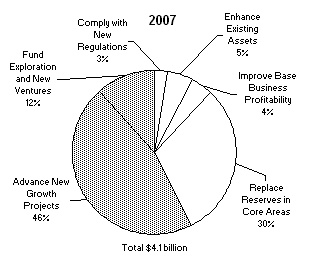
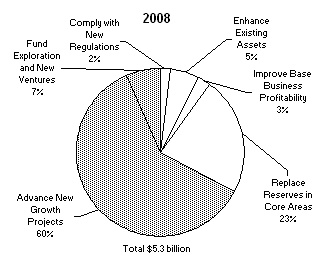
spending on new growth projects is expected to increase. Two-thirds of planned
capital expenditures support delivering profitable new growth and funding
exploration and new ventures. This is up by more than $1 billion compared with
the same categories in 2007. The remaining one-third of the 2008 planned capital
expenditures is directed toward replacing reserves in core areas, enhancing
existing assets, improving base business profitability and complying with new
regulations.
 |
 |
|
Capital
Investment Priorities
(millions
of Canadian dollars)
|
2007
Outlook
As
at July 26, 2007 (1)
|
2008
Outlook
As
at Dec. 13, 2007
|
2008
Highlights
|
|
Comply
with new regulations
|
$ 105
|
$ 105
|
Spending
on regulatory projects at Downstream facilities and investment
at Syncrude
to reduce sulphur emissions
|
|
Enhance
existing assets
|
210
|
290
|
Improving
reliability at Downstream, Oil Sands and North American Natural
Gas
facilities
|
|
Improve
base business profitability
|
180
|
140
|
Developing
the retail/wholesale marketing networks and increasing refinery
yield
|
|
Replace
reserves in core areas
|
1,250
|
1,195
|
Investing
for immediate impact across the four upstream
businesses
|
|
Advance
new growth projects
|
1,890
|
3,205
|
Investing
in medium-term growth projects, such as preliminary engineering
and design
for Fort Hills, developing the Libyan concessions, converting
the Edmonton
refinery to run oil sands feedstocks, preparing for the potential
new
coker at the Montreal refinery, developing the Ebla project in
Syria and
preliminary engineering and design for the MacKay River expansion
project
|
|
Fund
exploration and new ventures for long-term growth
|
480
|
350
|
Investing
in exploration activity in International, Alaska and the Mackenzie
Delta/Corridor
|
|
Total
continuing operations
|
$4,115
|
$5,285
|
|
(1)
|
2007 Outlook amounts have been re-categorized to align with the 2008
Outlook presentation
|
-
4
-
PETRO-CANADA
Capital
Expenditures by Business
Spending
reflects quality investment opportunities in the upstream and downstream
sectors. Of note in 2008, Petro-Canada plans to direct additional funds to
Oil
Sands to complete the FEED for the Fort Hills project, to East Coast Canada
to
develop the White Rose extensions, and to International for development of
the
Libyan concessions, advancing the Ebla project in Syria and for a balanced
exploration program. In the Downstream, capital spending is expected to decrease
as the Company completes the Edmonton RCP, which is expected to come on-stream
in the fourth quarter of 2008. This is partially offset by investing to advance
the potential Montreal coker.
|
Capital
Investment by Business Unit
|
2007
Outlook
|
2008
Outlook
|
|||||
|
(millions
of Canadian dollars)
|
As
at July 26, 2007
|
As
at December 13, 2007
|
|||||
|
Upstream
|
|||||||
|
North
American Natural Gas
|
|||||||
|
Western
Canada
|
$ |
540
|
$ |
415
|
|||
|
U.S. Rockies
|
130
|
190
|
|||||
|
North
of 60
|
155
|
70
|
|||||
|
Oil
Sands
|
|||||||
|
Fort
Hills
|
270
|
1,165
|
|||||
|
MacKay River
|
260
|
240
|
|||||
|
Syncrude
|
75
|
80
|
|||||
|
Other
leases
|
15
|
35
|
|||||
|
International
& Offshore
|
|||||||
|
East
Coast
Canada
|
205
|
295
|
|||||
|
International
|
|||||||
|
North
Sea
|
440
|
360
|
|||||
|
Libya/Syria
|
215
|
985
|
|||||
|
Trinidad
and
Tobago
|
315
|
290
|
|||||
|
2,620
|
4,125
|
||||||
|
Downstream
|
|||||||
|
Refining
and Supply
|
1,285
|
950
|
|||||
|
Sales
and Marketing
|
150
|
150
|
|||||
|
Lubricants
|
30
|
25
|
|||||
|
1,465
|
1,125
|
||||||
|
Shared
Services
|
30
|
35
|
|||||
|
Total
continuing operations
|
$ |
4,115
|
$ |
5,285
|
|||
OUTLOOK
– CONSOLIDATED PRODUCTION
Upstream
production is expected to decrease slightly in 2008, primarily due to natural
declines in East Coast Canada and Western Canada. Offsetting these decreases
are
additional volumes from the full-year impact of Buzzard and Saxon in the North
Sea and higher planned Oil Sands production. Production is expected to average
in the range of 390,000 boe/d to 420,000 boe/d in 2008.
Factors
that may impact production during 2008 include reservoir performance, drilling
results, facility reliability and the successful execution of planned
turnarounds.
|
2007
Outlook (+/-)
|
2008
Outlook (+/-)
|
|
|
(thousands
of boe/d)
|
As
at July 26, 2007
|
As
at December 13, 2007
|
|
North
American Natural Gas
|
||
|
Natural
gas
|
97
|
93
|
|
Liquids
|
13
|
12
|
|
Oil
Sands
|
||
|
Syncrude
|
34
|
35
|
|
MacKay River
|
24
|
25
|
|
International
& Offshore
|
||
|
East
Coast
Canada
|
95
|
85
|
|
International
|
||
|
North
Sea
|
90
|
93
|
|
Other
International
|
57
|
57
|
|
Total
continuing operations
|
400 – 420
|
390 – 420
|
-
5
-
PETRO-CANADA
North
American Natural Gas
Lower
capital spending is expected to result in production declines of around 5%.
The
business is shifting away from new exploration in Western Canada, with a greater
focus in the U.S. Rockies in the short term and North of 60 in the long
term.
The
planned capital program for North American Natural Gas is approximately
$675 million in 2008, down from forecast 2007 spending levels.
Approximately $415 million is planned for the replacement of reserves in
core areas of Western Canada, down 23%
from the estimate for 2007 of $540 million. Lower capital spending reflects
the
maturity of the basin and increasing royalty rates. Investment in unconventional
growth opportunities in the U.S. Rockies is estimated to be $190 million.
Exploration and new venture investments of approximately $70 million are
expected to be spent to develop longer term supply opportunities in the frontier
areas of Alaska and the Mackenzie Delta/Corridor. The Company plans to test
some
of its frontier exploration prospects by participating in two exploration wells
in the Alaska Foothills and one exploration well in the Mackenzie Corridor
in
2008.
North
American Natural Gas production is expected to decline around 5% to
105,000 boe/d, compared with estimated production of 110,000 boe/d in
2007. Declines in conventional production in Western Canada are forecast to
be
partially offset by additional annual average U.S. Rockies volumes. U.S. Rockies
production is expected to remain steady at the current rate of 95 million
cubic feet equivalent/day (MMcfe/d) of natural gas through 2008.
Oil
Sands
Increased
capital spending in 2008 reflects FEED work for Fort Hills and the MacKay River
expansion.
A
capital
program of about $1,520 million is planned for Oil Sands in 2008. Capital for
new growth opportunities of approximately $1,311 million includes funding
FEED for the Fort Hills project (forecast to be $1,165 million) and the
MacKay River expansion (forecast to be $90 million). The time frame for the
completion of FEED for the MacKay River expansion project has been extended
by
one year to evaluate opportunities for integration with the Fort Hills project
and to pursue cost-saving opportunities associated with utilizing an
international engineering, procurement and construction contractor. Spending
to
enhance existing operations and comply with regulations at Syncrude is budgeted
to be $62 million. Enhancing existing operations and improving base
business profitability at MacKay River is expected to be approximately
$85 million. Investment of $62 million is planned for the replacement
of reserves through ongoing pad development at MacKay River.
In
2008,
production from Oil Sands is expected to be 60,000 boe/d, compared with
estimated production of 58,000 boe/d in 2007. Higher expected production in
2008 is due to higher volumes anticipated at Syncrude and MacKay River.
Syncrude’s 2008 forecast production takes into account a planned 45-day Coker
8-1 turnaround starting in March and a planned 53-day hydrogen plant turnaround
starting in August. At MacKay River, a major five-year 10- to 15-day planned
turnaround is scheduled for May 2008.
International
& Offshore
In
the
first quarter of 2007, the Company combined its East Coast Canada and
International businesses under one management structure. This change leverages
and grows the capabilities of similar operations. The combined East Coast Canada
and International operations are now referred to as International &
Offshore.
East
Coast Canada
Lower
production planned for 2008 reflects anticipated natural declines, while capital
spending increases for future developments.
The
planned capital program in 2008 for East Coast Canada will be about
$295 million. Capital in 2008 is forecast to be spent primarily on
advancing the White Rose extension developments and drilling to replace reserves
at Hibernia and White Rose.
East
Coast Canada production is expected to be 85,000 boe/d in 2008, compared
with an estimate of 95,000 boe/d in 2007. The 2008 production estimate
reflects natural declines at Hibernia and Terra Nova, while White Rose volumes
are planned to come off plateau. Terra Nova and White Rose have planned
maintenance turnarounds of 16 days each in the summer of 2008. There is no
major
turnaround planned for Hibernia in 2008.
-
6
-
PETRO-CANADA
International
International
is delivering near-term growth in the North Sea and building a portfolio of
longer term growth opportunities through exploration and business
development.
In
2008,
a capital budget of approximately $1,635 million is planned for International.
Investment to replace reserves in core areas is expected to be approximately
$366 million, primarily for ongoing development drilling at Buzzard,
Guillemot West and on the producing fields in Trinidad and Tobago. About
$986 million will be invested in new growth projects, with a focus on
advancing the development of the Libyan concessions and for front-end
engineering and preliminary drilling at the Ebla project in Syria. It is
expected that approximately $283 million will be allocated to
exploration.
Production
from the International business is expected to increase to 150,000 boe/d in
2008, compared with estimated production of 147,000 boe/d in 2007. The slight
increase in production in 2008 reflects the full-year contributions from Buzzard
and Saxon (a small North Sea development that started up in November 2007).
These projects are expected to more than offset the 15% to 20% annual natural
declines in the North Sea.
Exploration
Summary
Petro-Canada’s
2008 exploration program is significant and reflects the Company’s success in
building a sizable, balanced portfolio of prospects.
|
(millions
of Canadian dollars)
|
2008
Exploration
and New
Ventures
|
2008
General
and Administrative, Geological and Geophysical
(including seismic) Exploration Expenses |
Total
(1)
|
||||||
|
International,
East Coast Canada, Alaska and Mackenzie
Delta/Corridor
|
$ |
350
|
$ |
180
|
$ |
530
|
|||
(1) The
total
exploration budget is comprised of capital investments for exploration and
new
ventures plus general and administrative, and geological and geophysical
(including seismic) exploration expenses.
Petro-Canada’s
exploration budget of $530 million includes exploration spending for
International, East Coast Canada, Alaska and the Mackenzie Delta/Corridor.
Spending of about $373 million covers an expected program of up to 17 wells
focused in the North Sea, Trinidad and Tobago, Syria and the Alaskan Foothills.
In addition, a planned seismic program will be focused on Libya and Trinidad
and
Tobago.
Downstream
Capital
investment is focused on growth and improving base business profitability.
The
Edmonton refinery conversion project (RCP) is expected to add net earnings
and
cash flow starting in late 2008.
A
capital
program of about $1,125 million for the Downstream is planned in 2008. The
majority of capital spending is forecast for new growth project funding of
$767
million. This capital will be directed toward completing the Edmonton RCP and
advancing the potential 25,000 barrel per day (b/d) Montreal coker. The total
project cost estimated for RCP has increased from $2.0 billion to $2.2 billion,
reflecting labour cost pressures in Alberta. Final RCP costs will depend on
the
labour productivity the Company is able to achieve this winter. Approximately
$136 million is forecast to be directed to the enhancement of existing
operations. This includes reliability and safety improvements at Downstream
facilities, as well as site enhancement within the wholesale and retail
networks. A further $138 million is planned to be invested to improve the
profitability of the Downstream’s base business. This includes a number of high
return refining projects and continued development of the retail and wholesale
network. Approximately $84 million is expected to be invested in regulatory
compliance, relatively flat compared with the estimated $70 million invested
in
2007.
In
the
third quarter of 2008, the Edmonton refinery is expected to commence a two-month
planned turnaround to tie-in RCP and to complete routine maintenance on other
units within the refinery. It is anticipated that this planned turnaround will
reduce the annual average crude throughput and light oil yield by approximately
20,000 b/d. The Montreal refinery has planned turnarounds on secondary
processing units in 2008. As with all planned Downstream turnarounds, supply
arrangements will be made to meet market demand during these outages. Other
planned maintenance activities at the Edmonton refinery and the Lubricants
plant
in Mississauga in 2008 are not expected to have a significant impact on
throughput or yields.
Conference
Call Details
Petro-Canada
will hold a conference call to discuss the 2008 outlook with investors on
Thursday, December 13, 2007 at 5:30 p.m. Eastern Standard Time (EST). To
participate, please call 1-866-898-9626 (toll-free in North America),
00-800-8989-6323 (toll-free internationally), or 416-340-2216 at 5:25 p.m.
Media
are invited to listen to the call by dialing 1-866-540-8136 (toll-free in North
America) or 416-340-8010. Media are invited to ask questions at the end of
the
call. A live audio webcast of the conference call will be available on
Petro-Canada's website at http://www.petro-canada.ca/en/investors/93.aspx
on December 13, 2007 at 5:30 p.m. EST. Those who are unable to listen to the
call live may listen to a recording of the call approximately one hour after
its
completion by calling 1-800-408-3053 (toll-free in North America) or
416-695-5800 (passcode number 3242534#). Approximately one hour after the call,
a recording will be available on Petro-Canada’s website.
-
7
-
PETRO-CANADA