Genesis Healthcare Corp DEF 14A, filed Jan 21, 2005: Definitive proxy statements
United States
Securities and Exchange Commission
Washington, DC 20549
SCHEDULE 14A
Proxy Statement Pursuant to Section 14(a) of the Securities Exchange Act of 1934
(Amendment No. )
Filed by the Registrant 
Filed by a Party other than the Registrant 
Check the appropriate box:
|
Preliminary Proxy Statement |
|
Confidential, for Use of the Commission Only (as permitted by Rule 14a-6(e)(2)) |
|
Definitive Proxy Statement |
|
Definitive Additional Materials |
|
Soliciting Material Pursuant to § 240.14a-12 |
| Genesis HealthCare Corporation | |
| (Name of Registrant as Specified In Its Charter) |
| Not Applicable | |
| (Name of Person(s) Filing Proxy Statement, if other than the Registrant) |
Payment of Filing Fee (Check the appropriate box)
|
No fee required. | ||||||
|
Fee computed on table below per Exchange Act Rules 14a-6(i)(4) and 0-11. | ||||||
| (1 | ) | Title of each class of securities to which transaction applies: | |||||
| (2 | ) | Aggregate number of securities to which transaction applies: | |||||
| (3 | ) | Per unit price or other underlying value of transaction computed pursuant to Exchange Act Rule 0-11 (set forth the amount on which the filing fee is calculated and state how it was determined): | |||||
1
| (4 | ) | Proposed maximum aggregate value of transaction: | |||||
| (5 | ) | Total fee paid: | |||||
|
Fee paid previously with preliminary materials. | ||||||
|
Check box if any part of the fee is offset as provided by Exchange Act Rule 0-11(a)(2) and identify the filing for which the offsetting fee was paid previously. Identify the previous filing by registration statement number, or the Form or Schedule and the date of its filing. | ||||||
| (1 | ) | Amount Previously Paid: | |||||
| (2 | ) | Form, Schedule or Registration Statement No.: | |||||
| (3 | ) | Filing Party: | |||||
| (4 | ) | Date Filed: | |||||
2

January 21, 2005
Dear Shareholder:
It is my great pleasure to invite you to attend the 2005 Annual Meeting of Shareholders (the “Annual Meeting”). The Annual Meeting marks the first meeting of the shareholders of Genesis HealthCare Corporation. The Annual Meeting will be held on Wednesday, February 23, 2005 at 10:00 a.m., local time, at 101 East State Street, Kennett Square, Pennsylvania 19348-3021.
At this year’s Annual Meeting, our shareholders will vote on two proposals: (1) the election of two Class I directors, each to hold office for a term of three years and until his successor is duly elected and qualified; and (2) the amendment to the 2003 Stock Incentive Plan increasing the number of shares available for issuance under the 2003 Stock Incentive Plan. The official notice of the Annual Meeting, together with the proxy statement, proxy card and/or instruction card, are enclosed. Please give this information your careful attention.
The vote of every shareholder is important. Therefore, whether or not you expect to attend the meeting in person, I urge you to sign and date the enclosed proxy card and/or instruction card and return it promptly in the envelope provided for that purpose, or to vote or provide voting instructions by telephone.
Thank you for your continued interest in Genesis HealthCare Corporation. I look forward to seeing you at the Annual Meeting.
| Sincerely, | |
 |
|
| George V. Hager, Jr. Chairman and Chief Executive Officer |
101 East State Street
Kennett Square, PA 19348-3021
___________________________________
Notice of Annual Meeting of Shareholders
to be held February 23, 2005
___________________________________
To Our Shareholders:
The 2005 Annual Meeting of Shareholders of Genesis HealthCare Corporation (“Genesis”) will be held at 101 East State Street, Kennett Square, Pennsylvania 19348-3021 on Wednesday, February 23, 2005 at 10:00 a.m., local time (the “Annual Meeting”), for the following purposes:
| 1. | To elect two Class I directors, each to hold office for a term of three years and until his successor is duly elected and qualified, as more fully described in the accompanying proxy statement; |
| 2. | To amend the 2003 Stock Incentive Plan to increase the number of shares of common stock available for issuance under the 2003 Stock Incentive Plan, as more fully described in the accompanying proxy statement; and |
| 3. | To transact such other business as may properly come before the Annual Meeting or any of its adjournments or postponements. |
You should carefully read this proxy statement in its entirety. Whether or not you expect to attend the meeting in person, you are urged to sign and date the enclosed proxy card and/or instruction card and return it promptly in the envelope provided for that purpose, or to vote or provide voting instructions by telephone as described in the accompanying proxy statement.
If the Annual Meeting is adjourned for one or more periods aggregating at least 15 days because of the absence of a quorum, those shareholders entitled to vote who attend the reconvened Annual Meeting, if less than a quorum as determined under applicable law, shall nevertheless constitute a quorum for the purpose of acting upon any matter set forth in this Notice of Annual Meeting.
Only shareholders of record of Genesis’ common stock, par value $0.01 per share, as shown on the transfer books of Genesis at the close of business on January 7, 2005, are entitled to notice of, and to vote at, the Annual Meeting or any adjournments or postponements thereof. Shareholders of record or their duly appointed proxies, may attend the meeting. Registration and seating will begin at 9:30 a.m. Each shareholder may be asked to present valid picture identification, such as a driver’s license or passport. Please note that if your shares, or the person or entity for whom you are the duly appointed proxy, are held in “street name” you will need to bring a copy of a brokerage statement
reflecting stock ownership as of the record date. Cameras (including camera cellular phones), recording devices and other electronic devices will not be permitted at the meeting.
| By Order of the Board of Directors | |
 |
|
| Eileen M. Coggins, Esquire Senior Vice President, General Counsel and Corporate Secretary |
Kennett Square, Pennsylvania
January 21, 2005
101 East State Street
Kennett Square, PA 19348-3021
_______________
PROXY STATEMENT
_______________
Genesis HealthCare Corporation (“Genesis”) will hold its 2005 Annual Meeting of Shareholders on Wednesday, February 23, 2005 at 10:00 a.m., local time, at 101 East State Street, Kennett Square, Pennsylvania 19348-3021 (the “Annual Meeting”). This proxy statement, which together with the accompanying proxy card and/or instruction card is first being mailed to shareholders on or about January 21, 2005, is furnished to the shareholders of Genesis in connection with the solicitation of proxies by its Board of Directors for use in voting at the Annual Meeting, including any adjournment or postponement thereof.
QUESTIONS AND ANSWERS ABOUT THE ANNUAL MEETING AND VOTING
| Q. | What is the purpose of the Annual Meeting? |
| A. | At the Annual Meeting, shareholders will consider and act upon the matters outlined in the Notice of Annual Meeting, including: |
| • | the election of two Class I directors to hold office for a term of three years and until his successor is duly elected and qualified; |
| • | the amendment to the 2003 Stock Incentive Plan increasing the number of shares of Common Stock (as defined below) available for issuance under the 2003 Stock Incentive Plan from 750,000 to 1,000,000; and |
| • | such other business as may properly come before the Annual Meeting or any of its adjournments or postponements. |
| The nominees for director are George V. Hager, Jr. and Kevin M. Kelley. Messrs. Hager and Kelley are currently Class I directors of Genesis. |
| Genesis is not currently aware of any additional matters that will be brought before the Annual Meeting or any of its adjournments or postponements. |
| Q. | Who is entitled to vote at the Annual Meeting? |
| A. | Shareholders of record, as shown on the transfer books of Genesis at the close of business on January 7, 2005 (the “Record Date”), are entitled to receive notice of and to vote at the Annual Meeting, or any adjournment or postponement thereof. Each share of Genesis common stock, par value $0.01 per share (“Common Stock”), is entitled to one vote on each matter that may be brought before the Annual Meeting. On the Record Date, there were 20,117,843 shares of Common Stock outstanding and, therefore, eligible to vote at the Annual Meeting. |
| Q. | How do I vote my shares? |
| A. | In order to vote your shares, you may attend the Annual Meeting and vote in person, or vote by proxy. For alternative methods of voting by proxy, see the question “Are there alternative methods to voting my shares by proxy or providing voting instructions?”. |
| A proxy in the form enclosed, if properly executed and received in time for voting either by telephone or by mail, and not revoked, will be voted as directed in accordance with the instructions thereon. Giving an executed proxy will not affect a shareholder’s right to attend the Annual Meeting and vote in person since the proxy is revocable. See the question “May I change my vote or instruction?”. |
| Q. | How do I instruct shares attributed to me in a Genesis employee benefit plan account to be voted? |
| A. | If you have an interest in the Genesis HealthCare Corporation Retirement Plan, Genesis HealthCare Corporation 401(k) Plan for Collective Bargaining Unit Employees or Genesis HealthCare Corporation Union Retirement Savings Plan (collectively the “Plans”) and your account is invested in Common Stock, you will find enclosed an instruction card to instruct Wachovia Bank, N.A., directed trustee of each of the Plans (the “Trustee”), how to vote the number of shares of Common Stock equivalent to the interest in Common Stock credited to your account as of the Record Date. Genesis has retained an independent service (the “Transfer Agent”) to tabulate the votes received from the participants and beneficiaries in the Plans and to report the results on a confidential basis to the Trustee. The Trustee will vote your shares in accordance with your duly executed instructions received by the Transfer Agent by 11:59 p.m., Eastern Standard Time, on February 21, 2005. Genesis has directed the Trustee to vote all shares held by the Plans for which no instructions are received from participants, beneficiaries or alternate payees “for” the approval of the election of the nominees for directors, and “for” the amendment to the 2003 Stock Incentive Plan increasing the number of shares available for issuance under the 2003 Stock Incentive Plan. With respect to any other matter that properly comes before the Annual Meeting, the Trustee will vote the shares held by the Plans as directed by Genesis. You may also revoke previously given voting instructions by 11:59 p.m., Eastern Standard Time, on February 21, 2005 by filing with the Transfer Agent either a written notice of revocation or a properly completed and signed instruction card bearing a later date. |
| Q. | Are there alternative methods to voting my shares by proxy or providing voting instructions? |
| A. | If you are a registered shareholder (that is, if your stock is registered in your name) or if you have an interest in the Plans, you may also vote or provide voting instructions by telephone by following the instructions included with your proxy card and/or instruction card. The deadline for registered shareholders to vote telephonically is 11:59 p.m., Eastern Standard Time, on February 22, 2005. The deadline for those with an interest in the Plans to provide voting instructions telephonically is 11:59 p.m., Eastern Standard Time, on February 21, 2005. |
| Genesis encourages you to take advantage one of the available ways to vote your shares for matters to be covered at the Annual Meeting. Set forth below is a summary of the two voting methods which registered shareholders and those with an interest in the Plans may utilize to submit their votes or voting instructions: |
2
| Vote by Telephone 1-866-626-4508. Use any touch-tone telephone to vote your proxy or provide voting instructions 24 hours a day, 7 days a week. Have your proxy card and/or instruction card in hand when you call. You will be prompted to enter your Control Number(s) which are located on your proxy card and/or instruction card and then follow the directions given. |
| Vote by Mail. Mark, sign and date your proxy card and/or instruction card and return such card in the postage-paid envelope Genesis has provided you. |
| If you vote by telephone, you do not need to return your proxy card and/or instruction card. Please note that although there is no charge to you for voting or providing voting instructions by telephone, there may be costs associated therewith such as usage charges by telephone companies. Genesis does not cover these costs; they are solely your responsibility. The telephone procedures being made available to you are valid forms of granting proxies under the Pennsylvania Business Corporation Law. |
| If your shares are held in “street name” (that is, if your stock is registered in the name of your broker or bank), please check your proxy card or contact your broker or nominee to determine whether you will be able to vote by telephone. |
| Q. | May I change my vote or instruction? |
| A. | Any shareholder giving a proxy may revoke it at any time before it is voted at the Annual Meeting by delivering a later dated proxy, or by giving written notice to the Secretary of Genesis at 101 East State Street, Kennett Square, Pennsylvania 19348-3021 at any time before the proxy is exercised, or by attending the Annual Meeting in person and voting. In addition, if you are permitted to vote or provide voting instructions by telephone, as described below, you may change your vote or voting instructions telephonically by following the procedures used to submit your initial vote or voting instructions. The last vote or voting instructions received chronologically will supercede any prior votes or voting instructions. The deadline for registered shareholders to change their vote telephonically is 11:59 p.m., Eastern Standard Time, on February 22, 2005. The deadline for those with an interest in the Plans to change their voting instructions telephonically is 11:59 p.m., Eastern Standard Time, on February 21, 2005. |
| Q. | What constitutes a quorum? |
| A. | The presence, in person or represented by proxy, of the shareholders entitled to cast at least a majority of the votes that all shareholders are entitled to cast on a particular matter to be acted upon at a meeting of the shareholders will constitute a quorum for the purpose of consideration and action on the matter. If you submit a properly executed proxy card or vote by telephone, then your shares will be counted as part of the quorum. To the extent that a quorum is present with respect to consideration of and action on a particular matter or matters, but a quorum is not present as to another matter or matters, consideration of and action on the matter or matters for which a quorum is present may occur and, after such consideration and action, the meeting may be adjourned for purposes of the consideration of and action on the matter or matters for which a quorum is not present. All shares of Common Stock present in person or represented by proxy (including “broker non-votes”) and entitled to vote at the Annual Meeting, and regardless of how they are voted or whether they abstain from voting, will be counted in determining the presence of a quorum. A “broker non-vote” occurs when a nominee holding shares for a beneficial owner does not vote on a particular proposal because the nominee does not have discretionary voting power with respect to that item and has not received instructions from the beneficial owner. |
3
| If the Annual Meeting is adjourned because of the absence of a quorum, those shareholders entitled to vote who attend the adjourned meeting, although constituting less than a quorum as provided herein, shall nevertheless constitute a quorum for the purpose of electing directors. If the Annual Meeting is adjourned for one or more periods aggregating at least 15 days because of the absence of a quorum, those shareholders entitled to vote who attend the reconvened Annual Meeting, if less than a quorum as determined under applicable law, shall nevertheless constitute a quorum for the purpose of acting upon any matter set forth in the Notice of Annual Meeting. |
| Q. | What vote is required for the election of directors, the amendment to the 2003 Stock Incentive Plan or for a proposal to be approved? |
| A. | The election of directors will be determined by a plurality vote and the two nominees receiving the most “for” votes will be elected. Approval of any other proposals that may be acted upon at the Annual Meeting, including the amendment to the 2003 Stock Incentive Plan, will require the affirmative vote of a majority of the votes cast on the proposal. See the question “If I abstain from voting or withhold authority to vote for any proposal, will my shares be counted in the vote?”. |
| Q. | If my shares are held by my broker or other nominee, how do I vote my shares? |
| A. | If your shares are held in a stock brokerage account or by another nominee, such as a bank or trust, then the broker or other nominee is considered to be the shareholder of record with respect to those shares. However, you still are considered to be the beneficial owner of those shares, with your shares being held in “street name.” Street name holders generally cannot vote their shares directly and must instead instruct the broker, bank, trust or other nominee how to vote their shares. Your broker or other nominee could vote your shares without your instructions on the proposal for election of directors, but are not required to do so. To be sure your shares are voted, you should instruct your broker or other nominee to vote your shares. |
| Q. | What if I do not specify how I want my shares voted? |
| A. | If you submit a signed proxy card and/or instruction card or submit your proxy or instructions by telephone, but do not indicate how you want your shares voted or provide instructions to the Trustee, the persons named in the enclosed proxy or the Trustee will vote your shares of Common Stock or shares of Common Stock held by the Plans that are attributed to your account: |
| • | “for” the election of the nominees, George V. Hager, Jr. and Kevin M. Kelley, as Class I directors; |
| • | “for” the amendment to the 2003 Stock Incentive Plan increasing the number of shares of Common Stock available for issuance under the 2003 Stock Incentive Plan from 750,000 to 1,000,000; and |
| • | with respect to any other matter that properly comes before the Annual Meeting, the proxy holders will vote the proxies in their discretion in accordance with their best judgment and in the manner they believe to be in the best interest of Genesis or the Trustee will vote shares of Common Stock held by the Plans that are attributed to your account as directed by Genesis. |
4
| Q. | If I abstain from voting or withhold authority to vote for any proposal, will my shares be counted in the vote? |
| A. | Under the Pennsylvania Business Corporation Law, an abstention, withholding of authority to vote or “broker non-vote” will have no effect on the vote and will not be counted in determining whether the proposals have received the required shareholder vote. |
| Q. | What does it mean if I receive more than one proxy card? |
| A. | If you receive more than one proxy card, it means that you hold shares that are registered in more than one account. To ensure that all of your shares are voted, you will need to sign and return each proxy card you receive or vote by telephone by using the different Control Number(s) on each proxy card. |
| Q. | Who pays for the cost of the solicitation? |
| A. | Genesis will pay all costs of this solicitation. In addition to solicitation by mail, proxies may be solicited in person or by telephone, telegraph or facsimile, by directors, officers or employees of Genesis and its subsidiaries without additional compensation. Genesis will, on request, reimburse shareholders of record who are brokers, dealers, banks or voting trustees, or their nominees, for their reasonable expenses in sending proxy materials and annual reports to the beneficial owners of the shares they hold of record. |
THE SPIN-OFF
Prior to December 1, 2003, Genesis was owned by NeighborCare, Inc. (“NCI”). On December 1, 2003, NCI completed the distribution (the “spin-off”) of all of the shares of Common Stock to holders of record of NCI common stock at the close of business on October 15, 2003 (“NCI Record Holders”), the record date for the spin-off. Based on the total number of shares of NCI common stock issued and outstanding at the close of business on the record date for the spin-off, an aggregate of 19,898,104 shares of Common Stock were distributed by NCI to NCI Record Holders, which was all of the issued and outstanding Common Stock. Each NCI Record Holder received 0.5 shares of Common Stock for each share of NCI common stock held by such NCI Record Holder, and/or cash in lieu of a fractional share of Common Stock. The Common Stock began trading publicly on the NASDAQ National Market System on December 2, 2003 under the symbol “GHCI.” Prior to the spin-off, NCI was named Genesis Health Ventures, Inc.
Additionally, immediately after the spin-off, Genesis issued 130,246 shares of Common Stock into an escrow account for future delivery to former unsecured claimants of NCI and its subsidiaries that were entitled to receive common equity securities under the terms of the 2001 joint plan of reorganization.
As a result of the spin-off, Genesis and NCI operate independently of one another. Genesis and NCI have agreed contractually to continue certain transitional arrangements and practices for a limited time after the spin-off. In addition, Genesis and NCI have agreed to certain mutually beneficial commercial arrangements. These arrangements include a separation and distribution agreement, a tax sharing agreement, a transition services agreement, a group purchasing agreement, an employee benefits agreement, a pharmacy services agreement, as amended, a pharmacy benefit management agreement, as amended, and a durable medical equipment agreement.
5
SECURITY OWNERSHIP OF CERTAIN BENEFICIAL OWNERS AND MANAGEMENT
The following table sets forth information with respect to the beneficial ownership of Common Stock as of the Record Date by: (i) each person who is known by Genesis to be the beneficial owner of 5% or more of Common Stock; (ii) each of Genesis’ directors, nominees for director and Named Executive Officers, as such term is hereinafter defined; and (iii) all of Genesis’ directors and executive officers as a group.
On the Record Date, there were 20,117,843 shares of Common Stock outstanding, including 134,008 shares held in escrow to be issued to former unsecured claimants of NCI and its subsidiaries that were entitled to receive securities under the terms of the 2001 joint plan of reorganization.
The number of shares beneficially owned by each shareholder is determined under rules promulgated by the Securities and Exchange Commission (the “SEC”). The information does not necessarily indicate beneficial ownership for any other purpose. Beneficial ownership, as set forth in the regulations of the SEC, includes securities as to which the person has or shares voting or investment power. Shares of Common Stock issuable upon the exercise or conversion of securities currently exercisable or convertible or exercisable or convertible within 60 days of the Record Date are deemed outstanding for computing the share ownership and percentage ownership of the person holding such securities, but are not deemed outstanding for computing the percentage of any other person.
Except as otherwise noted in the footnotes below and except to the extent authority is shared by spouses under applicable community property laws, to Genesis’ knowledge, the beneficial owners of Common Stock listed below have sole voting and investment power with respect to such shares. All addresses for Genesis’ executive officers and directors are c/o Genesis HealthCare Corporation, 101 East State Street, Kennett Square, Pennsylvania 19348-3021.
| Shares of Common Stock Beneficially Owned (1) |
Percent of Common Stock Beneficially Owned (1) |
||||||
| Advisory Research, Inc. 180 North Stetson Street Suite 5500 Chicago, IL 60601 |
2,038,810 | (2) | 10.13 | % | |||
| Copper Arch Capital, LLC Scott Sipprelle Jonathan Jodha 565 Fifth Avenue, 11th Floor New York, NY 10017 |
1,093,350 | (3) | 5.43 | % | |||
| Goldman, Sachs & Co. The Goldman Sachs Group, Inc. 85 Broad Street New York, NY 10004 |
1,705,822 | (4) | 8.48 | % | |||
| Wellington Management Company, LLP 75 State Street Boston, MA 02109 |
2,073,365 | (5) | 10.31 | % | |||
| David C. Almquist | 12,396 | (6) | * | ||||
| Richard P. Blinn | 23,334 | (7) | * | ||||
| John F. DePodesta | — | (8) | * | ||||
6
| Shares of Common Stock Beneficially Owned (1) |
Percent of Common Stock Beneficially Owned (1) |
||||||
| Robert H. Fish | — | (8) | * | ||||
| J. Michael Gallagher | — | (8) | * | ||||
| George V. Hager, Jr. | 100,000 | (9) | * | ||||
| Kevin M. Kelley | — | (8) | * | ||||
| James V. McKeon | 26,875 | (10) | * | ||||
| Charles W. McQueary | — | (8) | * | ||||
| Charlene Connolly Quinn | — | (8) | * | ||||
| Terry Allison Rappuhn | — | (8) | * | ||||
| Robert A. Reitz | 22,396 | (7) | * | ||||
| All executive officers and directors as a group (16 persons) | 222,187 | (11) | 1.09 | % | |||
|
|
|
| * | Less than one percent. |
| (1) | Excludes the beneficial ownership of units of Common Stock held by certain executive officers pursuant to Genesis’ deferred compensation plan, which such executive officers cannot vote. |
| (2) | Based on a Schedule 13G filed with the SEC on September 9, 2004. |
| (3) | Copper Arch Capital, LLC (“CAC”) is a registered investment advisor that serves as investment advisor to Copper Arch Fund, LP, which beneficially owns 381,900 shares of Common Stock, Copper Arch Fund Offshore Portfolio, Ltd., which beneficially owns 632,700 shares of Common Stock, and Copper Spire Fund plc, which beneficially owns 78,750 shares of Common Stock. As investment advisor, CAC may be deemed to beneficially own all such shares. Copper Arch Partners, LLC (“CAP”) is the general partner of Copper Arch Fund, L.P. and as such may be deemed to beneficially own the 381,900 shares beneficially owned by Copper Arch Fund, L.P. By virtue of their ownership interests, Scott Sipprelle and Jonathan Jodka may be deemed to beneficially own the aggregate amount of 1,093,350 shares of Common Stock beneficially owned by Copper Arch Fund, LP, Copper Arch Fund Offshore Portfolio, Ltd. and Copper Spire Fund plc. CAC, CAP, Mr. Sipprelle and Mr. Jodka disclaim beneficial ownership of the shares of Common Stock. Based on a Schedule 13G filed with the SEC on February 12, 2004. |
| (4) | Goldman, Sachs & Co. (“GSC”) beneficially owns the shares of Common Stock. The Goldman Sachs Group, Inc. (“GSG”) is the parent holding company of GSC and may be deemed to beneficially own such shares. GSG disclaims beneficial ownership of such shares. Based on a Schedule 13G filed with the SEC on February 11, 2004. |
| (5) | Wellington Management Company, LLP (“WMC”) indirectly beneficially owns 2,073,365 shares of Common Stock in its capacity as investment advisor. These shares are owned of record by clients of WMC. Based on a Schedule 13G/A filed with the SEC on September 10, 2004. |
| (6) | Includes 12,396 shares of Common Stock issuable upon the exercise of options that are exercisable within 60 days of the Record Date. Excludes 28,125 shares of Common Stock subject to an award granted pursuant to the 2003 Stock Incentive Plan, which restrictions will not lapse within 60 days of the Record Date. |
| (7) | Includes 22,396 shares of Common Stock issuable upon the exercise of options that are exercisable within 60 days of the Record Date. Excludes 28,125 shares of Common Stock subject to an award granted pursuant to the 2003 Stock Incentive Plan, which restrictions will not lapse within 60 days of the Record Date. |
| (8) | Excludes 7,452 shares of Common Stock subject to an award granted pursuant to the 2003 Stock Incentive Plan, which restrictions will not lapse within 60 days of the Record Date. |
| (9) | Includes 100,000 shares of Common Stock issuable upon the exercise of options that are exercisable within 60 days of the Record Date. Excludes 75,000 shares of Common Stock subject to an award granted pursuant to the 2003 Stock Incentive Plan, which restrictions will not lapse within 60 days of the Record Date. |
7
| (10) | Includes 26,875 shares of Common Stock issuable upon the exercise of options that are exercisable within 60 days of the Record Date. Excludes 37,500 shares of Common Stock subject to an award granted pursuant to the 2003 Stock Incentive Plan, which restrictions will not lapse within 60 days of the Record Date. |
| (11) | Includes: (i) 185,001 shares of Common Stock directly beneficially owned in the aggregate by the Named Executive Officers as set forth in this table; and (ii) 7,436, 17,917, 7,167 and 4,666 shares of Common Stock directly beneficially owned by Ms. Coggins, Ms. Hauswald, Mr. DiVittorio and Mr. Pell, respectively (of which 3,436, 17,917, 7,167 and 3,666 shares, respectively, are issuable upon the exercise of options that are exercisable within 60 days of the Record Date). Excludes 316,539 shares of Common Stock subject to an award granted pursuant to the 2003 Stock Incentive Plan, which restrictions will not lapse within 60 days of the Record Date. |
PROPOSAL 1 – ELECTION OF DIRECTORS
______________________________________
The Board of Directors recommends that you vote FOR the election
of each nominee for director as proposed.
______________________________________
Genesis’ Board of Directors has fixed the number of directors at eight. The Board of Directors is divided into three classes. The number of directors in each class is determined by the Board of Directors and consists of as nearly equal a number of directors as possible. Currently, Class I includes two directors and Class II and Class III include three directors each, which may be adjusted from time to time, should the Board of Directors increase or decrease the number of directors representing a class. One class of directors is to be elected annually for a term of three years and until their successors are duly elected and qualified.
Each director serves until his or her successor is duly elected and qualified or until his or her death, resignation, retirement, disqualification, removal or other cause. Newly created directorships resulting from any increase in the number of directors and any vacancies on the Board of Directors resulting from death, resignation, retirement, disqualification, removal or other cause may be filled by the affirmative vote of a majority of the remaining directors then in office, even though less than a quorum of the Board of Directors may exist. A vacancy on the Board of Directors may be filled by vote of the shareholders only at an annual meeting of shareholders at which directors are elected or at a special meeting of shareholders at which the vacancy has been created by removal of a director. A newly created directorship may be filled by vote of the shareholders only at an annual meeting of shareholders at which directors are elected. A director so elected to fill a vacancy will serve for the remainder of the present term of office of the class to which he or she was elected.
At the Annual Meeting, shareholders will elect two Class I directors, each to serve for a term of three years and until his respective successor is duly elected and qualified. Unless directed otherwise, the persons named in the enclosed proxy intend to vote such proxy “for” the election of the nominees or, in the event of inability of a nominee to serve for any reason, for the election of such other person as the Board of Directors may designate to fill the vacancy.
8
The Board of Directors has nominated George V. Hager, Jr. and Kevin M. Kelley, upon recommendation from the Nominating and Corporate Governance Committee, to serve as Class I directors, which nominees are currently serving as Class I directors and have indicated their willingness to continue serving as directors. Messrs. Hager and Kelley have consented to being named in the proxy statement. The Board of Directors knows of no reason why such nominees would be unable to serve as directors.
The following table and biographies set forth, as of the Record Date, information with respect to persons who serve as directors and nominees for re-election to the Board of Directors:
| Name | Age | Position | Term Expires | |||||||
| George V. Hager, Jr. (1) | 48 | Chief Executive Officer and Class I Director (Chairman of the Board of Directors) | 2005 | |||||||
| John F. DePodesta | 60 | Class III Director | 2007 | |||||||
| Robert H. Fish | 54 | Class II Director (Lead Director) | 2006 | |||||||
| J. Michael Gallagher | 57 | Class III Director | 2007 | |||||||
| Kevin M. Kelley (1) | 47 | Class I Director | 2005 | |||||||
| Charles W. McQueary | 52 | Class II Director | 2006 | |||||||
| Charlene Connolly Quinn | 50 | Class II Director | 2006 | |||||||
| Terry Allison Rappuhn | 48 | Class III Director | 2007 |
____________________________
(1) Nominee for director.
George V. Hager, Jr. has served as Genesis’ Chief Executive Officer and Chairman of the Board of Directors since its inception in May 2003. Mr. Hager joined NeighborCare, Inc. (formerly Genesis Health Ventures, Inc., Genesis’ predecessor), or NCI, in 1992. From 1992 to December 2003, he served as NCI’s Chief Financial Officer and was responsible for corporate finance, treasury, investor relations, information services, third-party reimbursement and risk management. Mr. Hager serves on the Board of Directors of Adolor Corporation (NASDAQ: ADLR).
John F. DePodesta has served as Genesis’ director since December 2003. Mr. DePodesta is a cofounder, director and Executive Vice President of Primus Telecommunications Group, Incorporated (NASDAQ: PRTL), a global telecommunications service provider, where he has served since 1994. From 1996 to March 1998, Mr. DePodesta served as Senior Vice President of Law and Public Policy for NCI.
Robert H. Fish has served as Genesis’ director since its inception in May 2003 and as Lead Director since December 2003. Mr. Fish served as Chairman of the Board of Directors and Chief Executive Officer of NCI from January 2003 until December 2003. Mr. Fish served as Interim Chief Executive Officer of NCI from May 2002 to January 2003 and as Interim Chairman of NCI from November 2002 to January 2003. Since November 1999, he has served as a Managing Partner of Sonoma-Seacrest, LLC, a California-based healthcare practice specializing in strategic planning, performance improvement, and merger and acquisition issues. Prior to joining Sonoma, Mr. Fish served as President and Chief Executive Officer of St. Joseph Health System, a healthcare provider, from August 1995 to September 1999. Mr. Fish serves on the Board of Directors of NCI (NASDAQ: NCRX).
J. Michael Gallagher has served as Genesis’ director since December 2003. Mr. Gallagher is President of J. Michael Gallagher & Associates, Inc., a California- and Nevada-based healthcare practice specializing in strategy, development and project management where he has served since January 1999. Mr. Gallagher served as Senior Vice President of Health System Development for Catholic Healthcare West, a not-for-profit healthcare provider, from January 1997 to January 1999. From June 1983 to December 1996, he served as President of the Hospital Council of Northern and Central California.
9
Kevin M. Kelley has served as Genesis’ director since December 2003. Since April 2004, Mr. Kelley has served as Principal of Stonehenge Partners Inc., an Ohio-based investment firm. From April 1999 to March 2003, Mr. Kelley served as Executive Vice President of Borden Inc., a chemical, food and consumer products company. From January 1996 to March 1999, he served as Managing Director of Ripplewood Holdings LLC, a New York-based investment firm.
Charles W. McQueary has served as Genesis’ director since December 2003. Mr. McQueary has served since January 2002 as Chairman and Managing Partner of Corinthian Health Services, Inc. and Corinthian Care Group, LLP, infusion companies which are headquartered in Texas. From May 1997 to January 2001, Mr. McQueary served as Senior Vice President of Operations, from February 2001 to December 2001 as the Chief Executive Officer of ProMedCo Management Company, a national medical practice management company. In April 2001, ProMedCo Management Company and certain of its subsidiaries filed for bankruptcy protection pursuant to Chapter 11 of the Bankruptcy Code.
Charlene Connolly Quinn, Ph.D., RN has served as Genesis’ director since December 2003. Dr. Quinn has served since 2001 as an Assistant Professor at the University of Maryland, School of Medicine, conducting research in geriatric health and long term care services and implementing gerontology education programs for health care professionals. From 1999 to 2001, Dr. Quinn was a Post-Doctoral Fellow with the University of Maryland, School of Medicine. From 1994 to 1998, Dr. Quinn worked as a consultant and conducted research at The Johns Hopkins University School of Hygiene and Public Health.
Terry Allison Rappuhn, CPA has served as Genesis’ director since December 2003. Ms. Rappuhn has served since 2002 as Project Leader/Consultant for the Patient Friendly Billing® Project, a national initiative led by Healthcare Financial Management Association to make financial communications with patients clear, correct, concise and patient focused. From 1999 to 2001, Ms. Rappuhn served as Senior Vice President and Chief Financial Officer of Quorum Health Group, Inc., an owner and operator of acute care hospitals. From 1996 to 1999 and from 1993 to 1996, Ms. Rappuhn served as Quorum’s Vice President, Controller and Assistant Treasurer and as Vice President, Internal Audit, respectively.
There are no other nominees for director known to the Genesis at this time. There are no family relationships among the current directors or executive officers of the Genesis.
NCI’s Chapter 11 Proceedings
On October 2, 2001, NCI emerged from bankruptcy. Mr. Fish served on the Board of Directors of NCI at the time of its emergence from bankruptcy. All of GHC’s executive officers were employed by NCI either prior to or during its bankruptcy proceedings.
10
Required Vote/Quorum
See the questions “What constitutes a quorum?” and “What vote is required for the election of directors, amendment to the 2003 Stock Incentive Plan or for a proposal to be approved?” under “Questions and Answers About the Annual Meeting and Voting”.
Independence of the Board of Directors
The Board of Directors has determined that the following directors, constituting a majority of the members of the Board of Directors, are independent as defined in the applicable listing standards of the NASDAQ National Market: John F. DePodesta, J. Michael Gallagher, Kevin M. Kelley, Charles W. McQueary, Charlene Connolly Quinn and Terry Allison Rappuhn.
Communication with the Board of Directors
Shareholders may communicate with the Board of Directors or individual directors, including the Chairperson of the Board of Director’s Audit, Compensation, Nominating and Corporate Governance or Compliance Committees, c/o General Counsel, Genesis HealthCare Corporation, 101 East State Street, Kennett Square, Pennsylvania 19348-3021. The General Counsel will review all correspondence and periodically forward any correspondence made by or on behalf of a shareholder, which in the opinion of the General Counsel deals with concerns regarding Genesis’ business or with the functions of its Board of Directors or which she otherwise determines require the Board of Directors’ attention, to the Board of Directors or to the member of the Board of Directors to whom the correspondence is addressed.
Meetings of the Board of Directors and Committees
The Board of Directors held 8 meetings during the 2004 fiscal year. The Audit Committee held 13 meetings during the 2004 fiscal year and one joint session with the Compliance Committee. The Compensation Committee held 5 meetings during the 2004 fiscal year. The Nominating and Corporate Governance Committee held 6 meetings during the 2004 fiscal year. The Compliance Committee held 2 meetings during the 2004 fiscal year and one joint session with the Audit Committee. During the 2004 fiscal year, the Board of Directors had an Executive Committee, which held no meetings and was dissolved in November 2004 by the Board of Directors. During fiscal 2004, none of the directors attended less than 75% of all of the meetings of the Board of Directors (held during the period for which he or she was a director) and all of the meetings of all committees of the Board of Directors on which such director served.
Attendance at Annual Meetings of Shareholders
The Board of Directors has adopted a policy that encourages all directors to attend Genesis’ Annual Meeting of Shareholders.
Committees of the Board of Directors
The Board of Directors has a standing Audit Committee, a Compensation Committee, a Nominating and Corporate Governance Committee, and a Compliance Committee.
Audit Committee
The Audit Committee currently consists of Messrs. DePodesta and McQueary and Ms. Rappuhn (Chairperson). The principle responsibilities of the Audit Committee are, among other things, to:
11
| • | appoint (and terminate), compensate and oversee the work of Genesis’ outside auditors; |
| • | pre-approve all auditing services and permissible non-audit services provided by Genesis’ outside auditors; |
| • | review and approve Genesis’ Internal Audit Plan prior to its inception for each fiscal year; |
| • | review reports submitted to the Audit Committee pursuant to the reporting provisions of the Code of Business Conduct Ethics and Policy for Reporting Financial and Accounting Concerns of Genesis; |
| • | review and discuss the financial statements contained in the annual report to shareholders with management and the outside auditors, including an analysis of the auditors’ judgment as to the quality of Genesis’ accounting principles and internal controls; |
| • | review Genesis’ quarterly financial statements; |
| • | engage independent counsel and other advisors as it deems necessary to carry out its duties, and determine their compensation; |
| • | consider the independence of Genesis’ outside auditors; |
| • | approve all related party transactions; |
| • | prepare a report for inclusion in Genesis’ annual proxy statement, in accordance with applicable rules and regulations; and |
| • | review and evaluate, at least annually, the performance of the Audit Committee and the adequacy of the Audit Committee’s Charter. |
The Audit Committee is governed by a written charter approved by the Board of Directors, a copy of which is attached hereto as Appendix A.
The Board of Directors has determined that each member of the Audit Committee is independent as defined in applicable NASDAQ National Market listing standards and Rule 10A-3 of the Securities Exchange Act of 1934, as amended (the “Exchange Act”). The Board of Directors has also determined that Ms. Rappuhn is an “audit committee financial expert” as defined under Item 401 of Regulation S-K.
Compensation Committee
The Compensation Committee currently consists of Messrs. Gallagher and Kelley (Chairperson) and Ms. Rappuhn. The principal responsibilities of the Compensation Committee are, among other things, to:
| • | annually review and determine the compensation of the Chief Executive Officer and other officers; |
| • | prepare a report on executive compensation for inclusion in Genesis’ annual proxy statement, in accordance with applicable rules and regulations; |
12
| • | approve cash incentives and deferred compensation plans for officers and oversee the performance objectives and funding for executive incentive plans; |
| • | approve the form of employment contracts, severance arrangements, change in control provisions and other compensatory arrangements with officers; |
| • | approve compensation programs and grants involving Genesis’ Common Stock and other equity securities, including without limitation, the administration of Genesis’ Stock Option Plan and Stock Incentive Plan; |
| • | determine Genesis’ policy with respect to the application of Section 162(m) of the Internal Revenue Code of 1986, as amended (the “Code”); and |
| • | review and evaluate, at least annually, the performance of the Compensation Committee and the adequacy of the Compensation Committee’s Charter. |
Nominating and Corporate Governance Committee
The Nominating and Corporate Governance Committee currently consists of Messrs. DePodesta, Gallagher (Chairperson) and McQueary. The principal responsibilities of the Nominating and Corporate Governance Committee are, among other things, to:
| • | identify individuals who are qualified to become members of the Board of Directors and recommend to the Board of Directors individuals to be considered by the Board of Directors to fill vacancies and serve on the Board of Directors’ committees and select the nominees for directorships to be proposed for election by shareholders; |
| • | develop and recommend policies to the Board of Directors regarding corporate governance matters; |
| • | determine director and committee member compensation (other than with respect to Mr. Hager); |
| • | oversee performance evaluations of the Board of Directors as a whole; and |
| • | review and evaluate, at least annually, the performance of the Nominating and Corporate Governance Committee and the adequacy of the Nominating and Corporate Governance Committee’s Charter. |
The Nominating and Corporate Governance Committee is governed by a written charter approved by the Board of Directors, a copy of which is attached hereto as Appendix B.
The Board of Directors has determined that each member of the Nominating and Corporate Governance Committee is independent as defined in applicable NASDAQ National Market listing standards.
Compliance Committee
The Compliance Committee currently consists of Messrs. Fish and Kelley and Ms. Quinn (Chairperson). The principal responsibilities of the Compliance Committee are, among other things, to:
13
| • | ensure that Genesis adopts and implements policies and procedures designed to ensure that Genesis complies with all applicable statutes, regulations and policies; |
| • | ensure that Genesis has a system in place to respond to federal, state, internal and external reports of quality of care issues and alleged non-compliance with applicable statutes or regulations; |
| • | review reports on the progress of Genesis’ efforts to improve the efficiency and quality of services; |
| • | review reports on Genesis’ efforts to reduce vulnerability to fraud and abuse; |
| • | review and evaluate, at least annually, the performance of the Compliance Committee and the adequacy of the Compliance Committee’s Charter; and |
| • | make such other recommendations to the Board of Directors on such matters, within the scope of its functions, as may come to its attention and which in its discretion warrant consideration by the Board of Directors. |
Director Nomination Process
Director Qualifications
Nominees for director must be over 21 years of age and have a high-level of business experience. The nominee should have knowledge about the issues affecting Genesis’ business and the long-term care industry in which Genesis operates, high moral character consistent with Genesis’ Corporate Integrity Plan and Code of Business Conduct and Ethics, and sufficient time to devote the director’s energy and attention to Board of Directors and Committee duties. Independence under applicable NASDAQ National Market listing standards and the SEC rules will also be considered. The proposed nominee should also be free of conflicts of interest that could prevent such nominee from acting in the best interest of Genesis and its shareholders. Additional special criteria apply to directors being considered to serve on a particular committee of the Board of Directors. For example, members of the Audit Committee must meet additional standards of independence and have the ability to read and understand Genesis’ financial statements.
Director Nominee Selection Process
In the case of an incumbent director whose term of office expires, the Nominating and Corporate Governance Committee reviews such director’s service to Genesis during the past term, including, but not limited to, the number of Board of Directors and committee meetings attended, as applicable, quality of participation and whether the candidate continues to meet the general qualifications for a director outlined above, including the director’s independence, as well as any special qualifications required for membership on any committees on which such director serves, and make a recommendation regarding such director’s nomination for re-election to the full Board of Directors.
In the case of a new director candidate, the selection process for director candidates includes the following steps:
| • | identification of director candidates by the Nominating and Corporate Governance Committee based upon suggestions from current directors and executives and recommendations received from shareholders; |
14
| • | possible engagement of a director search firm; |
| • | consideration whether the candidate meets the general qualifications for a director outlined above, including the candidate’s independence, as well as any special qualifications required for membership on a Committee; |
| • | interviews of candidates by the Nominating and Corporate Governance Committee; |
| • | reports to the Board of Directors by the Nominating and Corporate Governance Committee on the selection process; |
| • | recommendation by the Nominating and Corporate Governance Committee; and |
| • | formal nominations by the Board of Directors for inclusion in the slate of directors at the annual meeting. |
The Nominating and Corporate Governance Committee will consider properly submitted shareholder recommendations for director candidates. Director candidates recommended by shareholders are given the same consideration as candidates suggested by directors and executive officers. The Nominating and Corporate Governance Committee has the sole authority to select, or to recommend to the Board of Directors, the nominees to be considered for election as a director. The officer presiding over the shareholders meeting, in such officer’s sole and absolute discretion, may reject any nomination not made in accordance with the procedures outlined in this Proxy Statement and Genesis’ bylaws, as amended. Under Genesis’ bylaws, as amended, and the Nominating and Corporate Governance Committee’s Policy With Respect to Nominations of Director Candidates,a shareholder who desires to nominate directors for election at Genesis’ shareholders meeting must comply with the procedures summarized below. Genesis’ bylaws, as amended, and the Nominating and Corporate Governance Committee’s Policy With Respect to Nominations of Director Candidates, are available upon the shareholder’s written request directed to the Corporate Secretary at the address given below. Genesis’ bylaws, as amended, are also available, at no cost, at the SEC’s website, www.sec.gov, as Exhibit 3.3 to the Genesis’s Form 10-K for the fiscal year ended September 30, 2004 filed with the SEC on December 14, 2004.
Shareholder Nominations
According to Genesis’ bylaws, as amended, and the Nominating and Corporate Governance Committee’s Policy With Respect to Nominations of Director Candidates, nominations by shareholders for directors to be elected at a meeting of shareholders which have not previously been approved by the Board of Directors must be submitted to the Secretary of Genesis at 101 East State Street, Kennett Square, Pennsylvania 19348, in writing, either by personal delivery, nationally-recognized express mail or United States mail, postage prepaid, at 101 East State Street, Kennett Square, Pennsylvania 19348, not later than the 60th day nor earlier than the 90th day prior to the first anniversary of the preceding year’s annual meeting. In the event that the date of the annual meeting is more than 30 days before or more than 60 days after such anniversary date, notice by a shareholder must be delivered not later than the later of the 60th day prior to such annual meeting or the 10th day following on which public announcement of the date of such meeting is first made by Genesis. Each nomination is required to set forth:
| • | the name and address of the shareholder making the nomination; |
| • | evidence of the class and number of shares of Genesis that are owned by the shareholder beneficially and of record; |
15
| • | all information relating to the nominee that the shareholder is proposing required to be disclosed in solicitations of proxies for election of directors in an election contest, or is otherwise required, in each case pursuant to Regulation 14A under the Exchange Act and Rule 14A-11 thereunder; and |
| • | the written consent of each nominee being named in the proxy statement and willingness to serve as a director of the Genesis if so elected. |
All nominations that are late will be rejected by Genesis.
Report of the Audit Committee
In the performance of its oversight function and in accordance with its responsibilities under its charter, the Audit Committee has reviewed and discussed with management and Genesis’ independent registered pubic accounting firm, KPMG LLP, Genesis’ audited consolidated financial statements as of and for the fiscal year ended September 30, 2004. Management represented to the Audit Committee that Genesis’ consolidated financial statements were prepared in accordance with U.S. generally accepted accounting principles.
The Audit Committee has also discussed with KPMG LLP, the matters required to be discussed by Statement on Auditing Standards No. 61, Communication with Audit Committees,as amended by the Auditing Standards Board of the American Institute of Certified Public Accountants. In addition, the Audit Committee has, as required by Independence Standards Board Standard No. 1, “Independence Discussion with Audit Committees,” discussed with, and received the required written disclosures and a confirming letter from KPMG LLP regarding its independence and has discussed with KPMG LLP its independence. The Audit Committee has also considered whether the provision of non-audit services by the independent registered public accounting firm to Genesis is compatible with maintaining the auditor’s independence.
Based upon the review and discussion referred to above, the Audit Committee recommended to the Board of Directors that the consolidated financial statements referred to above be included in Genesis’ Annual Report on Form 10-K for the fiscal year ended September 30, 2004.
The Board of Directors has adopted a written Audit Committee charter which is reviewed annually. A copy of the Audit Committee charter has been included as Appendix A to this proxy statement.
Members of the Audit Committee:
| John F. DePodesta | Charles W. McQueary | Terry Allison Rappuhn (Chairperson) |
Director’s Compensation
Each director who is not an employee of Genesis receives an annual fee of $25,000 for serving as a director and $1,500 for each day during which he or she participates in a meeting of Genesis’ Board of Directors and, if on a separate day, $1,000 for each day during which he or she participates in a meeting of a committee of Genesis’ Board of Directors of which he or she is a member, with the exception of the meetings of the Audit Committee, which has a $1,500 daily meeting fee. The following additional fees are also paid annually: $25,000 to the Lead Director; $5,000 to the Chairperson of each committee (other than Audit Committee); and $7,500 to the Chairperson and financial expert of the Audit Committee (that fee will be split evenly if the Chairperson and financial expert are different people). Genesis intends to make annual grants of restricted Common Stock having a fair market value at the time of grant of $95,000 to each non-employee director. In fiscal 2004, Genesis awarded 4,328 shares of restricted Common Stock to each non-employee director, which vest on the earlier of December 1, 2006 or the date the director ceases to be a director. The director cannot sell or trade the restricted stock until it becomes vested. See “Certain Relationships and Related Party Transactions” for more information on fees paid to non-employee directors for their service to the Board of Directors and Committees in fiscal 2004.
16
Code of Business Conduct and Ethics
On June 23, 2004, Genesis’ Board of Directors approved and adopted a combined Code of Business Conduct and Ethics which satisfies both the requirements of the code of ethics definition enumerated in Item 406(b) of Regulation S-K and the NASDAQ National Market corporate governance rules regarding a company’s code of conduct. The Code of Business Conduct and Ethics combined and replaced Genesis’ previously separate Code of Ethics for Senior Financial Officers and Code of Business Conduct and applies to all of Genesis’ directors, officers and employees. The Code of Business Conduct and Ethics is available on Genesis’ website at www.genesishcc.com, or without charge upon written request directed to Investor Relations, Genesis HealthCare Corporation, 101 East State Street, Kennett Square, Pennsylvania 19348-3021. The information on the website listed is not and should not be considered part of this document. This website is and only is intended to be an inactive textual reference.
EXECUTIVE COMPENSATION AND CERTAIN TRANSACTIONS
Compensation Committee Report
The Compensation Committee administers Genesis’ executive compensation program. In this role, the Committee oversees Genesis’ executive compensation plan and policies, and, at least annually, reviews and appraises all executive officers’ compensation recommendations. In addition, the Committee administers Genesis’ 2003 Stock Option Plan (including the review and approval of stock option grants to executive officers), 2003 Stock Incentive Plan, and 2004 Compensation Incentive Program.
The Committee membership is determined by the Board of Directors upon the recommendation of the Nominating and Corporate Governance Committee and is composed entirely of independent directors. The Committee meets at scheduled times during the year and it also considers and takes action by written consent.
Executive Compensation Guiding Principles
Genesis’ compensation policies and practices with respect to executive officers (including any executive officer who serves on the Board of Directors) are designed and implemented to attract, motivate, and retain senior executives. In determining compensation levels, the Compensation Committee considers compensation packages offered by similar-sized companies within the health care industry and other publicly traded companies in the skilled nursing facility management business (the “Peer Group”). During the 2004 fiscal year, the Committee engaged an outside compensation consulting firm to assist the Committee in its review of the compensation for the executive officers.
Performance-Based Compensation
For the executive officers, total compensation is currently divided into three primary components: base salary, annual incentives, and long-term incentives.
17
Base salary for all employees, including executive officers, is set at levels competitive with like positions at other comparable companies. For executive officers, base salary is targeted to be within 15% of the 50th percentile of the Peer Group, taking into account the executive’s experience in the position and performance. Base salary for executive officers is reviewed and approved annually.
Annual incentives or cash incentive compensation is paid annually to executive officers based upon his or her individual performance during the year measured against the goals established by the Compensation Committee in concert with George V. Hager, Jr., Genesis’ Chief Executive Officer, at the beginning of the year. In addition, the payment of cash incentive compensation is dependent upon Genesis’ overall performance. Generally, such awards are targeted between the 25th and 50th percentile of the Peer Group. The 2004 Incentive Compensation Program was a cash-based program whereby executive and certain non-executive (manager level) employees were eligible to receive awards based on their contributions to Genesis. The target bonus for the executive officers was 15% of salary (with the exception of Mr. Hager who was eligible for a bonus of up to 100% of his salary) and was achieved by Genesis’ reaching its target financial goals and the individual officer’s reaching his/her individual goals. The stretch bonus was achieved by Genesis’ exceeding its financial goals and was up to an additional 20% of salary.
Long-term incentives, i.e. restricted stock awards and stock option grants, are targeted between the 25th and 50th percentile of the Peer Group. In addition, Genesis uses the 2003 Stock Option Plan and 2003 Stock Incentive Plan as long-term incentive plans for executive officers and key employees. The objectives of the 2003 Stock Option Plan and 2003 Stock Incentive Plan are to align the long-term interests of executive officers and shareholders by creating a direct link between executive compensation and shareholder return, and to enable executives to develop and maintain a significant long-term equity interest in Genesis. The 2003 Stock Option Plan and 2003 Stock Incentive Plan authorize the Compensation Committee to award stock options and restricted stock awards, respectively, to officers and key employees. In fiscal 2004, senior management received stock option grants and restricted stock awards. These grants were determined by the Compensation Committee based upon recommendations of the Chief Executive Officer and the outside compensation consulting firm’s report.
Fiscal 2004 Compensation
The annual base salary and other compensation of Mr. Hager, Genesis’ Chief Executive Officer, as set forth in his employment agreement, was established based upon the result of the Compensation Committee’s review of compensation packages of chief executive officers of the Peer Group as set forth in the outside compensation consulting firm’s report. His initial salary under the agreement was $600,000 and is reviewed annually and set by the Compensation Committee.
In addition, pursuant to his employment agreement, Mr. Hager was eligible for an annual bonus of up to 100% of his base salary for the fiscal year ended September 30, 2004. Based upon Genesis’ strong performance during the fiscal 2004 year measured against objectives established at the beginning of the year, Mr. Hager earned a cash bonus of $525,000, or 87.5% of his base salary, in fiscal 2004. Additionally, Mr. Hager earned a cash bonus of $155,000 in fiscal 2003, or 38.75% of his base salary in fiscal 2003, pursuant to the 2003Incentive Compensation Program.
Compensation of the named executive officers for fiscal 2004 was determined by the employment agreements effective upon the spin-off of Genesis. In the case of all other executive officers, compensation was set at levels consistent with Genesis’ Peer Group and the executive’s experience in the position.
18
Section 162(m) of the Code, establishes a limit of $1,000,000 on the amount of compensation that Genesis may deduct in any one year with respect to each of its five most highly paid executive officers. Certain performance-based compensation approved by shareholders is not subject to the deduction limit. Genesis’ 2003 Stock Option Plan is qualified so that all options under such plan granted prior to the first annual meeting of shareholders after the spin-off, i.e., the 2005 Annual Meeting of Shareholders, constitute performance-based compensation not subject to Section 162(m) of the Code. In an effort to maintain flexibility in Genesis’ compensation policies designed to promote varying corporate goals, the Compensation Committee has not adopted a policy that all compensation must be deductible.
Members of the Compensation Committee:
| J. Michael Gallagher | Kevin M. Kelley (Chairperson) | Terry Allison Rappuhn |
Summary Compensation Table
The following table sets forth certain information with respect to compensation paid by Genesis for services rendered in all capacities to the Company and its subsidiaries during the fiscal year ended September 30, 2004 to (1) the Chief Executive Officer of Genesis and (2) each of the four most highly compensated executive officers of Genesis whose salary and bonus exceeded $100,000 during the fiscal year ended September 30, 2004 (the “Named Executive Officers”). For the fiscal year ended September 30, 2003 and 2002, Genesis did not pay any compensation to any of the Named Executive Officers. All compensation set forth below for the fiscal years ended September 30, 2003 and 2002 were paid by NCI. The services rendered to NCI were, in some cases, in capacities not equivalent to those being provided to Genesis.
| Long Term Compensation | |||||||||||||||||||
| Annual Compensation | Restricted Stock Awards ($) (3) |
Securities Underlying Options/SARs (#) (4) |
All Other Compensation (5) |
||||||||||||||||
| Name and Position | Fiscal Year | Salary ($) (1) |
Bonus ($) (2) |
||||||||||||||||
| George V. Hager, Jr. Chief Executive Officer and Chairman |
2004 2003 2002 |
$ | 600,000 400,000 398,078 |
$ | 525,000 155,000 200,000 |
$ | 2,195,000 — 1,524,750 |
200,000 — 75,000 |
$ | 3,000 1,024,242 602,333 |
|||||||||
| James V. McKeon Executive Vice President and Chief Financial Officer |
2004 2003 2002 |
$ | 325,000 271,346 230,953 |
$ | 630,200 56,000 71,400 |
$ | 1,097,500 — 254,125 |
75,000 — 35,000 |
$ | 2,842 2,747 2,155 |
|||||||||
| Robert A. Reitz Executive Vice President and Chief Operating Officer |
2004 2003 2002 |
$ | 345,000 318,886 289,620 |
$ | 655,116 54,400 78,239 |
$ | 823,125 — 254,125 |
62,500 — 35,000 |
$ | 3,240 3,167 2,575 |
|||||||||
| David C. Almquist Executive Vice President |
2004 2003 2002 |
$ | 295,000 293,797 262,954 |
$ | 617,559 59,000 70,394 |
$ | 823,125 — 254,125 |
62,500 — 35,000 |
$ | 3,175 2,927 2,335 |
|||||||||
| Richard P. Blinn Executive Vice President |
2004 2003 2002 |
$ | 295,000 293,440 253,610 |
$ | 599,670 59,000 88,673 |
$ | 823,125 — 254,125 |
62,500 — 35,000 |
$ | 3,175 2,927 2,335 |
|||||||||
| (1) | Includes compensation deferred under the 401(k) Retirement Plan and Non-Qualified Deferred Compensation Plan. |
| (2) | In 2004, in consideration of their entering into employment agreements, Genesis paid a lump-sum cash bonus to Messrs. Almquist, Blinn, McKeon and Reitz in the amount of $349,559, $331,670, $318,200 and $377,116, respectively. In addition, Messrs. Almquist, Blinn, McKeon and Reitz received a lump-sum cash spin bonus payment of $118,000, $118,000, $112,000 and $128,000, respectively; and earned performance bonuses of $103,000, $103,000, $114,000 and $93,000, respectively, payable in fiscal 2005, and a one-time, special bonus for Genesis’ successful transition of operations in the amount of $47,000, $47,000, $86,000 and $57,000, respectively, payable in fiscal 2005. |
19
| In fiscal 2003, amounts represent performance bonuses earned in fiscal 2003 and paid in fiscal 2004. |
| In fiscal 2002, a bankruptcy court-approved special recognition bonus was received by Messrs. Almquist, Blinn, McKeon and Reitz in the amounts of $18,394, $18,673, $l6,400 and $20,239, respectively. All other amounts in 2002 reflect performance bonuses earned in fiscal 2002 and paid in fiscal 2003. |
| (3) | Restricted stock awards of 100,000 shares, 37,500 shares, 37,500 shares, 50,000 shares and 37,500 shares were granted by the Genesis Compensation Committee on December 1, 2003 to Messrs. Hager, Almquist, Blinn, McKeon and Reitz, respectively, and are scheduled to vest quarterly over a five-year period beginning January 1, 2004. The market value of the Common Stock as of December 1, 2003 was $21.95 per share. At September 30, 2004, the unvested portion of the restricted stock awards for Messrs. Hager, Almquist, Blinn, McKeon and Reitz was 85,000 shares, 31,875 shares, 31,875 shares, 42,500 shares and 31,875 shares, respectively. In fiscal 2004, the unvested value of the restricted stock grants made to Messrs. Hager, Almquist, Blinn, McKeon and Reitz was $2,584,850, $969,319, $969,319, $1,292,425 and $969,319, respectively, assuming the market value of the Common Stock of $30.41 on September 30, 2004. |
| Restricted stock awards of NCI common stock, listed in fiscal 2002, were granted by NCI’s board of directors on October 2, 2001 and were scheduled to vest quarterly over a five-year period beginning January 1, 2002. The market value of NCI’s common stock as of October 2, 2001 was $20.33 per share. At September 30, 2002, the unvested portion of the restricted stock awards for Messrs. Hager, Almquist, Blinn, McKeon, and Reitz were 60,000 shares, 10,000 shares, 10,000 shares, 10,000 shares, and 10,000 shares, respectively. In fiscal 2002, the unvested value of the restricted stock grants made to Messrs. Hager, Almquist, Blinn, McKeon and Reitz was $986,400, $164,400, $164,400, $164,400 and $164,400, respectively, assuming the market value of NCI’s common stock of $16.44 on September 30, 2002. In fiscal 2003, each Named Executive Officer tendered his outstanding options to purchase NCI common stock in exchange for accelerated vesting of shares of restricted stock awarded to such Named Executive Officer. The tendered options to purchase NCI common stock were accepted by NCI on May 13, 2003. |
| (4) | On December 1, 2003, Genesis granted options to purchase 31,250, 31,250, 37,500 and 31,250 shares of Common Stock to Messrs. Almquist, Blinn, McKeon and Reitz, respectively. On each of December 8, 12, 18 and 24, 2003, Genesis granted options to purchase 50,000 shares of Common Stock to Mr. Hager. On June 1, 2004, Genesis granted options to purchase 31,250, 31,250, 37,500 and 31,250 shares of Common Stock to Messrs. Almquist, Blinn, McKeon and Reitz, respectively. |
| In fiscal 2003, NCI’s Board of Directors granted options to purchase 75,000, 35,000, 35,000, 35,000 and 35,000 shares of NCI common stock to Messrs. Hager, Almquist, Blinn, McKeon and Reitz, respectively. In fiscal 2003, each Named Executive Officer tendered his outstanding options to purchase NCI common stock in exchange for accelerated vesting of shares of restricted stock awarded to such Named Executive Officer. The tendered options to purchase NCI common stock were accepted by NCI on May 13, 2003. |
| (5) | In fiscal 2004, includes matching contributions by Genesis under the 401(k) Retirement Plan and imputed income for life insurance and long-term disability insurance. Messrs. Hager, Almquist, Blinn, McKeon and Reitz each received $2,000 of 401(k) matching compensation. Messrs. Hager, Almquist, Blinn, McKeon and Reitz had imputed income for life insurance of $450, $625, $625, $292 and $690, respectively. Messrs. Hager, Almquist, Blinn, McKeon and Reitz each had imputed income for long-term disability insurance of $550. |
| In fiscal 2003, includes note forgiveness, matching contributions by Genesis under the 401(k) Retirement Plan and imputed income for life insurance and long-term disability insurance. Mr. Hager received $1,021,315 of note forgiveness. Messrs. Hager, Almquist, Blinn, McKeon and Reitz each received $2,000 of 401(k) matching compensation. Messrs. Hager, Almquist, Blinn, McKeon and Reitz had imputed income for life insurance of $450, $450, $450, $270 and $690, respectively. Messrs. Hager, Almquist, Blinn, McKeon and Reitz each had imputed income for long-term disability insurance of $477. |
| In fiscal 2002, includes note forgiveness, matching contributions by Genesis under the 401(k) Retirement Plan and imputed income for life insurance and long-term disability insurance. Mr. Hager received $599,998 of note forgiveness. Messrs. Hager, Almquist, Blinn, McKeon and Reitz each received $1,700 of 401(k) matching compensation. Messrs. Hager, Almquist, Blinn, McKeon and Reitz had imputed income for life insurance of $450, $450, $450, $270 and $690, respectively. Messrs. Hager, Almquist, Blinn, McKeon and Reitz each had imputed income for long-term disability insurance of $185. |
20
Option Grants in 2004
The following table sets forth information concerning the number of stock options granted during fiscal year 2004 to each of the Named Executive Officers.
| Individual Grants | |||||||||||||||||||
| Name | Number of Securities Underlying Options Granted (1) |
% of Total Options Granted to Employees in 2004 |
Exercise Price Per Share | Expiration Date | Potential Realizable Value at Assumed Annual Rates of Stock Price Appreciation for Option Term (2) | ||||||||||||||
| 5% | 10% | ||||||||||||||||||
| George V. Hager, Jr. | 50,000 | 5.56 | % | $ | 24.00 | 12/08/13 | $ | 754,674 | $ | 1,912,491 | |||||||||
| 50,000 | 5.56 | % | $ | 22.77 | 12/12/13 | $ | 715,997 | $ | 1,814,476 | ||||||||||
| 50,000 | 5.56 | % | $ | 21.74 | 12/18/13 | $ | 683,608 | $ | 1,732,398 | ||||||||||
| 50,000 | 5.56 | % | $ | 22.30 | 12/24/13 | $ | 701,218 | $ | 1,777,023 | ||||||||||
| James V. McKeon | 37,500 | 4.17 | % | $ | 21.95 | 12/01/13 | $ | 511,551 | $ | 1,302,123 | |||||||||
| 37,500 | 4.17 | % | $ | 25.87 | 06/01/14 | $ | 651,032 | $ | 1,611,297 | ||||||||||
| Robert A. Reitz | 31,250 | 3.47 | % | $ | 21.95 | 12/01/13 | $ | 426,292 | $ | 1,085,102 | |||||||||
| 31,250 | 3.47 | % | $ | 25.87 | 06/01/14 | $ | 542,527 | $ | 1,342,748 | ||||||||||
| David C. Almquist | 31,250 | 3.47 | % | $ | 21.95 | 12/01/13 | $ | 426,292 | $ | 1,085,102 | |||||||||
| 31,250 | 3.47 | % | $ | 25.87 | 06/01/14 | $ | 542,527 | $ | 1,342,748 | ||||||||||
| Richard P. Blinn | 31,250 | 3.47 | % | $ | 21.95 | 12/01/13 | $ | 426,292 | $ | 1,085,102 | |||||||||
| 31,250 | 3.47 | % | $ | 25.87 | 06/01/14 | $ | 542,527 | $ | 1,342,748 | ||||||||||
| (1) | In the event of a change of control (as defined in the option agreement) of Genesis, each option may, from and after the date which is six months after the change of control, be exercised for up to 100% of the total number of shares then subject to the option minus the number of shares previously purchased upon exercise of the option and the vesting date will accelerate accordingly. Each option is non-transferable during the lifetime of the executive officer. Each of Mr. Hager’s grant of options vested 25% on the grant date; 25% on December 1, 2004; 25% on December 1, 2005; and 25% on December 1, 2006. Messrs. Almquist’s, Blinn’s, McKeon’s, and Reitz’s first grant of options vested equally in 12 quarterly installments commencing on January 1, 2004, and continuing to, and including October 1, 2006; their second grant of options vested equally in 10 quarterly installments commencing on July 1, 2004 and continuing to, and including October 1, 2006. |
| (2) | Potential realizable value represents the difference between the market value of the Common Stock for which the option may be exercised, assuming that the market of the Common Stock on the date of grant appreciates in value to the end of the ten-year option term at annualized rates of 5% and 10%, respectively, and the exercise price of the option. The rates of appreciation used in this table are prescribed by regulation of the SEC and are not intended to forecast future appreciation of the market value of the Common Stock. |
Aggregated Option Exercises in 2004 and 2004 Year-End Option Values
The following table sets forth certain information concerning the number of unexercised options and the value of unexercised options at September 30, 2004 held by the Named Executive Officers.
21
| Number of Securities Underlying Unexercised Options at September 30, 2004 |
Value of Unexercised In-the- Money Options at September 30, 2004(1) |
||||||||||||||||||
| Name | Shares
Acquired on Exercise |
Value Realized | Exercisable | Unexercisable | Exercisable | Unexercisable | |||||||||||||
| George V. Hager, Jr. | 0 | $ | 0 | 50,000 | 150,000 | $ | 385,362 | $ | 1,156,087 | ||||||||||
| James V. McKeon | 0 | $ | 0 | 13,124 | 61,875 | $ | 96,338 | $ | 391,162 | ||||||||||
| Robert A. Reitz | 0 | $ | 0 | 10,938 | 51,563 | $ | 80,281 | $ | 325,968 | ||||||||||
| David C. Almquist | 0 | $ | 0 | 10,938 | 51,563 | $ | 80,281 | $ | 325,968 | ||||||||||
| Richard P. Blinn | 0 | $ | 0 | 10,938 | 51,563 | $ | 80,281 | $ | 325,968 | ||||||||||
| (1) | Values for “in-the-money” options represent the positive spread between the respective exercise prices of outstanding options and the fiscal year-end value of the Common Stock at September 30, 2004, which was $30.41. |
Employment Agreements
On December 1, 2003, Genesis entered into an employment agreement with Mr. Hager. Mr. Hager’s employment agreement has a term of two years with automatic one-year renewals thereafter. The automatic extension of the agreement may be terminated by an affirmative vote of two-thirds of the non-management membership of Genesis’ Board of Directors or by Mr. Hager giving notice prior to the applicable automatic extension date. His employment agreement is reviewable at least annually by the Compensation Committee. Under the terms of the employment agreement, Mr. Hager received an initial annual salary of $600,000. Mr. Hager has the opportunity to earn an annual bonus equal to 100% of his base salary for each year to the extent the Compensation Committee certifies that he achieved performance goals set by the Compensation Committee. Mr. Hager received an annual salary of $600,000 and a performance bonus of $525,000 with respect to fiscal 2004 pursuant to the employment agreement. The Compensation Committee has established Mr. Hager’s current annual salary at $675,000. In addition, the Compensation Committee has established the performance goals for fiscal year 2005 with regard to Mr. Hager’s bonus, which include: 100% achievement of Genesis’ EBITDA target; 100% achievement of Genesis’ EPS target; 100% achievement of Genesis’ Return on Invested Capital target; achievement of specific clinical and human relation objectives, and a stretch target to include a capped, proportional share of excess pre-tax earnings.
The employment agreement provides for option grants and eligibility to participate in each employee benefit plan or perquisite applicable generally to Genesis’ executive officers. Mr. Hager is entitled to a $3.0 million “whole life” insurance coverage during the term of his employment agreement. Upon termination of the employment agreement for any reason (including cause as defined in the agreement), Mr. Hager is entitled to his accrued and unpaid base salary through the date of termination, any earned but unpaid bonus for any fiscal year ending prior to the date of termination, any benefits accrued and vested under the terms of Genesis’ employee benefit plans and programs through the date of termination, all deferred compensation of any kind and the option to have assigned to him any assignable insurance policy relating to him. In addition, upon death, Genesis will pay Mr. Hager’s estate a lump sum equal to his base salary for the period from the date of death through the end of the term, benefits as if his employment had terminated on the last day of the month and a pro rata bonus for the portion of the year of termination preceding the date of his death based upon an annual amount equal to 100% of Mr. Hager’s salary. Also, all restricted stock, stock options and performance share awards will automatically vest as of the date of death.
If Mr. Hager’s employment agreement is terminated by Genesis without cause at any time or due to his disability (as defined by the agreement) or by him for good reason (as defined by the agreement), a change in control (as defined by the agreement) of Genesis or as a result of a non-extension (as defined by the agreement), in addition to the foregoing:
22
| • | Genesis will pay him a pro rata bonus for the portion of the year of termination preceding his termination based upon an annual amount equal to 100% of his salary, and a lump-sum cash payment equal to two times his termination base salary (as defined by the agreement) plus in lieu of bonus, two times his termination base salary, less any applicable disability insurance benefits (if terminated as a result of disability) for the two-year period beginning with the date of termination; |
| • | Genesis will also continue to provide the health and life insurance benefits provided to him and his spouse and eligible dependants immediately prior to his date of termination for a period of two years following the date of termination; and |
| • | all restricted stock, stock option and performance share awards made to him will fully vest. |
Mr. Hager’s employment agreement contains nondisclosure provisions that apply during and after the term of employment and non-competition provisions that limit him from competing with Genesis for the term of employment and for a period of two years thereafter, regardless of reason for the termination of employment.
The employment agreements for Messrs. Almquist, Blinn, McKeon and Reitz have similar terms. The term of each employment agreement is from December 1, 2003 until October 1, 2005 with automatic one year renewals thereafter. The automatic extension of the employment agreement may be terminated by an affirmative vote of two-thirds of the non-management membership of the Board of Directors or by the executive giving notice prior to the applicable automatic extension date. Each executive’s base salary is reviewable periodically. Pursuant to the employment agreements, Messrs. Almquist, Blinn, McKeon and Reitz received an initial annual salary of $295,000, $295,000, $325,000 and $345,000, respectively. In fiscal 2004, Messrs. Almquist, Blinn, McKeon and Reitz earned a performance bonus (excluding any bonus amounts paid in connection with the consummation of the spin-off) of $103,000, $103,000, $114,000 and $93,000, respectively, and a one-time, special bonus for Genesis’ successful transition of operations of $47,000, $47,000, $86,000 and $57,000, respectively, payable in fiscal 2005. The Compensation Committee has established Messrs. Almquist’s, Blinn’s, McKeon’s and Reitz’s current annual salary at $305,000, $305,000, $375,000, and $375,000, respectively. In addition, the Compensation Committee has established the performance goals for fiscal year 2005 with regard to the bonus amounts that Messrs. Almquist, Blinn, McKeon and Reitz are eligible to receive pursuant to the 2005 Incentive Compensation Program, which include: 100% achievement of Genesis’ EBITDA target; 100% achievement of Genesis’ EPS target; 100% achievement of Genesis’ Return on Invested Capital target; achievement of specific clinical and human relation objectives, and a stretch target to include a capped, proportional share of excess pre-tax earnings.
Each executive is eligible to participate in any welfare benefit plan and pension, profit sharing, retirement, deferred compensation or savings plan sponsored or maintained by Genesis. Each employment agreement provides that Genesis may terminate it with cause (as defined by the employment agreement). Upon termination by Genesis with cause, Genesis will pay the executive his full base salary through the date of termination and any deferred compensation. Additionally, each employment agreement terminates upon the executive’s death and may be terminated if he or she develops a disability (as defined by the employment agreement). Upon termination for death or disability, Genesis will pay the executive or his estate the full base salary through the last day of the month of death or termination for disability, all deferred compensation, any bonus prorated up to the last day of the month of death or termination for disability, and all stock options will become vested as of the date of termination. Each employment agreement may be terminated by Genesis without cause at any time. Messrs. Almquist, Blinn, McKeon and Reitz may terminate their respective employment agreement for good reason (as defined by their respective employment agreements). Mr. McKeon’s employment agreement provides that he may terminate the employment agreement within 60 days following the occurrence of an event that constitutes good reason (as defined by the employment agreement). If the employment agreements are terminated by Genesis without cause or by the executive for good reason, Genesis will make a lump-sum cash payment equal to the sum of the executive’s average base salary and average assumed cash incentive compensation (as defined by the employment agreements), and all stock options, granted and outstanding, will vest and become exercisable for a period of 90 days after the date of termination. Additionally, Genesis will maintain all insurance benefit plans to which the executive was entitled prior to the date of termination. During the 18 month period following December 1, 2003, if the employment agreement is terminated by Genesis without cause or by the executive for good reason during the 24 month period following a change of control (as defined by the employment agreement), in addition to the benefits outlined above, Genesis will pay the executive a lump-sum cash payment equal to one-half times the sum of his average base salary and his average assumed cash incentive compensation.
23
Each executive’s employment agreement contains nondisclosure provisions that apply during and after the term of employment and non-compete provisions that limit the executive from competing with Genesis for the term of employment and for a period of one year thereafter, regardless of reason for the termination of employment.
As consideration for entering into the employment agreements, Genesis paid a lump-sum cash bonus and granted stock options and restricted stock to each Named Executive Officer. Messrs. Almquist, Blinn, McKeon and Reitz received a lump-sum cash bonus in the amount of $349,559, $331,670, $318,200 and $377,116, respectively. On December 1, 2003, Genesis granted stock options to purchase 31,250, 31,250, 37,500, and 31,250 shares of Common Stock and awarded restricted stock in the amount of 37,500, 37,500, 50,000 and 37,500 shares of Common Stock to Messrs. Almquist, Blinn, McKeon and Reitz, respectively. On June 1, 2004, Genesis granted stock options to purchase 31,250, 31,250, 37,500 and 31,250 shares of Common Stock to Messrs. Almquist, Blinn, McKeon and Reitz, respectively. Messrs. Almquist, Blinn, McKeon and Reitz also received a lump-sum cash spin bonus in the amount of $118,000, $118,000, $112,000 and $128,000, respectively.
Genesis has employment contracts with other key executives. The terms of the contracts consider base compensation, incentive compensation, severance, and non-compete provisions. These contracts expire over periods from July to October 2005.
Benefit Plans
The following descriptions summarize Genesis’ employee benefits plans pursuant to which the Named Executive Officers receive benefits.
2003 Stock Option Plan
Genesis has a Stock Option Plan that provides for the grant of incentive stock options (as defined in Section 422 of the Code) and non-qualified stock options for officers, key employees and non-employee directors. Employees and non-employee directors are eligible to receive awards under the stock option plan, but only employees may receive incentive stock options.
A total of 1,500,000 shares of Common Stock are reserved for issuance under the Stock Option Plan. Additionally, no individual will be able to receive options for more than 80% of the total number of shares that may be awarded under the stock option plan.
24
The Compensation Committee or a majority of the independent directors of Genesis’ Board of Directors may administer the Stock Option Plan.
The Compensation Committee of Genesis’ Board of Directors will generally administer the stock option plan. The Compensation Committee selects the participants who will receive awards and determines the terms and conditions of the awards, including the number of shares subject to the awards, the exercise or purchase price, and the vesting and/or exercisability of the award. Stock options are generally subject to vesting, which means the optionee earns the right to exercise an increasing number of the shares underlying the option over a specific period of time only if he or she continues to provide services to Genesis over that period. Incentive stock options granted under the Stock Option Plan must have a per share exercise price of at least 100% of the fair market value of the Common Stock on the date of grant, and not less than 110% of the fair market value in the case of incentive stock options granted to an employee who holds more than 10% of the total voting power of all classes of Genesis’ stock or any parent or subsidiary’s stock. Payment of the exercise price or purchase price with respect to any award may be made in cash or other consideration as determined by the Compensation Committee.
As of September 30, 2004, 900,000 options were granted and outstanding under the Stock Option Plan, all of which are held by employees.
2003 Stock Incentive Plan
Genesis has a Stock Incentive Plan that provides for the grant of restricted stock to all of Genesis’ officers, employees and non-employee directors selected by the Compensation Committee or a majority of the independent directors of Genesis’ Board of Directors, who may administer the Stock Incentive Plan. A total of 750,000 shares of Common Stock are reserved for issuance under the Stock Incentive Plan. Additionally, an individual will not be able to receive awards for more than 80% of the total number of shares authorized for issuance under the Stock Incentive Plan. Restrictions on the awards to Genesis’ employees typically vest quarterly over a five-year period from the date of grant such that the employee cannot sell or trade the restricted stock until it becomes vested. Restrictions on grants to our directors are described under “Election of Directors – Director’s Compensation.”
As of September 30, 2004, 662,800 shares of restricted stock were awarded to employees, of which 99,487 were fully vested and 30,296 shares of restricted stock were awarded to members of Genesis’ Board of Directors under the Stock Incentive Plan.
Deferred Compensation Plan
Genesis has a Deferred Compensation Plan for all highly compensated employees as such term is defined in the Code which allows these individuals to defer receipt of compensation and supplement retirement savings under its retirement plan. The Deferred Compensation Plan allows eligible employees (i.e., in calendar 2004, employees whose base salary equaled or exceeded $90,000) to defer up to 50% of base pay and 100% of bonus (including restricted stock awards)subject to a $1,000 minimum each calendar year, and to receive distribution of the deferred compensation at a future date. Participants are able to select from several fund choices and their Deferred Compensation Plan account increases or decreases in value in accordance with the performance of the funds selected. The Deferred Compensation Plan is administered by a trustee.
Incentive Compensation Program
Annually, the Compensation Committee approves an incentive compensation program for management-level employees. The goal of the incentive compensation program is to reward management-level employees for their contributions to individual and corporate objectives. The incentive compensation program provides for a bonus equal to a percentage of a participant’s year-end base salary. The bonus varies depending upon the attainment of certain individual and corporate objectives. Among other things, the objectives include clinical and financial performance measures.
25
2004 Incentive Compensation Program. The Compensation Committee approved the award of annual cash incentive bonuses for fiscal 2004 to certain executive officers and management level employees. The awards were made pursuant to the 2004 Incentive Compensation Program adopted by the Compensation Committee in December, 2004, which is not set forth in a written agreement. The awards were made based on the individual’s achievement of his or her individual targets and Genesis’ achievement of the financial performance measures set by the Compensation Committee for fiscal 2004. Any incentive bonuses given were based on the achievement of targets set by the Compensation Committee for fiscal 2004, which depending on the individual related to a center’s net operating income, Genesis’ net operating income, earnings per share, return on invested capital, certain clinical goals, employee retention rate and earnings before interest, taxes, depreciation and amortization. The amount of each award is based on the target bonus set by the Compensation Committee for each individual for fiscal 2004. Senior officers (including the Named Executive Officers with the exception of Mr. Hager) were eligible for a 15% bonus if they achieved their baseline targets (100%) and a maximum bonus of 35% of their salary if they achieved their stretch targets; other officers and senior directors were eligible for a 15% baseline bonus and a maximum bonus of 30% of their salary; other directors, senior managers and administrators were eligible for a 12.5% baseline bonus and maximum bonus of 25% of their salary; and directors of nursing and lower level managers were eligible for a 10% baseline bonus and a maximum bonus of 20% of their salary. For information on the awards made to the Named Executive Officers, see “– Summary Compensation Table.”
2005 Incentive Compensation Program. In November 2004, the Compensation Committee adopted the 2005 Incentive Compensation Program, which is not set forth in a written agreement. The 2005 Incentive Compensation Program sets the annual incentive bonus targets for the individual and Genesis for fiscal 2005. The 2005 Incentive Compensation Program is very similar to the 2004 Incentive Compensation Program. Any incentive bonuses given will be based on the achievement of targets set by the Compensation Committee for fiscal 2005, which depending on the individual will relate to a center’s net operating income, Genesis’ net operating income, earnings per share, return on invested capital, certain clinical goals, employee retention rate and earnings before interest, taxes, depreciation and amortization.
In the 2005 Incentive Compensation Program, the target bonus for the Named Executive Officers and three other senior officers (with the exception of Mr. Hager who remains eligible for a bonus of up to 100% of his salary) is 40% of salary and is achieved by Genesis reaching its target financial goals and the individual officer reaching his/her individual goals. The stretch bonus is achieved by Genesis exceeding its financial goals and is up to an additional 20% of salary. To date, incentive bonuses have been paid in cash. In November 2004, the Compensation Committee determined that in the future 25% of the incentive bonus for certain senior officers (including the Named Executive Officers) will be paid in restricted Common Stock under the 2003 Stock Incentive Plan (to the extent that shares are available under the 2003 Stock Incentive Plan). The value of the portion of the incentive bonus paid in restricted Common Stock will be increased by 25%. The Common Stock would vest quarterly over a three-year period, beginning on January 1st of the year following the end of the fiscal year for which the award is granted (Year 1). In the event that Genesis achieved 105% of its earnings per share target in Year 1, the portion that would have vested in Year 3 would be accelerated to vest in Year 2.
See “– Employment Agreements.”
26
STOCK PERFORMANCE GRAPH
The following graph shows the comparison of cumulative total returns for Genesis HealthCare, the NASDAQ Stock Market (U.S.) Index and a Genesis HealthCare Peer Group. Stock price performances shown in the graph are not necessarily indicative of future price performances.
COMPARISON OF 1 YEAR CUMULATIVE TOTAL RETURN*
AMONG GENESIS HEALTHCARE CORPORATION, THE NASDAQ STOCK MARKET (U.S.) INDEX
AND A PEER GROUP
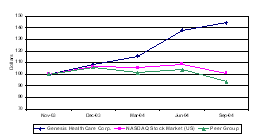
___________________________
* Fiscal year ends September 30.Assumes
an initial investment of $100 on November 18, 2003, the date Genesis’ Common
Stock began trading on the NASDAQ National Market, and the reinvestment of
dividends.
Genesis HealthCare Corporation spun-off from NeighborCare, Inc. on December 1, 2003. The above performance graph represents information regarding Genesis HealthCare Corporation’s Common Stock since the Common Stock began trading on the NASDAQ National Market on a when issued basis on November 18, 2003.
| 11/18/03 | 12/31/03 | 3/31/04 | 6/30/04 | 9/30/04 | ||||||||||||
| Genesis HealthCare Corporation | 100.00 | 108.22 | 115.68 | 137.96 | 144.47 | |||||||||||
| NASDAQ Stock Market (U.S.) | 100.00 | 106.44 | 105.70 | 108.84 | 101.00 | |||||||||||
| Peer Group (1) | 100.00 | 105.83 | 101.37 | 103.90 | 93.52 |
| (1) | The Peer Group index is based on the total return for investments in the common stock of Beverly Enterprises, Inc., Kindred Healthcare, Inc., and Manor Care, Inc. |
CERTAIN RELATIONSHIPS AND RELATED TRANSACTIONS
Genesis has a continuing relationship with NCI as a result of the agreements it entered into in connection with the spin-off, including the separation and distribution agreement, the transition services agreement, the Tidewater agreement, the employee benefits agreement, the tax sharing agreement, the pharmacy services agreement, as amended, pharmacy benefit management agreement, as amended, and durable medical equipment agreement. Genesis believes the charges for services under these agreements are no less favorable to Genesis than those Genesis could have obtained by negotiating these agreements with an independent third-party.
27
Some of Genesis’ officers and directors own shares of NCI common stock and options to acquire additional shares of NCI common stock. Additionally, Mr. Fish is a director of NCI and was an executive officer and director of NCI at the time Genesis entered into the spin-off related agreements with NCI. Ownership of NCI common stock, including options to acquire NCI common stock, or dual directorship, could create or appear to create conflicts of interest for such directors and officers when faced with decisions that could have disparate implications for Genesis.
In October 2003, Genesis purchased the 10% general partnership interest in a partnership which leased four assisted living facilities in Massachusetts for a total purchase price of $200,000. Genesis owned the 90% limited partnership interest in the partnership. The principal of the seller of the general partnership interest is Mr. DePodesta, who, subsequent to the transaction, became a director of Genesis’ Board of Directors. Simultaneously with the purchase of the general partnership interest, Genesis made a lease termination payment to ElderTrust and sold the leasehold rights to an unrelated third party.
In fiscal 2004, Genesis paid to each non-employee director a $25,000 annual retainer, $1,500 for each day during which the director participated in a Board of Directors meeting, $1,000 for each day during which the director participated in a meeting of a committee of the Board of Directors which the director was a member, with the exception of Audit Committee meetings for which $1,500 was paid for each day during which the director participated. Additionally, Mr. Robert Fish was paid $25,000 as the Board’s Lead Director and Ms. Rappuhn was paid $7,500 for serving as the Chairperson and financial expert of the Audit Committee. Each Chairperson of the other committees of the Board of Directors was paid a fee of $5,000 for serving in such capacity. Genesis also awarded 4,328 shares of Common Stock to each non-employee director, with a market value at the time of grant of $95,000.
Compensation Committee Interlocks and Insider Participation
The Compensation Committee consists of Messrs. Gallagher and Kelley and Ms. Rappuhn. No person who served as a member of the Compensation Committee during fiscal 2004 was a current or former officer or employee or engaged in certain transactions with Genesis, required to be disclosed by regulations of the SEC. Additionally, there were no compensation committee “interlocks” during fiscal 2004, which generally means that none of Genesis’ executive officers served as a director or member of the compensation committee of another entity, one of whose executive officers served as Genesis’ director or member of Genesis’ Compensation Committee.
SECTION 16(A) BENEFICIAL OWNERSHIP REPORTING COMPLIANCE
Section 16 (a) of the Exchange Act requires Genesis’ directors and executive officers and persons who own more than 10% of a registered class of Genesis’ equity securities, to file with the SEC initial reports of ownership and reports of changes in ownership of Common Stock and other equity securities. Officers, directors and greater than 10% shareholders are required by the SEC regulation to furnish Genesis with copies of all Section 16 (a) forms they file.
To Genesis’ knowledge, based solely on review of the copies of such reports submitted to Genesis with respect to the fiscal year ended September 30, 2004, all Section 16 (a) filing requirements applicable to Genesis’ executive officers, directors and greater than 10% beneficial owners were complied with, except that Richard Pell filed an initial statement of beneficial ownership of securities on a Form 3 and a statement of changes in beneficial ownership on a Form 4 reporting receipt of restricted stock and a grant of stock options late.
28
PROPOSAL 2 – AMENDMENT TO 2003 STOCK INCENTIVE PLAN
______________________________________
The Board of Directors recommends that you vote FOR the amendment
to the 2003 Stock Incentive Plan as proposed.
______________________________________
General
In January 2005, the Board of Directors approved an amendment to the 2003 Stock Incentive Plan, subject to approval by the shareholders of Genesis, to increase the number of shares of Common Stock authorized for issuance under the 2003 Stock Incentive Plan by 250,000 shares from 750,000 shares to 1,000,000 shares. The purpose of the 2003 Stock Incentive Plan is to promote Genesis’ long-term interests and those of its shareholders by providing a means for attracting and retaining directors, officers and other employees by providing for awards in the form of Common Stock.
Eligibility and Administration
All directors, officers and employees of Genesis and of any present or future parent or subsidiary corporation selected by Genesis’ Board of Directors are eligible to receive awards of Common Stock under the 2003 Stock Incentive Plan.
The 2003 Stock Incentive Plan is administered by a majority of the “Independent Directors,” as such term is defined by Rule 4200(a)(15) of the National Association of Securities Dealers Inc. or any subsequent rule, of Genesis’ Board of Directors or by the Compensation Committee of the Board of Directors. Each member of Genesis’ Board of Directors who administers the 2003 Stock Incentive Plan must meet the definitions of a “non-employee” director within the meaning of Exchange Act Rule 16b-3, and an “Independent Director” within the meaning of Rule 4200(a)(15) of the National Association of Securities Dealers Inc. Genesis’ Board of Directors intends that such directors will also meet the definition of an “outside director” as defined under Section 162(m) of the Code. References to the term “Committee” in this “Proposal 2 – Amendment to 2003 Stock Incentive Plan” refers to either a majority of the “Independent Directors” of Genesis’ Board of Directors or the Compensation Committee of the Board of Directors. Subject to the provisions of the 2003 Stock Incentive Plan, the Committee determines, among other things, which directors, officers and employees will be granted awards under the 2003 Stock Incentive Plan. The Committee also has the exclusive right to adopt or rescind rules for the administration of the 2003 Stock Incentive Plan, correct defects and omissions in, reconcile inconsistencies in, and construe the 2003 Stock Incentive Plan. In addition, the determinations and the interpretations and construction of any provision of the 2003 Stock Incentive Plan by the Committee shall be final.
Number of Shares and Adjustment
The aggregate number of shares which may be granted under the 2003 Stock Incentive Plan is 750,000 shares of Common Stock. The shares of Common Stock with respect to which awards may be made under the 2003 Stock Incentive Plan may be either authorized and unissued shares or issued shares heretofore or hereafter reacquired and held as treasury shares. An award will not be considered to have been made under the 2003 Stock Incentive Plan with respect to restricted Common Stock which is forfeited and new awards may be granted under the 2003 Stock Incentive Plan with respect to the number of shares as to which such forfeiture has occurred. No individual may receive awards under the 2003 Stock Incentive Plan for more than 80% of the total number of shares authorized for issuance under the 2003 Stock Incentive Plan.
29
The 2003 Stock Incentive Plan provides for adjustments to the number of shares issuable under the 2003 Stock Incentive Plan in the discretion of the Board of Directors in the event of a reorganization, recapitalization, stock split, stock dividend, combination or other exchange of shares, merger, consolidation or any change in Genesis’ corporate structure or its shares. To the extent shares are issued at the time of the award, such shares will be treated like all other outstanding shares of Common Stock. Any additional shares of Common Stock or other securities received by the participant as a result of the type of event described above will be subject to the same restrictions applicable to the original award.
Terms of Awards
Under the 2003 Stock Incentive Plan, the Committee has the authority, in its discretion, to grant awards entitling the participant to receive a stated number shares of Common Stock which awards may be subject to restrictions or forfeiture for a period of time as stipulated by the Committee. The dollar value of awards granted under the 2003 Stock Incentive Plan is based upon the fair market value of the Common Stock on the date of grant. Awards made to employees under the 2003 Stock Incentive Plan shall be based upon criteria established by the committee from time to time.
Vesting of Awards
All awards of Common Stock granted pursuant to the 2003 Stock Incentive Plan may be subject to vesting for a period of time and will become unrestricted under the 2003 Stock Incentive Plan in accordance with a vesting schedule, if any, set by the Committee at the time of grant. During the restricted period, Common Stock may not be sold, assigned, transferred, pledged or otherwise encumbered unless otherwise provided in the 2003 Stock Incentive Plan, such as in the event of death of a participant by will or the laws of descent and distribution. Under the terms of the 2003 Stock Incentive Plan, the Committee may also establish an additional period time during which the participant must hold the vested shares prior to resale. To the extent shares are issued at the time of the award, during the restricted period, if any, the participant shall have the right to vote the shares.
Cash Dividends
Pursuant to the terms of the 2003 Stock Incentive Plan, Genesis will defer the payment of cash dividends, if any, to the participant on any unvested shares until the shares vest and are no longer subject to the restrictions. Genesis will hold any deferred cash dividends for the account of the participant and will pay interest on the deferred dividends at a rate determined by the Board of Directors.
Termination of Service; Death
All unvested awards terminate immediately upon termination of the participant’s employment with Genesis or its affiliate, other than by reason of disability or death. If the participant ceases to be employed by Genesis or its affiliate because of death or disability, any unvested awards will immediately vest. Additionally, unless the Committee shall otherwise provide, if the participant’s employment with Genesis or its affiliate is involuntarily terminated for any reason, except for cause, during an 18-month period after a change in control of Genesis, the shares of Common Stock subject to the participant’s award will fully vest and no longer be subject to the restrictions under the 2003 Stock Incentive Plan. A change in control includes the following events: (i) as a result of any transaction, any one shareholder becomes the beneficial owner, directly or indirectly of our securities representing more than 40% of Genesis’ outstanding voting stock, or (ii) any other events deemed to be a charge in control by the Committee.
The Committee has the authority, in its sole discretion, to accelerate the time at which any or all of the restrictions shall lapse with respect thereto, or to remove any restrictions whenever it shall determine such action is appropriate by reason of changes in tax or other laws or other changes in circumstances occurring after the commencement of the restricted period.
30
Effect of Change in Control
If the continuous service of any participant is involuntarily terminated for whatever reason, except for cause, as defined by the Committee, at any time within 18 months after a change in control, unless the Committee shall otherwise provide, any restricted period with respect to an award to such participant will lapse upon such termination and all awards made to such participant will become fully vested. A “change in control” includes: (i) as a result of any transaction, any one shareholder becomes the beneficial owner, directly or indirectly, of securities of Genesis representing more than 40% of the shares of Common Stock or the combined voting power of Genesis’ then outstanding securities; or (ii) any other events deemed to constitute a “change in control” by the Committee.
Amendments, Suspension and Termination
The Board of Directors may amend or supplement the 2003 Stock Incentive Plan, including the form of agreement evidencing the award, in any way, or suspend or terminate such plan at any time, as determined by the Board of Directors without the approval of shareholders; provided, however, that such action shall not affect awards granted under the 2003 Stock Incentive Plan prior to the actual date on which such action occurred. If the Board of Directors voluntarily submits a proposed amendment, supplement, suspension or termination for shareholder approval, such submission shall not require any future amendments, supplements, suspensions or terminations (whether or not relating to the same provision or subject matter) to be similarly submitted for shareholder approval.
Expiration of the 2003 Stock Incentive Plan
Unless terminated earlier by the Board of Directors, the 2003 Stock Incentive Plan shall continue in effect for a period of ten years from December 1, 2003, or until all shares subject to awards have been granted and any restrictions applicable to such shares lapse.
Governing Law
The 2003 Stock Incentive Plan and all awards granted thereunder are governed by and construed in accordance with the laws of the Commonwealth of Pennsylvania.
Reasons for the Proposed Amendment
Under the 2003 Stock Incentive Plan, of the 750,000 shares of Common Stock authorized under the 2003 Stock Incentive Plan, 56,904 shares were available for future grants of restricted Common Stock at September 30, 2004. The purpose of the proposed increase is to provide sufficient shares for future grants to officers, key employees, non-employee directors and contractors of Genesis. The Board of Directors believes that Genesis and its shareholders benefit significantly from having Genesis’ key personnel receive shares of its Common Stock, and it is an essential element of an effective management incentive program. The Board of Directors also believes that grants of restricted Common Stock are valuable in attracting and retaining highly qualified personnel and in providing additional motivation to such personnel to use their best efforts on behalf of Genesis and its shareholders.
31
Required Vote/Quorum
See the questions “What constitutes a quorum?” and “What vote is required for the election of directors, amendment to the 2003 Stock Incentive Plan or for a proposal to be approved?” under “Questions and Answers About the Annual Meeting and Voting.”
Awards Under the 2003 Stock Incentive Plan
Information concerning shares of restricted Common Stock granted in 2004 to the Named Executive Officers is set forth under “Executive Compensation – Summary Compensation Table” above. The following table sets for information regarding the shares awarded under the 2003 Stock Incentive Plan as of the Record Date.
| Name and Position | Dollar Value ($)(1) | Number of Shares | |||||
| George V. Hager, Jr., Chairman, Chief Executive Officer and Director Nominee | $ | 3,311,000 | 100,000 | ||||
| James V. McKeon, Executive Vice President and Chief Financial Officer | 1,655,500 | 50,000 | |||||
| Robert A. Reitz, Executive Vice President and Chief Operating Officer | 1,241,625 | 37,500 | |||||
| David C. Almquist, Executive Vice President | 1,241,625 | 37,500 | |||||
| Richard P. Blinn, Executive Vice President | 1,241,625 | 37,500 | |||||
| John F. DePodesta, Director | 246,736 | 7,452 | |||||
| Robert H. Fish, Director | 246,736 | 7,452 | |||||
| J. Michael Gallagher, Director | 246,736 | 7,452 | |||||
| Kevin M. Kelley, Director Nominee | 246,736 | 7,452 | |||||
| Charles W. McQueary, Director | 246,736 | 7,452 | |||||
| Charlene Connolly Quinn, Director | 246,736 | 7,452 | |||||
| Terry Allison Rappuhn, Director | 246,736 | 7,452 | |||||
| Executive Officer Group (9 persons) | 11,671,275 | 352,500 | |||||
| Non-executive Director Group (7 persons) | 1,727,150 | 52,164 | |||||
| Non-executive Employee Group (54 persons) | 10,274,033 | 310,300 |
_____________________
(1) Based on the last sales price of the Common Stock on the Record Date, which was $33.11.
As part of the 2005 Incentive Compensation Program, the Compensation Committee approved that 25% of certain senior management’s bonus will be paid in shares of restricted Common Stock granted under the 2003 Stock Incentive Plan (to the extent that shares are available under the 2003 Stock Incentive Plan). The amount of shares to be granted in connection with the 2005 Incentive Compensation Program will be determined at the completion of fiscal 2005 based upon the satisfaction of certain performance measures. The Compensation Committee has not made any other determinations with respect to the grant of any shares of restricted Common Stock covering the additional shares of Common Stock authorized by the amendment to any director, executive officer or other employee of Genesis; therefore, the above table does not reflect such future determinations.
32
On January 19, 2005, the last sale price of the Common Stock was $35.00 per share as reported on the NASDAQ National Market. As of January 19, 2005, an aggregate of 714,964 shares of restricted Common Stock were awarded under the 2003 Stock Incentive Plan, of which an aggregate of 352,500 shares of restricted Common Stock were awarded to executive officers.
Genesis is seeking shareholder approval of Proposal 2 to satisfy the NASDAQ National Market listing standards that require companies whose shares are reported on the NASDAQ National Market to obtain shareholder approval of material amendments to stock plans for directors, officers or key employees.
If the shareholders do not approve Proposal 2, then the maximum number of shares issuable under the 2003 Stock Incentive Plan will remain at 750,000 shares.
EQUITY COMPENSATION PLAN INFORMATION
The following table details information regarding the Genesis’ existing equity compensation plans as of September 30, 2004:
| Plan Category | (a) Number of securities to be issued upon exercise of outstanding options, warrants and rights |
(b) Weighted-average exercise price of outstanding options, warrants and rights |
(c) Number of securities remaining available for future issuance under equity compensation plans (excluding securities reflected in column (a)) |
|||||||
Equity
compensation plans approved by security holders (1)(2) |
150,298 | $ | 22.96 | 1,384,369 | ||||||
Equity
compensation plans not approved by security holders |
— | — | — | |||||||
| Total | 150,298 | $ | 22.96 | 1,384,369 |
| (1) | At September 30, 2004, under the 2003 Stock Option Plan there were options currently exercisable to purchase 150,298 shares of Common Stock, options granted but not yet exercisable to purchase 730,465 shares of Common Stock and 600,000 shares of Common Stock eligible for future grant of options. At September 30, 2004, under the 2003 Stock Incentive Plan there were 56,904 shares of Common Stock eligible for future awards of restricted stock. Does not include 593,609 shares of Common Stock subject to awards granted pursuant to the 2003 Stock Incentive Plan, which have not vested and have not been issued. |
| (2) | Does not include the proposed increase of 250,000 shares under the 2003 Stock Incentive Plan. |
INDEPENDENT PUBLIC ACCOUNTANTS
Genesis’ independent public accountant for the fiscal year ended September 30, 2004, was the independent registered public accounting firm of KPMG LLP. The Audit Committee has selected KPMG LLP to be Genesis’ independent public accountant for the fiscal year ending 2005.
A representative of KPMG LLP is expected to be present at the Annual Meeting and to be available to respond to appropriate questions from shareholders. The representative will have the opportunity to make a statement if he or she so desires.
33
Consistent with the Audit Committee’s responsibility for engaging Genesis’ independent auditors, all audit and permitted non-audit services require pre-approval by the Audit Committee. The full Audit Committee approves proposed services and fee estimates for these services. The Audit Committee Chairperson or her designee has been designated by the Audit Committee to approve any services arising during the year that were not pre-approved by the Audit Committee and services that were pre-approved. Services approved by the Audit Committee Chairperson are communicated to the full Audit Committee at its next regular quarterly meeting and the Audit Committee reviews services and fees for the fiscal year at each such meeting. During fiscal 2003, all services performed by the auditors were pre-approved by NCI’s Audit Committee prior to the spin-off and the establishment of Genesis’ Audit Committee. During fiscal 2004, all services performed by the auditors were pre-approved by the Audit Committee. The Audit Committee has considered and determined that the services provided by KPMG LLP are compatible with KPMG LLP maintaining its independence.
| 2004 | 2003 | ||||||
| Audit Fees | $ | 1,016,000 | $ | 235,000 | |||
| Audit-Related Fees | 60,000 | — | |||||
| Tax Fees | — | — | |||||
| All Other Fees | 22,000 | — | |||||
Total |
$ | 1,098,000 | $ | 235,000 | |||
Audit Fees. Fiscal 2004 audit fees are fees paid for professional services for the audit of consolidated financial statements included in Form 10-K, review of financial statements included in Form 10-Q, statutory audits associated with various properties and for services that normally are provided by the accountant in connection with the review of SEC registration statements and other filings and consents. Fiscal 2003 audit fees consist of incremental fees in connection with the audit of Genesis’ combined financial statements prior to its spin-off from NCI.
Audit-Related Fees. Fiscal 2004 audit-related fees consist of fees in connection with the audit of certain pension plans.
All Other Fees. Fiscal 2004 all other fees consist of fees in connection with assistance relative to Sarbanes-Oxley Section 404 matters.
OTHER MATTERS
As of the date hereof, Genesis knows of no other business that will be presented for consideration at the Annual Meeting. However, the enclosed proxy card confers discretionary authority to vote with respect to any and all of the following matters that may come before the meeting: (i) matters that Genesis’ Board of Directors did not have notice of at least 45 days before the date on which Genesis first mailed its proxy materials for the 2005 Annual Meeting of Shareholders; (ii) approval of the minutes of a prior meeting of shareholders, if such approval does not amount to ratification of the action taken at the meeting; (iii) the election of any person to any office for which a bona fide nominee is named in this proxy and such nominee is unable to serve or for good cause will not serve; (iv) any proposal omitted from this proxy statement and the form of proxy pursuant to Exchange Act Rule 14a-8 or Rule 14a-9; and (v) matters incidental to the conduct of the meeting. If any such matters come before the meeting, the proxy agents named in the accompanying proxy card will vote in accordance with their best judgment.
34
SHAREHOLDER PROPOSALS FOR 2006 ANNUAL MEETING OF SHAREHOLDERS
Genesis’ shareholders are notified that in order to provide Genesis with timely notice of a shareholder proposal to be submitted outside of the Exchange Act Rule 14a-8 process for consideration at Genesis’ 2006 Annual Meeting of Shareholders (the “2006 Meeting”), Genesis must receive the notice between November 26, 2005 and December 26, 2005. As to all such matters which Genesis has not received notice on or prior to December 8, 2005, discretionary authority shall be granted to such person(s) designated in Genesis’ proxy related to the 2006 Meeting to vote on such proposals. In addition, the Rule 14a-8 requirements applicable to inclusion of shareholder proposals in Genesis’ proxy materials related to the 2006 Meeting require that a shareholder proposal regarding the 2006 Meeting must be submitted to Genesis at its office located at 101 East State Street, Kennett Square, Pennsylvania, 19348-3021 by September 24, 2005 to receive consideration for inclusion in Genesis’ proxy materials for the 2006 Meeting. Any such proposal must comply with the proxy rules under the Exchange Act, including Exchange Act Rule 14a-8.
ANNUAL REPORT TO SHAREHOLDERS AND FORM 10-K
This proxy statement is accompanied by Genesis’ 2004 Annual Report to Shareholders which includes a copy of the Annual Report on Form 10-K for the fiscal year ended September 30, 2004 as filed with the SEC on December 14, 2004.
EACH PERSON SOLICITED HEREUNDER CAN OBTAIN A COPY OF GENESIS’ ANNUAL REPORT ON FORM 10-K, INCLUDING THE FINANCIAL STATEMENTS AND THE FINANCIAL STATEMENT SCHEDULES, FOR THE YEAR ENDED SEPTEMBER 30, 2004 AS FILED WITH THE SECURITIES AND EXCHANGE COMMISSION, WITHOUT CHARGE (EXCEPT FOR EXHIBITS TO THE REPORT), BY SENDING A WRITTEN REQUEST TO:
Genesis HealthCare Corporation
101 East State Street
Kennett Square, PA 19348-3021
Attention: Investor Relations
Telephone: (610) 925-2000
| By Order of the Board of Directors | |
|
|
| Eileen M. Coggins, Esquire Senior Vice President, General Counsel and Corporate Secretary |
35
| APPENDIX A |
GENESIS HEALTHCARE CORPORATION
Audit Committee Charter
| I. | Purpose |
There shall be a committee of the board of directors (the “Board”) of Genesis HealthCare Corporation (the “Company”) to be known as the audit committee of the Company. The audit committee’s purpose is to oversee the accounting and financial reporting processes of the Company and the audit of the financial statements of the Company.
| II. | Composition |
The audit committee shall have at least three (3) members, comprised solely of directors who satisfy the audit committee composition and independence requirements of applicable law and national security exchange rules. Audit committee members shall be elected annually by the Board. Each member of the audit committee shall be able to read and understand fundamental financial statements, including the Company’s balance sheet, income statement, statement of shareholders equity, cash flow statement and related notes. In addition, at least one member of the audit committee shall be a financial expert, as defined by applicable law and regulations.
| III. | Meetings and Procedures |
| • | The audit committee shall fix its own rules of procedure, which shall be consistent with the Bylaws of the Company and this Charter. |
| • | The audit committee shall meet at least quarterly and more frequently as circumstances require. |
| • | The chairperson of the audit committee or a majority of the members of the audit committee may call special meetings of the audit committee. |
| • | If a chairperson is not elected by the Board, the members of the audit committee may designate a chairperson by majority vote of the full committee. |
| • | The audit committee may request that any directors, officers or employees of the Company, or other persons whose advice and counsel are sought by the audit committee, attend any meeting of the audit committee and/or provide such pertinent information as the audit committee requests. |
| • | Following each of its meetings, the audit committee shall deliver a report on the meeting to the Board, including a description of all actions taken by the audit committee at the meeting. |
| • | The audit committee shall keep written minutes of its meetings, which minutes shall be maintained with the books and records of the Company. |
| IV. | Responsibilities and Authority |
The responsibilities and authority of the audit committee are as follows:
A-1
| • | Sole power to appoint (and terminate), compensate, oversee the work of the outside auditors, including audit scope and procedures and resolution of disagreements between management and the outside auditor regarding financial reporting, for the purpose of preparing or issuing an audit report or related work. |
| • | Pre-approve all auditing services and permissible non-audit services provided by the outside auditors to the Company. |
| • | Review and discuss the formal written statement from the outside auditors delineating all relationships between the outside auditors and the Company or any other relationships that may adversely affect the independence of the auditor and, based on such review, assess the independence of the outside auditor consistent with the Independence Standards Board Standard No. 1. |
| • | Review and approve the audit committee report required to be filed with the SEC. |
| • | Review and approve the Company’s Internal Audit Plan prior to its inception for each fiscal year. |
| • | Review and discuss with management and the outside auditors for the Company the following: |
| • | all critical accounting policies and practices to be used utilized in connection with the preparation of the Company’s financial statements; |
| • | all alternative treatments of financial information within United States generally accepted accounting principles that have been discussed with the management of the Company, ramifications of the use of such alternative disclosures and treatments, and the treatment preferred by the outside auditors; and |
| • | other material written communications between the outside auditors and the management of the Company, such as any management letter or schedule of unadjusted differences. |
| • | Establish procedures for (i) the receipt, retention and treatment of complaints received by the Company regarding accounting, internal accounting controls, or auditing matters as set forth in section 10A(m)(4) of the Exchange Act and (ii) the confidential, anonymous submission by employees of the Company of concerns regarding questionable accounting or auditing matters. |
| • | Review reports submitted to the audit committee pursuant to the reporting provisions of the Code of Ethics of the Company alleging actual or suspected violations of federal, state or local laws or regulations, including anonymous reports of questionable accounting or auditing matters. |
| • | Review and discuss with management and the outside auditors: (i) all related party transactions which are relevant to an understanding of the Company’s financial statements, and (ii) any material financial or non-financial arrangements of the Company which do not appear on the financial statements of the Company. |
| • | Approve all related party transactions. |
A-2
| • | Review and discuss with the outside auditors, the Company’s internal auditor, and financial and accounting personnel, the adequacy and effectiveness of the accounting and financial controls of the Company, and elicit any recommendations for the improvement of such internal control procedures or particular areas where new or more detailed controls or procedures are desirable. |
| • | Review and discuss the financial statements contained in the annual report to shareholders with management and the outside auditors, including an analysis of the auditors’ judgment as to the quality of the Company’s accounting principles. |
| • | Review the Company’s quarterly financial statements. |
| • | Meet with the internal auditor, outside auditor or the management privately as necessary to discuss any matters that the audit committee, the internal auditor, the outside auditor or the management believe should be discussed privately with the audit committee. |
| • | Engage independent counsel and other advisors as it deems necessary to carry out its duties, and determine their compensation. |
| • | Review and reassess the adequacy of the audit committee’s charter annually. |
| • | Conduct or authorize investigations into any matters within the scope of its responsibilities. |
| V. | Delegation |
Any responsibility or authority of the audit committee, including but not limited to, the authority to preapprove all audit and permitted non-audit services, may be delegated to one or more members of the committee. The decisions of any member of the audit committee to whom authority to grant pre-approval has been delegated shall be presented to the full audit committee at the next scheduled meeting.
| VI. | Limitations |
The audit committee is responsible for the duties set forth in this Charter but is not responsible for either the preparation of the financial statements or the auditing of the financial statements. Management has the responsibility for preparing the financial statements and implementing internal controls and the independent auditors have the responsibility for auditing the financial statements and obtaining a sufficient understanding of internal control to plan the audit and to determine the nature, timing and extent of tests to be performed. The review of the financial statements by the audit committee is not of the same quality as the audit performed by the independent auditors. In carrying out its responsibilities, the audit committee believes its policies and procedures should remain flexible in order to best react to a changing environment.
A-3
| APPENDIX B |
GENESIS HEALTHCARE CORPORATION
Nominating and Corporate Governance Committee Charter
This Nominating and Corporate Governance Committee Charter (the “Charter”) has been adopted by the Board of Directors (the “Board”) of Genesis HealthCare Corporation (the “Company”)
| I. | Purpose |
The Nominating and Corporate Governance Committee (the “Committee”) of the Board is responsible for developing and recommending to the Board a set of corporate governance policies for the Company, establishing criteria for selecting new directors, and identifying, screening and recruiting new directors. The Committee will also recommend to the Board nominees for Board and committee memberships.
| II. | Composition |
Except as otherwise permitted by the applicable rules of the NASDAQ Stock Market, Inc. (“NASDAQ”), each member of the Committee shall be an independent director (“Independent Directors”) under the listing standards of NASDAQ. Committee members shall be elected annually by the Board.
If the Board fails to elect a chairperson, the Committee members shall elect a chairperson from their members. The chairperson shall be responsible for leadership of the Committee, including overseeing the agenda, presiding over the meetings and reporting to the Board. If the Committee chairperson is not present at a meeting, the remaining members of the Committee may designate an acting chairperson.
A member shall promptly notify the Committee and the Board if the member is no longer an Independent Director and such member shall be removed from the Committee unless the Board determines that an exception to the Independent Director requirement is available under the NASDAQ rules with respect to such member’s continued membership on the Committee.
| III. | Meetings and Procedures |
| • | The Committee shall fix its own rules of procedure, which shall be consistent with the Bylaws of the Company and this Charter. |
| • | The Committee shall meet at least annually and more frequently as circumstances require. |
| • | The Committee may request that any directors, officers or employees of the Company, or other persons whose advice and counsel are sought by the Committee, attend any meeting of the Committee and/or provide such pertinent information as the Committee requests, except that no director of the Company shall participate in discussions or attend any portion of a meeting of the Committee at which that director’s nomination or committee selection is being discussed. |
B-1
| • | Following each of its meetings, the Committee shall deliver a report on the meeting to the Board, including a description of all actions taken by the Committee at the meeting. |
| • | The Committee shall keep written minutes of its meetings, which minutes shall be maintained by the Company with the books and records of the Company. The chairperson may designate an officer or employee of the Company to serve as secretary to the Committee. |
| IV. | Responsibilities and Duties of the Nominating Committee |
The Nominating Committee has the following duties and responsibilities:
| Selection of Director Nominees and Committee Membership |
| • | Determine what types of backgrounds are needed to help strengthen and balance the Board and establish criteria for selecting new directors. |
| • | Conduct background and qualifications checks of persons it wishes to recommend to the Board as candidates or to fill vacancies. |
| • | Conduct director evaluations prior to renomination of directors for election. |
| • | Recommend to the board the slate of nominees of directors to be proposed for election by the shareholders including individuals to be considered by the Board to fill vacancies. Recommendations should follow a review by the Committee of the performance and contribution of fellow directors as well as the qualifications of proposed new directors. |
| • | Recommend annually to the Board those directors to be selected for membership on the various Board committees. Recommendations should consider the qualifications for membership on each committee, whether the candidate will be able to devote the requisite time to the Committee, the extent to which there should be a policy of periodic rotation of directors among the committees, and any limitations on the number of consecutive years a director should serve on any one Board committee. |
| • | Determine director and committee member/chair compensation for those directors who are not also salaried officers of the Company. |
Develop and Implement Policies Regarding Corporate Governance Matters
| • | Recommend to the Board policies to enhance the Board’s effectiveness, including with respect to the distribution of information to Board members, the size and composition of the Board, and the frequency and structure of Board meetings. |
| • | Develop and review periodically, and at least annually, the corporate governance policies of the Company to ensure that they are appropriate for the Company and that policies of the Company comply with applicable laws, regulations and listing standards, and recommend any desirable changes to the Board. |
| • | Maintain and recommend to the Board for adoption a Code of Conduct for directors, officers and employees and a Code of Ethics for certain senior officers, which codes may be combined into one code. |
B-2
| • | Consider any other corporate governance issues that arise from time to time, and recommend appropriate actions to the Board. |
| • | Assist management in the review of director and officer liability insurance requirements and the alternative methods available for satisfying them. |
Evaluation of the Board and Management
| • | Oversee performance evaluations for the Board as a whole. |
| • | Maintain an orientation program for new directors and continuing education programs for directors. |
Succession Planning and Other Matters
| • | Make recommendations to the Board with respect to potential successors for key management positions. |
| • | Obtain advice and assistance from internal or external legal, accounting or other advisors as required for the performance of its duties. |
| • | Review and evaluate the Committee’s performance annually. |
| • | Review and reassess the adequacy of this Charter on an annual basis and recommend to the Board any appropriate changes. |
| • | Perform such other duties and responsibilities as may be assigned to the Committee, from time to time, by the Board. |
| V. | Investigations and Studies; Outside Advisors |
The Committee may conduct or authorize investigations into or studies of matters within the scope of the Committee’s duties and responsibilities, and may retain, at the Company’s expense, such experts and other professionals as it deems necessary. The Committee shall have the sole authority to retain or terminate any search firm to be used to identify director candidates, including sole authority to approve the search firm’s fees and other retention terms, such fees to be borne by the Company.
B-3
FORM OF PROXY CARD
GENESIS HEALTHCARE CORPORATION
ANNUAL MEETING OF SHAREHOLDERS – FEBRUARY 23, 2005
THIS PROXY IS SOLICITED ON BEHALF OF THE BOARD OF DIRECTORS OF
GENESIS HEALTHCARE CORPORATION
The undersigned, a shareholder of Genesis HealthCare Corporation (the “Company”), hereby constitutes and appoints James V. McKeon and Robert A. Reitz, and each of them, as attorneys and proxies of the undersigned, with full power of substitution, for and in the name, place and stead of the undersigned, to attend, vote and act for the undersigned at the Annual Meeting of Shareholders to be held on February 23, 2005, and any adjournments or postponements thereof (the “Annual Meeting”), and to vote and represent all of the shares of the Company which the undersigned is entitled to vote, with all the powers and authority the undersigned would possess if personally present.
THIS PROXY WILL BE VOTED AS DIRECTED. IF NO DIRECTIONS TO THE CONTRARY ARE INDICATED, THE PROXY AGENTS INTEND TO VOTE “FOR” ALL OF THE NOMINEES FOR DIRECTOR AND “FOR” THE AMENDMENT TO THE 2003 STOCK INCENTIVE PLAN TO INCREASE THE NUMBER OF SHARES OF COMMON STOCK AVAILABLE FOR ISSUANCE UNDER THE 2003 STOCK INCENTIVE PLAN. WITH RESPECT TO SUCH OTHER BUSINESS THAT MAY PROPERLY COME BEFORE THE MEETING AND ANY ADJOURNMENTS OR POSTPONEMENTS THEREOF, SAID PROXY IS AUTHORIZED TO VOTE IN ACCORDANCE WITH ITS BEST JUDGMENT.
THE PROXY AGENTS PRESENT AND ACTING IN PERSON OR BY THEIR SUBSTITUTES (OR, IF ONLY ONE IS PRESENT AND ACTING, THEN THAT ONE) MAY EXERCISE ALL THE POWERS CONFERRED BY THIS PROXY. DISCRETIONARY AUTHORITY IS CONFERRED BY THIS PROXY AS TO CERTAIN MATTERS DESCRIBED IN THE COMPANY’S PROXY STATEMENT.
1. To elect the following two Class I director nominees, each to hold office for three years and until his successor has been duly elected and qualified, as more fully described in the accompanying Proxy Statement:
| 01-George V. Hager, Jr. 02-Kevin M. Kelley | For
all of the nominees except as marked to the contrary |
Withhold the authority to vote for all of the nominees |
| To withhold authority to vote for a nominee, put a line through or strike out the nominee’s name. | ||
| 2. To amend the 2003 Stock Incentive Plan to increase the number of shares available for issuance under the 2003 Stock Incentive Plan as more fully described in the accompanying proxy statement. | For Against Abstain |
|
(CONTINUED AND TO BE SIGNED ON REVERSE SIDE) Address Change/Comments (Mark the corresponding box on the reverse side) |
| |
MARK THE BOX AT LEFT IF AN ADDRESS CHANGE OR COMMENT HAS BEEN NOTED. | ||
|
MARK THE BOX AT LEFT IF YOU PLAN TO ATTEND THE 2005 ANNUAL MEETING OF SHAREHOLDERS. | ||
IMPORTANT: Please sign your name exactly as it appears on your stock certificate(s), including any official position or representative capacity. If shares are registered in more than one name, all owners should sign. Please date this proxy.
The undersigned hereby acknowledges receipt of the Company’s Annual Report on Form 10-K for the fiscal year ended September 30, 2004, the Notice of the Company’s 2005 Annual Meeting of Shareholders and the Proxy Statement relating thereto.
Signature:________________________
Date:____________________________
Signature:________________________
Date:____________________________
Please sign, date and return promptly in the enclosed envelope, which requires no postage if mailed in the United States. When shares are held by joint tenants, both joint tenants should sign. Persons signing as attorney, executor, administrator, trustee, guardian, or other fiduciary should state full title. If shares are held by a corporation, the president or duly authorized officer should sign.
YOUR VOTE IS IMPORTANT
VOTE TODAY IN ONE OF TWO WAYS:
| 1. | VOTE BY TELEPHONE: After you call the phone number below, you will be asked to enter the control number at the bottom of the page. You will need to respond to only a few simple prompts. Your vote will be confirmed and cast as directed. Call toll-free in the U.S. or Canada at 1-866-626-4508 on a touch tone telephone |
Telephone voting is available through 11:59 PM on February 22, 2005
OR
| 2. | VOTE BY MAIL: If you do not wish to vote by telephone, please complete, sign, date and return the above proxy card in the pre-paid envelope provided. |
YOUR CONTROL NUMBER IS:
You may vote by telephone 24 hours a day, 7 days a week. Your telephone vote authorizes the named proxies to vote in the same manner as if you marked, signed and returned your proxy card.
FORM OF INSTRUCTION CARD
GENESIS HEALTHCARE CORPORATION
ANNUAL MEETING OF SHAREHOLDERS – FEBRUARY 23, 2005
THIS INSTRUCTION IS SOLICITED ON BEHALF OF THE BOARD OF DIRECTORS OF
GENESIS HEALTHCARE CORPORATION
The undersigned, a participant, beneficiary or alternate payee in the Genesis HealthCare Corporation Retirement Plan, Genesis HealthCare Corporation 401(k) Plan for Collective Bargaining Unit Employees or Genesis HealthCare Corporation Union 401(k) Plan (collectively, the “Plans”), instructs Wachovia Bank, N.A., the directed trustee of each of the Plans (the “Trustee”), to vote the number of shares of Genesis HealthCare Corporation (“Company”) common stock equivalent to the interest in the Company common stock credited to the undersigned’s account under the Plans as of January 7, 2005 (the “Record Date”) at the Annual Meeting of Shareholders (the “Meeting”) to be held on February 23, 2005 (and at any postponement or adjournment thereof) in accordance with the instructions on the reverse side of this Instruction Card.
THE SHARES OF THE COMPANY’S COMMON STOCK EQUIVALENT TO THE INTEREST IN THE COMPANY’S COMMON STOCK CREDITED TO THE UNDERSIGNED’S ACCOUNT AS OF THE RECORD DATE WILL BE VOTED BY THE TRUSTEE AS DIRECTED. THE COMPANY HAS DIRECTED THE TRUSTEE TO VOTE ALL SHARES HELD BY THE PLAN FOR WHICH NO INSTRUCTIONS ARE RECEIVED FROM PARTICIPANTS, BENEFICIARIES OR ALTERNATE PAYEES “FOR” THE APPROVAL OF THE ELECTION OF THE NOMINEES FOR DIRECTORS AND “FOR” THE AMENDMENT TO THE 2003 STOCK INCENTIVE PLAN TO INCREASE THE NUMBER OF SHARES OF COMMON STOCK AVAILABLE FOR ISSUANCE UNDER THE 2003 STOCK INCENTIVE PLAN. WITH RESPECT TO ANY OTHER MATTER THAT PROPERLY COMES BEFORE THE MEETING, THE TRUSTEE IS AUTHORIZED TO VOTE THE SHARES HELD BY THE PLANS AS DIRECTED BY THE COMPANY.
1. To elect the following two Class I director nominees, each to hold office for three years and until his successor has been duly elected and qualified, as more fully described in the accompanying Proxy Statement:
| 01-George V. Hager, Jr. 02-Kevin M. Kelley | For
all of the nominees except as marked to the contrary |
Withhold
the authority to vote for all of the nominees |
| To withhold authority
to vote for a nominee, put a line through or strike out the
nominee’s name. |
||
| 2. To amend the 2003 Stock Incentive Plan to increase the number of shares of common stock available for issuance under the 2003 Stock Incentive Plan, as more fully described in the accompanying proxy statement. |
For Against Abstain |
|
(CONTINUED AND TO BE SIGNED ON REVERSE SIDE) Address Change/Comments (Mark the corresponding box on the reverse side) |
||
|
MARK THE BOX AT LEFT IF AN ADDRESS CHANGE OR COMMENT HAS BEEN NOTED. |
| |
MARK THE BOX AT LEFT IF YOU PLAN TO ATTEND THE 2005 ANNUAL MEETING OF SHAREHOLDERS. |
IMPORTANT: Please sign your name exactly as it appears on your stock certificate(s), including any official position or representative capacity. If shares are registered in more than one name, all owners should sign. Please date this proxy.
The undersigned hereby acknowledges receipt of the Company’s Annual Report on Form 10-K for the fiscal year ended September 30, 2004, the Notice of the Company’s 2005 Annual Meeting of Shareholders and the Proxy Statement relating thereto.
Signature:________________________
Date:____________________________
Signature:________________________
Date:____________________________
Please sign, date and return promptly in the enclosed envelope, which requires no postage if mailed in the United States. When shares are held by joint tenants, both joint tenants should sign. Persons signing as attorney, executor, administrator, trustee, guardian, or other fiduciary should state full title. If shares are held by a corporation, the president or duly authorized officer should sign.
YOUR VOTE IS IMPORTANT
VOTE TODAY IN ONE OF TWO WAYS:
| 1. | VOTE BY TELEPHONE: After you call the phone number below, you will be asked to enter the control number at the bottom of the page. You will need to respond to only a few simple prompts. Your vote will be confirmed and cast as directed. Call toll-free in the U.S. or Canada at 1-866-626-4508 on a touch tone telephone |
Telephone voting is available through 11:59 PM on February 21, 2005
OR
| 2. | VOTE BY MAIL: If you do not wish to vote by telephone, please complete, sign, date and return the above proxy card in the pre-paid envelope provided. |
YOUR CONTROL NUMBER IS:
You may vote by telephone 24 hours a day, 7 days a week. Your telephone vote authorizes the named proxies to vote in the same manner as if you marked, signed and returned your proxy card.
GENESIS HEALTHCARE CORPORATION
2003 STOCK INCENTIVE PLAN
1. Plan Purpose. The purpose of the Plan is to promote the long-term interests of the Corporation and its shareholders by providing a means for attracting and retaining officers, employees and directors of the Corporation and its Affiliates by providing for Awards in the form of Restricted Stock.
2. Definitions. The following definitions are applicable to the Plan:
“Award” – means the grant of Restricted Stock, as provided in the Plan.
“Affiliate” – means any “parent corporation” or “subsidiary corporation” of the Corporation, as such terms are defined in Section 424(e) and (f), respectively, of the Code.
“Board” – means the Board of Directors of the Corporation.
“Code” – means the Internal Revenue Code of 1986, as amended.
“Committee”– means the Compensation Committee of the Board or a majority of the Independent Directors of the Corporation’s Board.
“Continuous Service” – means the absence of any interruption or termination of service as an officer, employee or director of the Corporation or any Affiliate. Service shall not be considered interrupted in the case of sick leave, military leave or any other leave of absence approved by the Corporation or any Affiliate or in the case of transfers between payroll locations of the Corporation, or between the Corporation, its subsidiaries or its successor.
“Corporation” – means Genesis HealthCare Corporation, a Pennsylvania corporation.
“Fair Market Value” – means the last reported sale price of a share of the Corporation’s common stock on any stock exchange on which such stock is then listed or admitted to trading, or on the NASDAQ Stock Market, on such date, or if no sale took place on such day, the last such date on which a sale took place, or if the common stock is not then quoted on the NASDAQ Stock Market, or listed or admitted to trading on any stock exchange, the average of the bid and asked prices in the over-the-counter market on such date, or if none of the foregoing, a price determined in good faith by the Committee to equal the fair market value per share of the common stock.
“Independent Director” – shall have the meaning ascribed to it by the National Association of Securities Dealers Inc. Rule 4200(a)(15) or any future corresponding rule.
“Non-Employee Director” – shall have the meaning intended by Rule 16b-3(b)(3) under the Securities Exchange Act of 1934, as amended, or any future corresponding rule.
“Participant” – means any officer, employee or director of the Corporation or its Affiliates selected to participate in the Plan.
“Plan” – means the 2003 Stock Incentive Plan of the Corporation.
1
“Restricted Period” – means the period(s) of time, if any, selected by the Committee for the purpose of determining when restrictions are in effect under Section 3 hereof with respect to Restricted Stock awarded under the Plan.
“Restricted Stock” – means Shares which have been awarded to a Participant subject to any restrictions referred to in Section 3 hereof, so long as such restrictions are in effect.
“Shares” – means the common stock, par value $0.01 per share, of the Corporation.
3. Terms and Conditions of Restricted Stock.
(a) The Committee shall have full and complete authority, subject to the limitations of the Plan, to grant Awards of Restricted Stock and, in addition to the terms and conditions contained in paragraphs (b) through (i) of this Section 3 and Section 7, to provide such other terms and conditions (which need not be identical among Participants) with respect to such Awards, and the lapsing of restrictions thereon, as the Committee shall determine. The dollar value of Awards granted under the Plan shall be calculated based upon the Fair Market Value of the Corporation’s common stock on the date of the grant.
(b) At the time of an Award, the Committee shall establish for each Participant a Restricted Period, during which or at the expiration of which, as the Committee shall determine and provide in the agreement referred to in paragraph (f) of this Section 3, the Shares awarded as Restricted Stock shall vest. Subject to any such other terms and conditions as the Committee shall provide, Shares of Restricted Stock may not be sold, assigned, transferred, pledged or otherwise encumbered by the Participant, except as hereinafter provided, during the Restricted Period. The Committee may also establish a period of time, after the expiration of the Restricted Period, if any, during which the Participant must hold the Shares subject to the Award prior to sale. Except for such restrictions, and subject to paragraphs (e) and (g) of this Section 3 and Section 4 hereof, the Participant as owner of such Shares shall have all the rights of a shareholder, including the right to vote the Shares.
(c) Except as provided in Section 5 hereof, if a Participant ceases to maintain Continuous Service for any reason (other than death or disability), all Shares of Restricted Stock theretofore awarded to such Participant and which at the time of such termination of Continuous Service are subject to the restrictions imposed by paragraph (b) of this Section 3 shall upon such termination of Continuous Service be forfeited and returned to the Corporation. If a Participant ceases to maintain Continuous Service by reason of death or disability, Restricted Stock then still subject to restrictions imposed by paragraph (b) of this Section 3 will be free of those restrictions.
(d) The Committee shall have the authority, in its discretion, to accelerate the time at which any or all of the restrictions shall lapse with respect thereto, or to remove any or all of such restrictions, whenever it may determine that such action is appropriate by reason of changes in applicable tax or other laws or other changes in circumstances occurring after the commencement of such Restricted Period.
(e) Each certificate in respect of Shares of Restricted Stock awarded under the Plan shall be registered in the name of the Participant and shall be held, together with a stock power endorsed in blank, by the Corporation.
To the extent Shares subject to Awards have not been registered under the federal and state securities laws or an exemption is otherwise unavailable, the certificates for common stock to be issued pursuant to the Plan shall bear the following securities legend (the “Securities Legend”):
| The shares represented by this certificate have not been registered under the Securities Act of 1933, as amended, or under applicable state securities laws. The shares have been acquired for investment and may not be offered, sold, transferred, pledged or otherwise disposed of without an effective registration statement under the Securities Act of 1933, as amended, and under any applicable state securities laws or an opinion of counsel acceptable to the Corporation that the proposed transaction will be exempt from such registration. |
2
The foregoing legend shall be removed upon registration of the legended shares under the Securities Act of 1933, as amended, and under any applicable state laws or upon receipt of any opinion of counsel acceptable to the Corporation that said registration is no longer required.
(f) At the time of any Award, the Participant shall enter into an agreement with the Corporation substantially in the form attached hereto as Appendix A, agreeing to the terms and conditions of the Award and such other matters as the Committee, in its sole discretion, shall determine (the “Restricted Stock Agreement”). At the time of any Award, the Committee may, in its sole discretion, amend or supplement any of the terms contained in Appendix A for any particular Participant.
(g) The payment to the Participant of cash dividends declared or paid on such Shares by the Corporation shall be deferred until the lapsing of any restrictions imposed under paragraph (b) of this Section 3. Such deferred dividends shall be held by the Corporation for the account of the Participant. In such event, there shall be credited at the end of each year (or portion thereof) interest on the amount of the account at the beginning of the year at a rate per annum as the Board, in its discretion, may determine. Payment of deferred dividends, together with interest accrued thereon, shall be made upon the earlier to occur of the lapsing of the restrictions imposed under paragraph (a) of this Section 3 or upon death or disability of the Participant.
(h) At the expiration of the Restricted Period, if any, imposed by paragraph (b) of this Section 3, the Corporation shall deliver to the Participant (or where the relevant provision of paragraph (c) of this Section 3 applies in the case of a deceased Participant, to his legal representative, beneficiary or heir) the certificate(s) and stock power deposited with it pursuant to paragraph (e) of this Section 3. Notwithstanding the foregoing, the Securities Legend described in paragraph (e) of Section 3 shall continue to be included on all certificates as long as registration has not occurred.
(i) The provisions of this section may be modified pursuant to the terms of a Participant’s employment agreement with the Company.
4. Adjustments Upon Changes in Capitalization. In the event of any change in the outstanding Shares subsequent to the effective date of the Plan by reason of any reorganization, recapitalization, stock split, stock dividend, combination or exchange of shares, merger, consolidation or any change in the corporate structure or shares of the Corporation, the maximum aggregate number and class of shares as to which Awards may be granted under the Plan shall be appropriately adjusted by the Board, whose determination shall be conclusive. Outstanding Awards shall be treated like all other outstanding Shares of common stock. Any Shares of stock or other securities received, as a result of any of the foregoing adjustment by the Board or as part of an adjustment provided to shareholders in general, by a Participant with respect to an Award shall be subject to the same restrictions and the certificate(s) or other instruments representing or evidencing such Shares or securities shall be legended and deposited with the Corporation in the manner provided in Section 3 hereof.
5. Effect of Change in Control. Each of the events specified in the following clauses (i) and (ii) of this Section 5 shall be deemed a “change in control”: (i) as a result of any transaction, any one shareholder becomes the beneficial owner, directly or indirectly, of securities of the Corporation representing more than 40% of the Shares of the Corporation or the combined voting power of the Corporation’s then outstanding securities; or (ii) any other events deemed to constitute a “change in control” by the Committee. If the Continuous Service of any Participant is involuntarily terminated for whatever reason, except for cause, as defined by the Committee, at any time within 18 months after a change in control, unless the Committee shall otherwise provide, any Restricted Period with respect to an Award to such Participant shall lapse upon such termination and all Awards shall become fully vested in the Participant. The provisions of this section may be modified pursuant to the terms of a Participant’s employment agreement with the Company.
3
6. Assignment and Transfers. During the Restricted Period, no Award nor any right or interest of a Participant in such Award set forth in any instrument evidencing any Award under the Plan may be assigned, encumbered or transferred except, in the event of the death of a Participant, by will or the laws of descent and distribution.
7. Administration.
(a) This Plan shall be administered by the Committee. The Committee shall consist of a minimum of two members of the Board, each of whom shall be a Non-Employee Director and an Independent Director, except that the failure of the Committee for any reason to be compared solely of Non-Employee Directors or Independent Directors shall not prevent an Award being considered granted under this Plan.
(b) Except as limited by the express provisions of the Plan, the Committee shall have sole and complete authority and discretion to: (i) select Participants and grant Awards; (ii) determine individual Awards to be granted under the Plan; (iii) determine the terms and conditions upon which Awards shall be granted under the Plan; (iv) prescribe the form and terms of instruments evidencing such grants; and (v) establish from time to time regulations for the administration of the Plan, interpret the Plan, and make all determinations deemed necessary or advisable for the administration of the Plan.
(c) The Committee shall adopt such rules for the conduct of its business and administration of this Plan as it considers desirable. A majority of the members of the Committee shall constitute a quorum for all purposes. The vote or written consent of a majority of the members of the Committee on a particular matter shall constitute the act of the Committee on such matter. The Committee shall have the right to construe the Plan and the Awards issued pursuant to it, to correct defects and omissions and to reconcile inconsistencies to the extent necessary to effectuate the Plan and the options issued pursuant to it, and such action shall be final, binding and conclusive upon all parties concerned. No member of the Committee shall be liable for any act or omission (whether or not negligent) taken or omitted in good faith, or for the exercise of an authority or discretion granted in connection with the Plan to the Committee, or for the acts or omissions of any other members of the Committee.
(d) All costs incurred in connection with the administration and operation of the Plan shall be paid by the Corporation. Except for the express obligations of the Corporation under the Plan and under Awards granted in accordance with the Plan, the Corporation shall have no liability with respect to any Award, or to any Participant of an Award or any permitted transferee from any Participant, including, but not limited to, any tax liabilities, capital losses, or other costs or losses incurred by any Participant or any such transferee.
8. Shares Subject to Plan. The maximum aggregate number of Shares which may be granted under the Plan is 750,000 shares of common stock. The Shares with respect to which Awards may be made under the Plan may be either authorized and unissued shares or issued shares heretofore or hereafter reacquired and held as treasury shares. An Award shall not be considered to have been made under the Plan with respect to Restricted Stock which is forfeited and new Awards may be granted under the Plan with respect to the number of Shares as to which such forfeiture has occurred. No individual may receive Awards under this Plan for more than 80% of the total number of Shares authorized for issuance under this Plan.
4
9. Participant Rights Under the Plan. No officer, employee or director shall have a right to be selected as a Participant nor, having been so selected, to be selected again as a Participant and no officer, employee, director or other person shall have any claim or right to be granted an Award under the Plan or under any other incentive or similar plan of the Corporation or any Affiliate. Neither the Plan nor any action taken thereunder shall be construed as giving any employee any right to be retained in the employ of the Corporation or any Affiliate.
10. Withholding Tax. Upon the termination of any Restricted Period with respect to an Award (or at any such earlier time, if any, that an election is made by the Participant under Section 83(b) of the Code, or any successor provision thereto, to include the value of such shares in taxable income), the Corporation may withhold from any payment or distribution made under this Plan sufficient Shares or may withhold or cause to be paid by Participant sufficient cash to cover any applicable withholding and employment taxes. The Corporation shall have the right to deduct from all dividends paid with respect to shares of Restricted Stock the amount of any taxes which the Corporation is required to withhold with respect to such dividend payments. No discretion or choice shall be conferred upon any Participant with respect to the form, timing or method of any such tax withholding.
11. Amendment, Suspension or Termination. The Board may amend, suspend or terminate the Plan or any portion thereof at any time, provided, however, that no such amendment, suspension or termination shall impair the rights of any Participant, without Participant’s consent, in any Award theretofore made pursuant to the Plan.
12. Term of Plan. This Plan shall become effective upon the consummation of the spin-off of the Corporation from Genesis Health Ventures, Inc., subject to approval of the Shareholders of the Corporation. This Plan shall continue in effect for a term of ten (10) years unless sooner terminated under Section 11 hereof. Awards may be granted under this Plan prior to the receipt of shareholder approval; provided that any such Awards are expressly conditioned upon receipt of shareholder approval and forfeited if Shareholder approval is not obtained.
13. Other Provisions.
(a) The Plan, and all Awards granted hereunder, shall be governed by and construed in accordance with the laws of the Commonwealth of Pennsylvania.
(b) The headings of the Sections of the Plan are for convenience of reference only and shall not effect the interpretation of the Plan.
(c) All pronouns and similar references in the Plan shall be construed to be of such number and gender as the context requires or permits.
(d) If any provision of the Plan is determined to be unenforceable for any reason, then that provision shall be deemed to have been deleted or modified to the extent necessary to make it enforceable, and the remaining provisions of the Plan shall not be affected.
(e) Neither this Plan nor any Award shall confer upon any officer or employee any right to continue in the employ of the Corporation.
5
(f) The Plan shall be binding upon and inure to the benefit of any successor, successors or assigns of the Corporation.
(g) Neither the receipt of an Award nor the delivery of cash, Shares, or any other amounts pursuant to an Award shall be deemed compensation for purposes of computing benefits under any retirement plan nor affect any benefits under any other benefit plan now or hereafter in effect under which the availability or amount of benefits is related to the level of compensation.
(h) All notices with respect to the Plan shall be in writing and shall be hand delivered or sent by certified mail or reputable overnight delivery service, expenses prepaid. Notices to the Corporation or the Committee shall be delivered to the Corporation at 101 East State Street, Kennett Square, Pennsylvania 19348, to the attention of its General Counsel. Notices to any Participant or holder of Award Shares shall be sufficient if delivered or sent to such person’s address as it appears in the regular records of the Corporation or its transfer agent.
14. Amendments.
| Approval Date* | Section Amended | ||||||
| 8 |
8. Shares Subject to Plan. The maximum aggregate number of Shares which may be granted under the Plan is 1,000,000 shares of common stock. The Shares with respect to which Awards may be made under the Plan may be either authorized and unissued shares or issued shares heretofore or hereafter reacquired and held as treasury shares. An Award shall not be considered to have been made under the Plan with respect to Restricted Stock which is forfeited and new Awards may be granted under the Plan with respect to the number of Shares as to which such forfeiture has occurred. No individual may receive Awards under this Plan for more than 80% of the total number of Shares authorized for issuance under this Plan.
* |
The approval date will be the date of the Annual Meeting if Proposal 2 is approved by shareholders. If shareholder approval is not obtained, Section 8 will not be amended, this Section 14 will not be added and the share amount will remain at 750,000. |
6
Appendix A
GENESIS HEALTHCARE CORPORATION
2003 STOCK INCENTIVE Plan
RESTRICTED STOCK AGREEMENT
An Award of Restricted Stock is hereby awarded on ___________, ____ (the “Award Date”) by Genesis HealthCare Corporation (the “Corporation”), to ___________________ (the “Grantee”), in accordance with the following terms and conditions, and the conditions contained in the Genesis HealthCare Corporation 2003 Stock Incentive Plan (the “Plan”):
| 1. Share Award. The Corporation hereby awards the Grantee ___________ shares (the “Shares”) of common stock, par value $0.01 per share (“Common Stock”), of the Corporation pursuant to the Plan, as the same may from time to time be amended, and upon the terms and conditions and subject to the restrictions therein and hereinafter set forth. A copy of the Plan as currently in effect is incorporated herein by reference and is attached hereto. |
| 2. Restrictions on Transfer and Restricted Period. During the period (the “Restricted Period”) commencing on the Award Date and terminating on the date the Shares vest as provided below, the Shares may not be sold, assigned, transferred, pledged, or otherwise encumbered by the Grantee, except as hereinafter provided. |
Except as set forth below, the Shares will vest at a rate of ___% of the initial award per year of Continuous Service (as defined in the Plan) commencing on the Award Date pursuant to the following schedule:
| Date of Vesting | Amount of Initial Award Vested |
|
| ______________, 200_ | ___________ |
Subject to the restrictions set forth in the Plan, the Committee (as defined in the Plan) shall have the authority, in its discretion, to accelerate the time at which any or all of the restrictions shall lapse with respect to any Shares thereto, or to remove any or all of such restriction, whenever the Committee may determine that such action is appropriate by reason of changes in applicable tax or other laws, or other changes in circumstances occurring after the commencement of the Restricted Period.
3. Termination of Service. Except as provided in Section 8 below, if the Grantee ceases to maintain “Continuous Service” (as defined in the Plan) for any reason other than death or disability, all Shares which at the time of such termination of Continuous Service are subject to the restrictions imposed by Section 2 above shall upon such termination of Continuous Service be forfeited to the Corporation. If the Grantee ceases to maintain “Continuous Service” (as defined in the Plan) by reason of death or disability, the Shares then still subject to restrictions imposed by Section 2 will be free of those restrictions and shall not be forfeited.
A-1
4. Certificates for the Shares. The Corporation shall issue a certificate (or certificates) in the name of the Grantee with respect to the Shares, and shall hold such certificate (or certificates) on deposit for the account of the Grantee until the expiration of the Restricted Period with respect to the Shares represented thereby.
The Grantee further agrees that simultaneously with the execution of the Agreement, the Grantee shall execute stock powers in favor of the Corporation, in the form attached hereto as Attachment A, with respect to the Shares and that the Grantee shall promptly deliver such stock powers to the Corporation.
The following two paragraphs shall be applicable if, on the Award Date, the Common Stock subject to such Award has not been registered under the Securities Act of 1933, as amended, and under applicable state securities laws, and shall continue to be applicable for so long as such registration has not occurred:
The Grantee hereby agrees, warrants and represents that Grantee is acquiring the Common Stock to be issued pursuant to this Agreement for Grantee’s own account for investment purposes only, and not with a view to, or in connection with, any resale or other distribution of any of such shares, except as hereafter permitted. The Grantee further agrees that Grantee will not at any time make any offer, sale, transfer, pledge or other disposition of such Common Stock to be issued hereunder without an effective registration statement under the Securities Act of 1933, as amended, and under any applicable state securities laws or an opinion of counsel acceptable to the Corporation to the effect that the proposed transaction will be exempt from such registration. The Grantee shall execute such instruments, representations, acknowledgments and agreements as the Corporation may, in its sole discretion, deem advisable to avoid any violation of federal, state, local or securities exchange rule, regulation or law.
The certificates for Common Stock to be issued pursuant to this Agreement shall bear the following securities legend (the “Securities Legend”):
| The shares represented by this certificate have not been registered under the Securities Act of 1933, as amended, or under applicable state securities laws. The shares have been acquired for investment and may not be offered, sold, transferred, pledged or otherwise disposed of without an effective registration statement under the Securities Act of 1933, as amended, and under any applicable state securities laws or an opinion of counsel acceptable to the Corporation that the proposed transaction will be exempt from such registration. |
The Securities Legend shall be removed upon registration of the legended shares under the Securities Act of 1933, as amended, and under any applicable state laws or upon receipt of any opinion of counsel acceptable to the Corporation that said registration is no longer required.
The sole purpose of the agreements, warranties, representations and legend set forth in the two immediately preceding paragraphs is to prevent violations of the Securities Act of 1933, as amended, and any applicable state securities laws.
5. Grantee’s Rights. Except as otherwise provided herein, the Grantee, as owner of the Shares, shall have all rights of a shareholder. During any Restricted Period, the Grantee shall be entitled to vote such Shares as to which the Restricted Period has not yet lapsed or expired (the “Restricted Shares”) in Grantee’s sole discretion, at any annual and special meetings of the shareholders of the Corporation and at any continuations and adjournments of such meetings, upon any matters coming before such meetings or adjournments.
A-2
6. Cash Dividends. Cash dividends, if any, paid on the Restricted Shares shall be held by the Corporation for the account of the Grantee and paid to the Grantee upon the expiration of the Restricted Period or upon the death or disability of the Grantee. All such withheld dividends shall earn interest at an annual rate determined by the Board of Directors of the Corporation (the “Board”).
7. Expiration of Restricted Period. Upon the lapse or expiration of the Restricted Period with respect to any portion of the Shares, the Corporation shall deliver to the Grantee (or in the case of a deceased Grantee, to Grantee’s legal representative) the certificate in respect of such Shares and the related stock powers held by the Corporation pursuant to Section 4 above. The Shares as to which the Restricted Period shall have lapsed or expired shall be free of the restrictions referred to in Section 2 above. Notwithstanding the foregoing, the Securities Legend described in Section 4 shall continue to be included on the certificates as long as registration has not occurred.
8. Adjustments for Changes in Capitalization of the Corporation. In the event of any change in the outstanding shares of Common Stock by reason of any reorganization, recapitalization, stock split, stock dividend, combination or exchange of shares, merger, consolidation, or any change in the corporate structure of the Corporation or in the shares of Common Stock, the number and class of Shares covered by this Agreement shall be treated like all other outstanding shares. Any shares of Common Stock or other securities received, as a result of the foregoing, by the Grantee with respect to Shares subject to the restrictions contained in Section 2 above also shall be subject to such restrictions and the certificate or other instruments representing or evidencing such shares or securities shall be legended and deposited with the Corporation in the manner provided in Section 4 above.
9. Change in Control. If the “Continuous Service” (as defined in the Plan) of the Grantee is involuntarily terminated for whatever reason, other than for cause (as defined by the Committee), at any time within 18 months of a “change in control” (as defined in the Plan), the Restricted Period with respect to all Shares shall lapse upon such termination and all Shares shall become fully vested in the Grantee.
10. Delivery and Registration of Shares of Common Stock. The Corporation’s obligation to deliver Shares hereunder shall be conditioned upon the receipt of a representation as to the investment intention of the Grantee or any other person to whom such Shares are to be delivered, in such form as the Committee shall determine to be necessary or advisable to comply with the provisions of the Securities Act of 1933, as amended, or any other Federal, state or local securities legislation or regulation. Any representation regarding investment intent shall become inoperative upon the registration of such shares or other action eliminating the necessity of such representation under such Securities Act or other securities regulation.
The Corporation shall not be required to deliver any Shares under the Plan prior to (i) the admission of such Shares to listing on the Nasdaq Stock Market or any stock exchange on which the Shares of Common Stock may then be listed, and (ii) the completion of such registration or other qualification of such Shares under any state or federal law, rule or regulation, as the Committee shall determine to be necessary or advisable.
11. Plan and Plan Interpretations as Controlling. The Shares hereby awarded and the terms and conditions herein set forth are subject in all respects to the terms and conditions of the Plan, which are controlling. All determinations and interpretations by the Committee shall be binding and conclusive upon the Grantee or Grantee’s legal representatives with regard to any question arising hereunder or under the Plan.
12. Grantee Service. Nothing in this Agreement shall limit the right of the Corporation or any of its Affiliates to terminate the Grantee’s service as an officer, employee, director or otherwise impose upon the Corporation or any of its Affiliates any obligation to employ or accept the services of the Grantee.
A-3
13. Withholding and Social Security Taxes. Upon the termination of any Restricted Period with respect to any Shares (or any such earlier time, if any, that an election is made under Section 83(b) of the Internal Revenue Code of 1986, as amended (the “Code”), or any successor provision thereto, to include the value of such Shares in taxable income), the Corporation shall have the right to withhold from the Grantee’s compensation an amount sufficient to fulfill its or its Affiliate’s obligations for any applicable withholding and employment taxes. Alternatively, the Corporation may require the Grantee to pay the Corporation the amount of any taxes which the Corporation is required to withhold with respect to the Shares, or, in lieu thereof, to retain or sell without notice a sufficient number of Shares to cover the amount required to be withheld. The Corporation shall withhold from any cash dividends paid on the Restricted Stock an amount sufficient to cover taxes owed as a result of the dividend payment. The Corporation’s method of satisfying its withholding obligations shall be solely in the discretion of the Corporation, subject to applicable federal, state and local laws.
14. Tax Consequences. Grantee has reviewed with Grantee’s own tax advisors the federal, state, local and foreign tax consequences of this investment and the transactions contemplated by this Agreement. Grantee is relying solely on such advisors and not on any statements or representations of Corporation or any of its agents. Grantee understands that Grantee (and not Corporation) shall be responsible for Grantee’s own tax liability that may arise as a result of this investment or the transactions contemplated by this Agreement. Grantee understands that Section 83 of the Code, taxes (as ordinary income) the fair market value of the Shares as of the date any “restrictions” on the Shares lapse. To the extent that a grant hereunder is not otherwise an exempt transaction for purposes of Section 16(b) of the Securities and Exchange Act of 1934 (the “1934 Act”), with respect to officers, directors and 10% shareholders, a “restriction” on the Shares includes for these purposes the period after the grant of the Shares during which such officers, directors and 10% shareholders could be subject to suit under Section 16(b) of the 1934 Act. Alternatively, Grantee understands that Grantee may elect to be taxed at the time the Shares are granted rather than when the restrictions on the Shares lapse, or the Section 16(b) period expires, by filing an election under Section 83(b) of the Code with the I.R.S. within 30 days from the date of grant.
GRANTEE ACKNOWLEDGES THAT IT IS GRANTEE’S SOLE RESPONSIBILITY AND NOT THE CORPORATION’S TO FILE TIMELY THE ELECTION AVAILABLE TO GRANTEE UNDER SECTION 83(B) OF THE CODE, EVEN IF GRANTEE REQUESTS THAT THE CORPORATION OR ITS REPRESENTATIVES MAKE THIS FILING ON GRANTEE’S BEHALF.
15. Amendment/Choice of Law. This Agreement constitutes the entire understanding between the Corporation and the Grantee with respect to the subject matter hereof and no amendment, supplement or waiver of this Agreement, in whole or in part, shall be binding upon the Corporation unless in writing and signed by the Chief Executive Officer of the Corporation. This Agreement and the performances of the parties hereunder shall be construed in accordance with and governed by the laws of the Commonwealth of Pennsylvania.
16. Grantee Acceptance. The Grantee shall signify Grantee’s acceptance of the terms and conditions of this Agreement by signing in the space provided below and signing the attached stock powers and returning a signed copy of this Agreement and the original attached stock powers to the Corporation. IF A FULLY EXECUTED COPY HEREOF AND THE ATTACHED STOCK POWERS HAVE NOT BEEN RECEIVED BY ______________ OF THE CORPORATION, THE CORPORATION HAS THE RIGHT TO REVOKE THIS AWARD, AND AVOID ALL OBLIGATIONS UNDER THIS AGREEMENT.
[REMAINDER OF PAGE INTENTIONALLY LEFT BLANK]
A-4
IN WITNESS WHEREOF, the parties hereto have caused this RESTRICTED STOCK AGREEMENT to be executed as of the date first above written.
| GENESIS HEALTHCARE CORPORATION | ||
| By: | ||
| Name: | ||
| Title: | ||
| ACCEPTED: | ||
| (Street Address) | ||
| (City, State & Zip Code) | ||
A-5
Attachment A to Restricted Stock Agreement
Stock Power
For value received, I hereby sell, assign, and transfer to Genesis HealthCare Corporation (the “Corporation”) ____________ shares of the common stock of the Corporation, standing in my name on the books and records of the aforesaid Corporation, represented by Certificate No. _____ and do hereby irrevocably constitute and appoint the Secretary of the Corporation attorney, with full power of substitution, to transfer this stock on the books and records of the aforesaid Corporation.
| Dated: ______________ | |
| In the presence of: | |
A-6