s6y Register Com Inc DEF 14A

Register Com Inc DEF 14A, filed Jul 8, 2003: Definitive Proxy Statement

SCHEDULE 14A
(RULE 14A-101)

INFORMATION REQUIRED IN PROXY STATEMENT

SCHEDULE 14A INFORMATION

Proxy Statement Pursuant to Section 14(A) of the
Securities Exchange Act of 1934

Filed by the Registrant     

Filed by a Party other than the Registrant     

Check the appropriate box:

Preliminary proxy statement.
      Confidential, for use of the
   
          Commission only (as permitted
Definitive proxy statement.
          by Rule 14a-6(e)(2))
   
Definitive additional materials.
   
Soliciting material under Rule 14a-12.


REGISTER.COM, INC.


(Name of Registrant as Specified in Its Charter)


(Name of Person(s) Filing Proxy Statement)

Payment of Filing Fee (Check the appropriate box):

No fee required.
   
Fee computed on table below per Exchange Act Rules 14a-6(i)(1) and 0-11.
     
  (1)
Title of each class of securities to which transaction applies:


  (2)
Aggregate number of securities to which transaction applies:


  (3)
Per unit price or other underlying value of transaction computed pursuant to Exchange Act
Rule 0-11:


  (4)
Proposed maximum aggregate value of transaction:


  (5)
Total fee paid:


Fee paid previously with preliminary materials.
   
 
Check box if any part of the fee is offset as provided by Exchange Act Rule 0-11(a)(2) and identify the filing for which the offsetting fee was paid previously. Identify the previous filing by registration statement number, or the form or schedule and the date of its filing.
     
  (1)
Amount previously paid:


  (2)
Form, Schedule or Registration Statement no.:


  (3)
Filing Party:


  (4)
Date Filed:


July 9, 2003

Dear Stockholders:

You are cordially invited to attend the 2003 Annual Meeting of Stockholders of Register.com, Inc., to be held at the Princeton Club, 15 West 43rd Street, New York, New York 10036 on July 31, 2003 at 10:30 a.m. (Eastern Daylight time).

Details of the business to be conducted at the Annual Meeting are given in the Notice of Annual Meeting and Proxy Statement which you are urged to read carefully.

If you do not plan to attend the Annual Meeting, please sign, date, and return the enclosed Proxy Card promptly in the accompanying reply envelope. If you decide to attend the Annual Meeting and wish to change your proxy vote, you may do so automatically by voting in person at the Annual Meeting.

The Proxy Statement and the accompanying Proxy Card are first being mailed to the Stockholders of Register.com, Inc. entitled to vote at the Annual Meeting on or about July 10, 2003.

We look forward to seeing you at the Annual Meeting.

Sincerely,

PETER A. FORMAN
President, Chief Executive Officer

YOUR VOTE IS IMPORTANT

IN ORDER TO ASSURE YOUR REPRESENTATION AT THE ANNUAL MEETING, YOU ARE REQUESTED TO COMPLETE, SIGN AND DATE THE ENCLOSED PROXY CARD AS PROMPTLY AS POSSIBLE AND RETURN IT IN THE ENCLOSED ENVELOPE (TO WHICH NO POSTAGE NEED BE AFFIXED IF MAILED IN THE UNITED STATES).


REGISTER.COM, INC.
575 EIGHTH AVENUE, 8TH FLOOR
NEW YORK, NEW YORK 10018


NOTICE OF ANNUAL MEETING OF STOCKHOLDERS
TO BE HELD AT 10:30 A.M. JULY 31, 2003


To the Stockholders of Register.com, Inc.:

NOTICE IS HEREBY GIVEN that the Annual Meeting of Stockholders of Register.com, Inc., a Delaware corporation (the “Company”), will be held on July 31, 2003, at 10:30 a.m. (Eastern Daylight time) at the Princeton Club, 15 West 43rd Street, New York, New York 10036, for the following purposes:
  1.
To elect nine directors to serve until the 2004 Annual Meeting of Stockholders or until their respective successors shall have been duly elected and qualified;
     
  2.
To ratify the appointment of PricewaterhouseCoopers LLP as independent auditors of the Company for the fiscal year ending December 31, 2003; and
     
  3.
To transact such other business as may properly come before the meeting or any adjournments or postponements.

Only stockholders of record at the close of business on July 9, 2003 are entitled to notice of and to vote at the Annual Meeting or any adjournments or postponements.

All stockholders are cordially invited to attend the meeting in person. Whether or not you plan to attend, please sign and return the enclosed Proxy Card as promptly as possible in the envelope enclosed for your convenience. Should you receive more than one Proxy Card because your shares are registered in different names and addresses, each Proxy Card should be signed and returned to assure that all your shares will be voted. You may revoke your Proxy in the manner described in this Proxy Statement at any time prior to it being voted at the Annual Meeting. If you attend the Annual Meeting and vote by ballot, your Proxy will be revoked automatically and only your vote at the Annual Meeting will be counted.

The Company’s Annual Report on Form 10-K for the year ended December 31, 2002 and Letter to Stockholders are enclosed with this Proxy Statement.

By Order of the Board of Directors

Mitchell I. Quain
Chairman of the Board of Directors

New York, New York
July 9, 2003

YOUR VOTE IS VERY IMPORTANT REGARDLESS OF THE NUMBER OF SHARES YOU OWN. PLEASE READ THE ATTACHED PROXY STATEMENT CAREFULLY, COMPLETE, SIGN AND DATE THE ENCLOSED PROXY CARD AS PROMPTLY AS POSSIBLE AND RETURN IT IN THE ENCLOSED ENVELOPE.

IF YOU PLAN TO ATTEND: PLEASE NOTE THAT EACH STOCKHOLDER MAY BE ASKED TO PRESENT VALID PICTURE IDENTIFICATION, SUCH AS A DRIVER’S LICENSE OR PASSPORT, AND PROOF OF OWNERSHIP OF COMPANY STOCK AS OF THE RECORD DATE, SUCH AS THE ENCLOSED PROXY OR A BROKERAGE STATEMENT REFLECTING STOCK OWNERSHIP AS OF THE RECORD DATE.


REGISTER.COM, INC.


PROXY STATEMENT
FOR THE ANNUAL MEETING OF STOCKHOLDERS
TO BE HELD ON JULY 31, 2003


General

This Proxy Statement is furnished to stockholders of record of Register.com, Inc., a Delaware corporation (the “Company”), as of July 9, 2003 in connection with the solicitation of proxies by the board of directors of the Company (the “Board of Directors”) for use at the Annual Meeting of Stockholders to be held on July 31, 2003 or at any adjournment or postponement (the “Annual Meeting”). The Annual Meeting will be held at 10:30 a.m. (Eastern Daylight time) at the Princeton Club, 15 West 43rd Street, New York, New York 10036. This Proxy Statement and accompanying Proxy Card are being mailed on or about July 10, 2003 to all stockholders entitled to vote at the Annual Meeting.

Purpose of Meeting

The specific proposals to be considered and acted upon at the Annual Meeting are to (i) elect nine directors, (ii) ratify the appointment of PricewaterhouseCoopers LLP as independent auditors and (iii) act upon such other matters as properly come before the Annual Meeting. These proposals are described in more detail in this Proxy Statement.
Voting

On July 7, 2003, 41,266,135 shares of the Company’s common stock, par value $0.0001 per share (“Common Stock”), were issued and outstanding. No shares of the Company’s preferred stock, par value $0.0001 per share, were outstanding. At the Annual Meeting, each stockholder of record at the close of business on July 9, 2003 will be entitled to one vote for each share of Common Stock owned on that date as to each matter presented at the Annual Meeting. A list of stockholders eligible to vote at the Annual Meeting will be available for inspection at the Annual Meeting and for a period of ten days prior to the Annual Meeting during regular business hours at our principal executive offices, which are located at 575 Eighth Avenue, 8th Floor, New York, New York, 10018.

All votes will be tabulated by the inspector of elections appointed for the meeting, who will separately tabulate affirmative and negative votes, abstentions and broker non-votes. Broker non-votes are proxies from brokers or nominees indicating that such persons have not received instructions from the beneficial owner or other persons entitled to vote shares as to a matter with respect to which the brokers or nominees do not have discretionary power to vote. The holders of a majority of the shares of Common Stock issued and outstanding and entitled to vote, present in person or by proxy, are necessary to constitute a quorum in connection with the transaction of business at the Annual Meeting. Abstentions and broker non-votes are counted as present for purposes of determining the presence or absence of a quorum for the transaction of business. Broker non-votes will not be counted for purposes of determining whether a proposal has been approved and will not affect the outcome of the vote. With respect to proposal one, withheld votes will have no effect on the outcome of the vote. With respect to proposal two, abstentions will be counted towards the tabulations of votes cast on the proposal and will have the same effect as negative votes.
Proxies

If the enclosed Proxy Card is properly signed and returned, the shares represented thereby will be voted at the Annual Meeting in accordance with the instructions specified thereon. If the Proxy Card does not specify how the shares represented thereby are to be voted, the proxy will be voted (i) FOR the election of the directors proposed by the Board of Directors, (ii) FOR the ratification of PricewaterhouseCoopers LLP, independent public accountants, as our auditors for the fiscal year ending December 31, 2003, and will be

voted in accordance with the best judgment of the persons appointed as proxies with respect to other matters which properly come before the Annual Meeting. You may revoke or change your Proxy at any time before the Annual Meeting by filing with the Secretary of the Company at the Company’s principal executive offices at 575 Eighth Avenue, 8th Floor, New York, New York 10018, a notice of revocation or another signed Proxy Card with a later date. You may also revoke your Proxy by attending the Annual Meeting and voting in person.
Solicitation

The Company will bear the entire cost of solicitation, including the preparation, assembly, printing and mailing of this Proxy Statement, the Proxy Card and any additional solicitation materials furnished to the stockholders. Copies of solicitation materials will be furnished to brokerage houses, fiduciaries and custodians holding shares in their names that are beneficially owned by others so that they may forward this solicitation material to such beneficial owners. In addition, the Company may reimburse such persons for their costs in forwarding the solicitation materials to such beneficial owners. The original solicitation of proxies by mail may be supplemented by a solicitation by telephone, telegram or other means by directors, officers or employees of the Company. No additional compensation will be paid to these individuals for any such services. In addition, the Company has retained Innisfree M&A Incorporated to aid in the solicitation of proxies for a fee of $12,500, plus reimbursement of expenses.
Deadline for Receipt of Stockholder Proposals

Pursuant to Rule 14a-8 under the Securities Exchange Act of 1934, as amended (the “Exchange Act”), stockholders may present proper proposals for inclusion in our Proxy Statement relating to, and for consideration at, the 2004 Annual Meeting of Stockholders, by submitting their proposals to us in a timely manner. Such proposals will be so included if received at our principal executive offices not later than March 11, 2004 and if they otherwise comply with the requirements of Rule 14a-8.

Furthermore, our bylaws provide that nominations of persons for election to our Board of Directors and the proposal of business to be considered by the stockholders at the 2004 Annual Meeting may be made by any stockholder who is entitled to vote at the meeting, who complies with certain advance notice provisions and who is a stockholder of record at the time of giving such notice. The advance notice provisions provide, among other things, that notice of any nomination or proposal received by our Secretary at our principal executive offices not earlier than the close of business on March 31, 2004, nor later than the close of business on April 30, 2004 will be considered timely. The Proxy solicited by the Board of Directors for the 2003 Annual Meeting will confer discretionary authority to vote in accordance with the recommendations of the Board of Directors on a stockholder proposal which is not considered timely under the advance notice provisions of our bylaws (and which does not comply with the requirements of Rule 14a-8).


2


MATTERS TO BE CONSIDERED AT ANNUAL MEETING

PROPOSAL ONE: ELECTION OF DIRECTORS

General

The Board of Directors currently consists of eight persons. The Board of Directors approved a resolution increasing the number of authorized directors to nine. Each director elected will serve for a term of one year, expiring at the 2004 annual meeting of stockholders or until his successor has been duly elected and qualified. With the exception of James A. Mitarotonda and Niles H. Cohen, the nominees listed below are currently directors of the Company. Dr. Taher Elgamal will not stand for reelection at the Annual Meeting and will retire from the Board of Directors at the Annual Meeting. Mr. Mitarotonda has been nominated pursuant to an Agreement, dated June 9, 2003, between the Company and a group of stockholders of the Company led by Barington Companies Equity Partners, L.P. (“Barington”), that is made up of Barington, RCM Acquisition Co., LLC, Jewelcor Management, Inc., RCG Ambrose Master Fund, Ltd., Ramius Securities, LLC, James A. Mitarotonda and Seymour Holtzman. Barington is controlled by Mr. Mitarotonda. Under the terms of this Agreement, the Company agreed to include Mr. Mitarotonda in its Board of Directors’ slate of nominees for election as a director of the Company at the Annual Meeting. In addition, the Company agreed to distribute an aggregate of $120 million in cash to its stockholders by means of dividend, repurchase of shares, or a combination, by September 1, 2003. This Agreement also provided for the withdrawal of the proposed proxy contest by Barington in connection with the Annual Meeting.

The nominees for election have agreed to serve if elected, and management has no reason to believe that such nominees will be unavailable to serve. In the event a nominee is unable or declines to serve as a director at the time of the Annual Meeting, the proxies will be voted for any nominee who may be designated by the present Board of Directors to fill the vacancy. The affirmative vote of a plurality of the shares of Common Stock present in person or represented by proxy and entitled to vote on the election of directors at the Annual Meeting is required to elect the directors. This means that the director nominee with the most affirmative votes for a particular position will be elected for that position. Unless otherwise instructed, the proxy holders will vote the proxies received by them FOR the nominees named below.
Nominees for Election at the Annual Meeting of Stockholders

Peter A. Forman has been our Chief Executive Officer and President since June 2003 and was also our President from our inception until March 1998. He served as Chairman of the Board of Directors from our inception until May 1999 and has been a director since our inception. Since January 1998, Mr. Forman has been a Managing Member of Forman Capital Management, which specializes in investing and assisting early stage financial and technology companies. From February 1999 to July 2000, Mr. Forman served as President of WellSet, a consumer and commercial products manufacturing, marketing and distribution company. From August 1983 to February 1999, Mr. Forman served as the Chief Executive Officer of Ben Forman & Sons, Inc., a wholesale consumer products manufacturer. Mr. Forman received his B.S. in Economics from the Wharton School of Business in 1983. Mr. Forman is the brother of Richard D. Forman, one of our directors.

Mitchell I. Quain has served as one of our directors since April 2001, as Chairman of our Board of Directors since September 2002, and as the Executive Chairman since November 2002. Mr. Quain is a Principal at Charterhouse Group, a private equity firm. He retired from ABN AMRO in December 2001, where he had served most recently as a Vice Chairman, having joined a predecessor company in 1997. From June 1975 to May 1997, Mr. Quain was a Managing Director at Schroders plc. He is currently a director of MagnaTek, Inc., Mechanical Dynamic, Inc., Strategic Distribution, Inc. and Titan International. Mr. Quain received his B.S. in Electrical Engineering from the University of Pennsylvania in 1973 and his M.B.A. from Harvard Business School in 1975.

Niles H. Cohen is a Director Nominee. Mr. Cohen served as one of our Directors from November 1995 to April 2001. Since May 2003, Mr. Cohen has been a director and Vice President of CoNexus Software, Inc., a start-up software firm that he co-founded. Since 1994, Mr. Cohen has been the Managing Member of Capital Express, LLC, a New Jersey-based venture capital firm that he founded. Since December 1988,

3


Mr. Cohen has been the President of Nihco Equities, Inc., an investment and consulting firm that he founded. Mr. Cohen received his B.S. in Economics from the Wharton School of Business in 1982.

Dewain K. Cross has served as one of our directors since March 2003. Mr. Cross served Cooper Industries, Inc., a diversified, worldwide manufacturer of electrical tools and products, in various financial capacities from 1966 until his retirement in 1995, including as Senior Vice President of Finance from 1980 to 1995, Vice President, Finance from 1972 to 1980 and as Director of Accounting and Taxation and Assistant Controller and Treasurer prior to that. He is currently a director of Circor International, Inc. and Magnetek, Inc. Mr. Cross has also been a member of the American Institute of Certified Public Accountants. Mr. Cross received his B.B.A. from Clarkson University in 1961 and holds an AMP from Harvard University.

Richard D. Forman has served as one of our directors since our inception in 1994. He also served as our Chief Executive Officer from March 1996 until June 2003, our President from March 1998 until June 2003, and as Chairman of the Board of Directors from May 1999 to September 2002. Since 1994, Mr. Forman has served as the President of Lease On Line, Inc., a real estate brokerage and management firm. In addition, Mr. Forman has managed real estate in the New York City area since August 1992. Mr. Forman was formerly a consultant with Booz Allen & Hamilton, Inc. in its New York City and Sydney, Australia offices. In 1987, Mr. Forman graduated from the University of Pennsylvania’s Management and Technology Program, and received his B.S. in Economics from the Wharton School of Business and B.S. in Electrical Engineering from the Moore School of Electrical Engineering. In 1992, Mr. Forman received his M.S. in Real Estate from New York University. Mr. Forman is the brother of the Company’s President and Chief Executive Officer, Peter A. Forman.

James A. Mitarotonda is a Director Nominee. Mr. Mitarotonda is Chairman of the Board, President and Chief Executive Officer of Barington Capital Group, L.P., an investment firm which he co-founded in November 1991. Mr. Mitarotonda is also the Chairman of the board of directors, President and Chief Executive Officer of Barington Companies Investors, LLC, the general partner of Barington Companies Equity Partners, L.P, a small capitalization value fund. Mr. Mitarotonda serves as President, Chief Executive Officer and a director of MM Companies, Inc. In addition, he is Co-Chairman of the board of directors, Co-Chief Executive Officer, Co-President and Chairman of the audit committee of Liquid Audio, Inc. Mr. Mitarotonda also serves as an observer to the board of directors of FairMarket, Inc. Mr. Mitarotonda received his M.B.A. from the Stern School of Business at New York University and a B.A. degree with honors in Economics from Queens College.

Stanley Morten has served as one of our directors since November 2002. Mr. Morten, is a private investor with a focus on the biotechnology industry. Beginning in 1968, Mr. Morten served various research, management and corporate finance functions at Wertheim & Co. until the firm’s acquisition by Schroders plc in 1994. Mr. Morten was an Institutional Investor magazine-ranked analyst for ten consecutive years. His subsequent roles at Wertheim & Co. included Director of Research starting in 1982, General Partner starting in 1983, Executive Committee Member starting in 1988 and Equity Services Division Head starting in 1991. He is currently a director of WPP Group, plc. In 1977, Mr. Morten became a Chartered Financial Analyst. Mr. Morten received his B.A. in Economics with honors from Lake Forest College in 1966 and his M.B.A. from Harvard Business School in 1968.

Jim Rosenthal has served as one of our directors since August 2000. He is the President of Television and New Media for New Line Cinema, a division of AOL Time Warner. His responsibilities include TV Sales and Distribution, TV Development and Production, Licensing and Merchandising as well as managing the company’s online store and online auction site and overseeing web sites that promote the company’s films and properties. He joined New Line in 1992 as head of Business Development. Prior to joining New Line, Mr. Rosenthal was a Senior Associate at Booz Allen & Hamilton, where he focused on business strategy and new business evaluation for media and entertainment clients. Mr. Rosenthal received his A.B. in Economics from Harvard College in 1985.

Reginald Van Lee has served as one of our directors since January 2000. Mr. Van Lee joined Booz Allen & Hamilton, Inc. in 1984 and has been a Vice President and Partner there since 1993. Mr. Van Lee, who specializes in international business strategy and management of technology-driven companies in the global communications, media and technology industries, is currently the Managing Partner of Booz Allen &

4


Hamilton’s New York City office, leader of the firm’s U.S. media and entertainment practice and a member of the firm’s board of directors. Mr. Van Lee received his B.S. in Civil Engineering in 1979 and his M.S. in Civil Engineering in 1980 from the Massachusetts Institute of Technology. In 1984, Mr. Van Lee received his M.B.A. from Harvard Business School.

Committees of the Board of Directors and Director Compensation

The Board of Directors has a standing Audit Committee and Compensation Committee. The following lists the primary responsibilities of each of these committees and their members.
Audit Committee

The Audit Committee, currently composed of Stanley Morten, Dewain K. Cross and Dr. Taher Elgamal, assists the Board of Directors in fulfilling its oversight responsibilities by reviewing the Company’s financial information, systems of internal controls and financial reporting process. With the implementation of new rules by the Securities and Exchange Commission in accordance with the Sarbanes-Oxley Act of 2002, the Audit Committee’s responsibilities have increased significantly to include, among other things, the appointment, compensation and oversight of the Company’s auditors.
Compensation Committee

The Compensation Committee, composed of Jim Rosenthal and Reginald Van Lee, advises the Chief Executive Officer and the Board of Directors on matters of the Company’s compensation philosophy and the compensation of executive officers and other individuals compensated by the Company, including among other things, annual salaries and bonuses and incentive compensation arrangements. The Compensation Committee is also responsible for the administration of the Company’s Employee Stock Purchase Plan (“ESPP”) and the Amended and Restated 2000 Stock Incentive Plan (the “Amended 2000 Plan”).
Executive Committee

In February 2003, the Board of Directors formed an Executive Committee, composed of Peter A. Forman, Richard D. Forman and Mitchell I. Quain, to (i) review and make recommendations to the Board of Directors regarding the Company’s strategy, (ii) monitor, supervise and assist the Chief Executive Officer in the management of the Company’s business operations and execution of its restructuring plan and (iii) make recommendations to the Chief Executive Officer and the Board of Directors regarding organizational and other changes. The Board of Directors disbanded the Executive Committee in June 2003.
Board and Committee Fees

Prior to July 23, 2002, we paid our non-employee board members an annual fee of $4,000. From July 23, 2002 until November 15, 2002, we also paid our non-employee directors an additional fee of $500 for each duly constituted regular or special meeting of the Board, Compensation Committee or Audit Committee that such director attended either in person or by teleconference, with such payments to a non-employee director not to exceed $14,000 per year.

Since November 15, 2002, we now pay our non-employee directors an annual fee of $30,000. In addition, our non-employee Board members receive a $1,000 payment for each duly constituted regular or special meeting of the Board that they attend in person or by teleconference and a $500 payment for each duly constituted committee meeting that they attend in person or by teleconference (other than Executive Committee meetings). The Chairman of the Audit Committee receives an additional annual payment of $10,000. These payments were prorated for the remainder of 2002. We currently do not provide additional compensation for special assignments of the Board of Directors.

Messrs. Richard Forman and Quain received no additional compensation for serving as members of the Executive Committee. Mr. Peter Forman, who at the time, was the sole non-employee director on the Executive Committee, was compensated at a per diem rate of $800 for each day that he worked as a member of the Executive Committee.

5


Automatic Option Grant Program

Under the Automatic Option Grant Program of the Amended 2000 Plan, eligible non-employee Board members receive a series of option grants over their period of Board service. Eligible non-employee Board members are non-employee Board members other than those who (i) as of March 3, 2000, directly or indirectly (including through an affiliate), owned three percent of our voting stock and (ii) are independently compensated for his/her Board membership. Each eligible non-employee Board member will, at the time of his or her initial election or appointment to the Board, receive an option grant for 25,000 shares of Common Stock, provided such individual has not previously been in our employ, at an exercise price equal to the fair market value of our Common Stock on the close of business on the date of grant. In addition, each eligible non-employee Board member who continues to serve will automatically be granted an option to purchase 2,500 shares of Common Stock on the date of each regularly scheduled quarterly Board meeting that occurs in a calendar quarter following the quarter of his or her initial election or appointment to the Board at an exercise price equal to the fair market value of our Common Stock on the close of business on the date of grant. The automatic quarterly option grants commenced on July 23, 2002, the first regularly scheduled meeting of the Board of Directors following the approval of the Amended 2000 Plan at our 2002 Annual Meeting. Each grant under the Automatic Option Grant Program will have a minimum term of ten years, subject to earlier termination upon the director’s cessation of service as a Board member. Subject to the director’s continuing service on the Board, 50% of the initial 25,000-share option grant will vest upon the first anniversary of the individual’s becoming a director and 50% will vest upon the second anniversary; and each 2,500-share option grant will vest upon the director’s completion of one year of Board service measured from the grant date. Each option will be immediately exercisable for any or all of the option shares. However, any unvested shares purchased under the option shall be subject to repurchase by us, at the exercise price paid per share, upon the optionee’s cessation of Board service prior to vesting in those shares.

In the event of a change of control or a hostile take-over, the options to purchase shares of Common Stock held by our directors at such time will automatically vest in full and any repurchase rights shall automatically terminate so that each such option may, immediately prior to the effective date of such change of control or hostile take-over, become fully exercisable. Each option that is accelerated in connection with a change of control shall terminate upon the change of control, except to the extent assumed by our successor corporation or otherwise continued in full force and effect pursuant to the terms of the change of control. Any such options that are assumed by our successor corporation shall be subject to adjustment, both as to the number of shares and as to the exercise price. Each option that is accelerated in connection with a hostile take-over shall remain exercisable until its expiration date or sooner termination of the option term. Upon the occurrence of a hostile take-over, our directors will have a thirty day period in which to surrender their options in return for a cash distribution.
Stock Option Grants

Pursuant to the Automatic Option Grant Program of the Amended 2000 Plan, Taher Elgamal received options to purchase 25,000 shares of our Common Stock with an exercise price of $8.52 upon joining our Board. Fifty percent of these options vested on April 4, 2003, the first anniversary of his becoming a director and the remaining fifty percent will vest on April 4, 2004.

Pursuant to the Automatic Option Grant Program of the Amended 2000 Plan, Stanley Morten received options to purchase 25,000 shares of our Common Stock with an exercise price of $4.57 upon joining our Board. Fifty percent of these options will vest on November 19, 2003, the first anniversary of his becoming a director and the remaining fifty percent will vest on November 19, 2004.

Pursuant to the Automatic Option Grant Program of the Amended 2000 Plan, Dewain Cross received options to purchase 25,000 shares of our Common Stock with an exercise price of $5.40 upon joining our Board. Fifty percent of these options will vest on March 5, 2004, the first anniversary of his becoming a director and the remaining fifty percent will vest on March 5, 2005.

On July 24, 2001, the Board of Directors approved five option grants under the Discretionary Option Grant Program of our Amended 2000 Plan, each to purchase 2,500 shares of Common Stock, to each of Messrs. Jim Rosenthal, Mitchell I. Quain and Reginald Van Lee. The first three of the five grants were made

6


in 2001 and the remaining two grants were made on February 5 and April 16, 2002 at exercise prices per share of $8.09 and $8.60, respectively. On October 23, 2001, the Board of Directors approved four option grants under the Discretionary Option Grant Program to Peter Forman, each to purchase 2,500 shares of Common Stock. The dates and exercise prices of the grants made to Mr. P. Forman in 2002 are the same as those for the other non-employee directors listed above. All the options granted under the Discretionary Option Grant Program vest upon one year of Board service measured from the grant date. The Board approved these grants to non-employee directors to be made in lieu of a single annual grant of options and to provide that such grants would be made to all non-employee Board members other than individuals who, as of March 3, 2000, directly or indirectly (including through an affiliate), owned three percent of the Company’s voting stock and who were independently compensated for their Board membership.

In 2002, following the approval of and in accordance with, the Automatic Option Grant Program of the Amended 2000 Plan, we granted each of our non-employee directors options to purchase 2,500 shares of our Common Stock on each of the following dates on which we held regularly scheduled quarterly board meetings:
  •
July 23, 2002 at an exercise price per share of $7.08; and
     
  •
October 22, 2002 at an exercise price per share of $3.45

In addition, on April 16, 2002, the Board approved a discretionary option grant to Reginald Van Lee to purchase 35,000 shares of our Common Stock and a discretionary option grant to Jim Rosenthal to purchase 25,000 shares of our Common Stock, each with an exercise price of $8.65. Fifty percent of these options will vest on April 16, 2003 and the remaining fifty percent will vest, subject to Messrs. Van Lee’s and Rosenthal’s continuing service as directors, on April 16, 2004. These options have a ten-year term, subject to earlier termination upon the optionee’s cessation of services as a Board member, and other terms consistent with the terms of options granted under the Automatic Option Grant Program of the Amended 2000 Plan.

On September 29, 2002, in connection with Mr. Quain’s appointment as Chairman of the Board, we granted him options to purchase 50,000 shares of our Common Stock at an exercise price of $2.91 per share. These options have a five-year term and vest and become exercisable on September 29, 2003. In connection with Mr. Quain’s letter agreement of employment, we granted him options to purchase 600,000 shares of our Common Stock at an exercise price of $4.50 per share on November 25, 2002. These options vest and become exercisable in 48 equal monthly installments of 12,500 shares for as long as Mr. Quain remains a director on the Board, provided that (A) the option will accelerate and vest in full upon Mr. Quain’s death or permanent disability, or a change in control, which occurs at any time while Mr. Quain is serving as a director on the Board, and (B) in the event Mr. Quain is not reelected to the Board by our stockholders, the option will accelerate and vest as if Mr. Quain had continued to remain Executive Chairman or non-executive Chairman of the Board for the twelve-month period subsequent to his last date of service as a director, and provided further that the option will immediately terminate and cease vesting in the event that Mr. Quain’s employment is terminated for cause. In connection with this letter agreement, Mr. Quain waived any rights or entitlement to any stock option grants or other benefits under the Automatic Option Grant Program of the Amended 2000 Plan.

Each director and several executive officers are parties to an indemnification agreement that provides for indemnification and advancement of expenses to the fullest extent permitted by Delaware law, our Amended and Restated Certificate of Incorporation, and our Amended and Restated Bylaws.
Recommendation of the Board of Directors

The Board of Directors recommends that the stockholders vote FOR the election of the nominees listed above.


7


PROPOSAL TWO: RATIFICATION OF INDEPENDENT AUDITORS

The Audit Committee has appointed the firm of PricewaterhouseCoopers LLP during the 2003 fiscal year, to serve as independent public auditors for the Company for the year ending December 31, 2003, subject to the ratification of such appointment by the stockholders at the Annual Meeting. Although stockholder ratification of the selection of independent auditors is not required, the Audit Committee and the Board of Directors consider it desirable for the stockholders to vote upon this selection. The affirmative vote of a majority of the shares present in person or by proxy at the Annual Meeting is required to ratify the selection of PricewaterhouseCoopers LLP.

In the event the stockholders fail to ratify the appointment, the Audit Committee will reconsider its selection. Even if the selection is ratified, the Audit Committee in its discretion may direct the appointment of a different independent auditing firm at any time during the year if the Audit Committee believes that such a change would be in the best interests of the Company and its stockholders.

A representative of PricewaterhouseCoopers LLP is expected to be present at the Annual Meeting, will have the opportunity to make a statement if he or she desires to do so, and will be available to respond to appropriate questions from stockholders.
Fees billed to the Company by PricewaterhouseCoopers LLP during Fiscal Years 2002 and 2001

In addition to retaining PricewaterhouseCoopers LLP to audit the Company’s financial statements, the Company engages PricewaterhouseCoopers LLP to perform other services from time to time. The following table sets forth the aggregate fees billed by PricewaterhouseCoopers LLP in connection with the services rendered during the past two fiscal years.
Type of Fee
  2002   2001  


Audit Fees
  $ 604,000   $ 398,000  
Audit-Related Fees (1)
  $ 243,000   $ 209,000  
Tax Fees (2)
  $ 97,000   $ 152,000  
All Other Fees (3)
  $ 285,000   $ 402,000  


Total Fees For Services Provided
  $ 1,229,000   $ 1,161,000  


(1)
Audit-Related Fees are fees for assurance and related services that are related to accounting consultations and consultations concerning financial accounting and reporting standards, internal control reviews and attest services that are not required by statute or regulation.
(2)
Tax Fees are fees for tax compliance, tax advice and tax planning.
(3)
All Other Fees include fees for financial information systems implementation and design, information systems reviews not performed in connection with the audit and information technology consulting services.
 
Auditor Independence

The Audit Committee of the Board of Directors has considered whether provision of the non-audit services described above is compatible with maintaining the independent accountant’s independence and has determined that these services have not adversely affected PricewaterhouseCoopers LLP’s independence.
Recommendation of the Board of Directors

The Board of Directors recommends that the stockholders vote FOR the ratification of the selection of PricewaterhouseCoopers LLP to serve as the Company’s independent auditors for the fiscal year ending December 31, 2003.
OTHER MATTERS

The Board of Directors knows of no other matters that will be presented for consideration at the Annual Meeting. If any other matters properly come before the Annual Meeting, it is the intention of the persons named in the enclosed Proxy Card to vote the shares they represent as the Board of Directors may recommend. Discretionary authority with respect to such other matters is granted by the execution of the enclosed Proxy Card.

8


SECURITY OWNERSHIP OF CERTAIN BENEFICIAL OWNERS AND MANAGEMENT

The following table sets forth information known to the Company with respect to the beneficial ownership of the Company’s Common Stock as of July 2, 2003, by (i) each executive officer named in the Summary Compensation Table below, (ii) each director or director nominee, (iii) all directors and executive officers as a group, and (iv) each person (or group) that beneficially owns more than 5% of our Common Stock. Unless otherwise indicated, each of the stockholders can be reached at our principal executive offices located at 575 Eighth Avenue, 8th Floor, New York, NY 10018.

    Shares Beneficially Owned**

 
    Number   Percent  


Peter A. Forman (1)
    3,293,265     7.9 %
Mitchell I. Quain (2)
    179,900     *  
Niles H. Cohen
    396,238     1.0  
Dewain K. Cross
    —     —  
Taher Elgamal, Ph.D. (3)
    17,500     —  
Richard D. Forman (4)
    4,845,206     11.4  
James A. Mitarotonda (5)
    499,495     1.2  
Stanley Morten
    —     —  
Jim Rosenthal (6)
    72,500     *  
Reginald Van Lee (7)
    76,950     *  
Jonathan Stern (8)
    75,000     *  
Walt Meffert, Jr. (9)
    62,901     *  
Jack S. Levy (10)
    254,356     *  
Michael Pollack (11)
    70,039     *  
Rajiv Samant
    —     —  
All directors and executive officers as a group (15 persons) (12)
    9,233,000     20.9  
Farallon Capital Management, L.L.C. (13)
    2,074,644     5.0  
Royce & Associates, LLC (14)
    2,680,000     6.5  
Palisade Capital Management, LLC (15)
    2,063,900     5.0  


*
Represents less than 1%.
**
Gives effect to the shares of Common Stock issuable upon the exercise of all options exercisable within 60 days of July 2, 2003 and other rights beneficially owned by the indicated stockholders on that date. Beneficial ownership is determined in accordance with the rules of the Securities and Exchange Commission and includes voting and investment power with respect to shares. Unless otherwise indicated, the persons named in the table have sole voting and sole investment control with respect to all shares beneficially owned. Percentage ownership is calculated based on shares of our Common Stock outstanding as of July 2, 2003. To the Company’s knowledge, except as disclosed in this table, no other stockholder beneficially owned more than 5% of the outstanding shares of Common Stock as of July 2, 2003.
(1)
Includes 2,699,438 shares of Common Stock held by Forman Capital Management, LLC, warrants to purchase 548,247 shares of Common Stock at an exercise price of $0.97 per share, warrants to purchase 980 shares of Common Stock at an exercise price of $3.43 per share and currently exercisable options to purchase 12,500 shares of Common Stock at a weighted average price of $8.79.
(2)
Includes 7,400 shares held in trust for Mr. Quain’s children and currently exercisable options to purchase 162,500 shares of Common Stock at a weighted average price of $5.41.
(3)
Includes currently exercisable options to purchase 17,500 shares of Common Stock at a weighted average price of $8.33.
(4)
Includes 2,986,113 shares of Common Stock held by RDF Ventures LLC, 37,800 shares of Common Stock held by the RDF 1999 Family Trust, warrants to purchase 699,717 shares of Common Stock at an exercise price of $0.97 per share and currently exercisable options to purchase 589,285 shares of Common Stock at a weighted average price of $30.06 per share.

9


(5)
Includes 499,495 shares of Common Stock held by Barington. Mr. Mitarotonda controls Barington and has voting power over the shares.
(6)
Includes currently exercisable options to purchase 62,500 shares of Common Stock at a weighted average price of $12.46.
(7)
Includes currently exercisable options to purchase 76,950 shares of Common Stock at a weighted average price of $17.70.
(8)
Includes currently exercisable options to purchase 75,000 shares of Common Stock at a weighted average price of $6.62.
(9)
Includes currently exercisable options to purchase 54,047 shares of Common Stock at a weighted average price of $11.04 and a restricted stock grant of 8,734 shares, which shares are subject to our repurchase right that expires on November 12, 2004.
(10)
Includes currently exercisable options to purchase 216,305 shares of Common Stock at a weighted average price of $9.65 and a restricted stock grant of 37,951 shares, which shares are subject to our repurchase right, which right lapses with respect to one quarter of the total shares granted on each of November 1, 2003, February 1, May 1, and August 1, 2004.
(11)
Includes currently exercisable options to purchase 63,333 shares of Common Stock at a weighted average price of $12.74 and a restricted stock grant of 5,587 shares, which shares are subject to our repurchase right that expires on June 11, 2004.
(12)
Includes: Dewain K. Cross, Taher Elgamal, Richard D. Forman, Peter A. Forman, Stanley Morten, Mitchell I. Quain, Jim Rosenthal, Reginald Van Lee, Lori Faye Fischler, David W. Hirschler, Alan Kipust, Jack S. Levy, Michael Pollack, Walt Meffert, Jr. and Jonathan Stern.
(13)
Based on a Schedule 13D filed with the Securities and Exchange Commission on April 21, 2003 by Farallon Capital Partners, L.P. (“FCP”), Farallon Capital Institutional Partners, L.P. (“FCIP”), Farallon Capital Institutional Partners II, L.P. (“FCIP II”), Farallon Capital Institutional Partners III, L.P. (“FCIP III”), Tinicum Partners, L.P. (“Tinicum”), Farallon Partners, L.L.C. (“FPLLC”), Farallon Capital Management, L.L.C. (“FCM”) and David I. Cohen, Joseph F. Downes, William F. Duhamel, Richard B. Fried, Monica R. Landry, William F. Mellin, Stephen L. Millham, Thomas F. Steyer and Mark C. Wehrly (each a “Managing Member” and collectively, the “Managing Members”). FPLLC is the general partner of: (i) FCP, which beneficially owns and exercises shared voting and dispositive power with respect to 368,200 shares of Common Stock, (ii) FCIP, which beneficially owns and exercises shared voting and dispositive power with respect to 409,600 shares of Common Stock, (iii) FCIP II, which beneficially owns and exercises shared voting and dispositive power with respect to 22,600 shares of Common Stock, (iv) FCIP III, which beneficially owns and exercises shared voting and dispositive power with respect to 21,800 shares of Common Stock, and (v) Tinicum, which beneficially owns and exercises shared voting and dispositive power with respect to 14,900 shares of Common Stock. FPLLC may be deemed to beneficially own 837,100 shares of Common Stock but disclaims beneficial ownership of all such shares. FCM, as a registered investment advisor, may be deemed to be the beneficial owner of and exercises shared voting and dispositive power with respect to 1,237,544 shares of Common Stock held by certain accounts it manages (the “Managed Accounts”). FCM disclaims beneficial ownership of such securities. The Managing Members are managing members of both FPLLC and FCM and may be deemed to be the beneficial owners of shares held by each of FPLLC, FCM, FCP, FCIP, FCIP II, FCIP III and Tinicum and by the Managed Accounts. The Managing Members disclaim beneficial ownership of all such shares. Farallon’s principal business address is One Maritime Plaza, San Francisco, CA 94111.
(14)
Based on a Schedule 13F, dated as of March 31, 2003 and filed with the Securities and Exchange Commission by Royce & Associates, LLC (“Royce”), an Institutional Investment Manager. Royce’s principal business address is 1414 Avenue of the Americas, New York, NY 10019.
(15)
Based on a Schedule 13F, dated as of March 31, 2003 and filed with the Securities and Exchange Commission by Palisade Capital Management, LLC (“Palisade”), an Institutional Investment Manager investment manager. Palisade’s principal business address is 1 Bridge Plaza North — 695, Fort Lee, New Jersey 07024.


10


EXECUTIVE COMPENSATION AND RELATED INFORMATION

The following table sets forth our directors, director nominees and executive officers, their ages and the positions they hold:

Name
    Age     Position  


Peter A. Forman
    42     President, Chief Executive Officer and Director  
Mitchell I. Quain
    51     Executive Chairman of the Board of Directors  
Niles H. Cohen
    43     Director Nominee  
Dewain K. Cross
    65     Director  
Taher Elgamal, Ph.D.
    47     Director  
Richard D. Forman
    39     Director  
James A. Mitarotonda
    49     Director Nominee  
Stanley Morten
    59     Director  
Jim Rosenthal
    39     Director  
Reginald Van Lee
    46     Director  
Jonathan Stern
    58     Chief Financial Officer  
Walt Meffert, Jr.
    37     Chief Technology Officer  
Lori Faye Fischler
    46     General Manager, Corporate Services — Europe  
David W. Hirschler
    41     General Manager, Global Web Services  
Alan Kipust
    40     Vice President, Operations  
Jack S. Levy
    33     Vice President, General Counsel and Secretary  
Michael Pollack
    38     General Manager, Corporate Services  

INFORMATION CONCERNING EXECUTIVE OFFICERS

Jonathan Stern has served as our Chief Financial Officer since June 2002. From September 1998 to June 2002, Mr. Stern was Executive Vice President and Chief Financial Officer of Lexent Inc., a NASDAQ-listed infrastructure services company. From September 1990 to September 1998, he was Vice President and Controller of International Specialty Products Inc., a NYSE-listed specialty chemicals manufacturer. Prior to that, he was Vice President and Controller of Western Union Corp., a NYSE-listed telecommunications provider. Prior to that he was with Price Waterhouse & Co (now PricewaterhouseCoopers LLP). Mr. Stern received a B.A. in Economics from Brooklyn College and an M.B.A. in finance from the Stern School of Business at New York University. Mr. Stern is a Certified Public Accountant.

Walt Meffert, Jr. has served as our Chief Technology Officer since November 2001. From October 1999 to November 2001, Mr. Meffert served as the Vice President of Enterprise Application Engineering at Macromedia, Inc. From January 1998 to October 1999, Mr. Meffert served as the Director of the Electronic Commerce-Internet Center at Bell Atlantic where his responsibilities included information technology software development. From 1990 to 1998, Mr. Meffert managed the Internet Consulting and Systems Integration team at General Electric Company. Mr. Meffert received his B.S. in Computer Science from the University of Maryland in 1990 and his M.S. in Computer Science from The Johns Hopkins University in 1993.

Lori Faye Fischler has served as our General Manager of Corporate Services — Europe, since February 2003, after having served as Co-General Manager of Global Web Services from November 2002 to February 2003, General Manager of our Global Partner Network from July 2001 to November 2002, and Director of International Sales, Global Partner Network. Ms. Fischler joined Register.com in June 2000 as part of the Company’s acquisition of Inabox, Inc., where she had served as Executive Vice President since September 1998. From September 1995 to April 1998, Ms. Fischler was a corporate partner in the law firm of Leavy Rosensweig & Hyman, where she specialized in representing clients in the cable television, Internet and telecommunications industries. Ms. Fischler received a B.S. in Political Science and Psychology from Tulane University and her J.D. from Columbia Law School.

11


David W. Hirschler has served as our General Manager of Global Web Services since November, 2002, after having served as our General Manager of Retail since July 2001 and our Vice President of Global Marketing from December 2000 until July 2001. From January 2000 to January 2001, Mr. Hirschler was the Vice President of Marketing for Vault.com, where he ran the company’s marketing and product development operations. From June 1997 to December 2000, Mr. Hirschler was the Category Director of oral care products for Unilever where he ran the company’s domestic oral care division. From January 1996 to June 1997, Mr. Hirschler was the Director of Marketing for Remy Cointreau S.A., where he managed the company’s liqueur business in North and South America. Mr. Hirschler received his B.A. from the University of Rochester in 1983 and received his M.B.A. from the J.L. Kellogg School of Management at Northwestern University in 1988.

Alan Kipust has served as our Vice President of Operations since November 2002, and from February 2002 to November 2002, he served as a consultant to the Company in the area of operations. From October 2000 to February 2002, Mr. Kipust was the President of Awards.com, a promotional product and employee recognition firm. From May 1999 to October 2000, he was the Chief Operating Officer of Checkout.com, a movie and music content and commerce site and from July 1997 to May 1999, he was the Vice President of Operations at Genesis Direct, a direct marketing company with over 30 direct marketing brands. Prior to joining Genesis Direct, Mr. Kipust co-founded PaperDirect, a small business direct marketing firm that sells desktop publishing supplies. Mr. Kipust received his B.S. from California State University — Northridge in 1985 and his M.B.A. from Pepperdine University in 1987.

Jack S. Levy has served as our Vice President, General Counsel and Secretary since August 2001 and was General Counsel and Secretary from October 1999 until August 2001. From September 1996 until October 1999, Mr. Levy was an associate in the corporate department of Willkie Farr & Gallagher. Mr. Levy received his B.A. in Government from Harvard College in 1992 and his J.D. from Columbia Law School in 1996.

Michael D. Pollack has served as our General Manager for Corporate Services Division since July 2001. From September 2000 to June 2001, Mr. Pollack was the Chief Operating Officer at Mindswift, a marketing services and software company. From February 1999 to September 2000, Mr. Pollack worked in American Express’ Small Business Services Division as Vice President for the Internet Group, previously, and as Vice President of Corporate Strategic Planning and Business Development. From May 1998 to February 1999, Mr. Pollack was Chief Operating Officer of Dispatch Management Services Corp., a same day delivery firm. From August 1987 to May 1998, Mr. Pollack was a Consultant with Booz Allen & Hamilton. Mr. Pollack received his B.A. in Computer Science from Princeton University and holds an M.B.A. from Stanford Graduate School of Business.


12


Executive Compensation

The following table provides certain summary information concerning the compensation earned for each of the last three years by the Company’s former President and Chief Executive Officer and each of the four other most highly compensated executive officers of the Company who were serving as executive officers as of December 31, 2002. In addition, Mr. Samant is also included in the table because he would have been among the four most highly compensated executive officers of the Company on the last day of the 2002 fiscal year had he remained an executive officer of the Company until the end of the year. The listed individuals are hereinafter referred to as the “Named Executive Officers.”
SUMMARY COMPENSATION TABLE
 
                    Long-Term Compensation        
        Annual Compensation

  Awards Underlying

       
                All Other                    
                Annual                    
                Compensation   Restricted   Securities   All Other  
               
  Stock   Underlying   Compensation  
Name and Principal Position
  Year   Salary($)   Bonus($)   ($)   Awards ($)   Options   ($)  


Richard D. Forman (1)
    2002   $ 277,885   $ 40,000 (2) $ 32,055 (3)   —     150,000     —  
Former President and
    2001     204,616     200,000     —     —     50,000     —  
Chief Executive Officer
    2000     200,000     25,000     —     —     525,000     —  
                                             
Jonathan Stern (4)
    2002   $ 129,808   $ 80,800     —     —     350,000     —  
Chief Financial Officer
                                           
                                             
Walt Meffert, Jr. (5)
    2002   $ 225,000   $ 12,000   $ 25,754 (6) $ —     35,000     —  
Chief Technology Officer
    2001     22,499     12,000     —     100,000     120,000     —  
   
Jack S. Levy
    2002   $ 166,538   $ 37,000   $ —     —     35,000     —  
Vice President, General
    2001     157,692     40,000     —     —     60,000     —  
Counsel and Secretary
    2000     121,811     25,000     75,000 (7)   —     70,875     —  
                                             
Michael Pollack (8)
    2002   $ 200,000   $ 10,000   $ 6,988 (9) $ —     14,000     —  
General Manager,
    2001     109,615     64,000     —     50,000     120,000     —  
Corporate Services
                                           
                                             
Rajiv Samant (10)
    2002   $ 224,135   $ —     —   $ 300,000     100,000   $ 132,236 (11)
Chief Operating Officer
    2001     118,269     75,000     —     200,000     350,000     —  

 
(1)
Richard D. Forman resigned on June 16, 2003.
(2)
Mr. R. Forman’s bonus was approved by the Compensation Committee on May 7, 2003.
(3)
In accordance with Mr. R. Forman’s employment agreement with the Company, he was entitled to reimbursements for car expenses and other perquisites up to $20,000 per annum. Also pursuant to Mr. R. Forman’s employment agreement with the Company, we reimbursed him for certain expenses which he incurred in connection with obtaining professional tax and financial planning advice.
(4)
Jonathan Stern started with us on June 11, 2002.
(5)
Walt Meffert, Jr. started with us in November 2001. Mr. Meffert was issued a restricted stock award for 8,734 shares of Common Stock on December 20, 2001, at a purchase price of $0.0001 per share (par value) under our Amended 2000 Plan. The closing price per share was $11.35 on the grant date. These shares are subject to our repurchase rights which expire on November 12, 2004. At December 31, 2002, the aggregate market value of these shares was $39,303. Mr. Meffert is entitled to receive dividends paid on these shares.
(6)
Consists of a reimbursement of $13,389 in connection with taxes due on the portion of Mr. Meffert’s restricted stock that vested in 2002, and the forgiveness of a portion of the loan made to Mr. Meffert in connection with his relocation.
(7)
Consists solely of special bonus payments paid under Jack S. Levy’s employment agreement.

13


(8)
Michael Pollack started with us in June 2001. Mr. Pollack was issued a restricted stock award for 5,587 shares on June 11, 2001, at a purchase price of $0.0001 per share (par value) under our Amended 2000 Plan. The closing price per share was $7.55 on the grant date. These shares are subject to our repurchase rights which expires on June 11, 2004. At December 31, 2002, the aggregate market value of these shares was $25,141.50. Mr. Pollack is entitled to receive dividends paid on these shares.
(9)
Consists of a reimbursement of taxes due on the portion of Mr. Pollack’s restricted stock that vested in 2002.
(10)
Rajiv Samant started with us in June 2001 and his employment was terminated on October 29, 2002. His rate of annual salary in 2001 was $250,000. Mr. Samant received two restricted stock awards under our Amended 2000 Plan, both at a purchase price of $0.0001 per share (par value). The first was for 15,420 shares of our Common Stock on June 28, 2001, at which date the closing price per share was $12.97, and the second was for 34,247 shares on May 2, 2002, at which date the closing price per share as $8.76. At December 31, 2002, the aggregate market value of these shares was $69,390.
(11)
In connection with our termination of Mr. Samant’s employment, we forgave the loan of $102,236 made in connection with his first restricted stock grant and we paid him $30,000 in severance. Subsequent to Mr. Samant’s termination, we repurchased all of his restricted stock.
 
Stock Option Grants

The following table contains information concerning the stock options granted to the Named Executive Officers during the year ended December 31, 2002. All the grants were made under the Company’s Amended 2000 Plan. The Company has not granted any stock appreciation rights.

OPTION GRANTS DURING YEAR ENDED DECEMBER 31, 2002
 
    Individual Grants

             
        % of Total           Potential Realizable Value at  
    Number of   Options           Assumed Annual Rates of  
    Shares   Granted to           Stock Price Appreciation for  
    Underlying   Employees   Exercise       Option Term (3)>  
    Options   in Fiscal   Price Per   Expiration  


Name
  Granted (1)   Year (2)   Share   Date   5%   10%  


Richard D. Forman (4)
    150,000     4.9   $ 8.76     5/2/12   $ 826,368   $ 2,094,178  
                                       
Jonathan Stern
    150,000     5.0   $ 7.48     6/11/12   $ 704,398   $ 1,784,382  
      100,000     3.3     7.24     6/11/12     450,757     1,139,703  
      100,000     3.3     4.72     6/11/12     290,595     732,900  
                                       
Walt Meffert, Jr.
    35,000     1.2   $ 8.76     5/2/12   $ 192,819   $ 488,641  
                                       
Jack S. Levy
    35,000     1.2   $ 8.76     5/2/12   $ 192,819   $ 488,641  
                                       
Michael Pollack
    14,000     0.5   $ 8.76     5/2/12   $ 77,128   $ 195,457  
                                       
Rajiv Samant (5)
    100,000     3.3   $ 8.76     5/2/12   $ 550,912   $ 1,396,118  


(1)
The options shown in this table become exercisable in 42 equal monthly installments upon the optionee’s completion of each month of service commencing on the date six months after the date of grant. In the event of certain change of control transactions of the Company, the options will become immediately exercisable if not assumed or replaced with comparable rights.
(2)
During 2002, the Company granted employees options to purchase an aggregate of 3,038,827 shares of Common Stock.
(3)
The potential realizable value is calculated based upon the term of the option at its time of grant. It is calculated assuming that the stock price on the date of grant appreciates at the indicated annual rate, compounded annually for the entire term of the option, and that the option is exercised and sold on the last day of its term for the appreciated stock price.
(4)
Mr. R. Forman resigned on June 16, 2003. All of his unexercised options will expire on September 16, 2003.
(5)
Mr. Samant’s employment with us was terminated on October 29, 2002. All of his options expired unexercised on January 29, 2003.

14


Option Exercise and Year-End Values

The following table provides information, with respect to the Named Executive Officers, concerning the exercise of options during the 2002 Fiscal Year and unexercised options held by them at of the end of that fiscal year.


AGGREGATED OPTION EXERCISES IN LAST FISCAL YEAR
AND FISCAL YEAR-END OPTION VALUES
 
            Number of Shares Underlying   Value of Unexercised In-the-  
            Unexercised Options at Fiscal   Money Options at  
    Shares       Year End   December 31, 2002 (2)  
    Acquired on   Value  


Name
  Exercise (#)   Realized (1)   Exercisable   Unexercisable   Exercisable   Unexercisable  


Richard D. Forman (3)
    1,228,000   $ 4,939,601     451,189     273,811     —     —  
                                       
Jonathan Stern
    —     —     8,333     341,667     —     —  
                                       
Walt Meffert, Jr.
    —     —     24,523     130,477     —     —  
                                       
Jack S. Levy
    7,500   $ 53,774     167,210     103,665   $ 268,625   $ 53,725  
                                       
Michael Pollack
    —     —     37,809     96,191     —     —  
                                       
Rajiv Samant (4)
    —     —     91,666     —     —     —  


(1)
Based upon the market price of the purchased shares on the exercise date less the option exercise price paid for those shares.
(2)
Based upon the market price of $4.50 per share, determined on the basis of the closing selling price per share of Common Stock on the Nasdaq National Market on December 31, 2002, less the option exercise price payable per share.
(3)
Mr. R. Forman resigned on June 16, 2003. All of his unexercised options will expire on September 16, 2003.
(4)
Mr. Samant’s employment with us was terminated on October 29, 2002. All of his options expired unexercised on January 29, 2003.
 
Employment Agreements

We have entered into employment agreements with each of Peter A. Forman, our President and Chief Executive Officer; Jonathan Stern, our Chief Financial Officer; Walt Meffert, Jr., our Chief Technology Officer; Jack S. Levy, our Vice President, General Counsel and Secretary; and with Michael Pollack, our General Manager of Corporate Services. We also had an employment agreement with Richard D. Forman, our former President and Chief Executive Officer. In connection with Mr. Samant’s resignation, we entered into a Separation Agreement and Release with him.
Peter A. Forman

We have entered into an employment agreement dated as of June 16, 2003 with Peter A. Forman which provides for a two year term of employment as President and Chief Executive Officer of the Company with automatic one year renewals unless we or Mr. Forman give notice of cancellation at least 60 days prior to the expiration of the term. Under the terms of the agreement, Mr. Forman receives an annual base salary of $300,000, a minimum annual bonus of $100,000 per year, a discretionary bonus as may be approved by the Compensation Committee for 2003, and after 2003, annual bonuses equal to 3% of the Company’s earnings before interest and taxes (“EBIT”) between $7 and $25 million and 5% of EBIT over $25 million and certain other benefits such as medical and dental coverage, short and long term disability and life insurance. In the event of certain extraordinary corporate transactions (such as mergers, consolidations or spin-offs), the Compensation Committee has the authority to limit any annual bonus to $1 million.

The Company has agreed to grant Mr. Forman an option to purchase a number of shares of common stock of the Company equal to 1.375 percent of the Company’s outstanding shares of Common Stock,

15


including all shares underlying outstanding warrants, but excluding outstanding employee and director options and excluding the number of shares the Company expects to redeem or purchase under clause (2) below if such announcement occurs. The option grant will occur on the earliest of (1) the distribution of $120 million by way of dividend, (2) immediately prior to the announcement of one or more stock repurchases or redemptions of an aggregate of $120 million, (3) immediately prior to the announcement of certain changes in control of the Company or (4) December 31, 2003. The per share exercise price will be equal to (a) in the event the Company effects a distribution by means of a dividend, the closing price on the first full trading day following the announcement of the dividend, reduced by the quotient of (x) the cash distributed, divided by (y) the number of outstanding shares of common stock, including all shares underlying outstanding warrants, (b) in the event the Company effects a redemption or stock repurchase, the closing price on the first full trading day following the announcement of such redemption or repurchase, and (c) in the event of a change in control, the closing price on the first full trading day immediately prior to the grant date. The option shall begin vesting on December 16, 2003 and shall vest and become exercisable each month in 1/30th increments. The option will immediately vest and become fully exercisable (and remain exercisable for 6 months) if Mr. Forman’s employment terminates without cause, for good reason or upon the expiration of his employment, in the event that the Company gives notice of its election not to extend the term of the agreement. Mr. Forman will also be eligible for additional annual grants of stock options, at the sole discretion of the Compensation Committee.

In addition, in the event that Mr. Forman’s employment is terminated by the Company without cause or by Mr. Forman for good reason, the Company will be required to pay him all accrued but unpaid salary, bonus and benefits and any accrued but unused vacation as of the date of termination (the “Accrued Obligations”) and a lump sum amount equal to the greater of one year’s salary, or 1/12 of one year’s salary times the number of months remaining in his employment term. He would also be entitled to medical and dental benefits for himself and his eligible dependents under COBRA for a period of 18 months following the date of termination to be paid by the Company. However, if Mr. Forman’s employment is terminated without cause or if he resigns for good reason during the three month period following certain business combination transactions, he will only be entitled to the Accrued Obligations. Mr. Forman is also entitled to an additional payment in order to compensate him for any “golden parachute” excise tax that he incurs as a result of receiving the severance payments and benefits provided for in the employment agreement.

If Mr. Forman’s employment is terminated by him without good reason or by the Company for cause, or due to his death or disability, he will be entitled only to the Accrued Obligations.

Mr. Forman is prohibited under his employment agreement from using or disclosing any of our confidential information at any time in the future and has assigned to us all rights to any inventions he develops during his employment that pertain to our business or that are developed during work time or using our material or facilities. Mr. Forman is also prohibited from competing with us or soliciting any of our customers or employees during his employment and for a period of one year thereafter.
Jonathan Stern

We have a letter agreement with Mr. Stern which confirms the terms of his employment. The letter agreement provides that his employment will be “at will” and may be terminated at any time by either party. Mr. Stern is entitled to an annual salary of $250,000, which will be reviewed on an annual basis and an annual bonus of up to $150,000, which may be paid 50% in cash and 50% in fully-vested shares of Common Stock. In connection with Mr. Stern’s employment with us, we granted him options to purchase an aggregate of 350,000 shares of Common Stock, of which:
  •
options to purchase 150,000 shares have an exercise price of $7.48;
     
  •
options to purchase 100,000 shares have an exercise price of $7.24; and
     
  •
options to purchase 100,000 shares have an exercise price of $4.72.

These stock options began vesting on December 11, 2002 and vest in equal monthly amounts over a 42-month period, for as long as Mr. Stern is employed by us. In the event that he is terminated without cause or

16


resigns with good reason following a change in control, each option will accelerate, vest and become exercisable in full on the effective date of his termination.

On March 8, 2003, we granted Mr. Stern options to purchase 50,000 shares of our Common Stock at an exercise price of $5.27 per share. The options vest and become exercisable in 42 equal monthly installments commencing on September 8, 2003. In the event that he is terminated without cause or resigns with good reason following a change in control, this option will accelerate, vest and become exercisable in full on the effective date of his termination.

On March 8, 2003, we entered into a Retention Bonus Letter Agreement with Mr. Stern pursuant to which Mr. Stern is eligible to receive a retention bonus of $37,500. In addition, effective March 8, 2003, we entered into a Change in Control Termination Letter Agreement with Mr. Stern.

On May 8, 2003, we amended Mr. Stern’s letter agreement to provide that if Mr. Stern’s employment with us is terminated without cause or by him for good reason at any time, he will receive his base salary in effect at the time of such termination or resignation for a period of twelve months from the date of such termination or resignation. In addition, Mr. Stern’s medical coverage will be continued for such twelve month period at the Company’s expense. Mr. Stern must give the Company thirty days written notice and opportunity to cure prior to resigning for good reason.

Walt Meffert, Jr.

We have a letter agreement dated October 8, 2001, as amended on November 26, 2002, with Mr. Meffert which confirms the terms of his employment. The letter agreement provides that his employment will be “at will” and may be terminated at any time by either party. Mr. Meffert is entitled to an annual salary of $225,000, which will be reviewed on an annual basis and an annual bonus of not less than $50,000. Pursuant to this agreement, we granted Mr. Meffert options to purchase 120,000 shares of our Common Stock at an exercise price per share of $11.45. These options began vesting on May 14, 2002 and vest ratably on a monthly basis for a period of 42 months.

On November 12, 2001, we issued Mr. Meffert 8,734 restricted shares of our Common Stock at a purchase price of $0.0001 per share. These shares are subject to our repurchase right which expires on November 12, 2004. In the event of our change in control, if our repurchase right is not assigned to our successor corporation, then immediately prior to such change in control, our repurchase right shall automatically lapse in its entirety and Mr. Meffert’s restricted shares shall vest in full.

The letter agreement also provides that we will loan Mr. Meffert up to $50,000, net of applicable taxes, in order to cover the costs of his relocation to New York. The Company loaned $35,975 under this arrangement and will forgive the loan in three equal annual installments, which commenced on the first anniversary of Mr. Meffert’s start date, provided he remains employed by the Company.

On November 26, 2002, we amended Mr. Meffert’s letter agreement to provide that if Mr. Meffert’s employment with us is terminated without cause at any time, he will be entitled to receive his base salary for a period of twelve months from the date of his termination and medical and dental benefits under COBRA for a period of three months.

On March 8, 2003, we granted Mr. Meffert options to purchase 120,000 shares of our Common Stock at an exercise price of $5.27 per share. The options vest and become exercisable in 42 equal monthly installments commencing on September 8, 2003. In the event that Mr. Meffert is terminated without cause before March 8, 2005, this option will accelerate, vest and become exercisable in full on the effective date of his termination.

On March 8, 2003, we also entered into a Retention Bonus Letter Agreement with Mr. Meffert pursuant to which Mr. Meffert is eligible to receive a retention bonus of $33,750. In addition, effective March 8, 2003, we entered into a Change in Control Termination Letter Agreement with Mr. Meffert.

17


Jack S. Levy

Mr. Levy’s employment agreement with us became effective as of October 11, 1999. The agreement provides for a one-year term, followed by extensions of 45-day periods, unless terminated by either party. Mr. Levy is entitled to an annual salary of at least $116,327 and received a signing bonus of $25,000. Mr. Levy also received a $50,000 cash bonus in connection with the closing of our initial public offering and a $25,000 cash bonus at the one-year anniversary of the closing of our initial public offering.

We also granted Mr. Levy options to purchase up to 122,500 shares of our Common Stock at an exercise price of $1.43 per share. These options began to vest in January 2000 in 41 monthly installments of 2,916 shares and a final monthly installment of 2,944 shares. We also granted Mr. Levy options to purchase 52,500 shares of our Common Stock at an exercise price per share of $24.00. These options began to vest on a monthly basis over a period of 42 months following the closing of our initial public offering. The vesting of these options will accelerate upon the earlier of:
  •
our change in control, in which case vesting will accelerate to the six-month anniversary of the closing of the transaction; or
     
  •
the termination of Mr. Levy’s employment by us without cause or by him for good reason following our change in control, in which case vesting will accelerate to the date of his termination.

If Mr. Levy’s employment is terminated by us without cause or by him for good reason following our change in control, the vesting of any of these options that would have vested through the expiration of the employment term had the termination not occurred will be accelerated to the date of the termination. In addition, we would be required to pay Mr. Levy his salary until the scheduled expiration of his employment agreement. If Mr. Levy’s employment is terminated due to death or for good cause, or a voluntary resignation, he will not be entitled to any compensation from us other than the payment of any accrued base salary, bonuses and benefits.

On March 8, 2003, we granted Mr. Levy 37,951 shares of restricted stock at a purchase price of $0.0001 per share. These shares are subject to our repurchase right, which right lapses with respect to one quarter of the total shares granted on each of November 1, 2003, February 1, May 1, and August 1, 2004. In the event of our change in control, and immediately prior to such change in control, our repurchase right shall automatically lapse in its entirety and Mr. Levy’s restricted shares will vest in full. Mr. Levy is entitled to receive dividends paid on these shares.

On March 8, 2003, we also entered into a Retention Bonus Letter Agreement with Mr. Levy pursuant to which Mr. Levy is eligible to receive a retention bonus of $42,500. In addition, effective March 8, 2003, we entered into a Change in Control Termination Letter Agreement with Mr. Levy.
Michael Pollack

We have a letter agreement dated June 8, 2001 with Mr. Pollack which confirms the terms of his employment. The letter agreement provides that his employment will be “at will” and may be terminated at any time by either party. Mr. Pollack is entitled to an annual salary of $200,000, which will be reviewed on an annual basis and an annual bonus of up to $150,000. Pursuant to this agreement, we granted Mr. Pollack options to purchase 120,000 shares of our Common Stock at an exercise price per share of $12.96. These options began vesting on January 17, 2002 and vest ratably on a monthly basis for a period of 42 months.

On June 11, 2001, we issued Mr. Pollack 5,587 restricted shares of our Common Stock at a purchase price of $0.0001 per share. These shares are subject to our repurchase right which expires on June 11, 2004. In the event of our change in control, if our repurchase right is not assigned to our successor corporation, then immediately prior to such change in control, our repurchase right shall automatically lapse in its entirety and Mr. Pollack’s restricted shares shall vest in full.

Also on June 11, 2001 we loaned Mr. Pollack $17,277.82 for the payment of withholding taxes in connection with the grant of restricted shares. The loan accrues interest at a rate of 3.93% per annum, compounded annually and becomes due and payable in full on June 11, 2004. The Company will forgive the principal and interest due under the loan in three equal annual installments, which commenced on the first anniversary of Mr. Pollack’s start date, provided he remains employed by the Company. Should Mr. Pollack’s

18


employment be terminated by the Company without cause or by either the Company or Mr. Pollack with good reason, the unpaid principal and interest due under the loan shall be forgiven in full.

On March 8, 2003, we entered into a Retention Bonus Letter Agreement with Mr. Pollack pursuant to which Mr. Pollack is eligible to receive a retention bonus of $25,000.

On May 23, 2003, we entered into a letter agreement with Mr. Pollack amending certain terms of our June 8, 2001 letter agreement with him. Based on his achievement of a series of performance goals, Mr. Pollack is entitled to receive a minimum bonus for the 2004 fiscal year of $50,000. For the 2003 fiscal year only, Mr. Pollack is eligible for a quarterly bonus of $35,000 for achieving certain goals in each of the second, third and fourth quarters. Mr. Pollack is also entitled to an additional retention bonus of $15,000 if he remains employed with the Company through September 30, 2003. On June 25, 2003, Mr. Pollack was granted options to purchase 25,000 shares of the Company’s Common Stock, which will begin to vest on November 23, 2003 and will become exercisable in equal monthly installments over a 42 month period. If Mr. Pollack’s employment with us is terminated without cause or by him for good reason at any time, he will be entitled to receive his base salary for a period of three months from the effective date of his termination. Notwithstanding any provisions to the contrary in the Retention Bonus Letter Agreement, in the event that the Company terminates Mr. Pollack’s employment without cause prior to July 31, 2003, he will be entitled to the retention bonus. In addition, if the Company terminates his employment without cause prior to December 31, 2004, he will be entitled to receive the 2004 minimum bonus.
Richard D. Forman

Mr. Forman resigned on June 16, 2003. Mr. Forman’s employment agreement with us became effective as of February 27, 2000 and had an initial term of 42 months. The agreement entitled Mr. Forman to receive a base salary of $200,000 per year, discretionary annual bonuses and fringe benefits such as medical and dental coverage, short and long term disability and life insurance.

In addition, we granted Mr. Forman stock options under our Amended 2000 Plan to purchase up to 525,000 shares of Common Stock, of which:
  •
options to purchase 175,000 shares have an exercise price of $26.40;
     
  •
options to purchase 175,000 shares have an exercise price of $33.60; and
     
  •
options to purchase 175,000 shares have an exercise price of $38.40.

These stock options vested in equal monthly amounts over a 42-month period for the term of Mr. Forman’s employment. The options with an exercise price of $26.40 vested in full on April 27, 2001; the options with an exercise price of $33.60 vested in full on June 27, 2002; and the options with an exercise price of $38.40 began vesting in equal monthly installments on June 27, 2002 and would have vested in full on August 27, 2003.

The vesting of Mr. Forman’s stock options would have accelerated in full upon the termination of Mr. Forman’s employment by us without cause or by him for good reason. In addition, if his employment was terminated without cause or for good reason, Mr. Forman would have been entitled to a lump-sum severance payment in an amount equal to one month’s base salary multiplied by the number of months remaining in the contract term or 12 months, whichever number is greater. He would also have been entitled to medical and dental benefits for himself and his eligible dependents under COBRA for a period of 18 months following the date of termination to be paid by the Company. Under the terms of this Agreement, Mr. Forman was entitled to an additional payment in order to compensate him for any “golden parachute” excise tax that he incurs as a result of receiving the severance payments and benefits provided for in the employment agreement.

In addition, if Mr. Forman’s employment was terminated without cause or for good reason, or due to his death or disability, he would have been entitled to any earned but unpaid salary, as well as accrued but unused vacation, any unpaid bonus accrued prior to the date of termination, a pro rata bonus for the year in which the termination occurs, reimbursement for business expenses and any payments or benefits due under our policies or benefit plans.

19


Mr. Forman is prohibited under his employment agreement from using or disclosing any of our confidential information at any time in the future and has assigned to us all rights to any inventions he develops during his employment that pertain to our business or that are developed during work time or using our material or facilities. Mr. Forman is also prohibited from competing with us or soliciting any of our customers or employees during his employment and for a period of one year thereafter.

Rajiv Samant

On November 18, 2002, we entered into a Separation Agreement and General Release with Mr. Samant. Pursuant to the terms of this agreement, the Company paid Mr. Samant $30,000 in severance and forgave in full the principal and interest, $102,236, due under the loan the Company granted him for the payment of withholding taxes in connection with the grant of restricted shares when he joined the Company.
Executive Change in Control Severance Program

Effective March 8, 2003, the Company adopted the Executive Change in Control Severance Program pursuant to which the executive officers, other than Messrs. Peter Forman, Richard Forman and Mitchell I. Quain, including each of the other Named Executive Officers, participate. Under the terms of the program, if within one year following a change in control or effective change in control (each as defined under the Program) that occurs on or prior to May 31, 2004, a participant’s employment with the Company is terminated (1) by the Company other than for cause, by reason of the participant’s death or by reason of the participant’s disability or (2) by the participant within 90 days following an event constituting good reason, the participant will be entitled to separation benefits of 12 months’ base salary (in the event of a change in control) or five months’ base salary (in the event of an effective change in control), subject to a participant’s execution and non-revocation of a release.

The program cannot be amended in any manner that is adverse to the interests of a participant or terminated within one year following the date of its adoption or following a change in control. Any successor of the Company or its businesses will be bound by the terms of the severance program in the same manner and to the same extent that the Company would be obligated to perform its duties if no succession had taken place. The cash severance benefits payable under the terms of the program will be reduced by other severance benefits payable under any plan, program, policy, practice, agreement or arrangement between the participant and the Company, but will not be reduced by the payment of any retention bonuses described below.
Change in Control Termination Letters

Effective March 8, 2003, the Company entered into agreements with, among others, Messrs. Levy, Meffert and Stern. Under the terms of these agreements, each officer that is a party to this agreement will receive a payment equal to five months’ base salary within ten days after a voluntary termination during the 90-day period commencing 75 days after a change in control that occurs on or prior to May 31, 2004. If such officer receives a payment under one of the change in control programs for voluntarily resigning for “good reason” under that program, the change in control severance program, and not the change in control termination letters, will control.

Any successor of the Company or its businesses will be bound by the terms of the severance program in the same manner and to the same extent that the Company would be obligated to perform its duties if no succession had taken place.
Retention Bonus Letters

Effective March 8, 2003, the Company entered into agreements with, among others, Messrs. Levy, Meffert, Pollack and Stern. Under the terms of the agreements, each officer that is a party to this agreement will receive a cash lump sum payment by August 15, 2003 if such officer remains employed with the Company through July 31, 2003, or, within ten days following the termination of employment, in the event that a change in control occurs on or prior to July 31, 2003 and, on or after the date of such change in control, such officer’s employment with the Company is terminated (1) by the Company other than for cause,

20


death or disability or, (2) for certain participants in the executive change in control severance program, if the officer voluntarily resigns for good reason or for any other reason giving rise to severance payments.

In order to be eligible to receive the retention bonus, each officer that is a party to this agreement has agreed not to disclose or use any confidential information. Any successor of the Company or its businesses will be bound by the terms of the Retention Bonus Letter in the same manner and to the same extent that the Company would be obligated to perform its duties if no succession had taken place.

The retention bonuses for each of Messrs. Levy, Meffert, Pollack and Stern will be, respectively, $42,500, $33,750, $25,000 and $37,500. Retention bonuses will not be set off by any payments under any of the other arrangements described above.
Attendance at Board and Committees Meetings

The Board of Directors held 16 meetings and acted by unanimous written consent 6 times during the fiscal year ended December 31, 2002 (the “2002 Fiscal Year”). The Audit Committee held 11 meetings during the 2002 Fiscal Year. The Compensation Committee held 5 meetings and acted by unanimous written consent 13 times during the 2002 Fiscal Year. The Board of Directors does not have a Nominating Committee. Each director attended or participated in 75% or more of (i) the meetings of the Board of Directors and (ii) the meetings held by all committees of the Board of Directors on which such director served during the 2002 Fiscal Year.
Compensation Committee Interlocks and Insider Participation

During the 2002 Fiscal Year, the Compensation Committee consisted of two directors, Jim Rosenthal and Reginald Van Lee. No interlocking relationship has existed between the members of the Company’s Compensation Committee and the board of directors or compensation committee of any other company.
REPORT OF THE COMPENSATION COMMITTEE OF THE BOARD OF DIRECTORS

General Compensation Policy.     The fundamental policy of the Compensation Committee is to provide the Company’s executive officers with competitive compensation opportunities based upon their contribution to the development and financial success of the Company and their personal performance. In advising the Board of Directors with respect to compensation, the Compensation Committee seeks to achieve two objectives: (i) establish a level of base salary competitive with that paid by companies within the industry which are of comparable size to the Company and by companies outside of the industry with which the Company competes for executive talent and (ii) make a significant percentage of the total compensation package contingent upon the Company’s performance and stock price appreciation, as well as upon each executive officer’s level of performance. In determining the executive compensation for 2002, the Compensation Committee retained a compensation consultant, evaluated the compensation scale of other comparable companies and considered the Company’s progress over the last year.

Factors.     The principal factors that the Compensation Committee considered with respect to each executive officer’s compensation package for the fiscal year 2002 are summarized below. The Compensation Committee may, however, in its discretion apply entirely different factors in advising the Chief Executive Officer and the Board of Directors with respect to executive compensation for future years.

Base Salary.     The suggested base salary for each executive officer is determined on the basis of the following factors: experience, personal performance, the salary levels in effect for comparable positions within and without the industry and internal base salary comparability considerations. The weight given to each of these factors differs from individual to individual, as the Compensation Committee deems appropriate.

Annual Bonus.     During the last year, the executive officers of the Company were eligible for discretionary annual bonuses. These bonuses were determined by the Compensation Committee in accordance with both such officer’s personal performance as well as the Company’s performance against goals established by the Compensation Committee together with the Company’s Chief Executive Officer and in consultation with the Board of Directors.

21


Long-term Incentive Compensation.     Long-term incentives are provided through grants of stock options and direct stock issuances. The grants are designed to align the interests of each executive officer with those of the stockholders and provide each individual with a significant incentive to manage the Company from the perspective of an owner with an equity stake in the Company. Each option generally becomes exercisable in monthly installments over a forty-two month period (following a six month waiting period), contingent upon the executive officer’s continued employment with the Company. Accordingly, the option grant will provide a return to the executive officer only if the executive officer remains employed by the Company during the vesting period, and then only if the market price of the underlying shares appreciates. On March 8, 2003, restricted stock (subject to forfeiture to the Company upon termination of employment) was issued to Mr. Levy in consideration for his performance in 2002.

The number of shares subject to each option grant or stock issuance is set at a level intended to create a meaningful opportunity for stock ownership based on the executive officer’s current position with the Company, the base salary associated with that position, the size of comparable awards made to individuals in similar positions within the industry, the individual’s potential for increased responsibility and promotion over the term of the award and the individual’s personal performance in recent periods. The Compensation Committee also considers the number of unvested options or shares of Common Stock held by the executive officer in order to maintain an appropriate level of equity incentive for that individual. However, the Compensation Committee does not adhere to any specific guidelines as to the relative share holdings of the Company’s executive officers. Stock options to purchase an aggregate of 817,000 shares of Common Stock were granted to our executive officers in 2002. In addition, stock options to purchase an aggregate of 650,000 shares of Common Stock were granted to Mitchell I. Quain in 2002, of which stock options to purchase 50,000 shares of Common Stock were granted to him upon his appointment as our Chairman of the Board of Directors in September 2002, and the remaining options to purchase 600,000 shares of Common Stock were granted to him upon his appointment as our Executive Chairman of the Board of Directors in November 2002.

CEO Compensation.     The plans and policies discussed above were the basis for the 2002 compensation of Richard D. Forman, who served as the Company’s Chief Executive Officer in 2002. Based on this assessment, Mr. Forman received a base salary of $277,885 for the fiscal year 2002. The Compensation Committee also determined to grant Mr. Forman a $40,000 bonus on May 7, 2003. Options to purchase 150,000 shares of our Common Stock were granted to Mr. Forman in fiscal year 2002; as of July 3, 2003 he holds a total of 542,261 unexercised stock options, all of which expire on September 16, 2003.

Compliance with Internal Revenue Code Section 162(m).     As a result of Section 162(m) of the Internal Revenue Code of 1986, as amended, the Company will not be allowed a federal income tax deduction for compensation paid to certain executive officers, to the extent that compensation exceeds $1 million per officer in any one calendar year. This limitation will apply to all compensation which is not considered to be performance-based. Compensation which does qualify as performance-based compensation will not have to be taken into account for purposes of this limitation. The Amended 2000 Plan contains certain provisions which permit the Company, on a grant-by-grant basis, to make awards of stock options (with an exercise price equal to or greater than fair market value of the Common Stock on the date of grant) that will qualify as performance-based compensation so that any compensation deemed paid in connection with those options will be excluded from the 162(m) limitation. The Compensation Committee considers this among all factors taken into account when setting compensation policy and making individual compensation decisions.

The Compensation Committee does not expect that the Company would be denied a deduction under Code Section 162(m) for compensation paid during 2002; however, it is possible that in some future year, a portion of the compensation payable to an executive officer will not be deductible under 162(m). Although not anticipated, in some cases the Compensation Committee may elect to exceed the deductible limits. This may be necessary for the Company to meet competitive market pressures and to ensure that it is able to attract and retain top talent to successfully lead the organization.

Submitted by:

Jim Rosenthal
Reginald Van Lee

22


Membership of the Audit Committee

The Audit Committee currently consists of three directors, Stanley Morten, Dewain K. Cross and Dr. Taher Elgamal, Ph.D.

REPORT OF THE AUDIT COMMITTEE OF THE BOARD OF DIRECTORS

The following is the report of the audit committee with respect to the Company’s audited financial statements for the fiscal year ended December 31, 2002, included in the Company’s Annual Report on Form 10-K. The information contained in this report shall not be deemed to be “soliciting material” or to be “filed” with the Securities and Exchange Commission, nor shall such information be incorporated by reference into any future filing under the Securities Act of 1933, as amended, or the Securities Exchange Act of 1934, as amended, except to the extent that the Company specifically incorporates it by reference in such filing.
Role of the Audit Committee

Each of the members of the Audit Committee is independent as defined under the National Association of Securities Dealers, Inc. listing standards. The Audit Committee assists the Board of Directors in fulfilling its oversight responsibilities by reviewing the Company’s financial information, systems of internal controls and financial reporting process. With the implementation of new rules by the Securities and Exchange Commission in accordance with the Sarbanes-Oxley Act of 2002, the Audit Committee’s responsibilities have increased significantly to include, among other things, the appointment, compensation and oversight of the Company’s auditors. The Audit Committee operates under a written charter adopted by the Board of Directors, a copy of which was an appendix to the Company’s 2001 proxy statement.
Review of the Company’s Audited Financial Statements for the Fiscal Year ended December 31, 2002

The Audit Committee has reviewed and discussed the audited financial statements of the Company for the fiscal year ended December 31, 2002 with the Company’s management. The Audit Committee has discussed with PricewaterhouseCoopers LLP, the Company’s independent public accounts, the matters required to be discussed by Statement on Auditing Standards No. 61 (Communication with Audit Committees).

The Audit Committee has also received the written disclosures and the letter from PricewaterhouseCoopers LLP required by Independence Standards Board Standard No. 1 (Independence Discussion with Audit Committee) and has discussed with PricewaterhouseCoopers LLP its independence from the Company.

Based on the Audit Committee’s review and discussions noted above, the Audit Committee recommended to the Board of Directors that the Company’s audited financial statements be included in the Company’s Annual Report on Form 10-K for the fiscal year ended December 31, 2002.

Submitted by:

Stanley Morten (Chairman)
Taher Elgamal, Ph.D
Dewain K. Cross


23


PERFORMANCE GRAPH
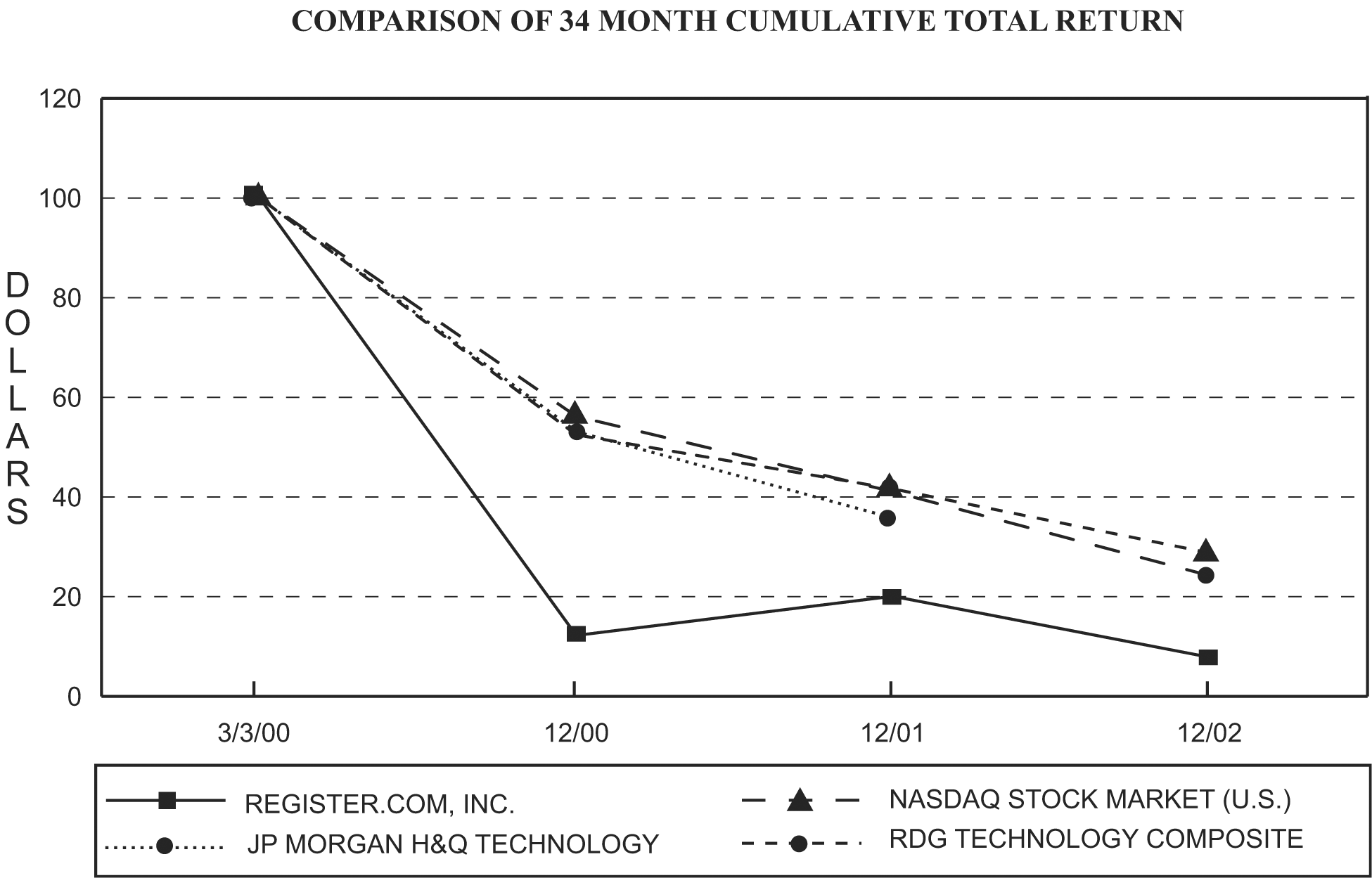
Set forth below is a graph comparing the cumulative total stockholder return of $100 invested in our Common Stock on March 3, 2000 (the day our shares commenced trading) through December 31, 2002 with the cumulative total return of $100 invested in the Research Data Group (RDG) Technology Composite Index and the Nasdaq Stock Market (U.S.) Index.


    Register.com, Inc.   Research Data
Group Technology
  Nasdaq Stock
Market (U.S.)


March 3, 2000
  $ 100.00   $ 100.00   $ 100.00  
December 29, 2000
    12.23     56.20     52.49  
December 31, 2001
    20.09     41.08     41.65  
December 31, 2002
    7.86     24.24     28.79  


Notes:
(1)
The graph covers the period from March 3, 2000, the first trading day of the Common Stock following the Company’s initial public offering of shares of its Common Stock, to December 31, 2002.
(2)
The graph assumes that $100 was invested at the market close on March 3, 2000 in the Company’s Common Stock and in each index, and that all dividends were reinvested. No cash dividends have been declared on the Company’s Common Stock.
(3)
Stockholder returns over the indicated period should not be considered indicative of future stockholder returns.
(4)
Because figures have been unavailable for the JPMorgan H & Q Technology Index over the past year, the Company now makes its Performance Graph comparison with the Research Data Group Technology Composite pursuant to Section 402(l)(1)(ii)(A) of Regulation S-K.

Notwithstanding anything to the contrary set forth in any of the Company’s previous filings made under the Securities Act of 1933, as amended, or the Securities Exchange Act of 1934, as amended, that might incorporate future filings made by the Company under those statutes, the Compensation Committee Report, the Audit Committee Report, Audit Committee Charter, reference to the independence of the Audit Committee members and the Stock Performance Graph are not deemed filed with the Securities and Exchange

24


Commission and shall not be deemed incorporated by reference into any of those prior filings or into any future filings made by the Company under those statutes.

CERTAIN RELATIONSHIPS AND RELATED TRANSACTIONS

On June 9, 2003, the Company entered into an Agreement with a group of stockholders of the Company led by Barington Companies Equity Partners, L.P. (“Barington”) that is made up of Barington, RCM Acquisition Co., LLC, Jewelcor Management, Inc., RCG Ambrose Master Fund, Ltd., Ramius Securities, LLC, James A. Mitarotonda and Seymour Holtzman. Barington is controlled by James A. Mitarotonda, our director nominee. Under the terms of this Agreement, the Company agreed to include Mr. Mitarotonda in its Board of Directors’ slate of nominees for election as a director of the Company at the Annual Meeting. In addition, the Company agreed to distribute an aggregate of $120 million in cash to its stockholders by means of dividend, repurchase of shares, or a combination, by September 1, 2003. This Agreement also provided for the withdrawal of the proposed proxy contest by Barington in connection with the Annual Meeting. In addition, the Company agreed to reimburse Barington for its out-of-pocket expenses (up to a maximum of $175,000) incurred in connection with the potential proxy contest.

In August 2002, we purchased U.S. Open tickets from Industrial Manufacturing Institute LLC (“IMI”), a company which is controlled by Mr. Quain. We paid $61,875 for these tickets, which is the same amount as IMI’s purchase price. These tickets were used for entertaining and conducting business with key customers, vendors and partners.

On December 20, 2001 we loaned Walt Meffert, Jr., our Chief Technology Officer $39,394.26 for the payment of withholding taxes in connection with restricted shares we granted him on November 12, 2001. The loan accrues interest at a rate of 3.93% per annum, compounded annually and becomes due and payable in full on November 12, 2004. The Company will forgive the principal and interest due under the loan in three equal annual installments, which commenced the first anniversary of Mr. Meffert’s start date, provided he remains employed by the Company. Should Mr. Meffert’s employment be terminated by the Company without cause or by either the Company or Mr. Meffert with good reason, the unpaid principal and interest due under the loan shall be forgiven in full. In addition, we gave Mr. Meffert a $35,975 loan to cover his relocation costs when he joined the Company. The Company will forgive the principal and interest due under the relocation loan in three equal annual installments, which commenced on the first anniversary of Mr. Meffert’s start date, provided he remains employed by the Company.

SECTION 16(a) BENEFICIAL OWNERSHIP REPORTING COMPLIANCE

The members of our Board of Directors, our executive officers and persons who hold more than ten percent of the Company’s outstanding Common Stock are subject to the reporting requirements of Section 16(a) of the Exchange Act, which requires them to file reports with respect to their ownership of our Common Stock and their transactions in such Common Stock. Based upon (i) the copies of Section 16(a) reports which the Company received from such persons for their 2002 Fiscal Year transactions in the Common Stock and their Common Stock holdings, and (ii) the written representations received from one or more of such persons that no annual Form 5 reports were required to be filed by them for the 2002 Fiscal Year, the Company believes that all reporting requirements under Section 16(a) for such fiscal year were met in a timely manner by its directors, executive officers and beneficial owners of greater than ten percent of our Common Stock.

ANNUAL REPORT

A copy of the Annual Report on Form 10-K for the 2002 Fiscal Year has been mailed concurrently with this Proxy Statement to all stockholders entitled to notice of and to vote at the Annual Meeting. The Annual Report is not incorporated into this Proxy Statement and is not considered proxy solicitation material.

The Company filed its Annual Report on Form 10-K with the Securities and Exchange Commission on April 4, 2003. Stockholders may obtain a copy of this report, without charge, by writing to the Secretary of the Company, at the Company’s principal executive offices located at 575 Eighth Av\enue, 8th Floor, New York, New York 10018.

25


PROXY

REGISTER.COM, INC.

PROXY FOR ANNUAL MEETING OF STOCKHOLDERS
JULY 31, 2003

(THIS PROXY IS SOLICITED BY THE BOARD OF DIRECTORS OF THE COMPANY)

The undersigned stockholder of Register.com, Inc. hereby appoints Peter A. Forman and Jonathan Stern, and each of them, with full power of substitution, proxies to vote the shares of stock which the undersigned could vote if personally present at the Annual Meeting of Stockholders of Register.com, Inc. to be held at the Princeton Club, 15 West 43rd Street, New York, New York 10036 on July 31, 2003 at 10:30 A.M. (Eastern Daylight time).

(continued and to be signed on reverse side)


Please date, sign and mail your
proxy card back as soon as possible!

Annual Meeting of Stockholders
REGISTER.COM, INC.

July 31, 2003

Please Detach and Mail in the Envelope Provided

A
Please mark your
votes as in this
example.

                     
1.  ELECTION OF
    DIRECTORS
    (for a term
    ending upon
    the 2004 Annual
    Meeting of
    Stockholders)


INSTRUCTION: To withhold authority to vote for
any nominee(s), write the nominee’s number on the
line below.

______________________________________
FOR ALL nominees
listed at right
(except as marked to
the contrary below)
WITHHOLD ALL


        Nominees:
  (01) Niles H. Cohen
  (02) Dewain K. Cross
  (03) Peter A. Forman
  (04) Richard D. Forman
  (05) James A. Mitarotonda
  (06) Stanley Morten
  (07) Mitchell I. Quain
  (08) Jim Rosenthal
  (09) Reginald Van Lee
2.  RATIFICATION OF
    PRICEWATERHOUSECOOPERS LLP,
    INDEPENDENT PUBLIC ACCOUNTANTS, AS
    THE COMPANY’S AUDITORS.


3.  IN THEIR DISCRETION UPON SUCH OTHER MATTERS AS MAY  PROPERLY COME BEFORE THE MEETING.

    UNLESS OTHERWISE SPECIFIED, THIS PROXY WILL BE VOTED FOR PROPOSALS 1 and 2.
  FOR


  AGAINST


  ABSTAIN


Signature ________________________________________ Date ____________________          Signature (Joint Owners) ________________________________________ Date ____________________

Note: Please date and sign exactly as your name appears on the envelope in which this material was mailed. If shares are held jointly, each stockholder should sign. Executors, administrators, trustees, etc. should give their full title and, if more than one, all should sign. If the stockholder is a corporation, please sign full corporate name by an authorized officer. If the stockholder is a partnership, please sign full partnership name by an authorized person.