Newmil Bancorp Inc DEF 14A, filed Mar 23, 2006: Newmil 3/24 2006 Proxy Statement
SCHEDULE
14A
(Rule
14a-101)
INFORMATION
REQUIRED IN PROXY STATEMENT
SCHEDULE
14A INFORMATION
Proxy
Statement Pursuant to Section 14(a) of the Securities
Exchange
Act of 1934 (Amendment No. )
Filed
by
the Registrant ⌧
Filed
by
a Party other than the Registrant ྑ
Check
the
appropriate box:
|
ྑ
Preliminary Proxy Statement
|
|
|
ྑ
Confidential, for Use of the Commission Only (as permitted by Rule
14a-6(e)(2))
|
|
|
S Definitive
Proxy Statement
|
|
|
ྑ
Definitive Additional Materials
|
|
|
ྑ
Soliciting Material Pursuant to
§240.14a-12
|
NewMil
Bancorp, Inc.
(Name
of
Registrant as Specified in Its Charter)
(Name
of
Person(s) Filing Proxy Statement, if other than the Registrant)
Payment
of Filing Fee (Check the appropriate box):
|
S
|
No
fee required.
|
|
ྑ
|
Fee
computed on table below per Exchange Act Rules 14a-6(i)(1) and 0-11.
|
|
(1)
|
Title
of each class of securities to which transaction applies:
|
|
________________________________________________________________________
|
|
(2)
|
Aggregate
number of securities to which transaction applies:
|
|
________________________________________________________________________
|
|
|
(3)
|
Per
unit price or other underlying value of transaction computed pursuant
to
Exchange Act Rule 0-11 (set forth the amount on which the filing
fee is
calculated and state how it was determined):
|
|
________________________________________________________________________
|
|
|
(4)
|
Proposed
maximum aggregate value of transaction:
|
|
________________________________________________________________________
|
|
|
(5)
|
Total
fee paid:
|
|
________________________________________________________________________
|
|
ྑ
|
Fee
paid previously with preliminary materials.
|
|
ྑ
|
Check
box if any part of the fee is offset as provided by Exchange Act
Rule
0-11(a)(2) and identify the filing for which the offsetting fee was
paid
previously. Identify the previous filing by registration statement
number,
or the form or schedule and the date of its filing.
|
|
(1)
|
Amount
previously paid:
|
|
|
______________________________________________________________________
|
|
(2)
|
Form,
Schedule or Registration Statement No.:
|
|
|
______________________________________________________________________
|
|
(3)
|
Filing
Party:
|
|
|
______________________________________________________________________
|
|
(4)
|
Date
Filed:
|
|
|
_____________________________________________________________________
|
NewMil
Bancorp, Inc.
19
Main Street, P.O. Box 600
New
Milford, Connecticut 06776
March
24,
2006
To
the Shareholders of
NewMil
Bancorp, Inc.:
You
are
cordially invited to attend the NewMil Bancorp, Inc. ("NewMil") Annual Meeting
of Shareholders to be held on Wednesday, April 26, 2006, at 9:30 a.m., at the
Candlewood Valley Country Club, New Milford, Connecticut.
At
the Annual
Meeting, you will be asked: (i) to elect four directors to serve for three-year
terms; (ii) to ratify the appointment of PricewaterhouseCoopers, LLP as
independent registered public accountants of NewMil for the year ending December
31, 2006; and (iii) to transact any other business that properly comes before
the Annual Meeting or any adjournments of the meeting.
The
Board of
Directors unanimously recommends that you vote
FOR
the
election of all the Board's nominees for election as directors and FOR
ratification
of the appointment of PricewaterhouseCoopers, LLP. We encourage you to read
the
accompanying Proxy Statement, which provides information regarding NewMil and
the matters to be voted on at the Annual Meeting. Also enclosed is our 2005
Annual Report to Shareholders.
It
is
important that your shares be represented at the Annual Meeting. Whether or
not
you plan to attend the Annual Meeting, you may complete, date, sign and return
the enclosed proxy card in the enclosed postage paid envelope. If you attend
the
meeting and prefer to vote in person, you may do so.
|
Sincerely,
|
||
|
/s/
Francis J. Wiatr
|
||
|
Francis
J. Wiatr
|
||
|
Chairman,
President and Chief Executive Officer
|
NEWMIL
BANCORP, INC.
Notice
of Annual Meeting of Shareholders
To
the
Shareholders of NewMil Bancorp, Inc.:
NOTICE
IS
HEREBY GIVEN that the 2006 Annual Meeting of Shareholders of NEWMIL BANCORP,
INC. will be held at the Candlewood Valley Country Club, New Milford,
Connecticut on Wednesday, April 26, 2006, at 9:30 a.m., for the purpose of
considering and voting on the following matters:
|
1.
|
To
elect four directors to serve until the Annual Meeting of Shareholders
in
2009 who, with the eight directors whose terms of office do not expire
at
this meeting, will constitute the full board of
directors.
|
|
2.
|
To
ratify the appointment of PricewaterhouseCoopers, LLP as independent
registered public accountants for the year ending December 31, 2006.
|
|
3.
|
To
transact such other business as may properly be brought before the
meeting
or any adjournment thereof.
|
Only
shareholders of record at the close of business on March 6, 2006, are entitled
to notice of and to vote at this meeting or any adjournment
thereof.
|
By
order of the Board of Directors,
|
|
|
/s/
Betty F. Pacocha
|
|
|
Betty
F. Pacocha
|
|
|
Secretary
|
|
New
Milford, Connecticut
March
24,
2006
YOUR
VOTE IS IMPORTANT. WE URGE YOU TO SIGN AND RETURN THE ENCLOSED PROXY IN THE
ENCLOSED POSTAGE PREPAID ENVELOPE AS PROMPTLY AS POSSIBLE WHETHER OR NOT YOU
PLAN TO ATTEND THE MEETING IN PERSON. IF YOU DO ATTEND THE MEETING, YOU MAY
THEN
REVOKE YOUR PROXY AND VOTE IN PERSON.
NewMil
Bancorp, Inc.
19
Main Street, P.O. Box 600
New
Milford, Connecticut 06776
_______________
PROXY
STATEMENT FOR ANNUAL MEETING OF SHAREHOLDERS
TO
BE HELD ON APRIL 26, 2006
________________
ANNUAL
MEETING
This
Proxy Statement (the "Proxy Statement") is being furnished to the shareholders
of NewMil Bancorp, Inc., a Delaware corporation ("NewMil"), as part of the
solicitation of proxies by its Board of Directors from holders of its
outstanding shares of common stock, par value $.50 per share (the "Common
Stock"), for use at the Annual Meeting of Shareholders of NewMil to be held
on
Wednesday, April 26, 2006,
at
9:30 a.m., local time, at the Candlewood Valley Country Club (the "Annual
Meeting") and at any adjournments of the meeting. The Proxy Statement, together
with the enclosed proxy card, is being mailed to shareholders of NewMil on
or
about March 24, 2006.
Purposes
of the Annual Meeting
The
Annual
Meeting has been called for the following purposes: (i) to elect four directors
to serve for three-year terms (Proposal 1); (ii) to ratify the appointment
of
the firm of PricewaterhouseCoopers, LLP as independent registered public
accountants of NewMil for the year ending December 31, 2006 (Proposal 2); and
(iii) to transact any other business that properly comes before the Annual
Meeting or any adjournments of the meeting.
If
you
vote using the enclosed form of proxy, your shares will be voted in accordance
with the instructions indicated. Executed but unmarked proxies will be voted
FOR
the
election of the Board's nominees as directors and FOR
the
ratification of the appointment of NewMil's independent registered public
accountants. Except for procedural matters incident to the conduct of the Annual
Meeting, the Board of Directors does not know of any matters other than those
described in the Notice of Annual Meeting that are to come before the Annual
Meeting. If any other matters are properly brought before the Annual Meeting,
the persons named in the proxy will vote the shares represented by such proxy
on
such matters as determined by a majority of the Board of Directors.
Who
Can Vote at the Annual Meeting; Record Date
Each
share of NewMil common stock entitles its owner to one vote on all matters
properly presented at the Annual Meeting. There is no cumulative voting of
shares. The Board of Directors has fixed the close of business on March 6,
2006
as the record date for the determination of shareholders of NewMil entitled
to
notice of and to vote at the Annual Meeting. On the record date, there were
approximately 1,322 holders of record of the 4,075,378 shares of Common Stock
then outstanding and eligible to be voted at the Annual Meeting.
How
to Vote
If
your
Common Stock is held by a broker, bank or other nominee (i.e.,
in
"street name"), you should receive instructions from that person or entity
that
you must follow in order to have your shares of Common Stock voted. If you
hold
your Common Stock in your own name and not through a broker or another nominee,
you may vote your shares of Common Stock:
|
●
by signing, dating and mailing the proxy card in the enclosed postage-paid
envelope; or
|
|
|
●
by attending the Annual Meeting and voting in
person.
|
The
proxy
holders will vote your Common Stock in accordance with your instructions. If
you
give a proxy without specific voting instructions, your proxy will be voted
by
the proxy holders FOR
the two
matters identified above, or as otherwise recommended by the Board of Directors.
Quorum
and Vote Required
The
presence,
in person or by proxy, of a majority of the total number of outstanding shares
of Common Stock entitled to vote at the Annual Meeting is necessary to
constitute a quorum at the Annual Meeting for the election of directors and
the
ratification of the appointment of NewMil's independent registered public
accountants. Assuming the presence of a quorum at the Annual Meeting, directors
will be elected by a majority of the votes of the shares of Common Stock present
in person or represented by proxy and entitled to vote. The
affirmative
vote of the majority of the votes cast is required to ratify the appointment
of
NewMil's independent registered public accountants. Shareholders' votes will
be
tabulated by
the
persons appointed by the Board of Directors to act as inspectors of election
for
the Annual Meeting. Abstentions and broker non-votes will be treated as shares
that are present, or represented, and entitled to vote for purposes of
determining the presence of a quorum at the Annual Meeting. Broker non-votes
will not be counted as a vote cast on any matter presented at the Annual
Meeting. Abstentions will not be counted in determining the number of votes
cast
in connection with any matter presented at the Annual Meeting.
Revocability
of Proxies
The
presence
of a shareholder at the Annual Meeting will not automatically revoke that
shareholder's proxy. A shareholder may, however, revoke a proxy at any time
before it is voted (i) by delivering either a written notice of revocation
of
the proxy or a duly executed proxy bearing a later date to Secretary, NewMil
Bancorp, Inc., 19 Main Street, P.O. Box 600, New Milford, Connecticut, 06776,
or
(ii) by attending the Annual Meeting and voting in person.
Solicitation
of Proxies
The
cost of
soliciting proxies for the Annual Meeting will be borne by NewMil. In addition
to use of the mails, proxies may be solicited personally or by telephone or
telecopy by directors, officers and employees, who will not be specially
compensated for such activities. NewMil also will request persons, firms and
companies holding shares in their names or in the name of their nominees, which
are beneficially owned by others, to send proxy materials to and obtain proxies
from those beneficial owners and will reimburse those holders for their
reasonable expenses incurred in that connection.
GOVERNANCE
OF NEWMIL
NewMil
is a
Delaware corporation and is the holding company of NewMil Bank (the "Bank").
The
business and affairs of NewMil are managed by or under the direction of the
Board of Directors of NewMil. Members of the Board of Directors inform
themselves of NewMil's business through discussions with its chairman, president
and chief executive officer and with other key members of management, by
reviewing materials provided to them, and by participating in meetings of the
Board of Directors and its committees.
The
Nominating Committee of the Board of Directors assists the Board in its
oversight of corporate governance policies and practices, board composition,
and
director nomination and related matters.
Independence
of NewMil's Board of Directors and Members of Its
Committees
It
is the
policy of the Board of Directors of NewMil that a majority of its directors
be
independent of NewMil within the meaning of applicable laws and regulations.
NewMil's Board of Directors has affirmatively determined that all of the
directors nominated for election at the annual meeting and all directors of
NewMil whose terms continue are independent, except for Ms. Pacocha and Mr.
Wiatr because they are both executive officers of NewMil and the Bank. NewMil's
Board of Directors has also affirmatively determined that the Audit, Salary
and
Benefits, and Nominating Committees, are comprised entirely of independent
directors within the meaning of applicable laws and regulations.
The
Nominating Committee has established a Director Independence Determination
Policy in order to make its determinations regarding independence of directors.
The Committee has established guidelines to assist it in determining director
independence as defined under the published listing standards of the NASDAQ
Stock Market, Inc. ("NASDAQ"). The NASDAQ independence definition includes
a
series of objective tests. In addition, as further required by NASDAQ rules,
the
Board has made a subjective determination as to each independent director that
no relationship exists which, in the opinion of the Board, would interfere
with
the exercise of independent judgment in carrying out the responsibilities of
a
director.
Meetings
of the Board of Directors and Its Committees
NewMil's
Board of Directors meets on a monthly basis and may hold additional special
meetings. During 2005, the Board held twelve regular meetings. In addition,
there were meetings during 2005 of the various committees of the Board of
Directors. None of our directors attended fewer than 75% of the aggregate number
of meetings of the Board of Directors held while he or she was a member of
the
Board during 2005 and the number of meetings held by all committees during
the
period which he or she served on such committee during 2005.
2
Although
NewMil has not formally adopted a policy regarding attendance by directors
at
the annual meeting of shareholders, all directors are encouraged to attend
the
annual meetings. At the April 27, 2005 Annual Meeting, all of the directors
were
in attendance. All of the NewMil directors are expected to attend the 2006
Annual Meeting of Shareholders.
Committees
of the Board of Directors
The
Board of
Directors of NewMil has four committees: the Audit Committee, the Investment
Committee, the Nominating Committee, and the Salary and Benefits Committee.
Excluding the Investment Committee, each of those committees is a joint
committee of NewMil and the Bank. The Bank has two additional committees, the
Community Reinvestment Act ("CRA") Committee and the Loan Committee. The Board
of Directors may, by resolution, designate one or more additional committees.
The
Audit
Committee
consists
of Directors Carlson, Dumas and McCarthy, with Carlson serving as Chair. The
Audit Committee, which operates under a charter, monitors the integrity of
financial statements of NewMil, the compliance of NewMil and the Bank with
legal
and regulatory requirements, and the independence and performance of NewMil's
internal and external auditors. The Audit Committee reviews and reassesses
the
adequacy of the charter each year. Each of the members of the Audit Committee
meets the independence requirements of the rules of NASDAQ and the SEC. Joseph
Carlson II and Kevin Dumas have accounting or related financial management
expertise and are considered by NewMil to be “financial experts” as defined in
the Securities Exchange Act of 1934, as amended (the "Exchange Act") rules
and
regulations. The Audit Committee met six times during the year ended December
31, 2005.
The
Salary
and Benefits Committee
consists
of Directors Dumas, Gonthier, Powers and Williams, with Williams serving as
Chair. The Salary and Benefits Committee oversees director and executive officer
compensation and administers the 1986 Stock Option and Incentive Plan (the
"Employee Plan") for officers and key employees of the Bank, which includes
recommendations for the granting of stock options. The Salary and Benefits
Committee met two times during the year ended December 31, 2005. This Committee
either determines, or recommends to the independent directors of the Board,
the
compensation of the chief executive office and all other executive
officers.
The
Nominating
Committee
consists
of Directors Bullock, Carlson, Powers and Williams, with Powers serving as
Chair. The Nominating Committee is responsible for establishing criteria for
directors, making recommendations for the nomination of directors, overseeing
self-assessment evaluations for the Board and its Committees and addressing
other governance issues. The Nominating Committee met two times for the year
ended December 31, 2005.
The
Investment
Committee
of the
Bank and the Investment Committee of NewMil consists of Directors Carlson,
Dumas, Gonthier, Jaber, McCarthy and Wiatr, with Gonthier serving as Chair.
NewMil's Investment Committee approves investment policy and monitors the
performance of NewMil's portfolio. NewMil did not have an investment portfolio
during 2005. The Bank's Investment Committee approves investment, liquidity
and
interest rate risk policies and monitors the performance of the Bank's
investment portfolio, liquidity and interest rate risk positions. The Investment
Committee of NewMil met once during the year ended December 31, 2005. The Bank’s
Investment Committee met twelve times during the year ended December 31,
2005.
The
Loan
Committee
consists
of Directors Bullock, Carlson, Dumas, Jaber, McCarthy, Otto, Powers and Wiatr,
with Wiatr serving as Chair. The Loan Committee approves the loan policies
of
the Bank, approves certain loans and reviews all reports on the loan portfolio.
The Loan Committee met thirteen times during the year ended December 31,
2005.
The
CRA
Committee
consists
of Directors Bullock, Otto, Pacocha, Rizzo and Wiatr, with Rizzo serving as
Chair. The CRA Committee was formed as a means of assuring compliance with
the
requirements of the CRA. The CRA Committee met four times during the year ended
December 31, 2005.
Director
Compensation
NewMil's
philosophy is to pay competitive retainer fees and to continue to provide
long-range incentives to directors through stock option grants and to more
closely align the fiscal interests of the directors with those of the
shareholders, as is the case with executive management compensation.
Non-employee directors ("Eligible Directors") received an annual retainer of
$13,500. The Chair of Audit Committee also received a retainer of $8,500 for
2005. Directors received $850 for each Board meeting attended. Audit Committee
members received $700 for each meeting attended. The members of all other
committees received fees for each meeting attended ranging from $400 to $650,
depending upon the committee. Officers of NewMil who are also directors receive
no compensation as directors.
3
Director
Deferred Compensation Agreements
Each
of
directors Carlson, Dumas, Jaber, and Rizzo is a party to an unfunded,
unqualified Director Deferred Compensation Agreement under which these directors
have elected to defer fees that would have otherwise been paid to each director
into a deferred balance account. In 2005, these agreements were amended to
cause
potential payments payable to be in compliance with Section 409A of the Internal
Revenue Code (the "Code"), which was added to the Code by the American Jobs
Creation Act of 2004. Each deferred balance account is credited annually with
interest, compounded monthly, at a rate based on each December’s 5-year U.S.
Treasury constant maturity index. The applicable index-crediting rate for 2005
was 3.60%. Upon the later of age 65 or termination of director service with
NewMil, directors are eligible to receive their deferral account balance either
in a lump sum or in 120 equal monthly installments. Should NewMil experience
a
change in control, each director will be entitled to receive their deferral
account balance in a lump sum.
Director
Split-Dollar Life Insurance Agreements
Effective
January 1, 2002, the Bank purchased insurance on the lives of its 10
non-employee directors and entered into split-dollar insurance agreements with
them. The Bank fully paid the premiums for the 10 policies with one lump sum
premium payment of $2.47 million. The premium paid is recorded as a Bank asset
and the increase in the cash surrender values of the policies is recorded as
Bank income. Under the split-dollar insurance agreements, policy interests
are
divided between the Bank and each director. The death benefit of each director
is fixed at $250,000, payable directly by the insurance company to the
director’s named beneficiary. As a consequence, the Bank has no benefit
obligation to the director. A director who is removed for cause or whose
re-nomination is withheld for cause forfeits all benefits under the split-dollar
insurance arrangement.
The
Bank
will receive the remainder of the death benefits after payment of the fixed
$250,000 benefit to the director’s beneficiary. The Bank expects to recover from
its portion of the policies’ death benefits the entire premium. The Bank also
owns the cash surrender value, including accumulated policy earnings. As it
does
in the case of any whole life insurance policy, the cash surrender value
increases over time. Because it is the intention of the Bank to hold the
bank-owned life insurance until the death of the insureds, increases in cash
surrender value should be tax-free income under current tax law. This contrasts
with a taxable gain that the Bank would recognize for assets in traditional
taxable investments such as U.S. Treasury or agency securities. The Bank expects
that collection of death benefits on the policies, which is likewise tax free
under current federal and state income taxation, will further enhance the Bank’s
return.
Selection
of Nominees for the Board of Directors
The
Nominating Committee is responsible for the identification and recruitment
of
director candidates. The Nominating Committee recommends to the independent
members of NewMil's Board of Directors candidates for director either to be
elected at annual meetings of shareholders or to be appointed by Board of
Directors from time to time for the purpose of filling any vacancy on the Board
of Directors. NewMil's practice is to recruit directors best able to provide
the
oversight necessary to insure that NewMil meets all of its fiduciary obligations
to shareholders. When recruiting a director it is generally thought that,
subject to shareholder approval, the director will become a long-term fiduciary
of NewMil. In this manner the director can serve on a variety of committees
over
time and bring objective oversight or specific knowledge to the oversight
function. In identifying and evaluating nominees for director, the Nominating
Committee considers each candidate’s experience, integrity, background and
skills, potential to enhance the Bank’s image in the business community and
business development opportunities, as well as any other qualities that the
candidate may possess and factors that the candidate may be able to bring to
the
Board. NewMil has not paid any fee to any third party for the identification
or
evaluation of any candidates. NewMil is not aware of any recommendations
submitted by a shareholder for nomination to the Board. The process for a
shareholder to make director nominations is described below in "Shareholder
Nominations for the Board."
Shareholder
Nominations for the Board
NewMil's
Bylaws also permit shareholders eligible to vote at the Annual Meeting to make
nominations for directors, but only if such nominations are made pursuant to
timely notice in writing to the Secretary of NewMil. To be timely, a
shareholder's notice must be delivered to or mailed and received at NewMil's
principal executive offices not fewer than 60 days nor more than 90 days prior
to the annual meeting; provided, however, that if fewer than 50 days' notice
or
prior public disclosure of the date of the annual meeting is given or made
to
shareholders, notice by the shareholder to be timely must be received not later
than the close of business on the 10th day following the day on which such
notice of the date of the meeting was mailed or such public disclosure was
made.
A shareholder's notice must set forth (a) as to each person whom the shareholder
proposes to nominate for election or re-election as a director, (i) the name,
age, business address and residence address of such person, (ii) the principal
occupation or employment of such person, (iii) the class and number of shares
of
capital stock of NewMil which are beneficially owned by such person, (iv) the
total number of shares of capital stock of NewMil that will be voted for each
proposed nominee,
4
and
(v)
any other information relating to such person that is required to be disclosed
in solicitation of proxies for election of directors, or is otherwise required,
in each case pursuant to Regulation 14A under the Exchange Act (including
without limitation such person's written consent to being named in the proxy
statement as a nominee and to serving as a director if elected) and (b) as
to
the shareholder giving the notice (i) the name and address of such shareholder,
as they appear on NewMil's books, and (ii) the class and number of shares of
capital stock of NewMil which are beneficially owned by such
shareholder.
Shareholder
Communications with the Board
NewMil
has
made an effort to ensure that the Board of Directors or individual directors,
if
applicable, consider the views of NewMil's shareholders. NewMil believes that
its responsiveness to shareholder communications to the Board of Directors
has
been appropriate and timely. Shareholders may communicate with the Board of
Directors by sending an email to NewMil’s Chairman, Francis J. Wiatr
(fwiatr@newmilbank.com)
or by
written correspondence to the Board of Directors or an individual director
with
a copy to Mr. Wiatr.
Code
of Conduct and Ethics
All
employees
and directors, officers and employees are required to comply with NewMil
Bancorp’s Code of Ethics Policy. The Code was adopted as a means of promoting
ethical conduct among all of the Bank's and NewMil's directors, officers and
employees. The Code is also designed to promote honesty in terms of
communications within the Bank and NewMil and from the Bank and NewMil to its
customers, markets and shareholders. The Bank and NewMil have and will continue
to place great emphasis on the importance of ethical conduct from it directors,
officers and employees. You may obtain a printed copy of the Code, without
charge, by written correspondence to Secretary, NewMil Bancorp, Inc., 19 Main
Street, P.O. Box 600, New Milford, Connecticut 06776.
RELATIONSHIP
WITH INDEPENDENT REGISTERED PUBLIC ACCOUNTANTS
General
The
Audit
Committee appointed PricewaterhouseCoopers, LLP as the independent registered
public accountants firm to audit NewMil’s financial statements for the year
ending December 31, 2006. In making its selection, the Audit Committee
considered whether PricewaterhouseCoopers, LLP’s provision of services other
than audit services is compatible with maintaining the independence of NewMil’s
outside accountants. In addition, the Audit Committee reviewed the fees
described below for audit-related services and tax services and concluded that
such fees are compatible with the independence of PricewaterhouseCoopers,
LLP.
Auditor
Fee Information
The
following
table presents fees for professional audit services rendered by
PricewaterhouseCoopers, LLP for the audit of NewMil's annual financial
statements for the years ended December 31, 2005 and 2004 and fees billed
for other services rendered by PricewaterhouseCoopers, LLP during those periods.
|
Year
Ended December 31,
|
|||||||
|
2005
|
2004
|
||||||
|
Audit
Fees
|
$
|
185,000
|
$
|
202,590
|
|||
|
Audit-Related
Fees
|
15,000
|
14,789
|
|||||
|
Tax
Services
|
32,000
|
33,350
|
|||||
|
Total
|
$
|
232,000
|
$
|
250,729
|
|||
Audit
Fees consist of fees billed for professional services rendered for the audit
of
NewMil's consolidated annual financial statements and review of the interim
consolidated financial statements included in quarterly reports and services
that are normally provided by PricewaterhouseCoopers, LLP in connection with
statutory and regulatory filings or engagements.
Audit-Related
Fees consist of fees billed for assurance and related services that are
reasonably related to NewMil's employee benefit plan audit, procedures related
to reports required by the Federal Deposit Insurance Corporation Improvement
Act
of 1991 and Sarbanes-Oxley Section 404 consultations.
Tax
Fees
consist of fees billed for professional services rendered for the preparation
of
NewMil's federal and state tax returns and reviews of quarterly estimated
federal and state tax payments.
5
Policy
on Audit Committee Pre-Approval of Audit and Non-Audit Services of Independent
Registered Public Accountant
Consistent
with SEC requirements regarding auditor independence, the Audit Committee is
required to pre-approve all audit and permissible non-audit services provided
by
the independent registered public accountants. Pre-approval is generally
provided for up to one year and any pre-approval is detailed as to the
particular service or category of services and is generally subject to a
specific budget.
All
engagements of the independent registered public accountants to perform any
audit services and non-audit services during 2005 were pre-approved by the
Audit
Committee in accordance with the pre-approval policy. The policy has not been
waived in any instance. All engagements of the independent auditor to perform
any audit services and non-audit services prior to the date the pre-approval
policy was implemented were approved by the Audit Committee in accordance with
its normal functions, and none of those engagements made use of the de minimus
exception to pre-approval contained in the SEC's rules.
REPORT
OF THE AUDIT COMMITTEE
In
accordance with rules adopted by the SEC, the Audit Committee of the Board
of
Directors of NewMil makes this report for the year ended December 31,
2005.
The
Audit
Committee of the Board of Directors is responsible for providing independent,
objective oversight of NewMil's accounting functions and internal controls.
Its
responsibilities include appointing, compensating and monitoring NewMil's
independent registered public accountants. During 2005, the Audit Committee
was
composed of three directors, each of whom is independent under the rules and
regulations of the Exchange Act and NASDAQ. All Audit Committee members are
considered to be financially literate by the Board of Directors of NewMil.
Joseph Carlson II and Kevin Dumas have accounting or related financial
management expertise and are considered to be "financial experts" as defined
in
the SEC's rules and regulations. The Audit Committee operates under a written
charter approved by the Board of Directors.
Management
is responsible for NewMil's internal controls and financial reporting process.
The independent registered public accountants, PricewaterhouseCoopers, LLP,
are
responsible for performing an independent audit of NewMil's consolidated
financial statements in accordance with auditing standards generally accepted
in
the United States of America and to issue a report thereon. The Audit
Committee's responsibility is to monitor and oversee these
processes.
In
connection with these responsibilities, the Audit Committee met with management
and PricewaterhouseCoopers, LLP to review and discuss the December 31, 2005
consolidated financial statements and to discuss the status of the internal
control reviews performed pursuant to section 404 of the Sarbanes Oxley Act.
The
Committee also discussed with PricewaterhouseCoopers, LLP the matters required
by Statement on Auditing Standards No. 61 (Communication with Audit Committees),
as amended by Statement on Auditing Standards No. 90 (Audit Committee
Communications). The Audit Committee also received written disclosures from
PricewaterhouseCoopers, LLP required by Independence Standards Board Standard
No. 1 (Independence Discussions with Audit Committees), and the Audit Committee
discussed with PricewaterhouseCoopers, LLP the firm's independence.
Based
upon the Audit Committee's discussions with management and the independent
registered public accountants, and the Committee's review of the presentations
of management and the independent registered public accountants, the Audit
Committee recommended that the NewMil Board of Directors include the audited
consolidated financial statements in NewMil's Annual Report on Form 10-K for
the
year ended December 31, 2005 filed with the SEC.
The
Audit Committee:
Joseph
Carlson II
Robert
J.
McCarthy
Kevin
L.
Dumas
6
ELECTION
OF DIRECTORS
(Proposal
1)
At
the
Annual Meeting, four directors will be elected to serve for three-year terms.
Unless otherwise specified on the proxy, it is the intention of the persons
named in the proxy to vote the shares represented by each properly executed
proxy for the election as directors of the persons named below as nominees.
The
Board of Directors believes that the nominees will stand for election and will
serve if elected as directors. If, however, any person nominated by the Board
fails to stand for election or is unable to accept election, the proxies will
be
voted for the election of such other person as the Board of Directors may
recommend. Assuming the presence of a quorum at the Annual Meeting, directors
will be elected by a majority of the votes of the shares of Common Stock present
in person or represented by proxy and entitled to vote at the Annual Meeting.
There are no cumulative voting rights in the election of directors.
Nominees
and Directors
The
Board
of Directors of NewMil consists of 12 members, each of whom belongs to one
of
three classes. Directors serve three-year staggered terms so that only
approximately one-third of the Directors are elected at each annual meeting
of
shareholders.
The
following tables set forth the names of the Board of Directors' nominees for
election as directors and the current directors of NewMil. Also set forth is
certain other information with respect to each such person's age at December
31,
2005, positions currently held with NewMil and its wholly owned subsidiary,
NewMil Bank, periods during which such person has served as a director of NewMil
and when their current term expires. The tables set forth information as of
March 1, 2006 with respect to the amount of NewMil Common Stock beneficially
owned by each director of NewMil, each nominee for election as a director,
each
of the named executive officers and by all directors and execution officers
of
NewMil as a group. The address of each person is NewMil Bancorp, Inc., 19 Main
Street, P.O. Box 600, New Milford, Connecticut 06776.
DIRECTOR
NOMINEES FOR A THREE-YEAR TERM EXPIRING IN 2009
|
Positions
Held With NewMil
|
Shares
of
|
|||||
|
and
the Bank;
|
Has
Served
|
Term
Will
|
Common
Stock
|
Percent
of
|
||
|
Principal
Occupation
|
as
a
|
Expire
At
|
Beneficially
|
Common
Stock
|
||
|
During
the Past Five Years
|
Director
|
the
Annual
|
Owned
as of
|
Beneficially
|
||
|
Name
|
and
Directorships
|
Age
|
Since
|
Meeting
in*
|
March
1, 2006
|
Owned
|
|
Herbert
E. Bullock
|
Director;
Employee, Echo
|
71
|
1987
(1)
|
2009
|
15,400
(2)
|
0.36%
|
|
Bay
Marina,
|
||||||
|
New
Milford, CT
|
||||||
|
Kevin
L. Dumas
|
Director;
Owner of Dumas
|
49
|
2000
|
2009
|
29,208
(3)
|
0.68%
|
|
&
Company, Certified Public
|
||||||
|
Accountants;
Former Director
|
||||||
|
of
NMBT Corporation
|
||||||
|
John
J. Otto
|
Director;
President of
|
70
|
2000
(4)
|
2009
|
31,377
(5)
|
0.73%
|
|
The
Otto Company; Former
|
||||||
|
Director
of Nutmeg Federal
|
||||||
|
Savings
and Loan Association
|
||||||
|
Francis
J. Wiatr
|
Director;
Chairman, President,
|
55
|
1994
(6)
|
2009
|
155,192
(7)
|
3.62%
|
|
and
CEO of NewMil
|
||||||
|
and
Bank
|
*
Assumes
election at Annual Meeting.
|
(1)
|
Mr.
Bullock has been a director of NewMil since its formation in 1987.
Mr.
Bullock has been a director of the Bank since 1972.
|
|
(2)
|
Includes
400 shares held jointly by Mr. Bullock with his spouse and options
to
purchase 15,000 shares of Common Stock exercisable within 60 days
of the
most recent practicable date.
|
|
(3)
|
Includes
18,708 shares held directly by Mr. Dumas, 500 shares held jointly
with his
brother, 2,000 shares held as custodian for his children and options
to
purchase 8,000 shares of Common Stock exercisable within 60 days
of the
most recent practicable date.
|
|
(4)
|
Mr.
Otto was elected a director of NewMil and the Bank contemporaneously
with
NewMil's acquisition of Nutmeg Federal Savings & Loan Association on
November 9, 2000.
|
|
(5)
|
Includes
26,377 shares held directly by Mr. Otto and 4,000 held jointly by
Mr. Otto
and his spouse
|
|
(6)
|
Mr.
Wiatr was appointed President of NewMil and President and Chief Executive
Officer ("CEO") of the Bank on March 21, 1994. He was appointed Chairman
and CEO of NewMil and Chairman of the Bank on August 5,
1997.
|
7
|
(7)
|
Includes
152,692 shares held directly by Mr. Wiatr and options to purchase
2,500
shares of Common Stock exercisable within 60 days of the most recent
practicable date.
|
DIRECTORS
CONTINUING IN OFFICE
|
Positions
Held With NewMil
|
Shares
of
|
|||||
|
and
the Bank;
|
Has
Served
|
Term
Will
|
Common
Stock
|
Percent
of
|
||
|
Principal
Occupation
|
as
a
|
Expire
At
|
Beneficially
|
Common
Stock
|
||
|
During
the Past Five Years
|
Director
|
the
Annual
|
Owned
as of
|
Beneficially
|
||
|
Name
|
and
Directorships
|
Age
|
Since
|
Meeting
in
|
March
1, 2006*
|
Owned
|
|
Joseph
Carlson II
|
Director;
Retired;
|
66
|
1997
|
2008
|
24,000
(1)
|
0.56%
|
|
St
Mary’s Health Systems
|
||||||
|
Director
and Financial
|
||||||
|
Consultant
|
||||||
|
Laurie
G. Gonthier
|
Director;
Vice President-
|
56
|
1990
|
2007
|
33,570
(2)
|
0.78%
|
|
Investments
for UBS
|
||||||
|
Financial
Services,
|
||||||
|
Middlebury,
CT
|
||||||
|
Paul
N. Jaber
|
Director;
Attorney;
|
63
|
2000
(3)
|
2007
|
77,816
(4)
|
1.82%
|
|
Former
Chairman of
|
||||||
|
Nutmeg
Federal Savings
|
||||||
|
&
Loan Association
|
||||||
|
Robert
J. McCarthy
|
Director;
Former Chairman,
|
62
|
1999
|
2007
|
74,082
(5)
|
1.73%
|
|
President
and Chief Operating
|
||||||
|
Officer
of Norco Inc.,
|
||||||
|
Georgetown,
CT
|
||||||
|
Betty
F. Pacocha
|
Director;
Secretary of
|
72
|
1997
(6)
|
2008
|
29,026
(7)
|
0.68%
|
|
NewMil
and
|
||||||
|
Executive
Vice President
|
||||||
|
and
Secretary of the Bank
|
||||||
|
Suzanne
L. Powers
|
Director;
Attorney;
|
67
|
1988
|
2007
|
29,001
(8)
|
0.68%
|
|
Former
Judge of Probate
|
||||||
|
Anthony
M. Rizzo
|
Director;
CEO of A.M. Rizzo
|
65
|
2000
(9)
|
2008
|
118,241
(10)
|
2.76%
|
|
Electrical
Contractors,
|
||||||
|
Former
Director of Nutmeg
|
||||||
|
Federal
Savings and Loan
|
||||||
|
Association
|
|
|
|
|
||
|
Mary
C. Williams
|
Director;
Former Vice
|
66
|
1990
|
2008
|
77,000
(11)
|
1.80%
|
|
President
of J & J Log and
|
||||||
|
Lumber
Corp.
|
||||||
| All Directors and Executive Officers as a Group (23 Persons) |
927,691
(12)
|
21.66%
(13)
|
|
(1)
|
Includes
23,000 shares held directly by Mr. Carlson and options to purchase
1,000
shares of Common Stock exercisable within 60 days of the most recent
practicable date.
|
|
(2)
|
Includes
6,500 shares held directly by Mr. Gonthier, 13,570 shares held jointly
with his spouse, 500 shares held as custodian for his son and options
to
purchase 13,000 shares of Common Stock exercisable within 60 days
of the
most recent practicable date.
|
|
(3)
|
Mr.
Jaber was elected a director of NewMil and the Bank contemporaneously
with
NewMil's acquisition of Nutmeg Federal Savings & Loan Association on
November 9, 2000.
|
|
(4)
|
Includes
7,828 shares held by the Profit Sharing Plan of the law firm of Cutsumpas,
Collins, Hannafin, Jaber and Tuozzolo, 64,988 held directly by Mr.
Jaber
and options to purchase 5,000 shares of Common Stock exercisable
within 60
days of the most recent practicable date.
|
|
(5)
|
Includes
18,682 shares held jointly by Mr. McCarthy with his spouse, 42,400
shares
held by family members where Mr. McCarthy has Power of Attorney or
is
trustee for those shares, options to purchase 10,000 shares of Common
Stock exercisable within 60 days of the most recent practicable date,
and
3,000 shares held by a non-profit agency of which Mr. McCarthy is
treasurer.
|
|
(6)
|
Ms.
Pacocha has been an employee of the Bank since 1961 and she has served
as
Secretary of NewMil since 1992.
|
8
|
(7)
|
Includes
18,276 shares held directly by Ms. Pacocha and options to purchase
10,750
shares of Common Stock exercisable within 60 days of the most recent
practicable date.
|
|
(8)
|
Includes
7,001 shares held directly by Ms. Powers, 14,000 shares held jointly
by
Ms. Powers with her spouse, 5,000 shares held by Ms. Powers' spouse
and
options to purchase 3,000 shares of Common Stock exercisable within
60
days of the most recent practicable date.
|
|
(9)
|
Mr.
Rizzo was elected a director of NewMil and the Bank contemporaneously
with
the NewMil's acquisition of Nutmeg Federal Savings & Loan Association
on November 9, 2000.
|
|
(10)
|
Includes
113,241 shares held jointly with Mr. Rizzo and his spouse and options
to
purchase 5,000 shares of Common Stock exercisable within 60 days
of the
most recent practicable date.
|
|
(11)
|
Includes
64,000 shares held directly by Ms. Williams and options to purchase
13,000
shares of Common Stock exercisable within 60 days of the most recent
practicable date.
|
|
(12)
|
Includes
206,300 shares issuable upon the exercise of options exercisable
by such
persons within 60 days of the most recent practicable
date.
|
|
(13)
|
For
the purpose of calculating the percentage of Common Stock beneficially
owned by the directors and executive officers as a group, the total
number
of shares outstanding includes 206,300 shares issuable upon the exercise
of options that may be exercised by such persons within 60 days of
the
most recent practicable date (the "Option
Shares").
|
*
In
accordance with Rule 13d-3 under the Exchange Act, as amended, a person is
deemed to be the beneficial owner, for purposes of this table, of any shares
of
Common Stock if such person has or shares voting power and/or investment power
with respect to the security, or has the right to acquire beneficial ownership
at any time within 60 days from March 1, 2006. As used herein, "voting power"
includes the power to vote or direct the voting of shares and "investment power"
includes the power to dispose or direct the disposition of shares.
The
Board of
Directors has determined that, except as noted below, all of the members
of the
Board are "independent directors" for purposes of Rule 4350 of NASDAQ. The
Board
of Directors based these determinations primarily on a review by the Nominating
Committee of the responses of the directors to questions regarding employment
and compensation history, affiliations and family and other relationships.
Ms.
Pacocha and Mr. Wiatr are not considered independent because they are both
executive officers of NewMil and the Bank.
Indemnification
and Limitation of Liability
NewMil's
and the Bank's Certificates of Incorporation and Bylaws contain provisions
that
limit the liability of and indemnify its directors, officers, employees and
agents. Such provisions provide that each person who was or is made a party
or
is threatened to be made a party to or is otherwise involved in any action,
suit
or proceeding, whether civil, criminal, administrative or investigative, by
reason of the fact that he or she is or was a director or officer or is or
was
serving at NewMil's request as a director, officer, employee or agent of another
corporation or business entity shall be indemnified and held harmless by NewMil
to the fullest extent authorized by the Delaware General Corporation Law against
all expense, liability and loss reasonably incurred. Under certain
circumstances, the right to indemnification shall include the right to be paid
by NewMil the expenses incurred in defending any such proceeding in advance
of
its final disposition. In addition, a director of NewMil shall not be personally
liable to NewMil or its shareholders for monetary damages for breach of
fiduciary duty as a director, except for liability for any breach of the duty
of
loyalty, for acts or omissions not in good faith or which involve intentional
misconduct or knowing violation of the law, under Section 174 of the Delaware
General Corporation Law, or for any transaction from which the director derived
an improper personal benefit.
PRINCIPAL
SHAREHOLDERS
There
are
no persons known to NewMil (including any "group" as that term is used in
Section 13(d)(3) of the Securities and Exchange Act of 1934) to be the
beneficial owners of more than five percent of the Common Stock as of the most
recent practicable date, which is March 1, 2006. NewMil has relied on
information supplied in public filings filed with the SEC.
Section
16(a) Beneficial Ownership Reporting Compliance
Section
16(a) of the Securities Exchange Act of 1934, as amended, requires NewMil's
directors, certain officers and persons who own more than 10% of its Common
Stock to file with the SEC initial reports of ownership of NewMil's equity
securities and to file subsequent reports when there are changes in such
ownership. Based on a review of reports submitted to NewMil, NewMil believes
that during the fiscal year ended December 31, 2005, all Section 16(a) filing
requirements applicable to NewMil's directors and officers were complied with
on
a timely basis.
9
EXECUTIVE
OFFICER COMPENSATION
The
following Summary Compensation Table sets forth cash compensation and certain
other compensation paid or accrued by NewMil or the Bank for services in all
capacities rendered during the years ended December 31, 2005, 2004 and 2003,
to
NewMil's CEO and the four most highly compensated executive officers of NewMil
and the Bank, other than the CEO, whose annualized cash compensation for the
year ended December 31, 2005, determined in accordance with Item 402 of SEC
Regulation S-K, exceeded $100,000 (together, the "Named Executives").
Summary
Compensation Table
|
Long
Term
|
||||||
|
Annual
Compensation Awards
|
Compensation
|
|||||
|
(a)
|
(b)
|
(c)
|
(d)
|
(e)
|
(g)
|
(i)
|
|
Name
and
|
|
|
|
Other
Annual
|
|
All
Other
|
|
Principal
|
Year
|
|
|
Compensation
|
Options/
|
Compensation
|
|
Position
|
ended
|
Salary
($)(1)
|
Bonus
($)(1)
|
($)(2)
|
SARs(#)
|
($)(3)
|
|
Francis
J. Wiatr
|
12/31/2005
|
$400,000
|
$115,000
|
-
|
$16,749
|
|
|
Chairman,
President and
|
12/31/2004
|
400,000
|
100,000
|
-
|
2,500
|
15,617
|
|
CEO
of NewMil
|
12/31/2003
|
325,000
|
175,000
|
-
|
-
|
14,602
|
|
and
the Bank
|
||||||
|
B.
Ian McMahon
|
12/31/2005
|
198,500
|
50,000
|
-
|
-
|
8,188
|
|
Executive
Vice President
|
12/31/2004
|
195,000
|
50,000
|
-
|
5,000
|
7,722
|
|
&
CFO of the Bank
|
12/31/2003
|
130,000
|
130,000
|
-
|
12,500
|
5,374
|
|
William
Starbuck
|
12/31/2005
|
131,300
|
32,500
|
|
2,500
|
5,505
|
|
Executive
Vice President
|
12/31/2004
|
127,500
|
52,000
|
-
|
6,000
|
6,501
|
|
of
the Bank
|
12/31/2003
|
125,000
|
45,000
|
-
|
-
|
6,346
|
|
Terrence
J. Shannon
|
12/31/2005
|
125,500
|
20,000
|
|
-
|
6,289
|
|
Senior
Vice President
|
12/31/2004
|
122,000
|
45,000
|
-
|
5,000
|
6,016
|
|
of
the Bank
|
12/31/2003
|
115,000
|
45,000
|
-
|
-
|
5,899
|
|
John
A. Baker
|
12/31/2005
|
115,500
|
25,000
|
|
2,000
|
3,758
|
|
Executive
Vice President
|
12/31/2004
|
109,400
|
30,000
|
-
|
5,000
|
3,306
|
|
Of
the Bank
|
12/31/2003
|
105,000
|
30,000
|
-
|
-
|
3,126
|
|
(1)
|
Salary
and bonus figures include amounts deferred under the Bank's 401K
Profit-Sharing Plan.
|
|
(2)
|
Perquisites
and other personal benefits paid to the Named Executives did not
exceed
the lesser of either $50,000 or 10% of the total of annual salary
and
bonuses reported for the Named Executive for the year ended December
31,
2005.
|
|
(3)
|
The
amounts reported for All Other Compensation for year ended December
31,
2004 include the following: (i) Imputed value for federal income
tax
purposes of insurance policies paid by NewMil or the Bank in the
year
ended December 31, 2005, on behalf of each of the named executives:
Mr.
Wiatr, $2,339; Mr. McMahon, $249; Mr. Starbuck, $406; Mr. Shannon,
$1,270;
and Mr. Baker, $292 and (ii) Contribution match paid by the Bank
under the
Bank's 401K Plan in the year ended December 31, 2005, on behalf of
the
named executives: Mr. Wiatr, $14,410; Mr. McMahon, $7,939; Mr. Starbuck,
$5,099; Mr. Shannon, $5,019; and Mr. Baker, $3,466. The Named Executives'
benefits and the Bank's costs for the insurance purchased on the
Named
Executives' lives under the split dollar agreements associated with
the
Named Executives' Salary Continuation Agreements are not reflected
in this
Summary Compensation Table. See "Salary Continuation and Split Dollar
Agreement."
|
The
following table provides detailed information concerning stock options exercised
by the Named Executives during the year ended December 31, 2005. This table
also
provides information concerning the number and value of specified exercisable
("vested") and unexercisable ("unvested") stock options at December 31, 2005.
Finally, this table reports the value of unexercised "in-the-money" stock
options at December 31, 2005, which represents the positive spread between
the
exercise price of any such existing stock options and the fair market value
of
NewMil's Common Stock on December 31, 2005 (represented by the average of the
bid and asked price, $30.27).
10
Aggregated
Option/SAR Exercises During Year Ended December 31, 2005
Option/SAR
Value Table
|
(a)
|
(b)
|
(c)
|
(d)
|
(e)
|
|
|
Number
of
|
Value
of Unexercised
|
||||
|
Unexercised
|
In-the-Money
|
||||
|
Options/SARs
|
Options/SARs
|
||||
|
Shares
Acquired
|
Value(1)
|
at
December 31, 2005
|
at
December 31, 2005
|
||
|
Name
|
on
Exercise(#)
|
Realized($)
|
Exercisable/Unexercisable
|
Exercisable/Unexercisable(2)
|
|
|
Francis
J. Wiatr
|
38,730
|
$796,459
|
2,500
/ 0
|
$
897
|
/$-
|
|
B.
Ian McMahon
|
13,500
|
243,813
|
5,000
/ 0
|
1,795
|
/
-
|
|
William
D. Starbuck
|
600
|
11,261
|
26,000
/ 0
|
72,979
|
/
-
|
|
Terrence
J. Shannon
|
-
|
-
|
15,000
/ 0
|
187,620
|
/
-
|
|
John
A. Baker
|
-
|
-
|
12,000
/ 0
|
6,395
|
/
-
|
|
(1)
|
Based
on the closing price of NewMil's common stock as reported on The
Nasdaq
Stock Market on the exercise date(s).
|
|
(2)
|
Based
on the average of the bid and asked price of NewMil's common stock
as
reported on The Nasdaq Stock Market on December 31,
2005.
|
Options
/ Grants
The
following tables provide information on options granted in the last fiscal
year
and securities authorized for issuance under NewMil's equity compensation
plans.
Options
/ Grants in last fiscal year
|
Number
of
|
Percent
of Total
|
Potential
Value at Assessed Annual
|
||||
|
Securities
|
Options
Granted
|
Rates
of Stock Price Appreciation for
|
||||
|
Underlying
|
to
Employees in
|
Exercise
or Base
|
Expiration
|
Option
Term
|
||
|
Name
|
Options
|
Fiscal
Year
|
Price
|
Date
|
5%
|
10%
|
|
Francis
J. Wiatr
|
-
|
-
%
|
$
-
|
-
|
$
-
|
$
-
|
|
William
Starbuck
|
2,500
|
11.4
|
30.27
|
12/30/2015
|
47,592
|
120,606
|
|
John
A. Baker
|
2,000
|
9.1
|
30.27
|
12/30/2015
|
38,073
|
96,485
|
|
B.
Ian McMahon
|
-
|
-
|
-
|
-
|
-
|
-
|
|
Terrence
J. Shannon
|
-
|
-
|
-
|
-
|
-
|
-
|
Equity
Compensation Plan Information as of December 31, 2005
|
Plan
Category
|
Number
of Securities to be issued upon exercise of outstanding
options
|
Weighted-Average
exercise price of outstanding options
|
Number
of Securities remaining available for future issuance under equity
compensation plans (excluding securities reflected in column
(a))
|
|
NewMil's
1986 Stock Option and
Incentive
Plan and NewMil's 1992
Stock
Option Plan to Outside Directors
Approved
by Shareholders
|
(a)
287,382
|
(b)
$21.90
|
(c)
145,116
|
The
1986
Stock Option and Incentive Plan ("Employee Plan") authorizes the granting of
both incentive and non-incentive options and stock appreciation rights (SARs)
to
officers and other key employees by the Salary and Benefits Committee of the
Board. The Employee Plan provides for the granting of options to purchase shares
of Common Stock for terms of up to 10 years at an exercise price not less than
85% of the fair market value of NewMil's stock on the date of the grant. During
the last three years no SARs were granted to any employee under the Employee
Plan.
The
1992
Stock Option Plan for Outside Directors ("Director Plan") authorizes the
granting of up to 1,000 options per year, per non-employee director, based
upon
the performance of NewMil and the Bank during the previous fiscal year by the
Salary and Benefits Committee of the Board. Options to purchase shares of Common
Stock shall be for terms of up to 10 years at an exercise price of not less
than
the fair market value (average of the bid and ask price) of NewMil's stock
on
the date of the grant.
11
Employment
Agreements
NewMil
entered into an employment agreement as of January 1, 2002, as amended on two
separate occasions in 2005 with Mr. Wiatr. Mr. Wiatr's employment agreement
was
amended for a second time in December 2005 to cause potential severance payments
payable in connection with termination of employment to be in compliance with
Section 409A of the Code. Mr. Wiatr’s employment agreement provides
for:
|
●
|
a
base salary of $325,000 during its term, or such greater amount as
may be
agreed upon from time to time; and
|
|
●
|
participation
throughout the term of the employment agreement in any and all officer
or
executive compensation, bonus, incentive, and benefit plans, including
without limitation plans providing pension, medical, dental, disability,
and group life benefits, and 401(k) retirement plans. As amended
in 2005,
Mr. Wiatr’s employment agreement provides that he is entitled to continued
health care coverage until 2015, regardless of whether his employment
terminates before 2015 (unless termination of employment is a termination
for cause).
|
Mr.
Wiatr
also agrees to serve as a director of NewMil and the Bank for as long as he
continues as an officer of NewMil and the Bank.
With
an
original term of three years from January 1, 2002, Mr. Wiatr's employment
agreement renews automatically for successive one-year periods at each
anniversary date, unless the Board of NewMil gives Mr. Wiatr written notice
before automatic renewal that the term of the employment agreement will not
be
extended. As a result of automatic renewals, the employment agreement has a
new
three-year term at each anniversary, with a terminus currently of December
31,
2008. The employment agreement contains a legal fee reimbursement provision
for
litigation or other legal action associated with the interpretation,
enforcement, or defense of Mr. Wiatr’s rights under the agreement up to a
maximum of $500,000.
If
Mr.
Wiatr’s employment is terminated without cause, or if Mr. Wiatr terminates
employment for good reason, Mr. Wiatr’s base salary and other benefits will
continue for a period of 36 months from the date of termination (other than
continued participation in 401(k) retirement plan(s) or any stock plans).
Subject to any applicable timing restrictions set forth in Section 409A of
the
Code, Mr. Wiatr would be entitled to a cash-out payment equal to the value
of
unvested stock options or stock awards and unvested contributions to his 401(k)
plan account as of the effective date of termination, each payable in a single
lump sum within 90 days after his termination of employment. NewMil must also
provide Mr. Wiatr with outplacement assistance in the amount of $25,000. Mr.
Wiatr may terminate his employment with 30 days’ advance written notice to
NewMil, whether with or without good reason. For purposes of the employment
agreement, termination for good reason means a material reduction in his salary
or benefits; involuntary reduction or discontinuance of his participation in
any
officer or employee benefit plans; transfer to a location more than 15 miles
from NewMil’s principal executive offices; a change in his status or
responsibilities without his consent; a material breach of the employment
agreement by NewMil that is not corrected within a reasonable time; failure
to
obtain assumption of NewMil’s obligations under the employment agreement by any
successor; or termination of his employment effected in a manner that does
not
satisfy the terms of the employment agreement.
Mr.
Wiatr’s employment agreement provides that if NewMil experiences a change in
control, Mr. Wiatr will be entitled to receive a lump sum cash payment equal
to
three times his annual compensation, which includes his base salary at the
time
of the change in control, and any bonuses or incentive compensation earned
for
the calendar year immediately preceding the year in which the change in control
occurs. The change-in-control payment will be paid to Mr. Wiatr no later than
five days after the change in control occurs or is deemed to have occurred.
In
addition, Mr. Wiatr becomes fully vested in any qualified and non-qualified
plans, programs, or arrangements which he participated in which do not address
the effect of a change in control. NewMil will also contribute or cause to
be
contributed to Mr. Wiatr’s 401(k) plan account the matching and profit-sharing
contributions that would have been paid had his employment not terminated prior
to the end of the plan year, and cause to be continued life, health, and
disability coverage substantially identical to the coverage maintained by NewMil
for Mr. Wiatr before his termination. Lastly, all right, title, and interest
in
and to the automobile provided for Mr. Wiatr’s use by NewMil or the Bank at the
time of the change in control would be vested in Mr. Wiatr after an announced
change in control. A
change
in control under the employment agreement means if any of the following events
occur:
1)
A
change in ownership of NewMil. A change in ownership of NewMil occurs on the
date any one person or group (as such term is used under Code Section 409A)
has
more than 50% ownership of the total fair market value or total voting power
of
NewMil's stock;
2)
A
change
in effective control of NewMil. A change in effective control of NewMil occurs
when (a) any one person, or more than one person acting as a group, acquires
35%
or more of the total voting power of NewMil's stock within a 12-month period
or
(b) a majority of NewMil's Board of Directors is replaced during any 12-month
period by directors whose appointment or election is not endorsed in advance
by
a majority of NewMil's Board of Directors; or
12
3)
A
change in ownership in a substantial portion of assets. A change in ownership
in
a substantial portion of asset occurs on the date any one person, or more than
one person acting as a group, acquires assets from NewMil having a "total gross
fair market value" (or the value of the assets being disposed of, without taking
into account any liabilities associated with the assets) equal to or exceeding
40% of the total gross fair market value of all of the assets of NewMil
immediately before such acquisition or acquisitions.
Change
in
control payments are not limited to amounts that would be fully deductible
for
federal income tax purposes pursuant to Section 280G of the Code and NewMil
will
be additionally obligated to reimburse Mr. Wiatr for any excise tax he incurs
on
such payments pursuant to Section 280G and related Code provisions. Under the
terms of the employment agreement, Mr. Wiatr is not entitled to duplicate
compensation and benefit payments if his employment is terminated without cause
or if he terminates employment with good reason within 24 months after a change
in control.
In
2005,
NewMil entered into change in control agreements with Messrs. Baker, McMahon,
Shannon and Starbuck and seven other Bank executive officers which superceded
and replaced such executive officer's existing change in control agreement
and
entered into a change in control agreement with an eighth executive officer.
The
agreements for Messrs. Baker and Starbuck and five other Bank executive officers
provide that the executive will be entitled to a lump sum cash payment equal
to
a multiple times the executive’s annual compensation if the executive is
involuntarily terminated without cause within two years after a change in
control or if the executive voluntarily terminates employment for good reason
within two years after a change in control. These change in control agreements
use a different definition of "change in control" as used in Mr. Wiatr's
employment agreement. These agreements define "change in control" as
follows:
1)
NewMil
shall have merged into or consolidated with another corporation, or merged
another corporation into NewMil, on a basis whereby 50% or less of the total
voting power of the surviving corporation is held by persons who were
shareholders of NewMil before the merger or consolidation;
2)
a
report
on Schedule 13D or another form or schedule (other than Schedule 13G) is filed
or required to be filed under sections 13(d) or 14(d) of the Securities Exchange
Act of 1934, if the schedule discloses that the filing persons or persons acting
in concert has or have become the beneficial owner of 25% or more of a class
of
NewMil voting securities;
3)
during
any period of two consecutive years, individuals who at the beginning of the
two-year period constitute the board of NewMil cease for any reason to
constitute at least a majority of the board, unless the election of each
director who was not a director at the beginning of the two-year period is
approved in advance by at least two thirds of the directors then in office
who
were directors at the beginning of the two-year period; or
4)
NewMil
shall have sold substantially all of its assets to a third
party.
The
change in control agreements for Mr. McMahon and four other Bank executive
officers use the same definitions of "change in control" and "good reason"
used
in Mr. Wiatr's employment agreement and provide that the executive will be
entitled to a lump sum cash payment within five days after the change in
control. For the purpose of all of the change in control agreements, annual
compensation means the executive's annual base salary on the date of the change
in control or date of termination, whichever amount is greater, plus any bonuses
or incentive compensation earned for the calendar year immediately before the
year in which the change in control occurred, or immediately before the year
in
which the executive's termination of employment occurred, whichever amount
is
greater, regardless of when the bonus or incentive compensation was paid. Mr.
McMahon, Mr. Shannon Mr. Starbuck and Mr. Baker will be entitled to multiples
of
2.99, 1.5, 1.0 and 1.0, respectively, times their annual compensation.
Executive
Group Term Carve-Out Split Dollar Life Insurance Agreements
NewMil
believes that adequate life insurance for key executives is an essential
component of the compensation necessary to retain and reward excellent executive
officer service. Bank executives have life insurance benefits under the group
term life insurance program available to employees generally. Under current
federal income tax law, a corporation may provide its employees with a group
term life insurance death benefit of up to $50,000 on a tax-free basis. But
the
cost of providing a death benefit exceeding $50,000 is taxed currently to the
employee as ordinary income. The executive group term carve-out split dollar
life insurance plan supplements the executives’ rights under the basic group
term life insurance program available to employees generally, replacing the
taxable portion of the group term life insurance plan with permanent life
insurance.
13
Effective
January 1, 2002, the Bank purchased insurance policies on the lives of seven
executive officers, making a single premium payment of $2.54 million. The
officers covered by the group term carve-out split dollar insurance include
the
five executive officers named in the Summary Compensation Table above. The
Bank
and the executives share rights to death benefits payable under the policies.
An
executive’s beneficiaries will receive an aggregate amount equal to
—
(a)
for
death before retirement:
If the
executive dies while actively employed by the Bank, his or her beneficiaries
will receive either $1,000,000 or an amount equal to twice the officer’s current
annual salary at the time of death, whichever amount is less, in either case
less the executive’s $50,000 group term life insurance benefit under the Bank’s
basic group term life insurance plan, and
(b)
for
death after normal retirement at age 65, for death after reaching age 55 with
10
years of service, for death after termination due to disability, or for death
after termination of service within three years after a change in
control:
If the
executive is no longer employed by the Bank at the time of death, his or her
beneficiaries will receive either $1,000,000 or an amount equal to the
executive’s salary at the time his or her employment terminated, whichever
amount is less. However, the death benefit will be payable to the executive’s
beneficiaries if and only if the executive’s termination satisfied one of three
conditions: (1) the executive’s employment is terminated within three years
after a change in control, or (2) the executive terminated employment after
having reached age 55 with at least 10 years of service to the Bank, or after
having reached age 65 regardless of years of service, or (3) the executive’s
employment terminated because of disability.
No
death
benefits are payable, however, if the executive’s employment terminated for
cause. The term “change in control” has the same meaning in the group term
carve-out plan as it has for purposes of the CEO’s Employment Agreement,
discussed above.
The
Bank
will receive the remainder of death benefits payable under the group term
carve-out split dollar insurance. The Bank expects to recover in full the
premium paid by it from the Bank’s portion of the death benefits, or upon the
cancellation or purchase of the policies by the executives. The death benefit
payable to an executive’s beneficiary is payable directly by the insurance
company to the named beneficiary. As a consequence, the Bank has no benefit
obligation to the participants in the executive group term carve-out split
dollar life insurance plan.
The
Board
believes that the bank-owned life insurance used to finance the director
split-dollar insurance agreements, the salary continuation agreement for the
benefit of the CEO, discussed below, and the group term carve-out insurance
program established for executive officers allows the Bank to implement in
a
cost-effective manner compensation programs that serve the vital purpose of
attracting, retaining, and rewarding valued director and executive officer
service.
EMPLOYEE
BENEFIT PLANS
Savings
and Protection Plan
The
Bank’s Savings and Protection Plan includes a Safe Harbor 401(k) Savings
Retirement Plan covering all eligible employees. In 2005 employee participants
were eligible to contribute up to 15% of their salaries, up to a contribution
limit of $14,000, and employee participants age 50 or over by the end of 2004
were eligible to contribute additional “catch-up” contributions up to $4,000.
The Bank provides matching contributions of 100% on the first 3% and 50% of
the
next 2% of an employee's salary contribution. If an employee elects to
contribute greater than 5% of his or her salary, the Bank's match is capped
at
100% of the first 3% and 50% of the next 2% of the employee's salary. The Bank's
matching contribution for the year ended December 31, 2005, was $201,000. All
contributions under the 401K are vested when made, except to the extent
adjustment may be necessary to comply with applicable allocation restrictions
that apply to 401K plans generally.
The
Bank’s
Savings and Protection Plan also includes a non-contributory Profit-Sharing
Plan
that benefits all full-time employees and follows the same eligibility
requirements contained in the Bank's Pension Plan. Contributions to the
Profit-Sharing Plan are determined annually by the Board of Directors of the
Bank on a discretionary basis. No contributions were made to the Profit-Sharing
Plan for the year ended December 31, 2005. The
Board
of Directors of the Bank reviews the structure of the Savings and Protection
Plan annually, and makes whatever adjustments it deems appropriate. The Bank
has
no long-term agreement or commitment to maintain the Savings and Protection
Plan.
14
Salary
Continuation and Split Dollar Agreement
The
Bank
has entered into Salary Continuation Agreements with Mr. Wiatr and Mr. Shannon
and two other Bank executive officers. The agreements are intended to provide
each executive with a fixed annual benefit for 15 years for retirement on or
after the normal retirement age of 65.
The
Salary Continuation Agreements provide for reduced benefits in the case of
early
termination or in the case of termination due to disability. Benefits under
the
Salary Continuation Agreement are also payable if NewMil experiences a change
in
control, payable in a lump sum within three days after the change in control.
The Salary Continuation Agreements use the same definition of "change in
control" as used in Mr. Wiatr's Employment Agreement.
Like
Mr.
Wiatr’s employment agreement discussed above, Mr. Wiatr’s Salary Continuation
Agreement also provides for payment of a tax gross-up benefit if Mr. Wiatr’s
benefits on account of a change in control are subject to excise taxes under
sections 280G and 4999 of the Code. The Bank has also agreed to pay legal fees
incurred by each officer associated with the interpretation, enforcement, or
defense of his or her rights under the Salary Continuation Agreement, up to
a
maximum of $500,000 and $150,000 for Mr. Wiatr and Mr. Shannon,
respectively.
Effective
January 1, 2002, the Bank purchased insurance policies on the lives of four
executive officers, making a single premium payment of $4.34 million. The
premium amounts are not reflected in the Summary Compensation Table. If either
of Mr. Wiatr or Mr. Shannon dies in active employment with the Bank, his
beneficiaries will be entitled to a death benefit under a split dollar agreement
entered into at the same time the Salary Continuation Agreement was entered
into, but no benefits will be payable under the Salary Continuation Agreement.
Once either of Mr. Wiatr or Mr. Shannon terminates employment with the Bank,
however, he will be entitled to benefits solely under the Salary Continuation
Agreement, and no benefits will be payable to his beneficiaries under the split
dollar agreement when he dies. If the executive dies before the normal
retirement age but in active service to the Bank, his or her beneficiaries
will
receive a life insurance death benefit in a fixed amount equivalent to his
account balance that would be maintained by the Bank as of the executive’s
normal retirement age. The Bank is entitled to any insurance policy death
benefits remaining after payment to the executive’s beneficiary(ies). The Bank
expects to recover the premium in full from its portion of the policies’ death
benefits. The Bank purchased the policies as a source of funds for the Salary
Continuation Agreement obligations arising out of each executive’s death before
retirement, as well as an investment to finance post-retirement payment
obligations. Although the Bank expects the policies to serve as a source of
funds for death benefits payable under the Salary Continuation Agreements,
the
executives’ contractual entitlements under the Salary Continuation Agreements
are not funded. These contractual entitlements remain contractual liabilities
of
the Bank, payable after the executive’s termination of employment.
15
The
following table shows benefits payable under the Salary Continuation Agreements
to Mr. Wiatr and Mr. Shannon.
|
Annual
benefit payable under the Salary Continuation Agreement for 15 years
for
|
|||||
|
Named
executive office
|
disability
occurring in 2005 - benefit payable at normal retirement age
(1)
|
early
termination occurring in 2005- benefit payable at normal retirement
age
(1)
|
retirement
on or after normal retirement age 65 (2)
|
Lump
sum payable on 12/31/05 after a change in control occurring in
2006
|
Life
insurance death benefit if the executive dies in
2005
|
|
Francis
J. Wiatr
|
$70,021
|
$70,021
|
$158,000
|
$1,618,808(3)
|
$1,429,211
|
|
Terrence
J. Shannon
|
$28,417
|
$28,417
|
$
30,000
|
$
307,369(4)
|
$
271,369
|
|
(1)
|
Early
termination and disability benefits are payable if employment terminates
before the normal retirement age. Early termination and disability
benefit
amounts increase for each year of service up to the normal retirement
age
of 65.
|
|
(2)
|
Mr.
Wiatr and Mr. Shannon will reach the normal retirement age of 65
in 2015
and 2006, respectively.
|
|
(3)
|
For
a change in control occurring on or before April 30, 2006, the lump
sum
benefit is determined by taking Mr. Wiatr’s normal retirement age accrual
balance and discounting that sum back to Mr. Wiatr’s current age as if he
had an additional 108 months of service and 108 additional months
of age
on the date of the Change in Control at a 4% discount rate. For a
Change
in Control occurring on or after May 1, 2006 through the normal retirement
date, the lump sum benefit is the normal retirement age accrual balance.
The change-in-control lump sum benefit is payable within three days
after
the change in control. The amount shown assumes a change in control
occurs
in 2006. The CEO’s employment agreement and Salary Continuation Agreement
also provide for an additional tax gross-up payment if the total
payments
and benefits due as a result of a change in control exceed the limits
under section 280G of the Code. The gross-up feature is discussed
in the
description of Mr. Wiatr’s employment agreement. The figures in the table
above do not include any tax gross-up payments.
|
|
(4)
|
The
change-in-control lump sum benefit is the normal retirement age accrual
balance. The change-in-control lump sum benefit is payable within
three
days after the change in control. The amount shown assumes a change
in
control occurs in 2006 and that Mr. Shannon’s employment is terminated
immediately thereafter.
|
Salary
and Benefits Committee Interlocks and Insider
Participation
The
members of the Salary and Benefits Committee for the year ended December 31,
2005 were Kevin L. Dumas, Laurie G. Gonthier, Suzanne L. Powers and Mary C.
Williams, with Ms. Williams as Chair. No Salary and Benefits Committee member
was, during 2005 or at any time prior thereto, an officer or employee of NewMil
or its subsidiaries. Additionally, there were no Salary and Benefits Committee
"interlocks" during 2005, which generally means that no executive officer of
NewMil served as a director or member of the compensation committee of another
entity, one of whose executive officers served as a director or member of the
Salary and Benefits Committee.
SALARY
AND BENEFITS COMMITTEE REPORT
ON
EXECUTIVE COMPENSATION
The
Salary and Benefits Committee of the Board of Directors consists of four
non-employee directors. The members of the Salary and Benefits Committee
currently are Kevin L. Dumas, Laurie G. Gonthier, Suzanne L. Powers and Mary
C.
Williams, with Ms. Williams as Chair. All of the Committee members are
"independent" as defined by NASDAQ rules.
The
Salary and Benefits Committee uses industry salary surveys as a guide for the
compensation ranges in effect for executive management. All compensation
programs that are in effect for senior managers are reviewed including base
pay
and performance bonus ranges, stock option grants, and change-of-control and
retirement plans.
16
In
this
exercise NewMil Bank compares itself to publicly traded peer group banks both
at
the national and regional level and as a result the Salary and Benefits
Committee has another tool to measure the appropriateness of executive
compensation in all forms and can be assured that it has examined it in a
fashion that is closely aligned with the performance objectives of the position
and ultimately shareholder interests.
The
Salary and Benefits Committee makes decisions on compensation for executive
officers. Because the business of NewMil consists of the business of the Bank,
no separate cash compensation is paid to the executive officers of NewMil.
Except for Mr. Wiatr, who participated in discussions concerning Ms. Pacocha's
compensation, no other members of the Committee who participated in these
decisions are employed by NewMil or the Bank, neither do any of these members
have an interlocking relationship with a compensation committee of another
entity, nor do they participate in any of NewMil's or Bank's executive
compensation plans.
In
addition, the Salary and Benefits Committee, none of whose members are employees
of NewMil or the Bank, makes recommendations to the Board of Directors
concerning the grant of stock options pursuant to the Employee Plan to
employees, including director and non-director executive employees. Based on
these recommendations, the Board of Directors makes decisions regarding the
grant of any such options (with Mr. Wiatr and Ms. Pacocha not participating
in
decisions concerning themselves). This Committee also makes recommendations
to
the Board of Directors on compensation for other officers and employees and
on
other benefit plans for employees of NewMil and the Bank.
In
addition to these considerations described above, the Committee considers
NewMil's and the Bank's performance, the accomplishment of business objectives,
and the individual's contribution to earnings and shareholder value in setting
senior officer compensation levels. The three principal components of executive
officers' compensation are salary, performance cash bonuses, and stock options.
The Committee considers granting bonuses only when it determines that
performance is meritorious and exceptional, and only after consideration of
such
factors as the Bank's performance for such year compared to prior years, and
the
time and effort exerted by management. These decisions are made on a judgmental
basis, and not according to a specific formula. NewMil's CEO, Mr. Wiatr,
received a salary of $400,000 during the year ended December 31, 2005, the
same
salary paid to him in 2004. A performance bonus of $115,000 was paid to Mr.
Wiatr for the year ended December 31, 2005, an increase from the bonus of
$100,000 paid in 2004, based on the Bank's profitability and the satisfaction
of
other Committee approved goals and objectives. The
Committee chose to recognize meritorious performance by Mr. McMahon, Mr.
Starbuck, Mr. Shannon and Mr. Baker in the year ended December 31, 2005, by
awarding performance bonuses as reflected in the Summary Compensation
Table.
Internal
Revenue Code Section 162(m)
In
1993, the
Code was amended to disallow publicly traded companies from receiving a tax
deduction on compensation paid to executive officers in excess of $1 million
(section 162(m) of the Code), unless, among other things, the compensation
meets
the requirements for performance-based compensation. In structuring NewMil's
compensation programs and in determining executive compensation, the Committee
takes into consideration the deductibility limit for compensation. The Committee
reserves the right, however, in the exercise of its business judgment, to
establish appropriate compensation levels for executive officers that may exceed
the limits on tax deductibility established under Section 162(m) of the
Code.
Salary
and Benefits Committee of NewMil and NewMil Bank
Kevin
L.
Dumas
Suzanne
L. Powers
Laurie
G.
Gonthier
Mary
C.
Williams
TRANSACTIONS
WITH DIRECTORS AND EXECUTIVE OFFICERS
Federal
law and regulation generally require that all loans or extensions of credit
to
directors and executive officers must be made on substantially the same terms,
including interest rates and collateral, as those prevailing at the time for
comparable transactions with the general public and must not involve more than
the normal risk of repayment or present other unfavorable features. However,
regulations also permit directors and executive officers to receive the same
terms through benefit or compensation plans that are widely available to other
employees, as long as the director or executive officer is not given
preferential treatment compared to the other participating employees.
Directors,
officers and employees of NewMil and its subsidiaries are permitted to borrow
from the Bank in accordance with the requirements of federal and state law.
All
loans made by the Bank to directors and executive officers or their related
interests have been made in the ordinary course of business and on substantially
the same terms, including interest rates and collateral, as those prevailing
at
the time for comparable transactions with other persons. NewMil believes that
at
the time of origination these loans neither involved more than the normal risk
of collectibility nor presented any other unfavorable features.
17
During
the year ended December 31, 2005, the Bank and the Bank's Pension Plan and
Profit-Sharing Plan paid UBS Financial Services fees or commissions for
investment services. Some of the commissions that were paid to UBS Financial
Services were earned by Director Laurie G. Gonthier, a Vice President of
Marketing for UBS Financial Services in Middlebury, Connecticut. The commissions
paid to Laurie G. Gonthier did not exceed $60,000 on an annualized basis.
PERFORMANCE
GRAPH
The
following graph compares over the last five years the cumulative total
shareholder return on NewMil's Common Stock, based on the market price of
NewMil's Common Stock, with the cumulative total return of companies on the
S&P 500 Index and the reported total return of companies on the SNL New
England Thrift Index. The return values were calculated based on cumulative
total return values assuming reinvestment of dividends. The graph assumes a
$100
investment on December 31, 2000.
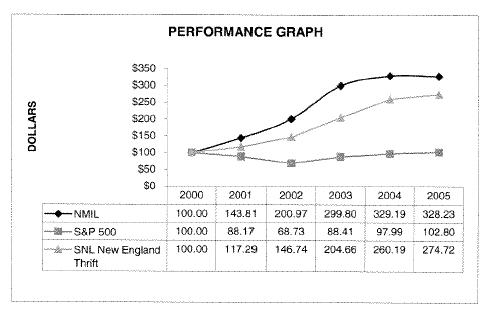
THE
BOARD OF DIRECTORS RECOMMENDS THAT SHAREHOLDERS VOTE FOR THE ELECTION OF
ALL OF
ITS
DIRECTOR
NOMINEES.
RATIFICATION
OF APPOINTMENT OF INDEPENDENT REGISTERED PUBLIC
ACCOUNTANTS
(Proposal
2)
The
Audit
Committee has appointed the firm of PricewaterhouseCoopers, LLP to continue
as
independent registered public accountants for NewMil for the year ending
December 31, 2006, subject to ratification of the appointment by NewMil's
shareholders. Unless otherwise indicated, properly executed proxies will
be
voted in favor of ratifying the appointment of PricewaterhouseCoopers, LLP,
independent registered public accountants, to audit the financial statements
of
NewMil for the year ending December 31, 2006 No determination has been made
as
to what action the Board of Directors would take if NewMil's shareholders
do not
ratify the appointment.
Assuming
the
presence of a quorum at the Annual Meeting, the affirmative vote of the majority
of the votes cast is required to ratify the appointment of
PricewaterhouseCoopers, LLP as NewMil's independent registered public
accountants for the year ending December 31, 2006.
Representatives
of
PricewaterhouseCoopers, LLP are expected to be present at the Annual Meeting.
They will be given an opportunity to make a statement if they desire to do
so
and will be available to respond to appropriate questions.
18
THE
BOARD OF DIRECTORS RECOMMENDS THAT SHAREHOLDERS VOTE FOR RATIFICATION OF
THE
APPOINTMENT OF PRICEWATERHOUSECOOPERS, LLP AS NEWMIL'S INDEPENDENT REGISTERED
PUBLIC
ACCOUNTS FOR THE YEAR ENDING DECEMBER 31, 2006.
OTHER
MATTERS
(Proposal
3)
As
of the
date of this Proxy Statement, the Board of Directors does not know of any
other
matters to be presented for action by the shareholders at the Annual Meeting.
If, however, any other matters not now known properly come before the meeting,
the persons named in the accompanying proxy will vote the proxy in accordance
with the determination of a majority of the Board of Directors.
DATE
FOR SUBMISSION OF SHAREHOLDER PROPOSALS
FOR
INCLUSION IN PROXY STATEMENT
Any
proposal which a NewMil shareholder wishes to have included in NewMil's Proxy
Statement and form of proxy relating to NewMil's 2007 Annual Meeting of
Shareholders under Rule 14a-8 of the Exchange Act must be received by NewMil's
Secretary at 19 Main Street, P.O. Box 600, New Milford, Connecticut 06776
by
November 17, 2006. Nothing in this paragraph shall be deemed to require NewMil
to include in its Proxy Statement and form of proxy for the meeting any
shareholder proposal which does not meet the requirements of the rules and
regulations of the SEC in effect at the time.
ANNUAL
REPORT
A
copy of
NewMil’s 2005 Annual Report to Shareholders accompanies this Proxy Statement
which is not a part of the proxy solicitation materials.
|
By
order of the Board of Directors
|
|
|
/s/
Francis J. Wiatr
|
|
|
|
|
|
Francis
J. Wiatr
|
|
|
Chairman,
President and Chief Executive
Officer
|
New
Milford, Connecticut
March
24,
2006
19