Cambior Inc 40-F, filed Mar 31, 2006: Information Circular

Longueuil, Québec, March 22, 2006
NOTICE IS HEREBY GIVEN that the Annual General and Special Meeting of Shareholders of Cambior Inc. (the "Company") will be held in the Ballroom of the Marriott Château Champlain, 1, Place du Canada, Montreal, Québec, on Wednesday, May 3, 2006 at 11:00 A.M. (local time) (the "Meeting") for the following purposes:
-
to receive the report of the directors and the audited financial statements of the Company for the fiscal year ended December 31, 2005 and the auditors' report thereon;
-
to elect directors;
-
to appoint auditors and authorize the Audit Committee of the Board of Directors to fix their remuneration;
-
to consider and, if deemed appropriate, adopt a resolution to ratify the Shareholders' Rights Plan adopted by the Board of Directors of the Company on November 3, 2005 and described in the enclosed Information Circular;
-
to transact such other business as may properly be brought before the Meeting or at any adjournment thereof.
The Information Circular and the Form of Proxy prepared in respect of the Meeting accompany this notice.
| BY ORDER OF THE BOARD OF DIRECTORS | |
| Lucie Desjardins | |
| Corporate Secretary |
| If you are unable to attend the | If you wish to receive, or to |
| Meeting in person, please | continue receiving, copy of the |
| complete, date and sign the | Company's financial statements, |
| enclosed Form of Proxy and | please refer to the instructions in |
| return it in the envelope | the Information Circular under the |
| provided for that purpose. | heading "Delivery of Financial |
| Statements and MD&A". |
INFORMATION CIRCULAR
This Information Circular is provided in connection with the solicitation of proxies by the management of Cambior Inc. (the "Company") for use at the Annual General and Special Meeting of Shareholders of the Company to be held in Montreal, Québec, on Wednesday, May 3, 2006, at 11:00 A.M. (local time) (the "Meeting") and for any adjournment thereof.
Unless otherwise indicated, all dollar amounts in this Information Circular are expressed in Canadian dollars.
Voting Information
How Are Proxies Solicitated?
Proxies are solicited primarily by mail. However, proxies may also be solicited by directors, senior officers, employees or agents of the Company, personally, in writing or by telephone. The Company will bear all costs and expenses of solicitation. In addition, upon demand, the Company will reimburse brokers and other persons holding Common Shares as nominees for their reasonable expenses in forwarding proxies and accompanying material to beneficial owners of the Company's Common Shares.
What Will I Be Voting On?
You will be voting on the election of directors of the Company, the appointment of PricewaterhouseCoopers, LLP, Chartered Accountants, as auditors of the Company and the adoption of a resolution to ratify the Shareholders' Rights Plan.How Will These Matters Be Decided At The Meeting?
A simple majority of the votes cast, by proxy or in person, will constitute approval of each of the matters appearing on the Notice of Meeting and specified in this Information Circular.How Many Votes Do I Have?
You will be entitled to exercise one vote for every Common Share of the Company you own at the close of business on March 15, 2006, the record date for the Meeting.
To vote Common Shares you acquired subsequent to the record date, you must, not later than ten days before the date of the Meeting, request that the Company add your name to the shareholders' list and produce properly endorsed share certificates, or otherwise establish that you own the shares.
How Do I Vote?
If you are entitled to vote and your shares are registered in you name, you can vote your shares in person at the Meeting or by proxy, as explained below.
If your shares are held in the name of a securities broker, a trust company or another intermediary, please see the instructions below under the headings "How can a non-registered shareholder vote?" and "How can a non-registered shareholder vote in person at the Meeting?".
What If I Plan To Attend The Meeting And Vote In Person? If your Common Shares are registered
in your name and you plan to attend the Meeting on May 3, 2006 and wish to vote
your shares in person at the Meeting, do not complete or return the Form of
Proxy. Your vote will be taken and counted at the meeting. Please register with
the Transfer Agent and Registrar of the Company, CIBC Mellon Trust Company, upon
arrival at the Meeting. If your Common Shares are not registered in your
name, please refer to the instructions under the heading "How Can A
Non-Registered Shareholder Vote In Person At The Meeting?". How Can I Vote By Proxy? Whether or not you attend the
Meeting, you may appoint someone else to vote for you as your proxyholder. You
may use the enclosed Form of Proxy, or any other appropriate form of proxy, to
appoint your proxyholder. The persons named in the enclosed Form of Proxy are
directors or officers of the Company. However, you can choose another person
to be your proxyholder, including someone who is not a shareholder of the
Company. You may do so by striking out the names printed on the Form of Proxy
and inserting another person's name in the blank space provided, or by
completing another proper form of proxy. In order to be valid, the Form of Proxy
must be delivered to CIBC Mellon Trust Company, attention Proxy Unit, at its
Montreal office, at 2001, University Street, 16th Floor, Montreal,
Québec, H3A 2A6, its Toronto office, at 200 Queen's Quay East, Unit 6, Toronto,
Ontario, M5A 4K9, attention Proxy Unit, or sent by facsimile at (416) 368-2502
no later than 5:00 P.M. on May 1st, 2006. Proxyholders must register
with the Transfer Agent upon arrival at the Meeting. How Will My Proxy Be Voted? The persons named as proxies in the
enclosed Form of Proxy will vote for or against, or withhold from voting your
Common Shares, in accordance with your instructions on the Form of Proxy. In
the absence of such instructions, they will vote your shares IN FAVOUR of all
the matters identified in the attached Notice of Meeting. What If There Are Amendments Or If Other Matters Are Brought Before The
Meeting? The enclosed Form of Proxy confers
discretionary authority upon the persons named therein with respect to
amendments or variations to matters identified in the Notice of Meeting and to
other matters which may properly come before the Meeting. At the time of
printing this Information Circular, the management of the Company knows of no
such amendment, variation or other matter expected to come before the Meeting
other than the matters referred to in the Notice of Meeting. What If I Change My Mind And Want To Revoke My Proxy? You may revoke your proxy at any
time, to the extent that it has not yet been exercised, by written notice signed
by you or your attorney duly authorized in writing or, if the shares are held by
a company, the notice must be under corporate seal and signed by an officer or a
duly authorized attorney of said company. Such instrument must be delivered at
the office of the Company located at 1111 St.Charles Street West, East Tower,
Suite 750, Longueuil, Québec, J4K 5G4, or to CIBC Mellon Trust Company, at one
of its above indicated addresses, by no later than 5:00 P.M. on May 1st,
2006. Your proxy may also be revoked by giving notice thereof to the chairman of
the Meeting on the date of the Meeting or of any adjournment thereof or in any
other manner permitted by law. Who Counts The Votes Cast By Proxy? Proxies are counted by CIBC Mellon Trust Company, the
Transfer Agent of the Company. 3
How Can A Non-Registered Shareholder Vote?
If your Common Shares are not registered in your name, they are held in the name of an intermediary, which is usually a securities broker, a trust company or other financial institution, or in the name of a clearing agency (such as The Canadian Depository for Securities Limited) of which the intermediary is a participant. The Company has distributed the Meeting materials to the intermediaries which are required to forward the Meeting materials to non-registered holders unless the non-registered holders have waived the right to receive them. Intermediaries very often call on service companies to forward the Meeting materials to non-registered holders. By forwarding to you the Meeting materials, your intermediary is seeking your instructions as to how to vote your shares. Each intermediary has its own signing and return instructions, which you should follow carefully to ensure your shares are voted. If you are a non-registered shareholder who provided instructions as to how your vote should be exercised and want to change your mind, kindly contact your intermediary to discuss which procedure to follow.
- If you received the Meeting material from the Company or its agent:
These securityholder materials are being sent to both registered and non-registered owners of the securities. If you are a non-registered owner, and the issuer or its agent has sent these materials directly to you, your name and address and information about your holdings of securities, have been obtained in accordance with securities regulatory requirements from the intermediary holding on your behalf.
By choosing to send these materials to you directly, the issuer (and not the intermediary holding on your behalf) has assumed responsibility for (i) delivering these materials to you, and (ii) executing your proper voting instructions. Please return your voting instructions as specified in the request for voting instructions.
How Can A Non-Registered Shareholder Vote In Person At The Meeting?
Only registered shareholders or their duly appointed proxyholders are permitted to vote at the meeting. Therefore, if you are a non-registered shareholder and wish to attend the Meeting and vote in person (or have another person attend and vote on your behalf), you should strike out the names of the persons named in the Form of Proxy sent to you by your intermediary and insert your own (or such other person's) name in the blank space provided or, in the case of a voting instruction form provided by your intermediary, follow the directions indicated on that latter form. By doing so, you are instructing your intermediary to appoint you (or such other person) as proxyholder. Then, follow the signing and return instructions provided by your intermediary. Do not otherwise complete the form as you will be voting at the Meeting. Please register with the Transfer Agent upon arrival at the Meeting.
How Many Shares Are Eligible To Vote?
On March 15, 2006, the Company had 275,521,625 Common Shares issued and outstanding, such shares being the only voting securities in the share capital of the Company. Each Common Share confers upon its holder the right to one vote. The Board of Directors of the Company fixed the close of business on March 15, 2006 as the record date for determining which shareholders shall be entitled to receive notice of the Meeting, but failure to receive such notice does not deprive a shareholder of his right to vote at the Meeting.
To the knowledge of the directors and officers of the Company, as of March 15, 2006, the only person or entity who beneficially owns, directly or indirectly, or exercises control or direction over more than 10% of the outstanding Common Shares of the Company is Mackenzie Financial Corporation which beneficially owns 44,444,850 Common Shares of the Company representing 16.13% of all voting shares.
4
Change Of Address? If your Common Shares are registered
in your name, please advise CIBC Mellon Trust Company, Stock Transfer Service,
of any change of address either by mail, at one of its above mentioned
addresses, or through its Website at www.cibcmellon.com
Questions?
Should you have any questions regarding voting and proxies, you may contact CIBC Mellon Trust Company by telephone at 1-800-387-0825, by e-mail at the following address: inquiries@cibcmellon.com, or through the Web at the following address: www.cibcmellon.com/investorinquiry.
Delivery of Financial Statements and MD&A
If you wish to receive, or to continue receiving, accordingly, the Company's annual financial statements and the related management's discussion and analysis ("MD&A"), or its interim financial statements and related MD&As, or both, please fill out and return the Financial Statements Request Form accompanying this Information Circular.
The Company will deliver a copy of its annual and interim financial statements and related MD&As only to those shareholders who requested them. As a result, failure to return the Financial Statements Request Form, or to otherwise specifically request a copy of the financial statements, will override a shareholder's previous instructions in respect of the delivery of financial statements.
The Company's financial statements and related MD&As are posted on its Website at www.cambior.com.
Election of Directors
The By-laws of the Company provide that the Board of Directors of the Company consist of not less than seven persons and not more than 15 persons. The Board of Directors of the Company currently consists of nine members. At the Meeting, the nine persons named hereunder will be proposed for election as directors of the Company. All nominees are currently directors of the Company.Each nominee is a member of the Institute of Corporate Directors. Except where authority to vote in favour of the election of directors is withheld, the nominees named in the accompanying Form of Proxy will vote the shares represented by such proxy IN FAVOUR of the election of each of the nine persons named hereunder. The management of the Company does not contemplate that any of such persons will be unable or, for any reason, will become unwilling to serve as a director, but if that should occur, for any reason, prior to the election, the nominees named in the accompanying Form of Proxy reserve the right to vote for another candidate at their discretion.
Each director shall, unless he resigns or his office becomes vacant for any reason, hold office until the close of the next annual meeting of shareholders or until his successor is elected or appointed.
5
|
Nominees for Election as Director |
|
|
Mr. Balogh is a corporate director. He was the Deputy Chairman of Noranda Inc. and Chairman of Falconbridge Limited, (mining company) from October 1994 to April 2003. Prior to October 1994, he was President and Chief Executive Officer of Noranda Minerals Inc. and Chief Executive Officer of Falconbridge Limited. Mr. Balogh holds a bachelor's degree in metallurgical engineering from McGill University. |
|
|
ALEXANDER G. BALOGH |
Over the past five years, he has also been a director of the following public companies: | |
|
Oakville, Ontario, Canada |
||
|
Age: 73 |
Falconbridge Limited | 1989 - current |
|
Director since: |
Strongco Inc. | 1996 – current |
|
April 30, 1997 |
Brascan Power Inc. | 2001 to July 2005 |
|
31,412 Common Shares |
Noranda Inc. | 1994 to June 2005 |
|
45,000 Options |
||
|
Mr. Balogh also serves on the board of the Advisory Council of Sentient Global Natural Resources Fund, is Chairman of the National Advisory Board for Mining and Metals Science and Technology and is the past Chairman of the International Council of Metals and the Environment. |
||
| 2005 Attendance: | ||
| Board: | 9/10 | |
| Corporate Governance and Human Resources Committee: | 5/5 | |
| Safety and Sustainability Committee: | 4/4 | |
|
|
Mr. Dufresne has been the President and Chief Executive Officer of Québec Cartier Mining Company (iron ore extraction and manufacturing company) since 1992. Prior to that, Mr. Dufresne held progressive senior positions within the forest product industry including President and COO of Kruger Inc. Mr. Dufresne earned a bachelor's degree in civil engineering at the École Polytechnique of Montreal, a master's degree of engineering at the Massachusetts Institute of Technology and earned an MBA at Harvard University. |
|
|
GUY G. DUFRESNE |
Over the past five years, he has also been a director of the following public company: | |
|
Boucherville, Québec, |
Tembec Inc. |
January 2005 - current |
|
Canada |
||
|
Age: 64 |
He also serves on the board of The Mining Association of Canada and Royal & Sun Alliance Insurance Company. He is the Chairman of Conseil du patronat du Québec and the Chamber of Maritime Commerce. |
|
|
Director since: April 1, 1995 |
||
|
30,000 Common Shares |
||
|
75,000 Options |
2005 Attendance: | |
| Board (Chairman): | 9/10 | |
| Audit Committee: | 7/7 | |
| Corporate Governance and Human Resources Committee: | 5/5 | |


6
| Nominees for Election as Director |
|
|
||
|
|
Mr. Élie is a corporate director. He has over 35 years of experience as a senior executive in the pulp and paper and energy industries as well as with securities and accounting firms. From 1998 to 2002, Mr. Élie was a managing director of a Canadian bank wholly-owned by Société Générale (France). He holds a law degree from McGill University and an MBA from the University of Western Ontario. |
|
|
JEAN-ANDRÉ ÉLIE |
Over the past five years, he has also served as a director of the following public company: | |
|
Town of Mount Royal, |
||
|
Québec, Canada |
Alimentation Couche-Tard Inc. | 1999 - current |
|
Age: 62 |
He currently also serves on the board of a number of private companies and non-profit organizations, including Mount Power Wind Energy Inc., Fondation du Centre Hospitalier de l'Université de Montréal and the Montreal Symphony Orchestra. |
|
|
Director since: |
||
|
December 15, 2004 |
||
|
15,000 Common Shares |
He is a member of the Institute of Internal Auditors. | |
|
|
||
|
|
2005 Attendance: | |
|
|
Board: | 9/10 |
|
|
Audit Committee: | 6/7 |
|
|
||
|
|
Mr. Farquharson has been the President of Strathcona Mineral Services Limited (mining consultant and project management firm) since 1974. He holds a Bachelor of Science in Mining Engineering from the University of Alberta and an MBA from Queen's University. |
|
|
GRAHAM FARQUHARSON |
Over the past five years, he has also served as a director of the following public companies: | |
|
Toronto, Ontario, Canada |
||
|
Age: 65 |
Consolidated Thompson-Lundmark Gold Mines Limited | 2001 - 2004 |
|
Director since: June 7, 1993 |
Placer Dome Inc. | 1999 – January 2006 |
|
52,954 Common Shares |
||
|
75,000 Options |
He currently also serves on the board of the Physicians Services Incorporated Foundation, and is the Chairman of the Canadian Mineral Industry Education Foundation. |
|
|
|
||
|
|
2005 Attendance: | |
|
|
Board: | 9/10 |
|
|
Corporate Governance and Human Resources Committee (Chairman): | 5/5 |
|
|
Safety and Sustainability Committee: | 2/4 |


7
| Nominees for Election as Director |
|
|
||
|
|
Mr. Gaucher, an entrepreneur since 1978, is the Chairman of the Board and Chief Executive Officer of Dynamis Group, Inc. (cogeneration and recycling projects construction and management firm). Mr. Gaucher holds a bachelor's degree in engineering from École Polytechnique of Montreal, an MBA from McGill University and a law degree from the University of Montreal. |
|
|
MICHEL H. GAUCHER |
Over the past five years, he has also been a director of the following public company: | |
|
Montréal, Québec, Canada |
||
|
Age: 62 |
Mindready Solutions Inc. |
2004 - current |
|
Director since: |
||
|
January 13, 1989 |
He is also a founding partner and director of Palos Capital, President of College Stanislas of Montreal, and director and member of several not-for-profit organizations. |
|
|
41,412 Common Shares |
||
|
45,000 Options |
||
| 2005 Attendance: | ||
|
|
Board: |
9/10 |
|
|
Audit Committee: |
6/7 |
|
|
Safety and Sustainability Committee (Chairman): |
3/4 |
|
|
||
|
|
Mr. Gignac has been the President and Chief Executive Officer of Cambior Inc. since its inception in 1986. Mr. Gignac previously held progressive management positions with Falconbridge Copper Company and Exxon Minerals. He was also a professor in Mining Engineering at Laval University. Mr. Gignac has a doctorate in mining engineering from the University of Missouri-Rolla, a master's degree in mining engineering from the University of Minnesota and a bachelor's degree in mining engineering from Laval University. |
|
|
LOUIS GIGNAC |
Over the past five years, he has also served as a director of the following public entities: | |
|
Brossard, Québec, Canada |
||
|
Age: 55 |
Domtar Inc. | 1995 - current |
|
Director since: |
Gaz Métro Limited Partnership | 1990 - current |
|
March 17, 1986 |
||
|
429,546 Common Shares |
2005 Attendance: | |
|
1,225,000 Options |
Board: |
10/10 |
|
|
Not a member of any committee but attends all meetings at the committees' request. | |


8
| Nominees for Election as Director |
|
|
||
|
|
Mr. Hick is a corporate director and has over 20 years of senior management experience in the mining industry, most recently as CEO of Rio Narcea Gold Mines Ltd., (mining company) of which he is currently Vice-chairman and a director. Mr. Hick previously acted as a director of Cambior from June 2000 to December 2004. Mr. Hick earned a bachelor's degree in law from the University of Ottawa Law School and an arts degree from the University of Toronto. |
|
|
JOHN W.W. Hick |
Over the past five years, he has also served as a director of the following public companies: | |
|
Toronto, Ontario, Canada |
||
|
Age: 55 |
Hudson Resources Inc. | 2002 - current |
|
Director since: |
Revett Minerals Inc. | 2004 - current |
|
January 10, 2006 |
Rio Narcea Gold Mines, Ltd. | 1997 - current |
|
25,000 Common Shares |
Defiance Mining Corporation | 2003 – 2004 |
|
|
Geomaque Explorations Ltd. | 2001 - 2003 |
|
|
||
|
|
Mr. Lacroix has been a Senior Advisor to Stikeman Elliott LLP (Montreal office) (national law firm) since 2003. From 2000 to 2003, Mr. Lacroix was Executive Chairman of the Board of Telemedia Corporation Inc. and of other companies in the Telemedia corporate structure. Prior thereto, he was a Senior Partner with McCarthy Tétrault, a law firm. He is also an adjunct professor at the Law Faculty of the University of Montreal. Mr. Lacroix holds a law degree and an MBA from McGill University. |
|
|
HUBERT T. LACROIX |
Over the past five years, he has been a director of the other following public entities: | |
|
Montreal, Québec, Canada |
||
|
Age: 50 |
ITS Investments Limited Partnership | 1998 - current |
|
Director since: May 12, 2005 |
SFK Pulp Fund | 2002 - current |
|
45,000 Common Shares |
Transcontinental Inc. | 2000 - current |
|
|
Zarlink Semiconductor Inc. | 1992 - current |
|
|
||
|
|
Mr. Lacroix is a trustee of the Lucie and André Chagnon Foundation as well as a director of their private management company, a trustee of the Martlet Foundation of McGill University and a director of the Montreal General Hospital Foundation and of the Fonds de développement du Collège Jean-de-Brébeuf. Mr. Lacroix is also an executive member of the Montreal Chapter of the Institute of Corporate Directors. |
|
|
|
||
|
|
2005 Attendance: | |
|
|
Board: | 6/6 |
|
|
Corporate Governance and Human Resources Committee: | 4/4 |


9
| Nominees for Election as Director |
 |
Mr. Normand is a corporate director. He is a chartered accountant and has been an auditor with large audit firms for six years. Mr. Normand held various management positions with Gaz Métropolitain Inc. for 25 years; he was Chief Financial Officer for 17 years. Mr. Normand holds a commercial science degree from the École des Hautes Études Commerciales. |
|
| ROBERT NORMAND | Over the past five years, he has been a director of the other following public companies: | |
| Rosemère, Québec, Canada | Aurizon Mines Ltd. | 1999 - current |
| Age: 66 | Enerplus Energy Fund | 2001 - current |
| Director since: May 17, 2000 | ING Canada Ltd. | 2004 - current |
| 43,317 Common Shares | Quebecor World Inc. | 1999 - current |
| 45,000 Options | Sportscene Ltd. | 1997 – current |
| Concert Industries Ltd. | 2000 - 2004 | |
| Groupe Coscient Inc. | 1999 - 2002 | |
| Groupe Covitec Inc. | 2000 – 2002 | |
| Mazarin Inc. | 2002 – 2004 | |
| He is an executive member of the Montreal Chapter of the Institute of Corporate Directors and a member of the Financial Executive Institute. | ||
| 2005 Attendance: | ||
| Board: | 9/10 | |
| Audit Committee (Chairman): | 6/7 | |
The information as regards Common Shares and Options is given as at March 15, 2006. Each nominee has supplied the information concerning the number of Common Shares over which he exercises control or direction.
All of the nominees whose names are hereinabove mentioned have been elected director of the Company at the May 2005 shareholders' meeting for which an information circular was issued, except for the following. Mr. Hick is a corporate director. He is also Vice Chairman of Rio Narcea Gold Mines Ltd. ("Rio Narcea"); Mr. Hick was, from 1997 until December 2004, President of John W.W. Hick Consultants Inc., a management consulting firm; from December 2001 to June 2003, President and Chief Executive Officer of Geomaque Explorations Inc.; from February 2003 to September 2004, President and Chief Executive Officer of Defiance Mining Corporation; from September 2004 to December 2004, Vice Chairman of Rio Narcea; and from December 2004 to December 2005, President and Chief Executive Officer of Rio Narcea.
Additional Disclosure Relating to Directors
To the knowledge of the Company, no nominee as director is, or has been in the last ten years, a director or executive officer of an issuer that, while that person was acting in that capacity, (a) was the subject of a cease trade order or similar order or an order that denied the issuer access to any exemptions under Canadian securities legislation, for a period of more than 30 consecutive days, (b) was subject to an event that resulted, after that person ceased to be a director or executive officer, in the issuer being the subject of a cease trade or similar order or an order that denied the issuer access to any exemption under Canadian securities legislation, for a period of more than 30 consecutive days, or (c) within a year of that person ceasing to act in that capacity, became bankrupt, made a proposal under any legislation relating to bankruptcy or insolvency or was subject to or instituted any proceedings, arrangement or compromise with creditors or had a receiver, receiver manager or trustee appointed to hold its assets except for the following: (i) Mr. Lacroix, a director of the Company, ceased serving as director of Adventure Electronics Inc. on February 6, 1998, less than a year before it filed an assignment in bankruptcy under the Bankruptcy and Insolvency Act (Canada) on November 17, 1998, and (ii) Mr. Normand, a director of the Company, served
10
as director of Concert Industries Ltd. when it and its Canadian operating subsidiaries announced on August 5, 2003 that they had filed for protection under the Companies' Creditors Arrangement Act (the "CCAA"). Concert Industries Ltd. was restructured and a plan of compromise and arrangement for its operating subsidiaries was approved in December 2004, allowing them to emerge from the CCAA proceedings. Mr. Normand no longer serves as director of Concert Industries Ltd.
Information Regarding the Audit Committee
The Company has an audit committee which consist of Messrs. Normand (Chairman), Dufresne, Élie and Gaucher. The Board of Directors of the Company has determined that all members of the Audit Committee are "independent" and "financially literate" within the meaning of Multilateral Instrument 52-110 Audit Committees and the US Sarbanes-Oxley Act of 2002 ("SOX"). The Board of Directors has also determined that Messrs. Normand and Élie are "Audit Committee Financial Experts" within the meaning of SOX.
Additional information regarding the Audit Committee, including a summary of the education and experience of each member of the Audit Committee that is relevant to the performance of their responsibilities as member of this committee, is available under Item VIII entitled "Audit Committee" in the Company's Annual Information Form for the fiscal year ended December 31, 2005. A copy of the Annual Information Form can be obtained on SEDAR's Website at
www.sedar.com, on (US) EDGAR's Website at www.sec.gov/edgar.shtml (Form 40-F), the Company's Website at www.cambior.com or by contacting our Investor Relations Services, by e-mail at info@cambior.com, by fax at (450) 677-3382 or by phone at 1-866-554-0554.Appointment of Auditors
In light of the Company's increased international activities, the Audit Committee conducted a review of Cambior's audit requirements and the offers of services received for the financial year 2006 and the fees associated with such services. As a result of such review, the Audit Committee determined to recommend the appointment of PricewaterhouseCoopers LLP ("PwC") as the Company's auditors for the fiscal year ending December 31, 2006.
The Board approved the unanimous recommendation of the Audit Committee to appoint PwC because of their knowledge of the Company and mining industry, the continuity of service, the international availability of services, and their competitive rates.
At the meeting, or any adjournment thereof, PwC will be proposed for appointment as auditors of the Company for the fiscal year ending December 31, 2006.
Attached to this Information Circular as Schedule A are copies of documents required by the regulatory authorities relating to the change of auditors, including a copy of the Notice of Change of Auditors. As indicated in the Notice of Change of Auditors, there have been no reportable events (including disagreements, unresolved issues and consultations) in connection with the audits of the Company's financial statements by its auditors, Raymond Chabot Grant Thornton, LLP, ("RCGT") for the two most recently completed financial years as at the date of the Notice of Change of Auditors, being the reports for the financial years ended December 31, 2004 and 2003.
Unless authority to vote in respect thereof is withheld, the nominees named in the accompanying Form of Proxy will vote IN FAVOUR of the appointment of PwC as auditors of the Company and IN FAVOUR of authorizing the Audit Committee of the Board of Directors to fix their remuneration.
Audit and Other Fees
The following table shows fees billed by RCGT, in the past two fiscal years for various services provided to the Company and its subsidiaries:
11
| Year ended | Year ended | |
| December 31, 2005 | December 31, 2004 | |
| $ | $ | |
| Audit Fees | 485,261 | 454,358 |
| Audit-Related Fees | 64,213 | 33,340 |
| Tax Fees | Nil | Nil |
| Other Fees | Nil | Nil |
| TOTAL | 549,474 | 487,698 |
Audit Fees
Audit fees include the professional services rendered for the audit of the consolidated annual financial statements of the Company, the review of the Company's quarterly financial statements and the accounting consultations arising during the audit.
Audit-Related Fees
These fees include professional services that reasonably relate to the performance of the audit or review of the Company's financial statements, including audit of the employees' retirement plans and assistance related to the Company's internal control certification program.
Shareholders' Rights Plan
At the Meeting, the shareholders will be asked to ratify the Shareholders Rights Plan (the "Rights Plan") adopted by the Board of Directors on November 3, 2005. The agreement dated as of November 4, 2005 between the Company and CIBC Mellon Trust Company, as Rights Agent, containing the terms and conditions of the Rights Plan (the "Rights Agreement") is filed on SEDAR at
www.sedar.com.The Board of Directors has unanimously determined that the Rights Plan is in the best interests of the shareholders and the Company and recommends that shareholders vote for its ratification. The Rights Plan will provide the Board of Directors and the shareholders more time to fully consider any unsolicited takeover bid for the Company. The Rights Plan is intended to discourage coercive or unfair takeover bids and gives the Board of Directors time to pursue alternatives to maximize shareholder value, if appropriate, in the event of an unsolicited takeover bid.
The Rights Plan is effective as of November 4, 2005 and is subject to ratification by the shareholders at the Meeting. To continue to be effective, the Rights Plan must be ratified by a resolution passed by a majority of the votes cast at the Meeting in person or by proxy. Should the resolution not be passed by a majority of the votes so cast at the Meeting, the Rights Plan and any then outstanding Rights shall be of no further force and effect from May 3, 2006.
Shareholders will be asked at the Meeting to consider and, if deemed advisable, to approve, by a simple majority of votes cast at the Meeting, a resolution, the text of which is set forth in Schedule B to this Information Circular (the "Rights Plan Resolution"), to ratify the Rights Plan.
Background: The primary objective of the Rights Plan is to provide the Board of Directors with sufficient time to explore and develop alternatives for maximizing shareholder value if a takeover bid is made for the Company and to provide every shareholder with an equal opportunity to participate in such a bid. The Rights Plan encourages a potential acquirer to proceed either by way of a Permitted Bid (as defined in the Rights Plan), which requires the takeover bid to satisfy certain minimum standards designed to promote fairness, or with the concurrence of the Board.
In adopting the Rights Plan, the Board of Directors considered the legislative framework in Canada governing takeover bids. Under provincial securities legislation, a takeover bid generally means an offer to acquire voting or equity shares of a person or persons, where the shares subject to the offer to acquire,
12
together with shares already owned by the bidder and certain related parties thereto, aggregate 20% or more of the outstanding shares of a corporation.
The existing legislative framework for takeover bids in Canada continues to raise the following concerns for shareholders of the Company:
(i) Time: Current legislation permits a takeover bid to expire 21 days after it is initiated. The Board of Directors is of the view that this is not sufficient time to permit shareholders to consider a takeover bid and make a reasoned and unhurried decision.
(ii) Pressure to Tender: A shareholder may feel compelled to tender to a takeover bid which the shareholder considers to be inadequate out of a concern that in failing to do so, the shareholder may be left with illiquid or minority discounted Common Shares. This is particularly so in the case of a partial takeover bid for less than all of the Common Shares, where the bidder wishes to obtain a control position but does not wish to acquire all of the Common Shares. The Rights Plan provides a shareholder tender approval mechanism which is intended to ensure that a shareholder can separate the decision to tender from the approval or disapproval of a particular takeover bid.
(iii) Unequal Treatment: Full Value: While existing provincial securities legislation has substantially addressed many concerns in this regard, there remains the possibility that control of the Company may be acquired pursuant to a private agreement in which one or a small group of shareholders dispose of Common Shares at a premium to market price which premium is not shared with the other shareholders. In addition, a person may slowly accumulate Common Shares through stock exchange acquisitions which may result, over time, in an acquisition of control without payment of fair value for control or a fair sharing of a control premium among all shareholders.
Summary: The following is a summary of the principal terms of the Rights Plan which is qualified in its entirety by reference to the text of the Rights Plan which is filed on the Company's Website at
www.cambior.com and on SEDAR at www.sedar.com. A shareholder or any other interested party may also obtain a copy of the Rights Plan by writing to or calling the Manager, Investors Relation, Cambior Inc., 1111, St. Charles West, East Tower, Suite 750, Longueuil, Quebec, J4K 5G4; telephone (450) 677-0040.All capitalized expressions or terms in the following summary have the meaning ascribed to them in the Rights Plan.
Effective Date: The effective date of the Rights Plan is November 4, 2005.
Term: Unless otherwise terminated in accordance with its terms, the Rights Plan will terminate at the close of the third annual meeting of the Company's shareholders following the meeting at which the Rights Plan is ratified by shareholders, unless the Rights Plan is reconfirmed and extended at such meeting.
Shareholder Approval: The Rights Plan must be ratified by shareholders within six months of its effective date. For the Rights Plan to continue to be effective following the Meeting, the Rights Plan Resolution must be approved by a majority of the votes cast at the Meeting by shareholders voting in person and by proxy.
Issue of Rights: On the Effective Date, one right to purchase a Common Share, upon the terms and subject to the conditions set forth in the Rights Plan, was issued and attached to each Common Share outstanding and attaches to each Common Share subsequently issued.
Rights Exercise Privilege: The Rights will separate from the Common Shares and will be exercisable on the tenth Business Day after the earlier of (i) the Stock Acquisition Date; (ii) the date of the commencement of, or first public announcement of the intent of any Person to commence, a Takeover Bid, other than a Permitted Bid or Competing Permitted Bid and; (iii) the date upon which a Permitted Bid or
13
Competing Permitted Bid ceases to be such; or such later date as may be determined by the Board of Directors in good faith.
Flip-in Event: The acquisition by any Person (an "Acquiring Person") of 20% or more of the outstanding Common Shares of the Company, other than by way of a Permitted Bid, a Voting Share Reduction, an Exempt Acquisition, a Pro Rata Acquisition or a Convertible Security Acquisition is referred to as a "Flip-in Event". Any Rights held by an Acquiring Person will become void upon the occurrence of a Flip-in Event. Ten Business Days after the occurrence of the Flip-in Event, each Right, (other than those held by the Acquiring Person), will permit the purchase of Common Shares at a substantial discount to the market price at the time.
The issue of the Rights is not initially dilutive. Upon a Flip-in Event occurring and the Rights separating from the Common Shares, reported earnings per share on a fully diluted or non-diluted basis may be affected. Holders of Rights not exercising their Rights upon the occurrence of a Flip-in Event may suffer substantial dilution.
Certificates and Transferability: Prior to the Separation Time, the Rights are evidenced by a legend imprinted on certificates for the Common Shares issued from and after the Effective Date and are not to be transferable separately from the Common Shares. From and after the Separation Time, the Rights will be evidenced by Rights certificates which will be transferable and traded separately from the Common Shares.
Permitted Bid Requirements: Under the Rights Plan, a "Permitted Bid" is a bid made to all shareholders of the Company and is open for acceptance for not less than 60 days. If, at the end of such 60-day period, at least 50 percent of the outstanding shares, other than those owned by the offeror and certain related parties, have been tendered, the offeror may take up and pay for the shares but must extend the bid for a further 10 days to allow other shareholders to tender. The Rights Plan is similar to other shareholders rights plans adopted by several other Canadian companies and approved by their respective shareholders.
Waiver: The Board of Directors may, until the occurrence of a Flip-in Event, waive the application of the Rights Plan to a particular Flip-in Event (an "Exempt Acquisition") where the Takeover Bid is made by a takeover bid circular to all holders of Common Shares. Where the Board of Directors exercises the power of waiver for one Takeover Bid, the waiver will also apply to any other Takeover Bid for the Company made by a takeover bid circular to all holders of Common Shares prior to the expiry of the other bid for which the Rights Plan has been waived by the Board of Directors.
Redemption: The Board of Directors, with the majority approval of shareholders (or the holders of Rights if the Separation Time has occurred) at a meeting duly called for that purpose, may redeem the Rights at $0.0001 per Right. Rights may also be redeemed by the Board of Directors without such approval following completion of a Permitted Bid, Competing Permitted Bid or Exempt Acquisition.
Amendment: The Company may amend the Rights Plan with the majority approval of shareholders (or the holders of Rights, if the Separation Time has occurred) at a meeting duly called for that purpose. The Company, without such approval, may correct clerical or typographical errors and, subject to approval as noted above at the next meeting of the shareholders (or holders of Rights, as the case may be), may make amendments to the Rights Plan which the Board of Directors acting in good faith considers necessary or desirable.
Board of Directors: The Rights Plan will not detract from or lessen the duty of the Board of Directors to act honestly and in good faith with a view to the best interests of the Company. The Board of Directors, when a Permitted Bid is made, will continue to have the duty and power to take such actions and make such recommendations to shareholders as are considered appropriate.
Exemptions for Investment Advisors: Persons whose ordinary business is managing investment funds for others, trust companies (acting in their capacities as trustees and administrators), statutory bodies
14
whose business includes the management of funds, and administrators of registered pension plans are exempt from triggering a Flip-in Event, provided that they are not making, or are not part of a group making, a takeover bid.
Recommendation of the Board of Directors: The Board of Directors has determined that the Rights Plan is in the best interests of the Company and its shareholders. The Board of Directors unanimously recommends that shareholders vote in favour of the Rights Plan Resolution.
The Rights Plan has not been adopted in response to, or in contemplation of, any specific proposal to acquire control of the Company. At the present time, the Company has no knowledge of any Takeover Bid, or any intended Takeover Bid from any person.
Unless otherwise instructed by the shareholder, the Common Shares represented by the Form of Proxy enclosed herewith will be voted FOR the resolution to ratify the Rights Plan.
Directors' Compensation
Directors' compensation is paid to outside directors only. On January 10, 2006, the Board approved the Corporate Governance and Human Resources Committee's recommendation to maintain, for 2006, directors' cash remuneration as established in 2005, being:
|
2006 |
|
|
$ |
|
|
|
|
| Annual Retainer: |
20,000 |
| Board fee per meeting: |
1,200 |
| Committee fee per meeting: |
1,200 |
|
Additional Annual Chair Retainer: |
|
| Board of Directors: |
30,000 |
| Audit Committee: |
10,000 |
| Corporate Governance and |
|
| Human Resources Committee: |
5,000 |
| Safety and Sustainability Committee: |
5,000 |
For any board or committee special meeting held via a telephone conference, the attendance fee is one-half the normal fee. The total amount of compensation paid by the Company to directors in respect of the 26 meetings of the Board of Directors and its committees during 2005 was $323,600. Travel and other expenses incurred by directors to attend board and committee meetings are reimbursed.
The Stock Option Plan, adopted at the Annual General and Special Meeting of Shareholders on May 2, 1990 and more fully described under the heading "Corporate Governance and Human Resources Committee – Report on Executive Compensation – Long-Term Incentive Plan (Stock Option Plan)", allows the granting of stock options to directors of the Company. On April 25, 2002, the Board of Directors approved a policy that provided for the granting to each outside director, on the date of each annual meeting of the shareholders of the Company, of an option to purchase 10,000 Common Shares at the same exercise price as for all employees receiving options of the Company and in accordance with the Stock Option Plan. On February 18, 2005, the Board of Directors decided to terminate said policy, and to consider other forms of compensation for directors. As at the date of this Information Circular, no other form of compensation has been established for directors.
Directors' Shareholding
In order to better link the interest of directors to those of shareholders, directors are required, since February 2004, to hold Common Shares of the Company with a value of no less than three times their annual retainer currently being equal to $60,000. Directors are expected to reach this level no later than
15
February 17, 2006, except for those appointed or elected director after February 2004 who have two (2) years following their appointment or election, accordingly, to satisfy this policy.
The following table shows, as at December 31, 2005, the number and value of Common Shares of the Company owned by each director and how much each director is required to invest to meet the minimum share ownership requirements set by the Board of Directors. The total value of Common Shares is the amount each director had at stake in the Company as at December 31, 2005.
| Directors' Shareholding | ||||
|
|
|
|
Investment |
Date at which |
|
|
|
Total Value of |
required to Meet |
Shareholding |
|
|
Number |
Common |
the Shareholding |
Requirement is to Be Met |
|
|
of |
Shares |
Requirements |
(yy/mm/dd) |
|
Director |
Common |
($)(1) |
($) |
|
|
|
Shares |
|
|
|
|
Alexander G. Balogh |
31,412 |
102,089.00 |
- |
2006/02/17 |
|
Guy G. Dufresne |
30,000 |
97,500.00 |
- |
2006/02/17 |
|
Jean-André Élie |
15,000 |
48,750.00 |
11,250 |
2006/12/14 |
|
Graham Farquharson |
52,954 |
172,100.50 |
- |
2006/02/17 |
|
Michel H. Gaucher |
41,412 |
134,589.00 |
- |
2006/02/17 |
|
Louis Gignac |
429,546 |
1,396,024.50 |
- |
2006/02/17 |
|
John W. W. Hick |
25,000 |
81,250.00 |
- |
2008/01/09 |
|
Hubert T. Lacroix |
45,000 |
146,250.00 |
- |
2007/05/11 |
|
Robert Normand |
43,317 |
140,780.25 |
- |
2006/02/17 |
|
(1) The price of a common share of the Company was $3.25 as at December 31, 2005. |
||||
Executive Compensation
The following table presents, for the periods indicated, the compensation of the President and Chief Executive Officer, the Vice President, Finance and Chief Financial Officer and the three other most highly compensated executive officers of the Company for the fiscal year ended December 31, 2005 (the "Named Executive Officers").
SUMMARY COMPENSATION TABLE
|
|
|
|
|
|
Long-Term |
|
|
|
|
Annual Compensation |
Compensation (3) |
|
||
|
|
|
|
|
Other Annual (2) |
Securities Under |
All Other |
|
|
|
Salary |
Bonus (1) |
Compensation |
Options Granted |
Compensation |
|
Name and Principal Position |
Year |
($) |
($) |
($) |
(no. of shares) |
($) |
|
Louis Gignac |
2005 |
416,000 |
120,000 |
- |
200,000 |
Nil |
|
President and Chief Executive |
2004 |
392,900 |
Nil |
- |
200,000 |
Nil |
|
Officer |
2003 |
362,600 |
200,000 |
- |
185,000 |
Nil |
|
Bryan A. Coates |
2005 |
261,700 |
88,000 |
- |
70,000 |
Nil |
|
Vice President, Finance and Chief |
2004 |
255,800 |
68,000 |
- |
70,000 |
Nil |
|
Financial Officer |
2003 |
249,000 |
95,000 |
1,800 |
65,000 |
Nil |
|
Réjean Gourde (4) |
2005 |
305,000 |
US50,000 |
37,900 |
70,000 |
Nil |
|
Senior Vice President, Guiana |
2004 |
304,300 |
US66,000 |
40,000 |
70,000 |
Nil |
|
Shield |
2003 |
267,900 |
US60,000 |
41,800 |
65,000 |
Nil |
|
Robert Ménard (5) |
2005 |
232,600 |
101,000 |
- |
70,000 |
Nil |
|
Vice President, Projects and |
2004 |
234,900 |
Nil |
- |
50,000 |
Nil |
|
Construction |
2003 |
273,100 |
116,000 |
- |
35,000 |
Nil |
16
|
|
|
|
|
|
Long-Term |
|
|
|
|
Annual Compensation |
Compensation (3) |
|
||
|
|
|
|
|
Other Annual (2) |
Securities Under |
All Other |
|
|
|
Salary |
Bonus (1) |
Compensation |
Options Granted |
Compensation |
|
Name and Principal Position |
Year |
($) |
($) |
($) |
(no. of shares) |
($) |
|
Jacques Perron (6) |
2005 |
255,000 |
50,000 |
- |
70,000 |
Nil |
|
Vice President, Canada |
2004 |
135,600 |
12,000 |
- |
70,000 |
Nil |
|
2003 |
N/A |
N/A |
N/A |
N/A |
N/A |
|
(1)
Bonuses are declared and paid in cash during the year following the year in which they were earned. The amounts shown are reported in the year earned.(2) The amount shown for Mr. Gourde is for a housing allowance to reflect his international employment status. The amount shown for Mr. Coates reflects the taxable benefit in connection with an interest free relocation loan. Named Executive Officers are entitled to the use of a Company-leased automobile, and other perquisites. The value of such perquisites is no greater than the lesser of 10% of the total annual compensation (base salary and bonus) and $50,000.
(3) There are no long-term compensation programs other than the Stock Option Plan.
(4) All salaries are expressed in Canadian dollars. Mr. Gourde's compensation is in US dollars and, except as otherwise indicated, is converted at the exchange rates applicable at the time it was allocated; all other amounts are converted at a rate of 1.3128 (2003), 1.2191 (2004) and 1.2116 (2005). As of April 1st, 2003, Mr. Gourde benefits from a quarterly conversion rate adjustment guarantying a 1.5000 exchange rate, as compared to the quarter's average exchange rate.
(5) Mr. Ménard's 2003 salary includes a non-recurring salary adjustment for additional responsibilities assumed and considerable time spent abroad. His bonus for 2005 is in regards to performance objectives achieved in 2004 and 2005.
(6) Mr. Perron joined the Company in June 2004.
OPTION GRANTS DURING THE MOST RECENTLY COMPLETED FINANCIAL YEAR
|
|
Market Value of | ||||
|
|
Securities | Securities | |||
|
|
Under Options | % of Total Options | Exercise | Underlying Options | |
|
|
Granted | Granted to | Price (1) | on the Date of Grant | Expiration |
|
Name |
(no. of shares) | Employees in 2005 | ($/Security) | ($/Security) | Date |
|
Louis Gignac |
200,000 | 11.8% | $2.30 | $2.30 | May 11, 2012 |
|
Bryan A. Coates |
70,000 | 4.1% | $2.30 | $2.30 | May 11, 2012 |
|
Réjean Gourde |
70,000 | 4.1% | $2.30 | $2.30 | May 11, 2012 |
|
Robert Ménard |
70,000 | 4.1% | $2.30 | $2.30 | May 11, 2012 |
|
Jacques Perron |
70,000 | 4.1% | $2.30 | $2.30 | May 11, 2012 |
(1)
The exercise price is equal to the average of the closing prices of a Common Share of the Company on the TSX for the five business-day period immediately preceding the date of grant.Options granted in 2005 under the terms of the long-term incentive plan are for Common Shares, have a term of seven years and become exercisable, as to 50%, two years after the date of grant and, as to the remaining 50%, three years after the date of grant. Reference is made to the disclosure under the heading "Corporate Governance and Human Resources Committee – Report on Executive Compensation – Long-Term Incentive Plan (Stock Option Plan)" for details on the Stock Option Plan.
AGGREGATED OPTIONS EXERCISED DURING THE MOST RECENTLY
COMPLETED FINANCIAL YEAR AND FINANCIAL YEAR-END OPTION VALUES
|
|
|
|
|
|
Value of Unexercised in-the- |
|
|
|
Securities |
Aggregate |
Unexercised Options at Financial |
Money Options at Financial |
||
|
|
Acquired on |
Value |
Year-End |
Year-End |
||
|
Name |
Exercise |
Realized (1) |
(no. of shares) |
($) |
||
|
|
(no. of shares) |
($) |
Exercisable |
Unexercisable |
Exercisable |
Unexercisable |
|
Louis Gignac |
- |
- |
732,500 |
492,500 |
1,091,850 |
310,250 |
|
Bryan A. Coates |
- |
- |
222,500 |
172,500 |
434,950 |
108,750 |
|
Réjean Gourde |
- |
- |
295,500 |
172,500 |
420,390 |
108,750 |
|
Robert Ménard |
- |
- |
183,500 |
137,500 |
265,830 |
89,250 |
|
Jacques Perron |
- |
- |
Nil |
140,000 |
Nil |
66,500 |
17
(1)
The aggregate value realized is equal to the number of shares purchased times the difference between the closing price of a Common Share on the date of exercise and the exercise price of the option.The market value of a Common Share of the Company was $3.25 at December 31, 2005.
Equity Compensation Plan Information
The following table presents information as at December 31, 2005 with respect to Common Shares authorized for issuance under the Stock Option Plan and other equity compensation plans that provide for the issuance of shares.
|
|
|
|
Number of securities |
|
|
|
|
remaining available for |
|
|
|
|
future issuance under equity |
|
|
Number of securities to be |
|
compensation plans |
|
|
issued upon exercise of |
Weighted-average exercise |
(excluding securities |
|
|
outstanding options |
price of outstanding options |
reflected in column (a)) |
|
|
(#) |
($) |
(#) |
|
|
|
|
|
|
Plan Category |
(a) |
(b) |
(c) |
|
Equity compensation plans |
|
|
|
|
approved by securityholders (1) |
7,394,700 (2) |
2.44 |
4,810,123 (2) |
|
|
|
|
|
|
Equity compensation plans not |
|
|
|
|
approved by securityholders (3) |
826,182 |
2.29 |
Nil |
|
|
|
|
|
|
Total |
8,220,882 |
2.42 |
4,810,123 |
(1)
The maximum number of Common Shares issuable under the Stock Option Plan is fixed at five percent (5%) of the Company's outstanding Common Shares.(2) As at March 15, 2006, as a result of expirations, cancellations, grants and exercises of options, there are 7,031,100 Common Shares under option and 4,871,281 Common Shares available for future grants.
(3) The Company assumed, pursuant to the merger agreement with Ariane Gold Corp. (in 2003), the options that were granted under the stock option plan of Ariane Gold Corp. The options were converted into options to purchase Common Shares of the Company on the basis of the exchange ratio established under the merger agreement.Retirement Benefits
Officers and senior management of the Company, specifically designated by the Board of Directors, participate in a non-contributory defined benefits registered pension plan. This pension plan is managed by a retirement committee composed of representatives of the Company and the participants, and an independent third party.
Estimated annual retirement allowance benefits payable upon retirement to the specified Named Executive Officers are shown in the following table.
PENSION PLAN TABLE
ESTIMATED TOTAL ANNUAL BENEFIT ON RETIREMENT
|
|
Years of Service | ||||
|
Remuneration($) |
15 |
20 |
25 |
30 |
35 |
|
125,000 |
32,812 |
43,750 |
54,687 |
65,625 |
76,562 |
|
150,000 |
39,375 |
52,500 |
65,625 |
78,750 |
91,875 |
|
175,000 |
45,937 |
61,250 |
76,562 |
91,875 |
107,187 |
|
200,000 |
52,500 |
70,000 |
87,500 |
105,000 |
122,500 |
|
225,000 |
59,062 |
78,750 |
98,437 |
118,125 |
137,812 |
|
250,000 |
65,625 |
87,500 |
109,375 |
131,250 |
153,125 |
|
300,000 |
78,750 |
105,000 |
131,250 |
157,500 |
183,750 |
18
|
|
Years of Service | ||||
|
Remuneration($) |
15 |
20 |
25 |
30 |
35 |
|
350,000 |
91,875 |
122,500 |
153,125 |
183,750 |
214,375 |
|
400,000 |
105,000 |
140,000 |
175,000 |
210,000 |
245,000 |
|
450,000 |
118,125 |
157,500 |
196,875 |
236,250 |
275,625 |
|
500,000 |
131,250 |
175,000 |
218,750 |
262,500 |
306,250 |
Pension benefits are calculated and accrued on the basis of 1.75% multiplied by years of pensionable service multiplied by the average of the highest three years base salary earned during the six years prior to retirement. The registered pension plan provides benefits up to the limits prescribed by Revenue Canada. Normal retirement age is 65. There is no reduction in the amounts paid under the plan to reflect the value of statutory retirement income benefits. Participants may choose to contribute to this registered pension plan and in return receive incidental benefits, subject to the maximum prescribed by Revenue Canada, which is established on an individual basis for each interested participant by the Company=s actuaries.
Members of the senior management of the Company specifically designated by the Board of Directors, including the Named Executive Officers, participate in a non-contributory supplementary executive retirement plan (the "SERP"). The intent of the SERP is to provide a pension that is equal to that which would otherwise be received if the registered pension plan reflected the full amount of base salary.
Benefits accrue under the combined terms of the registered pension plan and the SERP. The total pension payable under the terms of the registered pension plan and the SERP is limited to a maximum of 70% of pensionable earnings.
The registered pension plan is funded in accordance with applicable laws. Contributions are assessed by the Board of Directors on a yearly basis in light of the Company=s then financial position and other factors deemed relevant by the Board of Directors. The Board has discretion to elect to contribute or not in respect of any particular year. However, the Company is obliged by applicable laws to begin funding over a period of three years its obligations under the terms of the SERP when each participant reaches the age of 68, or immediately if there is a change of control of the Company.
The normal form of pension is a benefit payable for life, with 60% continuing to the surviving spouse. Pension benefits may be taken in other forms subject to actuarial adjustment. As of December 31, 2005, complete years of service credited to each Named Executive Officer under the terms of the plans were:
|
Years of Pensionable Service |
||
|
|
Registered Plan |
SERP |
|
Louis Gignac |
19 years and 7 months |
26 years and 7 months (1) |
|
Bryan A. Coates |
4 years and 5 months |
8 years and 5 months (2) |
|
Réjean Gourde |
17 years (3) |
21 years (4) |
|
Robert Ménard |
11 years and 10 months |
11 years and 10 months (5) |
|
Jacques Perron |
1 year and 6 months |
1 year and 6 months |
(1)
Mr. Gignac has a special retirement income arrangement wherein, for each two years of service since January 1st, 1991, he is credited with three years of pensionable service in the SERP.(2) Mr. Coates has a special retirement income arrangement wherein, for each year of service completed since his hiring date in July 2001, he is credited with one additional year of pensionable service in the SERP, subject to a maximum of five additional years of service.
(3) Mr. Gourde has been established out of Canada for over ten years. As a result of registered pension plan rules effective since 2000, his years of services after December 31, 2004 cannot be credited under the registered pension plan. However, his pension benefits for such years are fully covered under the SERP.
(4) Mr. Gourde has a special retirement income arrangement wherein, for each year of service completed since January 1st, 2003, he is credited with one additional year of pensionable service in the SERP, subject to a maximum of three additional years of service.
19
(5)
Employment Agreements
The senior officers of the Company, including Named Executive Officers, benefit from certain protection measures in the event of a change of control of the Company. Upon termination of employment subsequent to a change of control and for any reason other than death or for cause, each Named Executive Officer shall be entitled to: a) a severance payment equal to a certain number of months of base salary; b) the accelerated vesting of 100% of the stock options granted whether or not exercisable on such date; c) the immediate purchase of 100% of the shares acquired by the Company for the employee through the share purchase plan, but not yet available to the employee at such date; d) the credit of years of service for the purposes of the registered pension plan and of the SERP for a period equal to the lesser of i) the period covered by the severance payment and ii) the period covered between the date of termination and the date of the normal retirement age (65 years); e) the maintenance of fringe benefits for the period set forth above in d), including life insurance but excluding short and long-term disability insurance; and f) certain other benefits of less importance. The severance payment of the President and Chief Executive Officer and of the other Named Executive Officers shall be equal to 24 months of their base salary. When calculating severance amounts, no period should exceed the period covered between the date of termination of employment and the date of the normal retirement age (65 years).
The benefits described above also apply upon termination of employment by a senior officer in response to an improper change such as a substantial change in responsibilities or status subsequent to a change of control.
Corporate Governance and Human Resources Committee –
Report on Executive Compensation
The Corporate Governance and Human Resources Committee of the Board of Directors (the "Committee") oversees compensation and career development for officers and senior managers of the Company. The Committee is currently composed of four independent members of the Board of Directors. The Committee held five meetings in 2005.
The Committee makes recommendations to the Board of Directors on all aspects of the compensation payable to the President and Chief Executive Officer and the other officers. The President and Chief Executive Officer may attend committee meetings to provide advice and recommendations regarding issues of concern to the Committee, including compensation of the Named Executive Officers. However, the President and Chief Executive Officer is not a member of the Committee and as such, is not entitled to vote on any matter brought before the Committee and must not be present during discussion of his own compensation.
The Committee also reviews, for approval by the Board of Directors, the design and competitiveness of the Company's executive compensation program.
Executive Compensation Strategy
Compensation is a tool used to attract, retain and motivate superior managers who focus on performance and increasing shareholder value. As a result, the Committee fosters the development of executive compensation plans that are designed to accomplish the following objectives:
- attract to the Company superior managers who have already proven their
ability, insight and judgment;
- retain the services of such managers throughout successive business cycles typically experienced by resource-based companies;
20
The Company may retain independent
compensation consultants to assess its executive compensation policy relative to
the marketplace, and participates and subscribes to various surveys on executive
compensation. The Company also collects information about other corporations of
similar size within the mining industry. The Committee is committed to the
concept of executive compensation being related to corporate performance, but
also believes that compensation should reflect operational, developmental and
other results achieved by the Company that contribute to increasing its value.
Further, compensation design must recognize cyclical factors which are relevant
to the mining industry segment generally. Finally, employees based in foreign
countries must be compensated competitively with standards prevailing within the
international mining community. Advice and counsel is sought regularly from
various sources, including independent consultants, on competitive levels of
compensation for expatriate employees in the various locations where the Company
does business. Compensation for all senior officers,
including the Named Executive Officers, consists of four components: a base
salary, a cash-based annual incentive, a long-term incentive (Stock Option Plan)
and employee benefits. As a senior officer's level of responsibilities
increases, a greater portion of total compensation is based on performance.
Underlying the Company's compensation process is a performance measurement
assessment for operations, activities and senior officers. The Committee reviews
the Company's performance on a quarterly basis, and assesses individual
executive performance at yearend. The level of achievement of the objectives set
in respect of each performance criteria has a direct impact on the cash-based
annual incentive and may be considered for the long-term incentive of each said
senior officer, thereby establishing a direct link between senior executive
compensation and the Company's financial and non-financial performance. Base Salary The Committee reviews the base salary
of senior officers, including the Named Executive Officers, on an annual basis.
The base salaries of senior officers are established with reference to their
responsibilities, experience and specific competencies. The Company policy is to
set the base salary at a level comparable to the median base salaries offered by
a reference group consisting of Canadian mining companies (the "Reference
Group") for senior officers occupying positions of similar importance, scope and
complexity to those at the Company. Current salaries are generally equivalent to
the targeted competitive positions. From year to year, base salaries are
significantly increased only if the senior officer assumes material additional
responsibilities, or market compensation practices change substantially.
Accordingly, differentiation of assessed performance for senior officers is
primarily reflected in overall compensation through the cash-based annual
incentive and equity incentive awards under the long-term incentive plan. In
2005, the Committee approved recommendations to adjust the base salary of senior
officers including the Named Executive Officers, to maintain the median base
salaries of the Reference Group. Annual Incentive Compensation The Company provides a cash-based
annual incentive compensation to officers, including the Named Executive
Officers, and managers under the terms of its Bonus Incentive Plan. This Plan
provides for cash bonuses based on the achievement of financial and
non-financial performance objectives that are first identified by the Chief
Executive Officer. Part of the annual incentive amount payable to each executive
is based upon the achievement of such performance targets or objectives. For the
financial year 2005, performance objectives for senior officers, including the
Named Executive Officers, were in regards to corporate performance (share price
performance, adjusted cash flow, earnings), operational results (net 21
operating cash flow, safety, environmental and social
performance, mining reserves), project development, business development and
organizational results. Each performance measure is weighted relative to its
significance to the activities managed by the individual, and threshold, target
and superior levels of performance are defined. The Committee is committed to tying
executive compensation to both corporate results and individual performance.
Thus, the balance of incentive compensation rewards individual performance and
other significant contributions or achievements that relate directly to the
areas of operations for which the individual is responsible. Each year the
Committee approves the performance objectives or targets under the Bonus
Incentive Plan. The Board of Directors, upon recommendation of the Committee,
approves the final bonus awards. Long-Term Incentive Plan (Stock Option Plan) The Stock Option Plan serves as a
long-term incentive plan, pursuant to which stock options may be granted to
senior officers of the Company, including the Named Executive Officers,
directors of the Company and any key employee of the Company designated as such
by the Board of Directors (the "Beneficiaries"). This component of compensation
is a major component of total compensation for senior officers and is intended
to retain the services of valued employees, motivate them to take actions that
enhance shareholder value and align their interests with those of the
shareholders. The Board of Directors, upon
recommendation from the Committee, manages the Stock Option Plan with full
authority and considers option grants annually. The number of options granted
each year is recommended by the President and Chief Executive Officer, to the
Committee, other than for himself, based on his assessment of the performance or
contribution of each individual. The Committee in turn, makes recommendations to
the Board of Directors. The Board of Directors may take into consideration the
number and term of options previously granted when making the decision to grant
additional options. The principal terms of the Stock Option Plan are
summarized below: The maximum number of Common Shares
that may be issued under the Stock Option Plan shall not exceed five percent
(5%) of the issued and outstanding Common Shares at the time of grant,
representing approximately 13,776,081 as at March 15, 2006. The maximum number of Common Shares
that may be issued to any one person, including any insider of the Company, may
not exceed five percent (5%) of the outstanding Common Shares of the Company.
The exercise price for any option granted under the Stock Option Plan must not
be less than the average of the closing prices of the Common Share on the TSX
for the five business days immediately preceding the grant date. Options granted under the Stock
Option Plan are exercisable for such period of time as set by the Board of
Directors, which is currently seven (7) years after the date of grant.
Generally, options that have been granted under the Stock Option Plan have not
been exercisable during the first two years following their grant, with 50% of
the options becoming exercisable as of the second anniversary date of their
grant and 100% as of the third anniversary date of their grant. Outstanding options are forfeited in
the case of a Beneficiary who is dismissed for cause. In the case of a
Beneficiary dismissed without cause, outstanding options expire on the 90th day
following the termination of employment or on such later date as the Board of
Directors may determine (which date may not be later than the expiry date
otherwise applicable to such options). In other circumstances such as the
resignation, early retirement, retirement or death of a Beneficiary, outstanding
options expire within varying periods of up to 36 months following the cessation
of employment. The options are not assignable other than transmission by death.
Subject to the approval of any
applicable stock exchange, terms of the Stock Option Plan may be amended by the
Board of Directors, provided that any amendment which materially increases the
benefits under the plan, increases the number of Common Shares issuable under
the plan or materially modifies the
22
eligibility requirements of employees under the Stock Option Plan, requires approval of holders of Common Shares by a majority of votes cast at a shareholders' meeting. No such amendment may adversely affect the rights of a Beneficiary without the consent of such Beneficiary.
Since the inception of the Stock Option Plan in 1990, 1,873,700 Common Shares have been issued upon the exercise of options (0.68% of the outstanding share capital of the Company as at March 15, 2006). As of March 15, 2006, there were options outstanding to purchase 7,031,100 Common Shares (2.6% of the issued and outstanding Common Shares of the Company). Therefore 4,871,281 Common Shares are currently available for future grants (1.8% of the outstanding Common Shares).
Employee Benefits
Management and the Board of Directors believe that the Company's employee benefits and pension plan are comparable, on the whole, to those offered by the Reference Group.
Employee Share Purchase Plan
The Company promotes share ownership by its employees through its Employee Share Purchase Plan. Under this Plan, employees may contribute a minimum of 1% of their gross salary per year by way of payroll deductions. The Company's contribution consists in the lesser of an amount equal to 50% of the employee's contribution, up to 3% of their gross salary or a maximum of $5,000 per year. The Company's contributions are vested as of December 31st of each year in each employee who has participated continuously during said year.
President and Chief Executive Officer's Compensation
The compensation plans described above as regards senior officers, apply to the President and Chief Executive Officer; the Committee adjusts his compensation and assesses his performance using the same performance measures that apply to the other senior officers.
In February 2005, the Committee reviewed the bonus incentive plan and the base salary of the President and Chief Executive Officer to ensure that it remained competitive with the median base salary of the Reference Group. In addition to information on the Reference Group, the Committee's assessment was also based on studies from consulting firms.
Mr. Gignac's salary for the year 2005 is $416,000. Pursuant to the Bonus Incentive Plan and the achievement of the performance objectives and targets with respect to 2005, the Board of Directors approved a bonus of $120,000 for Mr. Gignac. Pursuant to the Stock Option Plan, in May 2005, Mr. Gignac was granted options to purchase 200,000 Common Shares of the Company at the market price of $2.30 per share. The options were granted for a period of seven years and will expire on May 11, 2012, subject to the terms of the Stock Option Plan. The options will vest as to 50% of the shares two years following the date of grant and the remaining 50% of the shares three years following the date of the grant.
Composition of the Committee
All of the individuals named below served on the Committee during all of the year 2005 except for Mr. Lacroix who was appointed thereon on May 12, 2005.
The members of the Committee were, for the fiscal year ended December 31, 2005:
| Graham Farquharson, Chairman | |
| Alexander G. Balogh | |
| Guy G. Dufresne | |
| Hubert T. Lacroix. |
23
Performance Graph
The following graph compares the cumulative total shareholder return over the last five fiscal years on the Company's Common Shares with the cumulative total return of the S&P/TSX Composite Stock Index and of the S&P/TSX Capped Gold, each Index as published by the TSX.
The year-end values of each investment are based on share appreciation plus dividends paid in cash, with the dividends reinvested on the date they were paid. The calculations exclude trading commissions and taxes. Total shareholder returns from each investment can be calculated from the year-end investment values shown in the following graph.
FIVE-YEAR CUMULATIVE TOTAL RETURN
December 31, 2000 -December 31, 2005
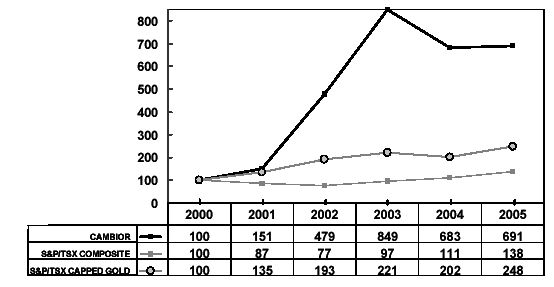
Note : Assuming an investment of $100 and reinvestment of dividends, if any, as described in the above paragraph.
Liability Insurance
The Company subscribes to insurance policies with respect to directors' and officers' liability covering directors and officers of the Company and its subsidiaries as a group. The total amount of insurance for the period from March 24, 2006 to March 24, 2007 is $25,000,000 with, unless otherwise provided in the policy, a deductible of $150,000 for the Company in case of loss. For the current year of coverage, the Company's total premium is $286,650 pursuant to the policies.
Statement of Corporate Governance Practices
The Common Shares of the Company are listed on the TSX and the American Stock Exchange ("AMEX"). As a result, the Company is subject to various rules and guidelines regarding corporate governance. The Company's corporate governance practices aim at ensuring the efficient administration of the Company and maximizing shareholders' value.
In 2005, the Canadian Securities Administrators ("CSA") implemented guidelines on best corporate governance practices (which are not mandatory) and require the annual disclosure of information dealing with the Board of Directors, directors orientation and continuing education measures, ethics, nomination and compensation processes and performance assessment of the Board and its committees. As a result of the above, the Toronto Stock Exchange repealed its corporate governance guidelines and requires that listed companies comply with the CSA's disclosure requirements. The Company's disclosure of corporate
24
governance practices is set out in Schedule C to this Information Circular. Also attached, as a Schedule D, is the Board of Directors Charter.
As proposals and new regulatory provisions come into effect, they are reviewed by the Board, through the Corporate Governance and Human Resources Committee, and if necessary or appropriate, the Company's governance practices are modified or supplemented. The Company complies with the CSA corporate governance best practices guidelines.
As part of its ongoing process to enhance the Company's corporate governance, the following measures were taken in 2005 by the Board, directly or through one of its committees:
Interest of Informed Persons in Material Transactions
To the knowledge of the management of the Company, no informed person of the Company or proposed director, or any associate or affiliate of any informed person or proposed director, has any interest in any transaction since the commencement of the Company's most recently completed financial year or in any proposed transaction which has materially affected or would materially affect the Company.
Interest of Certain Persons or Companies in Matters to be Acted Upon
None of the directors or senior officers of the Company, any person who has held such a position since the beginning of the last completed financial year of the Company, any proposed nominee for election as a director of the Company nor any associate or affiliate of the foregoing persons, has any material interest, directly or indirectly, by way of beneficial ownership of securities or otherwise, in any matter to be acted on at the Meeting (other than the election of directors) except for the senior officers of the Company and any of its subsidiaries inasmuch as, in the following year, they may be granted options to purchase Common Shares of the Company pursuant to its Stock Option Plan.
25
Additional Information
Financial information about the Company is contained in its Comparative Consolidated Financial Statements and Management's Discussion and Analysis for the fiscal year ended December 31, 2005, and additional information about the Company is available on SEDAR at www.sedar.com and (US) EDGAR at www.sec.gov/edgar.shtml.
Should you wish to obtain, at no cost, a copy of any of the following documents:
(i) the Company's latest Annual Information Form;
(ii) the Company's Comparative Consolidated Financial Statements for the year ended December 31, 2005, and Management's Discussion and Analysis with respect thereto; and/or
(iii) any of the Company's interim financial statements for a quarter subsequent to December 31, 2005,
please contact our Investor Relations Services, by e-mail at info@cambior.com, by fax at (450) 677-3382 or by phone at 1-866-554-0554.
Approval of the Board of Directors
The contents of this Information Circular and of the accompanying Form of Proxy, and the sending thereof, have been approved by the Company's Board of Directors.
Longueuil, Québec, March 22, 2006
Lucie Desjardins
Corporate Secretary
26
SCHEDULE A- Change of Auditors Reporting Documents
NOTICE OF CHANGE OF AUDITORS
Cambior Inc. ("Cambior") hereby gives notice, pursuant to section 4.11 of National Instrument 51-102, as follows:
- Currently, Raymond Chabot Grant Thornton LLP {"RCGT") are the auditors of
Cambior. The Audit Committee of Cambior's Board of Directors conducted a
review of Carnbior's audit requirements and the offer of services of RCGT and
P rice waterhouseCoopers LLP ("PwC") for the financial year 2006 and the fees
associated with such services. As a result of such review, Cambior's Audit
Committee determined to recommend (i) not to put RCGT forward for renewal as
auditors of Cambior at the expiry of RCGT's current term of office and (ii)
the appointment of PwC as Cambior's auditors at the annual meeting of
shareholders to be held in 2006 (the "Annual Meeting").
- During its meeting held on November 3rd 2005, the Board of Directors of Cambior approved the recommendations of its Audit
Committee indicated above.
-
There has been no adverse or qualified opinion or denial of opinion or reservation contained in the auditors' reports on Cambior's annual financial statements far the two fiscal years preceding the date of this notice, being the reports of RCGT for the fiscal years ended, respectively, December 31, 2004 and December 31, 2003.
-
There have been no reportable events (including disagreements, unresolved issues and consultations) in connection with the audits of the two most recent fiscal years and with any subsequent period to date.
Dated at Longueuil, Québec this 11th day of November 2005.
/s/ Lucie Desjardins
Lucie Desjardins
Corporate Secretary &
Senior Legal Counsel
27
 |
|
|
|
|
|
PricewaterhouseCoopers LLP |
|
|
Chartered Accountants |
|
|
1250 René-Lévesque Boulevard West |
|
|
Suite 2800 |
|
|
Montréal, Quebec |
|
|
Canada H3B 2G4 |
|
|
Telephone +1 541 205 5000 |
|
|
Direct Fax (514) 205-5675 |
To:
British Columbia Securities Commission
Alberta Securities Commission
Saskatchewan Financial Services Commission
The Manitoba Securities Commission
Ontario Securities Commission
Authorité des marchés financiers (Québec)
New Brunswick Securities Commission
Nova Scotia Securities Commission
Securities Commission of Newfoundland and Labrador
Prince Edward Island Securities Office
Dear Sirs:
We have read the statements made by Cambior Inc. in the attached copy of Notice of Change of Auditors dated November 11, 2005, which we understand will be filed pursuant to Section 4.11 of the National Instrument 51-102.
We agree with the statements in the Notice of Change of Auditors dated November 11, 2005 except that we have no basis to agree or disagree with, the following statement:
"There have been no reportable events (Including disagreements, unresolved issues and consultations) in connection with the audits of the two most recent fiscal years and with any subsequent period so date."
Yours very truly,

Chartered Accountants
Montreal, November 15, 2005
PricewaterhouseCoopers refers to the Canadian firm of PricewaterhouseCoopers LLP and the other member firms of PricewaterhouseCoopers International Limited, each of which is a separate and independent legal entity.
28
 |
|
| Raymond Chabot Grant Thornton, LLP. | |
| Chartered Accountants |
November 15, 2005
To the Securities Commissions and similar authorities of
British Columbia
Alberta
Saskatchewan
Manitoba
Ontario
Québec
New Brunswick
Nova Scotia
Prince Edward Island
Newfoundland
Northwest Territories
Yukon Territory
Nunavut
Subject: Cambior Inc. - Notice of Change of Auditors
Madam, Sir,
We are writing in accordance with section 4.11 of National instrument 51-102 "Continuous Disclosure Obligations" with respect to continuous disclosure obligations "Change of Auditor of a Reporting issuer" in connection with the change of auditors for Cambior Inc. We hereby wish to advise that we are in agreement with the information contained in the Notice of Change of Auditors of Cambior Inc. dated November 11, 2005, based on our knowledge of the information as at today's date.
Yours truly,

Chartered Accountants
Suite 1900
National Bank Tower
600 De La Gauchetiere Street West
Montreal, Quebec H3B 4L8
Telephone: (514) 878-2691
Fax: (514) 878-2127
www.rcgt.com
Member of Grant Thornton International
29
SCHEDULE B – Rights Plan Resolution
Upon motion duly proposed and seconded, it was resolved:
That the Shareholders Rights Plan entered into between the Company and CIBC Mellon Trust Company, as Rights Agent, dated November 4, 2005 and substantially described in the Information Circular of the Company dated March 22, 2006, be and is hereby, ratified.
30
SCHEDULE C – Statement of Corporate Governance Practices
The following is a description of the
Company's corporate governance practices. This statement has been reviewed by
the Corporate Governance and Human Resources Committee and approved by the
Board. When used herein, the term "independent" has the meaning ascribed thereto
by the Canadian Securities Administrators ("CSA") and the American Stock
Exchange ("Amex"), namely a director who has no direct or indirect material
relationship with the Company. A "material relationship" being a relationship
which could, in the view of the Company's Board of directors, be reasonably
expected to interfere with the exercise of the member's independent judgment.
Board of Directors
Independence
The Board of Directors of the Company (the "Board") currently consists of nine members. The Board can and does act independently of management. The positions of Chairman of the Board and Chief Executive Officer ("CEO") are separate and held by two different persons.
The Board, itself or through its Corporate Governance and Human Resources Committee, reviews, among other things, directors' relationship with the Company and its subsidiaries to determine the independence of the members of the Board. After consideration of all business, family and non for profit relationships among the directors and the Company, the Board determined that all directors, other than the President and CEO, have no direct or indirect material relationships with the Company which could reasonably interfere with the exercise of their independent judgment. Also, all members of the Audit Committee are "independent" as such term is defined in the rules of the CSA, the US Sarbanes-Oxley Act of 2002 ("SOX") and Amex for Audit Committees.
| DIRECTORS' RELATIONSHIP TO THE COMPANY | ||||
|
|
|
|
|
|
|
Name |
Management |
Dependent |
Independent |
Reason for dependent status |
|
|
|
|
|
|
|
Alexander G. Balogh |
|
|
a |
|
|
|
|
|
|
|
|
Guy G. Dufresne |
|
|
a |
|
|
(Chairman of the Board) |
|
|
|
|
|
|
|
|
|
|
|
Jean-André Élie |
|
|
a |
|
|
|
|
|
|
|
|
Graham Farquharson |
|
|
a |
|
|
|
|
|
|
|
|
Michel H. Gaucher |
|
|
a |
|
|
|
|
|
|
|
|
Louis Gignac |
a |
a |
|
President and Chief Executive Officer |
|
|
|
|
|
of the Company |
|
|
|
|
|
|
|
John W. W. Hick |
|
|
a |
|
|
|
|
|
|
|
|
Hubert T. Lacroix |
|
|
a |
|
|
|
|
|
|
|
|
Robert Normand |
|
|
a |
|
Other information about each director, including directorship of other reporting issuers, can be found under the heading "Election of Directors" in the Information Circular. Any director who is 75 years old at the time of an annual shareholders' meeting of the Company is not eligible for re-election.
31
Meetings and Closed Sessions
The Board held 10 meetings in 2005. Attendance is a critical element for directors to perform their duties and responsibilities. No minimum attendance level is established for Board and committee meetings. However, the Board expects that directors attend all regular meetings of the Board and committees in person unless circumstances make it impossible to do so. Information on each director's attendance to Board and committee meetings in 2005 can be found under the heading "Election of Directors" in the Information Circular.
During any meeting of the Board and its committees, any independent director may request that members of management not be present for all or part of the meeting. Also, at the end of regularly scheduled Board and committee meetings, independent directors have the opportunity to meet without management being present. These closed sessions promote open discussions among independent members. During closed sessions, independent directors address matters such as the CEO's performance, compensation and succession, performance of the Board and its committees, and any sensitive transaction, agreement or other matter. During 2005, independent directors held ten such closed sessions without any representatives of management being present following Board and Committee meetings. In addition to closed sessions of independent members, the Audit Committee holds, during each quarterly meeting, a closed session with the Company's external auditors to allow them to discuss openly about their quarterly review or annual audit of financial statements, accordingly. Committee Chairmen report to the Board on their committee's closed session discussion at the following Board meeting. The Board and Committee Chairmen communicate to management, as needed, the results of matters discussed in closed session and communicate to the Corporate Secretary matters that need to be inserted in the minutes of the meeting.
Board Mandate
The Board is elected by the Company's shareholders. The prime stewardship responsibility of the Board is to ensure the viability of the Company and to ensure that it is managed in the best interest of its shareholders as a whole while taking into account the interests of other stakeholders. The Board oversees the manner in which the Company conducts its business as well as the senior management responsible for the day-to-day operations of the Company. It sets the Company's policies, assesses their implementation by management and reviews the results. In addition to decisions requiring formal approval by the Board pursuant to the law or the Company's articles of incorporation and by-laws, the Board makes all important decisions concerning, among other things, major investments and significant divestitures. The Board acts in accordance with its mandate and the mandates of its committees, as well as with applicable laws and Company policies. The Board of Directors Charter is attached to the Information Circular as Schedule "D". It is also available on the Company's Website at
www.cambior.com. The Corporate Governance and Human Resources Committee reviews, annually, the Board's Charter and recommends appropriate changes to the Board.Position Descriptions
The Board of Directors Charter defines the role and responsibilities of the Board and management. The Chairman of the Board, Mr. Guy G. Dufresne, is not a member of management and is an independent director. He acts as liaison between management and the Board, presides the meetings of the Board and provides leadership and guidance to the Board and ensures that the Board fulfils its oversight responsibilities. The Corporate Governance and Human Resources Committee set forth a more detailed position description for the Chairman of the Board, which was approved by the Board.
The Corporate Governance and Human Resources Committee has also developed a position description for the Committee Chairmen which sets out their role and responsibilities. This position description was approved by the Board. The Chairman of each Committee presides the meetings of his Committee and ensures that it fulfills its oversight responsibilities.
The responsibilities of the CEO are set out in a written position description developed by the Corporate Governance and Human Resources Committee, with the CEO's input. The CEO's position description was approved by the Board and is reviewed annually by the Corporate Governance and Human Resources
32
Committee. The position description provides that the CEO develops and provides the strategic direction for the Company, and manages, directly or through delegated authority, the operations of the business and affairs of the Company in accordance with ethical conduct and applicable legislation, regulations, industry standards, contracts and agreements. The CEO is responsible for the sound administration, management and financial sustainability of the Company consistent with the best interests of shareholders while taking into consideration the interest of employees and other stakeholders. The CEO acts in conformity with the corporate policies and administrative directives and within the general parameters of the approved annual operating plan and budget. The CEO provides direction and leadership to the Company's staff toward the achievement of the Company's mission, strategy, philosophy, and its annual goals and objectives. The CEO reports to and is accountable to the Board for the achievement of corporate goals and objectives.
The CEO must determine and implement the appropriate systems for each of the five following areas of responsibility: Strategic planning, risk management, succession planning, communication with shareholders and the public, and internal controls and information management.
The CEO must submit to the Corporate Governance and Human Resources Committee any offer to join an outside board of directors to ensure that such additional directorship will not impair his ability to adequately fulfill his responsibilities.
Orientation and Continuing Education
The Corporate Governance and Human Resources Committee is responsible for the orientation and education of new directors. New directors meet with the Board and senior management to discuss the business activities of the Company and are given the opportunity to familiarize themselves with the Company and gain insight into the Company's business and operations by visiting various business locations and meeting local personnel. The Board ensures that prospective candidates fully understand the role and responsibilities of the Board and its committees and the contribution that individual directors are expected to make, including, in particular, the commitment of time that the Company expects of its directors.
Detailed current information on the Company and its business, operations and finances are sent on a quarterly basis to the directors. On an ongoing basis, as part of regular board meetings, presentations on different aspects of the Company's operations are made to Board members. Each director is provided with a copy of the Directors' Manual which contains information about the Company, the Board and its committees, and other relevant information. All directors are members of the Institute of Corporate Directors, and two of them are executive members thereof.
Ethics
The CEO's position description provides that he is responsible for promoting a Company culture which supports the highest of ethical standards, encourages personal integrity and assumes social responsibility.
The Company has adopted, from time to time, codes, policies and guidelines relating to ethics that apply to all directors, officers and employees of the Company. Cambior's Code of Ethics and the Specific Code of Ethics Governing Financial Reporting Officers, which complies with the requirements of SOX, are reviewed on an annual basis as well as adherence thereto. Copies of these codes are available on the Company's Website at
www.cambior.com. A copy may also be requested, free of charge, by communicating with the Company's Relations Services by email at info@cambior.com, by fax at (450) 677-3382 or by phone at 1-866-554-0554.Cambior's Code of Ethics establishes guidelines setting forth the ethical behavior required from every director, officer and employee of the Company, including, but not limited to, conflict of interests, protection of assets, confidentiality, and respect of the law, of the health and security of people, of the environment, of employees, of communities where the Company does business and of competitors, suppliers and shareholders. Directors, officers and designated employees are required, on an annual basis, to declare their commitment to respect Cambior's Code of Ethics.
33
Cambior's Code of Ethics provides that directors, officers and employees must avoid conflicts of interests, both real and perceived. In practice, should a director have a material interest or be otherwise in conflict of interests as regards a transaction or agreement considered by the Board, he must disclose his conflict of interests and withdraw from any discussions, assessment or decision related to the particular transaction or agreement.
The purpose of the Specific Code of Ethics Governing Financial Reporting Officers is to define standards applicable to the President and Chief Executive Officer, the Vice President, Finance and Chief Financial Officer, the Corporate Controller and any other person performing similar functions (the "Financial Reporting Officers"). It promotes, among other things: honest and ethical conduct; avoidance of conflicts of interests; full, fair, accurate, timely and understandable disclosure in public documents and communications made by the Company; and compliance with legislations and regulations. Financial reporting officers must, on an annual basis, undertake, in writing, to comply with this Code.
In addition, in compliance with its charter, the Audit Committee has established under the Company's Internal Whistle Blowing Policy, a process for the receipt and treatment of all complaints concerning accounting, internal accounting controls, auditing or related matters submitted by any employee, including procedures for the confidential anonymous submissions by employees of concerns regarding said matters.
Nomination of Directors
The Board, directly or through the Corporate Governance and Human Resources Committee, periodically examines issues relating to its composition to determine, among other things, its appropriate size to conduct its business effectively while providing a range of diverse skills and experience.
The Corporate Governance and Human Resources Committee, composed entirely of independent directors, evaluates and recommends nominees for the Board, in consultation with the Chairman of the Board and the President and CEO. As part of the process, the Committee assesses the skill sets of current Board members and determines what competencies, skills and personal qualities it should seek in new Board members to ensure that the Board, as a whole, has a diversity of skills and experience that support it in carrying out its responsibilities. The Committee maintains a list of potential nominees and may, at the Company's expense, retain outside consultants to conduct searches for appropriate nominees.
Compensation
The Corporate Governance and Human Resources Committee reviews, annually, the amount and form of compensation of directors. In making recommendations of appropriate adjustments to the Board, it considers the time commitment, risks and responsibilities of directors, as well as available information on compensation paid to directors of comparable companies. The Committee reviews such information and makes its recommendations to the Board. Directors' compensation is disclosed in the Information Circular under the heading "Directors' Compensation".
The Corporate Governance and Human Resources Committee is responsible for reviewing and approving, annually, the compensation for the President and CEO and the other senior officers of the Company. It also reviews and evaluates employees' compensation, fringe benefits and retirement plans. Executive compensation is disclosed under the heading "Executive Compensation" of the Information Circular. Additional information on the process for determining executive compensation is provided in the Information Circular under the heading "Corporate Governance and Human Resources Committee – Report on Executive Compensation".
When in need of assistance in determining compensation for any of the Company's directors or officers, the Corporate Governance and Human Resources Committee may, at the expense of the Company, retain the services of such independent advisors as it may deem necessary or useful in carrying out its responsibilities.
34
Committees of the Board
All committees are created by the Board and report directly to it. There are currently three committees of the Board. All committee members are appointed by the Board. Mr. Gignac, the only director who is not independent, is not a member of any committee of the Board. However, as President and CEO, he attends all the committees meetings at the members' request. The Chairman of a committee is selected by the Board among the members of the relevant committee. The minutes of all committee meetings as well as the written resolutions passed by a committee are provided to the Board. A committee may, at the Company's expense, retain the services of such independent advisors as it may deem useful or necessary in carrying out its mandate. The role and responsibilities of each committee are set out in written charters, which are reviewed annually by the relevant committee to ensure they reflect best practices and compliance to regulatory requirements.
The Board has created three committees to which is has delegated oversight responsibilities. In addition to the Corporate Governance and Human Resources Committee, the Board has an Audit Committee as well as a Safety and Sustainability Committee.
The Audit Committee consists of four independent directors. This committee has the general mandate to review and, if deemed appropriate, recommend the approval of the Company=s annual and quarterly financial statements to the Board, as well as management's discussion and analysis and the press releases regarding the financial statements, and more particularly (i) to consider and evaluate all aspects of the Company's financial reporting process, internal control, hedging operations and insurance coverage; (ii) to recommend to the Board the measures to be taken in connection with these four areas; and (iii) to monitor the implementation and administration of corporate policies and guidelines with respect to financial reporting and internal control and review the financial statements certification process. In addition, this committee evaluates and monitors the risk management program and reviews for approval all related party transactions. Based on its review, this committee makes recommendations to the Board.
With respect to the external auditors, the committee ensures that they remain independent of management. The committee reviews the audit plan and its execution, evaluates the auditor's overall performance and makes recommendations to the shareholders regarding their appointment. The committee reviews and approves the audit fees and pre-approves legally permissible non-audit related engagements. The committee meets, together and separately, with management and the external auditors to discuss matters related to the financial affairs of the Company. The Audit Committee's charter provides that it is responsible for resolving disagreements between management and the external auditors regarding financial reporting. The external auditors report directly to the Audit Committee.
All members of the Audit Committee are financially literate and the Board has determined that Mr. Robert Normand, the Chairman of the Audit Committee, and Mr. Jean-André Élie are Audit Committee Financial Experts in conformity with the rules of SOX. In considering criteria for determination of financial literacy, the Board looks at the ability to read and understand financial statements. In considering criteria for determination of accounting or related financial expertise, the Board looks at familiarity with emerging accounting issues, past employment experience in finance or accounting, requisite professional certification in accounting, or any other comparable experience or background which results in the individuals' financial sophistication, including being or having been a Chief Executive Officer, a Chief Financial Officer or having held another senior officer position of an entity with financial oversight responsibilities.
The charter of the Audit Committee was specifically approved by the Board, and is reviewed annually by said Committee. All modifications to the charter are submitted to the Board for approval. This committee's charter is attached as a schedule to the Company's Annual Information Form for the fiscal year ended December 31, 2005.
35
The members of the Audit Committee are:
Robert Normand, Chairman
Guy G. Dufresne
Jean-André Élie
Michel H. Gaucher
The Safety and Sustainability Committee consists of three independent directors. This committee reviews the general policies submitted by the Company's management in connection with occupational health, safety and training, corporate social responsibility and environment and receives reports on such matters from management. It reviews and evaluates practices, plans and programs related to these three areas. Based on its review, this committee makes recommendations to the Board.
The members of the Safety and Sustainability Committee are:
Michel H. Gaucher, Chairman
Alexander G. Balogh
Graham Farquharson
The Corporate Governance and Human Resources Committee consists of four independent directors and is responsible for monitoring corporate governance and human resources matters. This committee reviews the general policies submitted by management in connection with corporate governance and human resources and oversees the implementation and administration of policies and guidelines with respect to these two areas. It ensures that the Company's corporate governance practices are in line with corporate governance rules and guidelines set forth by the relevant authorities, in effect from time to time. It reviews and evaluates periodically and at least once a year, (i) the independence and performance of the Board and its committees, as well as the contribution of each director, and director succession planning; and (ii) compensation, fringe benefits, financial incentives and retirement plans as well as any matter concerning the proper implementation of human resources policies and programs. This committee also considers the appointment of new officers and reviews and evaluates nominees for election as directors. Based on its review, this committee makes recommendations to the Board.
The members of the Corporate Governance and Human Resources Committee are:
Graham Farquharson , Chairman
Alexander G. Balogh
Guy G. Dufresne
Hubert T. Lacroix
Assessment
The Corporate Governance and Human Resources Committee oversees and makes recommendations regarding the effectiveness of the corporate governance of the Company. It deals with all matters relating thereto, including, without restriction, reviewing and evaluating, periodically and at least once a year, the independence and performance of the Board and its committees, as well as the contribution of each director, and director succession planning.
As part of this process, the directors annually fill out a questionnaire concerning the direct and indirect relationship with the Company. Each year, directors also conduct an evaluation of the performance and effectiveness of the Board and its committees, along with self-assessments. The process usually involves the completion of a detailed questionnaire by individual directors. Answers are sent to the Chairman of the Board, who reports thereon at a Board meeting. Director peer reviews are performed in the context of discussions between individual directors and the Chairman of the Board. The Corporate Governance and Human Resources Committee reviews annually the qualifications and performance of the directors proposed for reelection. Based on its evaluation, the Committee makes recommendations to the Board.
36
Board's Expectations of Management
The Board's main expectations of the Company's management are to protect the Company's interests and ensure the long term growth of shareholder value.
The Board expects management to assume responsibility for the day-to-day operations of the Company while staying within authorized business limits and conforming to the strategic plan, annual operating plan and budget and various corporate policies approved by the Board. The Board expects to be regularly informed by management of the results obtained, the progress achieved, any business opportunities which may arise and any difficulties encountered. The Board also expects management to submit for its approval, alternative plans and strategies to be implemented based on the economic and market conditions.
Risks Assessment
The Board, through its Audit Committee, assumes specific responsibility for the identification of the principal risks of the Company's business and the implementation of appropriate systems to effectively manage these risks. Among other things, the Audit Committee reviews and evaluates the Company's risk management program, including the revenue protection program, to ensure that management has identified the principal risks of the Company's business and has implemented, and is maintaining appropriate systems and procedures to manage those risks. The Company reviews its principal risks and reports on said review to the Audit Committee on a quarterly basis. The Company's major risks are discussed in its Annual Report for its financial year ended December 31, 2005.
Financial Reporting and Internal Controls
The Audit Committee reviews the general policies submitted by the Company's management in connection with financial reporting and internal control; it deals with all matters relating thereto, including, without restriction, reviewing and evaluating, periodically and at least once a year, financial reports, the work of outside auditors, the structure of the accounting and internal control department and the efficiency of the records and systems used. Based on its review, the Audit Committee makes recommendations to the Board.
Strategic Planning
The Board assumes specific responsibility for the adoption of a strategic planning process. The Board reviews and, where appropriate, approves the Company's annual budget and strategic plan which takes into account, among other things, the opportunities and risks of the business, all of which are developed at first by management and discussed between management and the Board. The Board frequently discusses the Company's strategies and their implementation at Board meetings. The Company reviews its strategic plan periodically, taking into account changes in the general business conditions and, in particular, in the mining industry. This strategic plan is produced along with long-term financial forecasts.
Succession Planning
The Board, with the assistance of its Corporate Governance and Human Resources Committee, assumes specific responsibility for succession planning of senior management, including the appointing, training, evaluation and monitoring of senior management. The Board appoints the CEO and sets forth his position description. The Committee discusses with management and reports to the Board annually on succession planning matters.
Communication Policy
The Board, by itself and also through its Audit Committee, assumes specific responsibility for communications with shareholders and the public at large. The Audit Committee reviews and approves the contents of major financial disclosure documents, including the annual report, the unaudited quarterly and audited annual financial statements, the management's discussion and analysis of the financial conditions
37
and results of operation relating to said financial statements and management's assessment on internal controls.
The Board reviews all major disclosure documents, including the annual information form, circulars and the above-described financial disclosure documents. The Board adopted and also reviews from time to time the Company's disclosure policy that provides for the accurate and timely communication to the public of all important information, addresses how the Company interacts with shareholders, analysts, stakeholders and the public in general as regards to communication of information, and contains measures to avoid selective disclosure. In this regard:
the Company's disclosure committee
oversees the Company's corporate disclosure practices and ensures adherence to
the disclosure policy;
the Company maintains an investors
relations service with the responsibility of managing communications with the
investing public in accordance with the Company's disclosure policy and
procedure and legal disclosure requirements;
it is Company policy that every
shareholder inquiry should receive a prompt response from the Manager,
Investor Relations;
the President and CEO, the Vice
President, Finance and CFO and other senior executives as well as the Manager,
Investor Relations, meet periodically with financial analysts and
institutional investors and attend various events allowing them to meet with
current and potential investors, and other stakeholders;
the Manager, Investor Relations, makes
himself available to shareholders by telephone, fax and e-mail; and
the Company maintains an investor relations Website at www.cambior.com.
Internal Controls
The Board, through its Audit Committee, assumes specific responsibility for the integrity of the Company's internal control and management information systems. The Audit Committee considers and evaluates all aspects of the Company's financial reporting process and internal controls, monitors the implementation and administration of corporate policies and guidelines adopted by regulatory authorities and the Board with respect to financial reporting and internal controls, and makes recommendations to the Board in connection with these two areas.
38
SCHEDULE D – Board of Directors Charter
CAMBIOR INC.
BOARD OF DIRECTORS CHARTER
I. OVERALL ROLE AND RESPONSABILITY
The Board of Directors (the "Board") of Cambior Inc. (the "Company") is elected by the Company's shareholders to supervise the management of the business and affairs of the Company.
The Board monitors the manner in which the Company conducts its business as well as the senior management responsible for the day-to-day operations of the Company. It sets the Company's policies, assesses their implementation by management and reviews the results.
The prime stewardship responsibility of the Board is to ensure the viability of the Company and to ensure that it is managed in the best interest of its shareholders as a whole while taking into account the interests of other stakeholders.
The Board's main expectations of the Company's management are to protect the Company's interests and ensure the long term growth of shareholder value.
II. DUTIES AND RESPONSIBILITIES OF THE BOARD
In addition to statutory responsibilities, the Board, either directly or through one of its committees, assumes responsibility for:
(a) satisfying itself, to the extent feasible, as to the integrity of the Chief Executive Officer ("CEO") and other senior officers, and that the CEO and other senior officers maintain a culture of integrity throughout the Company;
(b) ensuring that the Company is operated so as to preserve its financial integrity and in accordance with policies approved by the Board;
(c) ensuring, through the Corporate Governance and Human Resources Committee, that appropriate structures and procedures are in place so that the Board and its committees can function independently of management and in accordance with sound corporate governance practices;
39
| Cambior Inc. | |
| Board of Directors Charter | Page 2 |
(d) reviewing and approving key policy statements developed by management on various issues such as ethics, regulatory compliance, protection of environment, sustainable development, health and safety and communications with shareholders, other stakeholders and the general public ;
(e) adopting a strategic planning process and thereafter reviewing and, where appropriate, approving, annually, a strategic plan and a budget which takes into account, among other things, the opportunities and risks of the business (all of which are developed at first by management), and monitoring the Company's performance with reference to the adopted budget and strategic plan;
(f) identifying the principal risks of the Company's business and ensuring the implementation of appropriate controls, measures and systems to manage these risks;
(g) appointing the CEO, setting forth the position description, as well as planning for the succession of the CEO with the recommendation of the Corporate Governance and Human Resources Committee;
(h) evaluating the performance and reviewing the compensation of the CEO with the Corporate Governance and Human Resources Committee, and ensuring that such compensation is competitive and measured according to appropriate benchmarks which reward contribution to shareholder value;
(i) appointing, training, evaluating and monitoring officers as well as planning for their succession with the recommendations of the Corporate Governance and Human Resources Committee; determining management compensation with the recommendations of the Corporate Governance and Human Resources Committee and ensuring that such compensation is competitive and measured according to appropriate industry benchmarks;
(j) overseeing, through the Audit Committee, the quality and integrity of the Company's accounting and financial reporting systems, and disclosure controls and procedures;
(k) ensuring, through the Audit Committee, the integrity of the Company's internal controls and management information systems;
(l) overseeing, through the Audit Committee, the process for evaluating the adequacy of internal control structures and procedures of financial reporting, and satisfy itself as to the adequacy of such process;
(m) advising management on critical and sensitive issues;
(n) ensuring that the Board's expectations of management are understood, that all appropriate matters come before the Board in a timely and effective manner and that the Board is kept informed of shareholder feedback;
40
| Cambior Inc. | |
| Board of Directors Charter | Page 3 |
(o) conducting annually, through the Corporate Governance and Human Resources Committee, a review of Board practices and the Board's and committees' performance (including director's individual contributions), to ascertain that the Board, its committees and the directors are capable of carrying out and do carry out their roles effectively;
(p) ensuring with the Corporate Governance and Human Resources Committee, the adequacy and form of the compensation of nonexecutive directors taking into account the responsibilities and risks involved in being an effective director;
(q) determining, with the Corporate Governance and Human Resources Committee, in light of the opportunities and risks facing the Company, what competencies, skills and personal qualities the Board should seek in recruiting new Board members, and the appropriate size of the Board to facilitate effective decision-making;
(r) determining, annually, with the Corporate Governance and Human Resources Committee, the independence of each member of the Board as such term is defined by applicable laws and regulations including, rules and guidelines of stock exchanges to which the Company is subject;
(s) setting forth, with the recommendation of the Corporate Governance and Human Resources Committee, the position description for the Chairman of the Board and the Chairmen of the committees of the Board;
(t) determining annually, with the Audit Committee, if at least one member of the Audit Committee is an "Audit Committee Financial Expert" and each member of the Audit Committee is "financially literate" as such terms are defined under applicable laws and regulations including rules and guidelines of stock exchanges to which the Company is subject;
(u) selecting, upon the recommendation of the Corporate Governance and Human Resources Committee, nominees for election as directors;
(v) selecting the Chairman of the Board;
(w) ensuring, through the Corporate Governance and Human Resources Committee, that new directors have a good understanding of their role and responsibilities and of the contribution expected of them (including as regards attendance at, and preparation for, meetings), and that they are provided with adequate education and orientation as regards the Company, its business and activities;
(x) approving capital expenditures requiring an investment of greater than Cdn $1,000,000, or significant divestiture, as well as acquisitions where environmental or other liabilities exist and which could result in significant exposure to the Company;
(y) reviewing alternate strategies in response to any possible takeover bid in order to maximize value for shareholders;
41
| Cambior Inc. | |
| Board of Directors Charter | Page 4 |
(z) discussing and developing the Company's approach to corporate governance issues in general, with the involvement of the Corporate Governance and Human Resources Committee;
(aa) discussing and developing the Company's approach to the work, human and physical environments in general, with the involvement of the Safety and Sustainability Committee;
(bb) discussing and developing the Company's approach to sustainable development, with the involvement of the Safety and Sustainability Committee;
(cc) reviewing and approving the content of the principal communications by the Company to its shareholders and the public, such as quarterly and annual financial statements and management's discussion and analysis, annual information form, information circulars, prospectuses and other similar documents which may be issued and distributed, provided that the quarterly and annual financial statements and related management's discussion and analysis and earnings press releases and any other public disclosure document containing financial information may be reviewed and approved by the Audit Committee instead of the Board;
(dd) ensuring ethical behavior and compliance with laws;
(ee) monitoring, directly or through one of its committees, compliance with all codes of ethics; and
(ff) consider the means by which stakeholders can communicate with the members of the Board (including independent directors). Directors are expected to make reasonable efforts to attend all Board meetings and to review materials distributed to them in advance of Board meetings.
III. CHARTER
The Corporate Governance and Human Resources Committee shall periodically review this Charter and recommend appropriate changes to the Board.
Approved by the Board on: July 21, 2004
Last reviewed on: February 20, 2006
42