Cambior Inc 40-F, filed Mar 31, 2006: Annual Information Form
March 31, 2006
ANNUAL INFORMATION FORM
For the year ended
December 31, 2005
CAMBIOR INC.
Table of Contents
| ITEM I | NAME AND INCORPORATION | 7 | |
| ITEM II | INTERCORPORATE RELATIONSHIPS | 7 | |
| ITEM III | GENERAL DEVELOPMENT OF THE BUSINESS | 11 | |
| 1. | THREE-YEAR HISTORY | 11 | |
| 2. | SIGNIFICANT ACQUISITIONS | 13 | |
| 3. | RISK FACTORS | 13 | |
| ITEM IV | NARRATIVE DESCRIPTION OF THE BUSINESS | 14 | |
| 1. | MINING ACTIVITIES – PROCESS | 14 | |
| 2. | MINING ACTIVITIES – PRODUCTS | 15 | |
| 2.1 | Gold | 15 | |
| 2.2 | Niobium | 17 | |
| 2.3 | Bauxite | 17 | |
| 3. | MINING ACTIVITIES – CANADA | 18 | |
| 3.1 | Gold Production | 18 | |
| 3.2 | Ferroniobium Production | 24 | |
| 4. | MINING ACTIVITIES – INTERNATIONAL | 25 | |
| 4.1 | South America: Guiana Shield | 26 | |
| 5. | EXPLORATION AND BUSINESS DEVELOPMENT | 37 | |
| 5.1 | General | 37 | |
| 5.2 | Business Development | 38 | |
| 5.3 | Exploration – Canada | 38 | |
| 5.4 | Exploration – Andes | 39 | |
| 5.5 | Exploration – French Guiana | 39 | |
| 5.6 | Exploration – Guyana | 40 | |
| 5.7 | Exploration – Suriname | 40 | |
| 5.8 | Outlook | 40 | |
| 6. | MINERAL RESERVES AND RESOURCES | 41 | |
| 7. | OTHER ASPECTS OF THE BUSINESS | 46 | |
| 7.1 | Marketing of Production | 46 | |
| 7.2 | Government Regulation | 49 | |
| 7.3 | Environment | 50 | |
| 7.4 | Community Relations | 52 | |
| 7.5 | Taxes | 52 | |
| 7.6 | Mining Development and Construction | 54 | |
| 7.7 | Intellectual Property | 54 | |
| 7.8 | Competition | 54 | |
| 7.9 | Sale of Production | 55 | |
| 7.10 | Employee Relations | 56 | |
| 8. | DIVIDENDS | 57 | |
| 9. | LITIGATION | 57 | |
| ITEM V | DESCRIPTION OF CAPITAL STRUCTURE | 57 | |
| ITEM VI | MARKET FOR SECURITIES | 58 | |
| ITEM VII | DIRECTORS AND OFFICERS | 61 | |
| 1. | DIRECTORS | 61 | |
| 2. | EXECUTIVE OFFICERS | 62 | |
| 3. | SHAREHOLDINGS OF DIRECTORS AND OFFICERS | 64 | |
| 4. | CORPORATE CEASE TRADE ORDERS OR BANKRUPTCIES | 64 | |
| ITEM VIII | AUDIT COMMITTEE | 65 |
| 1. | COMPOSITION AND RELEVANT EDUCATION AND EXPERIENCE OF MEMBERS | 65 |
| 2. | MANDATE OF THE AUDIT COMMITTEE | 67 |
| 3. | POLICIES AND PROCEDURES FOR THE ENGAGEMENT OF AUDIT AND NON-AUDIT SERVICES | 67 |
| 4. | EXTERNAL AUDITOR SERVICE FEES | 68 |
| ITEM IX | INTEREST OF MANAGEMENT AND OTHERS IN MATERIAL TRANSACTIONS | 69 |
| ITEM X | TRANSFER AGENT AND REGISTRAR | 69 |
| ITEM XI | MATERIAL CONTRACTS | 69 |
| ITEM XII | INTERESTS OF EXPERTS | 69 |
| 1. | NAMES OF EXPERTS | 69 |
| 2. | INTERESTS OF EXPERTS | 70 |
| ITEM XIII | ADDITIONAL INFORMATION | 70 |
| SCHEDULE A – Audit Committee Charter | ||
List of Maps and Tables
| Cambior's Corporate Structure | 9 |
| Cambior's Mines and Projects - Location | 10 |
Explanatory Notes:
1. All dollar amounts presented in this Annual Information Form are expressed in US dollars, unless otherwise indicated.
2. Production results are in metric units, unless otherwise indicated.
3. Cambior Inc. carries on business in Canada. The subsidiaries of Cambior Inc. carry on business in Canada and elsewhere. In this Annual Information Form, the words "Company" and "Cambior" are used interchangeably and in each case refer, as the context may require, to all or any of Cambior Inc. and its subsidiaries.
4. Unless otherwise specified, reference herein to the 2005 Annual Report are references to Cambior's Annual Report for the year ended December 31, 2005. All such references are incorporated herein.
5. The information in this Annual Information Form is complemented by the Company's Audited Consolidated Annual Financial Statements for the year ended December 31, 2005 and the management's discussion and analysis thereon.
6. The 2005 Annual Report, the Company's Annual Financial Statements for the year ended December 31, 2005 and the management's discussion and analysis thereon, are available on SEDAR at www.sedar.com and the Company's website at www.cambior.com.
Cautionary Note to US Investors
The United States Securities and Exchange Commission (the "SEC") allows mining companies, in their filings with the SEC, to disclose only those mineral deposits they can economically and legally extract or produce. The Company uses certain terms in this document, such as "mineral resources", that are recognized and mandated by Canadian securities regulators but are not recognized by the SEC. US investors are urged to consider closely the disclosure on the technical terms in section 6 of Item IV hereof.
Page 1 Special Note Regarding Forward-Looking Statements
This Annual Information Form contains or incorporates by reference certain information that may constitute "forward-looking statements". All statements other than statements which are reporting and commenting results as well as statements of historical fact set forth herein, are forward-looking statements that may involve a number of known and unknown risks, uncertainties and other factors; forward-looking statements include, without limitation, statements regarding strategic plans, future production, sales targets (including market share evolution as regards bauxite and niobium), cost estimates and anticipated financial results; potential mineralization and evaluation and evolution of mineral reserves and resources (Rosebel's potential for further increases in particular); expected exploration results, future work programs and objectives, evolution of development projects and exploration budgets and targets, particularly as regards the Westwood and La Arena projects; construction and production targets and timetables, as well as anticipated timing of grant of permits and governmental incentives, particularly as regards the Camp Caiman project; expected continuity of a favorable gold market and planned reduction of hedging and off-balance sheet transactions; contractual commitments, litigation matters and measures of mitigating financial and operational risks; anticipated liabilities regarding site closure and employee benefits; continuous availability of required manpower; possible exercise of outstanding warrants and, more generally, continuous access to capital markets; and Cambior's global outlook and that of each of its mines. These statements relate to analysis and other information that are based on forecasts of future results, estimates of amounts not yet determinable and assumptions of management.
Statements concerning actual mineral reserves and resources estimates are also deemed to constitute forward-looking statements to the extent that they involve estimates of the mineralization that will be encountered if the relevant project or property is developed, and in the case of mineral reserves, such statements reflect the conclusion based on certain assumptions that the mineral deposit can be economically exploited.
Forward-looking statements, which involve assumptions and describe the Company's future plans, strategies and expectations are generally identifiable by use of the words "may", "will", "should", "continue", "expect", "anticipate", "estimate", "believe", "intend", "plan" or "project" or the negative of these words or other variations on these words or comparable terminology. There can be no assurance that such statements will prove to be accurate and actual results and future events could differ materially from those anticipated in such statements.
Page 2
The following are some of the important factors that could cause actual results or outcomes to differ materially from those discussed in the forward-looking statements: hazards normally encountered in the mining business including unusual or unexpected geological formations, rock bursts, cave-ins, floods and other conditions; delays and repair costs resulting from equipment failure; liability under environmental legislation; uncertainties as to estimation of mineral reserves and resources; competition for qualified manpower and mining properties with Canadian and foreign companies that may have substantially greater financial and other resources; requirement of additional financing; risk related to hedging and non-hedge derivative instruments; fluctuations in the market price of gold, niobium, bauxite and fuel and in foreign currencies relative to the Canadian currency; labour strikes; community relations; risks involved with investments in emerging countries including stability of legislation and policy, unilateral revocation of mining or property rights and political instability; obtaining permits; federal, state and provincial legislation governing the acquisition and ownership of mining and property rights; mining duties; income taxes; labor, health, safety standards; exports and other related matters. Although the Company has attempted to identify important factors that could cause actual results to differ materially from expectations, intentions, estimates or forecasts, there may be other factors that cause results to differ from what is anticipated, estimated or intended.
Any forward-looking statement speaks only of the date on which it is made and the Company undertakes no obligation to update any forward-looking statement or statements to reflect events or circumstances after the date on which the statement is made or to reflect the occurrence of unanticipated events. New factors emerge from time to time, and it is not possible for the Company to predict which factor will arise. Readers are cautioned not to place undue reliance on forward-looking statements.
Page 3
Glossary
Mining Terms
By-product: a secondary metal or mineral product recovered in the milling process.
Carbon-in-pulp (CIP) process: a process used to recover dissolved gold from a cyanide leach slurry. Coarse activated carbon particles are moved counter-current to the slurry, absorbing gold as they pass through the circuit. Loaded carbon is removed from the slurry by screening. Gold is recovered from the loaded carbon by stripping in a caustic cyanide solution followed by electrolysis.
Concentrate: a product containing the valuable metal and from which most of the waste material in the ore has been eliminated.
Contained ounces: ounces in the ground without reduction due to mining loss or processing loss.
Converter: a furnace in which the pyrochlore concentrate is converted into ferroniobium and heat is produced by the oxidation reaction.
Cut-off grade: the lowest grade of mineralized material considered economic; used in the estimation of mineral reserves in a given deposit.
Deferred development: development of underground infrastructure to be used over an extended period. Costs related to this activity are capitalized.
Deferred stripping: additional waste mining in excess of the average stripping ratio for some period of time during the mine plan in an open-pit operation. Costs related to this additional waste mining are capitalized when occurring and charged back to operating costs when waste mining is less than the average stripping ratio.
Depletion: the decrease in quantity of mineral reserves in a deposit or property resulting from extraction or production.
Dilution: an estimate of the amount of waste or low-grade mineralized rock which will be mined with the ore as part of normal mining practices in extracting an orebody.
Grade: the relative quantity or percentage of metal or mineral content.
ISO 14001: a standard established by the International Organization for Standardization setting forth the guidelines for an environmental management system.
ISO 9001: a standard established by the International Organization for Standardization setting forth the guidelines for a quality management system.
Page 4 Leach/heap leach: to dissolve minerals or metals out of
ore with chemicals. Heap leaching gold involves the percolation of a cyanide
solution through crushed ore heaped on an impervious pad or base.
Mineral reserves: mineral reserves are divided into two categories; proven and probable mineral reserves, which are more particularly defined herein under section 6 of Item IV.
Mineral resources: mineral resources are divided into three categories; measured, indicated and inferred, which are more particularly defined herein under section 6 of Item IV.
Qualified person: an individual who is an engineer or geoscientist with at least five years of experience in mineral exploration, mine development or operation, mineral project assessment, or any combination of these, has experience relevant to the subject matter of the mineral project and the technical report, and is a member in good standing of a professional association.
Recovery: the proportion of valuable material obtained during the mining or processing. Generally expressed as a percentage of the material recovered compared to the total material present.
Restoration: operation consisting of restoring a mining site to a satisfactory condition. Stope: the underground excavation from which the ore is extracted. Stoping: the process of mining the orebody. Stripping: the process of removing overburden or waste rock to expose ore.
Tailings: the material that remains after all metals or minerals considered economic have been removed from ore during milling.
Tailings pond: a containment area used to deposit tailings from milling.
Financial Terms
2001 Financial Creditors: means the banking syndicate party to the 2001 Agreements.
2001 Agreements: means the amended and restated restructuring agreement, the second amended and restated $65 million credit facility agreement and the $55 million prepaid gold forward sale agreement, simultaneously closed on January 12, 2001, with the 2001 Financial Creditors.
2003 Credit Facility: means the amended and restated $65 million credit facility agreement entered into with a syndicate of international financial institutions on February 7, 2003.
Page 5 2003 Financial Creditors: means the syndicate of
international financial institutions party to the 2003 Credit Facility,
including the counter party to the Prepaid Gold Forward Sales Agreement. AMEX: American Stock Exchange. Forward sales: the sale of a commodity for delivery at a specified future
date and price, usually at a premium to the spot price. Hedge: a risk management technique used to manage
commodity price, interest rate, foreign currency exchange or other exposures
arising from regular business transactions. Hedging: a future transaction made to protect the price of a commodity as
revenue or cost and secure cash flows. Margin: money or securities deposited with a broker as security against
possible negative price fluctuations. Mine operating cost: the average cost of producing an
ounce of gold. Includes deferred stripping costs, refining and transportation
costs and by-product credits, but excluding royalties, depreciation and
restoration. Royalty: cash payment or physical payment (in-kind) generally expressed
as a percentage of Net Smelter Returns ("NSR") or mine production. Spot price: the current price of a metal for immediate delivery. TSX: the Toronto Stock Exchange.
Volatility: propensity for variability. A market or share is volatile when it records rapid variations.
Page 6 Conversion Table
| METRIC SYSTEM | IMPERIAL SYSTEM | |
| 1 metre (m) | = | 3.2808 feet (ft) |
| 1 kilometre (km) | = | 0.6214 mile (mi) |
| 1 square kilometre (km2) | = | 0.3861 square mile (mi2) |
| 1 gram (g) | = | 0.0322 troy ounce (oz) |
| 1 kilogram (kg) | = | 2.2046 pounds (lbs) |
| 1 tonne (t) | = | 1.1023 tons (t) |
| 1 gram/tonne (g/t) | = | 0.0292 ounce/ton (oz/t) |
| SYMBOLS USED | ||
| Ag | = | silver |
| Au | = | gold |
| Cu | = | copper |
| FeNb | = | ferroniobium |
| Nb | = | niobium |
| Nb2O5 | = | niobium pentoxide (pyrochlore) |
| SiO2 | = | Silica |
Page 7 Item I Name and Incorporation
The Company was incorporated on November 7, 1973 under the name "Niobec Inc." and was continued under Part IA of the Companies Act (Québec) pursuant to a certificate of continuance dated November 29, 1985. At the time of its continuance, the Company amended its articles to enable itself to issue shares to the public. The Company's articles were again amended on March 14, 1986 to change its name to "Cambior Inc.".
Cambior's articles were restated on January 1, 1988 when the Company amalgamated with Rouanda Mines Inc., a wholly-owned subsidiary of Cambior, itself a product of the amalgamation between Aiguebelle Resources Inc. and another wholly-owned Cambior subsidiary. The Company's articles were again restated on January 1, 1994 when Cambior amalgamated with VSM Exploration Inc., a wholly-owned Cambior subsidiary acquired through private purchases followed by an insider bid.
The Company's registered office is located at 1075, 3rd Avenue East, Val-d'Or, Québec, Canada, J9P 6M1, and its executive office at 1111 St. Charles Street West, East Tower, Suite 750, Longueuil, Québec, Canada, J4K 5G4.
Item II Intercorporate Relationships
Cambior Inc. currently owns all of its Canadian assets directly and serves as the holding company for the other companies in the group. A diagram featuring Cambior's main assets and privately-held subsidiaries (with the jurisdiction of incorporation for each of them shown in brackets under its name) is set forth on page 9. All shares held by Cambior in these subsidiaries are voting shares, except for the Class III non-voting Preference Shares of OGML (as defined below) which Cambior owns in totality. The location of Cambior's principal assets is illustrated on the page following the diagram.
Rosebel Gold Mines N.V. ("RGM"), a 95%-owned1 subsidiary of Cambior, was incorporated on May 8, 2002 pursuant to the Commercial Code of Suriname. RGM holds the mining rights and assets comprising the Rosebel mine and manages operations thereat. More detailed information on this subsidiary and the Rosebel property is given in subsection 4.1.1 of Item IV below. RGM's registered office is at Heerenstraat NR8, Paramaribo, P.O. Box 2973, Suriname.
OMAI Gold Mines Limited ("OGML"), a 95%-owned subsidiary of Cambior, was incorporated on August 15, 1991 pursuant to the Companies Act of the Co-operative Republic of Guyana ("Guyana"), and continued on February 3, 1997 under section 339 of the Companies Act 1991 (Guyana). OGML holds the mining rights and the assets comprising the Omai gold mine, and the gold production of which was terminated as of September 2005. More detailed information on this subsidiary and the Omai gold mine is given in subsection 4.1.2 of Item IV below. OGML's registered office is at 176-D, Middle Street, Cummingsburg, P.O. Box 12249, Georgetown, Guyana.
__________________________
1
As the Republic of Suriname also holds Class B voting shares since Rosebel mine's commencement of commercial production, its overall participation in RGM's share capital is slightly different than 5% (6% as at December 31, 2005). However, all Class B shares will be redeemed over the next years and, in any event, no dividends will be paid prior to the full redemption of Class B shares. Therefore, only Class A shares are considered for the purposes of reflecting each shareholder's true and permanent participation in RGM's share capital.
Page 8
OMAI Bauxite Mining Inc. ("OBMI"), a 70%-owned subsidiary of Cambior, was incorporated on June 25, 2004 pursuant to the Companies Act 1991 (Guyana). OBMI holds the rights and assets comprising the Omai bauxite mine complex and manages operations thereat. More detailed information on this subsidiary and the Omai bauxite mine is given in subsection 4.1.3 of Item IV below. OBMI's registered office is at 176-D, Middle Street, Cummingsburg, P.O. Box 12249, Georgetown, Guyana.
CBJ Caiman S.A.S. ("CBJ Caiman") is an indirect wholly-owned subsidiary of Cambior and the sole holder of the mineral rights and related assets comprising the Camp Caiman project in French Guiana. Originally, this project was owned by Asarco Guyane Française S.A.R.L., which became an indirect wholly-owned subsidiary of Cambior in December 2003. This entity was thereafter transformed into a simplified joint stock Company and renamed to its actual name on January 1, 2005. More detailed information on the Camp Caiman project is given in subsection 4.1.4 of Item IV below. CBJ Caiman's registered office is at PK 6, 5 Route de Montjoly, Chemin Poupon, 97354 Rémire-Montjoly, French Guiana.
Cambior also holds interests and options to earn direct or indirect interests in several exploration and development properties located in Peru, the most important project being known as La Arena. More detailed information on Peruvian activities is given in section 5.4 of Item IV below. Cambior holds its Peruvian interests primarily through its wholly-owned subsidiary, Sociedad Minera Cambior Peru S.A., which has its registered office at Ave. José Casimiro Ulloa No. 312, Urb. San Antonio, Miraflores, Lima 18, Peru.
Page 9
Cambior's Corporate Structure
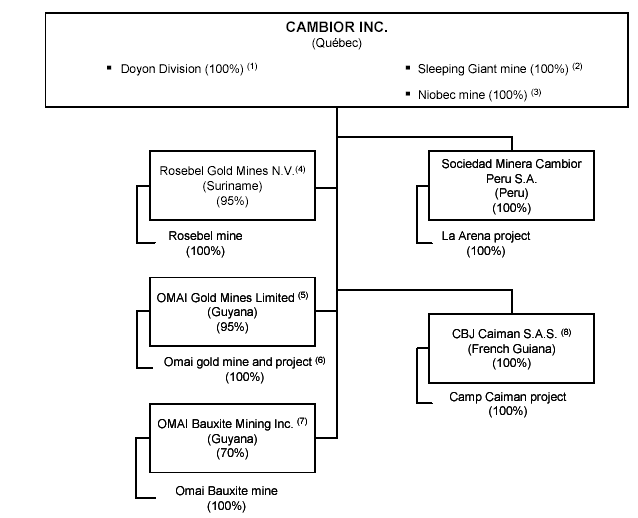
(1)
The Doyon Division is comprised of Cambior's wholly-owned Doyon and Mouska mines.(2)
Effective April 30, 2005, Cambior acquired the remaining 50% undivided interest in the Sleeping Giant mine from Aurizon Mines Ltd.(3) 100% since July 2, 2004. Prior to that, the Company held a 50% interest in the mine on a joint venture basis.
(4) RGM is owned 5% by the Republic of Suriname.
(5) OGML is owned 5% by the Republic of Guyana.
(6) The Omai gold mine ceased its operations in September 2005. The Company is however evaluating the potential of an underground operation on the depth extension of the Fennell deposit.
(7) OBMI is owned 30% by the Republic of Guyana.
(8) CBJ Caiman is owned by Cambior through wholly-owned subsidiaries.
Page 10
Cambior's Mines and Principal Projects – Location

(1)
Omai gold mine ceased its operations in September 2005. The Company is however evaluating the potential of an underground operation on the depth extension of the Fennell deposit.
Page 11 Item III General Development of the Business
1. Three-Year History
The Company is principally an international gold producer with operations, development projects and exploration activities throughout the Americas. To a lesser extent, the Company is also involved in mining and exploring for other metals and minerals from deposits and properties also located in the Americas.
In 2003, while strengthening its financial position, the Company was largely focused on the construction and development of its Rosebel gold project in Suriname, which was scheduled to begin commercial production in the first quarter of 2004.
On August 1, 2003, Cambior began assuming, on a contractual basis, the management of the bauxite mine operations and marketing activities of State-owned Linden Mining Enterprise, Limited ("Linmine"). Cambior had performed contract mining for Linmine since 2000, at its deposits located in and around the town of Linden, approximately 100 kilometres south of Georgetown. These mining and management contracts terminated in December 2004, as a result of the privatization of Linmine's bauxite mining and processing operations, as described below.
On August 12, 2003, the Company completed a public equity offering of 40 million units for gross proceeds to the Company of $72.2 million (C $100 million). Each unit consisted of one common share and one-half of one Series C common share purchase warrant. Each whole warrant is exercisable at a price of C $3.75 until August 12, 2008.
In August 2003, the 2003 Financial Creditors agreed to eliminate their hedging requirement and the Company adopted a policy that allows gold hedging only when required for project financing.
On September 19, 2003, the Company was included in the S&P/TSX Composite Index, as well as in the sub-indices: S&P/TSX Small Cap Index; S&P/TSX Capped Materials Index and S&P/TSX Capped Gold Index.
On November 29, 2003, the Company acquired Ariane Gold Corp. ("Ariane") through a merger transaction, thereby acquiring Ariane's interest in the Camp Caiman gold project located in French Guiana. Additional information on this transaction and this project is provided herein under subsection 4.1.4 of Item IV.
During the year 2003, the Company issued 24,754,000 Common Shares pursuant to the exercise of previously issued warrants for aggregate proceeds of $44 million.
On February 11, 2004, the Rosebel mine in Suriname achieved commercial production, as scheduled. In accordance with the Mineral Agreement between the Company and the Government of Suriname, the latter then received 5% of the participating capital stock of RGM, the subsidiary operating the mine, and 2,000,000 non-participating shares redeemable at $2,000,000. During the year 2004, the Rosebel mine surpassed its 2004 budgeted gold production.
Page 12
On July 2, 2004, after having owned 50% of the Niobec mine since 1986, the Company acquired Sequoia Minerals Inc. ("Sequoia"), then owner of the other 50% interest, through a merger transaction.
On September 3, 2004, the Company announced its agreement with a group of private shareholders to acquire a majority interest in the private Peruvian mining company Compañia Minera Poderosa S.A. ("Poderosa"). This transaction was not completed due to title issues.
On October 14, 2004, the Company completed a public offering of 29.3 million units for gross proceeds to the Company of C $110 million. Each unit consisted of one common share and one-half of one Series D common share purchase warrant. Each whole warrant is exercisable at a price of C $4.35 prior to October 16, 2006.
On December 8, 2004, Cambior closed a transaction with the Government of Guyana for the privatization of certain assets of State-owned Linmine. Additional information on this privatization is provided herein under subsection 4.1.3 of Item IV.
During the fourth quarter of 2004, the French Government granted to Cambior a 30 km2 mining concession for the Camp Caiman project for a period of 25 years.
During 2004, the Company made major progress towards its objective of becoming hedge-free for its gold operations, by reducing its hedging commitments by 73% or 541,000 ounces to a residual amount of 205,000 ounces committed at year-end.
Pursuing its strategy of concentrating on its current assets for future growth and its objective of increasing its reserve base, the Company purchased, effective as of April 30, 2005, from Aurizon Mines Ltd. ("Aurizon"), the residual 50% interest in the mine for a cash consideration of $4.1 million and thus became its exclusive owner.
In line with its objective of focusing on the development of gold properties, the Company announced, on April 19, 2005, that its Board of Directors had approved the divestiture of the Carlota Copper project ("Carlota") located in the Miami – Globe area of Arizona.
On August 8, 2005, the Company announced the completion of a feasibility study for the Camp Caiman open pit gold project located in French Guiana, with estimated gold contained of 1.1 million ounces. Additional information on the Camp Caiman project and its feasibility study is provided herein under subsection 4.1.4 of Item IV.
On October 5, 2005 the Company announced its agreement with Quadra Mining Ltd. ("Quadra") to sell Carlota for an estimated consideration of $37.5 million as follows: (i) $15 million in cash at closing and (ii) eight quarterly payments of 6,250 ounces of gold each, commencing on March 31, 2006, representing an aggregate cash equivalent of $22.5 million based on a reference gold price of $450 per ounce. Pursuant to the aforesaid agreement, the four last quarterly payments may be differed, albeit not later than June 30, 2010, if Quadra is unable to commence construction by the first quarter of 2007. Also, following an agreed-upon drilling program of approximately 3,000 metres, the Company may receive up to an additional $4.0 million in cash based on the estimated copper contained in defined areas. The transaction closed on December 21, 2005.
Page 13
In October 2005, Cambior concluded an amendment to its 2003 Credit Facility to increase the revolving credit facility from $10,000,000 to $15,000,000, and to change the basis for calculating interest rates and fees. The 2003 Credit Facility is secured by the Company's interests in the Doyon, Mouska, Omai gold, Sleeping Giant, Niobec and Rosebel mines, and is subject to various covenants, financial ratios and prepayments in the event of future financings.
On November 3, 2005, Cambior's Board of Directors adopted a Shareholders' Rights Plan (the "Plan") to encourage the fair treatment of shareholders should a take-over bid be made for Cambior. Although the Plan became effective on November 4, 2005, shareholders will vote on a resolution to ratify its adoption at the Annual and Special Meeting of Shareholders scheduled for May 3, 2006. The Plan is intended to discourage coercive or unfair take-over bids and gives the Board of Directors time to pursue alternatives to maximize shareholder value, if appropriate, in the event of an unsolicited takeover bid. If the resolution is not approved by a majority of votes cast by shareholders, the Plan and the rights issued under the Plan will terminate and cease to be effective. Additional information on the Plan is provided herein under Item V.
During 2005, the Company reduced its hedging commitments by 20% or 40,000 ounces to a residual amount of 165,000 ounces of gold committed at year-end. In addition, as part of the consideration paid by Quadra for the sale of Carlota, Cambior gained exposure to an additional 50,000 ounces to be received over the next 24 months.
Further information regarding the development of the Company over the past three fiscal years can be found on pages 4 to 37 of the Company's 2005 Annual Report, on pages 12 to 32 of the Company's 2004 Annual Report and on pages 2 to 27 of the Company's 2003 Annual Report, which are available on SEDAR at www.sedar.com and incorporated herein by reference.
2. Significant Acquisitions
During the year 2005, the Company did not complete any significant acquisition or disposal within the meaning of National Instrument 51-102.
3. Risk Factors
By the very nature of its activities, the Company is subject to various financial, operational and political risks in the normal course of business that could have a significant impact on its profitability and levels of operating cash flow. The Company assesses and seeks to manage these risks by applying high operating standards, including careful managing and planning of its facilities, hiring qualified personnel and developing their skills through training and development programs, establishing and maintaining internationally-recognized standards, independent audits and purchasing insurance policies. For information on the Company's major risk factors, reference is made to the discussion on Risks and Uncertainties on pages 34 to 36 of the Company's 2005 Annual Report. READERS SHOULD CAREFULLY CONSIDER THE RISK FACTORS SET FORTH THEREIN.
Page 14 Item IV Narrative Description of the Business
1. Mining Activities – Process1
Cambior is involved primarily in mining and exploring for gold and, to a lesser extent, other metals and minerals from deposits and properties located in the Americas. In that respect, Cambior pursues more particularly the following activities:
Mineral projects are different from other types of industrial projects because of the problems and opportunities that arise from working with the geological environment. There are four special features of mineral projects in this respect. Mineral deposits are:
The role of the mineral industry is to find, delineate and develop economic mineral deposits, and then to extract the valuable mineral commodities they contain for the benefit of society. The process of attaining economic production of minerals consists of a multi-stage series of activities by which minerals are converted from unknown geological resources to marketable commodities. The mineral supply process consists of three main phases: exploration, development and production.
The physical occurrence of mineral deposits in nature and the demand for mineral commodities in the economy provide the basic stimuli for mineral supply. Favourable perceptions of exploration geologists and market researchers regarding these geological and market factors combine to guide the selection of environments for exploration.
The mineral exploration phase is a sequential information-gathering process. In the primary exploration stage, potentially favourable areas of land are initially selected within an environment of interest and, then, these areas are subjected to a series of geological, geophysical, and geochemical tests. The successful result of primary exploration is the discovery of mineral occurrences. At this stage, the ultimate size, quality and value of each mineral occurrence is unknown.
_________________________
1
Text on pages 14 and 15 describing the mineral supply process is adapted from the Basics of Mining Modular Course provided by the Department of Mining and Metallurgical Engineering, McGill University, Montreal, Québec.
Page 15
The mineral occurrences discovered provide justification for the second, or delineation, stage of exploration, in which information is obtained for estimating the size, quality and physical characteristics of the discovery relevant to mineral extraction. The successful result of delineation is the definition of possible economic discoveries for evaluation.
When sufficient delineation has been completed, a decision is made that determines whether a mineral deposit should be developed to production. If the characteristics of the delineated deposit provide justification for mine development, what is perceived to be an economic mineral deposit is the end result of mineral exploration.
The development phase establishes productive mining and mineral processing capacity. Processing may be required to upgrade the mine product to a concentrate (or, in the case of gold, doré bars) for transportation and sale. Thus, the construction of processing facilities is carried out in parallel with mine development. The installation of a mill at the mine site may be required, or a common processing facility may be used to treat ores from a number of mines in a region.
When a mine has been developed and related processing facilities constructed, the production phase commences. The mining stage may include the stripping of waste for open-pit mining, the preparation of stopes for underground mining, the development of ore reserves, drilling, blasting, materials handling to the processing facilities, the filling of mined-out stopes, and associated technical and planning services. The processing stage may include, for instance, crushing, grinding, flotation, filtering and drying for base metal ores, leaching or cyanidation followed by carbon-in-pulp adsorption for gold ore, tailings disposal, and the loading of concentrate products for shipment.
When mineral reserves are exhausted, the mine is generally closed. During the rehabilitation phase, which may be initiated several years before mine closure, the mine site must be restored to a state compatible with the rest of the surrounding nature and topography. As well, safeguards must be taken to reduce to a minimum future damages to the environment that may result from surface subsidence and the exposure of underground openings as well as mine tailings to groundwater.
2. Mining Activities – Products1
2.1 Gold
Gold is a bright yellow precious metal which is characterized by its malleability, ductility and high density. Gold is the third best electrical and thermal conductor, behind silver and copper. Although this metal is chemically stable (which means that its physical state does not change under the influence of air, heat, humidity and most solvents), it may nonetheless dissolve in certain cyanide solutions or in a mixture of nitric and hydrochloric acid. Despite its scarcity, gold is disseminated throughout the earth's crust. Commonly found in nature in the form of an alloy, it occurs in quartz veins or in secondary alluvial deposits (placers) in the form of dust, grains, flakes or nuggets (its rarest form).
__________________
1
Text on pages 16 to 17 describing gold and niobium is adapted from the 1995 Grolier Multimedia Encyclopedia (copyright 1995 Grolier Incorporate), Mindscape Complete Reference Library (copyright Mindscape Inc.) and Microsoft Encarta 96 Encyclopedia (copyright 1993-1995 Microsoft Corporation). The text on page 17 describing bauxite is adapted from the US Geological Survey available at http://minerals.usgs.gov.
Page 16
From ancient times, gold has been known and prized for its beauty, lustre, corrosion resistance and malleability. In addition, the processing of gold into pure form is relatively easier than the refining of most other metals. Alloyed with other metals to enhance its hardness, gold has been used extensively in minting. In recent times, gold has been chiefly used in jewellery and, to a lesser but progressively increasing extent, in industrial applications, given its low chemical reactiveness.
On account of its scarcity, gold has been widely used as a medium of exchange for international transactions, particularly during the 19th and 20th centuries. However, World War I disturbed the international monetary system, and the gold standard was gradually phased out, which furthered the rise of the US dollar as the main currency in international monetary transactions.
Gold is traded on world markets, with benchmark prices for gold generally based on the London bullion market quotation and which may be subject to considerable fluctuations. Gold can be readily sold on numerous markets throughout the world and it is not difficult to ascertain its market price at any particular time.
Due to the size of the international bullion market and above ground stocks, individual gold producers generally do not significantly influence pricing or total quantities offered and sold. Primary demand for gold is in the fabrication of jewellery and industrial applications which accounts for approximately 80% of the annual demand. Other uses include coin and bar fabrication, dentistry and decorative applications.
Cambior's gold production is regularly shipped to the Royal Canadian Mint, in Ottawa, Ontario, or to other refiners, to be refined to meet market delivery standards and subsequently sold on the international market on a competitive basis. The existence of numerous companies and institutions capable of refining gold and the large number of gold buyers on the market prevent Cambior from having to depend on a single refiner or purchasing client.
Page 17 The following table outlines the gold production from
Cambior's operating units.
|
|
2005 | 2004 | ||
|
Cambior's share |
% of total | % of total | ||
|
|
Ounces | production | Ounces | production |
|
|
||||
|
Rosebel mine (1) |
341,400 | 53.4 | 273,700 | 39.5 |
|
Omai gold mine |
99,500 | 15.6 | 240,400 | 34.6 |
|
Doyon Division (2) |
157,500 | 24.7 | 146,500 | 21.1 |
|
Sleeping Giant mine |
||||
|
(100%)(3) |
40,000 | 6.3 | 33,500 | 4.8 |
|
Total |
638,400 | 100.0 | 694,100 | 100.0 |
Rosebel started its commercial production in February 2004.(1)
(2) Comprised of the Doyon and Mouska mines
(3)
Sleeping Giant mine is owned 100% by Cambior effective April 30, 2005. Prior thereto, it held a 50% interest therein.2.2 Niobium
Niobium is a greyish white metal which turns bluish when exposed to air for a long period of time. When polished, niobium resembles steel. Niobium is noted for its malleability, ductility and electrical conductivity. Niobium is characterized by its resistance to impacts, corrosion and high temperatures.
Discovered in 1801, it was not until 1874 that a Swedish scientist succeeded in isolating the niobium element for the first time. Although the International Union of Pure and Applied Chemistry adopted and confirmed the name "niobium" in 1950, this metal is sometimes called "columbium". Niobium is mainly used in special alloys in the steel used in pipelines, the automobile industry and structures, as it enhances impact strength as well as wear and corrosion resistance. It is also used in the manufacturing of superconducting magnets, and in medical applications such as the design of artificial joints and pacemakers.
2.3 Bauxite
Bauxite is a naturally occurring, heterogeneous material composed primarily of one or more aluminum hydroxide minerals, plus various mixtures of silica, iron oxide, titania, aluminosilicate, and other impurities in minor or trace amounts.
The principal aluminum hydroxide minerals found in varying proportions with bauxites are gibbsite and the polymorphs boehmite and diaspore. Gibbsite is the mineral component of OBMI's East Montgomery deposits. Bauxites are typically classified according to their intended commercial application: abrasive, cement, chemical, metallurgical, refractory, etc. The bulk of world bauxite production (approximately 80%) is used as feed for the manufacture of alumina.
OBMI markets three non-metallurgical products: calcined bauxite named Refractory "A" Grade Super Calcined (RASC), a chemical grade bauxite (CGB) and a cement grade bauxite (CeGB), the last two being non-calcined products.
Page 18
3. Mining Activities – Canada
In Québec, mining rights are governed by the Mining Act. Until January 1, 1966, Crown lands containing mineralized zones could be granted as a mining concession. In 1966, the mining concession system was replaced by a system of claims and mining leases. A claim entitles its holder to explore for minerals on the subject land. It remains in force for a 2-year term from the date it is registered and may be renewed indefinitely subject to continued exploration works in relation thereto. A mining lease entitles its holder to mine and remove valuable mineral substances from the subject land. Leases are granted initially for a 20-year term and are renewable up to three times, each for a 10-year duration.
The Mining Act was amended in June 1998 to bring material changes to the acquisition process of mining titles whereby map designation now replaces staking, and to consolidate under the same heading several exploration titles for different mineral substances.
All of Cambior's Canadian mines are underground mines and, unless otherwise specified herein, are readily accessible by existing roads and benefit from available water and electric power supply sources.
3.1 Gold Production
In Canada, the Company currently owns interests in three gold mines, all in commercial production.
3.1.1 Doyon Division
The Doyon Division is comprised of Cambior's wholly-owned Doyon and Mouska underground mines, located approximately 40 kilometres east of Rouyn-Noranda, in the Province of Québec, Canada. The Doyon Division covers an area of approximately 2,870 hectares and is situated on the prolific Cadillac-Bousquet gold belt in the Abitibi region.
i) Doyon Mine
Effective January 1, 1998, Cambior acquired the remaining 50% undivided interest in the Doyon mine from Barrick Gold Corporation ("Barrick"). Pursuant to this transaction, Barrick was granted a participation right in future revenues from the Doyon mine, under which it receives an annual payment equal to 24.75% of (i) the surplus, if any, of the average market price (as defined in the purchase agreement) for one troy ounce of gold over $375, multiplied by (ii) the number of gold ounces produced at the Doyon mine during the relevant year; this right applies to a maximum cumulative production of 2.6 million ounces of gold as from January 1, 1998, up to a maximum cumulative payment to Barrick of $30 million. In 2005, Barrick received $1.7 million ($1.2 million in 2004), and 1.3 million ounces remains subject to Barrick's participation right; no payment was made from 1998 to 2003.
Page 19
The Doyon mine was discovered in 1974 by Soquem Inc. Commercial open-pit mining began in March 1980, and underground mining in 1985. The transition to full-scale underground mining was completed on March 31, 1989. The Doyon mine currently consists of 116 claims and a mining lease that was renewed for a 10-year period until July 2, 2010. The Doyon mine has been a significant producer of gold for the past 26 years. In January 2006, it produced its 5,000,000th ounce of gold.
The mine facilities and equipment include a conventional mill equipped with a semi-autogenous grinding mill and cyanidation and carbon-in-pulp processing facilities, a high-density sludge plant, a water treatment plant, a tailings pond and settling pond (both allowing for natural degradation of the cyanide, decanting and recirculation of the water used in milling), electrical and mechanical maintenance shops and a headframe, mechanized mobile underground equipment, as well as a warehouse and an administrative building. A paste backfill plant was installed at the Doyon site and commissioned at the end of September 1998.
The Doyon mine deposit is divided in three sectors, namely the 1.0 Zone, the 2.0 Zone and the West Zone. Given the physical features of the deposit, the mining method used is sub-level stoping. The mineralization of the 2.0 Zone consists mostly of large envelopes containing gold-bearing veinlets associated with small quantities of pyrite and chalcopyrite. The mineralization of the 1.0 Zone consists of veinlets and accumulations of pyrite which form continuous lenses. Both zones lie within volcanic rocks. The mineralization in the intrusive rocks lies within narrow quartz-pyrite veins having fair continuity. The gold mineralization in the West Zone is associated with narrow quartz veins, the orientation of which varies but dominantly follows a north-south trend. The composition of country rock is dioritic at upper levels and tonalitic at deeper levels.
ii) Mouska Mine
The Mouska property is adjacent to the western border of the Doyon property. Cambior acquired the Mouska property in 1986, in connection with the privatization of most of Soquem Inc.'s assets. The property's production is subject to two royalties. The first, a 2% royalty on the value of gold recovered is payable to Newmont Mining Corporation. The second royalty is a 0.2% royalty on gold produced, payable to the estate of an individual. The Company paid $0.5 million in 2005 ($0.1 million in 2004 and $0.5 million in 2003) in respect of these two royalties.
Cambior owns this 876-hectare property through 22 claims and two mining leases, one expiring in 2011 and the second in 2018. The principal facilities include a headframe, a service building housing electrical and mechanical shops and an administrative office. All of the ore mined is processed at the Doyon milling facilities. Access to underground is via a main shaft of 485 metres and an internal shaft of 555 metres, which was deepened by 215 metres in 2004. The internal shaft (winze) is located 1.2 km from the main shaft.
Underground exploration at Mouska began in October 1987, pre-production development followed in May 1990, and commercial production commenced in July 1991. Production was suspended at the Mouska mine from December 2003 to October 2004 to allow for the deepening of the internal shaft to gain access to lower levels.
Page 20
The Mouska deposit can be described as a lode-type deposit, the economic mineralization of which is confined in narrow quartz veins (less than one metre) having good lateral continuity. Economic lenses are found both in volcanic rocks (andesite) and in the Mooshla intrusive (diorite). It is in the latter environment that the current reserves and the best potential for additional reserves are found. Considering the geometry of the deposit, shrinkage stoping is being used for mining operations.
iii) Operating information
In 2005, capital expenditures were $8.6 million and consisted mainly of underground infrastructure and development. During 2005, 59,520 metres of development drilling and 24,013 metres of definition drilling were conducted at the Doyon-Mouska properties from underground drifts.
All drill collars are surveyed and downhole surveys conducted in exploration holes. The logging and sampling of drill holes is done in accordance with industry standards. Exploration core is split and mineralized zones sampled on 0.5 to 1.5 metres lengths. In definition drilling core is usually whole sampled. In unmineralized areas, sample lengths may be up to 3.0 metres. Most core is assayed at the Doyon Division laboratory. Samples from mineralized areas are assayed by fire assay method while unmineralized samples are assayed by atomic absorption ("A.A."). All values greater than 3.0 g Au/t with the A.A. method are redone by fire assay.
The quality assurance procedures and assay protocols followed at the Doyon Division mines conform to industry-accepted quality control methods. The quality-assurance and quality control ("QA-QC") program at the Doyon Division includes assaying of renumbered pulps and rejects, addition of standards and blanks by geology department and pulps and rejects are routinely submitted to a commercial laboratory for external check assays.
As at December 31, 2005, proven and probable reserves at the Doyon Division stand at 2.8 million tonnes grading 6.4 g Au/t, representing 573,000 ounces of gold contained, being a decrease of 34.1% compared to 2004. More detailed information regarding mineral reserves and resources is provided below in section 6 of Item IV. The Company reviewed the carrying value of the Doyon Division reserve as at December 31, 2005 based on its long-term plan and related ore reserves. Mineral reserves were reduced in 2004 and 2005 by approximately 245,500 ounces and 187,000 ounces, respectively, due to geological continuity issues in some areas, higher unit mining cost and allocation for permanent pillars.
All ore extracted from the Doyon Division is currently processed on site. In 2005, the Doyon Division produced 157,500 ounces of gold, at a mine operating cost of $358 per ounce, an increase in production of 7.5% in comparison to 2004 due to the full year of production at the Mouska mine following the completion of the shaft deepening project and operational improvements following the reorganization of the Doyon mine in late 2004 further to ground control issues. Mine operating costs were affected in 2005 by inflationary pressures driven by energy costs and the strengthening of the Canadian dollar against the US dollar.
Page 21
The following table indicates operating information of the Doyon Division for the last two years.
|
DOYON DIVISION |
2005 |
2004 |
|
Ounces (Au) |
157,500 |
146,500 |
|
Tonnage milled (tonnes) |
806,000 |
1,172,000 |
|
Grade milled (g Au/t) |
6.3 |
4.1 |
|
Recovery (%) |
96 |
96 |
|
Mine operating costs ($/oz) |
358 |
374 |
Cambior believes that its land holdings in the prolific Cadillac gold belt have the potential for further discoveries as demonstrated by the results on the Westwood orebody. In 2004 the Company initiated the excavation of an exploration drift to gain access to the Westwood orebody discovered in 2003. The Company intends to fully pursue said work.
The 2006 mining plan for the Doyon Division anticipates the extraction of 821,000 tonnes of ore to be milled at an average grade of 5.9 g Au/t for 150,000 ounces of gold production at an estimated mine operating cost of $381 per ounce.
Capital expenditures for 2006 are estimated at $8.5 million, mainly for underground infrastructure and exploration in the Mouska area. The 2006 exploration program (surface and underground) and mineral reserve development program will include more than 47,870 metres of diamond drilling. Drilling will focus on the search for new mineral reserves and resources at depth and on the extensions of known ore zones.
All of Cambior's right, title and interest in and to the Doyon Division mines remains hypothecated pursuant to the 2003 Credit Facility, in favor of the 2003 Financial Creditors.
3.1.2 Sleeping Giant Mine
Prior to April 30, 2005, the property was held equally by Cambior and Aurizon pursuant to a joint venture agreement dated January 29, 1991. Cambior acted as operator under the guidance of a management committee consisting of two representatives of each party. During the late 1980s, Aurizon was the sole owner and operator of the mine, but a temporary reserve depletion in 1991 entailed a shutdown of operations. An exploration program funded by Cambior during 1992 led to the delineation of additional mining reserves and to Cambior's acquisition of a 50% undivided interest in the property and related assets. Commercial gold production resumed on July 15, 1993. Effective April 30, 2005, Cambior acquired the remaining 50% undivided interest in the property and assets from Aurizon for a cash purchase price of $4.1 million.
Page 22
The Sleeping Giant property covers an area of 2,908 hectares comprised of 71 claims and three mining leases, one expiring in 2008 and the others in 2018, and is located 80 kilometres north of Amos, Québec. The property is subject to two royalties: the first being a 2% royalty on gross operating earnings (as defined in the relevant agreement) held by Central Asia Goldfields Corporation; and the second being a 15% net profits interest (as defined in the relevant agreement) held by Mattagami Lake Exploration Ltd. on the greater part of the mine property. No payment has been required pursuant to these royalties thusfar, and none is expected in 2006. The Sleeping Giant mine also includes a 900-tonne per day capacity mill, a headframe and ancillary surface facilities as well as a tailings pond.
The Sleeping Giant mine is a high-grade lode-type gold deposit. The narrow (100 cm or less) smoky quartz veins are characterized by a high sulphide content (5% to 50%). Vein continuity varies between 50 and 500 metres laterally and between 100 and 750 metres vertically. Some veins remain open at depth. Given the ore's physical characteristics, shrinkage and room and pillar stoping are currently being used for mining operations.
During the year, the Company's aggregate capital expenditures totaled $4.0 million mainly for underground exploration and deferred development. In 2005, 45,559 metres of diamond drilling were completed at the mine. From this total, exploration and reserve development drilling represented 35,293 metres while definition drilling totaled 10,266 metres. All drilling is from underground drifts. Reserve development drilling (31,063 metres) mainly established reserves in the lower extension of zones 8, 18, 30 (levels 855-975).
All drill collars are surveyed and downhole surveys conducted in exploration holes. The logging and sampling of drill holes is done in accordance with industry standards. Exploration core (BQ size, 35,1 mm) is split and mineralized zones sampled on 0.5 to 1.0 metres lengths. In definition drilling, core (ATW size, 30.2 mm) is usually whole sampled. In unmineralized areas, sample lengths are usually 1.0 metre. All assays are performed on site at the Sleeping Giant mine laboratory. All samples are assayed by fire assay method.
The quality assurance procedures and assay protocols followed at the Sleeping Giant mine conform to industry-accepted quality control methods. The QA-QC program at Sleeping Giant includes assaying of re-numbered pulps and rejects, addition of standards and blanks by geology department and pulps and rejects are routinely submitted to a commercial laboratory for external check assays.
As of December 31, 2005, mineral reserves of the Sleeping Giant mine stand at 376,000 tonnes at 11.4 g Au/t, representing 137,800 ounces of gold contained. More detailed information regarding mineral reserves and resources is provided below in section 6 of Item IV.
Page 23
Cambior's share of gold production from the Sleeping Giant mine amounted to 40,000 ounces of gold in 2005 at a mine operating cost of $449 per ounce compared to 33,500 ounces at a mine operating cost of $291 per ounce in 2004. The increase in unit operating cost is mainly related to the large quantities of development, the strengthening of the Canadian dollar against the US dollar, the increase in the cost of oil and other consumables, and productivity shortfall resulting from manpower issues. Production was seriously impaired from May to September due to the loss of experienced miners as the mine is a labour intensive operation. The Company faces challenges in recruiting qualified manpower due to travelling distances from the surrounding towns and competition from other mining operations and projects. Facing these challenges, the Company has instituted training programs for inexperienced miners. Following the implementation thereof, gold production increased 42% in the fourth quarter to 13,900 ounces from 9,800 in the third quarter. Along with an increase in the grade milled, the higher production lowered the mine operating cost in the last quarter of 2005.
The following table indicates operating information for the Sleeping Giant mine for the last two years.
|
SLEEPING GIANT MINE |
|
|
|
|
2005(1) |
2004(2) |
|
Ounces (Au) |
40,000 |
33,500 |
|
Tonnage milled (tonnes) |
121,000 |
96,500 |
|
Grade milled (g Au/t) |
10.6 |
11.1 |
|
Recovery (%) |
97 |
97 |
|
Mine operating costs ($/oz) |
449 |
291 |
(1) Aggregate of Cambior's 50% interest from January 1st until April 30, 2005 and its 100% holding thereafter.
(2) Cambior's 50% interest.
The 2006 production is estimated at 44,000 ounces of gold at an estimated mine operating cost of $408 per ounce. Operating costs are expected to decrease as a result of higher productivity. A 18,700 metre reserve development drilling program will continue in 2006 in order to extend the reserves and resources at depth and laterally. Capital expenditures for 2006 is estimated at $2.0 million mainly for 867 metres of deferred development and 18,700 metres of diamond drilling for reserve development.
All of Cambior's right, title and interest in and to the Sleeping Giant mine remains hypothecated pursuant to the 2003 Credit Facility, in favor of the 2003 Financial Creditors.
Page 24
3.2 Ferroniobium Production
3.2.1 Niobec Mine
The Niobec mine is the only North American source of pyrochlore (the primary niobium ore) in operation and one of three major producers of niobium. The Niobec mine first produces a niobium pentoxide (Nb2O5) concentrate which is thereafter converted on site into standard grade ferroniobium (FeNb).
Prior to July 2, 2004, Cambior held a 50% interest in the mine on a joint venture basis with Sequoia, which held the other 50%. Under the joint venture arrangement, Cambior managed the marketing and sales of all commercial production from the mine and Sequoia managed mining operations, each at cost plus a nominal fee under the direction of a management committee. Mazarin Inc., Sequoia's predecessor in interest, had purchased its 50% interest in the Niobec mine from Teck Corporation (now Teck Cominco Limited) on March 2001. On July 2, 2004, Cambior acquired Sequoia through a merger transaction, for a total consideration of $48.6 million, thereby consolidating the ownership of the Niobec mine.
Commercial production of concentrates at the Niobec mine began in 1976 and ferroniobium production followed from December 1994 on. The Niobec mine has had an excellent history of mineral reserve renewal over 30 years of operation. It is currently producing approximately 10% of world consumption.
The mine is located on a 2,455-hectare property, comprised of two mining leases which have been renewed until 2015 and 61 claims, 15 kilometres northwest of Chicoutimi, in Simard Township, Québec. The facilities include a headframe, a pyrochlore-to-niobium pentoxide (Nb2O5) concentrator, a concentrate-to-ferroniobium converter and ancillary surface installations.
The initial tailing ponds closed in 2005 and the second started operating in 2003. Both ponds are located close to infrastructures and cover 1.5 square kilometres. An ore stockpile is also located on the plant site covering between 15 and 25 operation days. The mining method used is blasthole stoping.
Niobec maintains the ISO 9001 and ISO 14001 certifications for its production processes and its Environmental Management System, since December 1995 and June 2002, respectively.
The Niobec deposit is located in the southern portion of the Saint-Honoré carbonatite, which is mainly comprised of dolomitic carbonates in the centre and calcitic carbonates on the edges. The vertical lenses, which are irregularly shaped, are 10 to 80 metres wide and up to 300 metres long. The deposit is open at depth. The two niobium-bearing minerals are dispersed in the rock finely grained and rarely visible to the naked eye. Diamond drilling is the only way to evaluate the economic content of the mineralized zones. The average grade is 0.67% Nb2O5. The mineral reserves are located in the three first mining blocks between 90 and 440 metres in depth, and the mineral resources mainly in the fourth and fifth blocks, below the 440 metres level. Mine workings are concentrated between levels 90 and 440 metres, operating simultaneously on three mining blocks.
Page 25
An amount of $6.1 million was invested at the Niobec mine in 2005 for an expansion and optimization program aimed at increasing the mine's capacity by 20%. Additional amounts were allocated to sustaining capital and underground infrastructure development. In 2005, 8,874 metres of diamond drilling were completed at the Niobec mine. All drilling is from underground drifts.
All drill collars are surveyed and logging and sampling of drill holes is done in accordance with industry standards. Mineralization is well disseminated and a majority of holes are sampled continuously from top to bottom of the hole, and samples are normally 3 metres in length. All assays are performed on site at the Niobec mine laboratory and are assayed by fluorescence-X. Procedures and quality control at the laboratory are integrated with the mine's ISO system. External assay checks are performed every year even if not at the same level than for gold mines. Grade is very regular at Niobec and the results from external labs confirm that the assays are highly reproducible.
In 2005, the Company did not perform any reserve development drilling campaign at the mine and, as a result, year-end mineral reserves decreased to 21.5 million tonnes at 0.67% Nb2O5 from 24.3 million tonnes at 0.67% Nb2O5 the previous year, for approximately 13 remaining years of production at the current mining rate. As at December 31, 2005, the milling capacity of the Niobec mine is 4,200 tonnes per day. It is expected to increase to 4,500 tonnes per day starting in the second quarter of 2006. The pyrochlore concentrate produced at Niobec is transformed into ferroniobium grading 66% niobium using an aluminothermic process.
For 2005, the Company's niobium sales from the Niobec mine totaled $51.4 million compared to sales of $37.9 million in 2004. Sales were higher in 2005 due to the aforesaid Sequoia acquisition and the completion of the expansion and optimization program in September 2005. In 2005, profitability was affected by increased reagent costs, a stronger Canadian dollar relative to the US dollar, and certain operational difficulties related to implementing the expansion and optimization program while maintaining production.
For 2006, Niobium revenues are expected to be approximately $60 million and capital expenditures are estimated at $6.2 million of which $2.8 million will be invested to increase the mine's capacity by a further 10% and upgrade the mine's power line and other equipment.
All of Cambior's right, title and interest in the Niobec mine remains hypothecated pursuant to the 2003 Credit Facility, in favor of the 2003 Financial Creditors.
4. Mining Activities – International
In 2005, the Company held rights or interests in three producing mines outside of Canada: (i) the Rosebel mine located in Suriname which began commercial production in February 2004; (ii) the Omai gold mine located in Guyana which terminated commercial production in September 2005; and (iii) the Omai bauxite mine also located in Guyana and acquired in December 2004. Moreover, in November 2003, the Company acquired the Camp Caiman gold project located in French Guiana.
Page 26
4.1 South America: Guiana Shield
4.1.1 Gold Production: Rosebel Mine
The Rosebel property is located in Suriname, South America, approximately 100 kilometres south of the city of Paramaribo, the capital of Suriname. Suriname is a former Dutch colony located on the northeastern coast of South America. The property is accessible by plane or by road from Paramaribo. The Rosebel property covers 17,000 hectares in the Brokopondo district, between the Suriname River to the East and the Saramacca River to the West. The property is held by RGM, a 95%-owned1 subsidiary of Cambior.
The Rosebel mine began commercial production on February 11, 2004. Its facilities and equipment include a processing plant, maintenance and warehouse facilities, a transmission line to tap into the Afobaka power generating station owned by a major bauxite producer, and related support infrastructure. RGM concluded two long-term power supply agreements with the Government, one being indexed to the price of gold and one indexed to the oil price, both of which provide for the supply of 15 mega watts of average power and 19 mega watts for peak power to the mine and mill facilities.
The Rosebel property was optioned in 1992 by Golden Star from Grasshopper Aluminum Company N.V. ("Grassalco"), a state-owned mining company. Cambior held a 50% interest in the property from June 1994 to May 2002 when it acquired Golden Star's 50% interest (the "Rosebel Transaction") in consideration of $8 million in cash and a gold price participation right equal to 10% of the excess gold market price above $300 per ounce for soft and transitional ore and above $350 per ounce for hard rock ore, up to a maximum of 7 million ounces produced. Golden Star subsequently sold its price participation right to Euro Ressources Inc.
Production from the Rosebel mine is subject to a fixed royalty of 2% of production and, a price participation of 6.5% on the amount exceeding a market price of $425 per ounce of gold, when applicable, both payable to Grassalco, and a fixed royalty of 0.25% of production payable to a foundation to be established by RGM to promote the local development of natural resources. The foundation's board should be composed of two representatives from RGM, two from Grassalco and one from the Government of Suriname.
_______________________
1
As the Republic of Suriname also holds Class B voting shares since commencement of commercial production, its overall participation in RGM's share capital is slightly different than 5% (currently approximately 6%). However, all Class B shares will be redeemed over the next years and, in any event, no dividends will be paid prior to the full redemption of Class B shares. Therefore, only Class A shares are considered for the purposes of reflecting each shareholder's true and permanent participation in RGM's share capital.
Page 27
In 2005, RGM paid $3.8 million ($2.5 million in 2004) in royalties to Grassalco and the foundation and Cambior paid $4.7 million ($2.9 million in 2004) in gold price participations to Grassalco and Euro Ressources Inc.
A feasibility study and an environmental impact assessment were filed with the Government of Suriname in May 1997. Following additional drilling on the property, a revised feasibility study was submitted to the Government in December 1997. An updated feasibility study for the project was completed in August 2002 and submitted shortly thereafter to the Government of Suriname, with an environmental impact assessment, for approval.
On December 18, 2002, RGM was granted a 25-year renewable Right of Exploitation for the Rosebel mine from the Government of Suriname, following the Government's approval of the updated feasibility study and environmental impact assessment. In addition, the Council of Ministers and the National Assembly of Suriname approved amendments to the 1994 Mineral Agreement which sets forth the legal framework for the development and operation of the Rosebel project. The amendments include, among other things, the relinquishing of Grassalco's options to purchase up to a 40% interest in the Rosebel project in return for the State holding a 5% carried participation in the share capital of RGM (the Class A shares) and 2 million redeemable shares for $2 million (the Class B shares). The capital structure of RGM provides for the full redemption of Class B shares and the reimbursement of all capital invested by Cambior prior to distribution of dividends to its shareholders.
The 1994 Mineral Agreement, as amended, outlines various business conditions, including the right to export gold, to hold funds in foreign bank accounts, to access local currency at market rates and to import goods, with few exceptions, on a duty-free basis. The 1994 Mineral Agreement, as amended, provides for an income tax rate being the lesser of the statutory rate in effect (currently 36%) and 45%, an international dispute resolution mechanism and a debt-to-equity capital structure of 4 to 1.
Following the acceptance of the 2002 updated feasibility study and environmental impact assessment, the granting of the 25-year renewable Right of Exploitation, the securing of satisfactory business conditions, the completion of financing and implementation of political risk insurance coverage, the Company, through its subsidiary RGM, officially commenced construction of the Rosebel mine in December 2002 and commercial production began on February 11, 2004. The capital cost of the Rosebel mine amounted to $95 million over the 14-month construction period.
The Rosebel mine's general environment and its tropical climate is very similar to that of the Omai gold mine in Guyana, thus enabling the Company to draw on its more than 15 years of development and operating experience in the Guiana Shield.
The Rosebel concession lies within the Lower Proterozoic Guiana Shield. The property covers the sediment-dominated Rosebel formation and the older Armina formation made up of volcanic flows, volcaniclastics and graywackes. The known gold-bearing ore deposits in the Rosebel concession have varying geological characteristics but all show the typical characteristics of highly weathered, quartz vein-hosted gold mineralization.
Page 28
Early veins are usually deformed and are often cut by later veins. Primary gold mineralization mostly occurs in quartz and quartz-carbonite veins that are generally restricted to lithological contacts, fold closure and sub-vertical shear corridors. Veins vary from a few centimeters up to two metres in thickness. In general, gold mineralization is included in sub-vertical zones near the contact between the sedimentary and volcanic rocks. The mineralization shows good continuity and thickness.
The property hosts six principal deposits as well as numerous gold prospects in two distinct areas: the Pay Caro, East Pay Caro and Koolhoven deposits are located on the North Limb and the Rosebel, Mayo and Royal Hill deposits are located on the South Limb.
Since the commencement of commercial production in February 2004, improvements and circuit expansions have allowed the mill to process at a tonnage above design capacity. As a result of the mill optimization program, daily throughput averaged 19,700 tonnes in 2005, a 30% increase from the 15,200 tonnes averaged in 2004. The higher 2005 throughput forced the modification of the original mining plan, which called for selective processing of higher-grade ore at first and the stockpiling of low-grade material for milling later in the mine's life. Consequently, all available ore is now fed to the processing plant. The increase in the mining operating costs is mainly attributable to processing lower grade ore, increased stripping ratio and increased energy and blasting costs.
Capital expenditures for 2005 were $27.9 million, mainly to complete Phase 2 construction of the plant, add to the mining fleet and conduct exploration and development drilling.
A total of 54,854 metres of diamond drilling were completed in 2005 in a program totalling 867 holes and covering mainly three deposits: Pay Caro, Royal Hill and Rosebel. The new information was used to update 3D geological models of the three deposits, resulting in an increase in resources and reserves. The core is HQ size in soft rock and reduced to NQ size in solid rock. The majority of holes are sampled continuously from top to bottom of the hole and are normally 1.0 metre in length. The core is split. All drill collars are surveyed and downhole surveys conducted in exploration holes. The logging and sampling of drill holes is done in accordance with industry standards. Assays are performed on site at the Rosebel mine laboratory. All samples are assayed by fire assay method.
Industry standard quality assurance and quality control procedures, including standards, duplicates and check assays, are employed. In 2005, 18% of the coarse rejects and 6% of the pulps were internally re-assayed while 4% of the pulps were re-assayed by two external laboratories.
As of December 31, 2005, the mineral reserves at Rosebel stood at 73 million tonnes at 1.4 g Au/t, representing 3.2 million ounces of gold contained, calculated by using a long-term gold price of $425 per ounce, for an expected mine life of 11 years. More detailed information regarding mineral reserves and resources is provided below in section 6 of Item IV.
Page 29
The following table indicates operating information for the Rosebel mine for the last two years.
|
ROSEBEL |
2005 |
2004(1) |
|
Ounces (Au) |
341,400 |
273,700 |
|
Tonnage milled (tonnes) |
7,196,000 |
5,067,000 |
|
Grade milled (g Au/t) |
1.56 |
1.84 |
|
Recovery (%) |
94 |
94 |
|
Mine operating cost ($/oz) |
208 |
170 |
The Rosebel mine began commercial production on February 11, 2004.(1)
The Rosebel mine is expected to produce 335,000 ounces in 2006 at an estimated mine operating cost of $240 per ounce. The higher operating costs are due to a rising hard rock component of mill feed and a higher stripping ratio. Continued exploration and development drilling remains a primary objective. A total of 42,300 metres of diamond drilling is planned to expand the six known deposits and discover new ones.
Capital expenditures for 2006 are estimated at $14.8 million. An amount of $6.5 million will be allocated to exploration and development drilling. The sustaining capital budget is $8.3 million, and covers mainly mine equipment purchases and expansion of the tailings dam capacity.
In 2003, RGM established a community relations team with the responsibility for maintaining good relations with surrounding communities. Since then, this team has held numerous meetings with these communities to address issues of concern to them including employment, training, development of skills, and to minimize negative impacts, to the communities, of RGM's activities. The Company has also taken measures to prevent illegal miners from working on its property. While such measures cannot totally and permanently eliminate such illegal activities, they have minimized the impact thereof in a satisfactory manner thusfar.
All of Cambior's shares of RGM remain pledged in favor of the 2003 Financial Creditors under the 2003 Credit Facility subject, until March 31, 2013, to a first ranking pledge and hypothec granted by Cambior to Golden Star, in respect of 50% of RGM shares, under an hypothec and pledge agreement executed by and between Golden Star and Cambior on April 1, 2003, in connection with the Rosebel Transaction. Golden Star's first ranking pledge and hypothec has since been assigned to Euro Ressources (Canada) Inc.
The Company has obtained foreign investment insurance coverage for its investment in RGM for a portion of the losses resulting from certain political risks that may affect the Rosebel mine. Insurance was obtained from a syndicate of insurers including Export Development Canada (collectively the "Insurers"). The eventual proceeds of this insurance policy are assigned pursuant to the terms of the 2003 Credit Facility in favour of the 2003 Financial Creditors.
Page 30 4.1.2 Gold Production: Omai Gold Mine
The Omai gold mine site lies approximately 160 kilometres south of the city of Georgetown, the capital of Guyana. Guyana is a former British colony located on the northeastern coast of South America covering an area of 214,970 square kilometres and hosting a population of approximately 700,000 people. The Omai gold mine property covers 4,550 hectares and is held through an exclusive mining licence (the "Mining Licence") granted on December 12, 1991, to OGML, the mine operator.
Cambior and the Cooperative Republic of Guyana respectively own 95% and 5% of the voting common shares of OGML1. Cambior increased its participation in OGML from 65% to 95% on May 16, 2002 when, in connection with the Rosebel Transaction, it acquired all of the OGML shares then held by Golden Star. Cambior has pledged all of its OGML shares in favor of the 2003 Financial Creditors.
The relationship among Cambior, OGML and the Republic of Guyana is governed by a Mineral Agreement executed on August 16, 1991. This Agreement provides in particular for a 5% in-kind royalty on mineral production payable to the Republic of Guyana2. The Mineral Agreement provides the main legal framework and business conditions for activities at the Omai gold mine; among other things, it allows for the exportation and sale of gold production as well as capital and profit repatriation, and stipulates that any disagreement between the parties thereto shall be submitted to international arbitration.
The Omai gold property consisted, until April 2002, of two distinct deposits: the Fennell and Wenot deposits. The Wenot deposit was depleted in April 2002 and the last blast in the Fennell deposit took place in October 2004. Thereafter, the mill exclusively processed low-grade hard rock from the stockpiles accumulated during the initial years of production.
Cambior provided full financing for the construction of the Omai gold mine in return for full reimbursement on a priority basis of its investment plus a competitive return thereon. This aforementioned financing was totally reimbursed as at December 31, 2005. The Company had obtained foreign investment insurance coverage for its investment in OGML. The eventual proceeds of this insurance policy were assigned pursuant to the terms of the 2003 Credit Facility in favour of the 2003 Financial Creditors.
After 13 years of operation, the Omai gold mine ceased its operations in September 2005. During its operating period, Omai gold produced over 3.7 million ounces of gold at an average grade of 1.50 g Au/t. The final year was mostly devoted to processing the low grade ore stockpiled in the early years of operations. Consequently, a total of 3.7 million tonnes of ore were processed for production of 99,500 ounces of gold in 2005, compared to 5.5 million tonnes at an average grade of 1.46 g Au/t for production of 240,400 ounces in 2004. Mine operating costs were impacted by high fuel prices as power at the mine is generated by diesel power generating units.
___________________
1
While the Republic of Guyana also holds options entitling it to increase its shareholdings up to 32% in OGML, the Company has not received any indication that the Government of Guyana would exercise such options in the future.2
Effective as of May 15, 2001, the Government of Guyana agreed to reduce the aforesaid royalty from 5% to 4% when the price of gold (determined by the London Bullion Market) is lower than $280 per ounce.
Page 31
The following table indicates operating information as regards the Omai gold mine for the last two years.
|
OMAI GOLD MINE1 |
2005(2) |
2004 |
|
Ounces (Au) |
99,500 |
240,400 |
|
Tonnage milled (tonnes) |
3,703,000 |
5,545,000 |
|
Grade milled (g Au/t) |
0.9 |
1.5 |
|
Recovery (%) |
90 |
93 |
|
Mine operating costs ($/oz) |
366 |
244 |
(1) Notwithstanding minority interests in OGML, Cambior takes 100% of the Omai gold mine production into account, given the capital structure and cash flow distribution of OGML.
(2) The Omai gold mine ceased production as of September, 2005.
The dismantling of the Omai gold mine facilities began in 2003, with the transfer of a significant portion of the processing facilities and mobile equipment to the Rosebel mine. Also, certain assets were redeployed to Linden to support OBMI's operations. Some of the remaining facilities are earmarked for use at other operations, including the Camp Caiman project. The government-approved closure plan is currently being executed. Prior to final closure, however, the Company intends to evaluate the potential for an underground operation on the depth extension of the Fennell deposit. Should an adequate level of reserves be identified, the economics of such an operation could be enhanced by utilizing the remaining processing facilities. The Company budgeted $3.5 million to assess the depth potential of an underground operation under the Fennel deposit.
On May 29, 2003, a writ of summons was served on OGML in connection with a class action in Guyana claiming total compensation of approximately $2 billion for damages allegedly caused by the Omai gold mine in Guyana since 1995. The action was filed on behalf of the same group of people that previously filed the actions without success both in Québec and Guyana. Cambior and OGML consider this action as unfounded and frivolous and OGML is contesting same vigorously.
4.1.3 Bauxite Production: Omai Bauxite Mine
The Omai bauxite property is located near the town of Linden, Guyana. The processing facilities are situated on the banks of the Demerara River, approximately 100 kilometres from the Atlantic Ocean. The property is accessible by paved roads from Georgetown and the Demerara River. The climate is tropical and equatorial and is characterized by seasonal rainfall from May to August and November to January. On-site equipment includes trucks, shovels, bulldozers, gradersand drainage pumps. There are mine maintenance facilities near the Montgomery pit and several workshops at the plant site.
Page 32
Cambior became involved with bauxite mining in 1999 when Linmine, a State-owned entity, hired OGML to perform contract mining. In June 2002, Cambior, the Republic of Guyana and Linmine agreed on the principal terms for an eventual privatization of most of Linmine assets. Then, OGML undertook the overall management of the Linmine business on a contractual basis in August 2003. On December 8, 2004, the privatization was completed with OBMI being the sole owner and operator of most of the former Linmine bauxite assets and facilities, OBMI being held as to 70% by Cambior and as to 30% by National Industrial and Commercial Investments Limited, a Government entity. Environmental liabilities associated with the bauxite operation prior to the privatization remain with Linmine and the Government of Guyana.
The relationship among Cambior, OBMI and the Republic of Guyana is governed by a Mineral Agreement executed on December 8, 2004 and providing for a 1.5% royalty on the value of bauxite shipments from Linden after the five first years of production following privatization. The Mineral Agreement also provides that any amount of corporate tax paid by the Company shall reduce correspondingly the amount of royalty to be paid by the Company.
In connection with the aforesaid privatization, Cambior has established, through its wholly-owned subsidiary OMAI Services Inc., a fuel power generation plant to supply electricity to OBMI's facilities (33% of anticipated demand) and to a State-owned entity which distributes electricity to the town of Linden and surroundings (67% of anticipated demand).
On February 25, 2005, OBMI secured a ten-year $10 million non-recourse project loan facility bearing interest at a rate of 10.5% per annum, from a Caribbean financial institution. All of OBMI's assets and rights are mortgaged in favor of such institution.
OSI also entered into a non-recourse financing agreement with the same Caribbean institution and under similar terms, to finance the establishment of its power plant near OBMI's facilities.
OBMI's refractory grade "A" super calcine ("RASC") production represents approximately 90% of its total revenues. As part of the privatization agreement, Cambior and the Government agreed to reinvest all free cash flow during the initial five years of operation following privatization to expand the operation into other non-metallurgical products, as well as into MAZ products (for aluminum production) based on market conditions.
As part of Cambior's investment in OBMI, a total of $10.3 million was invested in 2004 as the result of the transfer of available equipment from the Omai gold mine, the rehabilitation of the processing plant and improvements to the existing infrastructure.
Bauxite is mined via an open pit truck-shovel method and is transported to the process plant located in Linden, Guyana, 12.5 kilometres from the pit. At the process plant, RASC is produced by calcining the bauxite in rotary kilns. Prior to calcination, some of the bauxite ore is processed in a wash plant to remove silica or kaolin contamination.
Page 33
Chemical grade bauxite ("CGB") is produced from the same bauxite ore, however, there is normally no washing and the bauxite is dried rather than calcined.
The bauxite mineralogy is mainly gibbsite with minor amounts of boehmite, kaolinite, quartz, hematite, siderite, pyrite, goethite and anatase. As is typical in the Linden district, the Montgomery bauxite layer has the shape of a broad dome, with dips of 2° to 8° in the broad central portion of the deposit and steeper dips along the fringes, where the bauxite layer thins rapidly. The dome as a whole tilts to the east, so that overburden thicknesses generally increase to the east.
The overburden at the Montgomery bauxite deposit consists of the unlithified and variably indurated Berbice sands, silts and clays that total almost 70 metres in thickness. Thin layers of lignite are minor constituents of the package. Discontinuous lenses of iron oxide-cemented sandy units, called "catchcow", are also found intermittently throughout the section.
A distinctive, reddish-colored Quaternary sand unit is locally present in the East Montgomery area. A layer of a relatively hard, stiff clay unit, up to a few metres in thickness, often lies at the base of the sedimentary package. This unit is referred to as "flint clay". Nodules of gibbsite are common within this unit but never predominate over the clay content. SiO2 contents of the flint clay typically range from 15 to 40%. The bauxite is typically pink to reddish or light gray to cream-colored, porous, and massive to nodular in texture. The gibbsite ore mineral often imparts the pinkish coloration, especially when it occurs as nodules. The upper portion of the bauxite layer is often relatively hard / indurated and may have higher silica (clay) concentrations than the softer, more porous lower portion.
The resources at the Montgomery bauxite deposit are entirely defined by diamond drill holes performed by Linmine and Cambior. All of the holes were drilled vertically, in order to properly outline the sub-horizontal bauxite mineralization. Linmine provided the historic drill hole data in the form of digital files, as well as the original typed drill log forms. The original logs were compared to the digital data on a hole-by-hole basis and any discrepancies or missing data in the digital files were corrected. The final database consists of 530 drill holes (43,614 metres) performed by Alcan Inc. (a predecessor owner) and Linmine and 25 drill holes (1,490 metres) performed by Cambior with lengths ranging from 13.5 to 153.0 metres. During 2005, no exploration activity was carried out.
Capital expenditures for 2005 totaled $19.9 million for the completion of Phase 1 investment, which included the rehabilitation of kiln #14, the purchase of the mine fleet and the construction of mine maintenance facilities, for the beginning of Phase 2 investment and for sustaining capital, mostly related to acquisition of service mobile equipment for the mine and the plant.
Once the rehabilitation of Kiln #14 was completed, the monthly production of Kiln #13 and #14 reached 28,300 tonnes of calcined bauxite in December 2005. The enhanced mining fleet and stabilized operations resulted in the production of 212,000 tonnes of RASC in 2005.
Page 34
Proven and probable reserves stand at 61.8 million tonnes at a grade of 60% Al2O3 as at December 31, 2005, which correspond to at least 70 years of mine life at the expected 2006 production rate. More detailed information regarding reserves and resources is provided below in section 6 of Item IV.
In 2006, OBMI is scheduled to process approximately 874,000 tonnes of raw bauxite with an overall process yield of 34.6% for production of approximately 300,000 tonnes of RASC at an average grade of 88% Al2O3. Also, OBMI expects to process approximately 28,000 tonnes of raw bauxite at an estimated grade of 5.5% SiO2 with an overall process recovery of 87% for production of 24,000 tonnes of CGB. It is anticipated that this mine will generate sales of approximately $64 million in 2006. Capital expenditures for 2006 are estimated at $17.6 million for the completion of Phase 2 investment, and $2.9 million in sustaining capital.
However, as fuel price is a significant component of direct production and transportation costs, RASC sales volume may be adversely affected by high fuel prices. OBMI is currently working on developing new products from the bauxite deposit that would complement the RASC product and contribute to the profitability of its bauxite operation.
4.1.4 Development Project: Camp Caiman
The Camp Caiman project is located about 45 kilometres (directly by air) southeast of Cayenne, the capital city of French Guiana, an overseas department of France located on the northeastern coast of South America between Brazil and Suriname. French Guiana covers an area of 91,000 square kilometres and hosts a population of approximately 200,000 people.
Over 95% of French Guiana is covered by rainforest with no infrastructure. Access to the Camp Caiman project area from Cayenne is by road, with approximately 65 kilometres of paved highway and 5 kilometres of all-weather unpaved road. There are presently no major infrastructures at Camp Caiman.
Gold mining has been carried out in French Guiana since 1857 and a total of approximately 6.5 million ounces of gold has been declared, essentially from alluvial and eluvial deposits. Systematic regional exploration funded by the French government and carried out by the Bureau de Recherches Géologiques et Minières ("BRGM") between 1975 and 1995, identified a number of primary gold targets that were auctioned to the private industry. BRGM identified a 7-kilometres long gold-in-soil geochemical anomaly at Camp Caiman and the project was auctioned in 1994 to Asarco Guyane Française S.A.R.L.
The property is held by CBJ Caiman, an indirect wholly-owned subsidiary of the Company, and was acquired in November 2003 as a result of a merger transaction with Ariane. The Camp Caiman project is comprised of a 30 km2 mining concession obtained in November 2004 for a period of 25 years and two adjacent exploration permits: Trésor (20 km2) to the West and Patawa (21 km2) to the East. The two exploration permits expire on July 31, 2009. The mineral rights held by the Company are subject to the French mining laws applicable in French Guiana.
Page 35
The initial drill program discovered the Scout Zone in 1996, which led to an expanded diamond drilling program in 1997 and the discovery of the CC-88 Zone. A pre-feasibility study of both deposits was carried out in April 1999. Further delineation drilling took place in 2000 and 2001 after the publication of the study. Intensive exploration drilling resumed in September 2002 when Ariane took over Camp Caiman.
A significant amount of exploration drilling has been carried out at Camp Caiman since 1996, with a total of 135,545 metres of drilling in 1,790 holes as at December 31, 2005: 82,530 metres of diamond drilling in 713 holes and 53,015 metres of reverse circulation ("RC") drilling in 1,077 holes.
A 10,880-metre drilling program was completed on the property in 2005 of which about 62% were core holes, with the remainder drilled by reverse circulation methods. The geological model was updated with an estimated measured and indicated resource base of 20.4 million tonnes at an average grade of 2.46 g Au/t, representing 1.615 million ounces of gold contained, of which 59% are in saprolite material. Resource calculations are calculated using 80% of the mining cutoffs: 0.66 g/t for saprolite, 0.88 g/t for transition and 1.40 g/t for hard rock. Exploration expenses totaled $3.1 million in 2005.
The core is HQ size in soft rock and reduced to NQ size in solid rock. Majority of holes are sampled continuously from top to bottom of the hole and are normally 1.0 metre in length and the core is split. Sample lengths are 1.524 metre for reverse circulation drilling. All drill collars are surveyed and downhole surveys conducted in exploration holes. The logging and sampling of drill holes is done in accordance with industry standards. Assays are performed in Cayenne by SGS-Cayenne (Filab) laboratory. All samples are assayed by fire assay method.
The quality assurance procedures and assay protocols followed for the Camp Caiman project conform to industry-accepted quality control methods. The QA-QC program includes assaying of field duplicates, re-numbered pulps and rejects, addition of standards and blanks by geology department and pulps and rejects are routinely submitted to a second commercial laboratory for external check assays.
The regional geology is dominated by northwest-trending belts of clastic, metasedimentary and metavolcanic rocks cut by a prominent east-west striking deformation zone. All premineral host rocks are cut by a zone of strong shearing and related deformation features. Post-mineral north-striking dolerite dikes of late Paleozoic age cut across the mineralized zone. All rocks have been intensely weathered to a fine-grained mixture of kaolinite, illite and saprolite, in which original rock-forming minerals have been destroyed but original rock textures have been variably preserved. A transition zone from saprolite to unweathered rock averages less than 5 metres thick, though, locally, it may be up to 20 metres thick. The depth to the base of weathered rock varies from 30 to 120 metres.
Page 36
In the Scout Zone, mineralization appears to be structurally confined to numerous narrow and elongated zones averaging about 8 metres true thickness at a 1 g Au/t gold cutoff. Strike lengths vary up to a maximum of 250 metres and dips are steep to the north. Zone CC-88 is higher grade and appears to be both stratigraphically and structurally controlled. At a 1 g Au/t cutoff, the mineral deposit varies from 25 to 85 metres thick. Zone CC-88 plunges 35º to the southeast, where it has been intersected to a depth of 260 metres. Mineralization identified to date is open along strike and down dip. Correlation of the mineral deposit grade intersections in drill holes indicates good continuity along both strike and down dip. Deeper down-plunge intersections within hard rock are high grade and extensions of this mineralization may be amenable to underground mining methods.
In August 2005, Cambior released a Feasibility Study for the Camp Caiman project which estimated probable ore reserves at 12.3 million tonnes at an average grade of 2.8 g Au/t representing some 1.1 million ounces of gold in situ. A gold price of $425/oz was used to calculate the cut off grades and pit design. The Camp Caiman ore body, located in a 30 km2 mining concession, will have two open pits. The Scout pit, comprised primarily of saprolite, represents 35% of the project's probable reserves. Adjacent, to the east of the Scout pit, Pit 88 is composed of saprolite and fresh rock in equal proportions, and represents 65% of the project's probable reserves. The deposits identified are open at depth in the north extension of Pit 88 and the western extension of the Scout pit.
Although the Company is currently working on fulfilling the conditions set by its Board of Directors to allow the beginning of construction, namely obtaining all operating permits, government grants under Loi Girardin and relief from certain regional fuel tax, there is no guaranty that the Company will fulfill said conditions.
The capital cost for the construction of the open pit mining project is estimated at $114.7 million, of which $62 million are planned for 2006. The capital cost could change depending on the timing of construction release, prices of commodities such as steel, and the availability of equipment and construction manpower. The capital cost allows for the transfer of certain equipment from the Omai gold mine. Construction is scheduled over a 18-month period following completion of the financing arrangements and the issue of operating permits. The open pit mining operations will be performed with a fleet of 40-tonne articulated trucks and excavators to maintain production in rainy conditions. Processing will consist of a crushing and grinding circuit followed by a leach and carbon-in-pulp (CIP) circuit. Power is expected to be supplied by the national utility company.
In addition to the Loi Girardin funding, the Company intends to finance the development of the project with a renewed corporate credit facility and internally generated cash flows. Project development is subject to final approval from Cambior's Board of Directors.
The Camp Caiman project is expected to produce an average of 150,000 ounces of gold per year in its first three years of operations at an average production cost of $228 per ounce. Total production from currently identified reserves will be 866,700 ounces at an average operating cost of $268 per ounce over a seven-year mine life.
Page 37
5. Exploration and Business Development
5.1 General
The Company continues to focus its efforts on acquiring and discovering new deposits and increasing the size of known deposits. Its exploration and business development strategy is as follows:
fund early stage exploration in areas with a strong potential for discovery; focusing mostly in North and South Americas; and
monitor the activities of junior and emerging producers with high value and potential in order to make acquisitions and/or joint ventures.
In 2005, Cambior pursued an aggressive exploration and business development program with total expenditures of $37 million. The program included completion of a feasibility study at the Camp Caiman project as well as exploration programs at the Westwood and La Arena projects. Drilling results at the La Arena property in Peru have been positive and the Company has plans to aggressively pursue additional drilling programs and complete a pre-feasibility study in 2006. Additionally, Cambior is accelerating its exploration of the Westwood deposit following positive surface drilling results.
Cambior has increased its gold exploration and business development activities during the recent years, with a focus on the Americas, while also considering opportunities in other regions of the world. Expenditures during the past two years were:
|
(in millions of $) |
2005 |
2004 |
|
Canada |
2.1 |
2.1 |
|
Guyana |
0.2 |
0.6 |
|
Peru |
1.7 |
4.6 |
|
Suriname |
0.4 |
0.5 |
|
French Guiana |
0.4 |
1.3 |
|
Corporate & others |
1.2 |
1.1 |
|
Total Expensed |
6.0 |
10.2 |
|
Advanced projects – capitalized |
27.7 |
17.8 |
|
Total Expenditures |
33.7 |
28.0 |
Page 38
5.2 Business Development
Business development activities (outside of mines and advanced projects) have been integrated since 2003. Expenses related to business development activities in 2005 totaled $1.2 million. Numerous projects and potential acquisitions were evaluated in a number of countries around the world.
5.3 Exploration – Canada
During 2005, Canadian exploration activities focused entirely on gold projects in Québec with net expenditures of C $2.5 million. All field activities were financed by flow-through share issues realized in 2003 and 2004. Total costs were reduced by C $1.5 million in government tax credits. Surface exploration expenses undertaken on capitalized projects are included in each project's capital expenditures.
The exploration property portfolio has again increased compared to the preceding year. Some claims were acquired by staking, or through the negotiation of option agreements to acquire projects. At the end of 2005, the portfolio was comprised of 4,486 mining titles covering 146,458 hectares (1,465 km2).
Net expenses on the Mooshla and the Westwood deposits located 2.5 kilometres east of the Doyon mine were $3.2 million. The surface exploration drilling program and the development of the underground exploration drift were reduced by C $0.9 million in Government tax credits. The exploration drift development totaled 930 metres and was partly financed by a flow-through share funding realized in previous years while 9,316 metres of surface drilling was covered by surface exploration funding. In addition, some underground drilling was completed. The style of mineralization encountered in the Westwood deep area was very similar to drilling results in 2004. The mineralization intersected in the Westwood and North Corridor horizons is clustered in felsic volcanics containing disseminated to semi-massive sulphides.
A preliminary evaluation of all drilling results of the Westwood project indicates inferred resources of 8.6 million tonnes at an average grade of 5.2 g Au/t diluted at 20%, representing 1.45 million ounces of gold contained in the Westwood and North Corridor mineralized horizons.
The quality assurance procedures and assay protocols followed for Canadian exploration conform to industry-accepted quality control methods. The QA-QC program includes assaying of field duplicates, re-numbered pulps and rejects, addition of standards and blanks by geology department and pulps and rejects are routinely submitted to a second commercial laboratory for external check assays. The program is supervised by a certified qualified person.
The net exploration budget in 2006 is estimated at $970,000, net of tax credits of $300,000. The exploration programs will follow up on results obtained in 2005 in various areas in Québec as well as reconnaissance work in northern Québec.
Page 39
5.4 Exploration – Andes
Cambior holds exploration properties in Peru covering areas aggregating 137,326 hectares. In 2005, regional exploration expenditures for the Andes region of South America totalled $6.2 million and were dedicated almost entirely to Peru and more specifically to the La Arena project. The region benefits from excellent road and power infrastructure which are located at close proximity to the La Arena project.
An amount of $4.5 million was spent in 2004 for drilling, geological mapping and tunnel sampling, as well as a 4,200-kilometre airborne geophysics survey (MAG and EM) which was completed over the Huamachuco region, in northeastern Peru. On the La Arena gold property, a 1,000-metre diamond drilling program was completed, following extensive surface mapping, and the results confirmed mineralization presence and grade. The drilling campaign in 2005 was aimed at confirming resources on the La Arena gold heap leachable deposit and at defining the adjacent La Arena gold-copper porphyry deposit. Encouraged by the drilling results to date, the Company is pursuing an aggressive plan to:
conduct additional metallurgical testing on various ores;
Peru is a country with a rich mining history and with an increasing gold and silver production profile. The 2006 drilling program should focus on completing a reserve estimate and extending the resources on the extensions of the known deposits.
The quality assurance procedures and assay protocols followed for Peruvian exploration conform to industry-accepted quality control methods. The QA-QC program includes assaying of field duplicates, re-numbered pulps and rejects, addition of standards and blanks by geology department and pulps and rejects are routinely submitted to a second commercial laboratory for external check assays.
The Andean regional development budget for 2006 is $6.2 million and is dedicated mainly to Peru. Cambior is allocating its entire budget on gold exploration. On La Arena, Cambior is planning approximately 6,000 metres of diamond drilling.
5.5 Exploration – French Guiana
Total 2006 budget is estimated at $1.1 million. Some 2,000 metres of diamond drilling will be implemented and will focus on the Sainte-Marie, Maripa, Crique Véoux and Changement exploration permits.
Page 40
5.6 Exploration – Guyana
The 2006 budget is estimated at $748,000 and will focus on Eagle Mountain, located some 30 kilometres from the Omai gold mine, and various other opportunities.
5.7 Exploration – Suriname
The 2005 exploration expenses in Suriname totaled $405,000 and focused on Headley's Reef and Thunder Mountain properties, and the acquisition and initiation of work on the Sara Kreek project, where camp and access were organized. Capitalized expenses totalling $7.7 million on the Rosebel concession, related to three mineralized trends: North (J Zone and Spin), Central (Rosebel deposit trend) and South (Roma and Monsanto Hill) where some 13,279 metres of drilling was completed on the North trend, the Central and the Mayo-Roma targets of the Rosebel property. In addition, exploration and definition drilling programs completed by the Rosebel mine geology department are also part of the capitalized expenses.
A $2.7 million budget is planned in 2006. Regional exploration programs should be conducted on the Rosebel mining concession as well as the adjacent Headley's Reef and Thunder Mountain exploration permits, and the Sara Creek project located some 80 kilometres to the South.
5.8 Outlook
The Company intends to pursue the discovery of new deposits in 2006. The 2006 overall exploration and development budget is estimated at $28.6 million. While approximately $5.7 million should be incurred for early stage projects in Peru and both the Canadian and Guiana shields, some $23 million should be capitalized and incurred at the Company's mines and advanced projects. Capitalized expenditures should include development drilling to increase reserves mainly at the Rosebel mine and advanced exploration and development work on the Doyon property.
The Company intends to pursue its work program to evaluate the potential for an underground operation under Omai gold's Fennell deposit. Drilling should continue on the La Arena deposit and plans also include the preparation of a pre-feasibility study if results are positive.
The Company finances exploration expenditures from internal cash resources and, in the case of its Canadian exploration activities, by the issuance, from time to time, of flow-through shares. Flow-through shares are usually issued at a premium to market, as they transfer the deduction for tax purposes to the subscribers of shares. The Company also benefits from financial assistance from the Québec government for some of its exploration programs in Québec.
Page 41
6. Mineral Reserves and Resources
In this Annual Information Form, the following terms have the meanings set forth below.
Reference is made to the Cautionary Note to US Investors at the beginning of this Annual Information Form.
Mineral Reserves
Mineral Reserves are sub-divided in order of increasing confidence into Probable Mineral Reserves and Proven Mineral Reserves. A Probable Mineral Reserve has a lower level of confidence than a Proven Mineral Reserve.
A Mineral Reserve is the economically mineable part of a Measured or Indicated Mineral Resource demonstrated by at least a preliminary feasibility study. This study must include adequate information on mining, processing, metallurgical, economic and other relevant factors that demonstrate, at the time of reporting, that economic extraction can be justified. A Mineral Reserve includes diluting materials and allowances for losses that may occur when the material is mined.
Proven Mineral Reserve
A Proven Mineral Reserve is the economically mineable part of a Measured Mineral Resource demonstrated by at least a preliminary feasibility study. This study must include adequate information on mining, processing, metallurgical, economic, and other relevant factors that demonstrate, at the time of reporting, that economic extraction is justified.
Probable Mineral Reserve
A Probable Mineral Reserve is the economically mineable part of an Indicated and, in some circumstances, a Measured Mineral Resource, demonstrated by at least a preliminary feasibility study. This study must include adequate information on mining, processing, metallurgical, economic, and other relevant factors that demonstrate, at the time of reporting, that economic extraction can be justified.
Mineral Resources
Mineral Resources are sub-divided, in order of increasing geological confidence, into Inferred, Indicated and Measured categories. An Inferred Mineral Resource has a lower level of confidence than that applied to an Indicated Mineral Resource. An Indicated Mineral Resource has a higher level of confidence than an Inferred Mineral Resource but has a lower level of confidence than a Measured Mineral Resource.
A Mineral Resource is a concentration or occurrence of natural, solid, inorganic or fossilized organic material in or on the Earth's crust in such form and quantity and of such a grade or quality that it has reasonable prospects for economic extraction. The location, quantity, grade, geological characteristics and continuity of a Mineral Resource are known, estimated or interpreted from specific geological evidence and knowledge.
Page 42
Measured Mineral Resource
A Measured Mineral Resource is that part of a Mineral Resource for which quantity, grade or quality, densities, shape, and physical characteristics are so well established that they can be estimated with confidence sufficient to allow the appropriate application of technical and economic parameters to support production planning and evaluation of the economic viability of the deposit. The estimate is based on detailed and reliable exploration, sampling and testing information gathered through appropriate techniques from locations such as outcrops, trenches, pits, workings and drill holes that are spaced closely enough to confirm both geological and grade continuity.
Indicated Mineral Resource
An Indicated Mineral Resource is that part of a Mineral Resource for which quantity, grade or quality, densities, shape and physical characteristics, can be estimated with a level of confidence sufficient to allow the appropriate application of technical and economic parameters to support mine planning and evaluation of the economic viability of the deposit. The estimate is based on detailed and reliable exploration and testing information gathered through appropriate techniques from locations such as outcrops, trenches, pits, workings and drill holes that are spaced closely enough for geological and grade continuity to be reasonably assumed.
Inferred Mineral Resource
An Inferred Mineral Resource is that part of a Mineral Resource for which quantity and grade or quality can be estimated on the basis of geological evidence and limited sampling and reasonably assumed, but not verified, geological and grade continuity. The estimate is based on limited information and sampling gathered through appropriate techniques from locations such as outcrops, trenches, pits, workings and drill holes.
Metallurgical Recovery and Cut-off Grade
In calculating mineral reserves, cut-off grades are established using the Company's long-term metal or mineral prices and foreign exchange assumptions, the average metallurgical recovery rates and estimated production costs over the life of the related operation. For an underground operation, a cut-off grade is calculated for each mining method, as production costs vary from one method to another. For a surface operation, production costs are determined for each block included in the block model of the relevant operation.
* * * * *
In the following table, reported mineral reserves and resources have been estimated by the Company's technical personnel for each property in accordance with definitions and guidelines adopted by the Canadian Institute of Mining, Metallurgy and Petroleum (CIM "Standard on Mineral Resources and Reserves"), and available on its website at http://www.cim.org/mainEn.cfm. Mineral reserves and resources were estimated using a long-term gold price assumption of $425/oz in 2005. Unlike proven and probable mineral reserves, mineral resources (of all categories) do not have a demonstrated economic viability.
Page 43
| MINERAL RESERVES AND RESOURCES (1) (2) | |||
| CAMBIOR'S SHARE | |||
|
|
December 31, 2005 |
||
|
|
@ $425/oz |
||
|
|
|
|
Ounces |
|
|
Tonnes |
Grade |
Contained |
| GOLD OPERATIONS |
(000) |
(g Au/t) |
(oz) |
|
Rosebel (100%) |
|
|
|
|
Proven Reserves |
42,307 |
1.4 |
1,862,000 |
|
Probable Reserves |
30,739 |
1.4 |
1,350,000 |
|
Subtotal |
73,046 |
1.4 |
3,212,000 |
|
Indicated Resources |
56,283 |
1.0 |
1,885,000 |
|
Inferred Resources |
59,973 |
1.1 |
2,194,000 |
|
Doyon Division (100%)(3) |
|
|
|
|
Proven Reserves |
1,477 |
6.0 |
284,600 |
|
Probable Reserves |
1,317 |
6.8 |
288,200 |
|
Subtotal |
2,794 |
6.4 |
572,800 |
|
Measured Resources |
520 |
3.9 |
65,900 |
|
Indicated Resources |
1,572 |
4.2 |
211,200 |
|
Inferred Resources |
4,562 |
5.2 |
767,500 |
|
Sleeping Giant(4) |
|
|
|
|
Proven Reserves |
186 |
11.8 |
70,600 |
|
Probable Reserves |
190 |
11.0 |
67,200 |
|
Subtotal |
376 |
11.4 |
137,800 |
|
Inferred Resources |
138 |
9.5 |
42,000 |
|
Omai Gold (100%) |
|
|
|
|
Proven Reserves |
- |
- |
- |
|
Camp Caiman (100%) |
|
|
|
|
Probable Reserves |
12,285 |
2.8 |
1,114,000 |
|
Measured Resources |
- |
- |
- |
|
Indicated Resources |
8,157 |
1.9 |
501,000 |
|
Inferred Resources |
3,767 |
2.1 |
249,000 |
|
La Arena (100%) |
|
|
|
|
Indicated Resources |
23,828 |
0.7 |
536,300 |
|
Inferred Resources |
2,286 |
0.6 |
43,100 |
|
Westwood (100%) |
|
|
|
|
Inferred Resources |
8,613 |
5.2 |
1,450,000 |
|
Grand Duc (100%) |
|
|
|
|
Indicated Resources |
150 |
1.3 |
6,300 |
|
Inferred Resources |
249 |
1.4 |
11,500 |
|
TOTAL GOLD |
|
|
|
|
Proven and Probable Reserves |
|
|
5,036,600 |
|
Measured and Indicated Resources |
|
|
3,205,700 |
|
Inferred Resources |
|
|
4,757,100 |
(1)
In underground operations, mineral resources contain similar dilution and mining recovery to mineral reserves.(2)
In mining operations, measured and indicated resources are considered uneconomic at the price used for reserves calculations.(3) Includes mineral reserves and resources from the Doyon and Mouska mines.
(4) Effective April 30, 2005, Cambior owns 100% of Sleeping Giant following the acquisition of the remaining 50% undivided interest held by Aurizon. Before that date, Cambior held its 50% through a joint venture with Aurizon.
Page 44
| MINERAL RESERVES AND RESOURCES | |||
| Non-Gold Operations | |||
|
December 31, 2005 |
|||
| Contained | |||
| Grade | tonnes | ||
| NIOBIUM OPERATION | Tonnes | Nb2O5 | (000) |
| (000) | (%) | Nb2O5 | |
| Niobec (100%) | |||
|
Proven Reserves |
15,018 | 0.65 | 98 |
|
Probable Reserves |
6,469 | 0.71 | 46 |
|
Inferred Resources |
4,447 | 0.67 | 30 |
| Grade | |||
| BAUXITE OPERATION | Tonnes | Al2O3 | SiO2 |
| (000) | (%) | (%) | |
| Omai Bauxite (100%) | |||
|
Proven Reserves |
6,415 | 59.8 | 6.0 |
|
Probable Reserves |
55,396 | 60.0 | 5.2 |
The Company's reserve estimate is comprised of in-place material, i.e. contained ounces of gold and contained tonnes of copper; metallurgical recovery factors (see the table setting forth the average metallurgical recovery and the cut-off grades below) must be taken into account in order to assess and quantify the recoverable material.
There are numerous parameters inherent in estimating proven and probable mineral reserves, including many factors beyond the Company's control. The estimation of reserves is a subjective process, and the accuracy of any reserve estimate is a function of the quality of available data and of engineering and geological interpretation and judgment. Results from drilling, testing and production, as well as material changes in metal prices subsequent to the date of an estimate, may justify a revision of such estimates.
Cambior's qualified persons responsible for the mineral reserve and resource calculations for each mine or project are as follows:
| Mines | Location | Name | Title |
| Rosebel | Suriname | R. Sirois | Geology Superintendent |
| A. Croal | Engineering Superintendent | ||
| Doyon | Québec, Canada | F. Blanchet | Chief of the Geology Department |
| F. Girard | Chief Engineer | ||
| Mouska | Québec, Canada | P. Lévesque | Chief of the Geology Department |
| P. Sévigny | Chief Engineer | ||
| Sleeping Giant | Québec, Canada | D. Vallières | Technical Services Superintendent |
| R. Asselin | Responsible, Mining geology |
Page 45
| Mines | Location | Name | Title |
| Gold Projects | |||
| Camp Caiman | French Guiana | P. Godin | Project General Manager |
| F. Clouston | Manager, Project Evaluation | ||
| E. Belzile | Manager, Mining Geology | ||
| La Arena | Peru | F. Clouston | Manager, Project Evaluation |
| Westwood | Québec, Canada | D. Doucet | Exploration Manager, Doyon Division |
| Grand Duc | Québec, Canada | D. Doucet | Exploration Manager, Doyon Division |
| Industrial Minerals | |||
| Niobec | Québec, Canada | D. Villeneuve | Chief of the Geology Department |
| S. Thivierge | Engineering Superintendent | ||
| Omai Bauxite | Guyana | R. Walish | General Manager |
Estimation Procedures
The Company has established rigorous methods and procedures aimed at assuring reliable estimates of the mineral reserves and resources at all its operations and projects. For each mine and project of the Company, the relevant qualified persons verified the data disclosed, including samplings, analytical and test data underlying the information contained herein. Quality control falls under the responsibility of Elzéar Belzile, P. Eng., Cambior's Manager, Mining Geology, who is also a qualified person (as defined in the Glossary).
In calculating mineral reserves, cut-off grades are established using the Company's long-term gold price and foreign exchange assumptions, the average metallurgical recovery rates and estimated production costs over the life of the related operation. For an underground operation, a cut-off grade is calculated for each mining method, as production costs vary from one method to another. For a surface operation, production costs are determined for each block included in the block model of the relevant operation.
The following table indicates the cut-off grade calculations and the average metallurgical recoveries at Cambior's gold mining operations for the proven and probable mineral reserves.
| Average Metallurgical Recovery (1) | Cut-off Grades | |
| Mine/Project | (Gold %) | (g Au /t) |
| Rosebel Mine | 92 to 94 | 0.4 to 0.6 |
| Camp Caiman Project | 58 to 93 | 0.8 to 1.8 |
| Doyon Mine | 97 | 3.0 to 5.0(2) |
Page 46
|
|
Average Metallurgical Recovery (1) |
Cut-off Grades |
|
Mouska Mine |
94.7 |
10.4(2) |
|
Sleeping Giant Mine |
97.2 |
10.0 to 10.5(2) |
(1)
The significant difference in the recovery at Camp Caiman is due to the fact that the ore contained in the rock is semi-refractory, therefore with a lower metallurgical recovery than in saprolite where it is oxidized.(2) Varies depending on the mining method used.
The average drill spacing for each category of reserves reported for each mining operation and project is as follows:
| Average Drill Spacing | |||
| Mines/Projects | Reserve Category | ||
| Proven | Probable | ||
| Rosebel Mine | 25 m x 50 m | 50 m X 50 m | |
| Camp Caiman Project | 25 m x 25 m | 25 m x 50 m | |
| Doyon Mine | Main Area | 8 m x 10 m | 10 m x 15 m |
| West Area | 10 m x 15 m | 20 m x 30 m | |
| Mouska Mine | 14 m x 14 m | 20 m x 20 m | |
| Sleeping Giant Mine | 20 m x 20 m | 20 m x 30 m | |
| Niobec Mine | 15 m x 23 m | 30 m x 46 m | |
The nature of mining activities is such that the extraction of ore from a mine reduces reserves. In order to renew reserves (at least partially) on most of its producing properties, the Company carries out exploration drilling at depth and laterally.
To establish the 2005 year-end mineral reserves, the Company used gold prices of $425 per ounce. For the Canadian operations, long-term exchange rates of C $1.35 per US $1.00 were used for 2005.
Proven and probable mineral reserves for the current gold operations at December 31, 2005 were 5.0 million ounces compared to 3.5 million ounces at December 31, 2004. A sensitivity analysis using a gold price of $400 per ounce indicates that mineral reserves would fall 2% to 4.9 million ounces. Mineral reserves increase by 5% when calculated at a gold price of $450 per ounce.
7.
Other Aspects of the Business7.1 Marketing of Production
The gold market is relatively deep and liquid, with the price of gold generally quoted in US dollars. The demand for gold is primarily for jewellery fabrication purposes and bullion investment. Gold is traded on a world-wide basis. Fabricated gold has a variety of uses, including jewellery (which accounts for 80% of fabricated demand), electronics, dentistry, decorations, medals and official coins. Central banks, financial institutions and private individuals buy, sell and hold gold bullion as an investment and as a store of value.
Page 47 The use of gold as a store of value (the
tendency of gold to retain its value in relative terms against basic goods and
in times of inflation and monetary crisis) and the large quantities of gold held
for this purpose in relation to annual mine production, has meant that
historically the potential total supply of gold has been far greater than
demand. Thus, while current supply and demand plays some part in determining the
price of gold, this does not occur to the same extent as for other commodities.
Gold prices have, in addition, been significantly affected by macro-economic
factors such as expectations of inflation, interest rates, exchange rates,
changes in reserve policy by central banks and global or regional political and
economic crises. In times of inflation and currency devaluation, gold was often
seen as a refuge, which increased purchases of gold and thereby supported its
market price. However, changes in the reserve policies of
central banks have affected the gold market and gold price on two levels. On the
physical level, a decision by a central bank to decrease or to increase the
percentage of gold holdings in bank reserves leads to either sales or purchases
of gold, which in turn has a direct impact on the physical market for the metal.
In practice, sales by central banks have often involved substantial tonnages
within one period, and this selling can place downward pressure on the markets
at the time when it is transacted. More importantly, announcements or rumours of
changes in central bank policies which might lead to the sale of gold reserves,
have in recent years had a powerful negative effect on market sentiment and
encouraged large speculative positions against gold in the futures market for
the metal. Most of the Company's revenue and earnings are
derived from the sale of gold. The gold price fluctuates continually due to
factors over which Cambior has no control. Until August 2003, the Company had
maintained a mandatory hedging program in compliance with the terms of the 2003
Credit Facility. In August 2003, the 2003 Financial Creditors agreed to
eliminate their hedging requirement and the Company adopted a policy that allows
gold hedging only when required for project financing. The following table indicates fluctuations in the gold price
in US dollars per troy ounce on the London Bullion Market for the periods
indicated:
|
Year Ended December 31, |
|||||
|
|
2005 |
2004 |
2003 |
2002 |
2001 |
|
High |
$537 |
$454 |
$416 |
$349 |
$293 |
|
Low |
$411 |
$375 |
$320 |
$278 |
$256 |
|
Average |
$444 |
$409 |
$363 |
$310 |
$271 |
Also, since revenue from sales of gold, ferroniobium and bauxite are received in US dollars while a significant portion of operating and other expenses are incurred in Canadian dollars, the value of the Canadian dollar relative to the American dollar has a direct impact on Cambior's profit margin. Following the merger with Ariane in late 2003, the Company began to incur expenditures in Euros. Its exposure to the Euro will increase as the Company expands its activities in French Guiana. From time to time, Cambior may reduce the volatility of its exposure through a currency hedging program.
Page 48
The following table illustrates fluctuations in the exchange rates for United States dollars
expressed in Canadian dollars for the last five calendar years, as established for customs purposes by the Bank of Canada.|
Year Ended December 31, |
|||||
|
$C/US$ |
2005 |
2004 |
2003 |
2002 |
2001 |
|
High |
1.2704 |
1.3968 |
1.5747 |
1.6132 |
1.6021 |
|
Low |
1.1507 |
1.1774 |
1.2924 |
1.5110 |
1.4936 |
|
Average |
1.2116 |
1.3015 |
1.4015 |
1.5704 |
1.5484 |
|
End of Period |
1.1630 |
1.2020 |
1.2965 |
1.5776 |
1.5928 |
The 2001 Agreement, as amended, contained certain covenants, including a mandatory hedging program, which required,
inter alia, Cambior to put hedges in place on a minimum of 35% (reduced from an initial requirement of 70%) of the forecasted loan life production at an average minimum gold price of $290 per ounce, including the impact of the prepaid gold forward sale.Under the 2003 Credit Facility, Cambior was required to maintain a revenue protection program covering 30% of its expected production during the loan life period, which terminates on December 31, 2007, at a minimum price of $290 per ounce. Although the hedging covenant was reduced on two occasions, the program prevented the Company from fully participating in the rise of the price of gold since 2001.
In line with its objective of providing shareholders with increased exposure to higher gold prices, the Company pursue, in 2003, its efforts to reduce its commitments under its mandatory hedging program. In August 2003, the Company obtained the elimination of the hedging covenant and implemented a new policy whereby it will not hedge future gold production unless required to do so for project financing.
Since 2002, the Company has reduced its gold hedging commitments through opportunistic buy-back programs and delivery against commitments by 1.7 million ounces. The Company eliminated all call option obligations and lease rate swaps during 2004. The buy-back of gold commitments impacts the revenue of the Company, as the losses incurred must be recorded as a reduction in sales, thereby partially offsetting the impact of sales made at market. During 2005, the Company's average realized price was $421 per ounce compared to an average market price of $444 per ounce. For 2004 and 2003, the average realized price was respectively, $39/oz and $43/oz below market price.
The Company expects its profitability to be adversely affected as the reduction in these commitments will be recognized at the original designation date of the various hedge instruments in the operations statement. However, the Company has positioned itself to deliver 79% of its 2006 targeted gold production at market price and remains committed to opportunistic buy-back of the remaining 2006-2007 positions on gold price weaknesses.
Page 49 The hedging counterparties are all
participants in the 2003 Credit Facility and have agreed to allow the Company to
reschedule gold deliveries as long as the gold is delivered during the term of
the loan and no margin calls are applicable.
FOR ADDITIONAL INFORMATION REGARDING CAMBIOR'S HEDGING, REFERENCE IS MADE TO NOTE 21 TO THE FINANCIAL STATEMENTS OF THE COMPANY PRESENTED ON PAGES 72 AND 73 OF THE COMPANY'S ANNUAL REPORT FOR THE YEAR 2005.
7.2 Government Regulation
The Canadian mining industries has evolved with federal and state or provincial legislation governing the exploration, mining, processing and marketing of minerals. This legislation governs the acquisition and ownership of mining rights, mining duties and income taxes, labour, health and safety standards, exports and other related matters.
The North American mining industry is also subject to federal and state or provincial environmental protection legislation. This legislation imposes high standards in order to reduce or eliminate the effects of waste generated by ore mining and processing operations. Consequently, the construction and commercial operation of a mine necessarily entails compliance with applicable environmental legislation and the obtaining of permits for the use of land and water or other similar authorizations from various government bodies. Each mining company is under a strict obligation to comply with all applicable environmental laws.
Failure to comply with this legislation may lead to the issuance of orders suspending or curtailing operations or requiring the installation of additional equipment. Cambior could be required to indemnify private parties suffering losses or damages arising from its mining activities and could be assessed fines if found guilty of penal infractions under the terms of such legislation.
In the Guiana Shield, OBMI, OGML and RGM must comply, in the course of their operations, with a range of Guyanese and Surinamese laws respectively, similar in their effects to legislation to which Cambior is subject in Canada. However, with respect to the Omai mine, the Mineral Agreement executed on August 16, 1991, provides exceptions to applicable Guyanese legislation in favour of OGML and its shareholders in certain instances, among which figure an alleviated tax system and, in certain cases, provisions for legislative stability. The terms and conditions of the mineral agreement in respect of the Rosebel mine are similar to those applicable to OGML. Both mineral agreements provide a comprehensive legal framework that applies to the specific activities of the Omai and Rosebel mines respectively.
Page 50 The Company commissioned an environmental
impact assessment for the Rosebel mine which was filed with, and approved by,
the Surinamese Government in 2002 along with an updated feasibility study.
Elsewhere in South America, the Company must
comply with various mining and environmental laws in force in such countries,
which laws are generally similar in effect to comparable laws in North American
jurisdictions. Cambior believes that it is in substantial compliance with all
material current legislation, regulations and administrative standards
applicable to its activities. 7.3 Environment In 1992, Cambior's Board of Directors created
an Environmental Committee and assigned a senior officer to the development and
implementation of a formal Environmental Management System ("EMS"). Roles and
responsibilities were defined, a manual of procedures was developed and internal
as well as independent environmental audits were initiated. In 1996, the Mining Association of Canada
("MAC") issued an Environmental Policy and a Management Framework, and the ISO
14001 standard applicable to EMS was published. Cambior enhanced its
Environmental Policy in line with the MAC's framework and consistent with the
basic requirements of ISO 14001 to compliance, prevention of pollution and
continuous improvement of its environmental performance. In 1998, Cambior was
the first gold mining company to obtain ISO 14001 certification for its EMS,
which certification has been maintained since then. The system is built on a database describing
operational activities and their impacts or risks on the environment.
Operational procedures aim at controlling said activities to minimize said
impacts. Continuous improvement of environmental performance is obtained through
programs with objectives and targets. Emergency response plans and closure plans
for reclamation are also prepared. Since 1998, a total of nearly $12 million has
been spent to reclaim Cambior's inactive sites. In 1997, Cambior received the US
Bureau of Land Management "Health of the Land" Award for the reclamation of the
Valdez Creek project in Alaska. In Québec, the reclaimed Solbec mine site
located in the municipality of Stratford was converted into an ecotourism
attraction in partnership with
Cambior's expansion in Guyana presented new challenges as Guyana had no legislation regulating mining activities or environmental protection. As a result, the Company applied North American standards and complied with the regulatory requirements for environmental protection of the Province of Québec, Canada. The lack of authorized waste depositories, the absence of local experts and certified laboratories as well as lack of governmental expertise for monitoring were addressed and training programs and technology transfers were done. Cambior's EMS was implemented at the Omai mine and received the ISO 14001 certification in January 2001. The Rosebel mine, which came into production in February 2004, received the ISO 14001 certification in December 2005.
Page 51 In 2005, the Company's mining operations
achieved overall 99.8% conformity with all applicable regulations. In addition,
the Company adhered to MAC's guidelines for the management of tailings and water
facilities and is involved in various initiatives. Cambior is also active in
environmental research projects through partnerships with universities or
members of the mining industry. The Company's challenge is to integrate its
economic activities with environmental integrity, social concerns and effective
governance, the four pillars of sustainable mining. Environment-related expenses for Canadian
operating sites totalled more than C $6.1 million in 2005. These expenses were
mainly related to infrastructures (39%), tailings ponds (8%), and reagent costs
for effluent treatment (17%). None of the environmental measures taken by
Cambior should impact negatively on its competitive position, as the whole of
the North American mining industry is subject to substantially similar
regulatory standards. The medium- and long-term financial impact of these
standards lies in the cost of mine site restoration during mining and once
mining activities have ceased. The Company annually reviews its provision for
environmental obligations, and no material adverse effect on earnings is
expected in the future. Cambior believes that its operations are substantially
in compliance with all relevant and material laws and regulations, as well as
standards and guidelines issued from the relevant regulatory authorities.
The estimates for restoration and closure
costs are prepared by knowledgeable individuals and are subject to review and
approval by government authorities. Site closure costs are charged against a
provision accumulated during the production phase. These obligations are
currently estimated as follows:
| (in millions of $) | |
| Doyon Division | 30.3 |
| Omai gold mine | 1.8 |
| Rosebel mine | 3.0 |
| Omai bauxite mine | 2.6 |
| Niobec mine | 2.3 |
| Sleeping Giant mine | 2.6 |
| Other sites | 1.4 |
| 44.0 |
The Company expects to fund these expenditures from operating cash flows and accumulated deposits made with the Government authorities. The planned disbursements for these outlays are as follows:
Page 52
| (in millions of $) | 2006 | 2007 | 2008 | 2009 | 2010 | 2011 | Total |
| Outlays/year | 8.4 | 5.3 | 12.0 | 5.0 | 6.7 | 6.1 | 43.5 |
All of the Company's mining operations except OBMI are currently certified under the ISO 14001 standard for environmental management.
7.4 Community Relations
As part of its strategy, the Company plays an active role in the communities in which it operates. The economic impacts of mining operations are often more noticeable in emerging countries. Therefore, in such countries, the Company implements development programs, which can be sustained beyond the mine life, to assist in improving the quality of life for those residents neighbouring the mines. Cambior has also established community outreach programs to interact with stakeholders with respect to its activities and their impact on the local communities. Community support for mining operations is viewed as a key ingredient for a successful mining venture.
7.5 Taxes
Cambior currently earns taxable income almost exclusively through its operations in Canada, Suriname and Guyana. Cambior's activities in other countries are not currently revenue producing.
Canada
Cambior Inc. is subject to federal income tax in Canada on its worldwide earnings, although earnings of the Company's foreign subsidiaries are not generally subject to tax until repatriated to Canada. Some of the foreign subsidiaries operate in countries which have concluded a tax treaty with Canada and, in consequence, active business income earned in those countries would be exempt from Canadian taxes when repatriated to Canada. However, earnings of foreign subsidiaries operating in other countries such as Suriname could attract Canadian taxes depending on the tax rate in the relevant foreign country. The Company's Canadian operations are also subject to provincial income tax. The statutory combined corporate tax rate is approximately 36%, reduced to an effective tax rate of approximately 29% by the application of the resource allowance. The Company is also subject to Québec mining duties at a statutory rate of 12%.
United States
In 2005, Cambior sold all its shares of Cambior USA, Inc., which owns 100% of Carlota Copper Company, through a new company, Cambior Holdings (USA) Inc. ("Holdings"), created for the transaction. At the end of 2005, Holdings and its wholly-owned subsidiaries are the only companies in the group with activities in the United States.
Holdings files its United States Federal income tax return on a consolidated basis. The top marginal rates are presently 35% for regular tax and 20% for alternative minimum tax. As at December 31, 2005, Holdings has approximately $11.8 million of cumulative regular tax benefits that were derived from past net operating losses, available to offset future income tax. These amounts are subject to adjustment upon a subsequent audit by the Internal Revenue Service. Holdings is also subject to state and local taxes in jurisdictions in which it is engaged in business operations.
Page 53 Guyana From 1993 to 1999, OGML's operations were
subject to corporate income tax in Guyana at a rate of 33.75% per year. Since
2000, production at the Omai mine is subject to the 35% prevailing corporate
income tax rate. OBMI's operations are subject to a corporate tax rate equal to
the lesser of 35% and of the prevailing tax rate from year to year (currently
35%). Operating expenses, including interest expenses, are, within limits,
deductible from taxable income; as regards OGML, losses may be carried forward
indefinitely; as regards OBMI, losses may be carried forward indefinitely but,
in a given year, cannot eliminate more than 50% of the taxable income of that
year. Capital expenditures may be depreciated on a straight-line basis over five
years. For OGML, withholding taxes on dividends paid, if any, to foreign
shareholders are levied at a 6.25% rate; however, there is no withholding tax on
interest. For OBMI, there are no withholding taxes on payment of interest or
dividends. Legislative stability of taxation rules and rates is guaranteed by
the OBMI Mineral Agreement
Suriname
Under the 1994 Mineral Agreement in effect for the Rosebel mine, as amended and
referred to above in subsection 4.1.1 of Item IV, it is provided that the corporate income tax rate applicable during the first 25 years of operation is the lesser of the year-to-year applicable corporate tax rate (currently 36%) and 45%. Operating expenses, including interest expenses, are generally deductible from taxable income, and losses may be carried forward indefinitely. Capital expenditures are generally depreciated over a four-year period for plant and equipments during the pre-production period and on an accelerated depreciation method during the production phase. Dividends and interest may be paid without any withholding taxes. Legislative stability of taxation rules and rates is guaranteed by the 1994 Mineral Agreement, as amended.
Page 54 French Guiana French Guiana being an overseas department of
France, the general French system of tax applies, subject to some
particularities such as the possibility of obtaining a tax exemption and the
possibility of reducing capital expenditures through tax credits (
The France-Canada tax treaty provides for a withholding tax rate of 10% on interest payments from France to Canada and of 5% on dividend payments to shareholders holding 10% or more of a local entity.
7.6 Mining Development and Construction
The Company formed, at the end of 1994, two in-house divisions to support project implementation and operations. Their goal consists of optimizing performance of their respective activities with a view to achieving greater effectiveness in terms of costs and schedule.
The objective of the Camroc Mining Development Division is to form and manage specialized teams performing mining development works at various mines or projects, in accordance with the Company's priorities.
The objective of the Projects and Construction Division is to form and manage teams of professionals and technicians specialized in planning, implementing and supervising construction activities of mine facilities and infrastructure.
7.7 Intellectual Property
Operations of the Company are not dependent upon or subject to patents or intellectual property licenses or rights.
7.8 Competition
7.8.1 Gold Market
The Company is in competition with other mining companies for the acquisition of interests in precious and base metal mining properties. In the pursuit of such acquisition opportunities, Cambior competes with several Canadian and foreign companies that may have substantially greater financial and other resources. Although Cambior has acquired many such assets in the past, there can be no assurance that its acquisition efforts will succeed in the future.
Page 55 7.8.2 Niobium Market On July 2, 2004, Cambior acquired its
joint-venture partner in the Niobec mine and, as a result, is currently the only
niobium producer in North America. The Company competes on a worldwide basis
against two major producers of ferroniobium, both located in Brazil, for the
sale of the mine's production. Companhia Brasilera de Metalurgia e Mineraçâo ("CBMM")
is the world's largest producer of ferroniobium with an estimated market share
in the range of 70% to 80%. Mineraçâo Catalâo, a member of the Anglo-American
plc group, holds a market share similar to the Company's, which is estimated at
approximately 10% to 15% of worldwide supply. Niobium demand has increased significantly
over the past three years due to a general increase in the use of niobium, high
steel demand in China and the additional use of niobium as a substitute for
other higher-priced specialty alloys. Its price has however remained constant
over the past five years, although it rose somewhat in the latter part of 2005.
Cambior's competitiveness in certain markets may be impacted by tariffs and
duties imposed by governments. Nevertheless, steady market growth has enabled
Cambior to expand production and increase sales. It is anticipated that increase
in intensity of the use of niobium will continue. 7.8.3 Bauxite Market On December 8, 2004, the Company acquired a
70% participation in OBMI, a bauxite mining and processing company. High-Alumina
Refractory "A" Grade Super Calcined Bauxite (RASC) is used for the production of
refractory products, abrasive products and welding products. The worldwide
market for RASC is approximately 1.3 million tonnes per year. The bauxite
produced by the Company is only designed to meet the needs of the refractory
market. The characteristics of Guyanese bauxite have made it the preferred
material for many refractory companies and customers around the world.
Nevertheless, because of its lower prices, China is the major supplier of the
refractory grade calcined bauxite accounting for an estimated 80% of the
high-alumina refractory bauxite supply worldwide. Cambior expects to produce over 300,000 tonnes
of RASC in 2006, accounting for approximately 25% of worldwide market. However,
as fuel price is a significant component of direct production and transportation
costs, RASC sales volume may be adversely affected by high fuel prices. OBMI is
currently working on developing new products from the bauxite deposit that would
complement the RASC product and contribute to the profitability of its bauxite
operation. 7.9 Sale of Production The Company's revenues are generated predominately from the
sale of gold, with the remaining portion from the sale of ferroniobium and
calcined bauxite. The gold price is subject to fluctuations resulting from
factors beyond the Company's control. These factors include general price
inflation, changes in investment trends and international monetary systems,
political events and changes in gold supply and demand on the public and private
markets. The gold market is characterized by significant above-ground
reserves which can dramatically affect the price should a portion of these
reserves be brought to market. In 1999, the gold market felt the effects of gold
reserve sales by some central banks as well as the effects of the announcement
at the end of September 1999 by European central banks of a self-imposed annual
limit on gold sales (the "Washington Agreement"). In 2004, the group of 15
signatories to the Washington Agreement renewed this agreement for a period of
five years, with additional participants joining the original group of
signatories. The renewal should provide for continued stability in the
marketplace.
Page 56 As was required by the Company's loan
covenants until August 2003, the Company used in the past various instruments to
reduce the volatility of its revenues and secure the cash flows from its
operating mines. In August 2003, the Company was able to eliminate the lenders'
requirement to maintain a revenue protection program. The Company's outstanding
instruments issued in compliance with this program impact on the price that the
Company realizes on the sale of gold.
From the commencement of commercial production until the end of 1994, production from the Niobec mine was sold in the form of concentrates to firms in Europe, India, Japan and the United States for conversion into ferroniobium and distribution in their respective markets. Commercial production of ferroniobium at the mine site commenced in December 1994 following the construction of a plant to convert niobium pentoxide concentrates into ferroniobium grading 66% niobium using an aluminothermic process. Ferroniobium produced at the Niobec mine is currently distributed, directly or through a distributor or an agent, mainly in North America, Europe and Asia.
A significant part of the annual production from the Niobec mine is sold under the terms of commercial contracts with third party purchasers. However, these purchasers are not bound to purchase and take delivery of all of Niobec's production under the terms of these contracts and there can be no assurance that these contracts will be renewed upon their expiry or that Cambior will be able to enter into agreements with other purchasers in the event that the existing contracts are not renewed.
During its management arrangement with the Government of Guyana and following the privatization of the Linmine bauxite operations in December 2004, Cambior became a reliable supplier of RASC to Europe, North America, South America, Asia and Australia. The RASC production is distributed either directly or through a distributor or an agent, and is sold under purchase orders from third parties which are not bound to continuously purchase the Company's bauxite production. There can be no assurance that additional purchase orders will come from such parties or others.
7.10 Employee Relations
All of Cambior's current operations are unionized. The Company's operations may be affected by legal and illegal work stoppages. However, during the past three years, the Company did not experience any significant work stoppages.
Page 57 In 2004, the Company negotiated the renewal of
the labour contract at the Niobec mine and in 2003, the Company negotiated a new
labour contract at OGML and a contract extension at Mouska. The Company considers that it has good
relations with its employees and unions. It offers a competitive compensation
program, a secure and challenging working environment, and an open dialogue.
The expiry dates of the collective agreements are as follows:
| Omai gold – Hourly employees | February 28, 2007 |
| Doyon – Hourly employees | November 30, 2006 |
| Mouska – Hourly employees | October 17, 2007 |
| Sleeping Giant – Hourly employees | July 31, 2007 |
| Niobec – Hourly, clerical and technical employees | April 30, 2008 |
At year end, the Company employed approximately 2,700 individuals (same as 2004). Reference is made to page 33 of the Company's 2005 Annual Report for additional discussion on human resources.
8.
DividendsThe Company has not paid any dividends since 1999. Pursuant to the 1999 credit agreements, Cambior had committed not to pay dividends or make other like distributions, and this commitment was maintained under the 2001 Agreements and 2003 Credit Facility; as regards the latter agreement, it had to be maintained until commercial completion (as defined therein) of the Rosebel project, which latter condition was satisfied in 2004. The payment of dividends is subject, however, to the obligation to give prior notice thereof to the 2003 Financial Creditors and meeting certain financial ratios under the 2003 Credit Facility.
9.
LitigationReference is made to page 33 of the Company's 2005 Annual Report for information on this matter.
Item V Description of Capital Structure
The authorized share capital of the Company consists of an unlimited number of common shares without par value of which, as at December 31, 2005, some 274,598,470 common shares are issued and outstanding. The holders of common shares are entitled to vote at all meetings of shareholders on the basis of one vote per common share, to receive dividends if, as and when declared by the board of directors, and to participate in the distribution of the remaining assets of the Company in the event of its liquidation or dissolution. The authorized share capital of the Company also includes non-voting Class I and Class II preferred shares, none of which is currently outstanding.
Page 58 For greater certainty, there is no agreement
or arrangement of any nature whatsoever conferring upon any shareholder
different voting rights. Further, there is currently no arrangement known to the
Company, the operation of which may, at a subsequent date, result in a change of
control of the Company. Shareholders' Rights Plan To encourage the fair treatment of
shareholders should a take-over bid be made for Cambior, the Board of Directors
adopted on November 3, 2005, a Shareholder Rights Plan (the "Plan"). The Plan is
effective as of November 4, 2005 and will provide the Board of Directors and the
shareholders more time to fully consider any unsolicited take-over bid for
Cambior. The Plan is intended to discourage coercive or unfair takeover bids and
gives the Board of Directors time to pursue alternatives to maximize shareholder
value, if appropriate, in the event of an unsolicited takeover bid. The Plan has not been adopted in response to,
or in contemplation of, any specific proposal to acquire control of Cambior. The
Plan must be ratified by shareholders within six months of the effective date of
the Plan and it will be so submitted for ratification at the Annual and Special
Shareholders Meeting to be held on May 3, 2006. Unless otherwise terminated in
accordance with its terms, the Plan will terminate at the close of the third
annual meeting of Cambior shareholders following the meeting at which the Plan
is ratified by shareholders, unless the Plan is reconfirmed and extended at such
meeting. The rights issued under the Plan will become
exercisable only when a person, including any party related to it, acquires or
announces its intention to acquire 20 percent or more of the outstanding shares
of Cambior without complying with the "Permitted Bid" provisions of the Plan or
without approval of the Board of Directors. Should such an acquisition occur,
each right would, upon exercise, entitle a rights holder, other that the
acquiring persons, to purchase shares of Cambior at a substantial discount to
the market price at the time. Under the Plan, a "Permitted Bid" is a bid
made to all shareholders of Cambior and is open for acceptance for not less than
60 days. If, at the end of such 60-day period, at least 50 percent of the
outstanding shares, other than those owned by the offer or and certain related
parties, have been tendered, the offeror may take up and pay for the shares but
must extend the bid for a further 10 days to allow other shareholders to tender.
The Plan is similar to other shareholder rights plans recently adopted by
several other Canadian companies and approved by their respective shareholders.
A complete copy of the rights plan is filed on SEDAR at
Item VI Market for Securities
Cambior's common shares trade on the Toronto Stock Exchange ("TSX") since August 13, 1986 and on the American Stock Exchange ("AMEX") since June 27, 1994, under the symbol "CBJ". Cambior's warrants series C ("CBJ.WT.C"), having an exercise price of C $3.75 per common share and expiring on August 12, 2008, and Cambior's warrants series D ("CBJ.WT.D"), having an exercise price of C $4.35 per common share and expiring on October 16, 2006, trade on the TSX.
Page 59 The following tables set forth the market
price range and trading volume of the Company's Common Shares on the TSX, in
Canadian dollars, and AMEX for each month of the year ended December 31, 2005.
| Common Shares – TSX | C $ per Share | |||
| Month | Volume | High | Low | Close |
| January | 18,384,494 | 3.31 | 2.97 | 3.12 |
| February | 16,937,552 | 3.28 | 2.89 | 3.19 |
| March | 28,678,031 | 3.19 | 2.55 | 2.66 |
| April | 30,419,679 | 2.75 | 2.15 | 2.43 |
| May | 23,556,714 | 2.43 | 1.94 | 2.39 |
| June | 19,208,228 | 2.73 | 2.30 | 2.63 |
| July | 22,276,432 | 2.87 | 2.51 | 2.60 |
| August | 47,369,713 | 3.00 | 2.21 | 2.35 |
| September | 29,760,068 | 2.85 | 2.35 | 2.46 |
| October | 24,013,976 | 2.54 | 2.00 | 2.11 |
| November | 24,020,003 | 2.78 | 2.10 | 2.57 |
| December | 31,724,501 | 3.33 | 2.64 | 3.25 |
| Year | 316,349,391 | 3.33 | 1.94 | 3.25 |
| Common Shares – AMEX | US $ per Share | |||
| Month | Volume | High | Low | Close |
| January | 10,198,600 | 2.76 | 2.45 | 2.54 |
| February | 10,366,000 | 2.66 | 2.30 | 2.55 |
| March | 11,485,100 | 2.63 | 2.11 | 2.17 |
| April | 11,102,300 | 2.22 | 1.74 | 1.91 |
| May | 5,706,600 | 1.94 | 1.51 | 1.90 |
| June | 7,439,700 | 2.21 | 1.85 | 2.18 |
| July | 3,932,100 | 2.34 | 2.06 | 2.13 |
| August | 10,790,500 | 2.45 | 1.85 | 1.94 |
| September | 11,627,400 | 2.39 | 1.98 | 2.13 |
| October | 12,010,000 | 2.16 | 1.70 | 1.81 |
| November | 10,929,700 | 2.39 | 1.77 | 2.22 |
| December | 14,855,700 | 2.84 | 2.25 | 2.80 |
| Year | 120,443,700 | 2.84 | 1.51 | 2.80 |
Page 60 The following tables set forth the market price range, in
Canadian dollars, and trading volume of the Company's series C and D warrants on
the TSX, for each month of the year ended December 31, 2005.
| Series C Warrants – TSX | C $ per Warrant | |||
| Month | Volume | High | Low | Close |
| January | 132,832 | 1.00 | 0.75 | 0.95 |
| February | 442,500 | 1.00 | 0.75 | 0.90 |
| March | 774,050 | 0.90 | 0.51 | 0.51 |
| April | 634,200 | 0.57 | 0.38 | 0.46 |
| May | 613,500 | 0.50 | 0.28 | 0.41 |
| June | 338,900 | 0.57 | 0.42 | 0.52 |
| July | 632,245 | 0.60 | 0.49 | 0.60 |
| August | 395,100 | 0.65 | 0.37 | 0.44 |
| September | 776,200 | 0.63 | 0.40 | 0.49 |
| October | 1,630,783 | 0.47 | 0.30 | 0.35 |
| November | 526,782 | 0.51 | 0.35 | 0.50 |
| December | 662,700 | 0.85 | 0.46 | 0.85 |
| Year | 7,559,792 | 1.00 | 0.28 | 0.85 |
| Series D Warrants – TSX | C $ per Warrant | |||
| Month | Volume | High | Low | Close |
| January | 1,215,889 | 0.50 | 0.37 | 0.39 |
| February | 371,650 | 0.45 | 0.33 | 0.36 |
| March | 455,775 | 0.49 | 0.17 | 0.25 |
| April | 1,183,700 | 0.24 | 0.14 | 0.18 |
| May | 929,900 | 0.17 | 0.09 | 0.14 |
| June | 412,850 | 0.18 | 0.11 | 0.12 |
| July | 324,800 | 0.19 | 0.12 | 0.16 |
| August | 996,350 | 0.27 | 0.09 | 0.09 |
| September | 805,000 | 0.23 | 0.12 | 0.13 |
| October | 689,882 | 0.15 | 0.08 | 0.08 |
| November | 1,122,150 | 0.14 | 0.08 | 0.09 |
| December | 554,300 | 0.22 | 0.09 | 0.20 |
| Year | 9,062,246 | 0.50 | 0.08 | 0.20 |
Page 61 Item VII Directors and
Officers 1.
As of the date hereof, the list of Cambior's directors is as follows:
| Name, Province and | Director | |
| Country of Residence | Principal Occupation | Since |
| ALEXANDER G. BALOGH (1) (2) | Corporate Director | 1997 |
| Ontario, Canada | ||
| GUY G. DUFRESNE (1)(3) | President and Chief Executive Officer | 1995 |
| Québec, Canada | Québec Cartier Mining Company | |
| (iron ore extraction and | ||
| manufacturing company) | ||
| JEAN-ANDRÉ ÉLIE(3) | Corporate Director | 2004 |
| Québec, Canada | ||
| GRAHAM FARQUHARSON (1)(2) | President | 1993 |
| Ontario, Canada | Strathcona Mineral Services Limited | |
| (mining consultant and project | ||
| management firm) | ||
| MICHEL H. GAUCHER (2)(3) | Chairman of the Board | 1988 |
| Québec, Canada | Dynamis Group, Inc. | |
| (cogeneration and recycling projects | ||
| construction and management firm) | ||
| LOUIS GIGNAC(4) | President and Chief Executive Officer | 1986 |
| Québec, Canada | Cambior Inc. | |
| JOHN W. W. HICK(5) | Corporate Director | 2006 |
| Ontario, Canada | ||
| HUBERT T. LACROIX(1) | Special Advisor | 2005 |
| Québec, Canada | Stikeman Elliott LLP (law firm) | |
| ROBERT NORMAND(3) | Corporate Director | 2000 |
| Québec, Canada |
| (1) | Member of the Corporate Governance and Human Resources Committee |
| (2) | Member of the Safety and Sustainability Committee |
| (3) | Member of the Audit Committee |
| (4) | Mr. Gignac is not a member of any committee of the Board of Directors, but he attends all meetings at the committee members' request. |
| (5) | Mr. Hick was a director of the Company from 2000 to December 2004. As at the date hereof, Mr. Hick is not a member of any committee of the Board of Directors. |
Page 62 All of the above-mentioned directors have held
their current positions or another position with their current employer or a
company related thereto during the last five years, with the following
exceptions. Mr. Élie was, from 1998 to 2002, a managing director of a Canadian
bank wholly-owned by Société Générale (France). Since 2002, he serves as
director of public and private companies as well as non-profit organizations.
Mr. Hick was, from December 2001 to June 2003, President and Chief Executive
Officer of Geomaque Explorations Inc.; from February 2003 to September 2004,
President and Chief Executive Officer of Defiance Mining Corporation; from
September 2004 to December 2004, Vice Chairman of Rio Narcea Gold Mines Ltd.
("Rio Narcea")(mining Company); and from December 2004 to December 2005,
President and Chief Executive Office of Rio Narcea. Mr. Hubert T. Lacroix is
Special Advisor to Stikeman Elliott LLP (a Canadian law firm) since June 2003.
He also teaches at the Law Faculty of the University of Montreal, holding the
position of guest professor. From January 1, 2000 to June 1, 2003, he was
Executive Chairman of the Board of Directors of Télémédia Corporation Inc. (a
private communications and telecommunications corporation). Each director shall, unless he resigns or his
office becomes vacant for any reason, hold office until the close of the next
annual meeting of shareholders or until his successor is elected or appointed.
2.
The current list of Company officers is as follows:
| Name, Province and | ||
| Country of Residence | Occupation | Officer since |
| GUY G. DUFRESNE | Chairman of the Board | 1998 |
| Québec, Canada | ||
| LOUIS GIGNAC | President and Chief | 1986 |
| Québec, Canada | Executive Officer | |
| RÉJEAN GOURDE | Senior Vice President, | 1995 |
| Trinidad & Tobago | Guiana Shield | |
| JACQUES PERRON | Vice President, Canada | 2004 |
| Québec, Canada | ||
| BRYAN A. COATES | Vice President, Finance and | 2001 |
| Québec, Canada | Chief Financial Officer | |
| GASTON CÔTÉ | Vice President, | 2005 |
| Québec, Canada | Organizational Development |
Page 63
| Name, Province and | ||
| Country of Residence | Occupation | Officer since |
| MARC DAGENAIS | Vice President, Legal Affairs | 1997 |
| Québec, Canada | ||
| ROBERT MÉNARD | Vice President, Projects and | 1994 |
| Québec, Canada | Construction | |
| SERGE VÉZINA | Vice President, Environment | 2001 |
| Québec, Canada | and Sustainable | |
| Development | ||
| FRANÇOIS VIENS | Vice President, Exploration | 2004 |
| Québec, Canada | and Business Development | |
| PIERRE BÉLIVEAU | Corporate Controller | 2001 |
| Québec, Canada | ||
| LUCIE DESJARDINS | Corporate Secretary and | 2002 |
| Québec, Canada | Senior Legal Counsel | |
| LUCIE GAGNON | Treasurer | 2004 |
| Québec, Canada | ||
| ANDRÉ LE BEL | Assistant Corporate | 2000 |
| Québec, Canada | Secretary and Senior Legal | |
| Counsel |
All of the executive officers of the Company have held their current positions or another management position with the Company or one of its affiliates during the last five years, with the following exceptions. Prior to July 2001, Mr. Coates was Vice President, Finance and Administration at Compañia Minera Antamina S.A. Prior to September 2005, Mr. Côté was with the National Defence; from 2003 to 2005, Mr. Côté was Commander, Land Forces-Québec Area, and he was, from 2000 to 2003, Director of Peacekeeping Policy. Prior to June 2004, Mr. Perron was Project Director with Cameco Corporation; he was General Manager, KeyLake/McArthur River, at Cameco Corporation from April 2002 to March 2004, Mine General Manager, Campbell mine, at Placer Dome Inc. from February 2001 to April 2002, General Manager, Québec Operations, at Breakwater Resources Ltd. from May 2000 to February 2001, and prior thereto, Manager, Bouchard-Hébert Mine, at Cambior. Mr. Viens was Vice President – Exploration with Ariane Gold Corp., from 2002 to 2003, and with Hope Bay Gold Corporation Inc., from 2000 to 2002. Prior thereto, he was General Manager, Mining Geology with Cambior. Prior to November 2002, Ms. Desjardins practiced law with major law firms in Montreal, Québec.
Page 64 3.
As at March 15, 2006, directors and executive officers of Cambior as a group beneficially own, directly or indirectly, or exercise control or direction over, approximately 1,093,818 common shares or 0.39% of all issued and outstanding common shares of Cambior.
4.
Corporate Cease Trade Orders or BankruptciesTo the knowledge of the Company, no director or officer of the Company is, or has been in the last ten years, a director or executive officer of an issuer that, while acting in such capacity, (a) was the subject of a cease trade order or similar order or an order that denied the issuer access to any exemptions under Canadian securities legislation, for a period of more than 30 consecutive days, (b) was subject to an event that resulted, after that person ceased to be a director or executive officer, in the issuer being the subject of a cease trade or similar order or an order that denied the issuer access to any exemption under Canadian securities legislation, for a period of more than 30 consecutive days, or (c) within a year of that person ceasing to act in that capacity, became bankrupt, made a proposal under any legislation relating to bankruptcy or insolvency or was subject to or instituted any proceedings, arrangement or compromise with creditors or had a receiver, receiver manager or trustee appointed to hold its assets, except for the following: (i) Mr. Normand served as director of Concert Industries Ltd. when it announced on August 5, 2003 that it and its Canadian operating subsidiaries had filed for protection under the
Companies' Creditors Arrangement Act (the "CCAA"). Concert Industries Ltd. was restructured and a plan of compromise and arrangement for its operating subsidiaries was approved in December 2004, allowing them to emerge from the CCAA proceedings. Mr. Normand no longer serves as director of Concert Industries Ltd.; (ii) Mr. Coates, who had joined Bre-X Minerals Ltd. in September 1996 (until October 31, 1997), was Vice President and Corporate Controller thereof when in May 1997, its stock was delisted from the stock exchanges on which it traded; (iii) Mr. Ménard served as director of Orléans Resources Inc. (now Orléans Energy Ltd.) when, on September 29, 1998, it filed for protection under the CCAA and filed with the Québec Superior Court, bankruptcy division, a notice of intention to make a proposal to its creditors; on January 25, 2005, Orleans Energy Ltd. announced that it had completed, and its shareholders had approved, a plan of arrangement; Mr. Ménard resigned as director of Orléans on June 20, 2001.Personal Bankruptcies
To the knowledge of the Company, no director or officer of the Company has, within the 10 years before the date of this Annual Information Form, become bankrupt, made a proposal under any legislation relating to bankruptcy or insolvency, or become subject to or instituted any proceedings, arrangement or compromise with creditors, or had a receiver, receiver manager or trustee appointed to hold his or her assets.
Page 65 Penalties and Sanctions To the best of management's knowledge, no penalties or
sanctions have been imposed on a director or executive officer of the Company in
relation to securities legislation or by a securities regulatory authority or
has entered into a settlement agreement with a securities regulatory authority
or any other penalties or sanctions imposed by a court or regulatory body that
would likely be considered important to a reasonable investor in making an
investment decision. Conflict of Interest To the best of management's knowledge, there is no existing
or potential material conflict of interest between the Company or one of its
subsidiaries and any director or officer of the Company or a subsidiary of the
Company. Item VIII Audit Committee 1.
The Company has an Audit Committee which consists of Messrs. Robert Normand (Chairman), Guy G. Dufresne, Jean-André Élie and Michel H. Gaucher. The Board of Directors of the Company has determined that all members of the Audit Committee are "independent" and "financially literate" within the meaning of Multilateral Instrument 52-110 Audit Committees and the US Sarbanes-Oxley Act of 2002. The Board of Directors has also determined that Messrs. Normand and Élie are "Audit Committee Financial Experts" within the meaning of the US Sarbanes-Oxley Act of 2002.
The following is a brief summary of the education and experience of each member of the Audit Committee that is relevant to the performance of his responsibilities as a member of the Audit Committee.
|
Name |
Relevant Education and Experience |
|
Robert Normand
|
Mr. Normand is a Chartered Accountant. He holds a commercial science degree from the École des Hautes Études Commerciales. He has been auditor with large audit firms for six years. As a Chartered Accountant, Mr. Normand has experience in preparing, auditing, analyzing and evaluating financial statements, understands internal controls and procedures for financial reporting, and understands the accounting principles used by the Company to prepare its financial statements as well as the implications of said accounting principles on the Company's results.Mr. Normand has also obtained significant financial experience and exposure to accounting and financial matters as Chief Financial Officer of Gaz Métropolitain Inc. for 25 years. Mr. Normand was a member and Chairman, Canada and Vice Chairman, U.S. of the Financial Executive Institute. Since his retirement in 1997, he has been involved on the board and audit committee of several large public companies, some of which are Canadian and US registrants. Mr. Normand is a member of the Financial Executive Institute and executive member of the Institute of Corporate Directors. |
Page 66
|
Name |
Relevant Education and Experience |
|
Guy G. Dufresne |
Mr. Dufresne holds a master's degree of engineering (M. Eng.) from the Massachusetts Institute of Technology and earned an MBA at Harvard University. Mr. Dufresne has acquired significant financial experience and exposure to accounting and financial matters as President and Chief Operating Officer of Kruger Inc. for three years, as President and Chief Executive Officer of Québec Cartier Mining since 1992, and as director and audit committee member of several public and private companies. |
|
|
|
|
Jean-André Élie |
Mr. Élie holds a law degree from McGill University and an MBA from the University of Western Ontario. He has over 35 years experience as senior executive in the pulp and paper and energy industries as well as with securities and accounting firms. Mr. Élie has acquired through his education and experience, an understanding of the accounting principles used by the Company to prepare its financial statements and the implications of said accounting principles on the Company's results, as well as an understanding of internal controls and procedures for financial reporting. Mr. Élie has obtained significant experience in analyzing and evaluating financial statements as well as exposure to accounting and financial matters as a managing director of a Canadian bank wholly-owned by Société Générale (France), as Vice President, Corporate Finance of a large Canadian investment bank, as Chairman of the audit committee of Hydro Québec and as director and audit committee member of public and private companies. Since his retirement in 2002, he serves on the boards and audit committees of public and private companies, as well as non for-profit organizations. Mr. Élie is a member of the Institute of Internal Auditors. |
Page 67
|
Name |
Relevant Education and Experience |
|
Michel H. Gaucher |
Mr. Gaucher earned a bachelor's degree in engineering from École Polytechnique of Montréal, an MBA from McGill University and a law degree from the University of Montreal. Mr. Gaucher, an entrepreneur since 1978, has obtained significant financial experience and exposure to accounting and financial matters and gained an understanding of the accounting principles used to prepare financial statements, and procedures for financial reporting. Mr. Gaucher is Chairman and Chief Executive Officer of Dynamis Group Inc., a cogeneration and recycling projects construction and management firm, and a partner and chairman of the Audit Committee of Palos Capital Corp., an investment fund. |
2. Mandate of the Audit Committee
The general mandate of the Audit Committee is to review and, if deemed appropriate, recommend the approval of the Company's annual and quarterly financial statements to the Board of Directors, and more particularly (i) to consider and evaluate all aspects of the Company's financial reporting process, internal control, hedging operations and insurance coverage; (ii) to recommend to the Board of Directors the measures to be taken in connection with these four (4) areas; and (iii) to monitor the implementation and administration of corporate policies and guidelines adopted by regulatory authorities and the Board of Directors with respect to financial reporting and internal control. Finally, the committee ensures that the external auditors are independent vis-à-vis management of the Company and makes its recommendations regarding their nomination for the ensuing year.
This committee reviews the general policies submitted by the Company's management in connection with financial reporting and internal control; it deals with all matters relating thereto, including, without restriction, reviewing and evaluating, periodically and at least once a year, the work of outside auditors, the structure of the accounting and internal control department and the efficiency of the records and systems used. Based on its review, this committee makes recommendations to the Board of Directors. The charter of the Audit Committee is attached hereto as Schedule A.
3. Policies and Procedures for the Engagement of Audit and Non-Audit Services
The Audit Committee of the Board of Directors has adopted a policy to pre-approve permitted non-audit services to be performed by the Company's external auditors. This policy authorizes management to retain the services of its external auditors for consultations (i) on the accounting treatment and application of new accounting standards; (ii) with respect to requests from regulatory authorities; (iii) on the application of the U.S. Sarbanes-Oxley Act of 2002 and other legislation and regulation; and (iv) on taxation matters, subject however to such services being in consideration of fees not exceeding C $30,000 per quarter.
Page 68 This policy also delegates to the Audit Committee chairman
the authority to authorize, upon request from management, the external auditors
to perform services that are different in nature and scope from the ones
described above, or in respect of which the fees will exceed the permitted
amount. Management must report to the Audit Committee on a quarterly basis on
the non-auditing services performed by the external auditors, at which time the
Audit Committee ensures that the provision of such work is compatible with
maintaining the external auditors' independence. 4.
The following table shows fees billed by Raymond Chabot Grant Thornton, LLP, Chartered Accountants, in Canadian dollars in the past two fiscal years for various services provided to the Company and its subsidiaries:
|
|
Year ended |
Year ended |
|
|
December 31, 2005 |
December 31, 2004 |
|
|
C $ |
C $ |
|
Audit Fees |
485,261 |
454,358 |
|
Audit-Related Fees |
64,213 |
33,340 |
|
Tax Fees |
Nil |
Nil |
|
Other Fees |
Nil |
Nil |
|
TOTAL |
549,474 |
487,698 |
Audit Fees
Audit fees include the professional services rendered for the audit of the consolidated annual financial statements of the Company, the review of the Company's quarterly financial statements and the accounting consultations arising during the audit.
Audit-Related Fees
These fees include professional services that reasonably relate to the performance of the audit or review of the Company's financial statements, including audit of the employees' retirement plans and assistance related to the Company's SOX 404 Certification Program.
Page 69 Tax Fees and All Other Fees No such fees were billed in 2005 and 2004. Item IX Interest of Management and Others in Material
Transactions Within the three most recently completed financial years and
during the current 2006 fiscal year to date, none of the directors or executive
officers of the Company or associates or affiliates of any of such persons has,
to the best of the Company's knowledge, any material interest, direct or
indirect, in any transaction that has materially affected or will materially
affect the Company and its subsidiaries. Item X Transfer Agent and Registrar The Company's transfer agent and registrar is: CIBC Mellon Trust Company
2001, University Street 16th Floor Montreal, Québec H3A 2A6 Item XI Material Contracts There are no other contracts, other than those herein
disclosed in this Annual Information Form and other than those entered into in
the ordinary course of the Company's business, that is material to the Company
and which was entered into in the most recently completed fiscal year or before
the most recently completed financial year but is still in effect as of the date
of this Annual Information Form. Item XII Interests of Experts
1. Names of Experts
Raymond Chabot Grant Thornton, LLP, Chartered Accountants ("RCGT"), external auditors of the Company, reported on the audited consolidated financial statements of the Company for the year ended December 31, 2004 which were filed with the Canadian securities regulators on March 31, 2005. RCGT's report on the Company's audited consolidated financial statements for the year ended December 31, 2005 will also be filed with the securities regulators.
Page 70 2.
To the best of management's knowledge, the experts named above did not have any registered or beneficial interest, direct or indirect, in any securities or other property of the Company when the experts prepared their respective reports.
Item XIII Additional Information
Additional information relating to the Company may be found on SEDAR at
www.sedar.com and the Company's website as www.cambior.com. Information, including directors' and officers' remuneration, principal holders of the Company's securities and securities authorized for issuance under equity compensation plans, is contained in the Company's Information Circular pertaining to its Annual General and Special Meeting of shareholders, scheduled for May 3, 2006, which will involve the election of directors. Additional information is also provided in the Company's audited consolidated financial statements and management's discussion and analysis for its most recently completed financial year ended December 31, 2005.
| Schedule A |
Page 71 |
SCHEDULE A – Audit Committee Charter
CAMBIOR INC.
AUDIT COMMITTEE CHARTER
I. PURPOSES OF THE AUDIT COMMITTEE
The purposes of the Audit Committee are to assist the Board of Directors:
1. in its oversight of the Company's accounting and financial reporting principles and policies and internal audit controls and procedures;
2. in its oversight of the Company's financial statements and the independent audit thereof;
3. in selecting, evaluating and, where deemed appropriate, replacing the external auditors;
4. in evaluating the independence of the external auditors;
5. in its oversight of the Company's risk identification, assessment and management program; and
6. in the Company's compliance with legal and regulatory requirements in respect of the above.
The function of the Audit Committee is oversight. The management of the Company is responsible for the preparation, presentation and integrity of the Company's financial statements. Management is responsible for maintaining appropriate accounting and financial reporting principles and policies and internal controls and procedures that provide for compliance with accounting standards and applicable laws and regulations. The external auditors are responsible for planning and carrying out a proper audit of the Company's annual financial statements and other procedures. In fulfilling their responsibilities hereunder, it is recognized that members of the Audit Committee are not full-time employees of the Company and are not, and do not represent themselves to be, accountants or auditors by profession or experts in the fields of accounting or auditing including in respect of auditor independence. As such, it is not the duty or responsibility of the Audit Committee or its members to conduct "field work" or other types of auditing or accounting reviews or procedures or to set auditor independence standards, and each member of the Audit Committee shall be entitled to rely on (i) the integrity of those persons and organizations within and external to the Company from which it receives information, (ii) the accuracy of the financial and other information provided to the Audit Committee by such persons or organizations absent actual knowledge to the contrary (which shall be promptly reported to the Board of Directors) and (iii) representations made by management as to non-audit services provided by the auditors to the Company.
| Schedule A |
Page 72 |
The external auditors are ultimately accountable to the Board of Directors and the Audit Committee as representatives of shareholders. The Board of Directors, with the assistance of the Audit Committee, has the ultimate authority and responsibility to select, evaluate and, where appropriate, replace the external auditors.
The external auditors shall submit annually to the Company and the Audit Committee, as representatives of the shareholders of the Company, a formal written statement delineating all relationships between the external auditors and the Company ("Statement as to Independence").
The external auditors shall submit annually to the Company and the Audit Committee a formal written statement of the fees billed in compliance with the disclosure requirements of Form 52-110F1 of Multilateral Instrument 52-110.
II. COMPOSITION OF THE AUDIT COMMITTEE
The Audit Committee shall be comprised of three or more independent directors as defined under applicable legislation and stock exchange rules and guidelines. Determination as to whether a particular director satisfies the requirements for membership on the Audit Committee shall be made by the Board of Directors.
All members of the Committee shall be financially literate (able to read and understand a set of financial statements that present a breadth and level of complexity of accounting issues that are generally comparable to the breadth and complexity of the issues that can reasonably be expected to be raised by the Company's financial statements), and at least one member of the Committee shall have accounting or related financial expertise or sophistication as such qualifications are interpreted by the Board of Directors in light of applicable laws and stock exchange rules. The later criteria may be satisfied by past employment experience in finance or accounting, requisite professional certification in accounting, or any other comparable experience or background which results in the individual's financial sophistication, including being or having been a chief executive officer, chief financial officer or other senior officer of an entity with financial oversight responsibilities.
III. MEETINGS, STRUCTURE AND OPERATIONS OF THE AUDIT COMMITTEE
The Audit Committee shall meet four times annually or more frequently if circumstances dictate, to discuss with management the annual audited financial statements and quarterly financial statements, and all other related matters. The Audit Committee may request any officer or employee of the Company or the Company's external counsel or external auditors to attend a meeting of the Audit Committee or to meet with any members of, or consultants to, the Audit Committee.
| Schedule A |
Page 73 |
Proceedings and meetings of the Audit Committee are governed by the provisions of General By-law no. 17 relating to the regulation of the meetings and proceedings of the Board of Directors as they are applicable and not inconsistent with this Charter and the other provisions adopted by the Board of Directors in regards to committee composition and organization.
IV. DUTIES AND POWERS OF THE AUDIT COMMITTEE
To carry out its purposes, the Audit Committee shall have the following duties and powers:
1. with respect to the external auditor,
Sarbanes-Oxley Act of 2002 (U.S.) ("SOX") and other legal or regulatory requirements with respect to the audit of the financial statements of the Company.(i) to review and assess, annually, the performance of the external auditors, and recommend to the Board of Directors the nomination of the external auditors for appointment by the shareholders, or if required, the revocation of appointment of the external auditors;
(ii) to review and approve the fees charged by the external auditors for audit services;
(iii) to review and pre-approve all services other than audit services to be provided by the Company's external auditors to the Company or to its subsidiaries, and associated fees. The Audit Committee may delegate such authority to one or more of its members, which member(s) shall report thereon to the committee;
(iv) to ensure that the external auditors prepare and deliver annually a Statement as to Independence (it being understood that the external auditors are responsible for the accuracy and completeness of such statement), to discuss with the external auditors any relationships or services disclosed in the Statement as to Independence that may impact the objectivity and independence of the Company's external auditors and to recommend that the Board of Directors take appropriate action in response to the Statement as to Independence to satisfy itself of the external auditors' independence;
(v) to instruct the external auditors that the external auditors are ultimately accountable to the Audit Committee and the Board of Directors, as representatives of the shareholders; and
(vi) to obtain from the external auditors confirmation that they are participants in good standing in the Canadian Public Accountability Board oversight program and in compliance with the provisions of the
| Schedule A |
Page 74 |
2. with respect to financial reporting principles and policies and internal controls,
(i) to advise management that they are expected to provide to the Audit Committee a timely analysis of significant financial reporting issues and practices;
(ii) to ensure that the external auditors prepare and deliver annually a detailed report covering 1) critical accounting policies and practices to be used; 2) material alternative treatments of financial information within generally accepted accounting principles that have been discussed with management, ramifications of the use of such alternative disclosures and treatments, and the treatment preferred by the external auditors; 3) other material written communications between the external auditors and management such as any management letter or schedule of unadjusted differences; and 4) such other aspects as may be required by the Audit Committee or legal or regulatory requirements;
(iii) to consider any reports or communications (and management's responses thereto) submitted to the Audit Committee by the external auditors, including reports and communications related to:
deficiencies noted following the audit of the design and operation of internal controls;
consideration of fraud in the audit of the financial statement;
detection of illegal acts;
the external auditors' responsibilities under generally accepted auditing standards;
significant accounting policies;
management judgements and accounting estimates;
adjustments arising from the audit;
the responsibility of the external auditors for other information in documents containing audited financial statements;
disagreements with management;
consultation by management with other accountants;
major issues discussed with management prior to retention of the external auditors;
difficulties encountered with management in performing the audit;
the external auditors judgements about the quality of the entity's accounting principles;
and reviews of interim financial information conducted by the external auditors;
| Schedule A |
Page 75 |
(iv) to meet with management and external auditors:
to discuss the scope of the annual audit;
to discuss the audited financial statements, including the accompanying management's discussion and analysis;
to discuss the unaudited interim quarterly financial statements, including the accompanying management's discussion and analysis;
to discuss the appropriateness and quality of the Company's accounting principles as applied in its financial reporting;
to discuss any significant matters arising from any audit or report or communication referred to in item 2 (iii) above, whether raised by management or the external auditors, relating to the Company's financial statements;
to resolve disagreements between management and the external auditors regarding financial reporting;
to review the form of opinion the external auditors propose to render to the Board of Directors and shareholders;
to discuss significant changes to the Company's auditing and accounting principles, policies, controls, procedures and practices proposed or contemplated by the external auditors or management, and the financial impact thereof;
to review any non-routine correspondence with regulators or governmental agencies and any employee complaints or published reports that raise material issues regarding the Company's financial statements or accounting policies;
to review, evaluate and monitor the Company's risk management program including the revenue protection program. This function should include:
risk assessment;
quantification of exposure;
risk mitigation measures;
and risk reporting;
to review the adequacy of the resources of the finance and accounting group, along with its development and succession plans;
(v) to discuss with the Chief Financial Officer any matters related to the financial affairs of the Company;
(vi) to discuss with the Company's Vice President Legal Affairs or Corporate Secretary any significant legal matters that may have a material effect on the financial statements, the Company's compliance policies, including material notices to or inquiries received from governmental agencies;
| Schedule A |
Page 76 |
(vii) to review, and discuss with the Company's Chief Executive Officer and Chief Financial Officer the procedure with respect to the certification of the Company's financial statements pursuant to Sections 302 and 906 of SOX, Multilateral Instrument 52-109 Certification of Disclosure in Isuuer' Annual and interim Filings and any other applicable law or stock exchange rule.
3. with respect to reporting and recommendations,
(i) to prepare/review any report or other disclosures to be included in the Company's annual information form and management information circular;
(ii) to review and recommend to the Board of Directors for approval, the interim and audited annual financial statements of the Company, management's discussion and analysis of the financial conditions and results of operations (MD&A) and the press releases related to those financial statements;
(iii) to review and recommend to the Board of Directors for approval, the annual report, management's assessment on internal controls and any other like annual disclosure filings to be made by the Company under the requirements of securities laws or stock exchange rules applicable to the Company;
(iv) to review and reassess the adequacy of the procedures in place for the review of the Company's public disclosure of financial information extracted or derived from the Company's financial statements, other than the public disclosure referred to in paragraph 3(ii) above;
(v) to review this Charter at least annually and recommend any changes to the Board of Directors;
(vi) to review and reassess the adequacy of the Specific Code of Ethics governing Financial Reporting Officers at least annually or otherwise, as it deems appropriate, and propose recommended changes to the Board of Directors, and monitor compliance to said Code; and
(vii) to report its activities to the Board of Directors on a regular basis and to make such recommendations with respect to the above and other matters as the Audit Committee may deem necessary or appropriate;
4. to review, discuss with management, and approve all related party transactions;
5. to establish and reassess the adequacy of the procedures for the receipt and treatment of any complaint regarding accounting, internal accounting controls or auditing matters, including procedures for the confidential anonymous submissions by employees of concerns regarding questionable accounting or auditing matters in accordance with applicable laws and regulations; and
| Schedule A |
Page 77 |
6. set clear hiring policies regarding partners, employees and former partners and employees of the present and, as the case may be, former external auditor of the Company.
V. RESOURCES AND AUTHORITY OF THE AUDIT COMMITTEE
The Audit Committee shall have the resources and authority appropriate to discharge its responsibilities, as it shall determine, including the authority to engage external auditors for special audits, reviews and other procedures and to retain special counsel and other experts or consultants.
Revised last on: February 20, 2006