Capitol Bancorp Ltd 10-K, filed Mar 10, 2008: 2007 Annual Report
EXHIBIT
13
TABLE
OF CONTENTS
Arrowhead
Community Bank
Asian
Bank of Arizona
Bank
of Tucson
Camelback
Community Bank
Mesa
Bank
Southern
Arizona Community Bank
Sunrise
Bank of Albuquerque
Sunrise
Bank of Arizona
Valley
First Community Bank
Yuma
Community Bank
Bank
of Escondido
Bank
of Feather River
Bank
of San Francisco
Bank
of Santa Barbara
Napa
Community Bank
Point
Loma Community Bank
Sunrise
Bank of San Diego
Sunrise
Community Bank
Fort
Collins Commerce Bank
Larimer
Bank of Commerce
Loveland
Bank of Commerce
Ann
Arbor Commerce Bank
Bank
of Auburn Hills
Bank
of Maumee
Bank
of Michigan
Brighton
Commerce Bank
Capitol
National Bank
Detroit
Commerce Bank
Elkhart
Community Bank
Evansville
Commerce Bank
Goshen
Community Bank
Grand
Haven Bank
Kent
Commerce Bank
Macomb
Community Bank
Muskegon
Commerce Bank
Oakland
Commerce Bank
Ohio
Commerce Bank
Paragon
Bank & Trust
Portage
Commerce Bank
Bank
of Belleville
Community
Bank of Lincoln
Summit
Bank of Kansas City
1st Commerce
Bank
Bank
of Las Vegas
Black
Mountain Community Bank
Desert
Community Bank
Red
Rock Community Bank
USNY
Bank
Bank
of Bellevue
Bank
of Everett
Bank
of Tacoma
High
Desert Bank
Issaquah
Community Bank
Bank
of Valdosta
Community
Bank of Rowan
First
Carolina State Bank
Peoples
State Bank
Sunrise
Bank of Atlanta
Bank
of Fort Bend
Bank
of Las Colinas
Amera
Mortgage Corporation
Capitol
Wealth
Dear
Shareholder:
During
the course of 2007, the American banking industry was bombarded with negative
events leading to declines in earnings and, of course, market value reductions.
The housing and mortgage industry fallout, margin compression and credit quality
deterioration produced an economic tsunami affecting most every financial
institution in the United States.
For
Capitol Bancorp, earnings for the year were cut in half from $42.4 million
($2.57 per diluted share) to $21.9 million ($1.27 per diluted share). Capitol
Bancorp’s stock price was reduced from $46.20 per share to $20.12 per share.
Talk of recession shared the front page of our newspapers with the Iraq War and
presidential politics.
Although
the business of Capitol Bancorp banks is not based on subprime residential
lending, we, like all financial institutions, are affected by it. It is during
these times that it is important to stay focused on our objective as a community
bank company — to develop a national affiliation of community banks which
represents all major regions of the United States.
REGIONAL
BALANCE
One of
the risks of a small community bank is geographical concentration. It is a risk
which is difficult to offset. If the community suffers economically, then there
is a high probability that the community bank will suffer with it. When a series
of affiliated community banks are clustered within the same region, then all are
affected by the economic fortunes of that region. We have witnessed regional
economic downturns throughout our history.
If a
community bank company can be established with a material presence in every
major region of the United States, then a regional weakness will not serve to
derail the performance of the whole company. It is this point which reveals the
underlying objective of Capitol Bancorp. Ironically, it is the weakened
performance of the Great Lakes Region which vividly makes this
point.
We have
identified and are operating in 10 separate regions of the United States today.
The Great Lakes Region has undergone a most difficult economic adjustment
largely as a result of its auto industry concentration. Because we began in the
Great Lakes Region years ago, we remain overly concentrated in this region
today. Specifically, 41.7% of our total assets rest in the Great Lakes. Although
this is down from 46.7% in 2006, it remains disproportionate to the other
regions of the United States.
BANK
DEVELOPMENT
The cover
of this report suggests the feverish pace with which we have operated over
the
2
past
year, moving Capitol Bancorp a step closer to regional balance. In 2007 we added
11 new community banks, more than any other previous year in our history. This
included two banks in Texas; two in California; two in Colorado; two in
Washington; one in Oregon; one in New York; and one in Nebraska. New bank
development promotes growth.Our asset growth rate for 2007 was 20.6%, moving
from $4.1 billion to more than $4.9 billion over the course of the year. During
that period portfolio loans increased from $3.5 billion to more than $4.3
billion representing an increase of 23.7%.
Unlike a
new branch of an existing bank, the development of a new bank is a challenging
undertaking. It requires a high level of direct, personal involvement by the
officer group of Capitol Bancorp. Selection of the president and a board of
directors is both crucial and time consuming. Location, staffing and the
development of a marketing strategy each require large concentrations of time
and energy. The regulatory process is cumbersome at best. Finally, raising the
necessary local capital provides its own obstacles. This is why we are
particularly pleased with the 11 successful development efforts of
2007.
IN
2008
As the
cover of this report also portrays, we continue to follow our strategic highway
to develop a regionally-balanced national affiliation of community banks. Over
the course of the current year, we will continue to pursue our objective with
the addition of several new bank affiliates. We will continue our intensified
effort to promote an exemplary risk management program. We will continue to
strengthen our core information technology, providing enhancements to the
product offerings at our bank affiliates. In this regard, we expect to have
completed our remote deposit project which began in 2007.
LOUIS
ALLEN AND ROBERT CARR
The past
year proved to be particularly difficult for all of us here at Capitol Bancorp
with the passing of our dear friends and colleagues, Louis Allen and Robert
Carr. Lou joined our Board of Directors in 1994 and served with distinction. He
was particularly helpful to us over these years drawing on a lifetime of
experience as a banker.
Bob was
president of our first bank, Capitol National Bank, which opened in 1982. He
served as a valuable mentor to many of the bank presidents who followed as we
developed additional banks across the country. Bob ultimately served as vice
chairman of Capitol Bancorp. He, along with a small handful of others, was truly
a founder of Capitol Bancorp. We all learned a great deal about banking from
Bob. He challenged every step taken by Capitol Bancorp as it grew; constantly
reminding us that banking is a “people business.” We will continue to build on
the legacy of Lou Allen and Bob Carr.
3
CONCLUSION
At year
end Capitol Bancorp banks represented 60 bank presidents; 636 board of director
seats; 60 different bank names; and operations in 17 states. There are today
more than 1,700 employees. Our customers expect a high level of service from
people without being forwarded to an 800 number.
As the
“largest small bank company in America” we need to remain constantly vigilant to
the importance of service and to the importance of the fact that “CBC banking”
is, has been and will continue to be a “people business.”
Thank you
for your support of our efforts.

JOSEPH
D. REID
Chairman
& CEO
Capitol Bancorp Limited
We have identified and are operating in 10 separate regions of the
United States today.
We will continue to pursue our
objective of a regionally-balanced national affiliation of community-based
banks.
THE
QUINTESSENTIAL
COMMUNITY
BANKER
“Banking
always has
been, and
always will be,
a people
business.”

Robert C.
Carr
1939 -
2007
BOARD
OF DIRECTORS
Joseph
D. Reid
Chairman
& CEO
Capitol
Bancorp Limited
Michael
L. Kasten
Vice
Chairman, Capitol Bancorp Limited
Managing
Partner
Kasten
Investments, LLC
Lyle
W. Miller
Vice
Chairman, Capitol Bancorp Limited
President
L.W.
Miller Holding Co.
David
J. O’Leary
Secretary,
Capitol Bancorp Limited
Chairman
O’Leary
Paint Company
Paul
R. Ballard
Retired
President & CEO
Portage
Commerce Bank
David
L. Becker
Retired
Founder
Becker
Insurance Agency, PC
Douglas
E. Crist
President
Developers
of SW Florida, Inc.
Michael
J. Devine
Attorney
at Law
James
C. Epolito
President
& CEO
Michigan
Economic Development
Corporation
Gary
A. Falkenberg, DO
Gary A.
Falkenberg, PC
Joel
I. Ferguson
Chairman
Ferguson
Development, LLC
Kathleen
A. Gaskin
Associate
Broker/State Appraiser
Tomie
Raines, Inc. Realtors
H.
Nicholas Genova
Chairman
& CEO
Washtenaw
News Co. Inc.
and H. N.
Genova Development
Michael
F. Hannley
President
& CEO
Bank of
Tucson
Richard
A. Henderson
President
Henderson
& Associates, PC
Lewis
D. Johns
President
Mid-Michigan
Investment Co.
John
S. Lewis
President
of Bank Performance
Capitol
Bancorp Limited
Leonard
Maas
President
L&M
Maas Investments, LLC
Myrl
D. Nofziger
President
Hoogenboom
Nofziger
Cristin
K. Reid
Corporate
President
Capitol
Bancorp Limited
Ronald
K. Sable
President
Concord
Solutions Ltd.
4
In millions, except per share amounts

5
John
S. Lewis, Region President
7 Arrowhead Community
Bank
8 Asian Bank
of Arizona
9 Bank of
Tucson
10 Camelback
Community Bank
11 Mesa
Bank
12
Southern
Arizona Community Bank
13 Sunrise Bank
of Albuquerque
14
Sunrise Bank
of Arizona
15
Valley
First Community Bank
16 Yuma Community
Bank
6
ARROWHEAD
COMMUNITY BANK
Arlene
Kulzer, President & CEO
Individual
success stories have been among the highlights of 2007. Arrowhead Community Bank
has continued its steady growth trend and our associated financial institutions,
including Capitol Wealth Advisors and Equipment Leasing Services, have both
spurred and shared in that forward movement. Like all accomplished
entrepreneurs, we understand success does not just come to those who want it —
success is reserved for those who focus and pursue it.
Over the
past year, Linda Reynolds, owner of Care from the Heart, a non-medical in-home
care provider, realized her dream of owning her own building in the Sun City
market. Reynolds shared her dream with West USA Realty agent Audrey Hickman and
through their combined efforts they found a perfectly located — albeit a larger
building than Reynolds required. Focusing on the desired end result, Reynolds
and Hickman soon secured letters of interest and signed contracts from
prospective tenants. At this point they sought the assistance of Arrowhead’s Deb
Charlesworth, who assembled an attractive financing package.
When Dr.
Amol Rakkar and his wife, Dr. Navjot Rakkar, mentioned their desire to prepare
for their children’s education, Charlesworth introduced the Rakkars to our
Capitol Wealth Advisors investment executive, Richard Oliver. After several
Saturday sessions with the Rakkars, Oliver was able to establish a tax exempt
account for their children’s future education and assist the doctors in
investing in other products designed to provide them with peace of mind and
financial security. The Rakkars were so impressed with the service they received
they referred Dr. Sra to the bank.
After
interviewing Dr. Sra, Charlesworth introduced him to an account executive at
Equipment Leasing Services. The account executive was able to rewrite Dr. Sra’s
equipment leases, saving him more than $25,000 per month in lease
payments.
At
Arrowhead Community Bank, our team members are committed to working with our
strategic partners for the benefit of our loyal clients. This cooperative
approach to business has been the key to our success in the past and it will
continue to be the key to our future.
— Arlene
Kulzer, President & CEO
Success
is reserved for those who focus and pursue it.
17235
North 75th Avenue, Suite B100 | Glendale, AZ 85308
623.776.0800
| www.arrowheadcommunitybank.com
BOARD
OF DIRECTORS
Shelley
L. Bade
RPA,
Principal
SL Bade
& Associates LLC
Janet
G. Betts
Attorney
at Law
Jennings,
Strouss & Salmon
W.
Patrick Daggett, CPA
Daggett,
McConachie & Moore,
CPAs,
LLP
Michael
J. Devine
Attorney
at Law
Hon.
Thomas R. Eggleston Sr.
Retired
Vice
Mayor of Glendale
George
L. Evans, PE, RLS
President
& Co-Founder
Evans,
Kuhn & Associates, Inc.
Richard
J. Hilde
Retired
CEO
EPW
Inc.
David
R. Hunter, DDS
Orthodontist
David R.
Hunter DDS, PC
Arlene
Kulzer
President
& CEO
Arrowhead
Community Bank
James
J. McCue
Aviation
Consultant
Sherwin
Industries
Terrance
C. Mead
Attorney
at Law
Mead
& Associates, PC
John
C. Ogden
Retired
CEO
SunCor
Development Company
Richard
A. Shelton
Agent
RE/MAX
Desert Showcase
OFFICERS
John
C. Ogden
Chairman
Michael
J. Devine
Vice
Chairman
Arlene
Kulzer
President
& CEO
James
J. McCue
Secretary
W.
Patrick Daggett
Chair,
Directors Loan
Committee
Amy
Lou Blunt
Executive
Vice President & CCO
Deborah
M. Charlesworth
Senior
Vice President
Mary
Catherine Mireles
Senior
Vice President
Richard
L. Oliver
Senior
Vice President
William
H. Smith
Senior
Vice President
Michael
T. Ganahl
Vice
President
Stacey
J. Morrison
Vice
President
Ann
L. Nestler
Vice
President
Nancy
M. Seid
Vice
President
7
ASIAN
BANK OF ARIZONA
Leslie
M. Gin, President
Asian
Bank of Arizona has been successful over the past year in establishing name
recognition in our market area. Our multi-faceted marketing strategy is
beginning to produce results.
Starting
with our location in the COFCO Chinese Cultural Center, the bank is a part of
the most identifiable Asian landmark in Arizona. The Community Art Wall inside
the bank is a popular attraction for our diverse clientele. Art representing
China, India, Japan and the Philippines was displayed in 2007.
Last year
we were invited by the Arizona Chinese
News to write a financial education article in the weekly
Chinese-language newspaper with statewide readership. This has resulted in
numerous inquiries, several new account openings and further name recognition
for the bank. Due to the popularity of these articles, the Las Vegas Chinese Daily News, which recently
expanded to the Phoenix area, also started publishing our articles for its
two-city readership.
Asian
Bank last year hosted the Greater Phoenix Chamber of Commerce monthly mixer for
about 80 business members, many of whom had never been to the Chinese Cultural
Center. Featuring food, entertainment and a free drawing, the two-hour event
took place in the Chinese gardens next to the bank. Our guests were amazed by
our beautiful and vibrant business center.
Asian
Bank continues to host the monthly meetings for the Philippine Chamber of
Commerce, the National Association of Asian American Professionals and the
Chinese American Citizens Alliance. This “open door” strategy is yet another way
to increase exposure for the bank while providing a worthwhile service for
non-profit organizations.
In May
2007, I was recognized as a Friend of the Pan Asian Community Alliance in Tucson
for championing cultural diversity and for philanthropic services and
achievements. Last summer, I was also elected to the Maricopa County Community
College Foundation Board.
In 2007
the bank added five new board members; four based in Phoenix and one in Tucson.
All five have been active in providing lucrative business
referrals.
Our
multi-faceted marketing strategy is designed to build a bank that lasts, serving
the diverse cultures that make up the American Southwest.
— Leslie
M. Gin, President
Serving
the diverse cultures that make up the American Southwest.
668
North 44th Street, Suite 123 | Phoenix, AZ 85008
602.263.8888
| www.asianbankaz.com
BOARD
OF DIRECTORS
Jay
A. Bansal
Attorney
at Law
Law
Offices of Jay A. Bansal
David
M. Chei, DMD
Doctor of
Dentistry
Somer
Dental PLLC
Jae
M. Chin
Business
Owner
JC Prince
LLC
Michael
J. Devine
Attorney
at Law
Leslie
M. Gin
President
Asian
Bank of Arizona
Robert
E. Hite
President
Securitech,
Inc.
John
S. Lewis
President
of Bank Performance
Capitol
Bancorp Limited
Rano
K. Singh-Sidhu
Business
Owner
DPS
Biotech SW
OFFICERS
John
S. Lewis
Chairman
Michael
J. Devine
Secretary
Leslie
M. Gin
President
James
A. Klussman
Executive
Vice President & CCO
Bruce
A. Kottwitz
Vice
President
Ryan
J. Mulligan
Vice
President
Beverly
F. Santiago
Vice
President
Steven
C. Soong
Vice
President
8
BANK
OF TUCSON
Michael
F. Hannley, President & CEO
Bank of
Tucson exceeded every financial goal we set for 2007. At the same time that we
enjoyed our success we knew that providing “banking as usual” would not assure
our continued prosperity. As a result, 2007 was a year of change. The change was
driven primarily by an all-out effort to improve on the bank’s stellar
performance while also delivering the type of cutting-edge financial products
and services we needed in our arsenal to remain ahead of the
competition.
Following
an in-depth assessment of the bank’s first 11 years and extensive discussions
with our board of directors, we adjusted our business plan to take advantage of
the changing banking landscape. Our plans for “The Next 10” started with the
bank doubling its physical size. We established an “e-banking” department. We
provided remote capture of deposits and integrated Capitol Wealth Advisors and
brokerage services into our main office in Tucson. At the same time, we are
diligently attending to the needs of our customers. After all, it was this type
of excellent customer service that was so successful for us during the first 11
years.
Our
extraordinary customer service and financial success in Tucson is being
replicated in Nogales, Arizona. The dramatic growth of the small loan office we
launched four years ago led to the October 2007 opening of our signature
building named “Bank of Tucson Business Center” in Nogales. This office, which
concentrates on serving companies involved in cross-border commerce and
industry, is already making significant contributions to our bottom line and
giving our bank a growing presence in Mexico.
Our board
of directors has also established an advisory board of entrepreneurs in the
community. These new leaders are being trained in the business of banking and
are being prepared for potential future openings on the board of directors. This
is a crucial investment in our bank’s development.
With the
enthusiastic participation of every member of the bank team, we will continue to
capitalize on business opportunities made available by the changing economy as
we set a new standard for community banking.
— Michael
F. Hannley, President & CEO
Bank
of Tucson exceeded every financial goal we set for 2007.
4400
East Broadway | Tucson, AZ 85711
520.321.4500
| www.bankoftucson.com
825
North Grand Avenue | Nogales, AZ 85621
520.397.9220
| Nogales Office
BOARD
OF DIRECTORS
Bruce
I. Ash
President
& CEO
Paul Ash
Management
Company,
LLC
Slivy
Edmonds Cotton
Chairman
& CEO
Portico
LLM Enterprises, LLC
Bradley
H. Feder
Managing
Partner
Simply
Bits, LLC
Michael
F. Hannley
President
& CEO
Bank of
Tucson
Michael
J. Harris
Vice
President
Long
Realty Company
Richard
F. Imwalle
President
Richard
F. Imwalle & Associates
David
Jeong, CPA
President
Jeong
Lizardi, PC
Michael
L. Kasten
Managing
Partner
Kasten
Investments, LLC
Burton
J. Kinerk
Attorney
at Law
Kinerk,
Beal, Schmidt, Dyer &
Sethi,
PC
Harold
H. Kitay
Commercial
Developer & Owner
Whirlygig
Properties, LLC
Humberto
S. Lopez
President
HSL
Properties, Inc.
OFFICERS
Richard
F. Imwalle
Chairman
Michael
L. Kasten
Vice
Chairman
Michael
F. Hannley
President
& CEO
Harold
H. Kitay
Secretary
C.
David Foust
Executive
Vice President & CCO
Sandra
L. Smithe
Executive
Vice President & COO
David
A. Esquivel
Senior
Vice President
Catherine
C. Garcia
Senior
Vice President
Richard
K. Mullen
Senior
Vice President
Richard
A. Garcia
Vice
President
Lucian
V. Moga
Vice
President
Clay
A. Naff
Vice
President
Robert
D. Placzek
Vice
President
Patricia
A. Taylor
Vice
President
9
CAMELBACK
COMMUNITY BANK
Gail
E. Grace, President & CEO
For
Camelback Community Bank, 2007 was a good, yet challenging year. We were
fortunate to welcome new staff members who not only generated new customer
relationships for the bank but who also benefited from our seasoned employees’
experience and expertise. Old and new alike, everyone was instrumental in
Camelback Community Bank being named the #1 bank in its asset category in Ranking Arizona for the fourth consecutive
year. We are very proud of this recognition and could not have achieved this
without the loyalty of our customers.
Our focus
continues to be on forming partnership relationships with our customers, being
trusted advisors and helping them achieve their financial goals. We also
recognize the importance of giving back to our community. Through various
contributions and our staff’s involvement in a number of local organizations, we
are helping meet the needs of our diverse community while also gaining positive
publicity and exposure for our bank.
In 2008,
Camelback Community Bank will celebrate its 10th year in business. Each
year, we have continued to improve performance through the growth of our
customer base, providing the very best customer service and offering a wide
array of products to meet all of their financial needs. As part of recognizing
our 10 years in business, we also underwent some renovations, creating a more
pleasant environment for both our customers and staff.
The bank
is expanding its reach within the Phoenix market. With the many ways in which we
can deliver our products and services, we are not limited to serving only
customers in our immediate area. Our customers are located throughout the Valley
of the Sun and appreciate the ways we make banking as convenient as they need it
— whether it’s through the various online options or the extensive ATM network
available to them. We strive to keep pace with current technology so we always
have the big bank offerings with the community bank delivery.
Camelback
Community Bank is fortunate to have the very best staff with a high level of
expertise. With our excellent staff and highly engaged board of directors, we
have the team necessary to grow the bank profitably for the next 10
years.
— Gail E.
Grace, President & CEO
Named
the #1 bank in its asset category in Ranking Arizona for the fourth consecutive
year.
2777
East Camelback Road, Suite 100 | Phoenix, AZ 85016
602.224.5800
| www.camelbackbank.com
BOARD
OF DIRECTORS
Shirley
A. Agnos
President
Emerita
Arizona
Town Hall
Cord
D. Armstrong, CPA
Senior
Tax Manager
CBIZ
Accounting,
Tax & Advisory Services, LLC
Michael
J. Devine
Attorney
at Law
James
L. Essert
Vice
President
Portfolio
Manager
ING Investment Management Co.
Gail
E. Grace
President
& CEO
Camelback
Community Bank
S.
Jill Hastings, JD
Principal
Pension
Strategies, LLC
Robert
V. Lester
President
Progressive
Financial Concepts
Tammy
A. Linn
President,
Arizona Character
Education Foundation
Executive Director, United Way
of Yavapai County
Susan
C. Mulligan
Community
Volunteer
Barbara
J. Ralston
Chairman
Camelback
Community Bank
Robert
S. Roda, DDS, MS
Roda
& Sluyk Ltd.
Daniel
A. Robledo
Senior
Vice President
Land
America Financial
Group, Inc.
Kenneth Van Winkle
Jr.
Attorney at Law
Lewis & Roca, LLP
OFFICERS
Barbara J. Ralston
Chairman
Dan A. Robledo
Vice Chairman
Gail E. Grace
President & CEO
Shirley A. Agnos
Secretary
Timothy J. Hoekstra
Executive Vice President & CCO
Tricia A. Blaylock
Vice President
Darrin R. Davidson
Vice President
Todd W. Grady
Vice President
Jennifer S. Higgins
Vice President
William F. Von Hatten
Vice President
10
MESA
BANK
Neil
R. Barna, President & CEO
The
success of our customers remains the focus of the Mesa Bank team. This will
never change. “Our Clientele is our Sales Force” is the motto that guides our
daily tasks. Along the way, dramatic events occur that pave the way and smooth
our path so we retain the edge required to manage a successful financial
entity.
In
January, Mesa Bank began operations in our neighboring community of Chandler,
Arizona, with East Valley Bank. Client demand required such a move in order to
maintain the convenience and attention to service that customers have grown to
expect. Newly appointed in 2007 as executive vice presidents, Sandra Zazula and
Staci Charles oversee client needs at this location, complementing the fine
service provided by our two other existing locations.
Our team
of professional bankers set us apart from the rest. “Golden Honors for Golden
Service” recognizes the best of the best employees in client relationship
building each quarter. Nominations limited to fellow employees make this award
even more special. The annual Mesa Bank client appreciation day at the Chicago
Cubs’ spring training facility, organized by vice president Conrad Morin, has
created a literal waiting list of excited customers. Portfolio manager Rick
Sweetnam came up with the idea to spend an evening with employees and their
families at an Arizona Diamondbacks baseball game. In only its second year, the
turnout for this event doubled from the first year. Finally, the employee Team
PICKLE (Professionalism, Integrity, Communication, Knowledge, Loyalty,
Exemplified) customer appreciation event draws the attention of everyone that
comes into the bank and is the brainchild of Sandra Zazula and her team of bank
operations specialists.
Along the
way, we celebrated our ninth year of operation by being named the 2007 Business
of the Year by the Mesa Chamber of Commerce. We were recognized for our
community involvement with the Crystal Award from A.T. Still University in Mesa.
Both achievements resulted from our focus on the success of our
customers.
It’s all
about the client. It’s all about the team. Our success depends on
it.
— Neil R.
Barna, President & CEO
Named
the 2007 Business of the Year by the Mesa Chamber of Commerce.
63
East Main Street, Suite 100 | Mesa, AZ 85201
480.649.5100
| www.mesabankers.com
1733
North Greenfield Road, Suite 101 | Mesa, AZ 85205
480.324.3500
| Mesa Falcon Field Office
1940
North Alma School Road | Chandler, AZ 85224
480.726.6500
| www.eastvalleybank.com | East Valley Bank
BOARD
OF DIRECTORS
Neil
R. Barna
President
& CEO
Mesa
Bank
Steve
Chader
Operating
Principal
Keller
Williams Integrity First
Michael
J. Devine
Attorney
at Law
Debra
L. Duvall, EdD
Superintendent
Mesa
Public Schools
Robert
R. Evans Sr.
President
Baron
Resources, Inc.
Stewart
A. Hogue
Principal
SALK
Management, LLC
Philip
S. Kellis
Partner
Dobson
Ranch Inn
Ruth
L. Nesbitt
Community
Volunteer
Wayne
C. Pomeroy
Owner
Pomeroy’s
Men’s Stores
Daniel
P. Skinner
Managing
Member
LeBaron
& Carroll LLC
Joseph
A. Tameron
CPA &
Partner
Skinner,
Tameron &
Company,
LLP
James
K. Zaharis, EdD
President
The
Zaharis Group
OFFICERS
Stewart
A. Hogue
Chairman
Michael
J. Devine
Vice
Chairman
Neil
R. Barna
President
& CEO
Staci
L. Charles
Executive
Vice President
Rita
E. Leaf
Executive
Vice President & CCO
Sandra
S. Zazula
Executive
Vice President &
Secretary
Daniel
R. Laux
Senior
Vice President
Christine
Bond
Vice
President
Susan
E. Haverstrom
Vice
President
James
G. LeCheminant
Vice
President
Conrad
B. Morin
Vice
President
11
SOUTHERN
ARIZONA COMMUNITY BANK
John
P. Lewis, President & CEO
Southern
Arizona Community Bank received its highest honor yet when it was presented with
the Pinnacle Award by the Northern Pima County Chamber of Commerce in 2007. The
award is given to the small business that has done the best job in improving the
quality of life in Pima County. We believe this recognition reflects our strong
commitment to community involvement and personal service.
One of
our most important ongoing areas of community service is to help the businesses,
property owners and public facilities on Mount Lemmon recover from devastating
wildfires. The bank has provided construction and permanent financing for a
number of homes and the rebuilding of the mountain community’s vital general
store, which re-opened for business less than a year after it was destroyed.
More recently, the bank earned applause for the dedication of the
2,300-square-foot Mount Lemmon community center. As a property owner and
business leader, I am honored to serve as an elected member of the community
center’s board of directors.
Last
year, Southern Arizona Community Bank supported more than 30 nonprofit groups,
helping to provide a brighter future for at-risk children, the disabled and the
poor. This support has included providing
internships for people at the Arizona School for the Deaf and Blind,
participation in the American Cancer Society’s Relay for Life, and donations to
Big Brothers & Big Sisters of Arizona. In the fall, we presented a minority
middle school with a check for $110,000 made possible through the Arizona State
Income Tax Credit Initiative. This bequest ultimately resulted in the Institute
for Better Education, which administers this tax credit program for more than
140 schools, bringing its banking business to our bank.
The team
at Southern Arizona Community Bank celebrated the bank’s ninth anniversary in
August 2007. We are proud of the many achievements we have made as a bank and as
individuals. Our goal is to build on these achievements so that we can look
forward to experiencing even greater satisfaction in the years to
come.
— John P.
Lewis, President & CEO
Southern
Arizona Community Bank was presented with the Pinnacle Award by the Northern
Pima County Chamber of Commerce.
6400
North Oracle Road | Tucson, AZ 85704
520.219.5000
| www.southernarizonabank.com
BOARD
OF DIRECTORS
William
R. Assenmacher
President
TA Caid
Industries, Inc.
Jody
A. Comstock, MD
Physician
& Owner
Skin
Spectrum
Amram
Dahukey, DPM
Physician
& Owner
Premier
Foot & Ankle Surgeons
Robert
A. Elliott
President
& Owner
The
Elliott Accounting Group
Michael
W. Franks
Principal
Seaver
Franks Architects
Michael
L. Kasten
Managing
Partner
Kasten
Investments, LLC
Yoram
S. Levy
Partner
Triangle
Ventures, LLC
John
P. Lewis
President
& CEO
Southern
Arizona
Community
Bank
Jim
Livengood
Director
of Athletics
University
of Arizona
James
A. Mather
Attorney
at Law & CPA
Morgan
E. North
President
& Owner
Borderland
Construction
Company,
Inc.
Susan
C. Ong
Broker/Owner
Broadstone,
Ltd.
James
M. Sakrison
Principal
& Attorney at Law
Slutes,
Sakrison & Rogers, PC
Jean
M. Tkachyk
CFO
University
Physicians Healthcare
Paul
A. Zucarelli
Principal
CBIZ
Benefits & Insurance
Services,
Inc.
OFFICERS
Paul
A. Zucarelli
Chairman
Michael
L. Kasten
Vice
Chairman
John
P. Lewis
President
& CEO
Robert
A. Elliott
Secretary
Michael
J. Trueba
Executive
Vice
President
& CCO
Terri
R. Gomez
Senior
Vice President
Minette
Goldsmith
Vice
President
Mindy
C. Webb
Vice
President & COO
12
SUNRISE
BANK OF ALBUQUERQUE
Steven
A. Marcum, President & CEO
The past
year was a memorable one primarily because we completed the consolidation and
relocation of our business into a historic building we believe is the premier
banking facility in the heart of downtown Albuquerque. Located on legendary
Route 66, the building’s construction coincided with the birth of the “Mother
Road.” Starting in Chicago and ending in Los Angeles, Route 66 symbolized the
“road to opportunity” and our building has stood as the landmark for banking in
Albuquerque for many years.
We
believe the relocation of Sunrise Bank of Albuquerque increases our visibility,
enhances our image and provides the foundation for future growth based on
relationship banking.
Relationship
banking is the essential ingredient for any successful community bank and a
fundamental component for our continued success. We will continue to recruit
bank board members and seasoned bankers who understand this philosophy and can
bring quality relationships to our bank. This strategy paid dividends last year
as we saw significant growth and increased quality in our loan portfolio. Our
challenge going forward will be to build a larger deposit base. To that end, we
have attracted bankers with the experience and energy to replicate the success
we enjoyed last year in lending.
We remain
committed to giving back to the community we serve with both time and money and
that commitment increased last year. For the third consecutive year, we reported
100 percent employee participation in the United Way of Central New Mexico
campaign, with a healthy increase in total contributions. We also provided
support to many other worthy organizations, including Big Brothers Big Sisters
of Central New Mexico, the Juvenile Diabetes Research Foundation, The Food
Pantry and Bernalillo County 4-H.
Moving to
a historically significant landmark is not about looking back. It is about
looking forward because we understand we are creating history each day. Our goal
is to be the best community bank in Albuquerque. This is history in the
making.
— Steven
A. Marcum, President & CEO
Located
on legendary Route 66, our building has stood as the landmark for banking in
Albuquerque for many years.
219
Central Avenue NW, Suite 100 | Albuquerque, NM 87102
505.244.8000
| www.sunrisebankabq.com
BOARD
OF DIRECTORS
Annette
Arrigoni
Account
Executive
Berger
Briggs Real Estate and
Insurance,
Inc.
Turner
W. Branch
President
Branch
Law Firm, PA
Helen
A. Elliott, CPA
Elliott,
Pohlman & Co., CPAs, PC
Steven
A. Marcum
President
& CEO
Sunrise
Bank of Albuquerque
James
Rogers
Chief
Manager
Sunland
Development Group LLC
Ronald
K. Sable
President
Concord
Solutions Ltd.
Todd
A. Sandoval
President
Sandia
Office Supply, Inc.
J.
Brad Steward, CPA
Shareholder/Partner
Pulakos
& Alongi, Ltd.
Stephen
D. Todd
Chief of
Bank Financial Analysis
Capitol
Bancorp Limited
OFFICERS
Stephen
D. Todd
Chairman
Ronald
K. Sable
Vice
Chairman
Steven
A. Marcum
President
& CEO
Robert
J. Valdiviez
Executive
Vice President & CCO
Benjamin
R. Raskob
Senior
Vice President
Michael
J. Sanchez
Senior
Vice President
Antoinette
E. Creel
Vice
President
Brad
L. Sackett
Vice
President
13
SUNRISE
BANK OF ARIZONA
Douglas
E. White, President & CEO
Sunrise
Bank of Arizona’s outlook for the future is full of ambition, energy and
optimism. Our team has a primary goal of being one of Arizona’s greatest
community banks. To achieve this lofty goal we must execute our strategic
roadmap to perfection.
We knew
it would take a very talented group of skilled team members to grow our bank. In
2007, we added knowledgeable, experienced bankers to our retail, underwriting,
client services, business development and commercial lending teams. All of these
team members are exceptional banking professionals with tremendous skills.
Combining our existing core team with our new additions makes Sunrise Bank of
Arizona a formidable competitor within the state of Arizona.
Our board
members are an integral part of our team and vital to our future. Their value to
our bank has been proven many times in 2007. Our bank’s success in 2008 will be
significantly enhanced by the number of referrals and opportunities presented to
our team by our directors.
In 2008,
we are reintroducing our bank to our community. We are the co-developer and
presenter of a financial literacy program for charter schools. We also act as
the title sponsor of the 5th Avenue Farmers Market in
Scottsdale, Arizona. Our team is active and will increase our efforts with the
Hispanic Chamber, United States Hispanic Chamber, Italian Chamber and the
Scottsdale Chamber of Commerce. We are a sponsor of the Arcadia Pride 5K run and
a contributor to Free Arts of Arizona, Mission of Mercy and the Boys & Girls
Club. Every community contribution we make is specifically targeted to benefit
children, cultural events, education and/or the arts.
Lastly,
we have created two very important teams. The Creative Solutions team takes on
our marketing and community challenges. Our Raving Fans team ensures that the
recognition of our team members is always the most important thing we do. As we
continue to grow our community bank, these two teams will be essential to our
success.
— Douglas
E. White, President & CEO
Our
board members are an integral part of our team and vital to our
future.
4350
East Camelback Road, Suite 100A | Phoenix, AZ 85018
480.624.2600
| www.sunrisebankofarizona.com
6263
North Scottsdale Road, Suite 100 | Scottsdale, AZ 85250
480.624.2600
BOARD
OF DIRECTORS
Thomas
W. Beal
President
Beal
Benefit Solutions
Patrick
M. Devine
Vice
President
CB
Richard Ellis Brokerage
Services
Richard
E. Garcia
President
&
Designated
Broker
Garcia
Realty
Advisors,
Inc.
George
B. Jackson
Financial
Consultant
A. G.
Edwards & Sons
Michael
L. Kasten
Managing
Partner
Kasten
Investments, LLC
John
S. Lewis
President
of Bank
Performance
Capitol
Bancorp Limited
Glen
M. Lineberry
Principal
Lineberry
Associates
Richard
Lustiger
General
Counsel
Harkins
Theaters
Gregory
G. McGill
Attorney
at Law
Gregory
G. McGill, P.C.
Andrew
C. Pacheco
Attorney
at Law
Sanders
& Parks
Joe
W. Panter
Partner
Wildflower
Bread Co.
Whitestone
Financial
Douglas
E. White
President
& CEO
Sunrise
Bank of Arizona
OFFICERS
Michael
L. Kasten
Chairman
Richard
E. Garcia
Vice
Chairman
Douglas
E. White
President
& CEO
Shari
A. White
Secretary
David
W. Tracy
Executive
Vice President
&
CCO
Tyrone
D. Couch
Senior
Vice President
Gary
M. Gibbs
Senior
Vice President
Mary
S. Madison
Senior
Vice President
Richard
M. Manning
Senior
Vice President
Cindy
L. Batten
Vice
President
Robert
J. Cantazaro
Vice
President
Jon
M. Chase
Vice
President
Byron
E. Gaylord
Vice
President
Cynthia
J. Heaps
Vice
President
Joseph
M. Koller
Vice
President
Jill
J. Lowell
Vice
President
Kristi
M. Richards
Vice
President
Alex
Solis
Vice
President
Eric
A. Stellhorn
Vice
President
14
VALLEY
FIRST COMMUNITY BANK
Judith
R. Egan, President & CEO
At Valley
First Community Bank we achieved two milestones in 2007. We celebrated the
bank’s 10th anniversary and relocated the bank to a larger and more visible
location that will accommodate our growth for many years to come.
We also
rededicated ourselves to delivering exceptional and unexpected service to our
customers. That service delivery starts with our customer
guarantee:
“We
guarantee every customer that they will personally know at least three of our
highly experienced bankers and one of them will always be available when they
are needed.”
In
addition to our guarantee, we execute several “points of light” that impress and
delight our customers, setting us apart from our competition.
Each
morning we post the names of scheduled visitors to our bank on the welcome board
in our lobby. Every team member also records a new voice message every day so
that all callers know whether that team member is present and when they can
expect a return call.
Our loan
officers are present at loan closings held at title or escrow companies to
assist our customers in understanding the voluminous documents they are asked to
sign.
Every new
customer receives a personal letter from me thanking them for their business and
offering them an opportunity to provide feedback on the service they received
from our team members.
All of
these “points of light” and many other things we do both surprise and delight
our customers because they are unexpected and make our customers feel valued and
recognized.
O. Robin
Sweet, executive director, Gateway Academy: “This is the best banking experience
to date. You define what personal banking is all about.”
Henry
Scheinerman, president, Today’s Pool and Patio: “You are at the top in customer
service. I model my business the same way — customer service is
key.”
We look
forward to continuing to “wow” our customers in 2008 and for years to
come.
— Judith
R. Egan, President & CEO
We
guarantee every customer that they will personally know at least three of our
highly experienced bankers…
7001
North Scottsdale Road, Suite 1000 | Scottsdale, AZ 85253
480.596.0883
| www.valleyfirstbank.com
BOARD
OF DIRECTORS
Sam
Kathryn Campana
Vice
President & Executive Director
National
Audubon Society, Inc.
Scott
B. Cohen
Attorney
at Law
Sacks
Tierney PA
Judith
R. Egan
President
& CEO
Valley
First Community Bank
William
R. Fitzpatrick, CPA
Eide
Bailly
Michael
L. Kasten
Managing
Partner
Kasten
Investments, LLC
Frederick
L. Kidder
Chief
Executive Officer
Scottsdale
Area Chamber of Commerce
Stewart
Larsen
President
& Broker
Holmes-Larsen
Auction Marketing
Gordon
D. Murphy
Retired
Executive Vice President
Arizona
Bankers Association
Eileen
S. Rogers
President
Allegra
Print & Imaging
Pamela
L. Sparks
Historical
Researcher & Archivist
Sparks,
Tehan, & Ryley, PC Law Firm
OFFICERS
Gordon
D. Murphy
Chairman
Michael
L. Kasten
Vice
Chairman
Sam
Kathryn Campana
Secretary
Judith
R. Egan
President
& CEO
Roni
M. Grodnick
Executive
Vice President & CCO
Nancy
E. Selby
Executive
Vice President
Cheryl
L. DeGroot
Vice
President
Daniel
R. Klenske
Vice
President
Michele
J. Yates
Vice
President
15
YUMA
COMMUNITY BANK
Katherine
M. Brandon, President & CEO
Over the
past seven years, the team at Yuma Community Bank has worked diligently to build
our bank, yet each new challenging opportunity shows us that we are only getting
started. There are more relationships to build, more contracts to be won and
more deals to be done. At the same time, we are committed to supporting our
community.
The Yuma
marketplace has changed profoundly in the past 10 years and continues to grow.
The opening of our new bank building on South 4th Avenue in 2005 led to
numerous new business opportunities. Just two years later, we are expanding
again with a new office in the high-growth area of the Foothills section of
Yuma, which is about 15 miles east of our main office. The new office opened its
doors in January of 2008.
A new
opportunity presented itself when General Motors (GM) recently announced a
partnership between the U.S. Army and GM to build a $120 million joint-use hot
weather test track for GM. We were proud to support the community in its
economic growth as a host sponsor at a GM welcome dinner event. The economic
impact on Yuma County as a result of the project promises to be
considerable.
Yuma
Community Bank presented a financial education program to a group of seventh and
eighth grade students at Centennial School. We plan to offer presentations to
the same students as they move up in grades through high school graduation. The
program is funded by a government grant to reduce the drop-out rate among
at-risk teenagers. Offering these students the opportunity to learn banking
basics may be the best way to help them develop good financial habits. Over the
long-term, it can improve the economic outlook for an entire community and can
create new business development opportunities for our bank.
As can be
seen, Yuma Community Bank continues to grow along with Yuma County. As we grow,
we will maintain our commitment to supporting our community as
well.
—
Katherine M. Brandon, President & CEO
We
are expanding again with a new office in the high-growth area of the Foothills
section of Yuma.
2285
South 4th Avenue |
Yuma, AZ 85364
928.782.7000
| www.yumabank.com
11242
South Foothills Boulevard | Yuma, AZ 85367
928.945.3888
BOARD
OF DIRECTORS
Katherine
M. Brandon
President
& CEO
Yuma
Community Bank
Clarence
B. Cheatham
Vice
President
DPE
Construction
Raymond
R. Corona
Optometrist
& President
Corona
Optique
Lawrence
L. Deason
Attorney
at Law
Lawrence
L. Deason, Ltd.
Michael
Didier
Treasurer
Select
Seed of Arizona, Inc.
Ram
R. Krishna, MD
President
Ram R.
Krishna, MD, PC
John
T. Osterman
President
Osterman
Financial Group
Ronald
K. Sable
President
Concord
Solutions Ltd.
David
S. Sellers
President
Sellers
Petroleum
John
R. Sternitzke
Owner
Sternco
Engineers, Inc.
Pamela
K. Walsma
Attorney
at Law
Westover,
Shadle &
Walsma,
PLC
Ronald
S. Watson
Real
Estate Associate
ERA Matt
Fischer Realtor
Robert
R. Woodman
Owner
Woodman
Realty
Leonard
C. Zazula
Corporate
Cashier
Capitol
Bancorp Limited
OFFICERS
Ronald
S. Watson
Chairman
Ram
R. Krishna, MD
Vice
Chairman
Katherine
M. Brandon
President
& CEO
Pamela
K. Walsma
Secretary
Keith
L. Simmonds
Executive
Vice President & CCO
Michael
G. Barker
Senior
Vice President
Theresa
N. Wine
Senior
Vice President
Terry
R. Gadberry
Vice
President
Kari
M. Reily
Vice
President
16
Scott
R. Andrews, Region President
18
Bank of Escondido
19
Bank of Feather River
20
Bank of San Francisco
21
Bank of Santa Barbara
22
Napa Community Bank
23
Point Loma Community Bank
24
Sunrise Bank of San Diego
25
Sunrise Community Bank
17
BANK
OF ESCONDIDO
Michael
R. Peters, President & CEO
Bank of
Escondido’s fourth full year of business in 2007 was very rewarding. Our success
is related largely to our employees who have built strong professional
relationships with customers, the community and with each other. We are proud of
our bank’s family atmosphere.
We have
benefited from our knowledgeable and influential local board of directors. Their
advice and referrals enhance the bank’s performance and their community
involvement reflects well on us all.
During
2007, the bank expanded two services that have been very successful. One was the
Certificate of Deposit Account Registry Service (CDARS), which has provided
individuals, nonprofits, local governments and businesses with FDIC insurance on
deposits of up to $50 million. We were recognized as a leader with this product,
placing more than $250 million with CDARS in 2007. The other service was wealth
management with the addition of a Capitol Wealth Advisors investment executive
at our bank.
Bank of
Escondido and our employees are committed to improving the quality of life in
our community. We are involved with local nonprofit organizations, such as the
Escondido Children’s Museum. The bank and employees were also active in the
area’s Breast Cancer 3-Day® benefiting Susan G. Komen for the Cure, raising more
than $10,000 for the fight against the disease.
We are
active with the Downtown Business Association of Escondido (DBA), which promotes
economic development in the bank’s area of downtown. The DBA’s weekly Cruisin’
Grand Classic Car Show is a family friendly event, bringing more than 5,000
people to downtown every Friday night from April to October. Community bands
perform on our patio during the show, enhancing the hometown feeling and
bringing recognition to our bank.
Last
June, I was privileged to be named the 2007 Business Leader of the Year by the
Escondido Chamber of Commerce. This was a tremendous honor as previous
recipients have been pillars of the community.
We market
the bank through our quality service, referral network, sponsorships and
community involvement rather than advertising. Our success comes primarily from
satisfied clients who happily refer friends and associates to the bank. It’s a
winning formula.
— Michael
R. Peters, President & CEO
I
was privileged to be named 2007 Business Leader of the Year by the Escondido
Chamber of Commerce.
200
West Grand Avenue | Escondido, CA 92025
760.520.0400
| www.bankescondido.com
BOARD
OF DIRECTORS
Scott
R. Andrews
President,
California Region
Capitol
Bancorp Limited
Robert
M. Cahan
President
Cahan
Properties
Richard
J. Fleck
President
Southland
Paving, Inc.
Marvin
L. Gilbert
President
North
County Insurance
L.
Richard Greenstein, MD
Anesthesiologist
Anesthesiologist
Consultants
of
California
Ronald
G. Guiles
Senior
Partner
GEM
Educational Consultants
Mark
E. Hayes
Owner
Mark E.
Hayes, CPA
Joan
M. Meyer, DPM
Podiatric
Medicine
And
Surgery
Michael
F. Murphy
President
Computer
Protection
Technology,
Inc.
Michael
R. Peters
President
& CEO
Bank of
Escondido
OFFICERS
Michael
F. Murphy
Chairman
Christopher
S. Burt
Secretary
& Executive Vice President
Michael
R. Peters
President
& CEO
Michael
C. Churchwell
Executive
Vice President & CCO
Linda
I. Blakley
Senior
Vice President
Marty
Estrada
Vice
President
Helen
M. Johnson
Vice
President
David
G. Mitchell
Vice
President
Kirsten
J. Younkin
Vice
President
18
BANK
OF FEATHER RIVER
Scott
R. Andrews, Chairman
Bank of
Feather River opened for business November 6, 2007. Ten days later, more than
200 business and community leaders joined our founding team members for the
bank’s grand opening celebration.
The
alliance with a Capitol Bancorp affiliate bank as a loan production office
during the bank’s organizational phase allowed us to maintain and renew
associations with long-time customers.
We have a
veteran team of local community bankers in a market that is semi-rural and
heavily agricultural. Some of us have been financing the local agricultural
industry for 20 years. All of our team members have at least 10 years of
experience and have worked together previously. We feel this local experience
provides an exceptional advantage for our new bank.
We expect
big things in 2008 and for years and decades to come. Our market is solid and
growing. Bank of Feather River soon will be moving into a new building at a new
location. This move will give us an opportunity to hold an open house and
communicate our story to an ever-growing group of clients and prospects. This
event will have special importance to both our team and the community since our
new office will be located in a new, landmark building for the community. It is
located in the heart of the commercially developing area of Yuba City. We will
have good signage, high visibility and great traffic flow.
At this
time our team, many of which have been involved in community events and service
projects for many years, are now doing so under the banner of Bank of Feather
River. So while we know our extracurricular work is benefiting deserving
families and organizations, the publicity is also benefiting the bank and our
shareholders.
The
entire staff is extremely enthusiastic about the future of the Bank of Feather
River. By serving the agricultural industry and the innovative entrepreneurs who
are launching new businesses to serve our expanding community, we anticipate
strong and steady growth for the distant future.
— Scott
R. Andrews, Chairman
We
have a veteran team of local community bankers…some of us have been financing
the local agricultural industry for 20 years.
1227
Bridge Street, Suite D | Yuba City, CA 95991
530.755.3700
| www.bankoffeatherriver.com
BOARD
OF DIRECTORS
Scott
R. Andrews
President,
California Region
Capitol
Bancorp Limited
Dinesh
Bajaj
President
Natural
Fashions Inc.
dba
Natural Nut
Brent
W. Hastey
Owner
Hastey
Consulting
Thomas
A. Iverson, DDS, MS
Orthodontist
– President
Iverson-Vota
Dental Corp.
Murry
D. Lewis
General
Manager
Dow Lewis
Motors, Inc.
Sean
M. O’Neill
President
Genesis
Engineering Inc.
Dennis
J. Pedisich
President
& CEO
Napa
Community Bank
OFFICERS
Scott
R. Andrews
Chairman
Adam
Fasani
Senior
Vice President
&
CCO
Jeffrey
W. Cryer
President
Feather
River Bancorp
Liz
Gates
Senior
Vice President
&
COO
Harman
S. Gosal
Vice
President
Mary
Goss
Vice
President
Barbara
VanGilder
Vice
President
19
BANK
OF SAN FRANCISCO
Edward
C. Obuchowski, President & CEO
Bank of
San Francisco focuses on providing exceptional banking services to business,
nonprofit and private banking clients throughout the Bay Area. Our experienced
and talented staff is making heads turn our way.
During
2007, we were honored to have the civil and structural engineering firm, T.Y.
Lin International, move its banking relationship to us. With more than 1,300
employees in offices throughout the U.S. and Asia, the firm serves clients
around the world. In making the decision to change to Bank of San Francisco,
T.Y. Lin International valued the experience and knowledge of our team as well
as our local decision-making capability and our ability “to deliver” the credit,
depository and cash management services needed to support its
business.
Serving
the banking needs of dental practices is a new market niche for us. This often
entails financing the acquisition of practices, providing merchant account and
depository services to practices and handling the personal banking needs of
dentists. It has been a great way to combine our business and private banking
capabilities. Our loan structures, quick credit decisions, team approach and
relationship orientation are what our dental clients tell us differentiate us
from the competition.
We are
committed to serving the nonprofit sector. We were proud to have
Lick-Wilmerding, a highly-regarded private high school, become a client. Our
ability to design products that suited the school’s unique needs was a driving
force in its decision to join Bank of San Francisco.
Our staff
continues to be active in the community by serving on various boards and taking
part in nonprofit events. For example, last year our employees taught a
five-week Junior Achievement program at a local elementary school. We were able
to assign an employee to each of the nine grades in the school, something Junior
Achievement could not accomplish previously.
The
bank’s clients, advisory board, board of directors, investors and referral
network are key to helping us “spread the word” about Bank of San Francisco to
the Bay Area’s business and nonprofit communities. It is through our
“ambassadors” that we are building our bank.
— Edward
C. Obuchowski, President & CEO
Serving
the banking needs of dental practices…has been a great way to combine our
business and private banking capabilities.
575
Market Street, Suite 2400 | San Francisco, CA 94105
415.744.6700
| www.bankofsf.com
BOARD
OF DIRECTORS
Roberta
Achtenberg
Chair,
Board of Trustees
The
California State University
Scott
R. Andrews
President,
California Region
Capitol
Bancorp Limited
Joseph
P. Cristiano
Chairman,
The MCM Group
Former
President & CEO
Kelly-Moore
Paint Company
James
R. Dobberstein
Managing
Director & Principal
Shea
Labagh Dobberstein CPAs
Arthur
F. Evans
Chairman
AF Evans
Company, Inc.
Susan
E. Lowenberg
Vice
President
Lowenberg
Corporation
Kelly
McCown
Co-Founder/Partner
McCown
& Evans LLP
Susan
S. Morse, CFA, CFP
Senior
Advisor &
Chief
Compliance Officer
Mosaic
Financial Partners, Inc.
Edward
C. Obuchowski
President
& CEO
Bank of
San Francisco
David
J. O’Leary
Chairman
O’Leary
Paint Company
George
J. Vukasin Jr.
Executive
Vice President
Peerless
Coffee & Tea
OFFICERS
Joseph
P. Cristiano
Chairman
Scott
R. Andrews
Vice
Chairman
Edward
C. Obuchowski
President
& CEO
Raymond
C. Brown
Executive
Vice President
&
CCO
Wendy
A. Ross
Executive
Vice President
Joan
T. Bolduc
Senior
Vice President
Edward
G. Damgen
Senior
Vice President
Ikuo
Ogata
Senior
Vice President
Katherine
J. Zinsser
Senior
Vice President
Jollin
H. Gonzales
Vice
President
Lisa
Lau
Vice
President
&
Secretary
Timothy
R. Rosenthal
Vice
President
20
BANK
OF SANTA BARBARA
Andy
L. Clark, President
Bank of
Santa Barbara is an innovative hometown bank. We have a dynamic staff of
seasoned banking professionals and an active board of directors composed of area
business leaders who take their roles seriously. Their referrals and advice
about business and marketing opportunities make them true partners in every
sense of the word.
Over the
past year, Bank of Santa Barbara was involved in several successful projects
with our strategic partners that generated positive publicity for the bank.
Working closely with our partners, our creative team of local bankers is
positioning the bank for continued growth and high performance.
Early in
the year, we organized, sponsored and moderated a seminar on buying and selling
businesses that was attended by 83 local entrepreneurs, including 30 business
clients. This seminar helped us co-brand with our strategic partners and
solidify our image as a bank that is nimble, cutting-edge and
entrepreneurial.
In May,
we partnered with legal, accounting and investment firms to host a client
appreciation event for more than 250 people at the Arroyo Hondo Preserve. This
was an excellent example of hosting an event with co-sponsors whose reputation
and client reach in the community are significant and positive.
When the
Santa Barbara Breakers debuted last March, Bank of Santa Barbara signed on as a
sponsor of the professional basketball team. It was a marketing bonanza for the
bank. The paid sponsorship made Bank of Santa Barbara “The Official Bank of the
Breakers,” a designation that appeared in all Breakers’ ads and promotional
material. We received publicity at the games, throughout the community and on
the Web.
Reaffirming
our community commitment, the bank began collaborating with the University of
California, Santa Barbara to offer a series of for-credit educational seminars
for first-year college students. Most of the students are from the Chumash
Indian Nation, which is located just north of Santa Barbara.
During
2007, our team made contributions of time and money to 47 local nonprofit
organizations, including the Santa Barbara Museum of Natural History where we
sponsored the ever popular Butterflies Alive exhibit.
Bank of
Santa Barbara — we are more than a bank, we are Santa Barbara.
— Andy L.
Clark, President
Signing
on as a sponsor of the Santa Barbara Breakers was a marketing
bonanza…
12
East Figueroa Street | Santa Barbara, CA 93101
805.730.7860
| www.bankofsantabarbara.com
BOARD
OF DIRECTORS
Scott
R. Andrews
President,
California Region
Capitol
Bancorp Limited
Greggory
M. Bigger
President
Santa
Barbara Bancorp
Ronald
M. Blitzer
Co-founder
Be Green
Packaging, LLC
Thomas
E. Caesar
Senior
Vice President
Hub
International Insurance
Andy
L. Clark
President
Bank of
Santa Barbara
David
W. Grotenhuis
Partner
Santa
Barbara Capital
Michael
F. Hannley
President
& CEO
Bank of
Tucson
John
L. Kavanagh
President
Kavanagh
Corporation
Craig
A. Makela
President
Santa
Barbara Olive Company
Frank
E. McGinity, CPA
Partner
McGinity
Nodar & Daley, LLP
Timothy
O’Connor, MD
President
Ventura
Radiation
Oncology
Group
Robert
M. Ornstein, Esq.
Senior
Consultant
Visionworks
Associates, LLC
Michael
D. White
President
MDW
Companies
OFFICERS
Scott
R. Andrews
Chairman
& CEO
Andy
L. Clark
President
Robert
H. Rothenberg
Executive
Vice President,
Secretary
Greggory
M. Bigger
Senior
Vice President
Andrew
E. Chung
Vice
President
Michael
D. Duhamel
Vice
President
Lisa
M. Howard
Vice
President
Paveena
Luangprasert
Vice
President
Darla
R. Mahon
Vice
President
21
NAPA
COMMUNITY BANK
Dennis
J. Pedisich, President & CEO
At the
start of 2007, Napa Community Bank was poised to capitalize on business
opportunities — and capitalize we did! The city of Napa is experiencing a
renaissance with unprecedented development in the downtown area, which sits at
the southern end of the world-renowned Napa Valley. Among the most exciting
projects in the downtown “Oxbow” district are two new luxury hotels — the
Ritz-Carlton and the Westin Verasa. Another exciting project is the Oxbow Public
Market.
We first
met with the principals behind the Oxbow Public Market project in November 2005.
From our first meeting we were determined to be part of this exciting retail
project, which brings together purveyors of artisan foods, fine wines,
locally-grown fresh produce, teas and other goods in a marketplace setting. In
spite of hefty competition, we were able to secure the lead financing for the
project and to help make it a reality this year. The principals have become
great ambassadors for Napa Community Bank and have agreed to appear in one of
our client testimonial ads in the local newspaper in early 2008.
Oxbow
principal Bart Rhoades had this to say about our bank: “Napa Community Bank has
been an indispensable partner in the Oxbow Market project, providing not only
financing but also timely advice and insights. We couldn’t be happier with our
relationship.”
This is
one of many examples of how Napa Community Bank is living up to the company’s
core value of entrepreneurship. We are proud to contribute to the economic
vitality of the community. We not only create jobs as an employer, but we create
jobs by providing financial services, which help local businesses grow and
prosper.
As happy
as we are with our growth and success in 2007, the management, staff and board
of directors at Napa Community Bank are excited to build our bank with the
support of Capitol Bancorp and play a growing role in the emergence of our
corner of the country.
— Dennis
J. Pedisich, President & CEO
The
city of Napa is experiencing a renaissance with unprecedented development in the
downtown area…
700
Trancas Street | Napa, CA 94558
707.227.9300
| www.napacommunitybank.com
BOARD
OF DIRECTORS
Kevin
S. Alfaro
Partner
G & J
Seiberlich & Co., LLP
Thomas
M. Andrews
Owner
& CFO
Andrews
& Thornley
Construction,
Inc.
Geni
A. Bennetts, MD
Medical
Consulting
Charles
H. Dickenson
Partner
Dickenson,
Peatman & Fogarty
Jeffrey
L. Epps
President
Epps
Chevrolet
Betty
L. O’Shaughnessy-Woolls
Owner
O’Shaughnessy
Estate Winery
John
R. Pappas, DDS, MD
Oral
& Maxillo-Facial Surgery
ADVISORY
DIRECTORS
Scott
R. Andrews
President,
California Region
Capitol
Bancorp Limited
Richard
A. Bennett
Retired
Superior
Court Judge
Joseph
P. Cristiano
Chairman,
The MCM Group
Former
President & CEO
Kelly-Moore
Paint Company
William
H. Dodd
Napa
County Board
of
Supervisors
Doug
W. Hill
Vineyard
Manager
Oak Knoll
Farming, Inc.
Paul
J. Krsek
Managing
Partner
K & A
Asset Management
Harold
D. Morrison
President
Bridgeford
Flying Service
David
J. O’Leary
Chairman
O’Leary
Paint Company
Dennis
J. Pedisich
President
& CEO
Napa
Community Bank
Salvador
S. Ramos
Vineyard
Supervisor
Jaeger
Vineyards
OFFICERS
Geni
A. Bennetts, MD
Chairman
Jeffrey
L. Epps
Vice
Chairman
Dennis
J. Pedisich
President
& CEO
Charles
H. Dickenson
Secretary
Douglas
C. Haigh
Executive
Vice President & CCO
James
A. Barrett
Senior
Vice President
Mark
C. Richmond
Senior
Vice President
Joen
M. McDaniel
Senior
Vice President
James
K. Fehring
Vice
President
Shiloh
M. Fehring
Vice
President
Patrick
J. McArdle
Vice
President
Sandra
J. Re
Vice
President
Sheila
G. Rogers
Vice
President
22
POINT
LOMA COMMUNITY BANK
Anthony
D. Calabrese Sr., President & CEO
Point
Loma Community Bank has been very well received by the local community since
opening in August 2004. Since inception, we have grown our deposits
significantly each year and look forward to further growth opportunities in
2008.
We are
proud to provide exceptional service to our nearly 2,000 customers, many of whom
live in Point Loma. Our clientele receives a warm welcome every time they
interact with our employees. We go above and beyond to ensure that our customers
feel personally supported and we have often delivered meals during an illness
when they are in need of a friend.
Community
outreach efforts continue to be our primary focus. We are proud to sponsor the
annual Point Loma Summer Concert Series and enjoy hosting these concerts where I
act as their Master of Ceremonies. We also contribute significantly to local
schools by providing volunteers and sponsorship funds to support educational
development of the children in our community. In 2007, we launched a program to
sponsor a Meals-on-Wheels route focused on bringing daily meals to the elderly
in Point Loma. We also introduced a new college internship program at our
office, providing our employees the opportunity to train and develop students
from the University of California at San Diego. It should also be noted that our
employees share the bank’s desire to give to others, shown by their 100 percent
participation in the 2007–08 United Way Campaign.
With
multiple years under our belt, we have implemented a strategic marketing plan
developed to continue our growth momentum over the next several years. Our new
plan focuses on print, radio and public television ads in local media reaching
our specific target markets. We also coordinated a direct mail campaign
resulting in healthy growth in our Home Equity Line commitments.
As a
local business bank, we take pride in supporting our local economy by serving
local businesses. We consider ourselves an extension of their staff and enjoy
guiding them through their financial decisions.
Now that
we are solidly positioned within our community, we are confident that 2008 will
show continued market share and financial growth for Point Loma Community
Bank!
— Anthony
D. Calabrese Sr., President & CEO
We
are proud to sponsor the annual Point Loma Summer Concert Series…
1350
Rosecrans Street | San Diego, CA 92106
619.243.7900
| www.pointlomabank.com
BOARD
OF DIRECTORS
Scott
R. Andrews
President,
California Region
Capitol
Bancorp Limited
Gregg
W. Beaty, DMD
Center
for Oral, Maxillofacial &
Implant
Reconstructive Surgery
Anthony
D. Calabrese Sr.
President
& CEO
Point
Loma Community Bank
Maurice
P. Correia, CPA
Correia
& Associates
Arthur
DeFever
President
DeFever
Marine Enterprises
William
T. Fiedler
President
Fiedler
Construction Company
Harold
O. Grafton
President
Cement
Cutting, Inc.
Theodore
Griffith
President
Pacific
Tugboat Service
&
Pearson Marine Fuel
Marcia
Haas
Owner/Managing
Partner
Aristocrat
Apartments
John
S. Lewis
President
of Bank Performance
Capitol
Bancorp Limited
Julius
S. Paeske Jr.
President
Commercial
Facilities, Inc.
Richard
D. Thorn
Attorney
at Law & Owner
Ward
& Thorn, A Professional
Law
Corporation
Mark
A. Winkler
Broker
Associate
Prudential
Realty
OFFICERS
John
S. Lewis
Chairman
Anthony
D. Calabrese Sr.
President
& CEO
Donald
H. Gruhl
Senior
Vice President
Millicent
M. McKibbin
Senior
Vice President
Jill
M. Faucher
Vice
President
Leticia
C. Trujillo
Vice
President
23
SUNRISE
BANK OF SAN DIEGO
Randall
S. Cundiff, President & CEO
Our road
to continued success is paved with a focus on the “blocking and tackling” of
banking, sound fundamentals that have made us successful. Supporting our team
with enhanced product knowledge and training are key components in this goal.
Our solid foundation is inherent in the synergy of our team and is complimented
by the enthusiasm we share for each other. The bank will continue to empower
team members with tools to take ownership in developing and maintaining client
relationships. Individual efforts that add value to our clients and contribute
to the bottom line are the essence of our strategy.
This was
present in two new relationships developed in 2007. We helped Bill Luther
Property Management create efficiencies through the implementation and personal
training for our cash management product. We saved the company time, money and
energy by helping it convert to an energized, more efficient operation. In
switching the company’s prior 25-year banking relationship to Sunrise Bank,
owner Bill Luther said, “We have been absolutely amazed at the level and quality
of service we have consistently received from the Sunrise team members. They
have delivered everything promised and more. The service level has been
excellent.”
Richard
Simis, owner of Simac Construction was attracted to Sunrise Bank by his direct
access to senior management. We earned his trust and confidence by developing a
complete relationship to help him attain long-term growth for his company. “The
knowledge, experience and attitude they brought forth just felt right,” he said.
“Sunrise Bank reinstilled the relationship bank feel that we were looking for in
a partner for the future.”
Product
diversification was a reoccurring theme throughout the year. The success of our
bank is reliant on strengthening our referral pipeline, utilizing all of the
loan products available to us and boosting fee income from the use of our wide
array of financial products and services. We continued to build on this plan in
2007 as it will be a key to our future success.
Implementing
strategies for strengthening our client relationships was successful for us in
2007 and will continue to be the “blocking and tackling” for years to
come.
— Randall
S. Cundiff, President & CEO
Sunrise
Bank reinstilled the relationship bank feel that we were looking for in a
partner for the future.
4570
Executive Drive, Suite 110 | San Diego, CA 92121
858.625.9050
| www.sunrisebanksd.com
BOARD
OF DIRECTORS
Scott
R. Andrews
President,
California Region
Capitol
Bancorp Limited
Craig
V. Castanos
Owner
Craig V.
Castanos, CPA
Randall
S. Cundiff
President
& CEO
Sunrise
Bank of San Diego
Michael
R. Labelle
Senior
Director
Studley
Jack
J. Landers
Commercial
Broker
Westland
Insurance Brokers
John
S. Lewis
President
of Bank Performance
Capitol
Bancorp Limited
John
F. McColl
President
Trinity
Capital Group
John
M. Rooney
President
Torrey
Financial Group
Elizabeth
K. Strom
Leasing
Director
The
Irvine Company Office Properties
OFFICERS
John
S. Lewis
Chairman
Randall
S. Cundiff
President
& CEO
Suzanne
K. Gregory
Executive
Vice President,
CCO &
Secretary
John
L. Brackett
Senior
Vice President
Gregory
S. Fletcher
Vice
President
Mary
Jane Gertino
Vice
President
Robin
Hill
Vice
President
Miranda
E. Klassen
Vice
President
Carla
M. Kraft
Vice
President
Michael
H. Markie
Vice
President
Bert
T. Woods
Vice
President
24
SUNRISE
COMMUNITY BANK
Stuart
E. Bailey, President
Sunrise
Community Bank joined the Capitol Bancorp family on February 27, 2007, opening
our bank in temporary facilities. We moved to our new permanent 8,000 square
foot building on April 1st and got down to the
business of becoming the most unique community business bank in the Coachella
Valley.
Our goal
is to provide business customers with what we call our “Chamber of Commerce”
philosophy. We are passionate about becoming our customers’ lifelong business
partner, networking our customers through bank-sponsored functions, including
our “Breakfast Club” where we invite small groups of related businesses to join
our senior officers and board members for breakfast and collectively brainstorm
solutions to local business challenges.
We are
consistent leaders in providing an array of cash management products for our
business customers including online banking, a lockbox product targeted to
capture the homeowner association market, and an effective use of account
analysis to attract new, profitable deposit relationships.
This year
the bank’s mortgage department entered into a strategic partnership with the
largest residential real estate company in our market, Keller Williams, to be
their mortgage company of choice for over 300 Valley agents. This has led to a
significant number of residential mortgage referrals and the expansion of our
mortgage department.
Sunrise
Community Bank is equally proud of being the first affiliate bank to embrace
Capitol Bancorp’s vision of being in the insurance business. In August we joined
with Capitol Wealth Advisors in the acquisition of BAIA Insurance Agency, LLC, a
local group health and benefits insurance agency, now integrated within our
bank’s family of business financial products.
What is
our goal for our second full year in business? To add traditional wealth
management and financial planning specialists, trust services and property and
casualty insurance products. Our ultimate goal is to be the provider of choice
in our market for a complete array of complementary financial services. And
we’re well on our way!
— Stuart
E. Bailey, President
We
are proud of being the first affiliate bank to embrace Capitol Bancorp’s vision
of being in the insurance business.
41990
Cook Street, Suite 701 | Palm Desert, CA 92211
760.346.6139
| www.sunrisecommunitybank.com
BOARD
OF DIRECTORS
Scott
R. Andrews
President,
California Region
Capitol
Bancorp Limited
Stuart
E. Bailey
President
Sunrise
Community Bank
Debra
L. Clark
Partner
Godecke
Clark
George
L. Gonzalez
President
Sierra
Landscape Co., Inc.
Ronald
B. Gregory
President
RGA
Landscape Architects, Inc.
Brian
S. Harnik
Attorney
at Law
Roemer
& Harnik LLP
Michael
C. Hilgenberg
Owner/Operating
Principal
Keller
Williams Realty
William
G. Kleindienst
Architect
WWCOT
Mills Architects
Bruce
J. Legawiec, CPA
Partner
Baltes,
Legawiec & Associates,
CPAs,
LLP
Robert
S. Smith
President
& Principal Engineer
MSA
Consulting, Inc.
Richard
E. Warfield
Owner
Personalized
Property
Management
OFFICERS
Scott
R. Andrews
Chairman
Stuart
E. Bailey
President
Fereshteh
(Tay) Fried
Executive
Vice President
Daniel
T. Grenci
Executive
Vice President
Joann
B. Dangwillo
Vice
President
William
E. Johnston
Vice
President
Allison
I. Kent
Vice
President
Deborah
O. McGarrey
Vice
President
Jerod
R. Pannell
Vice
President
25
John
S. Lewis, Region President
27
Fort Collins Commerce Bank
28
Larimer
Bank of Commerce
29
Loveland Bank of Commerce
26
FORT
COLLINS COMMERCE BANK
C.
Gerard Nalezny, President & CEO
Well-rounded
relationships are the cornerstone of Fort Collins Commerce Bank. The early
success of our bank, I am proud to point out, has helped launch additional
Capitol Bancorp affiliate banks in Colorado.
The past
year was just our second complete year in business. While the banking
competition is fierce, our bank has successfully faced the challenges because
the types of business we seek are the relationships that make sense. This steady
and consistent approach of serving our clients and earning their business has
resulted in many profitable transactions for our bank.
For
example, last year we had a client who wanted to sell his restaurant business.
We helped him structure the deal and then introduced him to the party that
eventually bought the business. Our bank made a loan to the buyer, establishing
a full banking relationship. We then worked with the seller to reinvest the
proceeds from the sale. Similarly, we have a long-time client who decided to
sell his manufacturing business. We helped him position his company to maximize
its sales potential and introduced him to the advisors he ultimately selected to
facilitate the sale. The Capitol Wealth Advisors investment executive at our
bank is working with this client to invest the proceeds.
In the
community, our officers are active with organizations that benefit youth and
education. I am currently a board member and chairman-elect of the Larimer
County Partners Mentoring Youth. I am a speaker and guest lecturer at Colorado
State University and a volunteer with the Court Appointed Special Advocates of
Larimer County and a local elementary school. We also have officers who
volunteer with a parent-teacher organization at another local elementary school
and Junior Achievement.
Our
business goal is to add value, take care of clients and pursue relationships
that make sense. This simple approach has resulted in another successful year
for our bank and the anticipation of many more to come. We are proud to be the
Capitol Bancorp trailblazer in Colorado, paving the way for other successful
affiliates in our state.
— C.
Gerard Nalezny, President & CEO
We
are proud to be the Capitol Bancorp trailblazer in Colorado, paving the way for
other successful affiliates in our state.
3700
South College, Unit 102 | Fort Collins, CO 80525
970.204.1010
| www.fortcollinscommercebank.com
BOARD
OF DIRECTORS
Margaret
A. Brown
Attorney
at Law
Fischer,
Brown & Gunn, PC
Rhys
P. Christensen
Broker
& Partner
Realtec
Thomas
W. Hoogendyk
Chief
Financial Officer
Hoogendyk
and Associates
Danielle
C. Korkegi
President
Cellular
Junction, Inc.
Mark
A. Kross
President
& CEO
Larimer
Bank of Commerce
C.
Gerard Nalezny
President
& CEO
Fort
Collins Commerce Bank
Joseph
D. Reid
Chairman
& CEO
Capitol
Bancorp Limited
Richard
F. Spillman, CPA
Hunt,
Spillman & Associates, PC
Jack
D. Vahrenwald
Attorney
at Law
Allen,
Vahrenwald & Johnson, LLC
ADVISORY
DIRECTOR
Spiro
Palmer
Owner
& President
Palmer
Flowers
OFFICERS
Joseph
D. Reid
Chairman
C.
Gerard Nalezny
President,
CEO & Secretary
Steven
R. Luttmann
Vice
President
Patricia
L. McLaren
Vice
President
27
LARIMER
BANK OF COMMERCE
Mark
A. Kross, President & CEO
In its
first seven months of business, Larimer Bank of Commerce has distinguished
itself in this small, manufacturing community in Larimer County as a solid,
accessible financial institution as evidenced by the support we are receiving
from our customers:
“Doing
business with Larimer Bank of Commerce is a breath of fresh air. They understand
business, add a high degree of intellectual prowess, and are sincere and genuine
in the process. Your business will be better by banking with them.”
— Steve
Hitz, President
US-Reports,
Inc.
When the
bank opened a simple philosophy was established that we call “Do The Right
Thing.” The four pillars of our organization are:
● Do right by our clients
●
Do right by our employees
●
Do right by our shareholders
●
Do right by our community
Implementation
of these values has been successful because our strongest assets — our employees
— make it happen. Together we bring a dynamic, seasoned team of professionals
who ensure we provide each customer with a positive and individualized
experience. A case in point is senior vice president and commercial loan
officer, Jeff Schoonover. Jeff has over 20 years of banking experience serving
this community. In addition, I was privileged to assist in the formation of Fort
Collins Commerce Bank, another Capitol Bancorp affiliated bank in Colorado, in
2005. Experience with the Capitol Bancorp model, in conjunction with our bank
professionals and committed board of directors, differentiates us from the
competition.
We look
forward to further supporting our community by volunteering our time to Habitat
for Humanity, the Sertoma (SERvice TO MAnkind) Club and a youth mentoring
program, Larimer County Partners. We embrace the opportunity to further develop
banking relationships while building a profitable future.
— Mark A.
Kross, President & CEO
Larimer
Bank of Commerce has distinguished itself in this small, manufacturing community
in Larimer County as a solid, approachable financial institution.
1432
East Mulberry Street, Unit B | Fort Collins, CO 80524
970.224.7200
| www.larimerbank.com
BOARD
OF DIRECTORS
Michael
L. Allen
President
Allen
Plumbing & Heating, Inc.
Robin
Bachelet
Owner
& Broker
Maxiiimo
Development
Venture
Pro LLLP
Jason
Ells
Partner
& Broker
Realtec
Commercial Real Estate
Steven
A. Hitz
President
US-Reports,
Inc.
Peter
Kelly
Partner
& Real Estate Broker
Everitt
Commercial Partners
Mark
A. Kross
President
& CEO
Larimer
Bank of Commerce
Charles
L. Lasky
President
Lasky,
Fifarek & Hogan, PC
C.
Gerard Nalezny
President
& CEO
Fort
Collins Commerce Bank
Wynne
Odell
President
Odell
Brewing Company
Joseph
D. Reid
Chairman
& CEO
Capitol
Bancorp Limited
OFFICERS
Joseph
D. Reid
Chairman
Charles
L. Lasky
Vice
Chairman
Mark
A. Kross
President
& CEO
Leonard
Lovin
Executive
Vice President & CCO
Jeff
Schoonover
Senior
Vice President
Ruth
T. Johnson
Vice
President
28
LOVELAND
BANK OF COMMERCE
John
A. Busby, President & CEO
Loveland
Bank of Commerce opened in October 2007, becoming Capitol Bancorp’s third
community bank based in northern Colorado. Located just 50 miles north of
Denver, our community is strategically positioned at the intersection of
Interstate 25 and US 34. Loveland is often called the “Gateway to the Rocky
Mountains” with Rocky Mountain National Park located 35 miles west. Loveland is
a thriving community with big-city amenities and a small-town
atmosphere.
With more
than 125 local shareholders, an active community-based board of directors and a
seasoned team of professional bankers, Loveland Bank of Commerce is poised to
take advantage of our community’s favorable business climate and vibrant
economy. Capitol Bancorp’s community banking model is well suited for
Loveland.
Our bank
has experienced outstanding growth during the first months of operation and we
believe 2008 will be a banner year as we continue to expand our customer base,
growing both loans and deposits. Our focus is on relationship banking with
products and services directed toward small to medium-sized business owners,
real estate professionals, professional practices and local consumers. With
attractive product and service offerings, we can address the needs of an
individual as well as those of a business.
Loveland
Bank of Commerce will remain true to a simple philosophy of “do the right thing”
by our clients, employees, shareholders and community. We recognize our
continued success is closely tied to relationships built upon this philosophy
and Capitol Bancorp’s core values.
We
believe it is our responsibility to volunteer and support organizations that
improve the overall well-being of our community. For instance, our employees
hold leadership roles at the United Way of Larimer County and other
organizations that are committed to improving the quality of life for all people
in our community.
Our
competitive advantage, a dedicated team of bank professionals, an active board
of directors and engaged shareholders make for a formidable community bank. We
are ready to embrace the challenges, opportunities and excitement associated
with operating our new bank in beautiful Loveland, Colorado!
— John A.
Busby, President & CEO
Loveland
Bank of Commerce is poised to take advantage of our community’s favorable
business climate and vibrant economy.
102
East 29th Street |
Loveland, CO 80538
970.679.7150
| www.lovelandbankofcommerce.com
BOARD
OF DIRECTORS
John
A. Busby
President
& CEO
Loveland
Bank of Commerce
Ryan
J. Ferrero
Owner
& Manager
Ferrero
Chrysler Jeep Dodge
Nanci
J. Garnand
Real
Estate Agent
RE/MAX
Alliance
Eric
L. Holsapple, PhD
Partner
Loveland
Commercial LLC
Mark
A. Kross
President
& CEO
Larimer
Bank of Commerce
Kenneth
G. Larson
President
& Treasurer
River
Stone Management Co.
Charles
L. Lasky
President
Lasky,
Fifarek & Hogan, PC
Leon
J. McCauley Jr.
President
& Founder
McCauley
Constructors, Inc.
C.
Gerard Nalezny
President
& CEO
Fort
Collins Commerce Bank
Jon
C. Patterson
Partner
Patterson
-Talbert Law Offices
Joseph
D. Reid
Chairman
& CEO
Capitol
Bancorp Limited
OFFICERS
Joseph
D. Reid
Chairman
Charles
L. Lasky
Vice
Chairman
John
A. Busby
President,
CEO & Secretary
Troy
A. Meissner
Senior
Vice President & CCO
Stephanie
L. Rankin
Vice
President & Operations Manager
29
John
C. Smythe, Region President
31
Ann Arbor Commerce Bank
32
Bank of Auburn Hills
33
Bank of Maumee
34
Bank of Michigan
35
Brighton Commerce Bank
36
Capitol National Bank
37
Detroit Commerce Bank
38
Elkhart Community Bank
39
Evansville Commerce Bank
40
Goshen Community Bank
41
Grand Haven Bank
42
Kent Commerce Bank
43
Macomb Community Bank
44
Muskegon Commerce Bank
45
Oakland Commerce Bank
46
Ohio Commerce Bank
47
Paragon Bank & Trust
48
Portage Commerce Bank
30
ANN
ARBOR COMMERCE BANK
Richard
G. Dorner, President & CEO
Ann Arbor
Commerce Bank was established 17 years ago as the third bank in the Capitol
Bancorp network of community banks. From the outset, we knew the bank would need
to be as diverse as the college community we serve, to stand the test of time.
As a strong community bank, we reflect the people and businesses we serve,
continuing to meet their ever-changing financial needs. As many of our customers
have holdings throughout the United States, we have developed community banking
on a national landscape.
We
embrace the ability to talk with and know our customers. Typically, we serve
thousands of walk-in or drive-through transactions during any week. However,
many times our customers are in another geographic area. We are able to serve
their financial needs through our distinctive international ATM and wire
transfer services and through Internet banking and telephone banking.
Additionally, upon many occasions, our affiliate banks across the country have
been able to help us serve our customers’ unique transcontinental
needs.
We have
grown during our 17 years and so have our customers. For example, one of our
property management clients merged with another local management group. We now
work with this new company, which manages about 50 percent of the student
properties in our area. Another customer took his start-up business to become
one of the leading title companies in the area. Many of our original customers
are now multi-generational companies serving a broad customer base. A very
successful local real estate investor became our customer in 1990. Ann Arbor
Commerce Bank continues to serve his personal and business financial needs and
we also work with many of his investors and partners. As we travel our “road to
the future,” our affiliation with Capitol Bancorp will continue to help us serve
our customers’ increasing financial needs.
Community,
customers, staff, board of directors, affiliate banks and shareholders — we
strive to create a symbiotic relationship that benefits all.
— Richard
G. Dorner, President & CEO
We
knew the bank would need to be as diverse as the college community we
serve.
2950
State Street South | Ann Arbor, MI 48104
734.887.3100
| www.annarborcommerce.com
BOARD
OF DIRECTORS
Henry
E. Alvarez, CPA
President
& Managing Principal
Curtis,
Bailey, Exelby &
Sposito,
PC
Richard
G. Dorner
President
& CEO
Ann Arbor
Commerce Bank
Brian
K. English
General
Counsel
Capitol
Bancorp Limited
James
A. Fajen
Attorney
at Law
Fajen
& Miller, PLLC
James
W. Finn
Chairman
& CEO
Finn’s –
JM&J Insurance
Agency,
Inc.
H.
Nicholas Genova
Chairman
& CEO
Washtenaw
News Co., Inc
Richard
M. Greene
Consultant
Richard
Greene Point Training
Marilyn
D. Katz-Pek
Partner
Emerita
Biotechnology
Business
Consultants
LLC
James
C. Keen Sr.
CEO
Cliff
Keen Athletic
David
W. Lutton
President
Charles
Reinhart Company
Realtors
David
M. O’Leary
Co-President
O’Leary
Paint Company
Fritz
Seyferth
Principal
Fritz
Seyferth & Associates
Carl
Van Appledorn, MD
President
& COO
Urological
Surgery
Associates,
PC
Warren
E. Wright
Chairman
& Partner
Renosol
Corporation
OFFICERS
James
A. Fajen
Chairman
Richard
G. Dorner
President
& CEO
Henry
E. Alvarez
Secretary
Clifford
G. Sheldon
Executive
Vice President &
Cashier
John
J. Wilkins
Executive
Vice President & CCO
Mary
Hays
Senior
Vice President
James
L. Jeszke
Senior
Vice President
Mary
D. Gyorke
First
Vice President
John
Nixon III
First
Vice
President
Mark
S. Aben
Vice
President
Noelle
C. Grigg
Vice
President
Patrick
J. McKeon
Vice
President
Bryan
T. Singer
Vice
President
Kathleen
Slocum
Vice
President
31
BANK
OF AUBURN HILLS
Neal
J. Searle, President
Located
in northern Oakland County, Bank of Auburn Hills is within the shadows of the
home of NBA greatness, the Palace, home to the Detroit Pistons. Fittingly, while
the past year had its challenges, the bank’s team rose to the
occasion.
With the
Pistons just down the street fighting for another championship, Bank of Auburn
Hills was competing for new deposits in 2007. Using a “Keep Your Money in
Michigan” theme, the bank ran a deposit special called “Maximize Michigan
Certificate of Deposit.” The CD special was extremely successful.
In
addition to Bank of Auburn Hills’ team members focusing on serving the Oakland
County business community with their active involvement in five area chambers of
commerce, they also helped many local organizations. For example, the bank
proudly delivered 100 percent employee participation in the United Way campaign,
with total contributions up 15 percent; bank staff and customers contributed
generously to the Gloves for Good campaign sponsored by the Lake Orion Sunrise
Rotary Club for the benefit of children in Auburn Hills, Pontiac and Lake Orion
(via the local Boys & Girls Club); and bank employees donated more than 50
pounds of nonperishable food items to Lighthouse of Oakland County, which
provides services to the county’s low-income residents.
The year
2007 brought about recognition, promotion and additions to our staff: Julie
Guigar was promoted to operations manager, Jodie Back joined as a credit analyst
and Karen Schneider joined as the business development officer. Elena Houlihan,
an Auburn Hills entrepreneur, also joined our board of directors.
Innovation
and a willingness to challenge the routine is a formula for success that Bank of
Auburn Hills will pursue — today and tomorrow. Not unlike that
championship-caliber NBA squad down the road.
— Neal J.
Searle, President
Innovation
and a willingness to challenge the routine is a formula for
success...
1988
North Opdyke Road | Auburn Hills, MI 48326
248.370.8200
| www.bankofauburnhills.com
BOARD
OF DIRECTORS
Kenneth
D. Currie
Business
Consultant
Currie
and Associates
Frederick
Gordon
Attorney
at Law
Jason
M. Horton
Executive
Vice President
REDICO
Richard
L. Horvath
VP
Finance & Administration
Atlas
Copco Tools & Assembly
Systems,
Inc.
Elena
H. Houlihan
President
& Owner
Elena’s
Brian
G. McGinnity
Director
& EVP Finance
Hirotec
America
Michael
M. Moran
Chief of
Capital Markets
Capitol
Bancorp Limited
Frank
Salucci, CPA
Capital
Resources of Michigan, Inc.
Neal
J. Searle
President
Bank of
Auburn Hills
John
C. Smythe
President,
Great Lakes Region
Capitol
Bancorp Limited
ADVISORY
DIRECTORS
Erwin
H. Billig
Chairman
MSX
International
David
L. Polk, CPA
Principal,
Polk & Associates PLC
Gary
M. Wetstein, CPA
Retired
Chairman of BDO Seidman, LLP
CFO,
Non-Invasive Monitoring
Systems,
Inc.
William
N. Widmyer
Business
Consultant and Real Estate
Investor
Marc
I. Wittenberg, MD
South
Oakland Anesthesia
Associates,
PC
OFFICERS
John
C. Smythe
Chairman
Brian
G. McGinnity
Secretary
Neal
J. Searle
President
Brian
R. Inglis
Senior
Vice President & CCO
Cheryl
L. Gault
Vice
President
32
BANK
OF MAUMEE
H.
Lee Dunn Jr., President
At Bank
of Maumee, we pride ourselves on offering high-touch, responsive customer
service. Our doors opened for business in October of 2006 with a focus on
providing small business banking for the greater Toledo area.
Our
passion for customer satisfaction was clearly demonstrated in early 2007. It was
late on a Monday afternoon when I received a call from a business acquaintance.
He and his partners had been working on a deal that had been two years in the
making. Final financing was in place but there was a need for short-term funding
and the money had to be disbursed by the end of the week or the project would go
elsewhere. Two years of effort would be lost. I told the prospective customer
the documentation the bank would need to assist him. We had the information the
next day and closed the transaction Wednesday morning. One of the partners, Rob
Robinson, is a retired senior officer at a midwestern regional bank. He sat
down, chuckled and said, “My bank could never have approved and closed this loan
as fast as you did.”
Rob asked
to attend our May shareholders meeting. He stood up and said, “Without the Bank
of Maumee, the Columbus Sports Network would not be in business
today.”
Customers
really appreciate our responsive local decision-making, in addition to the wide
range of Internet banking and cash management services available at Bank of
Maumee.
Our
officers are active with professional business organizations, such as the
Women’s Entrepreneurial Network (WEN), where they meet with peers and develop
new business for the bank. Last year, the bank hosted a WEN luncheon that
focused on the importance of obtaining Woman Business Enterprise certification
for companies owned by women doing business with corporations and
government.
At Bank
of Maumee we are setting the standard for excellence that will bring us
customers for life.
— H. Lee
Dunn Jr., President
Customers
really appreciate our responsive local decision-making.
3425
Briarfield Boulevard, Suite 100 | Maumee, OH 43537
419.868.1750
| www.bankofmaumee.com
BOARD
OF DIRECTORS
Robert
E. Alexander
President
& CEO
YMCA of
Greater Toledo
Thomas
J. Beutler
CPA,
CVA
Tebay,
Mosley Associates, LLC
Value
Defined, LLC
Thomas
P. Cox, MD
ProMedica
Physicians
Peter
A. Dewhirst
Attorney
at Law
Shindler,
Neff, Holmes,
Schlageter
& Mohler, LLP
H.
Lee Dunn Jr.
President
Bank of
Maumee
Brian
K. English
General
Counsel
Capitol
Bancorp Limited
C.
Edward Harmon
President
Spartan
Logistics
Brian
J. Pribis CPA, MT, CVA
Partner
Sobb
Roberts & Pribis, Inc.
James
L. Regan
President
Regan
Insurance Agency
Peter
S. Shawaker, CCIM, SIOR
Commercial
Realtor
CB
Richard Ellis/Reichle Klein
Olivia
K. Summons
Director
of Public Relations
Toledo
Refinery
Sunoco,
Inc.
ADVISORY
DIRECTOR
Juan
A. Hinojosa
Owner
Mondo
Mechanical
OFFICERS
Brian
K. English
Chairman
H.
Lee Dunn Jr.
President
Richard
D. Heltzel
Executive
Vice President,
CCO &
Secretary
Kevin
T. Rahe
Executive
Vice President
&
SLO
Veronica
Fish
Vice
President
Roxie
A. Hill
Vice
President
Susan
C. Martin
Vice
President
33
BANK
OF MICHIGAN
Michael
G. Sarafa, President & CEO
In 2007,
Bank of Michigan established itself as a major presence in southeast Michigan
and was named by Crain’s Detroit
Business as the fastest growing bank in the region. We put the proper
staffing and safeguards in place to serve our growing niche of money service
businesses. This has made Bank of Michigan a place where entrepreneurs want to
take their business.
Further
activity and interest in the bank was generated by hosting quarterly networking
sessions on various topics. For example, attorney and bank board member Randall
Denha shared his professional knowledge on living trusts with a group of the
bank’s high net-worth customers. These “roundtable” events were well attended
and very popular.
Board
members Burt Kassab and Neil Desai helped host a group of their respective
clients from the medical field at a local country club to network and introduce
them to Bank of Michigan and some of our team members. This event has resulted
in several large relationships.
In the
fall, Bank of Michigan sponsored a reception for CPAs where a legal expert
presented the topic “LLCs vs. S Corporations on Formation.” Three board members
who are CPAs — Desai, Pat Gregory and Al Yaldo — were instrumental to the
success of the event.
This past
year, we added two customer service representatives to continue our emphasis on
personal banking. We also significantly expanded our free courier program to
take our friendly service directly to the customer.
Bank of
Michigan continued its proud tradition of community involvement. We participated
in the American Cancer Society’s Relay for Life by raising money and sponsoring
a booth. I had the privilege of co-hosting Covenant House of Michigan’s 10th anniversary celebration,
which raised more than $150,000 to help take care of homeless
youth.
In
September, Bank of Michigan and three other Capitol Bancorp affiliate banks
co-sponsored a real estate conference with more than 200 attendees. Capitol
Bancorp Chairman & CEO Joseph D. Reid was the keynote speaker.
We look
forward to doing much more business at the bank and work in the community as we
further improve the bank’s performance.
— Michael
G. Sarafa, President & CEO
Named
by Crain’s Detroit Business as the fastest growing bank in the
region…
30095
Northwestern Highway | Farmington Hills, MI 48334
248.865.1300
| www.bankofmi.com
BOARD
OF DIRECTORS
Ronald
G. Acho
Senior
Partner
Cummings,
McClorey,
Davis
& Acho
Anthony
G. Antone
Vice
President of Development
Kojaian
Management Corporation
Randy
A. Denha
Attorney
at Law
Cox,
Hodgman & Giamarco PC
Nitin
P. Desai, CPA
Director
of Assurance & Tax Services
Martin
Arrington Desai & Meyers PL
Patrick
J. Gregory, CPA
Managing
Director
UHY
Advisors
Burt
S. Kassab
Vice
President
Kullen
& Kassab, PC
Martin
F. Manna
Managing
Partner
Interlink
Media
Nick
M. Sandiha
Manager
Sandiha
Holdings, LLC
Michael
G. Sarafa
President
& CEO
Bank of
Michigan
Bruce
A. Thomas
President
of Bank Operations
Capitol
Bancorp Limited
Al
S. Yaldo, CPA
Vice
President
Shimoun,
Yaldo & Associates, PC
OFFICERS
Bruce
A. Thomas
Chairman
Michael
G. Sarafa
President
& CEO
Thomas
M. Linden
Executive
Vice President & CCO
Cindy
L. Jensen
Executive
Vice President
Jack
Abbo
Vice
President
Barry
J. Boozan
Vice
President
Roxanne
C. Wiemer
Vice
President
34
BRIGHTON
COMMERCE BANK
Gary
T. Nickerson Sr., President & CEO
Brighton
Commerce Bank’s employees, board members and customers celebrated the bank’s
10th anniversary in
2007. We marked the milestone in June with a giveaway of 10 Michigan vacation
packages to help support our state’s challenged economy.
Being
known as the only local community bank in Brighton, we have earned the respect
and trust that comes from honest business dealings and providing excellent
service. Therefore, we have business opportunities communicated to us by
numerous spheres of influence. For instance, we provided the financing to
rebuild the Spirit Center, a Veterans Affairs building that was renovated to
accommodate the local American Legion. The building now has an enhanced banquet
hall to accommodate social functions for veterans as well as the
community.
In 2007,
we marked the 10th
consecutive year that we have reported 100 percent employee participation in the
United Way of Livingston County campaign. Our leadership as an early campaign
Pacesetter makes us a role model in United Way giving for other businesses in
the county. Our board members and officers were active with the United Way
throughout the campaign. The bank and employees also volunteer time or money to
support 55 local organizations.
The
holiday season kicks off in Brighton with our annual customer appreciation open
house. Held eight days before Thanksgiving, this event each year attracts more
than 200 people, including local VIPs, politicians and customers. The event is
beautifully catered by our customer, C&C Catering.
The
Birdie Day and Golf Ball Drop in November has become our signature event. Last
year was our third year as the major sponsor with proceeds going to the Gleaners
Community Food Bank. It grossed more than $17,000 and hundreds of turkeys were
donated in exchange for a round of golf at one of our area’s finest golf
courses.
As we
focus on our second decade in business, the team at Brighton Commerce Bank is
committed to earning business by serving our community with honesty and
integrity.
— Gary T.
Nickerson Sr., President & CEO
Earning
business by serving our community with honesty and integrity.
8700
North Second Street |Brighton, MI 48116
810.220.1199
| www.brightoncommerce.com
BOARD
OF DIRECTORS
John
C. Codere
President
Brighton
Block & Concrete
Michael
B. Corrigan
President
Corrigan
Oil Company, Inc.
Scott
C. Griffith
President
ERA
Griffith Realty
William
LaMarra
Chairman
& CEO
Excelda
Manufacturing
Piet
W. Lindhout
CEO
Lindhout
Associates Architects, AIA
Lyle
W. Miller
President
L. W.
Miller Holding Company
Gary
T. Nickerson Sr.
President
& CEO
Brighton
Commerce Bank
Kacee
M. Reid
Attorney
at Law
Kacee M.
Reid PLC
Mitchell
J. Stanley
President
Mickey
Stanley Associates
James
A. Winchel
President
Colt Park
Agency, Inc.
OFFICERS
Lyle
W. Miller
Chairman
Michael
B. Corrigan
Vice
Chairman
Gary
T. Nickerson Sr.
President
& CEO
Linda
K. Lavely
Senior
Vice President
Joseph
M. Petrucci
Senior
Vice President & CCO
John
Szydzik
Senior
Vice President & Cashier
William
R. Anderson
Vice
President
Mark
R. DuShane
Vice
President
John
M. Hulyk
Vice
President
Sandra
T. Radtke-Gerkin
Vice
President
Corey
M. Ruthig
Vice
President
35
CAPITOL
NATIONAL BANK
Paula
D. Cunningham, President & CEO
The
Capitol National Bank family will forever embrace the bank’s proud heritage. In
2007, we celebrated the bank’s silver anniversary with more than 200 customers,
board members, colleagues and community members, many of whom were here when the
bank first opened its doors in 1982.
Our
employees with the longest tenure — John Smythe, Toni Raleigh, David Feldpausch,
Lori Garcia, Ronda Thompson and Pam Crossley — prove that this really is “a
people business.” Lucile Belen, who cut the ribbon for the bank opening 25 years
ago, gave the invocation for our silver anniversary celebration.
In 1982,
there were eight banks in the Lansing area. Capitol National Bank is the only
one remaining with the same name and the same location. Our staff has multiplied
tenfold and total assets have increased more than 16 times. We have made local
charitable contributions of more than $1 million. The economic development we
have funded in greater Lansing is immeasurable.
Our
original office was 1,500 square feet. Now we have more than 10,000 square feet
with two additional offices in Okemos and Delta Township. We added 11 employees
in 2007 and three new board members. We continuously add new products and
services to better serve our customers.
However,
the most important lesson we learned during the past 25 years was taught by our
founding president, the late great Robert C. Carr, who passed away in 2007. The
quintessential community banker, Bob taught us that “banking always has been,
and always will be, a people business.”
As it was
25 years ago, our goal is to establish and nourish relationships. Rather than
transactions, our success is dependent on robust relationships built on trust.
Launching a new Health Care Division and working with our Young Entrepreneurs
Council, our talented staff, our board of directors and the community will help
ensure that we have a compelling story to share 25 years from now.
Our
success will always be dependent on the value that we embraced 25 years ago.
This is, and always will be, a people business. Happy Birthday to Capitol
National Bank!
— Paula
D. Cunningham, President & CEO
In
1982, there were eight banks in the Lansing area. Capitol National Bank is the
only one remaining with the same name and location.
200
Washington Square North | Lansing, MI 48933
517.484.5080
| www.capitolnational.com
4792
Marsh Road | Okemos, MI 48864
517.347.1006
| Meridian Office
644
Migaldi Lane | Lansing, MI 48917
517.627.8881
| Delta Office
BOARD
OF DIRECTORS
Christopher
J. Abood, MD
President
& CEO
CentisHealth
Nan
Elizabeth Casey
Attorney
at Law
Fraser
Law Firm
Charles
J. Clark
President
Clark
Construction
Company
Paula
D. Cunningham
President
& CEO
Capitol
National Bank
Frank
Garrison
Past
President
AFL-CIO
of Michigan
Patrick
F. Hayes
President
F. D.
Hayes Electric
Company
Richard
A. Henderson
President
Henderson
&
Associates,
PC
J.
Christopher Holman
Publisher
The
Greater Lansing
Business
Monthly
Lewis
D. Johns II
Vice
President
Mid-Michigan
Investment
Company
Kevin
A. Kelly
Executive
Director
Michigan
State Medical
Society
Charles
J. McDonald
Director
of Product
Development
&
Management
Capitol
Bancorp Limited
Kelly
D. Miller
Director
of
Specialty
Finance
Capitol
Bancorp Limited
John
D. O’Leary
Co-President
O’Leary
Paint Company
Cristin
K. Reid
Corporate
President
Capitol
Bancorp Limited
Robert
L. Reid
Owner
Reid Real
Estate, LLC
Patricia
A. Reynolds
Retired
John
C. Smythe
President
Great
Lakes Region
Capitol
Bancorp Limited
ADVISORY
DIRECTOR
Lupe
Izzo
Community
Volunteer
OFFICERS
John
C. Smythe
Chairman
Cristin
K. Reid
Vice
Chairman
Paula
D. Cunningham
President
& CEO
Patrick
F. Hayes
Secretary
Patricia
Lloyd-Barnas
Senior
Vice President
John
R. Farquhar
Senior
Vice President
David
E. Feldpausch
Senior
Vice President
Nancy
J. Fox
Vice
President
Lori
M. Garcia
Vice
President
Michael
S. Heath
Vice
President
Capitol
Wealth Advisors
Deborah
R. Keyes
Vice
President
Kathryn
H. Korpi
Vice
President
Jennifer
S. Marsh
Vice
President
Theodore
M. Terzian
Vice
President
Capitol
Wealth Advisors
Ronda
M. Thompson
Vice
President
36
DETROIT
COMMERCE BANK
Harold
G. Curry, President & CEO
Each
year, the professionals at Detroit Commerce Bank expand on the bank’s business
plan as we pursue our goal of creating the bank of choice in Detroit and
southeastern Michigan. Our pledge is to continually improve the bank’s
performance by providing the products and services that sustain strong and
extensive relationships with business clients. Like the historic Penobscot
Building in which our bank is located, we are building a financial institution
that will stand tall for generations.
Our team
is committed to providing a level of service that makes us a trusted advisor to
our clientele. Along the way, we have enhanced our team with seasoned bankers
and support staff, expanded our bank facility by 30 percent to accommodate
additional employees and added new products and services to ensure that we are
serving our clients’ needs now and well into the future.
We
continue to increase our community outreach and support by participating on
local boards, being involved in and supporting community events and programs,
and providing financial training to all members of our diverse community. For
example, last year we partnered with Wayne County Community College to present a
series of workshops for first-time homebuyers. We also conducted financial
education seminars for youth in the state’s foster care program. Our training
has helped many young people open their first bank account.
Detroit
is truly the renaissance city with a growing downtown area that is generating
new business and residential development. We believe that by providing a level
of service that sets us apart from the competition, our team is making loyal
customers out of our current clients. At the same time, we are positioning the
bank to meet the financial needs of prospective clients coming to the downtown
area for business or to live.
Detroit
Commerce Bank’s sound reputation is developed through our dedication to
excellence and community service. Profitably growing our successful bank demands
hard work and persistence. Our entire team is up to the challenge.
— Harold
G. Curry, President & CEO
We
are building a financial institution that will stand tall for
generations.
645
Griswold Street, Suite 70 | Detroit, MI 48226
313.967.9700
| www.detroitcommerce.com
BOARD
OF DIRECTORS
James
P. Allen Sr., Esq.
Attorney
at Law
Allen
Brothers, PLLC
Ralph
J. Burrell
President
SymCon
Harold
G. Curry
President
& CEO
Detroit
Commerce Bank
Donald
M. Davis Jr.
Vice
President
Human
Resources and
Customer
Relations
Health
Alliance Plan
Edward
Deeb
President
Michigan
Business &
Professional
Association
Curtis
L. Ivery, PhD
Chancellor
Wayne
County Community
College
District
Gregory
Kelser
Broadcaster,
FSN Detroit
Detroit
Pistons
Kelly
D. Miller
Director
of
Specialty
Finance
Capitol
Bancorp Limited
Martha
K. Richardson
President
Services
Marketing
Specialists,
Inc.
James
F. Stapleton
President
B & R
Consultants
Edward
Tinsley
Principal
Longfellow
Group
Neal
F. Zalenko
CPA &
Retired Partner
VIrchow,
Krause &
Company
LLP
OFFICERS
Edward
Tinsley
Chairman
Harold
G. Curry
President
& CEO
Donald
M. Davis Jr.
Secretary
Mark
V. McCulloch
Senior
Vice President
Joyce
A. Sutton
First
Vice President
James
R. Blanks
Vice
President
Richmond
J. Hawkins
Vice
President
Valora
L. Jackson-Cook
Vice
President
Mary
Seaberg King
Vice
President
Ryan
R. Vinco
Vice
President
37
ELKHART
COMMUNITY BANK
Steven
L. Brown, President & CEO
Elkhart
Community Bank experienced another year of growth in 2007 and added staff to
serve our ever-growing client base.
We are
also growing physically as the bank has started renovations on an adjacent
building that it purchased. The facility will include a modern kitchen and break
room, boardroom and offices for Capitol Wealth Advisors. The building also has a
large room that will be available to community groups for special
events.
Employee
achievements and community involvement in 2007 reflected well on the bank. As
the year began, I was honored to be named to a “40 Under 40” list of area
business and professional leaders to achieve success before age 40. In December,
our supporters cheered as our courier, Paul Randall, competed in the European
International Rowing Competition in the 90 and over age group. In between, our
employees came to the aid of our neighbors in a nearby community as they cleaned
up their property following a devastating tornado. We proudly reported 100
percent employee participation in the United Way campaign.
We remain
actively involved with professional and philanthropic organizations while always
seeking new client relationships. For instance, Sports-O-Zone USA, a local
company, needed financing on their patented machine that kills potentially
dangerous bacteria on athletic equipment. Their problem was getting a bank to
take the time to learn their business and understand their financing needs.
Because little was known of this emerging market, the company was deemed too
high a risk by other institutions. Last September, our lending staff analyzed
the company’s business plan. Our loan officer researched the company’s market
and niche. With this research and our knowledge of the partners and their
abilities, the bank was able to assemble an extensive financing package. With
the aid of our relationship, the company has leaped into the national spotlight
in the battle against infectious organisms that threaten the health of
athletes.
Knowing
our community and making prudent, yet swift decisions in all questions of credit
are what separates Elkhart Community Bank from the competition. We are growing
our bank with meaningful relationships.
— Steven
L. Brown, President & CEO
Employee
achievements and community involvement in 2007 reflected well on the
bank.
303
South Third Street | Elkhart, IN 46516
574.295.9600
| www.elkhartbank.com
BOARD
OF DIRECTORS
R.
Steven Bennett
President
Pilgrim
International
Daniel
L. Brekke
President
Gateway
Builders & Properties
Kenneth
W. Brink
President
Elkhart
Cattle and Land, LLC
Steven
L. Brown
President
& CEO
Elkhart
Community Bank
Lain
R. Downs
Executive
Director
The
Centre, PC
Curtis
T. Hill Jr.
Attorney
at Law
Elkhart
County Prosecuting
Attorney
Office
Michael
L. Kasten
Managing
Partner
Kasten
Investments, LLC
Richard
L. Max Sr.
President
& General Manager
Heart
City Enterprises - House of Herbs
Myrl
D. Nofziger
President
Hoogenboom
Nofziger Corp.
Brian
J. Smith, CPA
President
The
Heritage Group
OFFICERS
Michael
L. Kasten
Chairman
Myrl
D. Nofziger
Vice
Chairman & Secretary
Steven
L. Brown
President
& CEO
Lori
A. Faltynski
Vice
President
Duane
S. Klein
Vice
President & CCO
Vincent
J. VonDerVellen
Vice
President
38
EVANSVILLE
COMMERCE BANK
Thomas
L. Austerman, President
At
Evansville Commerce Bank, we believe we must earn the right to use the words
“Excellence and Superior Service.” We have set high standards:
|
●
|
Our
bank must be a reliable source of useful financial products with terms
customized to the individual.
|
|
●
|
We
expect our employees to exhibit sophisticated professionalism that assures
the customer that we will handle their needs in an empathetic and
expeditious manner and that we can and will deliver the results they have
a right to anticipate.
|
|
●
|
Our
employees are required to naturally and routinely go out of their way to
express an enthusiastic willingness to help in a way that causes the
customer to believe beyond a shadow of a doubt that we want and appreciate
their business.
|
|
●
|
We
ask our employees to remember that rather than being processors of papers
and policies, we are people “Helping people live their
Dreams!”
|
|
●
|
We
support our employees’ service efforts with tangibles such as world class
products, tools and materials and a historic banking facility second to
none.
|
Are we
succeeding? Well, maybe our customers express it best. Here is a testimonial
from CPA Robert S. Foncannon, one of many we received from customers this past
year:
“After
much consideration, I made the decision to move my firm’s accounts to your bank
and I couldn’t be more satisfied. I was looking for a bank where we weren’t just
a number and we would receive the kind of ‘above and beyond’ customer service
that we pride ourselves on at my firm. We have found your staff to be extremely
helpful, genuinely concerned and willing to be flexible to meet our needs.
Evansville Commerce Bank and its employees care about me and my business. I feel
as though I have a partner I can grow with and that will understand and
anticipate our future needs and concerns.”
Service
excellence shapes the bottom line. We expect to reap the dividends in the years
to come.
— Thomas
L. Austerman, President
Service
excellence shapes the bottom line.
20
NW 4th Street |
Evansville, IN 47708
812.492.1800
| www.evansvillecommercebank.com
BOARD
OF DIRECTORS
Thomas
L. Austerman
President
Evansville
Commerce Bank
John
W. Beman, MD
Retired
Marie
A. Bussing-Burks
Professor
University
of Southern Indiana
College
of Business
Gail
A. Dunn
Community
Affairs Director
Dunn
Hospitality
Katherine
L. Kleindorfer
Consultant
Drew
F. Peyronnin
Executive
Vice President
Peyronnin
Construction Company
Reed
S. Schmitt
Partner
Frick
Powell Whinrey
Cravens
& Schmitt, LLP
Frank
J. Schultheis
Chairman
& Partner
Evansville
Holding Inc.
Insuremax
Insurance Co.
John
C. Smythe
President,
Great Lakes Region
Capitol
Bancorp Limited
Andrew
T. Spurling
Property
Manager
Spurling
Management, LLC
Laurence
R. Steenberg
President
BST
Corporation
Kristen
K. Tucker
Vice
President
Tucker
Publishing Group
Robert
B. Wright
President
Wright
Motors Inc.
OFFICERS
John
C. Smythe
Chairman
Nina
K. Fink
Recording
Secretary
Thomas
L. Austerman
President
Christopher
M. Pfister
Executive
Vice President
R.
Jeanne Kelly
Vice
President
Sonya
G. Kincaid
Vice
President
Karen
J. Sosh
Vice
President
39
GOSHEN
COMMUNITY BANK
Douglas
A. Johnston, President & CEO
Goshen
Community Bank touches every one of our customers in a unique way that extends
far beyond a general loan or deposit relationship. When our bank opened in 2000,
Denny Sorg was one of the bank’s founding board members. Denny, along with his
two sons, Randy and Toby, ran Sorg Dodge Inc. in Goshen. Sorg Dodge is a car
dealership that has been a staple in the community since the early 1950s. When
Denny died suddenly in late 2006, it was a shock to his family, the bank and the
community. We worked closely with Randy and Toby to ensure changes in the
banking relationship with the dealership were seamless and done in a
professional manner. Don Riegsecker from Capitol Wealth Advisors assisted as
well in helping Denny’s wife, Judy, with investment transactions.
In the
middle of 2007, Randy, Toby and their sister Stephanie approached the bank about
buying a dealership in Warsaw, Indiana, just south of Goshen. Denny had looked
at expanding in the past but the right opportunity hadn’t developed. The bank
was able to put together an SBA 504 loan to purchase the real estate and other
loans for the purchase of the business. In a matter of months, Randy and Toby
have been able to increase sales significantly and are making important
contributions to their new community.
Last
November, while hosting our quarterly Women, Wisdom and Wine network and
marketing event for women entrepreneurs, the bank attracted the largest turnout
yet with more than 70 people attending. Judy Sorg was there, sharing with me her
appreciation for the event as well as her joy in spending time with her friends.
This signature event has allowed us to strengthen our customer relationships and
start new ones.
Denny
left his mark on Goshen Community Bank so it is fitting that we help his family
achieve their business goals. At Goshen Community Bank, it is more than helping
people open accounts. It is about making a positive difference for families and
the community.
— Douglas
A. Johnston, President & CEO
Making
a positive difference for families and the community.
511
West Lincoln Avenue | Goshen, IN 46526
574.533.2006
| www.goshenbank.com
BOARD
OF DIRECTORS
David
L. Cripe
Doctor of
Optometry & Senior Partner
Cripe,
Stephens & Stickel
Kevin
Deary
President
& CEO
Boys
& Girls Club of Greater Goshen
Stephen
L. Fidler
President
Kuert
Concrete, Inc.
Christopher
J. Graff
CEO &
Chairman
SJC
Industries Corp.
Wes
Herschberger
CEO
Maple
Tronics Computers
Gregory
A. Hoogenboom
President
Hoogenboom
Nofziger Real Estate
Mgmt.
Co., LLC
Douglas
A. Johnston
President
& CEO
Goshen
Community Bank
Michael
L. Kasten
Managing
Partner
Kasten
Investments, LLC
Laura
Morris, MD, MBA, FACS
Center
for Cancer Care
The
Retreat Women’s Health Center
Matthew
J. Pletcher, CPA
President
Insight
Accounting Group
Fred
M. Ramser
Managing
Partner
LMA
Development
Douglas
A. Stanley, DDS
Owner
Douglas
A. Stanley, DDS
Alan
L. Weldy
VP of
Human Resources and
Legal
Compliance
Goshen
Health System
OFFICERS
Michael
L. Kasten
Chairman
Douglas
A. Johnston
President
& CEO
Gregory
A. Hoogenboom
Secretary
Chris
R. Wolfe
Senior
Vice President
Lori
J. Cline
Vice
President
Robert
J. Eichorst
Vice
President
Deborah
K. Wilson
Vice
President
40
GRAND
HAVEN BANK
Thomas
A. Creswell, President & CEO
Consistently
putting the needs of our customers first has served Grand Haven Bank well in the
past, and will guide us well into the future.
As we
have expanded the products we offer, we have kept our focus on providing the
highest level of service as we build and develop customer relationships. This
high level of service may be the only thing that separates us from other
financial institutions and it is something we value highly.
We are
proud of the fact that our employees and customers have been with Grand Haven
Bank for many years – in some cases, since the bank opened in 1995. One
customer, Hortech, has been with our bank for more than 12 years. During this
time, the company’s annual sales have grown 250 percent and it recently launched
a second company, LiveRoof, which has quickly gained national
attention.
Every
three months, our bank staff meets with a team of Hortech employees to review
the company’s financial performance, go over its business plan and discuss plans
for the future. Hortech president Dave MacKenzie characterizes his company’s
long association with Grand Haven Bank as “truly an organizational
relationship.” He says: “It extends from the tellers that service our
employees…to the bank president and board members, and involves many members of
the Hortech staff as well. I feel that our associates at Grand Haven Bank
understand the Hortech culture, organizational structure, risks and potential.
Grand Haven Bank partners with us to our mutual benefit.”
At Grand
Haven Bank, the emphasis on relationships and service enables us to help our
many valued customers such as Hortech. Taking the time to get to know our
customers helps us to provide them with superior service. This approach to
business — along with our extensive community involvement and volunteer
activities — has given our team members the reputation as bankers who care. We
know our customers’ names and are making a positive difference in the community
— during regular working hours as well as evenings and weekends!
— Thomas
A. Creswell, President & CEO
Taking
the time to get to know our customers helps us to provide them with superior
service.
333
Washington Avenue | Grand Haven, MI 49417
616.846.1930
| www.grandhavenbank.com
BOARD
OF DIRECTORS
Jeffrey
W. Beswick
Attorney
at Law
Varnum,
Riddering, Schmidt
&
Howlett, LLP
Stanley
L. Boelkins
Broker
Capstone
Real Estate
Thomas
A. Creswell
President
& CEO
Grand
Haven Bank
Lee
W. Hendrickson
Chief
Financial Officer
Capitol
Bancorp Limited
Mark
A. Kleist
Attorney
at Law
Scholten
Fant, PC
Steven
L. Maas
President
Maas
Asset Management, Inc.
Michael
A. McKeough
President
McKeough
Land
Company,
Inc.
Calvin
D. Meeusen, CPA
Calvin D.
Meeusen, CPA, PLLC
Timothy
S. Parker
Vice
President of Operations
Harbor
Industries, Inc.
James
M. Van Dyke
President
The Abbit
Management Corp.
Bernard
J. Wade
President
Advanced
Signs, Inc.
Gerald
A. Witherell
Retired
OFFICERS
Calvin
D. Meeusen
Chairman
Gerald
A. Witherell
Vice
Chairman
Thomas
A. Creswell
President
& CEO
Steven
L. Maas
Secretary
Karen
K. Benson
Vice
President
Christopher
P. Cassleman
Vice
President
Douglas
F. Jones
Vice
President & CCO
Thomas
R. Ladd
Vice
President
Betsy
S. Lobdell
Vice
President
Sherry
J. Patterson
Vice
President
41
KENT
COMMERCE BANK
Mark
J. DeWitt, President & CEO
Our Kent
Commerce Bank team worked diligently in 2007 to develop new customer
relationships. Adding value through service, teamwork and a commitment to
working hard for the benefit of our clients and community remain the foundation
for our future. We strive to develop new business opportunities from prospects
and clients that share our core values. These relationships grow our
bank.
In 2007,
Kent Commerce Bank’s team became even more enterprising, focusing our efforts on
forming new relationships through changes in local businesses that expanded,
acquired new entities or changed ownership. We have actively sought out
prospective clients seeking new investments so that we could cultivate new
relationships that require the broad range of financial services that we
offer.
To
facilitate our efforts to reach new clients, the bank welcomed three business
development officers to the Kent Commerce team. These professionals have
significant experience in the West Michigan market. We have initiated marketing
efforts with community newspapers and business journals to support our
aggressive business development activities. This has generated more product and
brand awareness as we prepare for the bank’s 10th anniversary celebration
in 2008.
At the
same time, our community commitment grew with the bank’s participation in the
‘Financial Community Build’ for Habitat for Humanity of Kent County. We
increased our annual commitment with Healing the Children through the
encouragement of board member Bob Bruggink. We enhanced our continuing support
of United Way of Kent County with 100 percent employee participation in the
2007-08 campaign. Acknowledging that the young people of West Michigan hold the
keys to our future, we maintained our vigorous support of the Grand Rapids Youth
Commonwealth, Toys for Tots and the D.A. Blodgett Home for Children. In
addition, we have had a bank officer appointed to the Forest Hills Educational
Foundation board and another appointed president of the Rotary Club of Grand
Rapids — East.
Our team
at Kent Commerce Bank is proud of the bank’s upcoming milestone anniversary. Ten
years of service is an achievement to champion. We embrace the challenges the
future holds and we are as determined as ever to grow this bank safely, soundly
and profitably.
— Mark J.
DeWitt, President & CEO
Adding
value through customer service, teamwork and a commitment to working
hard.
4050
Lake Drive SE | Grand Rapids, MI 49546
616.974.0200
| www.kentcommerce.com
BOARD
OF DIRECTORS
James
M. Badaluco, SIOR
Executive
Vice President
S. J.
Wisinski & Company
Paul
R. Ballard
Retired
President & CEO
Portage
Commerce Bank
Robert
E. Bruggink, PE
President
Moore
& Bruggink, Inc.
Sharon
M. Buursma
Consultant
Mark
J. DeWitt
President
& CEO
Kent
Commerce Bank
Kevin
J. Einfeld
President
BDR
Executive Custom
Homes,
Inc.
Gary
D. Hensch, CPA
President
Redstone
Group, Inc.
R.
Ted Hudson
Owner
Prestige
Property, Inc.
Harold
A. Marks, CPA
Partner
Prangley
Marks, LLP
Calvin
D. Meeusen, CPA
Calvin D.
Meeusen, CPA, PLLC
Kelly
D. Miller
Director
of
Specialty
Finance
Capitol
Bancorp Limited
Valerie
R. Overheul
President
& CEO
Summit
Training Source, Inc
Mary
L. Ursul
Vice
President
MHA
Insurance Company
Michael
C. Walton
Attorney
at Law
Rhoades,
McKee, Boer,
Goodrich
& Titta
OFFICERS
Michael
C. Walton
Chairman
Paul
R. Ballard
Vice
Chairman
Mark
J. DeWitt
President
& CEO
Kevin
J. Einfeld
Secretary
Michael
P. Boelens
Vice
President
John
J. Coder
Vice
President & CCO
Linda
S. Crawford
Vice
President
Patricia
K. Julien
Vice
President
Daniel
E. McLean
Vice
President
David
H. Moored
Vice
President
Ryan
L. Wolthuis
Vice
President
42
MACOMB
COMMUNITY BANK
James
R. Kaye, President & CEO
Macomb
Community Bank, like so many other Michigan businesses, faces the challenge of
navigating a road to the future fraught with economic speed bumps affecting
progress and growth.
Year 2007
was one of statewide economic strife. Macomb Community Bank, its employees and
clients constantly faced financial adversity in one form or another. Together we
are working to turn these challenges into opportunities, and these opportunities
into a mutually beneficial environment where all roads lead to prosperity for
both Macomb Community Bank and our neighbors.
Now, more
than ever, our customers are depending on us to develop products and services
they will need to meet the demands of today’s business world and to prepare for
the future.
At Macomb
Community Bank we welcome these challenges and realize that our success relies
on the success and well-being of our community. By helping our neighbors we will
in turn be helping ourselves.
Macomb
Community Bank is fortunate to call on the dedication of our employees and their
community involvement with local charities as well as their professional
experience in banking. We also have an active board of directors dedicated to
numerous philanthropic endeavors and community service that keeps our name
prominent in the public’s eye.
The
future, though unpredictable, holds many possibilities for Macomb Community
Bank. Plans are being developed for a stand alone facility that will become the
focal point of a new financial center in Macomb County.
We don’t
know what lies ahead as we travel this road to the future, but we do know that
we now have the proper vehicles to successfully navigate our
journey.
You
cannot know where you are going if you do not remember where you have been. We
remember.
Macomb
Community Bank…where all roads lead to banking done the right way…your
way.
— James
R. Kaye, President & CEO
Our
success relies on the success and well-being of our community.
16000
Hall Road, Suite 102 | Clinton Township, MI 48038
586.228.1600
| www.macombcommunity.com
BOARD
OF DIRECTORS
Christina
C. D’Alessandro
Vice
President
Villa
Custom Homes
Tony
J. Gallo
CEO
Gallo
Companies
James
R. Kaye
President
& CEO
Macomb
Community Bank
David
F. Keown
Certified
Building Official
Washington
Township
Peter
J. Lucido
Attorney
& Counselor at Law
Law
Offices of Peter J. Lucido
Robert
Pelachyk
President
& CEO
Heller
Machine Tools
Delia
Rendon Martin
Co-Owner
Martin
Enterprises
Barbara
W. Rossmann
President
& CEO
Henry
Ford - Macomb
John
C. Smythe
President,
Great Lakes Region
Capitol
Bancorp Limited
OFFICERS
John
C. Smythe
Chairman
James
R. Kaye
President
& CEO
Christina
C. D’Alessandro
Secretary
Frank
J. Buscemi
Vice
President
Nicolet
B. Cassidy
Vice
President
Andrew
G. Harper
Vice
President
Bradley
A. Nicholson
Vice
President
Julie
B. Pellerito
Vice
President & CCO
43
MUSKEGON
COMMERCE BANK
Robert
J. McCarthy, President & CEO
Muskegon
Commerce Bank’s founding principles are to be competitive, flexible and
creative. We have a track record of producing customized banking solutions for
consumers, businesses, municipalities and high net-worth individuals. Our
founding principles have led to our success.
We
celebrated the bank’s 10th anniversary in 2007. The
bank’s growth has been rapid yet controlled which, considering the tumultuous
economy, is a monumental accomplishment.
Amid
challenges during 2007 we established a significant relationship with the
Muskegon County Treasurers’ Association. After the City of Norton Shores became
a customer in 2006, the Muskegon County government and other municipalities have
either opened significant accounts with our bank or given us the opportunity to
make a proposal for their business. Last June, we made a presentation to 29
local treasurers that led to the opening of several new accounts. We have since
followed-up with additional presentations and plan to open several new accounts
with the local governments in the coming years.
In
addition to meeting the financial needs of the Muskegon community, we take pride
in our pledge of service to the special needs of this community. We are proud
supporters of the Chamber of Commerce, United Way, American Red Cross and Animal
Control. Our employees are active with the Rotary Club and various civic,
religious and service-based groups. We’ve been a major sponsor of the Parade of
Homes, Michigan Irish Music Festival, Muskegon Summer Celebration, Muskegon Air
Fair and the Miss Michigan Scholarship Pageant.
As we
reflect on our bank’s first 10 years in business, we recall our humble
beginnings. We began operations in a 1,500-square-foot office, moved to a
5,500-square-foot former restaurant, and built our new 12,000-square-foot
building last year. Meanwhile, we grew our staff from six to 25
employees.
Muskegon
Commerce Bank has always adapted well to change because we know that with change
come new opportunities. Change has been an ingredient for our success. It will
be a part of our destiny as well.
— Robert
J. McCarthy, President & CEO
Change
has been an ingredient for our success.
281
Seminole Road | Muskegon, MI 49444
231.737.4431
| www.muskegoncommerce.com
BOARD
OF DIRECTORS
Philip
J. Andrie
President
Andrie,
Inc.
William
C. Cooper
President
& Owner
AMG
Business Center
Mark
Hoofman
President
ProFab –
Production Fabricators
Edgar
W. Hunt
Retired
Bank President
First of
America Bank
Christopher
L. Kelly
Attorney
at Law
Parmenter
O’Toole
Donald
Martines
President
Ace
Acquisition Company
Robert
J. McCarthy
President
& CEO
Muskegon
Commerce Bank
Kelly
D. Miller
Director
of Specialty Finance
Capitol
Bancorp Limited
James
Stanford Tyler
President
Tyler
Sales Company, Inc.
William
Vanderweele Jr.
President
Weber
Lumber
OFFICERS
Christopher
L. Kelly
Chairman
Robert
J. McCarthy
President,
CEO & Secretary
Jerry
L. Bayak
Chief
Credit Officer
Terri
K. Swarts
Chief
Operating Officer
David
C. Christopher
Vice
President
James
A. Mikesell
Vice
President
44
OAKLAND
COMMERCE BANK
Larry
R. Nichols, President & CEO
Oakland
Commerce Bank’s team of veteran bankers is pursuing new business opportunities
that fully utilize the cutting-edge financial products and services that we have
available for small and mid-size companies and professionals.
Business
development activities were at the forefront in 2007 and will remain so going
forward. For instance, we are displaying our entrepreneurial energy in courting
business from area dental practices. During the fourth quarter, we sponsored a
continuing education program for the Oakland County Dental Society at a public
library in Farmington Hills. We devoted a team of six bank officers to this
event. I spoke to the assembly of 120 dentists and presented the Oakland
Commerce Bank story. While a couple of my colleagues represented the bank at an
information table handing out brochures detailing the financial products and
services that can benefit the dentists, other officers introduced themselves to
potential customers. We are generating new business and vigorously pursuing
leads from this event.
In
developing new relationships, we take the time to understand a prospective
customer’s business so that we can fully service the potential client’s short
and long-term financial needs. We want to help our clients maximize their
earning potential as we save them money with lower operating costs. We do this
by customizing financial solutions for each client.
At the
same time, we are becoming more active with service and business organizations
to raise the bank’s brand awareness with our target audience — businesses and
professionals. In June, we were a court sponsor for the popular Gus Macker
3-on-3
basketball tournament organized by the Optimist Club of West Bloomfield. In
September, we joined Capitol Bancorp and four affiliate banks in sponsoring the
annual Real Estate Franchise Conference organized by the Chaldean Chamber of
Commerce. That same month, the bank was an exhibitor at the Farmington Hills
Chamber of Commerce Business Expo.
The
veteran staff at our full-service bank has much to offer clients and prospects.
We are determined to deliver quality financial services while adhering to safe
and sound banking practices.
— Larry
R. Nichols, President & CEO
We
take the time to understand a prospective customer’s business.
31731
Northwestern Highway, Suite 100 | Farmington Hills, MI 48334
248.855.0550
| www.oaklandcommerce.com
BOARD
OF DIRECTORS
Mark
A. Aiello
Attorney
at Law
Foley
& Lardner LLP
Donald
A. Bosco
President
Donald A.
Bosco Building, Inc.
Mark
B. Churella
President
& CEO
FDI
Group
Leon
S. Cohan
Counsel
to the Firm
Barris,
Scott, Denn & Driker
Michael
J. Devine
Attorney
at Law
Michael
Evangelista
Owner,
Secretary & Treasurer
Tony
Angelo Cement Construction
Company
Jeffrey
L. Hauswirth
CPA, CVA,
President
Hauswirth
+ Moncrief
David
F. Lau
President
Lau &
Lau Associates, LLC
Jeffrey
M. Leib
President
Law
Offices of Jeffrey M. Leib
Larry
R. Nichols
President
& CEO
Oakland
Commerce Bank
Julius
L. Pallone
President
J. L.
Pallone Associates
Francine
Pegues
President
Dan Teak,
LLC
OFFICERS
Michael
J. Devine
Chairman
Larry
R. Nichols
President
& CEO
Robert.
J. Malek
Executive
Vice President & CCO
Thomas
K. Perkins
Senior
Vice President
James
F. Miller
Vice
President & Secretary
Paula
K. Boegner
Vice
President
William
R. Hartley
Vice
President
45
OHIO
COMMERCE BANK
Dell
R. Duncan, President & CEO
The year
2007 will always hold a special place in the hearts of those associated with the
early history of Ohio Commerce Bank.
First, it
will be remembered for the special relationship built with Capitol Bancorp when
we became the 50th
affiliate to open and operate under the Capitol banner. Also, it will be
remembered for the commitment of a most dedicated, professional staff,
implementing the many new systems associated with the modern products and
services offered to businesses, professionals and retail customers of the
bank.
On
November 2, 2007 our team and supporters celebrated the bank’s first anniversary
with many reasons to be proud. Ohio Commerce Bank became the first new bank to
be chartered in Cuyahoga County in the past 16 years.
Ohio
Commerce Bank opened in temporary offices with a team of nine experienced
bankers. In April, we moved into sparkling new offices and on May 9, 2007,
hosted a formal grand opening event, which was attended by 250 guests. As we
celebrated our anniversary, we were grateful for the many contributions received
throughout this journey. Playing key roles were the Capitol Bancorp team, our
board of directors, and most importantly, our enthusiastic staff.
Our
achievements were considerable. We exceeded our noninterest deposit to total
deposit ratio. A state-of-the-art Internet cash management product was made
available to our customers and they responded positively by opening the highest
number of new accounts in the eastern region. We received the 2007 Emerging Bank
of the Year Award, from the Growth Capital Corporation, our area’s SBA 504
certified development company. And last but not least, we were featured in the
business section of The Cleveland Plain
Dealer on November 23, 2007.
Looking
forward, Ohio Commerce Bank will continue to build on its brand and tagline,
“It’s All About Attention,” focus on meeting aggressive business goals, develop
and diversify the board, and maintain our commitment to excellence in all we
do.
— Dell R.
Duncan, President & CEO
We
became the 50th
affiliate to open and operate under the Capitol banner.
24400
Chagrin Boulevard, Suite 100 | Beachwood, OH 44122
216.910.0550
| www.ohiocommercebank.com
BOARD
OF DIRECTORS
L.
Louis Amoroso
Retired
Bank Executive
Commerce
Exchange Bank
John
P. Andrews
President
Industrial
Security Services, Inc.
Dell
R. Duncan
President
& CEO
Ohio
Commerce Bank
Lawrence
D. Katz
Owner
L. Katz
Coaching & Consulting
Stuart
F. Kline
President
Chase
Properties, Ltd.
Mark
A. Mintz, Secretary
Director
& Founder
SageQuest
Cary
M. Root
President
American
Logistics Group, Inc.
Christopher
J. Smerglia
EVP/Chief
Credit Officer
Ohio
Commerce Bank
John
C. Smythe
President,
Great Lakes Region
Capitol
Bancorp Limited
Gary
A. Vaccaro
Retired
President & CEO
Ohio
Commerce Bank
James
R. Wymer
President
WXZ
Development, Inc.
Gregory
S. Zenczak
President
Orttech
Inc.
Stephen
J. Zenczak
President
Triad
Investments, Inc.
OFFICERS
L.
Louis Amoroso
Chairman
Gary
A. Vaccaro
Vice
Chairman
Mark
A. Mintz
Secretary
Dell
R. Duncan
President
& CEO
Christopher
J. Smerglia
Executive
Vice President & CCO
Jamie
A. Brotherton
Senior
Vice President
Richard
J. Miller
Vice
President
46
PARAGON
BANK & TRUST
Randall
R. Smith, President & CEO
At
Paragon Bank & Trust, we have spent a considerable amount of time and energy
on business development with our board of directors and staff. Our team is
focused on high-touch client service, high-profile community involvement and
leveraging these activities to develop new business for the bank.
Paragon
Bank & Trust maintains a high-profile in the community. We are active with
the Holland Chamber of Commerce, dozens of local nonprofit organizations and the
United Way of Ottawa County, which funds hundreds of local organizations that
assist deserving neighbors and keep our community attractive for
business.
We have
reported 100 percent employee participation in the United Way campaign for the
past several years, remaining active in the campaign from start to finish. We
always field a team of employee volunteers for the Day of Caring at the start of
the campaign. During the campaign, there are weekly events and fundraisers to
maintain the campaign excitement. Then we treat our staff to a luncheon at the
end of the campaign to thank them for their dedication.
Our
employees are engaged in every aspect of our bank. Employee involvement, we
believe, is the most effective way for them to remain committed to our shared
goals. In addition to promoting and providing a high level of client service,
all employees are encouraged to serve on one or more bank committees devoted to
business development, marketing, client appreciation, charitable contributions
and community involvement. We also have a sign committee that determines the
type of timely messages that will be displayed on the electronic sign in front
of the bank. Our social committee plans employee events that promote camaraderie
and team building.
In the
community, the bank maintains an active presence. In 2007, our employees staffed
an exhibition table and handed out brochures at such events as the Business to
Business Showcase, Senior Expo and the Holland Tulip Time festival.
This
steady employee involvement in business and the community is our strategy for
building on our past achievements and ensuring a profitable future for Paragon
Bank & Trust.
— Randall
R. Smith, President & CEO
Our
team is focused on high-touch client service.
240
East 8th Street |
Holland, MI 49423
616.394.9600
| www.paragonbank.com
Trust
& Investments Division
616.394.9055
BOARD
OF DIRECTORS
Robert
J. Bates, MD
Physician
Western
Michigan Urological
Assoc.,
PC
Charles
A. Brower
CPA &
Partner
DeLong
& Brower, PC
Scott
Diepenhorst
Principal
SD &
Associates, Inc.
Paul
Elzinga
President
Paul
Elzinga
Consulting,
Inc., PC
Chairman
Emeritus
Elzinga
& Volkers, Inc.
Michael
P. Haverdink
President
Ottawa
Kent Insurance
Agency,
Inc.
Lee
W. Hendrickson
Chief
Financial Officer
Capitol
Bancorp Limited
Grant
M. Kasten
President
Kasten
Insulation Services, Inc
Lawrence
D. Kerkstra
Chairman
Kerkstra
Precast, Inc.
Scott
G. Kling
President
Trust
Operations
Paragon
Bank & Trust
Leonard
Maas
President
L & M
Maas Investments, LLC
Mitchell
W. Padnos
Executive
Vice President
Louis
Padnos Iron & Metal
Company
Richard
H. Ruch
Director
Emeritus
Randall
R. Smith
President
& CEO
Paragon
Bank & Trust
Richard
G. Swaney
Attorney
at Law
Swaney
& Thomas, PC
Ned
B. Timmer
President
T2
Communications
Barry
L. Werkman
Retired
Vice
President
of Finance
Hope
College
ADVISORY
DIRECTOR
Robert
J. Trameri
Director
Emeritus
Retired
Chairman
Paragon
Bank & Trust
OFFICERS
Richard
G. Swaney
Chairman
Charles
A. Brower
Vice
Chairman & Secretary
Randall
R. Smith
President
& CEO
Scott
G. Kling
President
Trust
Operations
C.
Steven DeLoof
Senior
Vice President & CCO
M.
Jane Riemersma
Vice
President
Alan
K. Yamaoka
Vice
President
47
PORTAGE
COMMERCE BANK
Dennis
J. Kuhn, President & CEO
As we
celebrate Portage Commerce Bank’s 20th anniversary in 2008, we
thank our long-time customers, board members and employees. Ten of our 14 board
members have been with the bank since the beginning.
We are
proud of our achievements. The bank reached profitability after only nine months
in business. Our addition to Capitol Bancorp in 1990 signaled the beginning of
Capitol’s growth and transition into becoming the premiere bank development
company in America.
Portage
Commerce Bank has been a provider of meaningful jobs in our community. We have
funded economic development and small business growth in the Portage
area.
From our
start, navigating the economic challenges in the late 1980s, we have grown into
a respected and successful community bank. Almost 20 years later, the state’s
economy has come full circle and we are positioned to handle the current
economic challenges.
In 2007,
for example, we expanded our business, growing loans, deposits and revenues
while achieving strong asset quality measures. Much of the credit can be
attributed to our veteran staff. Our officers average more than 18 years of
experience in financial services. They have expanded relationships with existing
customers and cultivated business with new customers.
Our
relationships in the small business community continue to grow. In 2007, we
nearly doubled the bank’s U.S. Small Business Administration loan volume. Our
commercial lenders devote their time to tailoring solutions for
clients.
Capitol
Wealth Advisors is helping us develop new opportunities. The wealth management
business more than doubled in 2007, necessitating the addition of a second
investment representative.
We
approach the future with a clear vision and firm determination to uphold the
ideals upon which we were founded — to meet the financial services needs of our
community through superior service.
Despite
the economic fluctuations, there will always be a small business market that we
are very adept at serving. It is the many growing small businesses in
southwestern Michigan that provide the real financial stability for our
community. As long as we stay true to our mission and build relationships, that
market will stay true to us.
— Dennis
J. Kuhn, President & CEO
Our
officers average more than 18 years of experience in financial
services.
800
East Milham Road | Portage, MI 49002
269.323.2200
| www.portagecommerce.com
BOARD
OF DIRECTORS
Paul
R. Ballard
Retired
President & CEO
Portage
Commerce Bank
David
L. Becker
Retired
Founder
Becker
Insurance Agency, P.C.
Thomas
R. Berglund, MD
Retired
Portage
Physicians
Robert
B. Borsos
Attorney
at Law & Shareholder
Kreis,
Enderle, Callander
&
Hudgins, P.C.
John
M. Brink
CPA &
Partner
Brink,
Key & Chludzinski, P.C.
Patricia
E. Dolan
Community
Volunteer
Alan
A. Halpern, MD
Michigan
Orthopedic Surgery &
Rehabilitation,
P.C.
Robert
L. Johnson, Retired
Secretary
& Treasurer
Medallion
Properties, Inc.
Michael
L. Kasten
Managing
Partner
Kasten
Investments, LLC
Dennis
J. Kuhn
President
& CEO
Portage
Commerce Bank
Paul
M. Lane, PhD
Seidman
School of Business
Grand
Valley State University
William
J. Longjohn
Retired
Vice President
Midwest
Business Exchange
John
W. Martens, CPA
Retired
Russell
M. Rathburn
President
& Owner
Rathco
Safety Supply, Inc.
OFFICERS
Michael
L. Kasten
Chairman
William
J. Longjohn
Vice
Chairman & Secretary
Dennis
J. Kuhn
President
& CEO
Steven
K. Piper
Executive
Vice President
&
CCO
John
M. Crandle
Senior
Vice President
Cheryl
M. Germain
Senior
Vice President
James
V. Lunarde
Senior
Vice President
Kenneth
R. Blough
First
Vice President
Roy
L. Dangel Jr.
First
Vice President
James
E. Higgins
First
Vice President
Carol
L. Ludlow
First
Vice President
Susan
M. Wright
First
Vice President
James
S. Burkett
Vice
President
Steven
J. Todd
Vice
President
48
Stanley
E. Ricketts, Region President
50 Bank of
Belleville
51
Community Bank of Lincoln
52 Summit Bank of Kansas
City
49
BANK
OF BELLEVILLE
Kevin
M. Pesko, President
Unique
marketing and networking efforts in 2007 underscored Bank of Belleville’s
successful business development. The result was a solid year of growth and an
optimistic outlook for 2008. In addition to the bank adding three new board
members, we added key banking professionals to our staff to increase business
referrals.
We are
branding the bank through our extensive community involvement. In November, the
bank once again sponsored two meetings of The Alternative Board (TAB). TAB is
composed of local CEOs and business owners that meet monthly to exchange
business strategy ideas, advice and solutions.
Involvement
with the business community is emphasized at our local Rotary clubs. We were
proud last July when one of our officers became president of the St. Clair
County East Rotary Club.
Shortly
after the bank’s debut, we became the annual sponsor of the popular horse-drawn
trolley for downtown holiday shoppers. This past holiday season marked our third
year of involvement with this signature event.
Bank of
Belleville earned recognition last year for its sponsorship of an electronic
message sign at the region’s leading parochial high school. The sponsorship was
announced at the school’s Vision & Values dinner, which many business and
community leaders also attended.
Our staff
stayed late in November creating a gingerbread likeness of the bank building to
be displayed in a local merchant’s front window during the annual Gingerbread
Walk. This tradition recalls Belleville’s heritage. In the 1850s, the city had a
large population of German immigrants and many of the buildings feature
gingerbread architecture.
We have
seen the loan portfolio grow and diversify through the addition last year of two
experienced commercial lenders and a talented mortgage lender. The addition of
an investment executive with Capitol Wealth Advisors will further diversify our
revenue stream while providing us with many excellent opportunities to expand
our existing customer relationships and develop new ones.
The past
year was a period of growth for Bank of Belleville. The future remains bright as
we heighten our community presence and more fully service our
customers.
— Kevin
M. Pesko, President
We
are branding the bank through our extensive community involvement.
720
West Main Street, Suite 100 | Belleville, IL 62220
618.233.6400
| www.bankofbelleville.com
BOARD
OF DIRECTORS
Dennis
E. Bielke
Retired
Banker
Community
Volunteer
Michael
G. Guignon, MD
Michael
Guignon, MD, PC
President
& Physician
Gary
R. Hoelscher
President
Hoelscher
Engineering, PC
Edward
A. Hoering III
Principal,
CPA
Ganim,
Meder, Childers
&
Hoering, PC
Claire
S. Leopold
President
Nester
Realty Inc.
Carl
J. Miller
President
W. A.
Schickedanz Agency, Inc.
Kevin
M. Pesko
President
Bank of
Belleville
Pramual
P. Pongpitoon
President
Medical
Diagnostic
Laboratory
Inc.
Wyatt
Rawlings III
Owner
Wyatt
Rawlings III CPA, LLC
George
J. Renner III
Funeral
Director
George
Renner & Sons
Funeral
Homes Inc.
Stanley
E. Ricketts
President,
Midwest Region
Capitol
Bancorp Limited
James
E. Shay
President
Shay
Roofing, Inc.
Douglas
D. Sitton
President
Sitton
Consulting Group
OFFICERS
Stanley
E. Ricketts
Chairman
Kevin
M. Pesko
President
Ronald
R. Stephens
Executive
Vice President
&
CCO
Jean
L. Waeltz
Vice
President & COO
Mary
E. Blackard
Vice
President
Jo
Ann Bohnenstiehl
Vice
President
Ramona
A. Friederich
Vice
President
Pamela
S. Herbeck
Vice
President
Jacqueline
Lemmon
Vice
President
50
COMMUNITY
BANK OF LINCOLN
Mary
C. Gerdes, President
With the
launch of Community Bank of Lincoln as the first affiliate in Nebraska, we are
privileged to officially link the east and west nationally as we join the
Capitol Bancorp family of banks. We are positioned in the center of Capitol’s
geographic footprint, in a state that enjoys a stable economy and immense
potential for growth.
Lincoln
is Nebraska’s capital city as well as home to the University of Nebraska.
Lincoln also has an extensive medical community that we are developing as part
of the foundation of our customer base.
This bank
was organized with guidance provided by our local board of directors whose
members have pledged that our bank will provide premier financial services to
the businesses and individuals in and around Lincoln. As you can see from the
names on this page and the professions represented, the directors will develop a
unique approach to assisting local investors and the community at large. Many of
our directors are entrepreneurs who understand the needs of business people in
our market. We strive to know each of our customers so that we may provide them
with relationship-based banking and offer customized, individual solutions to
address their financial needs.
I am
proud to say that we personally selected a team of professional bankers with
years of experience in the Lincoln market. We recruited each employee because of
their excellent professional background in Nebraska banking. By doing this, we
have formed a team with the entrepreneurial spirit and commitment that will
partner with our investors to ensure a successful community bank.
With the
bank’s opening in December 2007, we are positioned to deliver our customized
financial solutions with a team that is excited about our future and the
possibilities to establish Community Bank of Lincoln as the premier bank in the
city of Lincoln.
— Mary C.
Gerdes, President
We
are positioned in the center of Capitol’s geographic footprint, in a state that
enjoys a stable economy and immense potential for growth.
3801
Union Drive, Suite 200 | Lincoln, NE 68516
402.423.2111
| www.bankoflincoln.com
BOARD
OF DIRECTORS
Mary
C. Gerdes
President
Community
Bank of Lincoln
Kaylyn
R. Jackman, OD
Optometrist
Eye
Surgical Associates
Gordon
V. Karels
Chair,
Dept. of Finance
College
of Business Administration
University
of Nebraska-Lincoln
Alan
C. Linderman, MD
Nebraska
Internal Medicine, PC
Paula
J. Metcalf
Attorney
at Law
Metcalf
Law
Gary
L. Novotny
Owner
& President
Gary
Michaels’ Clothiers
Donald
W. Pederson
Attorney
at Law
Retired
State Senator
Laura
E. Pederson
Student
Steve
B. Rexroth
Owner
Miracle
Workers Auto Collision
Robert
B. Rhodes, MD
Southwest
Family Health
Stanley
E. Ricketts
President,
Midwest Region
Capitol
Bancorp Limited
Kurtis
A. Suhr
Architect
Architecture
One
Mark
L. Vanicek, DDS
Dentist
Mark
Vanicek, DDS, PC
OFFICERS
Stanley
E. Ricketts
Chairman
Kaylyn
R. Jackman
Secretary
Mary
C. Gerdes
President
Brian
V. Wolford
Executive
Vice President & CCO
Steve
L. Schmidt
Executive
Vice President
Patrick
A. Dettmer
Vice
President
Angie
R. Schwartz
Vice
President
51
SUMMIT
BANK OF KANSAS CITY
Richard
L. Viar, President
There has
been extraordinary excitement and many challenges for the team at Summit Bank of
Kansas City during the bank’s second full year of business.
In
keeping with Capitol Bancorp’s unique business model and the latitude given to
achieve our strategic objectives, we were able to enjoy several meaningful
accomplishments in 2007:
|
●
|
Our
bank was the sixth highest volume lender in the U.S. Small Business
Administration’s Region VII and one of the top SBA loan producers for
Capitol Bancorp.
|
|
●
|
The
Kansas City Business Journal
recognized our bank as one of the top 10 “Best Places to Work in Kansas
City.”
|
|
●
|
We
hosted our first annual “Fan Appreciation Day.” The baseball-themed event
highlighted wealth management, residential mortgage, Internet banking and
SBA lending, attracting more than 110
guests.
|
|
●
|
In
keeping with our core value of Community Leadership, we formed strategic
partnerships with a local middle school, area chambers of commerce and
economic development councils to enhance business
development.
|
|
●
|
We
participated in a community-wide “Support our Troops” event honoring
active and retired military
personnel.
|
As we
look to future opportunities, Summit Bank of Kansas City is solidly positioned
to attract deposits, make loans and provide other products and services that
maximize value for all of our customers. Our board members continue to take an
exceptionally strong role in strengthening the bank’s business development
program, each opening doors to new relationships that would otherwise be
closed.
Our staff
enjoys a competitive advantage that is rare in our community and industry — the
advantage that results from being fully empowered to promptly meet the credit
needs of our customers. More and more, Summit Bank of Kansas City is becoming
the community bank of choice in the Kansas City metroplex.
Summit
Bank of Kansas City is “Where Relationship and Opportunity Meet!”
— Richard
L. Viar, President
Our
staff enjoys a competitive advantage that is rare in our community and
industry.
1650
NE Grand, Suite 100 | Lee’s Summit, MO 64086
816.251.9000
| www.summitbankofkc.com
BOARD
OF DIRECTORS
Jack
A. Accurso
Chairman
American
Foodservice Company
Carl
L. Chinnery
Attorney
at Law
Chinnery,
Evans & Nail, P.C.
William
W. Coates IV
President
Billy
Goat Industries
Roger
L. Fender, DDS
Fender
Family Dentistry
Robert
F. Glaser
Vice
President-Business
Development
Summit
Bank of Kansas City
Harlan
L. Limpus
Executive
Member
Winterstone
Golf Course
Kurt
D. Pycior
President
Froehlich
Pycior Companies
Stanley
E. Ricketts
President,
Midwest Region
Capitol
Bancorp Limited
Carson
Ross
Owner
Carson
Ross Consulting
Diane
J. Seif
President
DVA
Enterprises Inc.
Steven
M. Silverstein, MD, FACS
President
Silverstein
Eye Centers, PC
Richard
L. Viar
President
Summit
Bank of Kansas City
OFFICERS
Stanley
E. Ricketts
Chairman
Richard
L. Viar
President
Phillip
W. McElhaney
Executive
Vice President, CCO &
Secretary
Vicki
L. Henderson
Senior
Vice President & COO
Robert
K. Dempski
Senior
Vice President
Capitol
Wealth Advisors
Patricia
E. Case
Vice
President
Robert
F. Glaser
Vice
President
Gregory
L. Singleton
Vice
President
52
Thomas
C. Mangione, Region President
54 1st Commerce
Bank
55
Bank of Las Vegas
56 Black Mountain Community
Bank
57 Desert Community
Bank
58
Red
Rock Community Bank
53
1st COMMERCE
BANK
Al
G. Gourrier, President
1st Commerce Bank’s staff
and clients celebrated the bank’s first anniversary in October 2007. With our
dedication to building long-term client relationships, we are establishing a
reputation as the premier community bank in North Las Vegas. Along with the
staff’s community involvement, we are personifying our motto, “1st Class Service, 1st Class
Commitment.”
Through
the expertise and dedication of our highly skilled staff, the bank’s products
and services were expanded in 2007 to better serve our clients. Simultaneously,
we diversified our staff with the addition of an investment executive and
mortgage loan officer.
Client
satisfaction is generating new business referrals. A prime example is Madison
Grace Construction Services, a new client that was referred to the bank last
year. In addition to establishing a loan relationship, we were able to help with
the company’s ownership transition and improve its operations by providing
products and services essential to its continued success. Now that the company
is poised for growth and further success, this valued client has become a
terrific referral source for the bank.
In 2007,
I was honored to be recognized as one of the “40 under 40” named by In Business Las Vegas magazine and also named
a “Mover and Shaker” by Vegas Young Professionals. While these honors are
flattering, they have, more importantly, generated essential publicity for our
young bank.
Likewise,
our top officers are active in more than two dozen organizations that provide
professional development as well as numerous networking opportunities. Our
involvement with various community organizations puts us in touch with small and
mid-size businesses that belong to our niche market.
As a
committed community bank, we support local schools that are developing southern
Nevada’s future leaders. We also took part in food, clothing and toy drives to
help our less fortunate neighbors.
1st Commerce Bank is
becoming well known in the business communities of North Las Vegas and southern
Nevada. We believe our 1st class service and
commitment to our community helps us reach our goal of becoming a high
performing bank.
— Al G.
Gourrier, President
Our
involvement with various community organizations puts us in touch with small and
mid-size businesses…
5135
Camino Al Norte, Suite 100 | North Las Vegas, NV 89031
702.942.2050
| www.1stcommercebank.com
BOARD
OF DIRECTORS
Russell
S. Bono
Realtor
Award
Realty
Michael
J. Devine
Attorney
at Law
Al
G. Gourrier
President
1st Commerce
Bank
Xavier
D. Peterson
President
& CEO
Quality
Investigations Inc.
Rian
M. Ross
Owner
Southwest
Commercial
Real
Estate
Harry
H. Shull
Owner
Celebrate
Homes
Henry
B. Soloway, MD
Retired
Physician
John
J. Zanoni
President
Zanoni
& Company LLP
OFFICERS
Michael
J. Devine
Chairman
& Secretary
Al
G. Gourrier
President
John
R. Kley
Executive
Vice President & CCO
Marcel
M. Baker
Vice
President
David
G. Smith
Vice
President
Biagio
J. Vultaggio
Vice
President
54
BANK
OF LAS VEGAS
Vincent
J. Ciminise, President & CEO
Staff and
board members joined customers in celebrating the bank’s fifth anniversary last
year. In name and deed, we aim to be the
Bank of Las Vegas.
Perhaps
indicative of the bank’s success during the first five years was the need for
additional work space. We expanded our offices last year to make room for
additional lenders and our new Capitol Wealth Advisors investment executive.
This additional staffing will benefit our growth plans for 2008 and
beyond.
The
success of any business can be judged by its customers. Our customers tell us
that we are the best bank and, as a result, they are our best source of
referrals. We strive to make every customer feel like they are our only
customer.
Convenience
is something we know our busy business customers appreciate. In 2007, we offered
more depository products that allowed our customers more ease and flexibility in
transferring funds. Additionally, the bank’s online banking system saw several
upgrades and enhancements last year.
Our board
members are another excellent referral source. The addition last year of a board
member from the title insurance industry provided the board with additional
insight in the local commercial and residential real estate markets. In the
second half of 2007, we also added a new residential lending team, which has
several years of local market experience.
Our
ability to handle several larger loan transactions last year benefited the bank
from a growth standpoint, while also enhancing our credibility in the dynamic
Las Vegas market as a financial institution that can facilitate these types of
transactions.
Involvement
with community organizations reaffirms all we do as a business. In 2007, our
team was active with many organizations that help improve the quality of life
for our area’s less fortunate individuals. Our leadership was evident in
coordinating the breast cancer research fundraiser for the Capitol Bancorp
affiliate banks in southern Nevada in October. We are also involved with the
Nevada chapter of the Society for the Prevention of Cruelty to
Animals.
The first
five years were a rousing success. We are excited by the possibilities for the
next five years when we plan to solidify our status in name and deed as the Bank
of Las Vegas.
— Vincent
J. Ciminise, President & CEO
Our
customers tell us that we are the best bank and are our best source of
referrals.
6001
South Decatur Boulevard, Suite P | Las Vegas, NV 89118
702.939.2400
| www.bankoflasvegas.com
BOARD
OF DIRECTORS
Vincent
J. Ciminise
President
& CEO
Bank of
Las Vegas
Darlene
Copsey
Secretary
& Treasurer
The Alpha
Group Ltd.
Michael
J. Devine
Attorney
at Law
Leo
N. Durant
Owner
LND
Construction
Scott
R. Gragson
Managing
Partner
GKT
Acquisitions
Donald
K. Hamrick
General
Manager
Chapman
Dodge
Darryl
J. Hardy
Vice
President
Hardy
Painting & Drywall
Alan
R. Houldsworth
Partner
Houldsworth
& Company, CPAs
Ronald
H. Reynolds
Senior
Partner
Callister
& Reynolds
Philip
T. Saunders
Retired
Executive
General
Motors Corporation
Michael
H. Singer
Owner
& President
Michael
H. Singer, Ltd.
Herman
A. Vander Veldt
Branch
Manager
PrimeLending
Eleanor
N. Wilcox
President
Stewart
Title Company
OFFICERS
Michael
J. Devine
Vice
Chairman
Vincent
J. Ciminise
President
& CEO
Roger
S. Mellies
Executive
Vice President & CCO
Carol
A. Clemens
Senior
Vice President
Louis
Gonzalez III
Senior
Vice President
William
C. Russell
Senior
Vice President
Lynne
S. Adams
Vice
President
Debbie
V. Clarke
Vice
President
Randall
S. Daugherty
Vice
President
Ann
Fox
Vice
President
Tina
M. O’Malley
Vice
President
Michael
Rodriguez
Vice
President
55
BLACK
MOUNTAIN COMMUNITY BANK
Peter
M. Atkinson, President & CEO
The past
year has been the most interesting and perhaps the most challenging since Black
Mountain Community Bank opened seven years ago.
Las Vegas
has 40,000 new rooms under construction on the Las Vegas strip alone which will
create some 200,000 new jobs in the next three years. We have had more than
6,000 people move into Las Vegas on a monthly basis for almost two decades. So,
in spite of some current weakness in our residential market, there is certainly
no easing up in the demand for affordable housing.
This
growth also creates a need for office, retail and industrial space. The
commercial real estate sector is still strong, albeit more expensive. Quality
banking opportunities are still plentiful but pricing as always is very
competitive. Our local economy looks good for the next several years. Obtaining
full banking relationships, including loans, deposits and services are the keys
to a bright future — and that is our aim.
Last June
I was elected chairman of the Nevada Bankers Association and re-elected to the
board of the Henderson Development Association, which works with the Henderson
Economic Development Division and the Chamber of Commerce. I was also appointed
to the President’s Advisory Board for Nevada State College. These are
opportunities both to serve and gain recognition for our bank.
We began
funding two four-year memorial scholarships to Nevada State College: one in
nursing named after Mike and Carolyn O’Callaghan, the former governor and
parents of our director Colleen O’Callaghan-Miele, and one in teaching named for
two local Little League® ball players coached by customer DJ Allen.
As the
bank’s business lines diversify and grow, we are expanding our office space.
Last year, we needed more room for the residential mortgage division and to
handle the addition of Capitol Wealth Advisors personnel. This expansion of
employees, products and services makes us more competitive than ever. These
improvements position Black Mountain Community Bank for another successful year
and continued growth for many years to come.
— Peter
M. Atkinson, President & CEO
I
was elected chairman of the Nevada Bankers Association and re-elected to the
board of the Henderson Development Association.
1700
West Horizon Ridge Parkway, Suite 101 | Henderson, NV 89012
702.990.5900
| www.bmcb.com
BOARD
OF DIRECTORS
Kristine
E. Anaya, CPA
Anaya
& Company, Ltd.
Peter
M. Atkinson
President
& CEO
Black
Mountain Community Bank
Amador
Bengochea
President
Bentar
Development Inc
Michael
J. Devine
Attorney
at Law
Betty
A. Kincaid
Investor
Michael
J. Mixer
Corporate
Broker
Colliers
International
Colleen
C. O’Callaghan-Miele
President
& Owner
H.B.C.
Publications
Phillip
N. Ralston
Executive
Vice President & CFO
American
Nevada Company
Christopher
G. Samson
President
& Owner
FN
Investments Inc.
OFFICERS
Michael
J. Devine
Chairman
& Secretary
Peter
M. Atkinson
President
& CEO
David
S. Rennick
Executive
Vice President & CCO
Victor
T. Caron
Senior
Vice President
Kathy
M. Lucero
Senior
Vice President
Dennis
L. Monson
Senior
Vice President
Shari
A. Smith
Senior
Vice President
Grenell
Martin
First
Vice President
RaMon
McBride
Vice
President
Stephen
E. Norris
Vice
President
Claude
D. Rosenthal
Vice
President
56
DESERT
COMMUNITY BANK
James
W. Howard, President & CEO
The old
adage, “It takes money to make money,” may have never been more true. The
proliferation of banks and small business lenders is a testament to the business
climate in the Las Vegas market. Our economy has been robust for many decades
and we feel confident that it will remain healthy for many years to
come.
Despite
concerns in the housing market, there are reasons for optimism at Desert
Community Bank. In 2007, our bank became a U.S. Small Business Administration
Preferred Lender. This prestigious designation allows our bank to originate and
authorize SBA loans immediately and meet the demand for SBA loans in our
marketplace which remains relatively strong.
Also, in
an effort to react more quickly to these market shifts, the bank last year
created the position of marketing director. Larry Moulton, a vice president and
business development veteran, has been given the job of studying the market,
plotting strategy and acting proactively to combat external forces that may
affect us in the short and long term. Thus far, Larry has been successful in
managing our advertising, marketing and public appearances in a consistent and
more productive manner. We appreciate his efforts and look forward to his
continuing contributions in building the Desert Community Bank
brand.
Our team
celebrated Desert Community Bank’s eighth anniversary in 2007. We have
faithfully served the Las Vegas community since 1999. We continue to offer a
high level of personal banking and consulting services to help businesses
maximize their potential and weather any economic storm that may come our
way.
We stand
ready to assist small businesses in Las Vegas with a full platter of financial
services and decades of banking experience. We are very proud of our past
business achievements and we are optimistic about the economic future of Las
Vegas.
Desert
Community Bank is bullish on business and the business community is just as
bullish on Desert Community Bank!
— James
W. Howard, President & CEO
In
2007, our bank became a U.S. Small Business Administration Preferred
Lender.
3740
South Pecos-McLeod | Las Vegas, NV 89121
702.938.0500
| www.desertcommunity.com
BOARD
OF DIRECTORS
Robert
A. Albano
President
& CEO
American
Asphalt & Grading
Robert
J. Andrews
Chief
Operating Officer
Ryan’s
Express
Michael
J. Devine
Attorney
at Law
Rose
M. K. Dominguez
Realtor
AC Sales
Real Estate Services
Garry
L. Hayes
President
Law
Office of Garry L. Hayes
James
W. Howard
President
& CEO
Desert
Community Bank
Larry
W. Kifer
Chairman
& CEO
Lilack,
Inc.
Leland
D. Pace
Partner
Stewart,
Archibald & Barney, LLP
Vicki
Paulbick
Private
Property Manager
Thomas
A. Smith
President
& CEO
Group
Two, Inc.
OFFICERS
Michael
J. Devine
Chairman
& Acting Secretary
Garry
L. Hayes
Vice
Chairman
James
W. Howard
President
& CEO
Gerald
T. Buttaccio
Executive
Vice President & CCO
Robert
J. Beck
Senior
Vice President
Rodney
K. Chaney
Senior
Vice President
Eileen
S. Hagler
Senior
Vice President
Michelle
Scalzo
Senior
Vice President
John
J. Gentile
Vice
President
Larry
A. Moulton
Vice
President
57
RED
ROCK COMMUNITY BANK
J.
Randall Boesch, President & CEO
Red Rock
Community Bank experienced a rock-solid year in 2007. Building on a terrific
foundation we added five new officers; took on new community commitments to
broaden our presence; and are growing the bank safely, soundly and profitably.
We believe we are one of southern Nevada’s best kept secrets, but we aim to
change that as rapidly as possible.
In
addition to my arrival in 2006, the bank welcomed Steve Borgna, Lee Steinhauer,
Winona Houk and Margaret Kruglov during 2007. The five of us together have more
than 120 years of banking experience.
But the
real success is our ability to motivate the entire staff to grow the bank in the
areas of commercial banking, wealth management and residential mortgages. For
the convenience of our employees and clients, we developed a one-page
information sheet. If a customer wants to borrow money, our employees refer to
the list of credit, loan and leasing products that are available. If a customer
wants to deposit or invest money, the employees refer to the product list of
deposit, checking and investment services.
Use of
this reference tool is helping our team to expand existing relationships and
build new ones. Our strategy is to establish a relationship with one product and
build from there. Improving our product knowledge and engaging customers
resulted in many new deposit, loan and investment accounts, including more than
a dozen new million-dollar accounts. There is also added emphasis on obtaining
business referrals from our board members.
Red Rock
Community Bank is located in the heart of Summerlin, one of the largest master
plan communities in the country. In order to brand the bank, we are active with
more than 35 local community organizations. We are involved in the Nevada
Development Authority, Latin Chamber of Commerce and Faith Lutheran School
Business Advisory Council, to name a few. This aggressive publicity campaign
will level out in the years to come but we will always make community
contributions where they are needed the most.
Tom
Mangione, now our Nevada Region president, along with our longtime employees and
board members, have laid a rock-solid foundation. On that strength we are
growing a high-performing Red Rock Community Bank.
— J.
Randall Boesch, President & CEO
The
real success is our ability to grow in the areas of commercial banking, wealth
management and residential mortgages.
10000
West Charleston, Suite 100 | Las Vegas, NV 89135
702.948.7500
| www.redrockcommunity.com
BOARD
OF DIRECTORS
J.
Randall Boesch
President
& CEO
Red Rock
Community Bank
Richard
H. Bowler
Principal
Piercy
Bowler Taylor & Kern
Eric
L. Colvin
President
Apex of
Nevada
Michael
J. Devine
Attorney
at Law
James
L. Dunn
Owner
& Broker
Dunn
Properties, Ltd.
Molly
K. Hamrick
Vice
President & CFO
Coldwell
Banker Premier Realty
Philip
G. Hardy Jr.
President
Hardy
Companies Inc.
James
A. Harris
Vice
President
The
Harris Agency, LLC
Richard
Hollander
President
Hollander
Capital
Management,
Inc.
Lori
A. Marrs
Owner
Marrs
Bergquist, CPAs
Fredrick
P. Waid
Perth
Consulting &
Services,
LLC
J.
Bruce Wiggins
President
Strategic
Medical Management
OFFICERS
Michael
J. Devine
Chairman
J.
Randall Boesch
President
& CEO
Steven
B. Borgna
Executive
Vice President & CCO
Shahzad
B. Ali
Senior
Vice President
Susan
E. Daleiden
Senior
Vice President
Brent
D. Kamerath
Senior
Vice President
Armando
C. Rodriguez
Senior
Vice President
Michael
R. Beal
Vice
President
Eloise
Dominguez
Vice
President
Joel
C. Everitt
Vice
President
Margaret
Kruglov
Vice
President
R.
Mitch Taylor
Vice
President
58
John
S. Lewis, Region President
60 USNY Bank
59
USNY
BANK
R.
Michael Briggs, President & CEO
USNY Bank
debuted in July 2007 as Capitol Bancorp’s first bank established in New York
state and the Northeast Region. We have banking operations in two distinct
markets about 150 miles apart in upstate New York. We operate in Geneva on
beautiful Seneca Lake as Bank of the Finger Lakes and in Cooperstown, home to
the National Baseball Hall of Fame, as Bank of Cooperstown.
The
Finger Lakes region of New York is known for majestic, glacier-formed lakes and
a rapidly developing winery business. Our main focus at Bank of the Finger Lakes
is to provide financing to small and mid-size businesses, agribusinesses,
diversified agricultural operations, commercial real estate owners and
developers, professional practices and individuals throughout the central Finger
Lakes.
We have
developed strong relationships with some area wineries since we have been open.
Red Tail Ridge Winery is one example of these relationships. Nancy Irelan and
Mike Schnelle relocated from California with plans to establish a high-quality
vineyard and winery operation. They were looking for financing to help complete
their vineyard development project and construct a new tasting room. Working
closely with our clients, we put together a financing package that helped them
complete the first phase of their long-term plans.
Cooperstown
is well-known as the community where the game of baseball was invented and the
Hall of Fame is located. It is also home to many other museums. Our main focus
at Bank of Cooperstown is to provide locally-delivered banking solutions to
businesses, tourism-related enterprises, professional practices and individuals
throughout this beautiful region.
We have
been fortunate to assemble an exceptional team of experienced bankers and an
active board of directors. Each location has also established their own boards
with members specifically from the Finger Lakes and Cooperstown markets to help
us grow USNY Bank through referrals from their business contacts within these
respective communities.
We are
most grateful for the positive market reception and strong support we have
received in 2007. We are positioned to move forward and continue our growth as
we become further established in our communities.
— R.
Michael Briggs, President & CEO
We
are positioned to move forward and continue our growth.
73
Chestnut Street | Cooperstown, NY 13326
607.547.2210
| www.bankofcooperstown.com
389
Hamilton Street | Geneva, NY 14456
315.789.1500
| www.bankofthefingerlakes.com
BOARD
OF DIRECTORS
R.
Michael Briggs
President
& CEO
USNY
Bank
H.
Taylor Fitch III
Retired
Murray
P. Heaton
Partner
Heaton
& Venuti, LLP
J.
Michael Moffat
President
Black Ash
Holding Company, Inc.
Robert
F. O’Neill
Retired
Robert
Ranger
Owner
RWR
Funding
Joseph
D. Reid
Chairman
& CEO
Capitol
Bancorp Limited
Bruce
A. Thomas
President
of Bank Operations
Capitol
Bancorp Limited
OFFICERS
Joseph
D. Reid
Chairman
R.
Michael Briggs
President
& CEO
Jeffrey
E. Franklin
President
Bank of
the Finger Lakes
Scott
D. White
President
Bank of
Cooperstown
James
E. Willson
Chief
Credit Officer
Michelle
D. Catan
Vice
President
Michael
A. Fratto
Vice
President
Dawn
E. Maltman
Operations
Officer
60
Thomas
S. Giovanelli, Region President
62 Bank of
Bellevue
63
Bank of Everett
64
Bank of Tacoma
65
High Desert Bank
66
Issaquah Community Bank
61
BANK
OF BELLEVUE
Andrew
P. Barlass, President & CEO
For Bank
of Bellevue, 2007 was a year for partnering with spheres of influence to
generate new business opportunities and with nonprofit organizations to offer
hope to local families in need.
On the
business development front, the bank partnered with accountants and consultants
to host seminars for business clients and prospects. One seminar for medical
practitioners, held jointly with a local CPA firm, covered growth strategies and
succession planning. We also hosted two seminars with a local consultant who
detailed the principles for sustaining profitable growth for small
businesses.
During
2007, we successfully rolled out our new remote deposit product that allows us
to offer convenient deposit services to business clients, regardless of their
location. This has enabled us to serve clients who need to be closer to the bank
and has resulted in significant new demand deposits.
Economic
indicators in our area remain strong, maintaining Bellevue’s stature as an
idyllic place to live and work. Commercial development activity continues to
fuel the growth of quality jobs. In the meantime, residential real estate is
holding its value
because of state and local growth management policies that protect our natural
resources.
Illustrating
our community commitment, the bank partnered with Hopelink, a local nonprofit
organization serving families in need, for a “Creating Hope Campaign” during the
holiday season. The bank was a collection point for donations of food, baby
items and hygiene products. The campaign ended with a “Day of Hope” at the bank
as our staff served refreshments to thank customers, board members and
supporters for their generous contributions.
We are
creating brand awareness through our participation in prominent community
projects and business organizations. One of the many ways our team is dedicated
to the betterment of our community is reflected in the high percentage of our
employees who made generous contributions during the annual United Way campaign.
In 2007, I was honored to represent our bank as a newly-elected member of the
Bellevue Chamber of Commerce board of directors.
The past
year was productive for Bank of Bellevue as it launched our transition from a
de novo financial institution into a
high–performing business bank.
— Andrew
P. Barlass, President & CEO
We
launched our transition from a de novo financial institution into a high
performing business bank.
155-108th Avenue NE, Suite 100 |
Bellevue, WA 98004
425.467.5900
| www.bankofbellevue.com
BOARD
OF DIRECTORS
Andrew
P. Barlass
President
& CEO
Bank of
Bellevue
Richard
J. DePosit, CPA
DePosit
& Associates
Alvin
L. Eerkes
Retired
Senior Commercial Banker
Bank of
America
Thomas
S. Giovanelli
President,
Northwest Region
Capitol
Bancorp Limited
William
M. Hill
President
Western
Integrated Technologies
Susan
C. Ho
Director
Lakeville
Construction Inc.
Louie
J. Micheli
President
Phillips
Real Estate Services
H.
Cyrus Oskoui
President
Columbia
Athletic Clubs
Peter
W. Powell
President
Powell
Development Company
OFFICERS
Thomas
S. Giovanelli
Chairman
Richard
J. DePosit
Vice
Chairman
Andrew
P. Barlass
President
& CEO
Rita
E. Dillon
Senior
Vice President
John
S. Williams
Senior
Vice President
Peter
J. Barnes
Vice
President
Patrick
G. Cleary
Vice
President
Sheryl
D. Knowlton
Vice
President
W.
Scott Simmons
Vice
President
62
BANK
OF EVERETT
Michael
R. Deller, President & CEO
Bank of
Everett completed its first full year of operation in 2007. We experienced many
successes and our veteran staff is embracing the opportunities as we grow our
business into a high-performing bank.
We are
building our customer base through our service model of community banking. Our
theme at Bank of Everett is “Exceeding Your Expectations.” Our average of 22
years of experience per employee helps us build our client base and truly serve
as a financial partner with our customers. The word is spreading.
“Our
office manager can’t stop raving about Bank of Everett,” says James Courrier,
DDS. “She loves the courier service and not having to leave the office to make
deposits. Bank of Everett reflects the service standard that we have established
at our dental practice. The knowledge, service, and personal touch that my
bankers offer exceed our expectations, every day.”
Product
and operational expertise was clearly demonstrated in 2007 as we implemented a
convenient and sophisticated cash management suite of products and remote
deposit capability for our business customers. The Certificate of Deposit
Account Registry Service® (CDARS) which insures deposits of up to $50 million
for high net worth customers and nonprofits, attracts deposits, broadens
relationships and has proven to be a successful product.
Our
staff’s product knowledge was recognized as employees served on task forces and
strategic teams for Capitol Bancorp. At the same time, we have found that the
CBC model is a very effective one, providing true community banking with
sophisticated support and services.
Bank of
Everett’s board of directors and staff are very involved with the community. We
actively participate with organizations such as the Everett Chamber of Commerce,
Providence Everett Health Clinic, Everett Rotary Club, Everett Community College
Foundation and the EverTrust Foundation. Additionally, the United Way recognized
our bank’s team for its generosity.
“Exceeding
Your Expectations” is ringing true in Everett where the community bank of choice
is becoming Bank of Everett.
— Michael
R. Deller, President & CEO
The
Capitol Bancorp model is a very effective one, providing true community banking
with sophisticated support and services.
2722
Colby Avenue, Suite 100 | Everett, WA 98201
425.740.2888
| www.bankofeverett.com
BOARD
OF DIRECTORS
Robert
W. Bauer, CPA
BauerEvans,
Inc., P.S.
Thomas
R. Collins
Attorney
at Law
Anderson
Hunter Law Firm
Richard
H. Cooper
CEO
The
Everett Clinic
Michael
R. Deller
President
& CEO
Bank of
Everett
Thomas
S. Giovanelli
President,
Northwest Region
Capitol
Bancorp Limited
Randy
K. Hansen
President
PSG
Washington, Inc.
Thomas
P. Hoban Jr.
CEO
Coast
Real Estate Services
Wallace
S. Rodland
Owner
Rodland
Toyota, Inc.
Mary
B. Sievers
Executive
Director
EverTrust
Foundation
Brenda
D. Stonecipher
City
Council Member
City of
Everett
OFFICERS
Thomas
S. Giovanelli
Chairman
Wallace
S. Rodland
Vice
Chairman
Shannan
L. Ramey
Secretary
Michael
R. Deller
President
& CEO
Raymond
O. Corwin
Senior
Vice President
Malcolm
R. Harding
Senior
Vice President & CCO
Jeffrey
R. Mitchell
Senior
Vice President & COO
Kenneth
V. Pascoe
Senior
Vice President
Michele
L. Sayed
Vice
President
63
BANK
OF TACOMA
Michael
W. Hansch, President & CEO
Bank of
Tacoma debuted at the start of 2007. Our goal is to stand tall among the
financial institutions in Tacoma. Our experienced team has embraced the tagline,
“Customized Banking Your Way.”
Our team
members have been heavily involved in the community this past year as we began
to build the Bank of Tacoma brand. Taking part in our first United Way campaign,
we proudly reported 100 percent participation. Bank of Tacoma was also involved
with The American Heart Walk, Tacoma Pierce County Chamber of Commerce, Tacoma
Art Museum, Tacoma Goodwill Industries, Franciscan Health System, Tacoma YMCA,
Downtown Tacoma Rotary Club, Emergency Food Network, Geneva Foundation, Mary
Bridge Children’s Hospital and Catholic Community Services.
In 2007,
I challenged our team to bring in $2 million in deposits in one week. They
brought in $2.4 million by calling our investors, offering our competitive money
market account and rising to the challenge with persistence and a winning
attitude. We also adopted a blitz calling program where just about every team
member got out of the office and called on prospects and customers on a given
day and then met back at the bank to report the results and feedback. This
program has been very effective in building new relationships.
In our
first year, we had solid loan, deposit and fee income growth by focusing on
building strong and lasting relationships with our customers. Our board members
have been very helpful in referring business to the bank from their friends,
colleagues and associates. At the suggestion of John Xitco, one of our board
members, we recently presented all of our directors with dual-sided business
cards with their name on one side and my name on the other side in order to make
it easier for them to provide the bank with referrals.
We look
forward to many more successful campaigns as we expand on the strong foundation
we laid in 2007. We customize our expanding menu of financial services the way
our customers want it — or simply put, "Customized Banking Your
Way."
— Michael
W. Hansch, President & CEO
In
2007, I challenged our team to bring in $2 million in deposits in one week. They
brought in $2.4 million.
1015
A Street, Suite 100 | Tacoma, WA 98402
253.722.2900
| www.bankoftacoma.com
BOARD
OF DIRECTORS
Fred
Brown
Financial
Consultant
Thomas
S. Giovanelli
President,
Northwest Region
Capitol
Bancorp Limited
Michael
W. Hansch
President
& CEO
Bank of
Tacoma
Theodore
M. Johnson Jr.
Principal
& Owner
Simon
Johnson LLC
Sophia
M. Korum
Executive
Director
Korum for
Kids Foundation
Eugene
S. Lapin, MD
Cardiologist
Cardiac
Study Center
John
R. Long
President
Good
Samaritan Hospital
John
S. Wiborg
President
& Co-Founder
Stellar
Industrial Supply, Inc.
John
M. Xitco
Partner
Associated
Petroleum Products
ASADO and
MASA Restaurants
OFFICERS
Thomas
S. Giovanelli
Chairman
Michael
W. Hansch
President
& CEO
Perry
R. Colombini
Senior
Vice President
Ronald
H. Goodwin
Senior
Vice President
Steven
M. Harlow
Senior
Vice President
Andrea
B. Hogan
Vice
President
64
HIGH
DESERT BANK
Larry
R. Snyder, President
High
Desert Bank opened its doors for business on September 26, 2007, as Capitol
Bancorp’s 55th
affiliate bank and the first in the state of Oregon.
Our
slogan is “Local Service — Local Knowledge.” We started the bank with 160
investors and a board of directors whose members have longevity and success in
the community. Our staff averages more than 16 years in banking.
The bank
derives its name from the elevated arid region of central Oregon where our
community is established. The panoramic Oregon Mountains give us a gorgeous
backdrop to the west. Bend, a thriving city of more than 80,000 residents, is
developed at the bend in the Deschutes River. It is the hub of Deschutes County,
the fastest growing county in Oregon and the sixth fastest in growth in the
country. Founded as a lumber town in 1905, Bend has transformed itself into a
summer and winter recreational area, a great place to live, work and raise a
family. It has a solid core of local and regional businesses, and the lowest
unemployment rate in the state. The quality of life is enhanced further by
excellent medical facilities, great weather, quality education and a relatively
moderate cost of living.
Our staff
members know the importance and value of community involvement. We volunteer and
serve on the board of directors with the United Way, Rotary Club, Boys &
Girls Club of Bend, Volunteers in Medicine, Economic Development for Central
Oregon, Risk Management Associates, Habitat for Humanity, March of Dimes,
Chamber of Commerce and Mountain Star Nursery.
High
Desert Bank will be a vital part of this vibrant community by epitomizing the
Capitol Bancorp model — seizing the plentiful opportunities to provide for the
financial services needs of small and mid-size businesses and professionals.
Since our debut, we have experienced solid loan and deposit growth which has
provided a strong and fundamental basis to achieve our aggressive bank goals for
rapid profitability.
We are
looking forward to maximizing our potential in the coming years as High Desert
Bank becomes an ever-expanding presence in our marketplace. We will achieve
success with dedication, diligence and building relationships that
last.
— Larry
R. Snyder, President
Since
our debut, we have experienced solid loan and deposit growth and rapid
profitability.
1000
SW Disk Drive | Bend, OR 97702
541.848.4444
| www.highdesertbank.com
BOARD
OF DIRECTORS
Gwil
T. Evans
Owner
PV Power
Inc.
Professional
Air
Gary
D. Fish
Owner
Deschutes
Brewery Inc.
Thomas
S. Giovanelli
President,
Northwest Region
Capitol
Bancorp Limited
Cynthia
L. Kane, PhD
Vice
President
Clear
Choice Health Plans Inc.
John
P. Lietz
President
Arrowood
Development LLC
Bruce
A. McLellan, MD
President
Heart
Center Cardiology
Romy
E. Mortensen
Vice
President, Sales & Marketing
Brooks
Resources Corp.
Larry
R. Snyder
President
High
Desert Bank
Tim
D. Van Horn
Real
Estate Developer
OFFICERS
Thomas
S. Giovanelli
Chairman
Tim
D. Van Horn
Vice
Chairman
Larry
R. Snyder
President
Bruce
D. Stephenson
Senior
Vice President
Karyn
I. Simonton
Vice
President
65
ISSAQUAH
COMMUNITY BANK
Robert
M. Ittes, President
Issaquah
Community Bank opened its doors for business in July 2007 as the 53rd member of the Capitol
Bancorp family. Our bank’s debut represented the culmination of efforts on the
part of the bank’s board members and staff to create an enduring community bank
to support the businesses in the greater Issaquah market.
It is the
goal of Issaquah Community Bank to become a significant part of the fabric of
our community. With that in mind, we recruited board members who are well
established in the community, yet represent a diversity of business and social
allegiances. Each of our board members is a valuable resource in developing new
constituents for the bank and strengthening the community we serve.
Our staff
personifies the bank’s motto each and every day. “Relationship banking with a
personal touch” characterizes the value we place on each customer we are honored
to serve. Our experienced bank professionals provide the leadership and creative
resources that help to differentiate Issaquah Community Bank from other
financial institutions in our marketplace. Their knowledge and expertise provide
a valuable resource in marshalling the growth of the bank.
It is our
goal to establish Issaquah Community Bank as a cornerstone of our community. We
want the bank to be viewed as an organization that cares and a valuable resource
in supporting local business. Since the bank was launched last summer, we have
already been active in supporting various civic activities, including our local
Chamber of Commerce’s major festival. We acknowledge the value of building these
relationships, not only because they help publicize our bank and lead to new
business opportunities, but also because we are fulfilling a genuine need for
businesses to become involved in our community.
With the
valuable resources made available to us through our affiliation with Capitol
Bancorp, Issaquah Community Bank is poised to be the agent of positive influence
within our community. This is an exciting opportunity which we all
embrace.
— Robert
M. Ittes, President
Each
of our board members is a valuable resource…
1375
NW Mall Street, Suite 1 | Issaquah, WA 98027
425.395.1199
| www.issaquahcommunitybank.com
BOARD
OF DIRECTORS
Brett
Backues, CPA
Backues
& Company LLC
William
J. Baker
President
WJB
Enterprises Inc.
Charles
E. Burget
President
Pacific
Plants, Inc.
Carl
D. Cangie
President
Concept
Engineering, Inc.
Thomas
S. Giovanelli
President,
Northwest Region
Capitol
Bancorp Limited
Robert
M. Ittes
President
Issaquah
Community Bank
Carolyn
J. Pierce-Dyer
President
Refined
Design Interiors, LLC
Brett
D. Smith
Owner
Mt. Si
Mobile Home Park, LLC
Rosemary
Warren, DDS
Dentist
Rosemary
Warren, DDS
OFFICERS
Thomas
S. Giovanelli
Chairman
Charles
E. Burget
Vice
Chairman
Robert
M. Ittes
President
Carmen
L. Malsbury
Senior
Vice President & CCO
Charlotte
U. Jacobs
Vice
President
Naomi
R. Kennamer
Vice
President
Philip
A. Milne
Vice
President
John
P. Snorsky
Vice
President
66
Bruce
D. Jones, Region President
68 Bank of
Valdosta
69
Community Bank of Rowan
70 First
Carolina State Bank
71
Peoples State Bank
72
Sunrise Bank of Atlanta
67
BANK
OF VALDOSTA
Matthew
D. Stanaland, President
Founded
in June 2006, the team at Bank of Valdosta enjoyed the bank’s first full year of
business in 2007. In order to handle our growing customer base, we expanded our
team to 12 employees, who have more than 100 years of combined banking
experience.
Over the
past year, the bank has embraced the community much like the community welcomed
us when we opened our doors. In 2007, we supported our local farmers and the
agricultural industry at the annual Lowndes County Ham and Egg Show. Employees
gave several tours of the bank to school children. Two employees are officers
with the Rotary Club. We are active with the Lowndes Valdosta Chamber of
Commerce, South Georgia Regional Library, Hospice, United Way, LAMP (Lowndes
Associated Ministries to People), and the Homebuilders Association. We also
supported Special Olympics and have helped out with local youth
sports.
In 2007,
we began publicizing the bank throughout Valdosta and Lowndes County with an
aggressive advertising campaign on the local NBC affiliate television station.
This advertising package included 60 commercials a month. The 30-second spots
ran Monday through Friday during the Today
Show and the local news at noon, 5 pm and 11 pm. The commercials featured
bank employees and board members as we introduced our full-service community
bank to the viewing public. The first commercial took place inside the bank as
we highlighted our commitment to excellent customer service and our products and
services. The subsequent commercials were designed as cross marketing vehicles
as they showed our team members at some of our customers’ businesses. This is
the type of win-win approach that we believe will make our hometown bank
successful for many years.
We know
the success of our bank will be determined in good part by the success of our
community, so our plan is for Bank of Valdosta to grow and prosper with Valdosta
and Lowndes County. The future is as bright as a sunny day in our pleasant
Southern climate.
— Matthew
D. Stanaland, President
In
2007, we supported our local farmers and the agricultural industry at the annual
Lowndes County Ham and Egg Show.
301
Woodrow Wilson Drive | Valdosta, GA 31602
229.242.3522
| www.bankofvaldosta.com
BOARD
OF DIRECTORS
William
A. Culbreth
President
Culbreth,
Minick & Associates, PC
Thomas
W. Hobby, MD
Internal
Medicine
Valdosta
Medical Clinic
Bruce
D. Jones
President
Southeast
Region
Capitol
Bancorp Limited
Patrick
T. Reid
Attorney
at Law
Reid
& Reid
J.
Daniel Schert
Attorney
at Law & Partner
Langdale,
Vallotton, LLP
Matthew
D. Stanaland
President
Bank of
Valdosta
Thomas
R. Warren
Retired
Private
Investor
Teddy
W. Welch Sr.
Owner
Strategic
Wealth Group, LLC
Sherry
C. Wetherington
President
Only
Options, Inc.
OFFICERS
Patrick
T. Reid
Chairman
Bruce
D. Jones
Vice
Chairman
William
A. Culbreth
Secretary
Matthew
D. Stanaland
President
Penny
L. Brogdon
Vice
President
Beverly
G. Edwards
Vice
President
Lisa
Harrington
Vice
President
R.
Jeremy Ragan
Vice
President
Stephen
P. Sainz
Vice
President
68
COMMUNITY
BANK OF ROWAN
Bruce
D. Jones, President & CEO
During
the past year, Community Bank of Rowan established itself as one of the premier
community banks in Rowan County. Our two locations have experienced significant
growth since opening in February 2006. Our goal is to continue to grow
profitably and become the bank of choice in Rowan County.
As we
look toward the future, we recognize that our success is dependent upon our
customers. We truly believe that delivering outstanding service is critical to
our continued success. We have expanded our “Customer Always First” campaign,
which includes staff initiatives, as well as a customer service measurement
program that provides our valued clients a way to give feedback on the services
they receive. We are also continuing our employee rewards program, which
recognizes outstanding customer service.
Other
initiatives include an increased focus on our mortgage services. We are actively
working with local real estate agents on a variety of marketing programs
designed to enhance our relationship and improve the home-buying process for our
customers.
We are
also focusing our marketing efforts, going from start-up awareness to product
marketing. New initiatives in the coming year include emphasis on commercial
deposit accounts, mortgage loans and a new generation of profit-generating
checking accounts.
Our
community is where we live and work and our officers continue to play a vital
role in area organizations. We are actively involved in various local
organizations, including the Economic Development Commission, Rowan Regional
Medical Center, Habitat for Humanity, Alliance for Tomorrow, Rowan Jobs
Initiative and the Rowan County Chamber of Commerce. We also support numerous
area groups and schools, including local Civitan Clubs, Rotary Club, several
school-based initiatives and other community-based nonprofit
organizations.
One
exciting community initiative this year was the campaign to construct a
brick-and-iron fence for Livingstone College’s Salisbury campus. We led the
campaign in raising funds and gaining community support for this
project.
We look
forward to continued growth and becoming the high-performance bank of choice in
Rowan County.
— Bruce
D. Jones, President & CEO
Our
community is where we live and work and our officers play a vital role in area
organizations.
322
East Innes Street | Salisbury, NC 28144
704.639.0730
| www.communitybankofrowan.com
313
East Centerview Street | China Grove, NC 28023
704.857.3300
| China Grove Office
BOARD
OF DIRECTORS
Gregory
M. Alcorn
Owner
& CEO
Global
Contact Services
John
T. Bost
Developer
Jim L.
Bost Construction Co., Inc.
Bost
Development Co., Inc.
B & R
Realty
James
L. Comadoll, MD
Orthopedic
Surgeon/President
RoMedical
Care PA
John
W. Ellis II
Area
Manager
Baxter
Bio Surgery
William
M. Graham
Attorney
at Law
Wallace
and Graham, PA
Dianne
Y. Greene
Broker
& Owner
Century
21 Towne & Country
Bruce
D. Jones
President
Southeast
Region
Capitol
Bancorp Limited
Bobby
Clay Lindsay Jr.
President
Summit
Developers, Inc.
Patrick
T. Reid
Attorney
at Law
Reid
& Reid
Eric
C. Troyer, MD
Physician
Troyer
Family Practice
OFFICERS
Bruce
D. Jones
Chairman,
President & CEO
John
W. Ellis II
Secretary
Seamus
M. Donaldson
Senior
Vice President & CCO
Robert
C. Sieg
Senior
Vice President
Judy
K. Haire
Vice
President
Nancy
C. Hildreth
Vice
President
Crystal
L. Hodges
Vice
President
Brad
R. Martin
Vice
President
Jeff
S. Wetmore
Vice
President
Heidi
W. Whitesell
Vice
President
69
FIRST
CAROLINA STATE BANK
Timothy
N. Taylor, President & CEO
By
expanding our market and growing our loan portfolio, First Carolina State Bank
reached record asset levels in 2007. In addition to our existing service area of
Nash and Edgecombe counties, we opened a loan production office in Greenville
and added staff familiar with the Greenville/Pitt County market.
Greenville
is a growth market in eastern North Carolina. It is the home of East Carolina
University and a large regional hospital and medical school that was recently
approved for a dental school.
Total
loans increased by more than a third in 2007 and the Greenville office
contributed significantly to that growth.
Our staff
continues to maintain a high level of involvement in our communities. Our
employees are active with the chambers of commerce and United Way in both Rocky
Mount and Tarboro. They are volunteer tutors with the Communites in Schools of
the Rocky Mount Region, Inc. program and are members of local civic
clubs.
In
December, we became the title sponsor of the First Carolina State Bank Half
Marathon Road Race. A new race for the Rocky Mount area, the half marathon
attracted more than 600 runners. The activities also included a family 5K,
one-mile fun run and 100-yard dash for younger children. The proceeds from the
events were donated to local charities.
In 2007,
we provided sales training for our associates and implemented a sales incentive
program that increased product sales and referrals within the bank. We also
added a Capitol Wealth Advisors investment executive to enhance the product
offerings for clients and prospects in our expanded market.
Our
bank’s board of directors has been very involved in the bank’s growth this year
as they continue to be a great referral source for new business and personal
relationships. They promote our bank in the community and are supportive of our
efforts to make First Carolina the premier community bank in our
markets.
In the
coming year our plans include building on the strength of our experienced staff
and support of our board to continue to grow our bank profitably while providing
the quality of service our loyal customers deserve.
— Timothy
N. Taylor, President & CEO
We
implemented a sales incentive program that increased product sales and
referrals.
171
North Winstead Avenue | Rocky Mount, NC 27804
252.937.2152
| www.firstcarolinastatebank.com
2100
North Main Street | Tarboro, NC 27886
252.823.8230
| Tarboro Office
323
Clifton Street, Suite 5 | Greenville, NC 27858
252.756.4073
| Greenville Office
BOARD
OF DIRECTORS
Samuel
E. Anderson
Commercial
Agent
Fountain
Roberson & Anderson
Peggy
M. Braswell
Retired
Richard
C. Davenport
President
Calvin
Davenport, Inc.
Kathe
M. Henke
Retired
Bruce
D. Jones
President
Southeast
Region
Capitol
Bancorp Limited
W.
H. Kimball
Retired
Vice
President of Sales
Kenan
Transport
Thomas
W. King
Attorney
at Law
T. W.
King
David
A. Parker
Retired
James
E. Rabil
President
Chambliss
& Rabil
Contractors,
Inc.
James
R. Rose Jr.
Executive
Vice President
First
Carolina State Bank
Charles
D. Smith
President
First
Carolina
Communications,
Inc.
Randall
C. Stewart, DPT
President
& Physical Therapist
Carolina
Physical Therapy
Contractors,
Inc.
Timothy
N. Taylor
President
& CEO
First
Carolina State Bank
OFFICERS
Randall
C. Stewart, DPT
Chairman
David
A. Parker
Vice
Chairman
Timothy
N. Taylor
President
& CEO
Kathe
M. Henke
Secretary
James
R. Rose Jr.
Executive
Vice President
Reuben
M. Harris
Senior
Vice President
Samuel
W. Johnson
Senior
Vice President
Albert
E. Boone
Vice
President
William
D. Edgar Jr.
Vice
President
John
R. Johnson
Vice
President
Beverley
Riley
Vice
President
Edward
G. Taylor
Vice
President
70
PEOPLES
STATE BANK
Bruce
D. Jones, Interim President
Peoples
State Bank is a driving force in the community of Jeffersonville in Twiggs
County, helping fund economic development and furnishing the financial services
for area businesses and families.
The past
year was filled with strong growth and continued community support for the bank.
Customers and community members alike frequently comment about the beautiful new
appearance of our facility, which underwent a major renovation.
The
successful implementation of a new bank operations system allows our staff to
offer additional products and services to our valued customers. We have grown
customer participation in Internet banking, cash management products, home
equity lines of credit and mortgage lending. While our bank now has the
state-of-the-art products and services available at many modern financial
institutions, we retain the personalized customer service that people in Twiggs
County appreciate from their hometown bank.
Our focus
remains on our most important asset: our customers. To show our appreciation for
their continued support, and to raise awareness of the bank in Twiggs County, we
launched a monthly customer appreciation day. This ranged from preparing
refreshments for customers and holding drawings for boxes of chocolate and
Easter baskets, to delivering a fruit and chocolate basket to residents of a
local senior care facility.
We also
welcomed a new officer to our team, B. Kay Howell, who became the bank’s
executive vice president and chief operating officer. Kay brings 21 years of
banking experience, which includes her previous position as a regional retail
manager at another bank prior to joining our team.
We
continue to serve our wonderful community by supporting several local
organizations, including the Twiggs County Booster Club, the Twiggs County
Department of Children’s Services and Twiggs Academy. Our officers are dedicated
to being involved in community affairs. For example, Mae Starley, a senior
officer, was appointed to the Twiggs County Economic Development
Board.
Growth,
customer satisfaction and teamwork will be our focus as we tackle future
challenges. We will continue to serve the local community while expanding our
reach into the adjoining counties that make up our market area.
With hard
work and community support, the staff of Peoples State Bank anticipates a bright
future.
— Bruce
D. Jones, Interim President
The
year was filled with strong growth and community support.
207
Main Street | Jeffersonville, GA 31044
478.945.3262
| www.psbjeffersonville.com
BOARD
OF DIRECTORS
Alan
D. Curtis
President
& CEO
Cochran
Air Service, Inc.
Charles
R. Greene
President
& CEO
Allentown
Chip Company, Inc.
Bruce
D. Jones
President
Southeast
Region
Capitol
Bancorp Limited
Patrick
T. Reid
Attorney
at Law
Reid
& Reid
Matthew
D. Stanaland
President
Bank of
Valdosta
Bobby
G. Wetherington
Partner
Wetherington
Farms, LP
OFFICERS
Bruce
D. Jones
Chairman
& Interim President
B.
Kay Howell
Executive
Vice President & COO
Brenda
Best-Youmans
Senior
Vice President
Mae
C. Starley
Vice
President
71
SUNRISE
BANK OF ATLANTA
Charles
H. Green, President
As
Sunrise Bank of Atlanta’s first full year of operation, 2007 will be remembered
as a time when we gained momentum and took advantage of several business and
marketing opportunities.
SPOTLIGHT
ON THE ARTS
As the
volunteer chairman of the Fulton County Arts Council, our region’s largest arts
funding organization, I know that Atlanta’s nonprofit enterprises are viable
small businesses with specialized banking needs. Because of this, more than 25
nonprofit organizations have accounts at our bank representing significant
deposits and loans.
Our
slogan — The Art of Banking — is a registered trademark, communicating our
personalized approach to community banking as well as the value we place on the
arts. The term is incorporated in all of our marketing efforts and we continue
to host art exhibits showcasing local artists and their latest
creations.
FOCUS
ON INTERNATIONALS
Through
involvement in many international chambers of commerce, we have penetrated
another niche market – becoming the bank of choice for many international
executives moving to Atlanta. By building strong relationships with these
executives we can make their transitions smooth by fulfilling all of their
banking needs.
As our
regional governments make business with China a priority, we are helping several
Chinese executives acclimate to Atlanta. Last year, Fulton County initiated an
impressive business and cultural exchange with Chengdu, China. Hundreds of
people visited Sunrise Bank when we hosted a reception honoring the Chinese
delegation.
STAFF
KEEPS GETTING STRONGER
Several
savvy banking professionals joined Sunrise in 2007. Adding international
citizens to our staff with multiple language skills opened valuable
introductions to Atlanta’s burgeoning international communities. The results are
a diversified base of deposits and loans that are growing the bank. We also
added a seasoned wealth advisor to our bank as part of Capitol Wealth Advisors.
Wealth management is another specialty that enhances our ability to provide
personalized service and custom financial solutions.
As one of
only 16 Georgia banks certified to offer the SBA’s new Patriot Express loans for
veterans, we hosted two free seminars as another way to reach out to prospective
customers in our community.
— Charles
H. Green, President
The
bank of choice for many international executives.
600
West Peachtree Street NW, Suite 300 | Atlanta, GA 30308
404.249.6500
| www.sunrisebankofatlanta.com
BOARD
OF DIRECTORS
Kim
E. Anderson
Director
Boardwalk
Consulting LLC
Lawrence
E. Cooper MD
Principal
Bentley
Investments, Inc.
Herbert
M. Dangerfield
President
& Owner
Carey
Executive Limousine
Peter
G. Davis
President
& CEO
Vesdia
Corporation
Karen
Burkhart Dick
Executive
Vice President
Ackerman
& Co.
Randal
A. Enterkin
President
& CEO
PrecisionJet,
LLC
Charles
H. Green
President
Sunrise
Bank of Atlanta
Angela
Hsu
Senior
Corporate Attorney
Duke
Realty Corporation
Bruce
D. Jones
President
Southeast
Region
Capitol
Bancorp Limited
Bari
R. Love
Principal
Jackson
Spalding
Communications
M.
Kasim Reed
Partner
Holland
& Knight LLP
Patrick
T. Reid
Attorney
at Law
Reid and
Reid
R.
Kirk Rich
President
Rich Real
Estate Services, Inc.
Grace
M. Lopez-Williams
President
Grace
Williams CPA, PC
OFFICERS
Patrick
T. Reid
Chairman
Bruce
D. Jones
Vice
Chairman
Charles
H. Green
President
June
F. Kossow
Senior
Vice President & CCO
Tareasa
P. Sexton
First
Vice President &
Senior
Loan Officer
Melanie
L. Brown
First
Vice President
Rick
S. Darlington
Vice
President & Mortgage
Lending
Manager
Lori
J. Roberts
Vice
President
Miroslava
Torres-Young
Vice
President
72
Clinton
D. Dunn, Region President
74
Bank of Fort Bend
75
Bank of Las Colinas
73
BANK
OF FORT BEND
R.
Bruce Mercer, President
I am
gratified and honored that Bank of Fort Bend, located near Houston, is now a
part of the Capitol Bancorp family and the first affiliate bank in Texas. We are
very excited about this business model which we believe combines the best
advantages of local, community bank customer service with the product and
technological support that is similar to those offered at the larger regional
and national banks operating in our Fort Bend County market.
We have
been very fortunate to have built a veteran, experienced staff of friendly
faces. These individuals are well known in our community and have a loyal
following of business and consumer customers who are also joining us. Our staff
members are actively involved in our community as volunteers for churches, youth
sports organizations and as directors on the boards of local
nonprofits.
Fort Bend
County has been one of the fastest growing marketplaces in the U.S. in recent
years. Fort Bend’s population growth from 1990 to 2000 was an astounding 57
percent compared to the national average of 13 percent. Household income in 2000
for the area was also very strong, averaging $77,861 compared to $50,248
nationally.
We found
an opportune location on one of the main entryways to the 900-acre Sugar Land
Business Park, which is home to approximately 100 distribution, light
manufacturing and service companies. We are the only banking facility in the
business park so we offer convenience plus personalized community bank service
with customized financial solutions that can be as sophisticated or as simple as
our customers need.
Our
contacts in this market and the advantages in our business model have allowed us
to attract a first-class, highly visible and active board of directors. They
have all expressed a strong desire to help us grow in this marketplace through
their personal businesses, with a continued stream of referrals and by acting as
“cheerleaders” for our bank whenever possible.
We are
truly blessed with this opportunity and we are tremendously excited about our
future. We look forward to working with folks from our previous relationships
and with the new friends we are meeting!
— R.
Bruce Mercer, President
I
am gratified and honored that Bank of Fort Bend is the first Capitol Bancorp
bank in Texas.
12946
Dairy Ashford Road, Suite 100 | Sugar Land, TX 77478
281.276.1800
| www.bankoffortbend.com
BOARD
OF DIRECTORS
Ronald
W. Bickers
President
Southwest
Calibration
Service,
Inc.
Robert
P. Brooks
Owner
Robert P.
Brooks Investments
Clinton
D. Dunn
President,
Texas Region
Capitol
Bancorp Limited
George
V. Head
Vice
President
Stratos
Global Corporation
Douglas
A. Heath
Executive
Director
Butler
Waddell Interests
Rajni
Jain, CPA
Partner
Jain
& Jain, P.C.
Mark
I. Kaufman
Investor
R.
Bruce Mercer
President
Bank of
Fort Bend
Rajesh
Naran
President
ALS/
e-Lab Analytical, Inc.
John
M. Null, CPA
Managing
Partner
Null-Lairson,
P.C.
Mehran
Rafizadeh
Dealer
Principal
Republic
Harley-Davidson/
Buell
Inc.
Mark
A. Simmons
Managing
Director
The
Avalon Group
William
J. Swinbank
President
The
Sprint Companies
OFFICERS
Clinton
D. Dunn
Chairman
R.
Bruce Mercer
President
James
Q. Dearing
Executive
Vice President
Sandi
S. Otero
Executive
Vice
President & CCO
Gil
R. Edmundson
Senior
Vice
President
Claudia
S. Riggins
Senior
Vice
President
Jean
C. Goff
Vice
President & COO
Amy
C. Marsters
Vice
President
J.
Keith Miller
Vice
President
74
BANK
OF LAS COLINAS
Gerold
L. Hooker, President
Bank of
Las Colinas opened for business in December 2007 as Capitol Bancorp Limited’s
60th affiliate bank.
Our goal is to establish meaningful and long-lasting relationships with our
clients, who we believe are our most valuable assets.
Our staff
of 11 veteran bankers understand that true relationship banking is growing
increasingly rare. As a result, Bank of Las Colinas was founded on the principle
that most commercial and consumer customers want a skillful and insightful
banker with the ability to assist with all facets of their financial needs in a
timely manner.
In
addition to our team of experienced banking professionals, we have also
assembled an excellent board of directors which consists of customers and
business leaders. Their referrals, contacts and experience are key to achieving
our growth objectives and crucial to our marketing strategy. With their
assistance, Bank of Las Colinas is poised to become a high-performance bank for
businesses, professionals and consumers in our vibrant community.
From the
early organizational stage through the capitalization process and the bank’s
opening, our previous customers and the residents of our community have
enthusiastically welcomed our new bank. This was evident during the stock
subscription process when the demand exceeded the amount of stock
available.
Our bank
is located in the Las Colinas district of Irving, situated in close proximity to
Dallas and Dallas/Fort Worth International Airport. Since the conception of Las
Colinas in 1972, the area has become home to many corporate headquarters, luxury
hotels and upscale residential communities. In addition to being one of the
first master-planned communities in the United States, Las Colinas is also one
of the largest mixed-use developments in the Southwest. This blend of commercial
and consumer activity is a perfect match for our business model, which seeks to
provide a superior alternative to the common banking experience.
Our team
of bankers and directors are approaching 2008 with enthusiasm. We intend to
deliver exceptional customer service to our existing customer base and to many
new friends.
— Gerold
L. Hooker, President
Las
Colinas is also one of the largest mixed-use developments in the Southwest…a
perfect match for our business model.
300
East John Carpenter Freeway, Suite 100 | Irving, TX 75062
214.574.4900
| www.bankoflascolinas.com
BOARD
OF DIRECTORS
Gary
L. Cain
President
& CEO
Cain
Foods Industries, Inc.
Clinton
D. Dunn
President,
Texas Region
Capitol
Bancorp Limited
Gerold
L. Hooker
President
Bank of
Las Colinas
Nicholas
F. Leber, DDS
All
Seasons Dental Associates
Paul
L. Moore
Chairman
of the Board
Southwestern
Wholesale Co., Inc.
Robert
B. Neely
President
& CEO
TCP
Realty Services
Kelly
G. Saxton
President
Saxton
Pierce Restaurant Corporation
John
D. Settle Jr.
Founder
SettlePou
Attorneys & Counselors
Darrell
W. Wilson
President
The
Slalom Shop Boats & Yachts
OFFICERS
Clinton
D. Dunn
Chairman
Gerold
L. Hooker
President
Brad
D. Tidwell
Executive
Vice President & CCO
D.
Wes Griffin
Senior
Vice President & COO
Cody
D. Edge
Vice
President
Ginny
E. Guerra
Vice
President
Ann
N. Glockzin
Vice
President
75
77 Amera Mortgage Corporation
78 Capitol Wealth
76
AMERA
MORTGAGE CORPORATION
Mark
A. Janssen, CEO
For Amera
Mortgage, 2007 was a period of expansion to meet the demands of a growing number
of affiliate banks and one of change in adapting to the evolving landscape of
the residential mortgage industry. Amera held two multi-state sales conferences
for Capitol Bancorp, which brought mortgage originators together to address the
needs of the national sales force. These were forums where mortgage loan
officers could establish relationships, network and allow Amera’s management to
discuss plans for future technology enhancements to aid in the origination of
mortgage loans.
In the
West, the sales meeting focused on bringing fresh ideas to the table. We shared
best practices to spread the success experienced in markets throughout the
expanding footprint of Capitol Bancorp. Mortgage lenders shared business plans
and successful strategies while Capitol’s marketing department presented a
variety of marketing tools created in conjunction with Amera and individual
banks that are now available for use by mortgage lenders
nationally.
In the
East, additional focus was placed on sales success in the mortgage business. In
particular, we looked at methods for setting and achieving sales and income
goals through the utilization of specific sales and marketing strategies.
Additionally, Amera focused on the changing mortgage landscape and the tools it
is providing through its client service and product placement groups to ensure
that Capitol Bancorp’s affiliate banks can continue to provide a wide array of
mortgage products and services to their clients.
From a
technology standpoint, we have begun a process to consolidate mortgage
origination technology under a single umbrella while expanding our automated
pricing and guideline engine. The pricing engine serves as a single point of
reference for all investor products offered by Amera. We will also be evaluating
a front-end origination tool that will complete this migration and further
streamline the origination process.
As we
move forward, we have positioned Amera Mortgage to meet the needs of a growing
number of affiliate bank clients as well as the clients served by our retail
originators. We vow to adapt responsibly to changes in our
industry.
— Mark A.
Janssen, CEO
2007
was a period of expansion to meet the demands of a growing number of affiliate
banks…
1050
Corporate Office Drive, Suite 200 | Milford, MI 48381
248.685.1700
| www.ameramortgage.com
BOARD
OF DIRECTORS
Susan
L. Bowen
Executive
Vice President
Amera
Mortgage Corporation
Melinda
F. Cain
Executive
Vice President
Amera
Mortgage Corporation
Lee
W. Hendrickson
Chief
Financial Officer
Capitol
Bancorp Limited
Mark
A. Janssen
CEO
Amera
Mortgage Corporation
Lyle
W. Miller
President
L. W.
Miller Holding Company
Jerald
H. Rock
President
Amera
Mortgage Corporation
John
C. Smythe
President,
Great Lakes Region
Capitol
Bancorp Limited
OFFICERS
John
C. Smythe
Chairman
Mark
A. Janssen
CEO
Jerald
H. Rock
President
Lee
W. Hendrickson
Secretary
& Treasurer
Susan
L. Bowen
Executive
Vice President
Melinda
F. Cain
Executive
Vice President
Kathleen
M. DeFrances
Executive
Vice President
John
A. Korch
Senior
Vice President
Sharon
A. Pastori
Senior
Vice President & CFO
James
A. Sellick
Senior
Vice President
Nancy
J. Caruso
Vice
President
Susan
Good
Vice
President
Melodie
A. Haverkate
Vice
President
Kathleen
E. S. Lawrence
Vice
President
Paul
G. Richer
Vice
President
Robert
A. Risher
Vice
President
James
M. Shaffer
Vice
President
Susan
L. Shaffer
Vice
President
77
CAPITOL
WEALTH
Robert
R. Hogan, President & CEO
At
Capitol Wealth, we provide our customers wealth advisory solutions through a
trusted advisor at many of our Capitol Bancorp banks. Besides growing
noninterest income for the Corporation, our efforts are directed at assisting
customers in preparing today, so they can be financially secure
tomorrow.
Throughout
2007, I have had the opportunity to visit most of our affiliate banks, receiving
a warm welcome and enthusiastic support from both bank presidents and their
boards of directors. These personal visits have provided tremendous feedback
that has enabled us to improve our customer service. Furthermore, board members
have provided many introductions to qualified candidates who have joined our
team as the wealth advisor expert, providing positive financial results to the
customers of our local banks as well as the Corporation overall.
With that
said, I am proud to report that we more than doubled our business in 2007. Here
are our other achievements:
|
●
|
Launched
an acquisition strategy, purchasing an investment advisory firm and a
commercial insurance agency, which added substantial assets under
management with a healthy boost to our projected
revenue;
|
|
●
|
Grew
total assets under management
considerably;
|
|
●
|
Added
15 new bank wealth programs, bringing the total number of financial
advisors on our platform to 40;
|
|
●
|
Deployed
tools to our advisors assisting them in delivering financial planning
advice to our customers; and,
|
|
●
|
Implemented
a branding strategy (“Prepare Today, Secure Tomorrow”) that can be found
in our brochures, web site and electronic
kiosks.
|
In 2008,
we will continue to accelerate our growth, broaden our financial network, and
improve our services to our clients through the following, multi-faceted
plan:
|
●
|
Expanding
our acquisition pipeline;
|
|
●
|
Obtaining
a national trust charter; and,
|
|
●
|
Recruiting
additional talented financial
advisors.
|
Finally,
I would like to thank our employees for their contribution, our customers for
their confidence and each of our bank presidents and their board members for
their support. We look forward to serving your needs and exceeding your
expectations.
— Robert
R. Hogan, President & CEO
We
provide our customers wealth advisory solutions.
9300
Harris Corners Parkway, Suite 410 | Charlotte, NC 28269
704.599.1055
| www.capitolwealth.com
BOARD
OF DIRECTORS
Jay
J. Butler
Retired
Bank Executive
Robert
R. Hogan
Vice
Chairman, President & CEO
Capitol
Wealth, Inc.
Michael
M. Moran
Chief of
Capital Markets
Capitol
Bancorp Limited
Enrico
S. Piraino
Business
Entrepreneur
Joseph
D. Reid
Chairman
& CEO
Capitol
Bancorp Limited
Patrick
T. Reid
Attorney
at Law
Reid and
Reid
Pamela
E. West
Retired
Bank Executive
Ben
E. Yeakley
Retired
Trust Executive
Real
Estate Developer
OFFICERS
Joseph
D. Reid
Chairman
Robert
R. Hogan
Vice
Chairman, President & CEO
David
M. Paventi
Secretary,
Treasurer & COO
78
________________________________________________________
Table
of Contents
|
F-2
|
|
|
F-3
|
|
|
F-4
|
|
|
F-4
|
|
|
F-5
|
|
|
F-6
|
|
|
F-7
|
|
|
F-8
|
|
|
Bank
Development as a Defined
Focus
|
F-8
|
|
"Incubation"
of Young Community
Banks
|
F-8
|
|
Monitoring
and Managing Capitol's Investments in Community Banks
|
F-9
|
|
F-12
|
|
|
F-15
|
|
|
F-21
|
|
|
F-25
|
|
|
F-29
|
|
|
Use
of Estimates in Determining the Allowance for Loan Losses
|
F-29
|
|
Accounting
for Goodwill and Other
Intangibles
|
F-29
|
|
Consolidation
Policy
|
F-30
|
|
F-30
|
|
|
F-30
|
|
|
F-31
|
|
|
F-32
|
|
|
Consolidated
Financial Statements:
|
|
|
F-34
|
|
|
F-35
|
|
|
F-36
|
|
|
F-37
|
|
|
F-38
|
|
|
F-39
|
F -
1
(in
$1,000s, except per share data)
|
As
of and for the Year Ended December 31
|
|||||||||||||||||||
|
2007(1)
|
2006(2)
|
2005(3)
|
2004(4)
|
2003(5)
|
|||||||||||||||
|
For
the year:
|
|||||||||||||||||||
|
Interest
income
|
$ | 330,439 | $ | 279,353 | $ | 224,439 | $ | 179,089 | $ | 164,416 | |||||||||
|
Interest
expense
|
147,162 | 105,586 | 67,579 | 47,496 | 49,490 | ||||||||||||||
|
Net
interest income
|
183,277 | 173,767 | 156,860 | 131,593 | 114,926 | ||||||||||||||
|
Provision
for loan losses
|
25,340 | 12,156 | 10,960 | 12,708 | 9,861 | ||||||||||||||
|
Noninterest
income
|
24,381 | 21,532 | 21,048 | 19,252 | 20,087 | ||||||||||||||
|
Noninterest
expense
|
176,160 | 137,804 | 117,289 | 97,787 | 86,952 | ||||||||||||||
|
Net
income
|
21,937 | 42,391 | 35,925 | 26,716 | 23,380 | ||||||||||||||
|
Net
income per share:
|
|||||||||||||||||||
|
Basic
|
1.29 | 2.69 | 2.42 | 1.88 | 1.86 | ||||||||||||||
|
Diluted
|
1.27 | 2.57 | 2.34 | 1.79 | 1.77 | ||||||||||||||
|
Cash
dividends paid per share
|
1.00 | .95 | .72 | .65 | .51 | ||||||||||||||
|
At
end of year:
|
|||||||||||||||||||
|
Total
assets
|
$ | 4,901,763 | $ | 4,065,816 | $ | 3,475,721 | $ | 3,091,418 | $ | 2,737,062 | |||||||||
|
Total
earning assets
|
4,527,006 | 3,743,041 | 3,204,646 | 2,885,545 | 2,521,375 | ||||||||||||||
|
Portfolio
loans
|
4,314,701 | 3,488,678 | 2,991,189 | 2,692,904 | 2,247,440 | ||||||||||||||
|
Deposits
|
3,844,745 | 3,258,485 | 2,785,259 | 2,510,072 | 2,288,664 | ||||||||||||||
|
Notes
payable and short-term
borrowings
|
320,384 | 191,154 | 175,729 | 172,534 | 92,774 | ||||||||||||||
|
Subordinated
debentures
|
156,130 | 101,035 | 100,940 | 100,845 | 90,816 | ||||||||||||||
|
Minority
interests in consolidated
subsidiaries
|
156,198 | 126,512 | 83,838 | 39,520 | 30,946 | ||||||||||||||
|
Stockholders'
equity
|
389,145 | 361,879 | 301,866 | 252,159 | 218,897 | ||||||||||||||
|
Quarterly
Results of Operations (unaudited)
|
|||||||||||||||||||
|
Total
for
the
Year
|
Fourth
Quarter
|
Third
Quarter
|
Second
Quarter
|
First
Quarter
|
|||||||||||||||
|
Year
ended December 31, 2007:(1)
|
|||||||||||||||||||
|
Interest
income
|
$ | 330,439 | $ | 86,310 | $ | 85,036 | $ | 81,254 | $ | 77,839 | |||||||||
|
Interest
expense
|
147,162 | 39,924 | 38,368 | 35,712 | 33,158 | ||||||||||||||
|
Net
interest income
|
183,277 | 46,386 | 46,668 | 45,542 | 44,681 | ||||||||||||||
|
Provision
for loan losses
|
25,340 | 9,528 | 7,890 | 3,990 | 3,932 | ||||||||||||||
|
Net
income
|
21,937 | 3,394 | 5,974 | 6,298 | 6,271 | ||||||||||||||
|
Net
income per share:(7)
|
|||||||||||||||||||
|
Basic
|
1.29 | .20 | .35 | .37 | .38 | ||||||||||||||
|
Diluted
|
1.27 | .20 | .35 | .37 | .36 | ||||||||||||||
|
Cash
dividends paid per share
|
1.00 | .25 | .25 | .25 | .25 | ||||||||||||||
|
Year
ended December 31, 2006:(2)
|
|||||||||||||||||||
|
Interest
income
|
$ | 279,353 | $ | 74,978 | $ | 73,082 | $ | 68,196 | $ | 63,097 | |||||||||
|
Interest
expense
|
105,586 | 30,896 | 28,387 | 24,559 | 21,744 | ||||||||||||||
|
Net
interest income
|
173,767 | 44,082 | 44,695 | 43,637 | 41,353 | ||||||||||||||
|
Provision
for loan losses
|
12,156 | 3,444 | 3,441 | 2,815 | 2,456 | ||||||||||||||
|
Net
income
|
42,391 | 11,382 | (6) | 10,789 | 10,267 | 9,953 | |||||||||||||
|
Net
income per share:(7)
|
|||||||||||||||||||
|
Basic
|
2.69 | .71 | .68 | .65 | .64 | ||||||||||||||
|
Diluted
|
2.57 | .68 | (6) | .66 | .63 | .61 | |||||||||||||
|
Cash
dividends paid per share
|
.95 | .25 | .25 | .25 | .20 | ||||||||||||||
|
(1)
|
Includes
Bank of Tacoma, effective January 2007 (located in Tacoma, Washington),
Sunrise Community Bank, effective February 2007 (located in Palm Desert,
California), Larimer Bank of Commerce, effective May 2007 (located in Fort
Collins, Colorado), Issaquah Community Bank (located in Issaquah,
Washington) and USNY Bank (located in Geneva, New York), both effective
July 2007, High Desert Bank, effective September 2007 (located in Bend,
Oregon), Loveland Bank of Commerce, effective October 2007 (located in
Loveland, Colorado), Bank of Feather River, effective November 2007
(located in Yuba City, California) and Community Bank of Lincoln (located
in Lincoln, Nebraska), Bank of Fort Bend (located in Sugar Land, Texas)
and Bank of Las Colinas (located in Irving, Texas), each effective
December 2007.
|
|
(2)
|
Includes
Community Bank of Rowan, effective February 2006 (located in Salisbury,
North Carolina), Asian Bank of Arizona, effective April 2006 (located in
Phoenix, Arizona), Evansville Commerce Bank, effective May 2006 (located
in Evansville, Indiana), Bank of Valdosta (located in Valdosta, Georgia),
Sunrise Bank of Atlanta (located in Atlanta, Georgia) and Bank of Everett
(located in Everett, Washington), all effective June 2006, Bank of Maumee
(located in Maumee, Ohio) and 1st
Commerce Bank (located in North Las Vegas, Nevada), both effective October
2006, and Ohio Commerce Bank (located in Beachwood, Ohio), effective
November 2006.
|
|
(3)
|
Includes
Bank of Michigan, effective January 2005 (located in Farmington Hills,
Michigan), Peoples State Bank, acquired April 7, 2005 (located in
Jeffersonville, Georgia), Bank of Bellevue (located in Bellevue,
Washington) and Fort Collins Commerce Bank (located in Fort Collins,
Colorado), both effective June 2005, Bank of Auburn Hills, effective July
2005 (located in Auburn Hills, Michigan), Bank of San Francisco, effective
August 2005 (located in San Francisco, California), Bank of Belleville
(located in Belleville, Illinois) and Summit Bank of Kansas City (located
in Lee's Summit, Missouri), both effective November 2005, and Bank of
Santa Barbara, effective December 2005 (located in Santa Barbara,
California).
|
|
(4)
|
Includes
First Carolina State Bank (located in Rocky Mount, North Carolina),
acquired April 1, 2004 and Point Loma Community Bank (located in San
Diego, California), effective August 2004.
|
|
(5)
|
Includes
Bank of Escondido (located in Escondido, California), effective October
2003.
|
|
(6)
|
Fourth
quarter 2006 net income was favorably impacted by year-end adjustments,
primarily driven by loan fees, approximating $1.3 million ($0.07 per
diluted share) net of income taxes.
|
|
(7)
|
Each
period’s computation of net income per share is performed independently
and, accordingly, net income per share for the year (basic and diluted)
may not equal the sum of the amounts shown for the quarterly
periods.
|
F -
2
Capitol's
common stock is traded on the New York Stock Exchange (NYSE) under the symbol
"CBC." Market quotations regarding the range of high and low sales
prices of Capitol's common stock, as reported by the NYSE, were as
follows:
|
2007
|
2006
|
||||||||||||||
|
Low
|
High
|
Low
|
High
|
||||||||||||
|
Quarter
Ended:
|
|||||||||||||||
|
March
31
|
$ | 36.81 | $ | 47.06 | $ | 36.74 | $ | 47.22 | |||||||
|
June
30
|
27.06 | 37.60 | 37.84 | 47.16 | |||||||||||
|
September
30
|
20.00 | 27.86 | 36.89 | 46.00 | |||||||||||
|
December
31
|
18.15 | 27.24 | 44.12 | 47.49 | |||||||||||
Below is
a graph which summarizes the cumulative return earned by Capitol's shareholders
over the last five years compared with the SNL (SNL Financial LC) $1B-$5B
Asset-Size Index (SNL) and the cumulative total return on the Russell 2000 Index
(R-2000). This presentation assumes the value of an investment in
Capitol's common stock and each index was $100 on December 31, 2002 and that
subsequent cash dividends were reinvested.
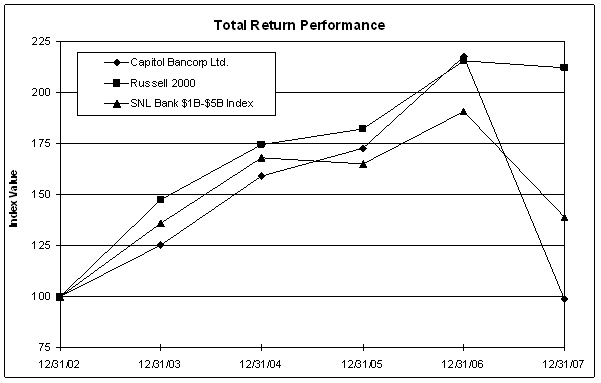
|
Period
Ended
|
||||||||||||
|
Index
|
12/31/02
|
12/31/03
|
12/31/04
|
12/31/05
|
12/31/06
|
12/31/07
|
||||||
|
CBC
|
100.00
|
125.08
|
158.81
|
172.55
|
217.72
|
98.54
|
||||||
|
R-2000
|
100.00
|
147.25
|
174.24
|
182.18
|
215.64
|
212.26
|
||||||
|
SNL
|
100.00
|
135.99
|
167.83
|
164.97
|
190.90
|
139.06
|
||||||
F -
3
INFORMATION
REGARDING CAPITOL'S COMMON STOCK--Continued
During
2007, Capitol paid quarterly cash dividends of $0.25 per share. In
2006, Capitol paid cash dividends of $0.20 per share in the first quarter and
$0.25 per share in the second, third and fourth quarters. Future
payment of dividends is subject to approval by Capitol's board of directors,
future operating performance and management's assessment of the consolidated
organization's capital adequacy.
As of
January 31, 2008, there were 6,998 beneficial holders of Capitol's common stock,
based on information supplied to Capitol from its stock transfer agent and other
sources.
At
February 25, 2008, 17,319,178 shares of common stock were
outstanding. Capitol's stock transfer agent is Computershare Trust
Company, N.A., 250 Royall Street, Canton, MA 02021 (telephone
800/884-4225). The web site for Computershare Trust Company, N.A. is
http://www.computershare.com.
Capitol
has a direct purchase and dividend reinvestment plan, the Capitol Bancorp
Limited Direct Purchase and Dividend Reinvestment Plan ("Capitol Bancorp
Direct"), which offers a variety of convenient features including dividend
reinvestment, certain fee-free transactions, certificate safekeeping and other
benefits. For a copy of the Capitol Bancorp Direct prospectus,
informational brochure and enrollment materials, contact Computershare Trust
Company, N.A. at 800/884-4225 or Capitol at 517/487-6555.
In
addition to Capitol's common stock, trust-preferred securities of Capitol Trust
I (a subsidiary of Capitol) are listed on the NYSE under the symbol
"CBCPrA." Those trust-preferred securities consist of 2,530,000, 8.5%
cumulative preferred securities, with a liquidation amount of $10 per preferred
security. The trust-preferred securities are guaranteed by Capitol
and mature in 2027, are currently callable and may be extended to 2036 if
certain conditions are met.
Capitol
has filed with the U.S. Securities and Exchange Commission (SEC) all required
certifications of its Chief Executive Officer (CEO) and Chief Financial Officer
regarding the quality of Capitol’s public disclosures. In addition,
Capitol’s CEO submitted to the NYSE an annual CEO certification stating that he
is not aware of any violation by Capitol of the NYSE’s corporate governance
listing standards. Further, Capitol filed certifications by its CEO
and CFO with the SEC in accordance with the Sarbanes-Oxley Act of 2002 as
exhibits to Capitol’s Form 10-K for the year ended December 31,
2007.
A copy of
Capitol's 2007 report on Form 10-K, without exhibits, is available to holders of
its common stock or trust-preferred securities without charge, upon written
request. Form 10-K includes certain statistical and other information
regarding Capitol and its business. Requests to obtain Form 10-K
should be addressed to Investor Relations, Capitol Bancorp Limited, Capitol
Bancorp Center, 200 Washington Square North, Lansing, Michigan
48933.
F -
4
AVAILABILITY
OF FORM 10-K AND CERTAIN OTHER REPORTS--Continued
Form 10-K
and certain other periodic reports are filed with the SEC. The SEC
maintains an Internet web site that contains reports, proxy and information
statements and other information regarding companies which file electronically
(which includes Capitol). The SEC's web site address is http://www.sec.gov. Capitol's
filings with the SEC are also available at Capitol's web site, http://www.capitolbancorp.com.
EXECUTIVE
OFFICES
|
Capitol
Bancorp Center
|
2777
East Camelback Road
|
|
200
Washington Square North
|
Suite
375
|
|
Lansing,
Michigan 48933
|
Phoenix,
Arizona 85016
|
|
517/487-6555
|
602/955-6100
|
|
www.capitolbancorp.com
|
|
INDEPENDENT
AUDITORS
BDO
Seidman, LLP
Grand
Rapids, Michigan
SHAREHOLDER
INFORMATION
ANNUAL
MEETING
Capitol's
2008 Annual Meeting of Shareholders will be held on Wednesday, April 23, 2008 at
4:00 p.m. at the Lansing Center, located at 333 E. Michigan Avenue, Lansing,
Michigan.
COMMON
STOCK TRADING INFORMATION
Capitol's
common stock trades on the New York Stock Exchange (NYSE) under the trading
symbol "CBC."
COMMON
STOCK TRANSFER AGENT
Computershare
Trust Company, N.A.
250
Royall Street
Canton,
MA 02021
800/884-4225
DIRECT
PURCHASE AND DIVIDEND REINVESTMENT PLAN
Capitol
offers an easy and affordable way to invest in Capitol's common stock through
its direct purchase and dividend reinvestment plan, Capitol Bancorp
Direct. Capitol Bancorp Direct’s benefits include the ability to make
an initial investment in common stock with as little as $50, reinvestment of
dividends in additional common stock, direct deposit of dividends, ability to
purchase common stock as frequently as once a month, and the option to make
transfers or gifts of Capitol's common stock to another
person. Participation in Capitol Bancorp Direct is voluntary and
shareholders and prospective investors are eligible. Purchases under
Capitol Bancorp Direct are not currently subject to any brokerage fees or
commissions. For further information regarding Capitol Bancorp Direct
or a copy of Capitol Bancorp Direct’s prospectus, informational brochure and
enrollment materials, contact Computershare Trust Company, N.A. at 800/884-4225
or Capitol at 517/487-6555.
F -
5
SHAREHOLDER
INFORMATION--Continued
TRUST-PREFERRED
SECURITIES TRADING INFORMATION
Preferred
securities of Capitol Trust I (a subsidiary of Capitol) trade on the NYSE under
the trading symbol "CBCPrA."
TRUST-PREFERRED
SECURITIES TRUSTEE
JP Morgan
Institutional Trust Services – Tempe, Arizona
Some of
the statements contained in this annual report that are not historical facts may
constitute forward-looking statements. Those forward-looking
statements, within the meaning of the Private Securities Litigation Reform Act
of 1995, are subject to known and unknown risks, uncertainties and other factors
which may cause the actual future results, performance or achievements of
Capitol and/or its subsidiaries and other operating units to differ materially
from those contemplated in such forward-looking statements. The words
"intend," "expect," "project," "estimate," "predict," "anticipate," "should,"
"will," "may," "believe" and similar expressions also identify forward-looking
statements. Important factors which may cause actual results to
differ from those contemplated in such forward-looking statements include, but
are not limited to: (i) the results of Capitol's efforts to implement its
business strategy, (ii) changes in interest rates, (iii) legislation or
regulatory requirements adversely impacting Capitol's banking business and/or
expansion strategy, (iv) adverse changes in business conditions or inflation,
(v) general economic conditions, either nationally or regionally, which are less
favorable than expected and that result in, among other things, a deterioration
in credit quality and/or loan performance and collectability, (vi) competitive
pressures among financial institutions, (vii) changes in securities markets,
(viii) actions of competitors of Capitol's banks and Capitol's ability to
respond to such actions, (ix) the cost of capital, which may depend in part on
Capitol's asset quality, prospects and outlook, (x) changes in governmental
regulation, tax rates and similar matters, (xi) changes in management and (xii)
other risks detailed in Capitol's other filings with the Securities and Exchange
Commission. If one or more of these risks or uncertainties
materialize, or if underlying assumptions prove incorrect, actual outcomes may
vary materially from those indicated. The preparation of consolidated
financial statements in conformity with generally accepted accounting principles
in the United States of America requires management to make certain estimates
and assumptions, many of which are based on assumptions relating to the
above-stated forward-looking statements, that affect the reported amounts of
assets and liabilities at the date of the consolidated financial statements and
the reported amounts of revenues and expenses during the reporting
period. Actual results will differ from those estimates because of
the inherent subjectivity and inaccuracy of any estimation. All
subsequent written or oral forward-looking statements attributable to Capitol or
persons acting on its behalf are expressly qualified in their entirety by the
foregoing factors. Investors and other interested parties are
cautioned not to place undue reliance on such statements, which speak as of the
date of such statements. Capitol undertakes no obligation to release
publicly any revisions to these forward-looking statements to reflect events or
circumstances after the date of such statements or to reflect the occurrence of
unanticipated events.
F -
6
Financial
Condition and Results of Operations
This
section of the Annual Report is intended to discuss, from management's
perspective, matters of importance and relevance to readers regarding Capitol's
operations, financial position and other things which have a significant effect
on Capitol, its business and its banks. This narrative includes some
comments about future events and other forward-looking statements and readers
are advised to carefully read the cautionary statement about forward-looking
statements which is on page F-6 of this Annual Report.
Capitol
is unique in the community banking industry. As
a bank-development
company, Capitol forms new community banks in a wide variety of markets
during an era of industry consolidation. Capitol operates in one
business segment, community banking. Capitol's banks are staffed with
banking professionals, serving customers who desire professional banking
services delivered personally.
No other
bank holding company in the U.S. is believed to hold as many bank 'charters'
(i.e., individually capitalized, licensed and managed, community banks) as
distinct operating subsidiaries. Capitol had 60 banks operating in 17
states as of December 31, 2007. Capitol previously announced plans to
expand to 100 banks within the next five years.
Capitol's
de novo bank model is
intended to create a scalable, low overhead structure which is focused on
delivering return-on-equity results, while empowering its individual banks with
operating autonomy in all areas which impact the customer
relationship. Capitol's centralized 'back-office' functions, which
support the banks, are capable of expanding coverage in concert with growth in
both the number and size of affiliate banks.
2007 was
another significant year of expansion:
|
·
|
The
addition of 11 new banks, the largest number in any year in Capitol’s
history, bringing the affiliation network total to 60 financial
institutions at year-end 2007.
|
|
·
|
Total
assets surpassing $4.9 billion at year end, marking a growth rate of 20.6%
for the year.
|
Earnings
decreased from $42.4 million ($2.57 per diluted share) in 2006 to $21.9 million
($1.27 per diluted share) in 2007, primarily due to weakened bank earnings
performance in the Great Lakes Region.
F -
7
Bank
Development as a Defined Focus
Each new
bank typically starts as a single-location office. Each is led by a
bank president and a team of banking professionals with significant local
experience, overseen by an independent board of directors composed of business
leaders drawn from that local community. Each bank has complete on-site authority to make all
decisions which directly affect the customer, such as credit approval and the
pricing and structure of both loans and deposits. The notion of
banking as a profession
is key to Capitol's model where its banks' customers seek a relationship with
banking professionals
to meet their needs as opposed to transaction-oriented financial institutions
pushing financial products at customers and emphasizing market
share.
With
Capitol's focused banking model, bank development on a national scale is a
natural extension of this business philosophy. Capitol's bank
development philosophy is based on just a few key ingredients necessary to start
a new bank:
|
·
|
A
bank president candidate with a significant background in the future
bank's business community, capable of attracting customer relationships
and other banking professionals
|
|
·
|
An
office address from which to operate a bank, optimally located in that
business community
|
|
·
|
A
strong group of potential board members, drawn from the local business
community, to oversee the future bank's activities and assist in business
development
|
|
·
|
Availability
of capital from community investors seeking to invest up to 49% in the
required start-up equity of the future
bank
|
Notably,
'market size' is not a big factor in Capitol's approach to
bank-development. Rather, the key is people. Capitol has
recognized from its beginning that its banking focus always has been, and always
will be, a people business. Capitol's banks are small in market
stature, emphasizing personalized banking relationships.
"Incubation"
of Young Community Banks
New
banks, just like most start-up businesses, are not profitable from the
outset. Each new bank is started with sufficient capital to absorb
early period losses and to support balance-sheet growth. During these
early periods of operation, Capitol's management works closely with the de novo bank's president in
providing guidance and assistance to help achieve the bank's goals and
objectives as it navigates toward future profitability. When a de novo bank achieves certain
developmental milestones (age, cumulative profitability, return on equity or
other measures), Capitol may offer the bank's community investors (up to 49% of
the bank's start-up capital) an opportunity to exchange their bank investment
for shares of Capitol's common stock, at a multiple of the bank's then current
book value (typically 150%). The exchange offer (which is not a
contractual obligation of Capitol) is generally subject to
F -
8
approval
by the bank's shareholders. When the offer is made, the bank is often
'turning the corner' on cumulative profitability and the share-exchange enables
the bank's shareholders to achieve both a return on their original investment in
the bank and liquidity in the form of marketable shares of Capitol's common
stock, if the shareholders elect to enter into the share-exchange
transaction. In 2007, Capitol completed one share-exchange
transaction; two share-exchange transactions were completed in
2006.
Monitoring
and Managing Capitol's Investments in Community Banks
The
concept of bank
development is not limited to starting and nurturing new
banks. At Capitol, it also means nurturing middle-stage and mature
bank affiliates to help them maximize their potential. Capitol
monitors and manages its investments in community banks working through regional
presidents, supported by Capitol’s bank financial analysis
group. Capitol's bank financial analysis group assists the banks in
the development of detailed budgets, assisting with asset/liability management
strategies, monitoring progress on the banks' business plans and reviewing
monthly operating results for each bank. Capitol's regional
presidents also assist in the identification of new bank development
opportunities within their respective regions. In addition to the
monitoring of operating results, Capitol assists the banks in managing capital,
including funding supplemental capital when needed to support bank
growth.
Capitol's
unique relationship with its banks is multidimensional, as an investor, mentor
and service provider. As investor, Capitol closely monitors the
financial performance of its bank subsidiaries. Capitol's mentoring
role of providing assistance and guidance when and where necessary to help
enhance bank performance is most important for its youngest affiliates where
guidance is needed during their early formative stages. Capitol
provides efficient back-office support services which can be done centrally for
all of its banks and which do not involve a direct interface with the bank
customer, such as:
|
·
|
Accounting
|
|
·
|
Capital
management
|
|
·
|
Credit
administration
|
|
·
|
Data
processing
|
|
·
|
Human
resources administration
|
|
·
|
Internal
audit
|
|
·
|
Legal
support
|
|
·
|
Risk
management
|
Some of
these functions are performed nationally from a single location, while others
are performed regionally, where it is more efficient to have personnel located
geographically based on their respective responsibilities in relation to the
physical location of the banks.
F -
9
Total
assets and revenues of each bank within Capitol's regions are summarized below
as of and for the years ended December 31, 2007 and 2006 (in
$1,000s):
|
Total
Assets
|
Total
Revenues(3)
|
||||||||||||||
|
2007
|
2006
|
2007
|
2006
|
||||||||||||
|
Arizona
Region:
|
|||||||||||||||
|
Arrowhead
Community Bank
|
$ | 89,060 | $ | 79,152 | $ | 8,161 | $ | 8,076 | |||||||
|
Asian
Bank of Arizona(2)
|
25,017 | 20,248 | 1,760 | 781 | |||||||||||
|
Bank
of Tucson
|
187,468 | 187,683 | 16,000 | 15,358 | |||||||||||
|
Camelback
Community Bank
|
84,671 | 83,003 | 6,780 | 6,355 | |||||||||||
|
Mesa
Bank
|
217,861 | 201,776 | 19,685 | 19,000 | |||||||||||
|
Southern
Arizona Community Bank
|
85,158 | 85,912 | 6,872 | 6,629 | |||||||||||
|
Sunrise
Bank of Albuquerque
|
71,726 | 59,798 | 6,168 | 4,796 | |||||||||||
|
Sunrise
Bank of Arizona
|
116,245 | 119,785 | 9,336 | 10,347 | |||||||||||
|
Valley
First Community Bank
|
77,306 | 72,333 | 5,544 | 5,629 | |||||||||||
|
Yuma
Community Bank
|
78,489 | 74,477 | 6,078 | 6,049 | |||||||||||
|
Arizona
Region Total
|
1,033,001 | 984,167 | 86,384 | 83,020 | |||||||||||
|
California
Region:
|
|||||||||||||||
|
Bank of Escondido
|
89,557 | 82,412 | 5,914 | 5,115 | |||||||||||
|
Bank of Feather River(1)
|
17,283 | 171 | |||||||||||||
|
Bank of San Francisco
|
68,902 | 28,122 | 3,250 | 1,649 | |||||||||||
|
Bank of Santa Barbara
|
58,738 | 42,559 | 4,282 | 2,138 | |||||||||||
|
Napa Community Bank
|
131,457 | 99,009 | 9,483 | 7,212 | |||||||||||
|
Point Loma Community Bank
|
56,428 | 43,715 | 4,161 | 3,185 | |||||||||||
|
Sunrise Bank of San Diego
|
81,905 | 71,170 | 7,092 | 5,800 | |||||||||||
|
Sunrise Community Bank(1)
|
21,113 | 1,099 | |||||||||||||
|
California Region Total
|
525,383 | 366,987 | 35,452 | 25,099 | |||||||||||
|
Colorado
Region:
|
|||||||||||||||
|
Fort
Collins Commerce Bank
|
61,083 | 54,410 | 4,696 | 3,641 | |||||||||||
|
Larimer
Bank of Commerce(1)
|
51,906 | 2,199 | |||||||||||||
|
Loveland
Bank of Commerce(1)
|
15,941 | 234 | |||||||||||||
|
Colorado
Region Total
|
128,930 | 54,410 | 7,129 | 3,641 | |||||||||||
|
Great
Lakes Region:
|
|||||||||||||||
|
Ann
Arbor Commerce Bank
|
362,429 | 310,407 | 25,800 | 23,598 | |||||||||||
|
Bank
of Auburn Hills
|
44,767 | 31,559 | 3,298 | 1,849 | |||||||||||
|
Bank
of Maumee(2)
|
35,576 | 9,915 | 1,552 | 133 | |||||||||||
|
Bank
of Michigan
|
69,909 | 51,287 | 4,945 | 3,073 | |||||||||||
|
Brighton
Commerce Bank
|
108,664 | 103,909 | 8,308 | 7,889 | |||||||||||
|
Capitol
National Bank
|
228,556 | 256,741 | 17,794 | 17,531 | |||||||||||
|
Detroit
Commerce Bank
|
113,243 | 106,233 | 9,083 | 8,634 | |||||||||||
|
Elkhart
Community Bank
|
89,064 | 86,883 | 6,876 | 6,476 | |||||||||||
|
Evansville
Commerce Bank(2)
|
50,819 | 20,772 | 2,789 | 591 | |||||||||||
|
Goshen
Community Bank
|
93,173 | 80,137 | 6,128 | 5,216 | |||||||||||
|
Grand
Haven Bank
|
130,492 | 129,033 | 9,575 | 9,702 | |||||||||||
|
Kent
Commerce Bank
|
87,060 | 86,916 | 6,545 | 6,800 | |||||||||||
|
Macomb
Community Bank
|
93,045 | 101,353 | 6,666 | 7,713 | |||||||||||
|
Muskegon
Commerce Bank
|
98,975 | 95,551 | 7,117 | 7,494 | |||||||||||
|
Oakland
Commerce Bank
|
109,370 | 134,437 | 9,288 | 9,660 | |||||||||||
|
Ohio
Commerce Bank(2)
|
35,690 | 14,466 | 1,533 | 199 | |||||||||||
|
Paragon
Bank & Trust
|
103,711 | 98,804 | 7,034 | 7,816 | |||||||||||
|
Portage
Commerce Bank
|
189,944 | 179,413 | 15,479 | 14,813 | |||||||||||
|
Great Lakes Region Total
|
2,044,487 | 1,897,816 | 149,810 | 139,187 | |||||||||||
|
Midwest
Region:
|
|||||||||||||||
|
Bank
of Belleville
|
50,485 | 24,948 | 2,389 | 1,188 | |||||||||||
|
Community
Bank of Lincoln(1)
|
12,960 | 65 | |||||||||||||
|
Summit
Bank of Kansas City
|
50,142 | 19,529 | 3,452 | 841 | |||||||||||
|
Midwest
Region Total
|
113,587 | 44,477 | 5,906 | 2,029 | |||||||||||
F -
10
Summary
of total assets and revenues – continued:
|
Total
Assets
|
Total
Revenues(3)
|
||||||||||||||
|
2007
|
2006
|
2007
|
2006
|
||||||||||||
|
Nevada
Region:
|
|||||||||||||||
|
1st
Commerce Bank(2)
|
$ | 32,091 | $ | 14,829 | $ | 1,762 | $ | 202 | |||||||
|
Bank
of Las Vegas
|
72,768 | 67,478 | 5,966 | 5,331 | |||||||||||
|
Black
Mountain Community Bank
|
147,433 | 138,961 | 12,282 | 10,984 | |||||||||||
|
Desert
Community Bank
|
101,840 | 93,914 | 8,216 | 7,464 | |||||||||||
|
Red
Rock Community Bank
|
120,750 | 108,362 | 9,319 | 8,515 | |||||||||||
|
Nevada Region Total
|
474,882 | 423,544 | 37,545 | 32,496 | |||||||||||
|
Northeast
Region:
|
|||||||||||||||
|
USNY
Bank(1)
|
17,171 | 438 | |||||||||||||
|
Northwest
Region:
|
|||||||||||||||
|
Bank
of Bellevue
|
45,122 | 33,155 | 3,152 | 2,061 | |||||||||||
|
Bank
of Everett(2)
|
28,946 | 20,061 | 1,907 | 489 | |||||||||||
|
Bank of Tacoma(1)
|
24,325 | 1,304 | |||||||||||||
|
High Desert Bank(1)
|
11,501 | 221 | |||||||||||||
|
Issaquah Community Bank(1)
|
13,696 | 330 | |||||||||||||
|
Northwest Region Total
|
123,590 | 53,216 | 6,914 | 2,550 | |||||||||||
|
Southeast
Region:
|
|||||||||||||||
|
Bank
of Valdosta(2)
|
43,842 | 21,626 | 2,574 | 561 | |||||||||||
|
Community
Bank of Rowan(2)
|
117,495 | 45,503 | 6,195 | 1,870 | |||||||||||
|
First
Carolina State Bank
|
115,243 | 93,819 | 7,556 | 6,341 | |||||||||||
|
Peoples
State Bank
|
26,159 | 32,714 | 2,226 | 2,629 | |||||||||||
|
Sunrise
Bank of Atlanta(2)
|
48,664 | 16,990 | 3,922 | 912 | |||||||||||
|
Southeast Region Total
|
351,403 | 210,652 | 22,473 | 12,313 | |||||||||||
|
Texas
Region:
|
|||||||||||||||
|
Bank of Ford Bend(1)
|
9,551 | 27 | |||||||||||||
|
Bank of Las Colinas(1)
|
11,383 | 37 | |||||||||||||
|
Texas Region Total
|
20,934 | 64 | |||||||||||||
|
Other,
net(4)
|
68,395 | 30,547 | 2,705 | 550 | |||||||||||
|
Consolidated
Totals
|
$ | 4,901,763 | $ | 4,065,816 | $ | 354,820 | $ | 300,885 | |||||||
|
(1)
|
Became
a Capitol affiliate in 2007 and is included for periods after addition to
the Capitol banking network.
|
|
(2)
|
Became
a Capitol affiliate in 2006 and is included for periods after addition to
the Capitol banking network.
|
|
(3)
|
Total
revenues is the sum of interest income and noninterest
income.
|
|
(4)
|
Includes
corporate and other nonbank
entities.
|
[The
remainder of this page is intentionally left blank]
F -
11
Net
income for 2007 approximated $21.9 million, a 48% decrease from the $42.4
million earned in 2006. Net income for 2005 was $35.9
million. Diluted earnings per share for 2007 was $1.27 compared to
$2.57 in 2006 and $2.34 in 2005.
The table
below summarizes, for Capitol's banks individually and regionally, net income
and the related rates of return on average equity and assets, where applicable
(in $1,000s):
|
Net
Income
|
Return
on Average Equity
|
Return
on Average Assets
|
||||||||||||||||||||||||||||||||||
|
2007
|
2006
|
2005
|
2007
|
2006
|
2005
|
2007
|
2006
|
2005
|
||||||||||||||||||||||||||||
|
Arizona
Region:
|
||||||||||||||||||||||||||||||||||||
|
Arrowhead
Community Bank
|
$ | 762 | $ | 1,293 | $ | 1,255 | 9.24 | % | 15.68 | % | 17.47 | % | 0.89 | % | 1.49 | % | 1.56 | % | ||||||||||||||||||
|
Asian
Bank of Arizona(2)
|
(507 | ) | (567 | ) | ||||||||||||||||||||||||||||||||
|
Bank
of Tucson
|
4,527 | 4,656 | 3,732 | 26.48 | % | 29.93 | % | 27.61 | % | 2.52 | % | 2.62 | % | 2.12 | % | |||||||||||||||||||||
|
Camelback
Community Bank
|
992 | 1,119 | 1,167 | 11.14 | % | 13.64 | % | 13.90 | % | 1.13 | % | 1.36 | % | 1.42 | % | |||||||||||||||||||||
|
Mesa
Bank
|
3,983 | 4,509 | 3,121 | 21.46 | % | 25.51 | % | 22.53 | % | 1.89 | % | 2.32 | % | 1.93 | % | |||||||||||||||||||||
|
Southern
Arizona Community Bank
|
1,082 | 1,189 | 1,290 | 12.04 | % | 13.51 | % | 14.74 | % | 1.22 | % | 1.39 | % | 1.46 | % | |||||||||||||||||||||
|
Sunrise
Bank of Albuquerque
|
601 | 494 | 929 | 8.95 | % | 7.50 | % | 13.58 | % | 0.86 | % | 0.86 | % | 1.36 | % | |||||||||||||||||||||
|
Sunrise
Bank of Arizona
|
409 | 1,372 | 2,215 | 3.51 | % | 10.82 | % | 18.12 | % | 0.35 | % | 1.17 | % | 1.82 | % | |||||||||||||||||||||
|
Valley
First Community Bank
|
327 | 716 | 604 | 4.10 | % | 9.67 | % | 9.06 | % | 0.46 | % | 0.97 | % | 0.86 | % | |||||||||||||||||||||
|
Yuma
Community Bank
|
936 | 1,199 | 992 | 12.09 | % | 16.95 | % | 14.88 | % | 1.28 | % | 1.70 | % | 1.66 | % | |||||||||||||||||||||
|
Arizona
Region Total
|
13,112 | 15,980 | 15,305 | |||||||||||||||||||||||||||||||||
|
California
Region:
|
||||||||||||||||||||||||||||||||||||
|
Bank
of Escondido
|
505 | 787 | 452 | 3.54 | % | 7.70 | % | 4.78 | % | 0.58 | % | 1.04 | % | 0.72 | % | |||||||||||||||||||||
|
Bank
of Feather River(1)
|
(576 | ) | ||||||||||||||||||||||||||||||||||
|
Bank
of San Francisco(3)
|
(397 | ) | (484 | ) | (726 | ) | ||||||||||||||||||||||||||||||
|
Bank
of Santa Barbara(3)
|
(191 | ) | (630 | ) | (514 | ) | ||||||||||||||||||||||||||||||
|
Napa
Community Bank
|
1,542 | 1,572 | 965 | 11.73 | % | 13.65 | % | 9.47 | % | 1.29 | % | 1.86 | % | 1.27 | % | |||||||||||||||||||||
|
Point Loma Community Bank
|
168 | 196 | (467 | ) | 2.37 | % | 2.84 | % | 0.31 | % | 0.48 | % | ||||||||||||||||||||||||
|
Sunrise Bank of San Diego
|
432 | 885 | 1,095 | 4.06 | % | 8.18 | % | 10.18 | % | 0.50 | % | 1.27 | % | 1.69 | % | |||||||||||||||||||||
|
Sunrise
Community Bank(1)
|
(998 | ) | ||||||||||||||||||||||||||||||||||
|
California
Region Total
|
485 | 2,326 | 805 | |||||||||||||||||||||||||||||||||
|
Colorado
Region:
|
||||||||||||||||||||||||||||||||||||
|
Fort
Collins Commerce Bank(3)
|
588 | 170 | (396 | ) | 6.81 | % | 2.10 | % | 1.07 | % | 0.42 | % | ||||||||||||||||||||||||
|
Larimer
Bank of Commerce(1)
|
(586 | ) | ||||||||||||||||||||||||||||||||||
|
Loveland
Bank of Commerce(1)
|
(426 | ) | ||||||||||||||||||||||||||||||||||
|
Colorado
Region Total
|
(424 | ) | 170 | (396 | ) | |||||||||||||||||||||||||||||||
|
Great
Lakes Region:
|
||||||||||||||||||||||||||||||||||||
|
Ann
Arbor Commerce Bank
|
3,635 | 3,739 | 4,007 | 13.56 | % | 14.19 | % | 14.80 | % | 1.08 | % | 1.21 | % | 1.22 | % | |||||||||||||||||||||
|
Bank
of Auburn Hills(3)
|
(335 | ) | (332 | ) | (437 | ) | ||||||||||||||||||||||||||||||
|
Bank
of Maumee(2)
|
(1,063 | ) | (619 | ) | ||||||||||||||||||||||||||||||||
|
Bank
of Michigan(3)
|
(136 | ) | (343 | ) | (1,017 | ) | ||||||||||||||||||||||||||||||
|
Brighton
Commerce Bank
|
621 | 845 | 1,097 | 6.63 | % | 8.93 | % | 11.86 | % | 0.58 | % | 0.80 | % | 1.02 | % | |||||||||||||||||||||
|
Capitol
National Bank
|
1,977 | 2,879 | 3,510 | 10.45 | % | 14.97 | % | 18.62 | % | 0.84 | % | 1.20 | % | 1.46 | % | |||||||||||||||||||||
|
Detroit
Commerce Bank
|
241 | 942 | 633 | 2.57 | % | 11.23 | % | 9.15 | % | 0.22 | % | 0.99 | % | 0.80 | % | |||||||||||||||||||||
|
Elkhart
Community Bank
|
766 | 948 | 726 | 8.67 | % | 11.18 | % | 9.21 | % | 0.90 | % | 1.16 | % | 0.97 | % | |||||||||||||||||||||
|
Evansville
Commerce Bank(2)
|
(689 | ) | (851 | ) | ||||||||||||||||||||||||||||||||
|
Goshen
Community Bank
|
431 | 383 | 47 | 5.72 | % | 5.58 | % | 0.71 | % | 0.54 | % | 0.55 | % | 0.08 | % | |||||||||||||||||||||
|
Grand
Haven Bank
|
483 | 1,284 | 999 | 4.43 | % | 11.75 | % | 9.75 | % | 0.37 | % | 1.01 | % | 0.82 | % | |||||||||||||||||||||
|
Kent
Commerce Bank
|
(161 | ) | 365 | 678 | 4.72 | % | 8.14 | % | 0.44 | % | 0.79 | % | ||||||||||||||||||||||||
|
Macomb
Community Bank
|
(1,118 | ) | 58 | 442 | 0.66 | % | 5.03 | % | 0.06 | % | 0.47 | % | ||||||||||||||||||||||||
|
Muskegon
Commerce Bank
|
(1,145 | ) | 158 | 1,184 | 1.87 | % | 12.52 | % | 0.16 | % | 1.23 | % | ||||||||||||||||||||||||
|
Oakland
Commerce Bank
|
(461 | ) | 1,143 | 1,835 | 11.50 | % | 17.75 | % | 0.94 | % | 1.46 | % | ||||||||||||||||||||||||
|
Ohio
Commerce Bank(2)
|
(770 | ) | (383 | ) | ||||||||||||||||||||||||||||||||
|
Paragon
Bank & Trust
|
(187 | ) | 858 | 819 | 7.71 | % | 7.18 | % | 0.85 | % | 0.74 | % | ||||||||||||||||||||||||
|
Portage
Commerce Bank
|
2,252 | 2,706 | 2,940 | 13.82 | % | 16.72 | % | 18.31 | % | 1.21 | % | 1.51 | % | 1.56 | % | |||||||||||||||||||||
|
Great
Lakes Region Total
|
4,341 | 13,780 | 17,463 | |||||||||||||||||||||||||||||||||
F -
12
Net
income and the related rates of return on average equity and assets –
continued:
|
Net
Income
|
Return
on Average Equity
|
Return
on Average Assets
|
||||||||||||||||||||||||||||||||||
|
2007
|
2006
|
2005
|
2007
|
2006
|
2005
|
2007
|
2006
|
2005
|
||||||||||||||||||||||||||||
|
Midwest
Region
|
||||||||||||||||||||||||||||||||||||
|
Bank
of Belleville(3)
|
$ | (572 | ) | $ | (548 | ) | $ | (405 | ) | |||||||||||||||||||||||||||
|
Community
Bank of Lincoln(1)
|
(500 | ) | ||||||||||||||||||||||||||||||||||
|
Summit
Bank of Kansas City(3)
|
(404 | ) | (593 | ) | (319 | ) | ||||||||||||||||||||||||||||||
|
Midwest
Region Total
|
(1,476 | ) | (1,141 | ) | (724 | ) | ||||||||||||||||||||||||||||||
|
Nevada
Region:
|
||||||||||||||||||||||||||||||||||||
|
1st
Commerce Bank(2)
|
(578 | ) | (432 | ) | ||||||||||||||||||||||||||||||||
|
Bank
of Las Vegas
|
608 | 707 | 670 | 6.77 | % | 7.24 | % | 9.70 | % | 0.83 | % | 1.09 | % | 1.16 | % | |||||||||||||||||||||
|
Black
Mountain Community Bank
|
2,612 | 2,556 | 2,204 | 18.40 | % | 20.40 | % | 20.95 | % | 1.81 | % | 1.96 | % | 1.84 | % | |||||||||||||||||||||
|
Desert
Community Bank
|
1,296 | 1,302 | 1,061 | 13.54 | % | 15.29 | % | 13.65 | % | 1.35 | % | 1.51 | % | 1.42 | % | |||||||||||||||||||||
|
Red
Rock Community Bank
|
1,652 | 2,162 | 1,856 | 12.34 | % | 17.38 | % | 15.32 | % | 1.44 | % | 2.09 | % | 1.73 | % | |||||||||||||||||||||
|
Nevada Region Total
|
5,590 | 6,295 | 5,791 | |||||||||||||||||||||||||||||||||
|
Northeast
Region:
|
||||||||||||||||||||||||||||||||||||
|
USNY Bank(1)
|
(908 | ) | ||||||||||||||||||||||||||||||||||
|
Northwest
Region:
|
||||||||||||||||||||||||||||||||||||
|
Bank of Bellevue(3)
|
(154 | ) | (384 | ) | (551 | ) | ||||||||||||||||||||||||||||||
|
Bank of Everett(2)
|
(636 | ) | (733 | ) | ||||||||||||||||||||||||||||||||
|
Bank
of Tacoma(1)
|
(1,067 | ) | ||||||||||||||||||||||||||||||||||
|
High
Desert Bank(1)
|
(514 | ) | ||||||||||||||||||||||||||||||||||
|
Issaquah
Community Bank(1)
|
(574 | ) | ||||||||||||||||||||||||||||||||||
|
Northwest
Region Total
|
(2,945 | ) | (1,117 | ) | (551 | ) | ||||||||||||||||||||||||||||||
|
Southeast
Region:
|
||||||||||||||||||||||||||||||||||||
|
Bank
of Valdosta(2)
|
(423 | ) | (822 | ) | ||||||||||||||||||||||||||||||||
|
Community
Bank of Rowan(2)
|
(183 | ) | (1,095 | ) | ||||||||||||||||||||||||||||||||
|
First
Carolina State Bank
|
539 | 637 | 478 | 4.52 | % | 5.59 | % | 4.42 | % | 0.53 | % | 0.75 | % | 0.64 | % | |||||||||||||||||||||
|
Peoples
State Bank(3)
|
254 | 282 | 77 | 5.14 | % | 6.57 | % | 2.90 | % | 0.93 | % | 0.55 | % | 0.36 | % | |||||||||||||||||||||
|
Sunrise
Bank of Atlanta(2)
|
(338 | ) | (820 | ) | ||||||||||||||||||||||||||||||||
|
Southeast
Region Total
|
(151 | ) | (1,818 | ) | 555 | |||||||||||||||||||||||||||||||
|
Texas
Region:
|
||||||||||||||||||||||||||||||||||||
|
Bank
of Fort Bend(1)
|
(461 | ) | ||||||||||||||||||||||||||||||||||
|
Bank
of Las Colinas(1)
|
(658 | ) | ||||||||||||||||||||||||||||||||||
|
Texas
Region Total
|
(1,119 | ) | ||||||||||||||||||||||||||||||||||
|
Other,
net
|
5,432 | 7,916 | (2,323 | ) | ||||||||||||||||||||||||||||||||
|
Consolidated totals
|
$ | 21,937 | $ | 42,391 | $ | 35,925 | 5.72 | % | 12.94 | % | 13.34 | % | 0.49 | % | 1.12 | % | 1.08 | % | ||||||||||||||||||
|
(1)
|
Became
a Capitol affiliate in 2007 and is included for periods after addition to
the Capitol banking network.
|
|
(2)
|
Became
a Capitol affiliate in 2006 and is included for periods after addition to
the Capitol banking network.
|
|
(3)
|
Became
a Capitol affiliate in 2005 and is included for periods after addition to
the Capitol banking network.
|
The
preceding table presents net income (or loss) of each bank without regard to
Capitol’s direct or indirect ownership percentage. Young de novo banks are expected to
incur operating losses in their early periods of operations and, due to
Capitol’s ownership percentage, individual start-up losses at banks typically do
not have a material effect on consolidated earnings.
Earnings
at mature wholly-owned banks have a more significant and direct impact on
consolidated earnings. The preceding table indicates a significant
decrease in combined net income of banks within the Great Lakes
Region. Dominating the Great Lakes Region are Capitol’s eleven
mature, wholly-owned banks located in Michigan. Total earnings of
this group of banks amounted to $6.1 million in 2007, compared to $15 million in
2006 and $18.1 million in 2005. The material decrease in earnings in
this group of banks is attributable
F -
13
to loan
losses stemming from a sustained difficult economic environment, significant
increases in nonearning assets and elevated collection costs. These
are the largest items adversely impacting Capitol’s 2007 consolidated earnings
results, followed by compression in margins and related net interest
income.
The
principal revenue source for Capitol’s banks is interest income from
loans. Net interest income is the total of all interest income minus
all interest expense. This is an important measure that is used to
help determine the amount of net operating revenues for financial
institutions. Net operating revenue is the sum of net interest income
and noninterest income.
Net
interest income totaled $183.3 million in 2007, a 5% increase over the $173.8
million reported in 2006, compared to an 11% increase in 2006 versus 19% in
2005. The 2007 increase in net interest income is substantially less
than the growth rate in loans, other earning assets and deposits due to a
challenging interest rate environment which reduced the spread between interest
earned on loans and rates paid on deposits. In 2006 and 2005,
double-digit asset growth generally correlated with somewhat similar
double-digit growth in net interest income, although margin compression reduced
the growth rate of net interest income in the second half of
2006. The modest 2007 increase in net interest income is due to the
compression in margins caused by lower rates earned on loans and elevated levels
of nonperforming loans coupled with the slower repricing of rates paid on
deposits.
Combined
with noninterest income, total consolidated net operating revenues approximated
$207.7 million in 2007, $195.3 million in 2006 and $177.9 million in
2005. Noninterest income for these periods was $24.4 million, $21.5
million and $21 million, respectively. Noninterest income increased
13% in 2007.
Service
charges, which approximated $4.8 million in 2007, increased 9% from the 2006
level of $4.3 million ($4.1 million in 2005). Revenue from trust and
wealth management activities increased more than 54% in 2007 and 61% in 2006,
following the late-2005 launch of Capitol Wealth, Inc., an initiative to expand
Capitol’s banks’ scope of services in meeting the needs of their clients beyond
loans and deposits. Full-time Capitol Wealth advisors are located at
a majority of Capitol's banks to work in tandem with their traditional banking
colleagues to expand the availability of financial services to the banks'
clientele, while increasing noninterest revenues.
In 2007,
2006 and 2005, revenue from mortgage loans originated for sale amounted to $4.5
million, $5.4 million and $6.1 million, respectively. Loan
origination volume decreased in 2006 and 2005 and increased slightly in
2007. Increased interest rates on mortgage loans in 2006 and 2007
substantially reduced origination volume from refinancings. Further,
reduction in home sales volume in many communities has also negatively impacted
origination volume. Other noninterest income increased 20% in 2007
and 5% in 2006. Due to the nature of these revenues, as well as gains
on the sale of government-guaranteed loans, the amount of the revenue can vary
significantly from year to year depending on interest rates and business
opportunities.
F -
14
The
provision for loan losses approximated $25.3 million, $12.2 million and $11
million in 2007, 2006 and 2005, respectively. The very significant
increase in the provision for loan losses in 2007 is primarily associated with
loan losses incurred in the Great Lakes Region’s mature wholly-owned Michigan
banks and related elevated levels of nonperforming loans. The amount
of the provision for loan losses is determined based on management’s analysis of
amounts necessary for the allowance for loan losses; this is discussed in
greater detail later in the Financial Position section of
this narrative.
Noninterest
expense totaled $176.2 million, $137.8 million and $117.3 million in 2007, 2006
and 2005, respectively. In total, these expenses increased 27.8% in
2007, 17.5% in 2006 and 19.9% in 2005. Increases in the components of
noninterest expense in 2007 were primarily associated with added staffing and
other costs associated with growing young banks and adding new banks (eleven in
2007 and nine in each of 2006 and 2005). The more significant
elements of other noninterest expense consisted of the following (in
$1,000s):
|
2007
|
2006
|
2005
|
|||||||||
|
Advertising
|
$ | 3,315 | $ | 2,921 | $ | 2,266 | |||||
|
Travel,
lodging and meals
|
3,080 | 2,322 | 1,623 | ||||||||
|
Paper,
printing and supplies
|
2,870 | 2,409 | 2,135 | ||||||||
|
Directors’
fees
|
2,819 | 2,196 | 1,577 | ||||||||
|
FDIC
insurance premiums and other
regulatory
fees
|
2,723 | 879 | 837 | ||||||||
|
Professional
fees
|
2,468 | 2,547 | 2,124 | ||||||||
|
Bank
services (ATMs, telephone
banking
and Internet banking)
|
2,115 | 1,564 | 1,229 | ||||||||
|
Loan
and collection expense
|
1,952 | 1,116 | 1,059 | ||||||||
|
Taxes
other than income taxes
|
1,786 | 1,372 | 1,401 | ||||||||
|
Communications
|
1,728 | 1,380 | 1,229 | ||||||||
|
Postage
|
1,113 | 1,009 | 864 | ||||||||
|
Courier
service
|
997 | 872 | 803 | ||||||||
|
Costs
associated with foreclosed
properties
and other real estate owned
|
989 | 417 | 8 | ||||||||
|
Dues
and memberships
|
928 | 810 | 592 | ||||||||
|
Contracted
labor
|
496 | 549 | 370 | ||||||||
|
Insurance
expense
|
473 | 398 | 386 | ||||||||
|
Other
|
8,951 | 4,880 | 7,324 | ||||||||
|
Total
|
$ | 38,803 | $ | 27,641 | $ | 25,827 | |||||
Capitol’s
effective tax rate was 45.9% in 2007, 34.1% in 2006 and 38.7% in
2005. The statutory federal income tax rate applicable to Capitol is
currently 35%. The effective tax rate includes state income taxes,
but excludes taxes incurred in states which are based on measures other than
income (which are shown in the table above). The higher effective tax
rate in 2007 resulted primarily from lower taxable income while nondeductible
items were relatively consistent with prior years.
Consolidated
total assets increased significantly in 2007 to $4.9 billion from $4.1 billion
at the end of 2006 and $3.5 billion at the beginning of 2006.
F -
15
Key to
the balance-sheet strength of Capitol is its total capital position
(subordinated debentures, minority interests in consolidated subsidiaries and
stockholders’ equity totaling approximately $701.5 million or 14.3% of total
assets) and liquidity (cash and cash equivalents of $352.4 million or 7.2% of
total assets) at December 31, 2007. Both of those key elements are
discussed in the next section, Liquidity, Capital Resources and
Capital Adequacy.
When
considering Capitol’s financial position, as shown in its consolidated balance
sheet, it is clear that the single largest asset category is portfolio
loans. Accordingly, the narrative in this section is devoted
primarily to loans.
Net
portfolio loans (total portfolio loans after subtracting the allowance for loan
losses) approximated $4.3 billion at December 31, 2007 and $3.4 billion at
December 31, 2006. These amounts approximated 87% of total
consolidated assets at December 31, 2007 and 85% at December 31,
2006. Loan growth in 2007 approximated $826 million ($497.5 million
in 2006). On a consolidated basis, portfolio loan growth at banks
less than three years of age as of year-end 2007 approximated 66% of all banks’
portfolio loan growth, which is the expected result of Capitol’s growing number
of banks.
Capitol’s
banks emphasize commercial loans, consistent with their focus on lending to
local entrepreneurs, professional service firms and other
businesses. All of Capitol’s banks use a common credit policy;
however, as emphasized earlier, all credit decisions are made at the local level
at each community bank. The utilization of an enterprise-wide credit
policy has several key benefits to Capitol and its banks, such as procedural
guidance for:
|
·
|
Loan
underwriting and documentation
|
|
·
|
Credit
granting authorities within the bank
|
|
·
|
Acceptable
collateral and loan structuring
|
|
·
|
Loan
participations amongst other affiliates or other funding sources, when
proposals exceed an individual bank’s limitations
|
|
·
|
Collections
and workouts
|
|
·
|
Documenting
and evaluating the adequacy of the allowance for loan losses
|
|
·
|
Establishing
corporate credit administration resources to aid the banks when
needed
|
As part
of the banks’ emphasis on commercial lending, commercial real estate is sought
as the primary source of collateral for commercial loans when
possible. This emphasis on use of commercial real estate as
collateral has been a consistent practice of Capitol and its banks from their
earliest days of operation, based on the use of appropriate loan-to-value
ratios, avoidance of large real estate development projects and the belief that,
even in soft economies, commercial real estate tends to have substantially less
loss potential than other types of business-asset collateral, such as
receivables, inventory and equipment.
F -
16
A
potentially negative aspect of real estate as a primary source of collateral for
commercial loans is that when some commercial loans develop performance
difficulties and reach nonperforming status (i.e., becoming 90 days past due or
being placed on nonaccrual status), the resolution period can be long due to the
foreclosure process and may be further extended if the real estate sales
environment is weak in particular markets. In contrast, a commercial
loan secured by receivables, inventory or equipment which becomes nonperforming
tends to have a higher loss potential due to the probable dissipation of
collateral value.
At
December 31, 2007, the consolidated allowance for loan losses approximated $58.1
million or 1.35% of total portfolio loans outstanding, compared with $45.4
million or 1.30% at December 31, 2006. As stated earlier, the
allowance is based on management’s analysis of inherent losses in the portfolio
at the balance sheet date.
Nonperforming
loans approximated $72.6 million and $34.3 million at December 31, 2007 and
2006, and approximated 1.68% and 0.98% of portfolio loans and 1.48% and 0.84% of
total assets, respectively. Of the nonperforming loans at December
31, 2007, about 86% were real-estate secured. At December 31, 2007,
the coverage ratio of the allowance for loan losses to nonperforming loans
(i.e., the allowance as a percentage of nonperforming loans) was 80%, compared
to 132.5% at the beginning of the year.
At
December 31, 2007, about 71% of Capitol’s total nonperforming loans were
Michigan-based (including nonperforming loans held at the parent level) where
nonperforming loans increased $20 million or 63% in 2007. In concert
with elevated levels of nonperforming loans at Michigan banks, their combined
allowance ratio of about 1.58% and 1.48% of portfolio loans at year-end 2007 and
2006, respectively, has been maintained at a higher level than the consolidated
ratio, and some banks have allowance ratios exceeding 2%. Although
the majority of nonperforming loans at December 31, 2007 were Michigan-based, it
should be noted that other regions (Arizona and California, for example)
experienced increases in this category in 2007. Increases in other
regions’ nonperforming loans were expected due to softened economic conditions
and the historically low levels of such loans in prior periods.
Due to a
combination of commercial real estate collateral and a weak economic climate,
resolution of nonperforming loans and other nonperforming assets may take
extended periods, levels of nonperforming loans could increase further and
general economic conditions may not improve in the near
term. Management believes that nonperforming loans have been properly
considered in its evaluation of the adequacy of the allowance for loan losses as
of December 31, 2007.
In
addition to the identification of nonperforming loans involving borrowers with
payment performance difficulties (i.e., nonaccrual loans and loans past-due 90
days or more), management utilizes an internal loan review process to identify
other potential problem loans which may warrant additional monitoring or other
attention. This loan review process is a continuous activity which
periodically updates internal loan classifications. At inception, all
loans are individually assigned a classification which grades the credits on a
risk basis, assessing the financial strength of the borrower and guarantors and
other factors such as the borrowers’ historical and projected financial
performance, local economic conditions and other subjective
factors. The loan classification process is fluid and
subjective.
F -
17
Potential
problem loans include loans which are generally performing as agreed; however,
because of loan review’s and/or lending staff’s risk assessment, increased
monitoring is deemed appropriate. In addition, some loans are
identified for monitoring because of specific performance issues or other risk
factors requiring closer management attention and the development of specific
remedial action plans.
At
December 31, 2007, potential problem loans (which include nonperforming loans)
approximated $219 million or about 5% of total consolidated portfolio
loans. Such totals typically approximate 4% to 5% of loans
outstanding and are an important part of management’s ongoing and proactive loan
review activities which are designed to early-identify loans which warrant close
monitoring at the bank and corporate credit-administration levels. It
is important to note that these potential problem loans do not necessarily have
significant loss exposure (nor are they necessarily deemed ‘impaired’), but
rather are identified by management in this manner to aid in loan administration
and risk management. These loans are considered in management’s
evaluation of the adequacy of the allowance for loan losses.
As noted
in the Critical Accounting
Policies section, which appears later in this narrative, the use of
estimates in determining the allowance for loan losses is very important for an
understanding of Capitol’s consolidated financial statements. Simply
stated, the allowance for loan losses is management’s estimate of loan losses
inherent in the loan portfolio at the balance-sheet date. The
allowance for loan losses is increased by provisions for loan losses, which are
charged against operations, and reduced by net loan write-offs which are charged
against the allowance. There are many ways to estimate losses or
‘loss reserves’ and there is no one ‘right’ way. Management’s
experience is that its estimation techniques have accurately determined
historical losses.
Capitol
had 60 separately chartered banks at year-end 2007. Each bank
separately documents the adequacy of its respective allowance for loan
losses. As mentioned previously, Capitol has a uniform,
enterprise-wide credit policy which, among other things, provides the banks
guidance on evaluating and documenting the adequacy of the allowance for loan
losses. Essentially, a standardized computational template is used
consistently by all of Capitol’s banks. The template includes
elements for all portfolio loan categories for performing loans, nonperforming
loans, watch credits and environmental factors. While a standardized
template is utilized, management is required to apply subjective judgment in
determining risk factors specific to their banks and other matters in
determining the allowance needed at the bank level. Further, the
combined results of the banks’ separate analyses are evaluated at the Capitol,
or parent, level on a judgmental basis. The process to evaluate and
determine the adequacy of the allowance for loan losses at each individual bank
and on a consolidated basis is labor intensive and requires a high degree of
judgment. It is possible that others, given the same information, may
at any point in time reach different reasonable conclusions.
F -
18
The
following table summarizes portfolio loans, the allowance for loan losses and
nonperforming loans for each of the banks, regionally, and on a consolidated
basis (in $1,000s):
|
Total
Portfolio Loans
|
Allowance
for
Loan
Losses
|
Nonperforming
Loans
|
Allowance
as a %
of
Total Portfolio
Loans
|
|||||||||||||||||||||||||||||
|
2007
|
2006
|
2007
|
2006
|
2007
|
2006
|
2007
|
2006
|
|||||||||||||||||||||||||
|
Arizona
Region:
|
||||||||||||||||||||||||||||||||
|
Arrowhead
Community Bank
|
$ | 81,836 | $ | 71,252 | $ | 818 | $ | 720 | $ | 361 | $ | 855 | 1.00 | % | 1.01 | % | ||||||||||||||||
|
Asian
Bank of Arizona(2)
|
21,514 | 14,499 | 405 | 200 | 314 | 1.88 | % | 1.38 | % | |||||||||||||||||||||||
|
Bank
of Tucson
|
168,427 | 160,009 | 1,385 | 1,472 | 752 | 199 | 0.82 | % | 0.92 | % | ||||||||||||||||||||||
|
Camelback
Community Bank
|
79,869 | 78,922 | 800 | 733 | 451 | 46 | 1.00 | % | 0.93 | % | ||||||||||||||||||||||
|
Mesa
Bank
|
202,511 | 189,863 | 1,760 | 1,794 | 3,699 | 0.87 | % | 0.94 | % | |||||||||||||||||||||||
|
Southern
Arizona Community Bank
|
78,467 | 77,845 | 792 | 775 | 600 | 16 | 1.01 | % | 1.00 | % | ||||||||||||||||||||||
|
Sunrise
Bank of Albuquerque
|
67,192 | 53,027 | 866 | 778 | 183 | 1.29 | % | 1.47 | % | |||||||||||||||||||||||
|
Sunrise
Bank of Arizona
|
112,211 | 112,720 | 1,125 | 1,126 | 4,250 | 246 | 1.00 | % | 1.00 | % | ||||||||||||||||||||||
|
Valley
First Community Bank
|
71,689 | 66,256 | 653 | 611 | 0.91 | % | 0.92 | % | ||||||||||||||||||||||||
|
Yuma
Community Bank
|
66,092 | 58,577 | 525 | 500 | 600 | 0.79 | % | 0.85 | % | |||||||||||||||||||||||
|
Arizona
Region Total
|
949,808 | 882,970 | 9,129 | 8,709 | 11,210 | 1,362 | 0.96 | % | 0.99 | % | ||||||||||||||||||||||
|
California
Region:
|
||||||||||||||||||||||||||||||||
|
Bank of Escondido
|
54,707 | 37,398 | 560 | 370 | 311 | 19 | 1.02 | % | 0.99 | % | ||||||||||||||||||||||
|
Bank of Feather River(1)
|
13,345 | 187 | 1.40 | % | ||||||||||||||||||||||||||||
|
Bank of San Francisco
|
44,989 | 26,415 | 695 | 375 | 392 | 1.54 | % | 1.42 | % | |||||||||||||||||||||||
|
Bank of Santa Barbara
|
52,340 | 40,198 | 741 | 533 | 1.42 | % | 1.33 | % | ||||||||||||||||||||||||
|
Napa Community Bank
|
100,253 | 78,467 | 1,069 | 1,020 | 1,459 | 1.07 | % | 1.30 | % | |||||||||||||||||||||||
|
Point Loma Community Bank
|
49,607 | 38,018 | 695 | 510 | 1.40 | % | 1.34 | % | ||||||||||||||||||||||||
|
Sunrise Bank of San Diego
|
74,526 | 65,250 | 908 | 540 | 2,386 | 1.22 | % | 0.83 | % | |||||||||||||||||||||||
|
Sunrise Community Bank(1)
|
17,624 | 255 | 1.45 | % | ||||||||||||||||||||||||||||
|
California
Region Total
|
407,391 | 285,746 | 5,110 | 3,348 | 4,548 | 19 | 1.25 | % | 1.17 | % | ||||||||||||||||||||||
|
Colorado
Region:
|
||||||||||||||||||||||||||||||||
|
Fort
Collins Commerce Bank
|
59,388 | 52,147 | 889 | 695 | 1.50 | % | 1.33 | % | ||||||||||||||||||||||||
|
Larimer
Bank of Commerce(1)
|
50,927 | 765 | 1.50 | % | ||||||||||||||||||||||||||||
|
Loveland
Bank of Commerce(1)
|
15,253 | 229 | 1.50 | % | ||||||||||||||||||||||||||||
|
Colorado
Region Total
|
125,568 | 52,147 | 1,883 | 695 | 1.50 | % | 1.33 | % | ||||||||||||||||||||||||
|
Great
Lakes Region:
|
||||||||||||||||||||||||||||||||
|
Ann
Arbor Commerce Bank
|
332,624 | 288,408 | 4,504 | 4,393 | 5,161 | 4,441 | 1.35 | % | 1.52 | % | ||||||||||||||||||||||
|
Bank
of Auburn Hills
|
36,586 | 26,432 | 820 | 410 | 1,293 | 629 | 2.24 | % | 1.55 | % | ||||||||||||||||||||||
|
Bank
of Maumee(2)
|
32,102 | 3,327 | 482 | 50 | 1.50 | % | 1.50 | % | ||||||||||||||||||||||||
|
Bank
of Michigan
|
63,448 | 44,630 | 952 | 669 | 370 | 1.50 | % | 1.50 | % | |||||||||||||||||||||||
|
Brighton
Commerce Bank
|
99,627 | 94,987 | 1,018 | 995 | 18 | 522 | 1.02 | % | 1.05 | % | ||||||||||||||||||||||
|
Capitol
National Bank
|
206,449 | 196,074 | 3,421 | 2,833 | 3,449 | 3,365 | 1.66 | % | 1.44 | % | ||||||||||||||||||||||
|
Detroit
Commerce Bank
|
108,992 | 103,153 | 1,355 | 1,335 | 3,948 | 1,328 | 1.24 | % | 1.29 | % | ||||||||||||||||||||||
|
Elkhart
Community Bank
|
83,754 | 77,515 | 1,282 | 1,010 | 2,677 | 676 | 1.53 | % | 1.30 | % | ||||||||||||||||||||||
|
Evansville
Commerce Bank(2)
|
48,113 | 14,711 | 720 | 232 | 80 | 1.50 | % | 1.58 | % | |||||||||||||||||||||||
|
Goshen
Community Bank
|
70,799 | 63,653 | 874 | 862 | 491 | 233 | 1.23 | % | 1.35 | % | ||||||||||||||||||||||
|
Grand
Haven Bank
|
122,208 | 120,025 | 2,644 | 2,643 | 6,970 | 2,682 | 2.16 | % | 2.20 | % | ||||||||||||||||||||||
|
Kent
Commerce Bank
|
83,357 | 83,065 | 1,527 | 1,237 | 2,456 | 2,256 | 1.83 | % | 1.49 | % | ||||||||||||||||||||||
|
Macomb
Community Bank
|
87,670 | 87,737 | 2,283 | 1,670 | 11,846 | 3,738 | 2.60 | % | 1.90 | % | ||||||||||||||||||||||
|
Muskegon
Commerce Bank
|
90,031 | 81,799 | 1,762 | 1,231 | 2,362 | 3,906 | 1.96 | % | 1.50 | % | ||||||||||||||||||||||
|
Oakland
Commerce Bank
|
99,770 | 114,876 | 1,816 | 1,636 | 3,803 | 2,862 | 1.82 | % | 1.42 | % | ||||||||||||||||||||||
|
Ohio
Commerce Bank(2)
|
29,110 | 739 | 437 | 11 | 1.50 | % | 1.49 | % | ||||||||||||||||||||||||
|
Paragon
Bank & Trust
|
91,481 | 82,259 | 1,431 | 1,298 | 2,220 | 2,132 | 1.56 | % | 1.58 | % | ||||||||||||||||||||||
|
Portage
Commerce Bank
|
179,219 | 167,005 | 1,812 | 1,729 | 1,127 | 1,380 | 1.01 | % | 1.04 | % | ||||||||||||||||||||||
|
Great
Lakes Region Total
|
1,865,340 | 1,650,395 | 29,140 | 24,244 | 48,271 | 30,150 | 1.56 | % | 1.47 | % | ||||||||||||||||||||||
|
Midwest
Region:
|
||||||||||||||||||||||||||||||||
|
Bank
of Belleville
|
46,951 | 17,410 | 700 | 260 | 1.49 | % | 1.49 | % | ||||||||||||||||||||||||
|
Community
Bank of Lincoln(1)
|
10,501 | 168 | 1.60 | % | ||||||||||||||||||||||||||||
|
Summit
Bank of Kansas City
|
45,165 | 15,645 | 641 | 235 | 1.42 | % | 1.50 | % | ||||||||||||||||||||||||
|
Midwest
Region Total
|
102,617 | 33,055 | 1,509 | 495 | 1.47 | % | 1.50 | % | ||||||||||||||||||||||||
F -
19
Summary
of loan information – continued:
|
Total
Portfolio Loans
|
Allowance
for
Loan
Losses
|
Nonperforming
Loans
|
Allowance
as a %
of
Total Portfolio
Loans
|
|||||||||||||||||||||||||||||
|
2007
|
2006
|
2007
|
2006
|
2007
|
2006
|
2007
|
2006
|
|||||||||||||||||||||||||
|
Nevada
Region:
|
||||||||||||||||||||||||||||||||
|
1st
Commerce Bank(2)
|
$ | 27,030 | $ | 9,588 | $ | 393 | $ | 125 | 1.45 | % | 1.30 | % | ||||||||||||||||||||
|
Bank
of Las Vegas
|
61,662 | 62,818 | 751 | 705 | 1.22 | % | 1.12 | % | ||||||||||||||||||||||||
|
Black
Mountain Community Bank
|
137,308 | 127,844 | 1,415 | 1,529 | $ | 659 | 1.03 | % | 1.20 | % | ||||||||||||||||||||||
|
Desert
Community Bank
|
90,050 | 83,284 | 837 | 830 | 356 | $ | 137 | 0.93 | % | 1.00 | % | |||||||||||||||||||||
|
Red
Rock Community Bank
|
106,559 | 100,010 | 977 | 1,084 | 64 | 151 | 0.92 | % | 1.08 | % | ||||||||||||||||||||||
|
Nevada
Region Total
|
422,609 | 383,544 | 4,373 | 4,273 | 1,079 | 288 | 1.03 | % | 1.11 | % | ||||||||||||||||||||||
|
Northeast
Region:
|
||||||||||||||||||||||||||||||||
|
USNY
Bank(1)
|
12,421 | 187 | 1.51 | % | ||||||||||||||||||||||||||||
|
Northwest
Region:
|
||||||||||||||||||||||||||||||||
|
Bank of Bellevue
|
37,364 | 28,037 | 665 | 370 | 222 | 1.78 | % | 1.32 | % | |||||||||||||||||||||||
|
Bank of Everett(2)
|
24,170 | 8,269 | 418 | 122 | 1.73 | % | 1.48 | % | ||||||||||||||||||||||||
|
Bank
of Tacoma(1)
|
19,639 | 285 | 1.45 | % | ||||||||||||||||||||||||||||
|
High
Desert Bank(1)
|
9,080 | 126 | 1.39 | % | ||||||||||||||||||||||||||||
|
Issaquah
Community Bank(1)
|
6,598 | 93 | 1.41 | % | ||||||||||||||||||||||||||||
|
Northwest Region Total
|
96,851 | 36,306 | 1,587 | 492 | 222 | 1.64 | % | 1.36 | % | |||||||||||||||||||||||
|
Southeast
Region:
|
||||||||||||||||||||||||||||||||
|
Bank
of Valdosta(2)
|
41,629 | 18,870 | 619 | 283 | 1.49 | % | 1.50 | % | ||||||||||||||||||||||||
|
Community
Bank of Rowan(2)
|
96,271 | 36,534 | 1,444 | 534 | 1.50 | % | 1.46 | % | ||||||||||||||||||||||||
|
First
Carolina State Bank
|
94,047 | 73,884 | 1,157 | 800 | 829 | 150 | 1.23 | % | 1.08 | % | ||||||||||||||||||||||
|
Peoples
State Bank
|
13,609 | 15,154 | 247 | 263 | 86 | 1.81 | % | 1.74 | % | |||||||||||||||||||||||
|
Sunrise
Bank of Atlanta(2)
|
45,024 | 14,553 | 760 | 215 | 1.69 | % | 1.48 | % | ||||||||||||||||||||||||
|
Southeast
Region Total
|
290,580 | 158,995 | 4,227 | 2,095 | 915 | 150 | 1.45 | % | 1.32 | % | ||||||||||||||||||||||
|
Texas
Region:
|
||||||||||||||||||||||||||||||||
|
Bank of Fort Bend(1)
|
3,140 | 46 | 1.47 | % | ||||||||||||||||||||||||||||
|
Bank of Las Colinas(1)
|
9,830 | 144 | 1.46 | % | ||||||||||||||||||||||||||||
|
Texas Region Total
|
12,970 | 190 | 1.46 | % | ||||||||||||||||||||||||||||
|
Other,
net
|
28,546 | 5,520 | 789 | 1,063 | 6,385 | 2,305 | 2.76 | % | 19.26 | % | ||||||||||||||||||||||
|
Consolidated
totals
|
$ | 4,314,701 | $ | 3,488,678 | $ | 58,124 | $ | 45,414 | $ | 72,630 | $ | 34,274 | 1.35 | % | 1.30 | % | ||||||||||||||||
|
(1)
|
Became
a Capitol affiliate in 2007 and is included for periods after addition to
the Capitol banking network.
|
|
(2)
|
Became
a Capitol affiliate in 2006 and is included for periods after addition to
the Capitol banking network.
|
There are
several other asset categories. Loans held for sale ($16.4 million
and $34.6 million at December 31, 2007 and 2006, respectively) are home
mortgages which are sold into the secondary market generally within 30-60 days
of closing (discussed in more detail in the following section of this
narrative). There is also a modest amount of investment securities on
the balance sheet ($39.6 million and $40.7 million at December 31, 2007 and
2006, respectively). Goodwill and other intangibles increased to
$72.7 million at year-end 2007, an increase of $10.5 million primarily resulting
from a share-exchange transaction; accounting for goodwill is described in the
Critical Accounting
Policies section of this narrative. All other asset categories
are individually less than $85 million at December 31, 2007 and
2006.
The
primary source of funding of loans is deposits, which is discussed in the next
section of this narrative.
F -
20
Asset
liquidity for financial institutions typically consists of cash and cash
equivalents, loans held for sale and investment securities available for
sale. These categories totaled $382.9 million at year-end 2007, or
about 7.8% of total assets. This compares to $402.4 million or about
9.9% of total assets at year-end 2006. Liquidity is important for
financial institutions because of their need to meet loan funding commitments,
depositor withdrawal requests and various other commitments discussed in the
accompanying notes to consolidated financial statements. Liquidity
can vary significantly on a daily basis, based on customer
activity.
About a
third of the investment securities portfolio is classified as available for
sale, although the banks generally have not sold investments to meet liquidity
needs. During 2007 and 2006, there were no significant sales of
investment securities available for sale ($1.8 million in
2005). Sales of investment securities available for sale are
typically made to facilitate changes in risk-management strategies.
Loans
held for sale, as previously mentioned, approximated $16.4 million at December
31, 2007, compared to $34.6 million at year-end 2006. These loans are
residential real estate mortgages originated by the banks, primarily through
Capitol's mortgage affiliate, Amera Mortgage Corporation. These loans
are subsequently sold into the secondary market, rather than being held in the
banks' portfolios, to reduce interest rate risk. In 2007, reports of
turmoil relating to subprime mortgage activity dominated the media; Capitol’s
banks’ mortgage lending activity is an extension of its relationship-based
operating model. Mortgage loan origination volume in 2007 increased
slightly, to approximately $500 million compared to $483.9 million in 2006 and
$634.4 million in 2005. The increase in volume was primarily due to
lower interest rates in the second half of 2007 versus the higher rates in 2005
and 2006 after record low interest rates, which generated refinancing volume and
home sale activity as discussed previously. Future volume will depend
in large part on interest rates and the relative strength of residential real
estate market conditions. Also, to the extent warranted, the banks
may sell other loans from time to time.
The
primary source of funds for the banks is deposits. The banks rely
upon interest-bearing time deposits as part of their funding
strategy. The banks also emphasize noninterest-bearing deposits, or
checking accounts, which reduce the banks' cost of
funds. Noninterest-bearing deposits were about 17% of total deposits
at year-end 2007 (about 20% at year-end 2006). The decrease in this
ratio is significant inasmuch as a lower percentage of noninterest-bearing
deposits has the effect of increasing a bank’s funding costs and, accordingly,
reducing net interest income.
In recent
periods, many banks within the industry have experienced competitive challenges
in obtaining additional deposits to fuel growth. Capitol's banks have
had similar experiences in their individual markets. As depositors
have wider access to the Internet and other real-time interest rate monitoring
resources, deposit sourcing and pricing has become more
competitive. Deposit growth requires competitive pricing, resulting
in tight net interest margins, especially during periods of relatively low
interest rates. As interest rates have recently decreased, customers
are more attracted to aggressively-priced time deposits, and
F -
21
growth in
noninterest-bearing balances is very difficult to achieve. The banks
do not generally rely on brokered deposits as a key funding source
(approximately $533 million at year-end 2007 or 13.9% of interest-bearing
deposits compared to 13.6% in 2006); however, brokered deposits are a ready
resource to help meet funding needs, such as loan commitments (which are
discussed in greater detail in Note O of the consolidated financial statements),
and manage interest rate risk.
To
supplement their funding sources, some of the banks have lines of credit from
the Federal Home Loan Bank system. At year-end 2007, a total of
approximately $299 million ($184 million at year-end 2006) was borrowed under
those facilities and additional borrowing availability approximated $490
million. Some of the banks also have smaller lines of credit with
their correspondent banks. Borrowings under those facilities are
generally at short-term market rates of interest and, although the repayment
dates can be extended, are generally outstanding for brief periods of
time.
Capitol
has a credit facility aggregating $25 million from an unaffiliated
bank. At year-end 2007 and 2006, no amounts were borrowed under this
facility.
Capitol's
longer-term contractual obligations are disclosed in the notes to the
consolidated financial statements. Such obligations consist
principally of time deposits of the banks, debt and lease obligations and
trust-preferred securities, the principal amounts of which are summarized as
follows (in $1,000s):
|
Payments
Due by Period
|
|||||||||||||||||||
|
Total(1)
|
Within
1
Year
|
Within
1-3
Years
|
Within
3-5
Years
|
After
5
Years
|
|||||||||||||||
|
Deposits
without a stated
maturity
|
$ | 2,023,628 | $ | 2,023,628 | |||||||||||||||
|
Time
deposits
|
1,821,117 | 1,524,347 | $ | 241,596 | $ | 53,604 | $ | 1,570 | |||||||||||
|
Debt
obligations
|
320,384 | 176,234 | 128,700 | 15,344 | 106 | ||||||||||||||
|
Rent
commitments under
noncancelable
leases
|
56,238 | 9,098 | 15,935 | 13,447 | 17,758 | ||||||||||||||
|
Trust-preferred
securities
|
158,300 | 158,300 | |||||||||||||||||
|
Total
|
$ | 4,379,667 | $ | 3,733,307 | $ | 386,231 | $ | 82,395 | $ | 177,734 | |||||||||
|
(1)
|
Excludes
interest.
|
Loan
commitments of Capitol's banks (stand-by letters of credit and unfunded loans)
generally expire within one year. Other than the items set forth
above, there are no individually material contractual obligations, such as
purchase obligations.
A
significant source of capital has been investments made by community investors,
or minority shareholders, in the subsidiaries which are consolidated for
financial reporting purposes. Total minority interests in
consolidated subsidiaries amounted to $156.2 million at year-end 2007, a net
increase of $29.7 million from the $126.5 million level at year-end
2006. The net increase in minority interests in 2007 resulted from
Capitol's formation of new banks and bank-development
subsidiaries.
F -
22
Capitol
has formed several bank-development subsidiaries, each capitalized with two
classes of common stock, voting and nonvoting. All of the voting
common stock (an investment of $1 million for each bank-development entity) is
owned by Capitol. All of the nonvoting common stock, ranging from
$12.7 million to $15.8 million for each of the bank-development companies, was
sold in private offerings to accredited investors, some of whom are related
parties of Capitol. These entities are engaged in bank-development
activities, through Capitol, either on a de novo basis or through
acquisition opportunities. Each of these entities bear a similar
name, Capitol Development Bancorp Limited ("CDBL"), numbered in their sequential
formation, CDBL-I through CDBL-VII. CDBL-I became wholly-owned via a
share-exchange with Capitol effective November 30, 2006. CDBL-II
became wholly-owned via a share exchange with Capitol completed in February 2007
through the issuance of approximately 371,000 shares of previously unissued
common stock.
Two
subsidiaries became wholly-owned from share-exchange transactions completed in
2006 which resulted in the issuance of about 555,000 shares of Capitol's common
stock. In these transactions, the shares acquired from the minority
shareholders were exchanged for Capitol's common stock according to fixed, but
differing, exchange ratios. In 2005, Capitol similarly completed
three separate share-exchange transactions which resulted in the issuance of
approximately 610,000 shares of Capitol's common stock.
While, in
the future, it is likely that share exchange transactions may occur, as a
strategy to gain full ownership of some majority-owned affiliates, any such
transactions depend upon whether Capitol offers such an exchange and whether
minority shareholders vote in favor of it on a transaction-by-transaction
basis.
Capitol
generally adds banks on a de
novo or start-up basis. Capitol does, however, consider bank
acquisition opportunities, particularly when such opportunities facilitate entry
into a state where Capitol did not previously have a presence. For
example, in April 2005, Capitol acquired Peoples State Bank located in
Jeffersonville, Georgia, which subsequently enabled Capitol to form and/or
acquire banks in that state.
Capitol's
capital structure consists of these primary elements:
|
·
|
Stockholders'
equity
|
|
·
|
Minority
interests in consolidated subsidiaries
|
|
·
|
Trust-preferred
securities and related subordinated
debentures
|
Total
stockholders' equity approximated $389.1 million at year-end 2007, an increase
of $27.3 million for the year. The 2007 increase in stockholders'
equity includes earnings (less dividends paid), the previously-mentioned
share-exchange transactions and proceeds from the issuance of common stock from
the exercise of stock options. The book value per share of common
stock (i.e., stockholders' equity divided by the number of common shares
outstanding) was $22.47 at year-end 2007, compared with $21.73 at year-end
2006. Cash dividends per share of $1.00 were paid in 2007, compared
to $0.95 in 2006 and $0.72 in 2005. In early 2008, Capitol's board of
directors approved a first-quarter cash dividend of $0.25 per
share. Future payment of dividends is subject to approval by
Capitol's board of directors, future operating performance and management's
assessment of the consolidated organization's capital adequacy.
F -
23
Minority
interests in consolidated subsidiaries represent the underlying noncontrolling
interests in the equity of banks and bank-development subsidiaries owned by
others. Those shareholders include some shareholders of Capitol;
however, these equity interests are separate from their ownership of Capitol's
common stock. These minority interests increase as new banks are
added with investors other than Capitol, decrease when minority interests are
exchanged for Capitol's common stock (and those interests then "migrate" to
Capitol's stockholders' equity) and increase or decrease for the minority
interests' share of their entity's income or losses.
Capitol
has previously raised a total of $158 million of capital through issuance of
trust-preferred securities, including $55 million in March 2007. Most
of these funds have been obtained through private placements of pooled
trust-preferred securities. Trust-preferred securities are long-term
debt obligations which are treated as elements of capital for regulatory
purposes. As noted in the accompanying financial statements, the
trusts relating to Capitol's trust-preferred securities are classified as debt
obligations on the consolidated balance sheet. Future availability of
trust-preferred securities as a near-term capital resource diminished in late
2007 as U.S. capital markets became unstable, which precludes this as a capital
resource until capital market conditions improve.
Total
capitalization at year-end 2007 amounted to $701.5 million, or 14.3% of total
assets. This compares to $589.4 million, or 14.5% at year-end
2006.
At
December 31, 2007, Capitol and its bank-development subsidiaries had $27.7
million of funds available for deployment into formation of new banks and/or
other corporate purposes.
Capitol
and each of its banks and bank-development subsidiaries are subject to a complex
series of regulatory rules and requirements which require specific levels of
capital adequacy at both the bank level and on a consolidated
basis. Under those rules and regulations, banks are categorized as
well capitalized, adequately capitalized or
inadequately
capitalized using several ratio measurements, including a risk-weighting
approach to assets and financial commitments. Banks falling into the
inadequately
capitalized category are subject to the prompt corrective action
provisions of the FDIC Improvement Act, which can result in significant
regulatory agency intervention and other adverse action. Although it
is permissible to maintain capital adequacy at the adequately capitalized level,
Capitol operates with the objective of its banks meeting the well
capitalized standard. The well capitalized banks have
previously benefitted from lower FDIC deposit insurance costs and less
restrictive limitations on some banking activities which are attributable to
that classification. Increases in FDIC insurance premiums experienced
by Capitol’s banks in 2007 were attributable to general increases in FDIC
assessments, not due to their capital classification.
New
banks, as a condition of regulatory charter approval, are required to maintain
higher ratios of capital adequacy. Generally, they are required to
keep a specific ratio of capital-to-average-total-assets of not less than 8%
during their first three years of operation.
In the
opinion of management, Capitol and its banks met the criteria to be classified
as well
capitalized at year-end 2007.
F -
24
The most
significant trends which can impact the financial condition and results of
operations of financial institutions are changes in market rates of interest and
changes in general economic conditions.
Changes
in interest rates, either up or down, have an impact on net interest income
(plus or minus), depending upon the direction and timing of such
changes. At any point in time, there is an imbalance between interest
rate-sensitive assets and interest rate-sensitive liabilities. This
means that when interest rates change, the timing and magnitude of the effect of
such interest rate changes can alter the relationship between asset yields and
the cost of funds. This timing difference between interest
rate-sensitive assets and interest rate-sensitive liabilities is characterized
as a "gap" which is quantified by the distribution of rate-sensitive amounts
within various time periods in which they reprice or mature. The
following table summarizes the consolidated financial position in relation to
the "gap" at December 31, 2007 (in $1,000s):
|
Interest Rate
Sensitivity
|
|||||||||||||||||||
|
0 to 3
Months
|
4 to 12
Months
|
1 to 5
Years
|
Over 5
Years
|
Total
|
|||||||||||||||
|
ASSETS
|
|||||||||||||||||||
|
Money market and interest-bearing
deposits
|
$ | 22,541 | $ | 3,091 | $ | 198 | $ | 1,094 | $ | 26,924 | |||||||||
|
Federal funds
sold
|
129,365 | 129,365 | |||||||||||||||||
|
Loans held for
sale
|
16,419 | 16,419 | |||||||||||||||||
|
Investment
securities
|
20,271 | 777 | 6,645 | 11,904 | 39,597 | ||||||||||||||
|
Portfolio
loans
|
1,698,824 | 488,514 | 1,878,942 | 248,421 | 4,314,701 | ||||||||||||||
|
Nonearning
assets
|
374,757 | ||||||||||||||||||
|
Total
assets
|
$ | 1,887,420 | $ | 492,382 | $ | 1,885,785 | $ | 261,419 | $ | 4,901,763 | |||||||||
|
LIABILITIES AND STOCKHOLDERS'
EQUITY
|
|||||||||||||||||||
|
Interest-bearing
deposits:
|
|||||||||||||||||||
|
Time deposits under
$100,000
|
$ | 275,273 | $ | 363,048 | $ | 114,697 | $ | 894 | $ | 753,912 | |||||||||
|
Time deposits $100,000 and
over
|
407,957 | 478,069 | 180,503 | 676 | 1,067,205 | ||||||||||||||
|
All other interest-bearing
deposits
|
926,304 | 177,348 | 240,157 | 8,131 | 1,351,940 | ||||||||||||||
|
Total interest-bearing
deposits
|
1,609,534 | 1,018,465 | 535,357 | 9,701 | 3,173,057 | ||||||||||||||
|
Notes payable and short-term
borrowings
|
90,535 | 85,699 | 144,044 | 106 | 320,384 | ||||||||||||||
|
Trust preferred
securities
|
68,000 | 35,000 | 55,300 | 158,300 | |||||||||||||||
|
Noninterest-bearing
liabilities
|
704,679 | ||||||||||||||||||
|
Minority interests in consolidated
subsidiaries
|
156,198 | ||||||||||||||||||
|
Stockholders'
equity
|
389,145 | ||||||||||||||||||
|
Total liabilities and
stockholders' equity
|
$ | 1,768,069 | $ | 1,104,164 | $ | 714,401 | $ | 65,107 | $ | 4,901,763 | |||||||||
|
Interest rate sensitive period
gap
|
$ | 119,351 | $ | (611,782 | ) | $ | 1,171,384 | $ | 196,312 | ||||||||||
|
Interest rate sensitive cumulative
gap
|
$ | 119,351 | $ | (492,431 | ) | $ | 678,953 | $ | 875,265 | ||||||||||
|
Period rate sensitive
assets/period rate
sensitive
liabilities
|
1.07 | 0.45 | 2.64 | 4.02 | |||||||||||||||
|
Cumulative rate sensitive
assets/cumulative
rate sensitive
liabilities
|
1.07 | 0.83 | 1.19 | 1.24 | |||||||||||||||
|
Cumulative gap to total
assets
|
2.43 | % | (10.05 | )% | 13.85 | % | 17.86 | % | |||||||||||
F -
25
The table
on the preceding page indicates that, in the immediate short-term, Capitol is
slightly “asset sensitive” (i.e., interest-rate sensitive assets exceed
interest-rate sensitive liabilities) and, accordingly, if interest rates
increase it would favorably impact net interest income. Early 2008
reality, however, was a falling rate environment with unprecedented large rate
cuts made by the Federal Reserve in January. The "gap" changes daily
based upon changes in the underlying assets and liabilities at the
banks. Analyzing exposure to interest rate risk is prone to
imprecision because the "gap" is constantly changing, the "gap" differs at each
of the banks and it is difficult to predict the timing, amount and direction of
future changes in market interest rates and the potential corresponding effect
on customers' balances and transactions.
The banks
endeavor to manage and monitor interest rate risk in concert with market
conditions and risk parameters. Management strives to maintain a
reasonably balanced position of interest rate-sensitive assets and
liabilities. Capitol and its banks have not engaged in speculative
positions, for example through the use of derivatives, in anticipation of
interest rate movements. In periods of relatively lower interest
rates, the banks emphasize variable rate loans and time deposits to the extent
possible in a competitive environment; however, competitive influences often
result in making fixed rate loans, although the banks seek to limit the duration
of such loans. Similarly, low interest rates generally make
competition more intense for deposits, since loan demand will typically increase
during periods of lower rates and, accordingly, result in higher interest costs
on deposits as competitors bid-up rates, adversely impacting interest
margins. Future interest rates and the impact on earnings are
difficult to predict. In addition to interest rate risk relating to
interest-bearing assets and liabilities, changes in interest rates also can
impact future transaction volume of loans and deposits at the
banks. For activities which are influenced by levels of interest
rates for transaction volume (for example, origination of residential mortgage
loans), pricing margins and demand can become impacted significantly by changes
in interest rates.
As a
means of monitoring and managing exposure to interest rate risk, management uses
a computerized simulation model which is intended to estimate pro forma effects
of changes in interest rates. Using the simulation model, the
following table illustrates, on a consolidated basis, changes which would occur
in annual levels of interest income, interest expense and net interest income
(in $1,000s) assuming both 100 and 200 basis point ("bp") parallel increases and
decreases in interest rates:
|
Pro
Forma
Assuming
No
Change
in
Interest
Rates
|
Pro
Forma Effect of
Interest
Rate Increases
|
Pro
Forma Effect of
Interest
Rate Decreases
|
|||||||||||||
|
+100
bp
|
+200
bp
|
-100
bp
|
-200
bp
|
||||||||||||
|
Interest
income
|
$ |
358,877
|
$ |
383,200
|
$ |
407,570
|
$ |
334,553
|
$ |
310,505
|
|||||
|
Interest
expense
|
189,394
|
213,826
|
238,258
|
164,295
|
|
139,195
|
|||||||||
|
Net
interest income
|
$ |
169,483
|
$ |
169,374
|
$ |
169,312
|
$ |
170,258
|
$ |
171,310
|
|||||
The pro
forma analysis above is intended to quantify theoretical changes in interest
income based on stated assumptions. The pro forma analysis excludes
the effect of numerous other variables such as borrowers' ability to repay
loans, the ability of banks to obtain deposits in a
F -
26
radically
changed interest-rate environment and how management would revise its asset and
liability management priorities in concert with rate changes.
While the
pro forma analysis above is intended to estimate the impact of an immediate 100
and 200 basis point change in rates, actual results will be
different. Those results will differ (and may be materially
different) because a change in market rates does not result in an instantaneous
parallel shift in rates on loans and deposits at banks. Further, any
financial model intended to estimate the impact of interest rate changes will
not necessarily incorporate other variables, including management's efforts to
manage its asset and liability interest rate sensitivity, or customer
behavior.
As
mentioned previously, the Federal Reserve took unprecedented action in January
2008 to reduce market interest rates by a total of 125 basis
points. Because of Capitol’s consolidated asset-sensitive gap
position such action is expected to have an adverse impact on net interest
margin (and profitability) as interest rates on loans reprice quickly while
rates paid on deposits will reprice over an extended period of
time. At the time this narrative was written, there appeared to be
consensus within the financial media that the Federal Reserve may reduce
interest rates by another 100 basis points by mid-2008. If that
occurs, Capitol’s net interest margins could become further
compressed. It is impossible to speculate further on the timing, size
and direction of future interest rate changes.
General
economic conditions also have a significant impact on both the results of
operations and the financial condition of financial
institutions. Local economic conditions, and to some extent national
economic conditions, have a significant impact on levels of loan demand as well
as the ability of borrowers to repay loans timely and the availability of funds
for customers to make deposits. As discussed earlier, Michigan's
economic climate has been weak and is uncertain. Capitol's
Michigan-based banks have minimal amounts of loans made directly to auto
industry-related businesses; however, the stress of the U.S. auto industry and
weaknesses in other commerce in Michigan is likely to have a continuing adverse
impact on the communities in which the banks are located. At the time
this narrative was written, stresses of the domestic economic and global
instability preclude prediction of near-term trends and their potential
effects.
Bank
regulatory agencies have recently issued commentary regarding asset
concentrations, with particular emphasis on commercial real estate when used as
collateral for loans. As discussed elsewhere, Capitol's banks
intentionally seek commercial real estate as collateral when making loans
because its experience suggests lower loss potential on those loans than ones
merely secured by accounts receivable, inventory or
equipment. Further, many of these loans at Capitol's banks are made
to borrowers with owner-occupied businesses, where the real estate collateral is
obtained as part of a broader collateral package for business loans, with less
emphasis on loans solely dependent on speculative real estate development
projects.
Capitol
continues to expand geographically to minimize or avoid a concentration of
assets in a particular region. The Great Lakes Region comprised 41.7%
of consolidated assets at December 31, 2007, compared to 46.7% at December 31,
2006, and is disproportionate to other denominated regions of
Capitol. Future asset growth and bank development is expected to
emphasize other regions, improving the balance of Capitol’s geographic presence
and to reduce the exposure to adverse economic conditions of any particular
region.
F -
27
Continuing
consolidation of the banking industry on a national basis, and in the markets of
Capitol's banks, has presented opportunities for growth. As a result
of consolidation of the banking industry and the handling of customer
relationships as perceived 'commodities' by the larger banks, many customer
relationships have been displaced, generating opportunities for cultivation by
Capitol's banks, as well as opportunities for development of new banks where
Capitol has not previously had banks. For many customers, banking
services have become a commodity in an environment that is dominated by larger
mega-bank or mass-merchandising institutions. For the professional,
entrepreneur and other customers seeking a more service-oriented, customized and
professional banking relationship, Capitol's banks fill that need through their
focus on single-location banks with full, local decision-making
authority. As Capitol's banks focus on service delivery and keeping
their relative operational size at a manageable level, only a modest market
share of deposits and loan activity is necessary to achieve profitability and
investor-oriented earnings performance.
Start-up
banks generally incur operating losses during their early periods of
operation. Recently formed start-up banks will detract from
consolidated earnings performance and additional start-up banks formed in 2007
and beyond will similarly negatively impact short-term consolidated
profitability. On a consolidated basis, such operating losses reduce
net income by the pro rata share of Capitol's ownership percentage in those
banks. Capitol reduces the net income impact of early-period losses
of start-up banks through its unique ownership structure of substantially less
than 100% of those banks either directly or indirectly through bank-development
subsidiaries. When those banks become profitable, their operating
results will contribute to consolidated earnings to the extent of Capitol's
ownership percentage.
Commercial
banks continue to be subject to significant regulatory requirements which impact
current and future operations. In addition to the extent of
regulatory interaction with financial institutions, extensive rules and
regulations governing lending activities, deposit gathering and capital adequacy
(to name a few), translate into a significant cost burden of financial
institution regulation. Such costs include the significant amount of
management time and expense which is incurred in maintaining compliance and
developing systems for compliance with those rules and regulations as well as
the cost of examinations, audits and other compliance activities. The
future of financial institution regulation, and its costs, is uncertain and
difficult to predict.
Premiums
for FDIC insurance have been maintained at a stable and modest level for the
last several years, until mid-2007 ($362,000 in 2006 and $375,000 in
2005). FDIC deposit insurance premium levels became a much more
significant expense in 2007 ($2.0 million) and will increase in future periods
as a result of the FDIC imposing a risk-based matrix approach for assessment of
premiums for deposit insurance.
International
bank regulatory agencies are currently contemplating revisions to the existing
risk-based capital adequacy framework through the Basel l-A and other
proposals. As currently proposed, management does not expect those
proposals to have a material impact on Capitol and its banks.
F -
28
Note B of
the notes to the consolidated financial statements is captioned Significant Accounting
Policies. That disclosure spans numerous pages, all of which
are deemed "significant" and are required disclosures under generally accepted
accounting principles (GAAP). For purposes of this narrative, current
SEC guidance requires the selection of a few of those, for discussion, as
"critical accounting policies." The selection of which few will
differ from company to company, even within a common industry, such as within
the business of banking. Capitol considers its critical accounting
policies to include the following:
Use of Estimates in Determining the
Allowance for Loan Losses. Bank regulatory agencies,
accounting standard setters and the SEC have all issued commentary, guidance and
a variety of rule-making releases on how financial institutions are to determine
the amount of their allowance for loan losses. Some of this guidance
is recent. Determining the allowance is really a process and
methodology which is inherently subjective in how and when to recognize and
record a loss allowance or 'reserve' for loans. It is not a process
or methodology which can be merely reduced to a strict absolute computation,
like a mathematical formula to compute taxes. The process and
methodology will differ from one financial institution to another and there is
no 'one size fits all' format or approach to loss reserving. All of
Capitol's banks use a consistent computational template, combined with
judgmental factors unique to the loan portfolio at each bank, to determine their
respective allowances for loan losses. Management believes its
process and methodology for determining the allowance for loan losses is
appropriate and adequate to properly estimate losses inherent in the loan
portfolio at the balance-sheet date; however, actual future losses will differ
from amounts considered in the allowance methodology. Further, bank
regulatory agencies may have differing perspectives on the process, methodology
and adequacy of the allowance for loan losses when examining the
banks. The process of determining the level of the allowance for loan
losses at each individual bank and on a consolidated basis requires a high
degree of subjective judgment. It is possible that others, given the
same information, may at any point in time reach different reasonable
conclusions. At December 31, 2007, Capitol's allowance for loan
losses approximated 1.35% of portfolio loans outstanding. Based on
portfolio loans outstanding at that date, any 1 basis-point (.01%) change in the
allowance would have an approximate $430,000 impact on both the allowance for
loan losses and income before income taxes.
Accounting for Goodwill and Other
Intangibles. At December 31, 2007, Capitol had $72.7 million
of intangibles on its balance sheet, which consisted principally of
goodwill. Goodwill arises in acquisition accounting. In
Capitol's transactions, most of this goodwill is the result of share-exchange
transactions when Capitol has issued its shares of common stock at a premium
(usually around 50%) over the book value of the minority interest of a
subsidiary bank's shares. Current accounting rules require an annual
review of goodwill for potential impairment. Goodwill is reviewed for
impairment by management by comparing estimated entity fair value (using bank
sale transaction multiples) to net assets of the entity. If any
amount of the goodwill is deemed to be impaired, such amount is to be written
off in the period the determination is made. This is an area
involving significant judgment. Based on management's review, no
amount of goodwill was deemed to be impaired at December 31,
2007.
F -
29
Consolidation
Policy. Current accounting rules require consolidation of
entities which are majority-owned or controlled by Capitol. This
means that partially-owned banks and bank-development subsidiaries are combined
with Capitol for financial reporting purposes along with banks and other
subsidiaries which are wholly-owned. The consolidated balance sheet
includes all assets and liabilities of those entities. However, after
giving effect to the minority interest in net income or losses of consolidated
subsidiaries, Capitol's net income only includes the entities' net income or
loss to the extent of Capitol's ownership. Reported results would be
materially different if Capitol had 100% ownership of those
entities. Capitol has typically gained full ownership at a later date
through share-exchange transactions.
There
were several new accounting standards which were issued or became effective in
2007, in addition to some which have later effective dates. Those are
listed and discussed in Note B of the consolidated financial statements,
beginning on page F-46.
Current
SEC reporting guidance suggests this narrative identify risk factors of the
reporting entity in summary form. The summary below is not a complete
list of all risk factors identified by management and readers are encouraged to
review Capitol's other SEC filings, particularly registration statements, for a
more comprehensive review of risk factors, which include the
following:
|
·
|
The
environment for formation of new banks could change adversely
|
|
·
|
New
banks, which include Capitol's younger affiliates, incur operating losses
and may not contribute to consolidated earnings for a period of
time
|
|
·
|
The
environment which has made both capital and management talent readily
available for formation of new banks could change adversely
|
|
·
|
Changes
in regulations, or regulatory action regarding Capitol or its banks could
limit future expansion plans
|
|
·
|
The
consolidated allowance for loan losses is based on estimates
|
|
·
|
Concentrations
in loans secured by commercial real estate could limit or delay future
expansion plans and loss estimates could change significantly if real
estate market conditions deteriorate
|
|
·
|
The
complexity of Capitol's structure (a mixture of partially-owned and
wholly-owned banks and related entities) complicates financial
analysis
|
In
addition to the items listed above, of course, changes in interest rates can
have a pervasive impact on Capitol and its banks.
Capitol
has a risk management program in place which endeavors to manage these and other
risks.
F -
30
Internal
Control Over Financial Reporting
Capitol
Bancorp Ltd. is responsible for the preparation, integrity and fair presentation
of the consolidated financial statements included in this annual
report. The consolidated financial statements and notes included in
this annual report have been prepared in conformity with United States generally
accepted accounting principles and necessarily include some amounts that are
based on management’s best estimates and judgments.
We, as
management of Capitol Bancorp Ltd., are responsible for establishing and
maintaining effective internal control over financial reporting that is designed
to produce reliable financial statements in conformity with United States
generally accepted accounting principles. The system of internal
control over financial reporting as it relates to the financial statements is
evaluated for effectiveness by management and tested for reliability through a
program of internal audits. Actions are taken to correct potential
deficiencies as they are identified. Any system of internal control,
no matter how well designed, has inherent limitations, including the possibility
that a control can be circumvented or overridden and misstatements due to error
or fraud may occur and not be detected. Also, because of changes in
conditions, internal control effectiveness may vary over
time. Accordingly, even an effective system of internal control will
provide only reasonable assurance with respect to financial statement
preparation.
Capitol’s
Audit Committee, consisting entirely of independent directors, meets regularly
with management, internal auditors and the independent registered public
accounting firm, and reviews audit plans and results, as well as management’s
actions taken in discharging responsibilities for accounting, financial
reporting, and internal control. BDO Seidman, LLP, independent
registered public accounting firm, and the internal auditors have direct and
confidential access to Capitol’s Audit Committee at all times to discuss the
results of their examinations.
Management
assessed Capitol’s system of internal control over financial reporting as of
December 31, 2007, in relation to criteria for effective internal control over
financial reporting as described in Internal Control – Integrated
Framework, issued by the Committee of Sponsoring Organizations of the
Treadway Commission. Based on this assessment, management concluded
that, as of December 31, 2007, its system of internal control over financial
reporting was effective and met the criteria of the Internal Control – Integrated
Framework. BDO Seidman, LLP, independent registered public
accounting firm, has issued an attestation report on Capitol's internal control
over financial reporting.
 Joseph
D. Reid
Chairman
and CEO
Lansing,
Michigan
March
10, 2008
|
 Lee
W. Hendrickson
Chief
Financial Officer
|
F -
31
 |
BDO Seidman,
LLP
Accountants and Consultants
|
99 Monroe Avenue N.W., Suite 800
Grand Rapids,
Michigan 49503-2654
Telephone:
(616) 774-7000
Fax:
(616) 776-3680
|
Board of
Directors and Stockholders
Capitol
Bancorp Ltd.
We have
audited Capitol Bancorp Ltd. and subsidiaries’ internal control over financial
reporting as of December 31, 2007, based on criteria established in Internal Control-Integrated
Framework issued by the Committee of Sponsoring Organizations of the
Treadway Commission (the COSO criteria). Capitol Bancorp Ltd.’s
management is responsible for maintaining effective internal control over
financial reporting and for its assessment of the effectiveness of internal
control over financial reporting, included in the accompanying Management’s
Report on Internal Control Over Financial Reporting. Our
responsibility is to express an opinion on the Corporation’s internal control
over financial reporting based on our audit.
We
conducted our audit in accordance with the standards of the Public Company
Accounting Oversight Board (United States). Those standards require
that we plan and perform the audit to obtain reasonable assurance about whether
effective internal control over financial reporting was maintained in all
material respects. Our audit included obtaining an understanding of
internal control over financial reporting, assessing the risk that a material
weakness exists, and testing and evaluating the design and operating
effectiveness of internal control based on the assessed risk. Our
audit also included performing such other procedures as we considered necessary
in the circumstances. We believe that our audit provides a reasonable
basis for our opinion.
A
company’s internal control over financial reporting is a process designed to
provide reasonable assurance regarding the reliability of financial reporting
and the preparation of financial statements for external purposes in accordance
with generally accepted accounting principles. A company’s internal
control over financial reporting includes those policies and procedures that (1)
pertain to the maintenance of records that, in reasonable detail, accurately and
fairly reflect the transactions and dispositions of the assets of the company;
(2) provide reasonable assurance that transactions are recorded as necessary to
permit preparation of financial statements in accordance with generally accepted
accounting principles, and that receipts and expenditures of the company are
being made only in accordance with authorizations of management and directors of
the company; and (3) provide reasonable assurance regarding prevention or timely
detection of unauthorized acquisition, use, or disposition of the company’s
assets that could have a material effect on the financial
statements.
Because
of its inherent limitations, internal control over financial reporting may not
prevent or detect misstatements. Also, projections of any evaluation
of effectiveness to future periods are subject to the risk that controls may
become inadequate because of changes in conditions, or that the degree of
compliance with the policies or procedures may deteriorate.
F -
32
In our
opinion, Capitol Bancorp Ltd. and subsidiaries maintained, in all material
respects, effective internal control over financial reporting as of December 31,
2007, based on the COSO criteria.
We have
also audited, in accordance with the standards of the Public Company Accounting
Oversight Board (United States), the accompanying consolidated balance sheets of
Capitol Bancorp Ltd. and subsidiaries as of December 31, 2007 and 2006, and the
related consolidated statements of income, changes in stockholders’ equity and
cash flows for each of the three years in the period ended December 31, 2007,
and our report dated March 10, 2008 expressed an unqualified opinion
thereon.
 Grand
Rapids, Michigan
March
10, 2008
|
F -
33
| |
BDO Seidman,
LLP
Accountants and Consultants
|
99 Monroe Avenue N.W., Suite 800
Grand Rapids,
Michigan 49503-2654
Telephone:
(616) 774-7000
Fax:
(616) 776-3680
|
Board of
Directors and Stockholders
Capitol
Bancorp Ltd.
We have
audited the accompanying consolidated balance sheets of Capitol Bancorp Ltd. and
subsidiaries as of December 31, 2007 and 2006, and the related consolidated
statements of income, changes in stockholders’ equity and cash flows for each of
the three years in the period ended December 31, 2007. These
financial statements are the responsibility of the Corporation’s
management. Our responsibility is to express an opinion on these
financial statements based on our audits.
We
conducted our audits in accordance with the standards of the Public Company
Accounting Oversight Board (United States). Those standards require
that we plan and perform the audit to obtain reasonable assurance about whether
the financial statements are free of material misstatement. An audit
includes examining, on a test basis, evidence supporting the amounts and
disclosures in the financial statements, assessing the accounting principles
used and significant estimates made by management, as well as evaluating the
overall financial statement presentation. We believe that our audits
provide a reasonable basis for our opinion.
In our
opinion, the consolidated financial statements referred to above present fairly,
in all material respects, the financial position of Capitol Bancorp Ltd. and
subsidiaries as of December 31, 2007 and 2006, and the results of their
operations and their cash flows for each of the three years in the period ended
December 31, 2007, in conformity with accounting principles generally accepted
in the United States of America.
We have
also audited, in accordance with the standards of the Public Company Accounting
Oversight Board (United States), Capitol Bancorp Ltd. and subsidiaries’ internal
control over financial reporting as of December 31, 2007, based on criteria
established in Internal
Control – Integrated Framework issued by the Committee of Sponsoring
Organizations of the Treadway Commission (COSO) and our report dated March 10,
2008 expressed an unqualified opinion thereon.
|
Grand
Rapids, Michigan
March
10, 2008
|
F -
34
|
-December
31-
|
||||||||
|
2007
|
2006
|
|||||||
|
(in
$1,000s)
|
||||||||
|
ASSETS
|
||||||||
|
Cash
and due from banks
|
$ | 196,083 | $ | 169,753 | ||||
|
Money
market and interest-bearing deposits
|
26,924 | 37,204 | ||||||
|
Federal
funds sold
|
129,365 | 141,913 | ||||||
|
Cash
and cash equivalents
|
352,372 | 348,870 | ||||||
|
Loans
held for sale
|
16,419 | 34,593 | ||||||
|
Investment
securities—Note C:
|
||||||||
|
Available
for sale, carried at market value
|
14,119 | 18,904 | ||||||
|
Held
for long-term investment, carried at amortized
cost
which approximates market value
|
25,478 | 21,749 | ||||||
|
Total
investment securities
|
39,597 | 40,653 | ||||||
|
Portfolio
loans, less allowance for loan losses of $58,124 in
2007
and $45,414 in 2006—Note D
|
4,256,577 | 3,443,264 | ||||||
|
Premises
and equipment—Note F
|
60,031 | 54,295 | ||||||
|
Accrued
interest income
|
19,417 | 17,524 | ||||||
|
Goodwill
and other intangibles—Notes B and R
|
72,722 | 62,215 | ||||||
|
Other
assets
|
84,628 | 64,402 | ||||||
|
TOTAL
ASSETS
|
$ | 4,901,763 | $ | 4,065,816 | ||||
|
LIABILITIES
AND STOCKHOLDERS' EQUITY
|
||||||||
|
Deposits:
|
||||||||
|
Noninterest
bearing
|
$ | 671,688 | $ | 651,253 | ||||
|
Interest-bearing—Note
G
|
3,173,057 | 2,607,232 | ||||||
|
Total
deposits
|
3,844,745 | 3,258,485 | ||||||
|
Debt
obligations:
|
||||||||
|
Notes
payable and short-term borrowings—Note H
|
320,384 | 191,154 | ||||||
|
Subordinated
debentures—Note I
|
156,130 | 101,035 | ||||||
|
Total
debt obligations
|
476,514 | 292,189 | ||||||
|
Accrued
interest on deposits and other liabilities
|
35,161 | 26,751 | ||||||
|
Total
liabilities
|
4,356,420 | 3,577,425 | ||||||
|
MINORITY
INTERESTS IN CONSOLIDATED SUBSIDIARIES—Note A
|
156,198 | 126,512 | ||||||
|
STOCKHOLDERS'
EQUITY—Notes B, J and P
|
||||||||
|
Common
stock, no par value, 50,000,000 shares authorized;
issued
and outstanding: 2007 – 17,316,568 shares
2006
– 16,656,481 shares
|
272,208 | 249,244 | ||||||
|
Retained
earnings
|
117,520 | 112,779 | ||||||
|
Undistributed
common stock held by employee-benefit trust
|
(586 | ) | ||||||
|
Market
value adjustment (net of tax effect) for investment
securities
available
for sale (accumulated other comprehensive income/loss)
|
3 | (144 | ) | |||||
|
Total
stockholders' equity
|
389,145 | 361,879 | ||||||
|
TOTAL
LIABILITIES AND STOCKHOLDERS' EQUITY
|
$ | 4,901,763 | $ | 4,065,816 | ||||
|
See
notes to consolidated financial
statements.
|
F -
35
|
-Year
Ended December 31-
|
|||||||||||
|
2007
|
2006
|
2005
|
|||||||||
|
(in
$1,000s except per share data)
|
|||||||||||
|
Interest
income:
|
|||||||||||
|
Portfolio
loans (including fees)
|
$ | 314,800 | $ | 264,701 | $ | 214,882 | |||||
|
Loans
held for sale
|
2,133 | 2,740 | 2,627 | ||||||||
|
Taxable
investment securities
|
773 | 956 | 1,008 | ||||||||
|
Federal
funds sold
|
10,687 | 8,703 | 4,734 | ||||||||
|
Other
|
2,046 | 2,253 | 1,188 | ||||||||
|
Total
interest income
|
330,439 | 279,353 | 224,439 | ||||||||
|
Interest
expense:
|
|||||||||||
|
Deposits
|
124,160 | 88,629 | 53,213 | ||||||||
|
Debt
obligations and other
|
23,002 | 16,957 | 14,366 | ||||||||
|
Total
interest expense
|
147,162 | 105,586 | 67,579 | ||||||||
|
Net
interest income
|
183,277 | 173,767 | 156,860 | ||||||||
|
Provision
for loan losses—Note D
|
25,340 | 12,156 | 10,960 | ||||||||
|
Net
interest income after provision for
loan
losses
|
157,937 | 161,611 | 145,900 | ||||||||
|
Noninterest
income:
|
|||||||||||
|
Service
charges on deposit accounts
|
4,787 | 4,318 | 4,120 | ||||||||
|
Trust
and wealth-management revenue
|
5,149 | 3,336 | 2,069 | ||||||||
|
Fees
from origination of non-portfolio residential
mortgage
loans
|
4,482 | 5,439 | 6,146 | ||||||||
|
Gains
on sale of government-guaranteed loans
|
2,733 | 2,434 | 2,980 | ||||||||
|
Realized
gains (losses) on sales of investment
securities
available for sale
|
(2 | ) | 8 | ||||||||
|
Other
|
7,232 | 6,005 | 5,725 | ||||||||
|
Total
noninterest income
|
24,381 | 21,532 | 21,048 | ||||||||
|
Noninterest
expense:
|
|||||||||||
|
Salaries
and employee benefits
|
106,563 | 85,196 | 72,387 | ||||||||
|
Occupancy
|
15,079 | 12,116 | 9,735 | ||||||||
|
Equipment
rent, depreciation and maintenance
|
10,022 | 8,389 | 6,369 | ||||||||
|
Preopening
and start-up costs of de
novo banks
and
bank-development subsidiaries
|
5,693 | 4,462 | 2,971 | ||||||||
|
Other
|
38,803 | 27,641 | 25,827 | ||||||||
|
Total
noninterest expense
|
176,160 | 137,804 | 117,289 | ||||||||
|
Income
before income taxes and minority interest
|
6,158 | 45,339 | 49,659 | ||||||||
|
Income
taxes—Note L
|
2,824 | 15,463 | 19,232 | ||||||||
|
Income
before minority interest
|
3,334 | 29,876 | 30,427 | ||||||||
|
Minority
interest in net losses of consolidated subsidiaries
|
18,603 | 12,515 | 5,498 | ||||||||
|
NET
INCOME
|
$ | 21,937 | $ | 42,391 | $ | 35,925 | |||||
|
NET
INCOME PER SHARE—Note M:
|
|||||||||||
|
Basic
|
$ | 1.29 | $ | 2.69 | $ | 2.42 | |||||
|
Diluted
|
$ | 1.27 | $ | 2.57 | $ | 2.34 | |||||
|
See
notes to consolidated financial
statements.
|
F -
36
|
Common
Stock
|
Retained
Earnings
|
Undistributed
Common
Stock
Held
by
Employee-
Benefit
Trust
|
Accumulated
Other
Comprehensive
Income
(Loss)
|
Total
|
||||||||||||||||
|
Balances
at January 1, 2005
|
$ | 191,719 | $ | 60,476 | $ | (36 | ) | $ | 252,159 | |||||||||||
|
Issuance
of 610,383 shares of common stock
to
acquire minority interest in subsidiaries
|
20,136 | 20,136 | ||||||||||||||||||
|
Issuance
of 337,059 shares of common stock
upon
exercise of stock options, net of common
stock
surrendered to facilitate exercise
|
2,510 | 2,510 | ||||||||||||||||||
|
Recognition
of compensation expense relating
to
restricted common stock of $1,242 and other
|
1,590 | 1,590 | ||||||||||||||||||
|
Issuance
of shares to ESOP
|
584 | 584 | ||||||||||||||||||
|
Cash
dividends paid ($0.72 per share)
|
(10,848 | ) | (10,848 | ) | ||||||||||||||||
|
Components
of comprehensive income:
|
||||||||||||||||||||
|
Net
income for 2005
|
35,925 | 35,925 | ||||||||||||||||||
|
Market
value adjustment for investment
securities
available for sale (net of income
tax
effect)
|
(190 | ) | (190 | ) | ||||||||||||||||
|
Comprehensive
income for 2005
|
35,735 | |||||||||||||||||||
|
BALANCES
AT DECEMBER 31, 2005
|
216,539 | 85,553 | (226 | ) | 301,866 | |||||||||||||||
|
Issuance
of 555,280 shares of common stock to
acquire
minority interest in subsidiaries
|
24,962 | 24,962 | ||||||||||||||||||
|
Issuance
of 244,259 shares of common stock
upon
exercise of stock options, net of common
stock
surrendered to facilitate exercise
|
3,573 | 3,573 | ||||||||||||||||||
|
Issuance
of 80,750 unvested shares of restricted
common
stock, net of related unearned
employee
compensation
|
-- | -- | ||||||||||||||||||
|
Recognition
of compensation expense relating to
restricted
common stock
|
1,689 | 1,689 | ||||||||||||||||||
|
Tax
benefit from share-based payments
|
2,481 | 2,481 | ||||||||||||||||||
|
Cash
dividends paid ($0.95 per share)
|
(15,165 | ) | (15,165 | ) | ||||||||||||||||
|
Components
of comprehensive income:
|
||||||||||||||||||||
|
Net
income for 2006
|
42,391 | 42,391 | ||||||||||||||||||
|
Market
value adjustment for investment
securities
available for sale (net of income
tax
effect)
|
82 | 82 | ||||||||||||||||||
|
Comprehensive
income for 2006
|
42,473 | |||||||||||||||||||
|
BALANCES
AT DECEMBER 31, 2006
|
249,244 | 112,779 | (144 | ) | 361,879 | |||||||||||||||
|
Issuance
of 371,314 shares of common stock to
acquire
minority interest in subsidiary
|
15,927 | 15,927 | ||||||||||||||||||
|
Issuance
of 222,295 shares of common stock
upon
exercise of stock options, net of common
stock
surrendered to facilitate exercise
|
2,836 | 2,836 | ||||||||||||||||||
|
Recognition
of compensation expense relating
to
restricted common stock ($1,562) and stock
options
|
1,972 | 1,972 | ||||||||||||||||||
|
Issuance
of 41,972 unvested shares of restricted
common
stock, net of related unearned
employee
compensation and 2,000 forfeited
shares
|
-- | -- | ||||||||||||||||||
|
Tax
benefit from share-based payments
|
1,688 | 1,688 | ||||||||||||||||||
|
Issuance
of 24,506 shares to ESOP
|
1,132 | 1,132 | ||||||||||||||||||
|
Acquisition
of 85,543 shares for employee benefit
trust
|
$ | (2,482 | ) | (2,482 | ) | |||||||||||||||
|
Transfer
of 64,430 shares to ESOP and distribution
of
435 shares to employees upon anniversary of
employment
|
(591 | ) | 1,896 | 1,305 | ||||||||||||||||
|
Cash
dividends paid ($1.00 per share)
|
(17,196 | ) | (17,196 | ) | ||||||||||||||||
|
Components
of comprehensive income:
|
||||||||||||||||||||
|
Net
income for 2007
|
21,937 | 21,937 | ||||||||||||||||||
|
Market
value adjustment for investment
securities
available for sale (net of income
tax
effect)
|
147 | 147 | ||||||||||||||||||
|
Comprehensive
income for 2007
|
22,084 | |||||||||||||||||||
|
BALANCES
AT DECEMBER 31, 2007
|
$ | 272,208 | $ | 117,520 | $ | (586 | ) | $ | 3 | $ | 389,145 | |||||||||
See notes
to consolidated financial statements.
F -
37
|
-Year
Ended December 31-
|
||||||||||||
|
2007
|
2006
|
2005
|
||||||||||
|
(in
$1,000s)
|
||||||||||||
|
OPERATING
ACTIVITIES
|
||||||||||||
|
Net
income
|
$ | 21,937 | $ | 42,391 | $ | 35,925 | ||||||
|
Adjustments
to reconcile net income to net cash
provided
by operating activities:
|
||||||||||||
|
Provision
for loan losses
|
25,340 | 12,156 | 10,960 | |||||||||
|
Depreciation
of premises and equipment
|
8,980 | 7,219 | 5,661 | |||||||||
|
Amortization
of intangibles
|
315 | 585 | 577 | |||||||||
|
Net
amortization (accretion) of investment security
premiums
(discounts)
|
11 | (8 | ) | 63 | ||||||||
|
Loss
(gain) on sales of premises and equipment
|
(57 | ) | 18 | 157 | ||||||||
|
Minority
interest in net losses of consolidated
subsidiaries
|
(18,603 | ) | (12,515 | ) | (5,498 | ) | ||||||
|
Share-based
compensation expense
|
1,972 | 1,689 | 1,242 | |||||||||
|
Deferred
federal income tax credit
|
(10,397 | ) | (5,493 | ) | (5,263 | ) | ||||||
|
Originations
and purchases of loans held for sale
|
(499,787 | ) | (483,850 | ) | (634,362 | ) | ||||||
|
Proceeds
from sales of loans held for sale
|
517,961 | 470,895 | 655,867 | |||||||||
|
Increase
in accrued interest income and other assets
|
(11,292 | ) | (17,504 | ) | (15,815 | ) | ||||||
|
Increase
(decrease) in accrued interest expense on
deposits
and other liabilities
|
8,410 | (1,338 | ) | 11,801 | ||||||||
|
NET
CASH PROVIDED BY OPERATING ACTIVITIES
|
44,790 | 14,245 | 61,315 | |||||||||
|
INVESTING
ACTIVITIES
|
||||||||||||
|
Cash
and cash equivalents of acquired subsidiary
|
3,557 | |||||||||||
|
Proceeds
from sales of investment securities available
for
sale
|
301 | 1,756 | ||||||||||
|
Proceeds
from calls, prepayments and maturities of
investment
securities
|
11,303 | 14,266 | 11,249 | |||||||||
|
Purchases
of investment securities
|
(10,629 | ) | (9,347 | ) | (14,667 | ) | ||||||
|
Net
increase in portfolio loans
|
(838,653 | ) | (504,790 | ) | (306,258 | ) | ||||||
|
Proceeds
from sales of premises and equipment
|
407 | 708 | 93 | |||||||||
|
Purchases
of premises and equipment
|
(15,066 | ) | (20,611 | ) | (14,879 | ) | ||||||
|
NET
CASH USED BY INVESTING ACTIVITIES
|
(852,337 | ) | (519,774 | ) | (319,149 | ) | ||||||
|
FINANCING
ACTIVITIES
|
||||||||||||
|
Net
increase in demand deposits, NOW accounts and
savings
accounts
|
185,376 | 134,250 | 85,385 | |||||||||
|
Net
increase in certificates of deposit
|
400,884 | 338,976 | 189,802 | |||||||||
|
Net
borrowings from debt obligations
|
129,230 | 15,425 | 3,195 | |||||||||
|
Net
proceeds from issuance of subordinated debentures
|
55,000 | |||||||||||
|
Resources
provided by minority interests
|
55,713 | 68,751 | 62,794 | |||||||||
|
Net
proceeds from issuance of common stock
|
2,836 | 3,573 | 2,510 | |||||||||
|
Tax
benefit from share-based payments
|
1,688 | 2,481 | ||||||||||
|
Acquisition
of shares for employee benefit trust
|
(2,482 | ) | ||||||||||
|
Cash
dividends paid
|
(17,196 | ) | (15,165 | ) | (10,848 | ) | ||||||
|
NET
CASH PROVIDED BY FINANCING
ACTIVITIES
|
811,049 | 548,291 | 332,838 | |||||||||
|
INCREASE
IN CASH AND CASH EQUIVALENTS
|
3,502 | 42,762 | 75,004 | |||||||||
|
Cash
and cash equivalents at beginning of year
|
348,870 | 306,108 | 231,104 | |||||||||
|
CASH
AND CASH EQUIVALENTS AT END OF
YEAR
|
$ | 352,372 | $ | 348,870 | $ | 306,108 | ||||||
|
See
notes to consolidated financial
statements.
|
F -
38
Capitol
Bancorp Limited
|
NOTE
A—NATURE OF OPERATIONS, BASIS OF PRESENTATION
AND
|
Capitol
Bancorp Limited ("Capitol" or the "Corporation") is a multibank holding
company. Consolidated bank subsidiaries consist of the
following:
|
Affiliate
|
Location
|
Percentage
Owned
at
December 31,
2007
|
Year
Formed or
Acquired
|
|||
|
Arizona
Region:
|
||||||
|
Arrowhead
Community Bank
|
Glendale,
Arizona
|
100%
|
2000
|
|||
|
Asian
Bank of Arizona
|
Phoenix,
Arizona
|
(1)
|
2006
|
|||
|
Bank
of Tucson
|
Tucson,
Arizona
|
100%
|
1996
|
|||
|
Camelback
Community Bank
|
Phoenix,
Arizona
|
100%
|
1998
|
|||
|
Mesa
Bank
|
Mesa,
Arizona
|
100%
|
1998
|
|||
|
Southern
Arizona Community Bank
|
Tucson,
Arizona
|
100%
|
1998
|
|||
|
Sunrise
Bank of Albuquerque
|
Albuquerque,
New Mexico
|
100%
|
2000
|
|||
|
Sunrise
Bank of Arizona
|
Phoenix,
Arizona
|
100%
|
1998
|
|||
|
Valley
First Community Bank
|
Scottsdale,
Arizona
|
100%
|
1997
|
|||
|
Yuma
Community Bank
|
Yuma,
Arizona
|
100%
|
2000
|
|||
|
California
Region:
|
||||||
|
Bank
of Escondido
|
Escondido,
California
|
100%
|
2003
|
|||
|
Bank
of Feather River
|
Yuba
City, California
|
(1)
|
2007
|
|||
|
Bank
of San Francisco
|
San
Francisco, California
|
51%
|
2005
|
|||
|
Bank
of Santa Barbara
|
Santa
Barbara, California
|
(1)
|
2005
|
|||
|
Napa
Community Bank
|
Napa,
California
|
87%
|
2002
|
|||
|
Point
Loma Community Bank
|
Point
Loma, California
|
51%
|
2004
|
|||
|
Sunrise
Bank of San Diego
|
San
Diego, California
|
100%
|
2001
|
|||
|
Sunrise
Community Bank
|
Palm
Desert, California
|
(1)
|
2007
|
|||
|
Colorado
Region:
|
||||||
|
Fort
Collins Commerce Bank
|
Fort
Collins, Colorado
|
51%
|
2005
|
|||
|
Larimer
Bank of Commerce
|
Fort
Collins, Colorado
|
51%
|
2007
|
|||
|
Loveland
Bank of Commerce
|
Loveland,
Colorado
|
51%
|
2007
|
|||
|
Great
Lakes Region:
|
||||||
|
Ann
Arbor Commerce Bank
|
Ann
Arbor, Michigan
|
100%
|
1990
|
|||
|
Bank
of Auburn Hills
|
Auburn
Hills, Michigan
|
51%
|
2005
|
|||
|
Bank
of Maumee
|
Maumee,
Ohio
|
(1)
|
2006
|
|||
|
Bank
of Michigan
|
Farmington
Hills, Michigan
|
51%
|
2005
|
|||
|
Brighton
Commerce Bank
|
Brighton,
Michigan
|
100%
|
1997
|
|||
|
Capitol
National Bank
|
Lansing,
Michigan
|
100%
|
1982
|
|||
|
Detroit
Commerce Bank
|
Detroit,
Michigan
|
100%
|
1998
|
|||
|
Elkhart
Community Bank
|
Elkhart,
Indiana
|
100%
|
1999
|
|||
|
Evansville
Commerce Bank
|
Evansville,
Indiana
|
(1)
|
2006
|
|||
|
Goshen
Community Bank
|
Goshen,
Indiana
|
100%
|
2000
|
|||
|
Grand
Haven Bank
|
Grand
Haven, Michigan
|
100%
|
1995
|
|||
|
Kent
Commerce Bank
|
Grand
Rapids, Michigan
|
100%
|
1998
|
|||
|
Macomb
Community Bank
|
Clinton
Township, Michigan
|
100%
|
1996
|
|||
|
Muskegon
Commerce Bank
|
Muskegon,
Michigan
|
100%
|
1997
|
|||
|
Oakland
Commerce Bank
|
Farmington
Hills, Michigan
|
100%
|
1992
|
|||
|
Ohio
Commerce Bank
|
Beachwood,
Ohio
|
(1)
|
2006
|
|||
|
Paragon
Bank & Trust
|
Holland,
Michigan
|
100%
|
1994
|
|||
|
Portage
Commerce Bank
|
Portage,
Michigan
|
100%
|
1988
|
|
|
(1) Majority-owned
by a bank development subsidiary in which Capitol holds a controlling
interest.
|
F -
39
NOTES
TO CONSOLIDATED FINANCIAL STATEMENTS
Capitol
Bancorp Limited
|
NOTE
A—NATURE OF OPERATIONS, BASIS OF PRESENTATION
AND
|
PRINCIPLES OF CONSOLIDATION—Continued
Consolidated
bank subsidiaries – continued:
|
Affiliate
|
Location
|
Percentage
Owned
at
December 31,
2007
|
Year
Formed or
Acquired
|
|||
|
Midwest
Region:
|
||||||
|
Bank
of Belleville
|
Belleville,
Illinois
|
51%
|
2005
|
|||
|
Community
Bank of Lincoln
|
Lincoln,
Nebraska
|
(1)
|
2007
|
|||
|
Summit
Bank of Kansas City
|
Lee’s
Summit, Missouri
|
(1)
|
2005
|
|||
|
Nevada
Region:
|
||||||
|
1st
Commerce Bank
|
North
Las Vegas, Nevada
|
(1)
|
2006
|
|||
|
Bank
of Las Vegas
|
Las
Vegas, Nevada
|
100%
|
2002
|
|||
|
Black
Mountain Community Bank
|
Henderson,
Nevada
|
100%
|
2000
|
|||
|
Desert
Community Bank
|
Las
Vegas, Nevada
|
100%
|
1999
|
|||
|
Red
Rock Community Bank
|
Las
Vegas, Nevada
|
100%
|
1999
|
|||
|
Northeast
Region:
|
||||||
|
USNY
Bank
|
Geneva,
New York
|
(1)
|
2007
|
|||
|
Northwest
Region:
|
||||||
|
Bank
of Bellevue
|
Bellevue,
Washington
|
51%
|
2005
|
|||
|
Bank
of Everett
|
Everett,
Washington
|
(1)
|
2006
|
|||
|
Bank
of Tacoma
|
Tacoma,
Washington
|
(1)
|
2007
|
|||
|
High
Desert Bank
|
Bend,
Oregon
|
(1)
|
2007
|
|||
|
Issaquah
Community Bank
|
Issaquah,
Washington
|
(1)
|
2007
|
|||
|
Southeast
Region:
|
||||||
|
Bank
of Valdosta
|
Valdosta,
Georgia
|
(1)
|
2006
|
|||
|
Community
Bank of Rowan
|
Salisbury,
North Carolina
|
(1)
|
2006
|
|||
|
First
Carolina State Bank
|
Rocky
Mount, North Carolina
|
100%
|
2004
|
|||
|
Peoples
State Bank
|
Jeffersonville,
Georgia
|
100%
|
2005
|
|||
|
Sunrise
Bank of Atlanta
|
Atlanta,
Georgia
|
(1)
|
2006
|
|||
|
Texas
Region:
|
||||||
|
Bank
of Fort Bend
|
Sugar
Land, Texas
|
(1)
|
2007
|
|||
|
Bank
of Las Colinas
|
Irving,
Texas
|
(1)
|
2007
|
|
(1) Majority-owned
by a bank development subsidiary in which Capitol holds a controlling
interest.
|
[The
remainder of this page intentionally left blank]
F -
40
NOTES
TO CONSOLIDATED FINANCIAL STATEMENTS
Capitol
Bancorp Limited
|
NOTE
A—NATURE OF OPERATIONS, BASIS OF PRESENTATION
AND
|
PRINCIPLES OF CONSOLIDATION—Continued
Capitol
has formed several bank-development subsidiaries, each capitalized with two
classes of common stock, voting and nonvoting. All of the voting
common stock (an investment of $1 million for each bank-development entity) is
owned by Capitol. All of the nonvoting common stock, ranging from
$12.7 million to $15.8 million for each of the bank-development companies, was
sold in private offerings to accredited investors, some of whom are related
parties of Capitol. These entities are engaged in bank development
activities, through Capitol, either on a de novo basis or through
acquisition opportunities. Each of these entities bear a similar
name, Capitol Development Bancorp Limited ("CDBL"), numbered in their sequential
formation, CDBL-I through CDBL-VII. CDBL-I and CDBL-II became
wholly-owned by Capitol effective November 30, 2006 and February 9, 2007,
respectively (see Note R), and were merged with and into Capitol effective
December 31, 2007.
Capitol
views itself as a bank-development company. It is engaged in the
formation of de novo
banks through majority ownership made directly by Capitol, or through a
subsidiary bank-development company, with the remainder of a bank's start-up
capital provided by local investors in the community of that
bank. When a de
novo bank reaches a point of development (historically, often near its
third year of operation), Capitol has typically offered the bank's minority
shareholders an opportunity to exchange their bank shares for shares of
Capitol's common stock. Capitol has made similar exchange proposals
regarding the minority interests of some of its prior bank-development company
subsidiaries which, after the share exchange, were merged with and into
Capitol. In each instance, however, Capitol is under no obligation to
offer such a share exchange and such share exchange proposals are generally
subject to approval by the minority shareholders in each proposed
transaction. Capitol also pursues bank-development activities through
exploring acquisition opportunities.
Capitol
and its subsidiaries are engaged in a single business
activity--banking. Capitol's bank affiliates provide a full range of
banking services to individuals, businesses and other customers located in the
respective communities of the bank. Many of the banks operate from a
single location and all are primarily commercially-focused (as contrasted to
retail or transaction-oriented banks) on meeting the various credit and other
financial needs of entrepreneurs, professionals and other businesses and
individuals. A variety of deposit products are offered, including
checking, savings, money market, certificates of deposit and individual
retirement accounts. In addition, trust and investment services are
offered through Paragon Bank & Trust. In late 2005, a wealth
management subsidiary was established to pursue and deliver wealth management
services to Capitol's banks. The principal markets for the banks'
financial services are the communities in which the banks are located and the
areas immediately surrounding those communities. The majority of
Capitol’s banks are state-chartered institutions and, commencing in 2007, some
have been chartered as federal savings banks. In addition to banking
units, mortgage banking activities are offered through Amera Mortgage
Corporation, a less than 50%-owned affiliate, which is accounted for under the
equity method.
F -
41
NOTES
TO CONSOLIDATED FINANCIAL STATEMENTS
Capitol
Bancorp Limited
|
NOTE
A—NATURE OF OPERATIONS, BASIS OF PRESENTATION
AND
|
PRINCIPLES OF CONSOLIDATION—Continued
Each bank
is viewed by management as being a separately identifiable business or segment
from the perspective of monitoring performance and allocation of financial
resources. Although the banks operate independently and are managed
and monitored separately, each bank is substantially similar in terms of
business focus, type of customers, products, services and economic
characteristics. Further, each of the banks and the Corporation are
subject to substantially similar laws and regulations unique to the financial
institution industry. Accordingly, the Corporation's consolidated
financial statements reflect the presentation of segment information on an
aggregated basis.
The
consolidated financial statements include the accounts of the Corporation and
its majority-owned and/or controlled subsidiaries, after elimination of
intercompany accounts and transactions, and after giving effect to applicable
minority interests. Banks formed or acquired during 2005, 2006 and
2007 are included in the consolidated financial statements for periods after
joining the consolidated group. Certain 2006 and 2005 amounts have
been reclassified to conform to the 2007 presentation.
NOTE
B—SIGNIFICANT ACCOUNTING POLICIES
Estimates: The
preparation of consolidated financial statements in conformity with generally
accepted accounting principles in the United States of America requires
management to make certain estimates and assumptions that affect the reported
amounts of assets and liabilities at the date of the consolidated financial
statements and the reported amounts of revenues and expenses during the
reporting period. Actual results will differ from those estimates
because of the inherent subjectivity and inaccuracy of any
estimation.
Cash and Cash
Equivalents: Cash and cash equivalents include cash on hand,
amounts due from banks (interest-bearing and noninterest-bearing), money-market
funds and federal funds sold. Generally, federal funds transactions
are entered into for a one-day period.
Loans Held For
Sale: Loans held for sale represent residential real estate
mortgage loans held for sale into the secondary market. Loans held
for sale are stated at the aggregate lower of cost or market. Fees
from the origination of loans held for sale are recognized in the period the
loans are originated.
Investment
Securities: Investment securities available for sale
(generally most debt investment securities of Capitol's banks) are carried at
market value with unrealized gains and losses reported as a separate component
of stockholders' equity, net of tax effect (accumulated other comprehensive
income). All other investment securities are classified as held for
long-term investment and are carried at amortized cost which approximates market
value (see Note C).
F -
42
NOTES
TO CONSOLIDATED FINANCIAL STATEMENTS
Capitol
Bancorp Limited
NOTE
B—SIGNIFICANT ACCOUNTING POLICIES—Continued
Investments
are classified at the date of purchase based on management's analysis of
liquidity and other factors. The adjusted cost of the specific
securities sold is used to compute realized gains or losses. Premiums
and discounts are recognized in interest income using the interest method over
the period to maturity.
Loans, Credit Risk and Allowance for
Loan Losses: Portfolio loans are carried at their principal
balance based on management's intent and ability to hold such loans for the
foreseeable future until maturity or repayment.
Credit
risk arises from making loans and loan commitments in the ordinary course of
business. Substantially all portfolio loans are made to borrowers in
the banks' geographic areas. Consistent with the banks' emphasis on
business lending, there are concentrations of credit in loans secured by
commercial real estate and less significant concentrations exist in loans
secured by equipment and other business assets. The maximum potential
credit risk to Capitol, without regard to underlying collateral and guarantees,
is the total of loans and loan commitments outstanding. Management
reduces Capitol's exposure to losses from credit risk by requiring collateral
and/or guarantees for loans granted and by monitoring concentrations of credit,
in addition to recording provisions for loan losses and maintaining an allowance
for loan losses.
The
allowance for loan losses is maintained at a level believed adequate by
management to absorb estimated losses inherent in the portfolio at the balance
sheet date. Management's determination of the adequacy of the
allowance is an estimate based on evaluation of the portfolio (including
potential impairment of individual loans and concentrations of credit), past
loss experience, current economic conditions, volume, amount and composition of
the loan portfolio, loan commitments outstanding and other
factors. The allowance is increased by provisions charged to
operations and reduced by net charge-offs.
Capitol
has stand-by letters of credit outstanding that, when issued, commit the banks
to make payments on behalf of customers if certain specified future events
occur, generally being non-payment by the customer. These obligations
generally expire within one year and require collateral and/or personal
guarantees based on management's credit assessment. The maximum
credit risk associated with these instruments equals their contractual amounts,
assuming that the counterparty defaults and the collateral proves to be
worthless. The total contractual amounts do not necessarily represent
future cash requirements since many of these guarantees may expire without being
drawn upon. Capitol records a liability, generally equal to the fees
received, for these stand-by letters of credit.
Credit
risk also arises from amounts of funds on deposit at other financial
institutions (i.e., due from banks) to the extent balances exceed the limits of
federal deposit insurance. Capitol monitors the financial position of
such financial institutions to evaluate credit risk
periodically.
F -
43
NOTES
TO CONSOLIDATED FINANCIAL STATEMENTS
Capitol
Bancorp Limited
NOTE
B—SIGNIFICANT ACCOUNTING POLICIES—Continued
Interest and Fees on
Loans: Interest income on loans is recognized based upon the
principal balance of loans outstanding. Direct costs of successful
origination of portfolio loans generally exceed fees from loan originations
(approximately $13.9 million and $8.1 million of net deferred costs as of
December 31, 2007 and 2006, respectively).
The
accrual of interest is generally discontinued when a loan becomes 90 days past
due as to interest. When interest accruals are discontinued, interest
previously accrued (but unpaid) is reversed. Management may elect to
continue the accrual of interest when the estimated net realizable value of
collateral is sufficient to cover the principal balance and accrued interest and
the loan is in process of collection.
Premises and
Equipment: Premises and equipment are stated on the basis of
cost. Depreciation, which relates primarily to equipment, furniture
and software with estimated useful lives of approximately three to seven years,
is computed principally by the straight-line method. Buildings are
generally depreciated on a straight-line basis with estimated useful lives of
approximately 40 years. Leasehold improvements are generally
depreciated over the shorter of the respective lease term or estimated useful
life.
Goodwill and Other
Intangibles: Goodwill is reviewed annually by management for
impairment by comparing estimated entity fair value to net assets of the
entity. This review is performed at the applicable subsidiary
reporting-unit level which has recorded goodwill resulting from specific
share-exchange transactions (see Note R) or acquisitions. Impairment
adjustments of goodwill (none through December 31, 2007) are charged against
earnings, when determined. Other intangibles, which generally consist
of acquired customer lists and core deposit intangibles, are amortized over
varying periods of 7 years or less and are not material.
Other Real
Estate: Other real estate (included as a component of other
assets and which, at December 31, 2007 and 2006, approximated $16.4 million and
$9.5 million, respectively) comprises properties acquired through a foreclosure
proceeding or acceptance of a deed in lieu of foreclosure. These
properties held for sale are carried at estimated fair value (net of estimated
selling cost) at the date acquired and are periodically reviewed for subsequent
changes in fair value.
Stock-Based
Compensation: No stock-based compensation expense has been
recorded upon granting of options to acquire common stock through December 31,
2006, because such stock options were accounted for under the provisions of
Accounting Principles Board (APB) Opinion 25 (and related interpretations), when
applicable, and were granted at an exercise price equal to the market price of
common stock at grant date (such stock options were granted prior to 2006 and
became fully vested at December 31, 2005 in advance of a new accounting standard
applicable to stock options). Stock options state a specific exercise
price
F -
44
NOTES
TO CONSOLIDATED FINANCIAL STATEMENTS
Capitol
Bancorp Limited
NOTE
B—SIGNIFICANT ACCOUNTING POLICIES—Continued
and
expiration date and may be exercised by the optionee upon payment of the
exercise price and related taxes due from the optionee; the Corporation, in its
discretion, may permit cashless exercises of stock
options. Generally, previously unissued shares of common stock are
issued upon exercise of stock options. Compensation expense for
awards of stock options after January 1, 2006 is recognized ratably over the
vesting period of the award based on the fair value of the option, computed
using the Black-Scholes valuation model. Compensation expense for
awards of restricted stock is recognized ratably over the vesting periods of
such awards (generally ranging from four years to fifteen years), based on the
fair value of the common stock on the date of grant.
Stock
price volatility used in the valuation model is based on historical
volatility. The risk-free interest rate was based on the yield of
U.S. government securities with a maturity date that coincides with the expected
option life. The expected option life was estimated based on past
exercise behavior of optionees and the related option term.
Statement
of Financial Accounting Standards No. 123(R), Share-Based Payment, requires
the fair value method of accounting for stock options whereby compensation
expense will be recognized based on the computed fair value of the options on
the grant date for stock options granted on or after the effective date of the
standard, January 1, 2006. Certain pro forma disclosures of the
expense recognition provisions of Statement No. 123(R) are required for periods
prior to implementation of the standard for companies, such as Capitol, which
used the intrinsic-value method for accounting for stock options, and were as
follows for the year ended December 31, 2005:
|
Fair
value assumptions:
|
||||
|
Risk-free
interest rate
|
4.2 | % | ||
|
Dividend
yield
|
2.0 | % | ||
|
Stock
price volatility
|
.30 | |||
|
Expected
option life
|
6.8
years
|
|||
|
Aggregate
estimated fair value of
options
granted (in thousands)
|
$ | 9,373 | ||
|
Net
income (in thousands):
|
||||
|
As
reported
|
35,925 | |||
|
Pro
forma
|
29,833 | |||
|
Net
income per share:
|
||||
|
Basic:
|
||||
|
As
reported
|
2.42 | |||
|
Pro
forma
|
2.01 | |||
|
Diluted:
|
||||
|
As
reported
|
2.34 | |||
|
Pro
forma
|
$ | 1.94 | ||
F -
45
NOTES
TO CONSOLIDATED FINANCIAL STATEMENTS
Capitol
Bancorp Limited
NOTE
B—SIGNIFICANT ACCOUNTING POLICIES—Continued
Trust Assets and Related
Income: Customer property, other than funds on deposit, held
in a fiduciary or agency capacity by Capitol's banks is not included in the
consolidated balance sheet because it is not an asset of the banks or
Capitol. Trust and wealth management revenue are recorded on the
accrual method.
Federal Income
Taxes: Capitol and subsidiaries owned 80% or more by Capitol
file a consolidated federal income tax return. Deferred federal
income taxes are recognized for the tax consequences of temporary differences by
applying enacted tax rates applicable to future years to differences between the
financial statement carrying amounts and the tax bases of existing assets and
liabilities. The effect on deferred income taxes of a change in tax
laws or rates is recognized in income in the period that includes the enactment
date.
Net Income Per
Share: Basic net income per share is computed by dividing net
income by the weighted-average number of common shares
outstanding. Diluted net income per share is based on the
weighted-average number of common shares outstanding, plus common share
equivalents calculated for stock options and restricted common stock outstanding
using the treasury stock method.
Comprehensive
Income: Comprehensive income is the sum of net income and
certain other items which are charged or credited to stockholders'
equity. For the periods presented, Capitol's only element of
comprehensive income other than net income was the net change in the market
value adjustment for investment securities available for
sale. Accordingly, the elements and total of comprehensive income are
shown within the statement of changes in stockholders' equity presented
herein.
New Accounting
Standards: In March 2006, the Financial Accounting Standards
Board (FASB) issued Statement No. 156, Accounting for Servicing of
Financial Assets, which is an amendment of Statement No. 140, intended to
simplify the accounting for servicing assets and liabilities, such as those
common with mortgage securitization activities. Statement No. 156 is
effective for years beginning after September 15, 2006. The
standard's adoption effective January 1, 2007 did not have a material effect on
Capitol's consolidated financial statements.
In July
2006, the FASB issued Interpretation No. 48 (FIN 48), Accounting for Uncertainty in Income
Taxes, which clarifies the accounting for uncertainty in income taxes
recognized in financial statements in accordance with Statement No. 109, Accounting for Income
Taxes. FIN 48 prescribes a comprehensive model for how
companies should recognize, measure, present and disclose in their financial
statements uncertain tax positions taken or expected to be taken in a tax
return. Under FIN 48, tax positions are recognized in the financial
statements when it is more-likely-than-not the position will be sustained upon
examination by the tax authorities. Such tax positions will be
measured initially and thereafter as the largest amount of tax benefit that is
greater than 50% likely of being realized upon ultimate
settlement,
F -
46
NOTES
TO CONSOLIDATED FINANCIAL STATEMENTS
Capitol
Bancorp Limited
NOTE
B—SIGNIFICANT ACCOUNTING POLICIES—Continued
presuming
the tax authority has full knowledge of the position and all relevant
facts. FIN 48 also revises disclosure requirements to include
disclosure of unrecognized tax benefits. FIN 48 did not have a
material effect on Capitol's consolidated financial statements upon
implementation effective January 1, 2007.
In
September 2006, the FASB issued Statement No. 157, Fair Value Measurements,
which provides a definition of fair value for accounting purposes, establishes a
framework for measuring fair value and expands related financial statement
disclosures. In February 2007, the FASB issued Statement No. 159,
The Fair Value Option for
Financial Assets and Financial Liabilities, which permits entities to
choose to measure, on an item-by-item basis, specified financial instruments and
certain other items at fair value. Unrealized gains and losses on
items for which the fair value option has been elected are required to be
reported in earnings at each reporting date. Statement No. 159 will
be applied prospectively and implemented by Capitol effective January 1,
2008. The effect of these new standards’ adoption is not expected to
be material. Statement No. 157 does not require any new fair value
measurements and was initially effective for the Corporation beginning January
1, 2008. In February 2008, the FASB issued FASB Staff Position (FSP)
FAS 157-2. FSP FAS 157-2 defers the effective date of SFAS No. 157
until January 1, 2009 for nonfinancial assets and nonfinancial liabilities
except those items recognized or disclosed at fair value on an annual or more
frequently recurring basis. Management has not completed its review
of the new guidance; however, the effect of the Statement’s implementation is
not expected to be material to the Corporation’s results of operations or
financial position.
In June
2007, the FASB ratified an Emerging Issues Task Force (EITF) consensus regarding
Accounting for Income Tax
Benefits of Dividends on Share-Based Payment Awards, which becomes
effective for Capitol January 1, 2008. Management expects the effect
of this new guidance upon implementation will not be material to Capitol’s
consolidated financial statements.
In
December 2007, the FASB issued Statement No. 141(R), Business Combinations, to
further enhance the accounting and financial reporting related to business
combinations. Statement No. 141(R) establishes principles and
requirements for how the acquirer in a business combination (1) recognizes and
measures in its financial statements the identifiable assets acquired, the
liabilities assumed and any noncontrolling interest in the acquiree, (2)
recognizes and measures goodwill acquired in the business combination or a gain
from a bargain purchase, (3) requires that acquisition-related and restructuring
costs to be recognized separately from the acquisition, generally charged to
expense when incurred and (4) determines information to disclose to enable users
of the financial statements to evaluate the nature and financial effects of the
business combination. Statement No. 141(R) applies prospectively to
business combinations for which the acquisition date is on or after January 1,
2009. The effects of the Corporation’s adoption of Statement No.
141(R) will depend upon the extent and magnitude of acquisitions after December
31, 2008.
F -
47
NOTES
TO CONSOLIDATED FINANCIAL STATEMENTS
Capitol
Bancorp Limited
NOTE
B—SIGNIFICANT ACCOUNTING POLICIES—Continued
Also in
December 2007, the FASB issued Statement No. 160, Noncontrolling Interests in
Consolidated Financial Statements – an amendment of ARB No. 51, to create
accounting and reporting standards for the noncontrolling interest in a
subsidiary and for the deconsolidation of a subsidiary. Statement No.
160 establishes accounting and reporting standards that require (1) the
ownership interest in subsidiaries held by parties other than the parent to be
clearly identified and presented in the consolidated balance sheet within
equity, but separate from the parent’s equity, (2) the amount of consolidated
net income attributable to the parent and the noncontrolling interest to be
clearly identified and presented on the face of the consolidated statement of
income, (3) changes in a parent’s ownership interest while the parent retains
its controlling financial interest in its subsidiary to be accounted for
consistently, (4) when a subsidiary is deconsolidated, any retained
noncontrolling equity investment in the former subsidiary to be initially
measured at fair value and (5) entities provide sufficient disclosures that
clearly identify and distinguish between the interests of the parent and the
interests of the noncontrolling owners. Statement No. 160 applies to
fiscal years, and interim periods within those fiscal years, beginning on or
after December 15, 2008, and early adoption is prohibited. Management
has not completed its review of this new guidance.
Also
recently, the FASB has issued several proposals to amend, supersede or interpret
existing accounting standards which may impact Capitol's financial statements at
a later date:
|
·
|
Proposed
amendment to Statement No. 128, Earnings per
Share;
|
|
·
|
FASB
FSP to require recalculation of leveraged leases if the timing of tax
benefits affect cash flows; and
|
|
·
|
EITF
Issue No. 06-4 which addresses accounting for deferred compensation and
post retirement benefits of endorsement split-dollar life
insurance.
|
Capitol's
management has not completed its analysis of this new guidance (as proposed,
where applicable) although it anticipates the potential impact (if finalized,
where applicable) would not be material to Capitol's consolidated financial
statements.
A variety
of proposed or otherwise potential accounting standards are currently under
study by standard-setting organizations and various regulatory
agencies. Because of the tentative and preliminary nature of these
proposed standards, management has not determined whether implementation of such
proposed standards would be material to Capitol's consolidated financial
statements.
F -
48
NOTES
TO CONSOLIDATED FINANCIAL STATEMENTS
Capitol
Bancorp Limited
NOTE
C—INVESTMENT SECURITIES
Investment
securities consisted of the following at December 31 (in $1,000s):
|
2007
|
2006
|
||||||||||||||
|
Amortized
Cost
|
Estimated
Market
Value
|
Amortized
Cost
|
Estimated
Market
Value
|
||||||||||||
|
Available
for sale:
|
|||||||||||||||
|
United
States treasury securities
|
$ | 499 | $ | 499 | |||||||||||
|
United
States government agency
securities
|
8,991 | 9,025 | $ | 13,403 | $ | 13,285 | |||||||||
|
Mortgage
backed securities
|
3,402 | 3,368 | 4,089 | 3,991 | |||||||||||
|
Municipals
|
1,222 | 1,227 | 1,630 | 1,628 | |||||||||||
| 14,114 | 14,119 | 19,122 | 18,904 | ||||||||||||
|
Held
for long-term investment:
|
|||||||||||||||
|
Federal
Reserve Bank stock
|
563 | 563 | 864 | 864 | |||||||||||
|
Federal
Home Loan Bank stock
|
18,765 | 18,765 | 14,148 | 14,148 | |||||||||||
|
Corporate
|
4,204 | 4,204 | 4,419 | 4,419 | |||||||||||
|
Other
|
1,946 | 1,946 | 2,318 | 2,318 | |||||||||||
| 25,478 | 25,478 | 21,749 | 21,749 | ||||||||||||
| $ | 39,592 | $ | 39,597 | $ | 40,871 | $ | 40,653 | ||||||||
At
December 31, 2007, securities with a market value approximating $10 million were
pledged to secure public and trust deposits and for other purposes as required
by law. Investments in Federal Reserve Bank stock and Federal Home
Loan Bank stock are restricted and may only be resold to, or redeemed by, the
issuer.
Gross
unrealized gains and losses on investment securities available for sale were as
follows at December 31 (in $1,000s):
|
2007
|
2006
|
||||||||||||||
|
Gains
|
Losses
|
Gains
|
Losses
|
||||||||||||
|
United
States government agency
securities
|
$ | 38 | $ | 4 | $ | -- | $ | 118 | |||||||
|
Mortgage
backed securities
|
23 | 57 | 13 | 111 | |||||||||||
|
Municipals
|
14 | 9 | 11 | 13 | |||||||||||
| $ | 75 | $ | 70 | $ | 24 | $ | 242 | ||||||||
[The
remainder of this page intentionally left blank]
F -
49
NOTES
TO CONSOLIDATED FINANCIAL STATEMENTS
Capitol
Bancorp Limited
NOTE
C—INVESTMENT SECURITIES—Continued
The age
of gross unrealized losses and carrying value (at estimated market value) of
securities available for sale are summarized below (in $1,000s):
|
2007
|
2006
|
||||||||||||||
|
Unrealized
Loss
|
Carrying
Value
|
Unrealized
Loss
|
Carrying
Value
|
||||||||||||
|
One
year or less:
|
|||||||||||||||
|
United
States government agency
securities
|
$ | -- | $ | -- | $ | 7 | $ | 3,488 | |||||||
|
Mortgage
backed securities
|
-- | -- | -- | -- | |||||||||||
|
Municipals
|
-- | -- | -- | -- | |||||||||||
| $ | -- | $ | -- | $ | 7 | $ | 3,488 | ||||||||
|
In
excess of one year:
|
|||||||||||||||
|
United
States government agency
securities
|
$ | 4 | $ | 1,552 | $ | 111 | $ | 9,297 | |||||||
|
Mortgage
backed securities
|
57 | 2,823 | 111 | 3,444 | |||||||||||
|
Municipals
|
9 | 235 | 13 | 231 | |||||||||||
| 70 | 4,610 | 235 | 12,972 | ||||||||||||
| $ | 70 | $ | 4,610 | $ | 242 | $ | 16,460 | ||||||||
Management
does not believe any individual unrealized loss as of December 31, 2007
represents an other-than-temporary loss (primarily due to such amounts being
attributable to changes in interest rates) and has both the intent and ability
to hold these securities for a time period necessary to recover the amortized
cost.
Gross
realized gains and losses from sales and maturities of investment securities
were insignificant for each of the periods presented.
Scheduled
maturities of investment securities held as of December 31, 2007 were as follows
(in $1,000s):
|
Amortized
Cost
|
Estimated
Market
Value
|
||||||
|
Due
in one year or less
|
$ | 2,220 | $ | 2,218 | |||
|
After
one year, through five years
|
6,145 | 6,175 | |||||
|
After
five years, through ten years
|
2,974 | 2,975 | |||||
|
After
ten years
|
2,775 | 2,751 | |||||
|
Securities
held for long-term investment,
without
standard maturities
|
25,478 | 25,478 | |||||
| $ | 39,592 | $ | 39,597 | ||||
F -
50
NOTES
TO CONSOLIDATED FINANCIAL STATEMENTS
Capitol
Bancorp Limited
NOTE
D—LOANS
Portfolio
loans consisted of the following at December 31 (in $1,000s):
|
2007
|
2006
|
|||||||
|
Loans
secured by real estate:
|
||||||||
|
Commercial
|
$ | 1,917,113 | $ | 1,602,743 | ||||
|
Residential
(including multi-family)
|
698,960 | 529,357 | ||||||
|
Construction,
land development and other
land
|
852,595 | 705,255 | ||||||
|
Total
loans secured by real estate
|
3,468,668 | 2,837,355 | ||||||
|
Commercial
and other business-purpose loans
|
768,473 | 602,294 | ||||||
|
Consumer
|
48,041 | 39,957 | ||||||
|
Other
|
29,519 | 9,072 | ||||||
|
Total
portfolio loans
|
4,314,701 | 3,488,678 | ||||||
|
Less
allowance for loan losses
|
(58,124 | ) | (45,414 | ) | ||||
|
Net
portfolio loans
|
$ | 4,256,577 | $ | 3,443,264 | ||||
Loans
serviced for the benefit of others, which are not recorded on the consolidated
balance sheet, approximated $90 million and $92 million at December 31, 2007 and
2006, respectively.
Transactions
in the allowance for loan losses are summarized below (in $1,000s):
|
2007
|
2006
|
2005
|
||||||||||
|
Balance
at January 1
|
$ | 45,414 | $ | 40,559 | $ | 37,572 | ||||||
|
Provision
charged to operations
|
25,340 | 12,156 | 10,960 | |||||||||
|
Net
charge-offs:
|
||||||||||||
|
Loans
charged off (deduction)
|
(14,219 | ) | (8,699 | ) | (9,643 | ) | ||||||
|
Recoveries
|
1,589 | 1,398 | 1,670 | |||||||||
|
Net
charge-offs
|
(12,630 | ) | (7,301 | ) | (7,973 | ) | ||||||
|
Balance
at December 31
|
$ | 58,124 | $ | 45,414 | $ | 40,559 | ||||||
Impaired
loans (i.e., loans for which there is a reasonable probability that borrowers
would be unable to repay all principal and interest due under the contractual
terms of the loan documents), which are a subset of nonperforming loans, were
not material.
[The
remainder of this page intentionally left blank]
F -
51
NOTES
TO CONSOLIDATED FINANCIAL STATEMENTS
Capitol
Bancorp Limited
NOTE
D—LOANS—Continued
Nonperforming
loans (i.e., loans which are 90 days or more past due and loans on nonaccrual
status) are summarized below (in $1,000s):
|
December 31
|
||||||||
|
2007
|
2006
|
|||||||
|
Nonaccrual
loans:
|
||||||||
|
Loans secured by real
estate:
|
||||||||
|
Commercial
|
$ | 19,016 | $ | 8,771 | ||||
|
Residential (including
multi-family)
|
13,381 | 6,808 | ||||||
|
Construction, land development and
other land
|
29,756 | 8,583 | ||||||
|
Total loans secured by real
estate
|
62,153 | 24,162 | ||||||
|
Commercial and other
business-purpose loans
|
5,782 | 5,349 | ||||||
|
Consumer
|
66 | 215 | ||||||
|
Other
|
84 | -- | ||||||
|
Total nonaccrual
loans
|
68,085 | 29,726 | ||||||
|
Past due (>90 days)
loans:
|
||||||||
|
Loans secured by real
estate:
|
||||||||
|
Commercial
|
113 | 1,380 | ||||||
|
Residential (including
multi-family)
|
1,116 | 526 | ||||||
|
Construction, land development and
other land
|
2,531 | 1,116 | ||||||
|
Total loans secured by real
estate
|
3,760 | 3,022 | ||||||
|
Commercial and other
business-purpose loans
|
714 | 1,375 | ||||||
|
Consumer
|
66 | 151 | ||||||
|
Other
|
5 | -- | ||||||
|
Total past due
loans
|
4,545 | 4,548 | ||||||
|
Total nonperforming
loans
|
$ | 72,630 | $ | 34,274 | ||||
If
nonperforming loans had performed in accordance with their contractual terms
during the year, additional interest income of $4.8 million, $2.3 million and
$1.9 million would have been recorded in 2007, 2006 and 2005,
respectively. Interest income recognized on loans in nonaccrual
status in 2007, 2006 and 2005 operations approximated $1,876,000, $888,000 and
$845,000, respectively. At December 31, 2007, there were no material
amounts of loans which were restructured or otherwise renegotiated as a
concession to troubled borrowers.
F -
52
NOTES
TO CONSOLIDATED FINANCIAL STATEMENTS
Capitol
Bancorp Limited
NOTE
D—LOANS—Continued
The
amounts of the allowance for loan losses allocated in the following table (in
$1,000s) are based on management's estimate of losses inherent in the portfolio
at the balance sheet date, and should not be interpreted as an indication of
future charge-offs:
|
December 31,
2007
|
December 31,
2006
|
|||||||||||||||
|
Amount
|
Percentage
of Total
Portfolio
Loans
|
Amount
|
Percentage
of Total
Portfolio
Loans
|
|||||||||||||
|
Loans secured by real
estate:
|
||||||||||||||||
|
Commercial
|
$ | 21,918 | 0.51 | % | $ | 17,886 | 0.51 | % | ||||||||
|
Residential (including multi-family)
|
10,235 | 0.24 | 7,234 | 0.21 | ||||||||||||
|
Construction, land development
and
other land
|
11,278 | 0.26 | 8,471 | 0.24 | ||||||||||||
|
Total loans secured by real
estate
|
43,431 | 1.01 | 33,591 | 0.96 | ||||||||||||
|
Commercial and other
business-purpose
loans
|
13,727 | 0.32 | 11,112 | 0.32 | ||||||||||||
|
Consumer
|
667 | 0.01 | 558 | 0.02 | ||||||||||||
|
Other
|
299 | 0.01 | 153 | 0.00 | ||||||||||||
|
Total allowance for loan
losses
|
$ | 58,124 | 1.35 | % | $ | 45,414 | 1.30 | % | ||||||||
NOTE
E—RELATED PARTIES TRANSACTIONS
In the
ordinary course of business, Capitol's banking subsidiaries make loans to
officers and directors of Capitol and its subsidiaries including their immediate
families and companies in which they are principal owners. At
December 31, 2007 and 2006, total loans to these persons were $184 million and
$131 million, respectively. During 2007, $146 million of new loans
were made to these persons and repayments totaled $93 million. Such
loans are made at the banking subsidiaries' normal credit terms.
Officers
and directors of Capitol (and their associates, family and/or affiliates) are
also depositors of the banking subsidiaries. Such deposits, which
approximated $210 million and $171 million at December 31, 2007 and 2006,
respectively, are accepted based upon the banks' normal terms as to interest
rate, term and deposit insurance.
F -
53
NOTES
TO CONSOLIDATED FINANCIAL STATEMENTS
Capitol
Bancorp Limited
NOTE
F—PREMISES AND EQUIPMENT
Major
classes of premises and equipment consisted of the following at December 31 (in
$1,000s):
|
2007
|
2006
|
|||||||
|
Land,
buildings and improvements
|
$ | 20,064 | $ | 19,891 | ||||
|
Leasehold
improvements
|
25,257 | 19,483 | ||||||
|
Equipment,
furniture and software
|
52,639 | 45,734 | ||||||
| 97,960 | 85,108 | |||||||
|
Less
accumulated depreciation
|
(37,929 | ) | (30,813 | ) | ||||
| $ | 60,031 | $ | 54,295 | |||||
Capitol
and certain subsidiaries rent office space under operating
leases. Rent expense (net of sublease income) under these lease
agreements approximated $9.2 million, $7.6 million and $6.2 million in 2007,
2006 and 2005, respectively (including rent expense approximating $1.6 million,
$1.5 million and $1.7 million, respectively, under leases with related
parties).
At
December 31, 2007, future minimum rental payments under operating leases that
have initial or remaining noncancelable lease terms in excess of one year were
as follows (in $1,000s):
|
2008
|
$ | 9,098 | |
|
2009
|
8,486 | ||
|
2010
|
7,449 | ||
|
2011
|
7,164 | ||
|
2012
|
6,283 | ||
|
2013
and thereafter
|
17,758 | ||
| $ | 56,238 |
NOTE
G—DEPOSITS
The
aggregate amount of time deposits of $100,000 or more approximated $1.1 billion
and $960 million as of December 31, 2007 and 2006, respectively.
At
December 31, 2007, the scheduled maturities of time deposits were as follows (in
$1,000s):
|
2008
|
$ | 1,524,347 | |
|
2009
|
183,633 | ||
|
2010
|
57,963 | ||
|
2011
|
34,858 | ||
|
2012
|
18,746 | ||
|
2013
and thereafter
|
1,570 | ||
| $ | 1,821,117 |
Interest
paid approximates amounts charged to operations on an accrual basis for the
periods presented.
F -
54
NOTES
TO CONSOLIDATED FINANCIAL STATEMENTS
Capitol
Bancorp Limited
NOTE
H—NOTES PAYABLE AND SHORT-TERM BORROWINGS
Notes
payable and short-term borrowings consisted of the following at December 31 (in
$1,000s):
|
2007
|
2006
|
||||||
|
Borrowings
from Federal Home
Loan
Banks
|
$ | 298,744 | $ | 183,598 | |||
|
Federal
funds purchased
|
20,850 | 6,997 | |||||
|
Repurchase
agreements
|
790 | 559 | |||||
| $ | 320,384 | $ | 191,154 | ||||
Borrowings
from Federal Home Loan Banks (FHLB) represent advances secured by certain
portfolio residential real estate mortgage loans and other eligible
collateral. Such advances become due at varying dates and bear
interest at market short-term rates (approximately 5% at December 31,
2007). At December 31, 2007, unused lines of credit under these
facilities approximated $490 million. Assets pledged to secure these
credit facilities approximated $579 million at December 31, 2007.
Capitol
has a credit facility with an unaffiliated bank. Up to $25 million
can be borrowed pursuant to a one-year revolving credit agreement which bears
interest at a variable rate (7% at December 31, 2007), payable monthly, and a
quarterly facility fee on the unused portion. There were no amounts
drawn on the line of credit at December 31, 2007 or 2006. The credit
facility is reviewed annually for continuance and requires Capitol, among other
things, to maintain certain minimum levels of capital, rates of return on assets
and other ratios or requirements, and is secured by the common stock of certain
bank subsidiaries.
For the
periods presented, interest paid on debt obligations approximated amounts
charged to expense.
At
December 31, 2007, scheduled debt maturities of notes payable and short-term
borrowings were as follows (in $1,000s):
|
2008
|
$ | 176,234 | |
|
2009
|
80,950 | ||
|
2010
|
47,750 | ||
|
2011
|
10,844 | ||
|
2012
|
4,500 | ||
|
2013
and thereafter
|
106 | ||
| $ | 320,384 |
In
addition to the foregoing, Capitol has guaranteed some obligations of its
subsidiaries (see Note O).
F -
55
NOTES
TO CONSOLIDATED FINANCIAL STATEMENTS
Capitol
Bancorp Limited
NOTE
I—SUBORDINATED DEBT
Subordinated
debt relates to trust-preferred securities issued by Capitol which are
summarized as follows:
|
Interest
Rate at
December
31,
2007
|
Scheduled
Maturity
|
Aggregate
Liquidation
Amount
(in
$1,000s)
|
Net
Carrying Amount
at
December 31
|
|||||||
|
(in
$1,000s)
|
||||||||||
|
2007
|
2006
|
|||||||||
|
Capitol
Trust I
|
8.50%
fixed
|
2027
|
$
25,300
|
$
24,579
|
$
24,543
|
|||||
|
Capitol
Trust II
|
10.25%
fixed
|
2031
|
10,000
|
9,763
|
9,753
|
|||||
|
Capitol
Statutory Trust III
|
8.54%
variable
|
2031
|
15,000
|
14,645
|
14,630
|
|||||
|
Capitol
Trust IV
|
7.91%
variable
|
2032
|
3,000
|
2,918
|
2,914
|
|||||
|
Capitol
Trust VI
|
8.54%
variable
|
2033
|
10,000
|
9,748
|
9,738
|
|||||
|
Capitol
Trust VII
|
7.78%
fixed
|
2033
|
10,000
|
9,871
|
9,866
|
|||||
|
Capitol
Statutory Trust VIII
|
7.94%
variable
|
2033
|
20,000
|
19,663
|
19,650
|
|||||
|
Capitol
Trust IX
|
7.69%
fixed
|
2034
|
10,000
|
9,943
|
9,941
|
|||||
|
Capitol
Trust X
|
6.55%
fixed
|
2037
|
35,000
|
35,000
|
||||||
|
Capitol
Trust XI
|
6.64%
variable
|
2037
|
20,000
|
20,000
|
||||||
|
$
158,300
|
$
156,130
|
$
101,035
|
||||||||
Securities
of Capitol Trust I were issued in a 1997 public offering. All other
Capitol Trust securities were subsequently formed in conjunction with private
placements of trust-preferred securities. Each of these securities
have similar terms and, subject to certain provisions, may be called by the
issuer five years after issuance. The liquidation amount of these
securities is guaranteed by Capitol.
Interest
paid to the Trusts by Capitol (which is recorded as interest expense in its
consolidated financial statements) is distributed by the Trusts to the holders
of the trust-preferred securities. Under certain conditions, Capitol
may defer payment of interest on the subordinated debentures for periods of up
to five years. Under current regulatory guidelines, such
trust-preferred securities are included as capital for purposes of meeting
certain ratio requirements.
NOTE
J—RESTRICTED COMMON STOCK AND STOCK OPTIONS
Shares of
restricted common stock have been granted to certain
officers. Compensation expense related to restricted stock
approximated $1.6 million in 2007, $1.7 million in 2006 and $1.2 million in
2005. Tax benefits associated with such compensation expense
approximated $436,000 in 2007, $351,000 in 2006 and $229,000 in
2005. Future compensation expense related to unvested restricted
common stock as of December 31, 2007 approximates $3.7 million (based on grants
through December 31, 2007), to be recorded ratably over a period of
approximately 3.5 years, based on the weighted-average remaining vesting period
at that date.
F -
56
NOTES
TO CONSOLIDATED FINANCIAL STATEMENTS
Capitol
Bancorp Limited
NOTE
J—RESTRICTED COMMON STOCK AND STOCK OPTIONS—Continued
Restricted
share activity is summarized below:
|
2007
|
2006
|
2005
|
|||||||||||||||||||||
|
Shares
|
Weighted-
Average
Grant
Date
Fair
Value
|
Shares
|
Weighted-
Average
Grant
Date
Fair
Value
|
Shares
|
Weighted-
Average
Grant
Date
Fair
Value
|
||||||||||||||||||
|
Unvested
at January 1
|
224,416 | $ | 27.72 | 200,631 | $ | 21.76 | 258,978 | $ | 21.91 | ||||||||||||||
|
Granted
|
43,972 | 21.55 | 80,750 | 38.69 | -- | -- | |||||||||||||||||
|
Vested
|
(58,966 | ) | 22.28 | (56,965 | ) | 22.27 | (58,347 | ) | 22.43 | ||||||||||||||
|
Forfeited
|
(2,000 | ) | 44.56 | -- | -- | -- | -- | ||||||||||||||||
|
Unvested
at December 31
|
207,422 | $ | 27.80 | 224,416 | $ | 27.72 | 200,631 | $ | 21.76 | ||||||||||||||
Stock
options have been granted to certain officers and directors which provide for
the purchase of shares of common stock. Generally, stock options are
granted at an exercise price equal to the fair value of common stock on the
grant date. All such stock options expire at varying periods up to
seven years after the date granted. Stock option activity is
summarized as follows:
|
Number
of
Stock
Options
Outstanding
|
Exercise
Price
Range
|
Weighted
Average
Exercise
Price
|
||||||||||||||
|
Outstanding
at January 1, 2005
|
2,584,139 | $ | 10.81 |
to
|
$ | 33.01 | $ | 21.06 | ||||||||
|
Granted
in 2005
|
929,425 | 30.21 |
to
|
37.48 | 33.96 | |||||||||||
|
Exercised
in 2005
|
(589,943 | ) | 11.00 |
to
|
30.21 | 15.94 | ||||||||||
|
Cancelled
or expired in 2005
|
(41,338 | ) |
|
|||||||||||||
|
Outstanding
at December 31, 2005
|
2,882,283 | 10.81 |
to
|
37.48 | 26.07 | |||||||||||
|
Granted
in 2006
|
-- | |||||||||||||||
|
Exercised
in 2006
|
(312,192 | ) | 10.81 |
to
|
37.48 | 19.59 | ||||||||||
|
Cancelled
or expired in 2006
|
-- |
|
||||||||||||||
|
Outstanding
at December 31, 2006
|
2,570,091 | 10.81 |
to
|
37.48 | 26.86 | |||||||||||
|
Granted
in 2007
|
168,720 | 22.46 | 46.20 | 25.09 | ||||||||||||
|
Exercised
in 2007
|
(277,149 | ) | 10.81 |
to
|
33.01 | 16.98 | ||||||||||
|
Cancelled
or expired in 2007
|
(1,580 | ) |
|
|||||||||||||
|
Outstanding
at December 31, 2007
|
2,460,082 | $ | 13.50 |
to
|
$ | 46.20 | $ | 27.85 | ||||||||
The aggregate intrinsic value of
exercised options approximated $4.7 million, $8.3 million and $12.7 million in 2007, 2006 and 2005, respectively.
Stock
options with an aggregate fair value of $1,102,000 were granted in
2007. Fair value was computed using the Black-Scholes valuation
model. Fair value assumptions included a risk-free interest rate of
4.6%, stock price volatility of .37, dividend yield of 4.5% and an expected
option life of 7 years. Compensation expense related to such stock
options
F -
57
NOTES
TO CONSOLIDATED FINANCIAL STATEMENTS
Capitol
Bancorp Limited
NOTE
J—RESTRICTED COMMON STOCK AND STOCK OPTIONS—Continued
approximated
$410,000 in 2007 and associated tax benefits approximated
$144,000. Future compensation expense relating to stock options as of
December 31, 2007 approximates $692,000 (based on grants subject to FASB
Statement 123(R) through December 31, 2007) and will be recorded ratably over a
period of 2.6 years, based on the weighted-average remaining vesting period at
that date.
As of
December 31, 2007, substantially all outstanding stock options were vested,
currently exercisable and had a weighted average remaining contractual life of
3.4 years (excluding certain stock options granted in 2007 which are not vested
and are not currently exercisable). The following table summarizes
stock options outstanding segregated by exercise price range:
|
Weighted
Average
|
||||||||||||||
|
Exercise
Price
Range
|
Number
Outstanding
|
Exercise
Price
|
Remaining
Contractual
Life
|
Aggregate
Intrinsic
Value
|
||||||||||
| $ |
10.00
to 14.99
|
7,587 | $ | 12.12 |
0.07
years
|
$ | 60,696 | |||||||
| $ |
15.00
to 19.99
|
232,688 | 16.59 |
2.10
years
|
821,389 | |||||||||
| $ |
20.00
to 24.99
|
570,198 | 21.78 |
3.33
years
|
0 | |||||||||
| $ |
25.00
to 29.99
|
586,987 | 27.09 |
2.64
years
|
0 | |||||||||
| $ |
30.00
to 34.99
|
695,115 | 32.10 |
3.69
years
|
0 | |||||||||
| $ |
35.00
or more
|
367,507 | 37.92 |
4.92
years
|
0 | |||||||||
| 2,460,082 | $ | 882,085 | ||||||||||||
Cash
received upon exercise of stock options approximated $3.7 million, $5.1 million
and $4.2 million and tax benefits realized approximated $1.3 million, $2.1
million and $1.8 million in 2007, 2006 and 2005, respectively.
NOTE
K—EMPLOYEE RETIREMENT PLANS
Capitol
has a contributory employee retirement savings 401(k) plan which covers
substantially all full-time employees of Capitol and certain subsidiaries over
age 21. The Plan provides for employer contributions in amounts
determined annually by Capitol's board of directors. Eligible
employees make voluntary contributions to the Plan. Employer
contributions to the Plan, a partial match based on employee contributions (50%,
subject to certain limitations), charged to expense for the years ended December
31, 2007, 2006 and 2005 were $2.2 million, $1.5 million and $1.1 million,
respectively.
Capitol
also has a defined contribution employee stock ownership plan (ESOP) which
covers substantially all employees of Capitol and certain
subsidiaries. ESOP contributions charged to expense in 2007, 2006 and
2005 approximated $1,324,000, $1,134,000 and $949,000,
respectively. As of December 31, 2007, the ESOP held approximately
350,000 shares of Capitol's common stock which have been allocated to
participants' accounts; there were no unallocated shares as of that
date.
F -
58
NOTES
TO CONSOLIDATED FINANCIAL STATEMENTS
Capitol
Bancorp Limited
NOTE
L—INCOME TAXES
Income
taxes include the following components (in $1,000s):
|
2007
|
2006
|
2005
|
||||||||||
|
Federal:
|
||||||||||||
|
Currently
payable
|
$ | 13,003 | $ | 21,367 | $ | 22,326 | ||||||
|
Deferred
(credit)
|
(10,397 | ) | (5,493 | ) | (5,263 | ) | ||||||
| 2,606 | 15,874 | 17,063 | ||||||||||
|
State
income taxes (credit)
|
218 | (411 | ) | 2,169 | ||||||||
| $ | 2,824 | $ | 15,463 | $ | 19,232 | |||||||
In
addition to state income taxes, certain states in which the banks operate impose
taxes based on measures other than income. Tax expense incurred
associated with those jurisdictions approximated $1.5 million in 2007 ($1.2
million in 2006 and $1.3 million in 2005), and is excluded from income tax
expense (included as a component of other noninterest expense).
Federal
income taxes paid in 2007, 2006 and 2005 approximated $10.1 million, $20.9
million and $19.3 million, respectively. State income taxes
approximating $735,000 were paid in 2007, $928,000 was received in refunds for a
net refund of $193,000 ($1.8 million was paid in 2006 and $1.9 million in
2005). Federal income taxes payable at December 31, 2007 and 2006
were reduced by tax benefits approximating $1.9 million and $2.1 million,
respectively, arising from the exercise of stock options.
Differences
between income tax expense recorded and amounts computed using the statutory tax
rate are reconciled below (in $1,000s):
|
2007
|
2006
|
2005
|
||||||||||
|
Federal
income tax computed at statutory
|
||||||||||||
|
rate
of 35%
|
$ | 2,155 | $ | 15,869 | $ | 17,381 | ||||||
|
State
income taxes (credit)
|
218 | (411 | ) | 2,169 | ||||||||
|
Federal
tax effect of:
|
||||||||||||
|
Amortization
of intangibles
|
54 | 205 | 202 | |||||||||
|
State
income taxes
|
(76 | ) | 144 | (759 | ) | |||||||
|
Other
|
473 | (344 | ) | 239 | ||||||||
| $ | 2,824 | $ | 15,463 | $ | 19,232 | |||||||
[The
remainder of this page intentionally left blank]
F -
59
NOTES
TO CONSOLIDATED FINANCIAL STATEMENTS
Capitol
Bancorp Limited
NOTE
L—INCOME TAXES—Continued
Net
deferred income tax assets, which are a component of other assets, consisted of
the following at December 31 (in $1,000s):
|
2007
|
2006
|
|||||||
|
Allowance
for loan losses
|
$ | 20,134 | $ | 15,099 | ||||
|
Net
operating losses of subsidiaries
|
14,247 | 8,202 | ||||||
|
Deferred
compensation
|
2,890 | 2,635 | ||||||
|
Depreciation
|
(2,843 | ) | (2,136 | ) | ||||
|
Start-up
costs for de novo
banks
|
4,463 | 2,730 | ||||||
|
Market
value adjustment for investment
securities
available for sale
|
14 | 74 | ||||||
|
Other,
net
|
(3,593 | ) | (1,629 | ) | ||||
| $ | 35,312 | $ | 24,975 | |||||
Certain
subsidiaries (generally less than 80%-owned entities) have net operating loss
carryforwards which may reduce income taxes payable in future periods, which
have been recognized for financial reporting purposes and, as of December 31,
2007, expire at the following dates and amounts (in $1,000s):
|
2024
|
$ | 526 | |
|
2025
|
5,977 | ||
|
2026
|
13,177 | ||
|
2027
|
21,027 | ||
| $ | 40,707 |
In
conjunction with implementation of FIN 48 effective January 1, 2007 (see Note
B), management concluded that there were no significant uncertain tax positions
requiring recognition in the consolidated financial statements. The
evaluation was performed for the tax years ended 2003, 2004, 2005 and 2006, the
tax years which remain subject to examination by major tax jurisdictions and was
updated as of December 31, 2007.
The
Internal Revenue Service commenced and completed an examination of the
Corporation’s consolidated federal income tax return for the year ended December
31, 2005 during 2007. No significant adjustments to taxable income or
taxes due arose from that examination.
Capitol
may from time to time be assessed interest or penalties associated with tax
liabilities by major tax jurisdictions, although any such assessments are
estimated to be minimal and immaterial. To the extent Capitol has
received an assessment for interest and/or penalties, it has been classified in
the consolidated statements of income as a component of other noninterest
expense.
F -
60
NOTES
TO CONSOLIDATED FINANCIAL STATEMENTS
Capitol
Bancorp Limited
NOTE
M—NET INCOME PER SHARE
The
computations of basic and diluted net income per share were as follows (in
1,000s):
|
2007
|
2006
|
2005
|
|||||||||
|
Numerator—net
income
|
$ | 21,937 | $ | 42,391 | $ | 35,925 | |||||
|
Denominator:
|
|||||||||||
|
Weighted
average number of shares outstanding,
excluding
unvested restricted shares
(denominator
for basic earnings per share)
|
16,967 | 15,772 | 14,867 | ||||||||
|
Effect
of dilutive securities:
|
|||||||||||
|
Unvested
restricted shares
|
70 | 86 | 86 | ||||||||
|
Stock
options
|
179 | 623 | 412 | ||||||||
|
Potential
dilution
|
249 | 709 | 498 | ||||||||
|
Denominator
for diluted earnings per share—weighted
average
number of shares and potential dilution
|
17,216 | 16,481 | 15,365 | ||||||||
|
Number
of antidilutive stock options excluded from
diluted
earnings per share computation
|
1,063 | -- | 1,085 | ||||||||
Additional
disclosures regarding restricted shares and stock options are set forth in Note
J.
[The
remainder of this page intentionally left blank]
F -
61
NOTES
TO CONSOLIDATED FINANCIAL STATEMENTS
Capitol
Bancorp Limited
NOTE
N—ESTIMATED FAIR VALUE OF FINANCIAL INSTRUMENTS
Carrying
values and estimated fair values of financial instruments were as follows at
December 31 (in $1,000s):
|
2007
|
2006
|
||||||||||||||
|
Carrying
Value
|
Estimated
Fair
Value
|
Carrying
Value
|
Estimated
Fair
Value
|
||||||||||||
|
Financial
Assets:
|
|||||||||||||||
|
Cash
and cash equivalents
|
$ | 352,372 | $ | 352,372 | $ | 348,870 | $ | 348,870 | |||||||
|
Loans
held for sale
|
16,419 | 16,419 | 34,593 | 34,593 | |||||||||||
|
Investment
securities:
|
|||||||||||||||
|
Available
for sale
|
14,119 | 14,119 | 18,904 | 18,904 | |||||||||||
|
Held
for long-term investment
|
25,478 | 25,478 | 21,749 | 21,749 | |||||||||||
| 39,597 | 39,597 | 40,653 | 40,653 | ||||||||||||
|
Portfolio
loans:
|
|||||||||||||||
|
Loans
secured by real estate:
|
|||||||||||||||
|
Commercial
|
1,917,113 | 1,923,373 | 1,602,743 | 1,598,643 | |||||||||||
|
Residential
(including multi-family)
|
698,960 | 699,216 | 529,357 | 527,563 | |||||||||||
|
Construction,
land development and
other
land
|
852,595 | 854,965 | 705,255 | 702,873 | |||||||||||
|
Total
loans secured by real estate
|
3,468,668 | 3,477,554 | 2,837,355 | 2,829,079 | |||||||||||
|
Commercial and other business-purpose
loans
|
768,473 | 774,043 | 602,294 | 598,684 | |||||||||||
|
Consumer
|
48,041 | 48,983 | 39,957 | 38,116 | |||||||||||
|
Other
|
29,519 | 30,421 | 9,072 | 8,978 | |||||||||||
|
Total
portfolio loans
|
4,314,701 | 4,331,001 | 3,488,678 | 3,474,857 | |||||||||||
|
Less
allowance for loan losses
|
(58,124 | ) | (58,124 | ) | (45,414 | ) | (45,414 | ||||||||
|
Net
portfolio loans
|
4,256,577 | 4,272,877 | 3,443,264 | 3,429,443 | |||||||||||
|
Financial
Liabilities:
|
|||||||||||||||
|
Deposits:
|
|||||||||||||||
|
Noninterest-bearing
|
671,688 | 671,688 | 651,253 | 651,253 | |||||||||||
|
Interest-bearing:
|
|||||||||||||||
|
Demand
accounts
|
1,351,940 | 1,351,939 | 1,186,999 | 1,187,320 | |||||||||||
|
Time
certificates of less than $100,000
|
753,912 | 753,817 | 460,203 | 461,145 | |||||||||||
|
Time
certificates of $100,000 or more
|
1,067,205 | 1,069,111 | 960,030 | 961,649 | |||||||||||
|
Total
interest-bearing
|
3,173,057 | 3,174,867 | 2,607,232 | 2,610,114 | |||||||||||
|
Total
deposits
|
3,844,745 | 3,846,555 | 3,258,485 | 3,261,367 | |||||||||||
|
Notes
payable and short-term borrowings
|
320,384 | 320,038 | 191,154 | 191,713 | |||||||||||
|
Subordinated
debentures
|
156,130 | 158,300 | 101,035 | 103,300 | |||||||||||
Estimated
fair values of financial assets and liabilities are based upon a comparison of
current interest rates on financial instruments and the timing of related
scheduled cash flows to the estimated present value of such cash flows using
current estimated market rates of interest (unless quoted market values or other
fair value information is more readily available). Such estimates of
fair value are not intended to represent market value or portfolio liquidation
value, and only represent an estimate of fair values based on current financial
reporting requirements.
F -
62
NOTES
TO CONSOLIDATED FINANCIAL STATEMENTS
Capitol
Bancorp Limited
NOTE
O—COMMITMENTS, GUARANTEES AND OTHER CONTINGENCIES
In the
ordinary course of business, loan commitments are made to accommodate the
financial needs of bank customers. Loan commitments include stand-by
letters of credit, lines of credit, and other commitments for commercial,
installment and mortgage loans. Stand-by letters of credit, when
issued, commit the bank to make payments on behalf of customers if certain
specified future events occur and are used infrequently by the banks ($28.8
million and $32.3 million outstanding at December 31, 2007 and 2006,
respectively). Other loan commitments outstanding consist of unused
lines of credit and approved, but unfunded, specific loan commitments ($1
billion and $794 million at December 31, 2007 and 2006,
respectively). These loan commitments (stand-by letters of credit and
unfunded loans) generally expire within one year and are reviewed periodically
for continuance or renewal.
All loan
commitments have credit risk essentially the same as that involved in routinely
making loans to customers and are made subject to the banks' normal credit
policies. In making these loan commitments, collateral and/or
personal guarantees of the borrowers are generally obtained based on
management's credit assessment.
The
banking subsidiaries are required to maintain average reserve balances in the
form of cash on hand and balances due from the Federal Reserve Bank and
correspondent banks. The amount of reserve balances required as of
December 31, 2007 and 2006 was $6.3 million and $6.7 million,
respectively.
Deposits
at each of the banks are insured up to the maximum amount covered by FDIC
insurance. Some of the banks have municipal government deposits which
are guaranteed by Capitol ($20 million at December 31, 2007).
Capitol
has guaranteed up to $2.5 million of secured borrowings by Amera Mortgage
Corporation, a less than 50%-owned affiliate.
[The
remainder of this page intentionally left blank]
F -
63
NOTES
TO CONSOLIDATED FINANCIAL STATEMENTS
Capitol
Bancorp Limited
|
NOTE P—DIVIDEND LIMITATIONS OF
SUBSIDIARIES AND OTHER
CAPITAL
|
|
|
REQUIREMENTS
|
Current
banking regulations restrict the ability to transfer funds from subsidiaries to
their parent in the form of cash dividends, loans or
advances. Subject to various regulatory capital requirements, bank
subsidiaries' current and retained earnings are available for distribution as
dividends to Capitol (and other bank shareholders, as applicable) without prior
approval from regulatory authorities. Substantially all of the
remaining net assets of the subsidiaries are restricted as to payments to
Capitol.
Each bank
and Capitol are subject to certain other capital
requirements. Federal financial institution regulatory agencies have
established certain risk-based capital guidelines for banks and bank holding
companies. Those guidelines require all banks and bank holding
companies to maintain certain minimum ratios and related amounts based on 'Tier
1' and 'Tier 2' capital and 'risk-weighted assets' as defined and periodically
prescribed by the respective regulatory agencies. Failure to meet
these capital requirements can result in severe regulatory enforcement action or
other adverse consequences for a depository institution and, accordingly, could
have a material impact on Capitol's consolidated financial
statements.
Under the
regulatory capital adequacy guidelines and related framework for prompt
corrective action, the specific capital requirements involve quantitative
measures of assets, liabilities and certain off-balance-sheet items calculated
under regulatory accounting practices. The capital amounts and
classifications are also subject to qualitative judgments by regulatory agencies
with regard to components, risk weighting and other factors.
As a
condition of their charter approval, de novo banks are generally
required to maintain a core capital (Tier 1) to average assets ratio of not less
than 8% (4% for other banks) and an allowance for loan losses of not less than
1% for the first three years of operations.
As of
December 31, 2007, the most recent notifications received by the banks from
regulatory agencies have advised that the banks are classified as 'well
capitalized' as defined by the applicable agencies. There are no
conditions or events since those notifications that management believes would
change the regulatory classification of the banks.
Management
believes, as of December 31, 2007, that Capitol and its banks meet all capital
adequacy requirements to which the entities are subject.
F -
64
NOTES
TO CONSOLIDATED FINANCIAL STATEMENTS
Capitol
Bancorp Limited
|
NOTE
P—DIVIDEND LIMITATIONS OF SUBSIDIARIES AND OTHER
CAPITAL
|
|
|
REQUIREMENTS—Continued
|
The
following table summarizes the amounts (in $1,000s) and related ratios of
Capitol's consolidated regulatory capital position:
|
December
31
|
||||||||||
|
2007
|
2006
|
|||||||||
|
Tier
1 capital to average adjusted total assets:
|
||||||||||
|
Minimum
required amount
|
≥ | $ | 188,551 | ≥ | $ | 155,110 | ||||
|
Actual
amount
|
$ | 628,747 | $ | 527,355 | ||||||
|
Ratio
|
13.34 | % | 13.60 | % | ||||||
|
Tier
1 capital to risk-weighted assets:
|
||||||||||
|
Minimum
required amount(1)
|
≥ | $ | 177,353 | ≥ | $ | 145,475 | ||||
|
Actual
amount
|
$ | 628,747 | $ | 527,355 | ||||||
|
Ratio
|
14.18 | % | 14.50 | % | ||||||
|
Combined
Tier 1 and Tier 2 capital to risk-
weighted
assets:
|
||||||||||
|
Minimum required amount(2)
|
≥ | $ | 354,706 | ≥ | $ | 290,949 | ||||
|
Amount required to meet 'Well-Capitalized'
category(3)
|
≥ | $ | 443,382 | ≥ | $ | 363,687 | ||||
|
Actual amount
|
$ | 684,204 | $ | 572,816 | ||||||
|
Ratio
|
15.43 | % | 15.75 | % | ||||||
|
(1)
|
The
minimum required ratio of Tier 1 capital to risk-weighted assets is
4%.
|
|
(2)
|
The
minimum required ratio of Tier 1 and Tier 2 capital to risk-weighted
assets is 8%.
|
|
(3)
|
In
order to be classified as a 'well-capitalized' institution, the ratio of
Tier 1 and Tier 2 capital to risk-weighted assets must be 10% or
more.
|
[The
remainder of this page intentionally left blank]
F -
65
NOTES
TO CONSOLIDATED FINANCIAL STATEMENTS
Capitol
Bancorp Limited
NOTE
Q—PARENT COMPANY FINANCIAL INFORMATION
Condensed
Balance Sheets
|
-December
31-
|
||||||||
|
2007
|
2006
|
|||||||
|
(in
$1,000s)
|
||||||||
|
Assets
|
||||||||
|
Cash
on deposit principally with subsidiary banks
|
$ | 2,460 | $ | 3,314 | ||||
|
Money
market funds on deposit principally with subsidiary
banks
|
7,347 | 4,113 | ||||||
|
Time
deposits principally with subsidiary banks
|
9,377 | 10,406 | ||||||
|
Cash
and cash equivalents
|
19,184 | 17,833 | ||||||
|
Investment
securities
|
3,321 | 4,048 | ||||||
|
Loans,
net
|
28,242 | 11,314 | ||||||
|
Investments
in and advances to subsidiaries
|
474,436 | 418,239 | ||||||
|
Investment
in and advances to Amera Mortgage Corporation
|
482 | 482 | ||||||
|
Equipment,
software and furniture, net
|
10,320 | 9,332 | ||||||
|
Other
assets
|
23,960 | 13,206 | ||||||
|
Total
assets
|
$ | 559,945 | $ | 474,454 | ||||
|
Liabilities
and Stockholders' Equity
|
||||||||
|
Accounts
payable, accrued expenses and other liabilities
|
$ | 9,770 | $ | 8,342 | ||||
|
Subordinated
debentures
|
161,030 | 104,233 | ||||||
|
Total
liabilities
|
170,800 | 112,575 | ||||||
|
Stockholders'
equity
|
389,145 | 361,879 | ||||||
|
Total
liabilities and stockholders' equity
|
$ | 559,945 | $ | 474,454 | ||||
Condensed
Statements of Income
|
-Year
Ended December 31-
|
||||||||||||
|
2007
|
2006
|
2005
|
||||||||||
|
(in
$1,000s)
|
||||||||||||
|
Income:
|
||||||||||||
|
Dividends
from subsidiaries
|
$ | 32,750 | $ | 30,475 | $ | 34,350 | ||||||
|
Intercompany
fees
|
24,854 | 23,039 | 19,458 | |||||||||
|
Interest
|
610 | 199 | 816 | |||||||||
|
Other
|
2,021 | 943 | 1,413 | |||||||||
|
Total
income
|
60,235 | 54,656 | 56,037 | |||||||||
|
Expenses:
|
||||||||||||
|
Interest
|
12,174 | 8,896 | 7,976 | |||||||||
|
Salaries
and employee benefits
|
11,756 | 10,482 | 13,325 | |||||||||
|
Occupancy
|
2,049 | 1,584 | 1,249 | |||||||||
|
Amortization,
equipment rent and depreciation
|
3,499 | 2,146 | 1,839 | |||||||||
|
Other
|
8,800 | 1,606 | 3,153 | |||||||||
|
Total
expenses
|
38,278 | 24,714 | 27,542 | |||||||||
|
Income
before equity in undistributed net earnings
(losses)
of consolidated subsidiaries and income
tax
credit
|
21,957 | 29,942 | 28,495 | |||||||||
|
Equity
in undistributed net earnings (losses) of
consolidated
subsidiaries
|
(4,469 | ) | 11,773 | 6,171 | ||||||||
|
Income
before income tax credit
|
17,488 | 41,715 | 34,666 | |||||||||
|
Income
tax credit
|
(4,449 | ) | (676 | ) | (1,259 | ) | ||||||
|
Net
income
|
$ | 21,937 | $ | 42,391 | $ | 35,925 | ||||||
F -
66
|
NOTES
TO CONSOLIDATED FINANCIAL
STATEMENTS
|
|
Capitol
Bancorp Limited
|
|
NOTE
Q—PARENT COMPANY FINANCIAL
INFORMATION—Continued
|
|
Condensed
Statements of Cash Flows
|
|
-Year
Ended December 31-
|
||||||||||||
|
2007
|
2006
|
2005
|
||||||||||
|
(in
$1,000s)
|
||||||||||||
|
OPERATING
ACTIVITIES
|
||||||||||||
|
Net
income
|
$ | 21,937 | $ | 42,391 | $ | 35,925 | ||||||
|
Adjustments
to reconcile net income to net cash provided
(used)
by operating activities:
|
||||||||||||
|
Equity
in undistributed net earnings (losses) of
subsidiaries
|
4,469 | (11,773 | ) | (6,171 | ) | |||||||
|
Depreciation
and amortization of intangibles
|
2,189 | 1,459 | 1,245 | |||||||||
|
Loss
on sale of equipment and furniture
|
3 | 3 | ||||||||||
|
Decrease
(increase) in amounts due from subsidiaries and
other
assets
|
(31,716 | ) | 23,388 | 7,938 | ||||||||
|
Increase
(decrease) in accounts payable, accrued expenses
and
other liabilities
|
1,428 | (3,214 | ) | 1,772 | ||||||||
|
NET
CASH PROVIDED (USED) BY OPERATING
ACTIVITIES
|
(1,693 | ) | 52,254 | 40,712 | ||||||||
|
INVESTING
ACTIVITIES
|
||||||||||||
|
Net
cash investments in subsidiaries
|
(16,830 | ) | (36,193 | ) | (31,723 | ) | ||||||
|
Net
payments from Amera Mortgage Corporation
|
315 | |||||||||||
|
Purchases
of investment securities
|
(2,000 | ) | (673 | ) | ||||||||
|
Net
increase in loans
|
(16,928 | ) | (8,449 | ) | (1,635 | ) | ||||||
|
Proceeds
from sales of equipment and furniture
|
126 | 4 | ||||||||||
|
Purchases
of equipment and furniture
|
(3,170 | ) | (5,098 | ) | (4,034 | ) | ||||||
|
NET
CASH USED BY INVESTING ACTIVITIES
|
(36,802 | ) | (51,740 | ) | (37,746 | ) | ||||||
|
FINANCING
ACTIVITIES
|
||||||||||||
|
Net
proceeds from issuance of common stock
|
2,836 | 3,573 | 2,510 | |||||||||
|
Net
proceeds from issuance of subordinated debentures
|
55,000 | |||||||||||
|
Tax
benefit from share-based payments
|
1,688 | 2,481 | ||||||||||
|
Acquisition
of shares for employee benefit trust
|
(2,482 | ) | ||||||||||
|
Cash
dividends paid
|
(17,196 | ) | (15,165 | ) | (10,848 | ) | ||||||
|
NET
CASH PROVIDED (USED) BY FINANCING
ACTIVITIES
|
39,846 | (9,111 | ) | (8,338 | ) | |||||||
|
INCREASE
(DECREASE) IN CASH AND CASH
EQUIVALENTS
|
1,351 | (8,597 | ) | (5,372 | ) | |||||||
|
Cash
and cash equivalents at beginning of year
|
17,833 | 26,430 | 31,802 | |||||||||
|
CASH
AND CASH EQUIVALENTS AT END OF YEAR
|
$ | 19,184 | $ | 17,833 | $ | 26,430 | ||||||
F -
67
NOTES
TO CONSOLIDATED FINANCIAL STATEMENTS
Capitol
Bancorp Limited
NOTE
R—ACQUISITION OF MINORITY INTERESTS
During
February of 2007, a share-exchange transaction was completed, whereby
approximately 371,000 shares of Capitol common stock were exchanged for minority
interests in Capitol Development Bancorp Limited II.
Had these
acquisitions occurred at the beginning of 2006, unaudited pro forma consolidated
net income would have approximated $21.7 million in 2007 and $41.4 million in
2006 and diluted earnings per share would have been $1.24 in 2007 and $2.46 in
2006.
During
2006, two share-exchange transactions were completed which involved the issuance
of previously unissued shares of Capitol's common stock in exchange for the
minority interests of the following subsidiaries:
|
Entity
|
Effective
Date
|
Number
of Common
Shares
Issued
|
||
|
Bank
of Escondido
|
December
31, 2006
|
189,000
|
||
|
Capitol
Development Bancorp Limited I
|
November
30, 2006
|
366,000
|
Had these
acquisitions occurred at the beginning of 2005, unaudited pro forma consolidated
net income would have approximated $42.3 million in 2006 and $34.3 million in
2005 and diluted earnings per share would have been $2.49 in 2006 and $2.16 in
2005. Each of these acquisitions has been accounted for under the
purchase method of accounting. The carrying value of assets and
liabilities of the entities closely approximated fair value at the date of the
share exchanges. Total consideration for these transactions
approximated $25 million which resulted in the recording of goodwill of
approximately $11 million and acquisition of minority interests approximating
$14 million.
[The
remainder of this page intentionally left blank]
F -
68